Tag Archives: Refugees

ECtHR Grand Chamber to Deliver Judgement in Hirsi v Italy on 23 February

The decision in Hirsi and others v Italy, Requête no 27765/09, is scheduled to be released by the Grand Camber of the European Court of Human Rights next Thursday, 23 February.  The case was filed on 26 May 2009 by 11 Somalis and 13 Eritreans who were among the first group of about 200 migrants interdicted by Italian authorities and summarily returned to Libya under the terms of the Libya-Italy agreement which took effect on 4 February 2009.  The Applicants were intercepted on 6 May 2009 approximately 35 miles south of Lampedusa.   On 17 November 2009 the Second Section of the Court communicated the case and then subsequently relinquished jurisdiction in favour of the Grand Chamber.  The argument before the Grand Chamber occurred on 22 June 2011.

Today’s statement from the CoE web site:

“Human rights judges will soon deliver their judgement in a case which involved Italy intercepting Somalian and Eritrean migrants at sea and returning them to Libya.  The European Court of Human Rights’ Grand Chamber final judgment in the case of Hirsi Jamaa and Others v. Italy (application no. 27765/09), is expected at a public hearing scheduled for Thursday 23 February.

Principal facts

The applicants are 11 Somalian and 13 Eritrean nationals. They were part of a group of about 200 people who left Libya in 2009 on board three boats bound for Italy. On 6 May 2009, when the boats were 35 miles south of Lampedusa (Agrigento), within the maritime search and rescue region under the responsibility of Malta, they were intercepted by Italian Customs and Coastguard vessels. The passengers were transferred to the Italian military vessels and taken to Tripoli.

The applicants say that during the journey the Italian authorities did not tell them where they were being taken, or check their identity. Once in Tripoli they were handed over to the Libyan authorities.

At a press conference on 7 May 2009 the Italian Minister of the Interior explained that the interception of the vessels on the high seas and the return of the migrants to Libya was in accordance with the bilateral agreements with Libya that entered into force on 4 February 2009, marking a turning point in the fight against illegal immigration.

Complaint

The applicants consider that their case falls within the jurisdiction of Italy. Relying on Article 3 of the European Convention on Human Rights (prohibition of inhuman or degrading treatment), they argue that the decision of the Italian authorities to send them back to Libya exposed them to the risk of ill-treatment there, as well as to the serious threat of being sent back to their countries of origin (Somalia and Eritrea), where they might also face ill-treatment.

They also complain that they were subjected to collective expulsion prohibited by Article 4 of Protocol No. 4 (prohibition of collective expulsion of aliens) of the Convention. Lastly, relying on Article 13 (right to an effective remedy), they complain that they had no effective remedy against the alleged violations of Article 3 and Article 4 of Protocol No. 4.

The application was lodged with the European Court of Human Rights on 26 May 2009.

On 15 February 2011 the Chamber to which the case had been allocated relinquished jurisdiction in favour of the Grand Chamber. A hearing took place in public in the Human Rights Building, Strasbourg on 22 June 2011.

The following have been authorised to intervene as a third party (under Article 36 § 2 of the Convention):

– the Office of the United Nations High Commissioner for Refugees,

– the Office of the United Nations High Commissioner for Human Rights,

– the non-governmental organisations Aire Center, Amnesty International, and International Federation for Human Rights (FIDH),

– the non-governmental organisation Human Rights Watch, and

– the Columbia Law School Human Rights Clinic.”

Click here for CoE Statement.

Click here for Press Statement from ECtHR.

Click here for previous post on the argument before the Grand Chamber.

Leave a comment

Filed under Council of Europe, European Court of Human Rights, Italy, Judicial, Libya, Mediterranean, News

3 Year Anniversary of 25 Deaths Off Lanzarote, Canary Islands

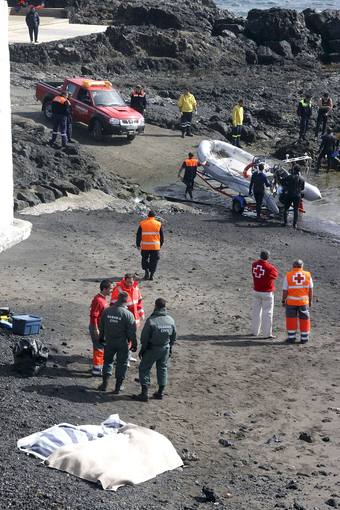
15 February marks the third anniversary of the deaths in 2009 of 25 migrants, including 17 children.  The boat capsized 20 metres off the coast of Lanzarote in the Canary Islands.  There were 6 survivors.  Local officials and organisations are marking the anniversary today with a memorial ceremony.

Click here for article. (ES)

Click here (ES) here (EN) and here (ES) for articles from 2009.

EFE/Martínez de Cripan

1 Comment

Filed under Eastern Atlantic, Morocco, News, Spain

Increase in Numbers of Migrants Reaching Spanish Coast in 2011

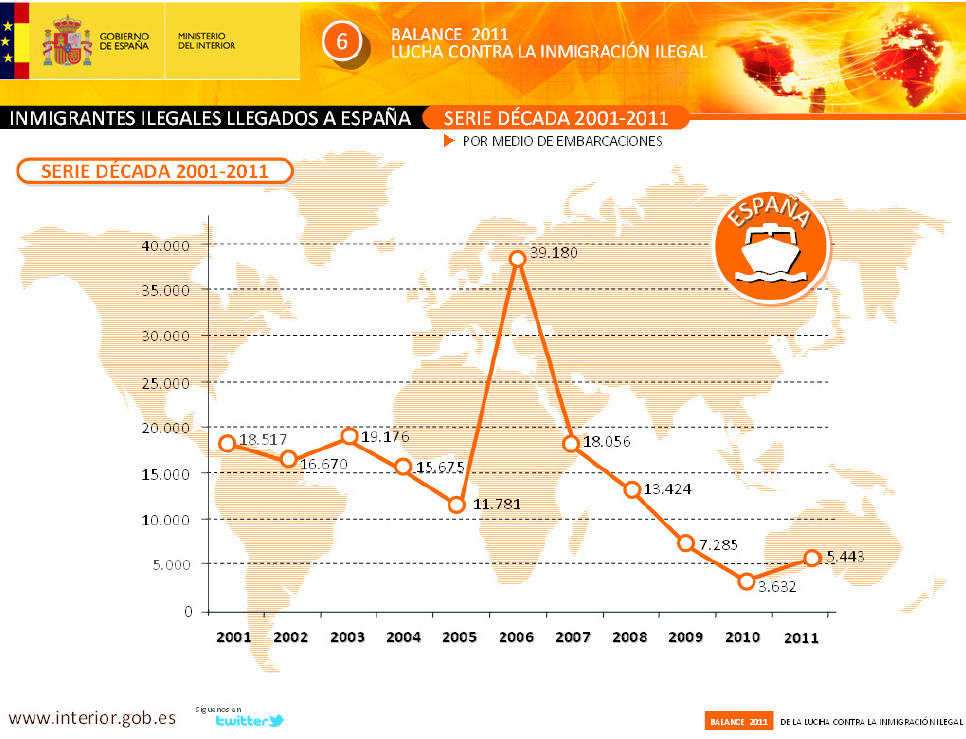
The Spanish Ministry of Interior and the Asociación Pro Derechos Humanos de Andalucía (APDHA) both released reports regarding the numbers of migrants who reached Spain by sea in 2011.  APDHA reports larger numbers of arrivals and deaths in 2011 than the official governmental report.

The report from Spanish authorities states that a total of 5,443 migrants were known to have reached Spanish territory by sea, including the Canary Islands, in 2011.  This represents an increase over 2010 when 3,632 persons are known to have arrived, but represents a substantial reduction in total numbers compared to the peak year of 2006 when over 36,000 migrants reached Spain by sea or by entering the North African territories of Ceuta and Melilla.

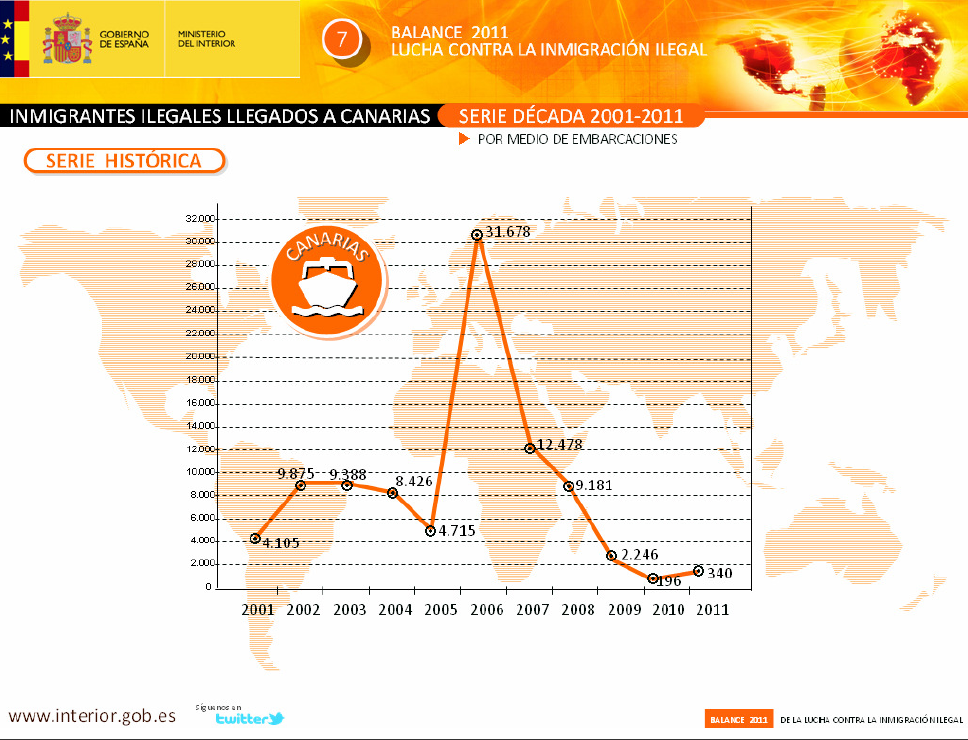
According to Spanish authorities, 340 migrants reached the Canary Islands by sea in 2011, an increase over the 196 who arrived in 2010, but significantly fewer that the over 31,000 migrants who reached the Canary Islands in 2006.  3,345 migrants reached Ceuta and Melilla by sea, by being smuggled into the territories, or by otherwise crossing the border fencing.

The Guardia Civil reported that 29 migrants are known to have drowned in 2011, but some NGOs believe the numbers of deaths are much larger.

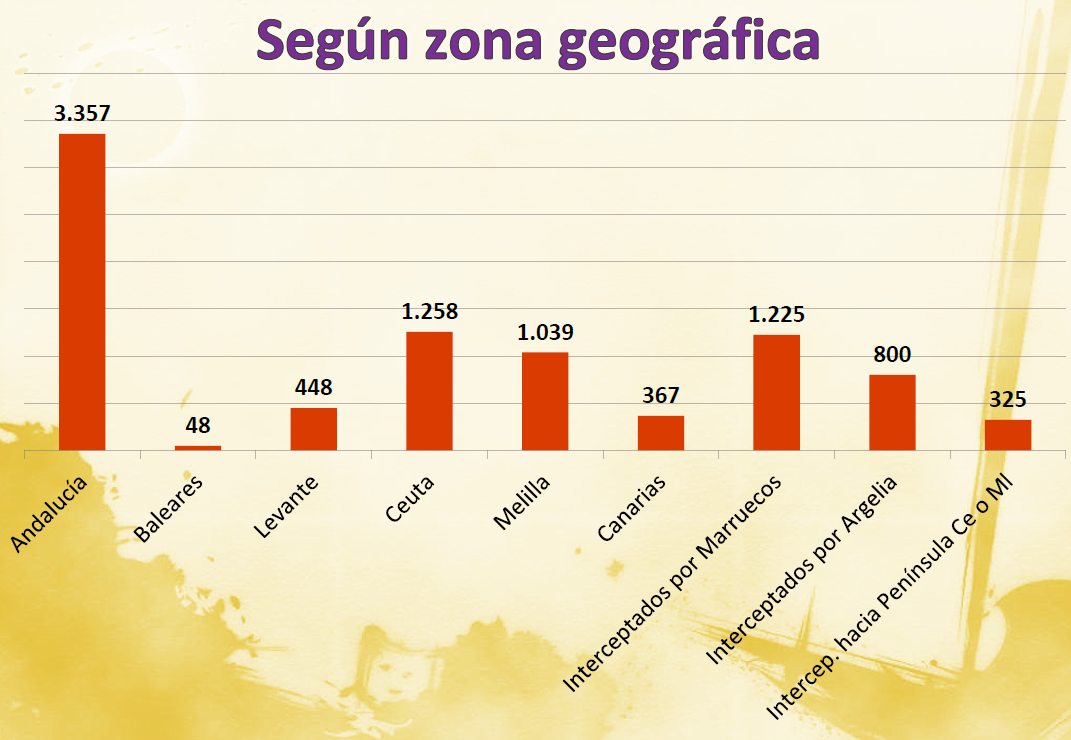
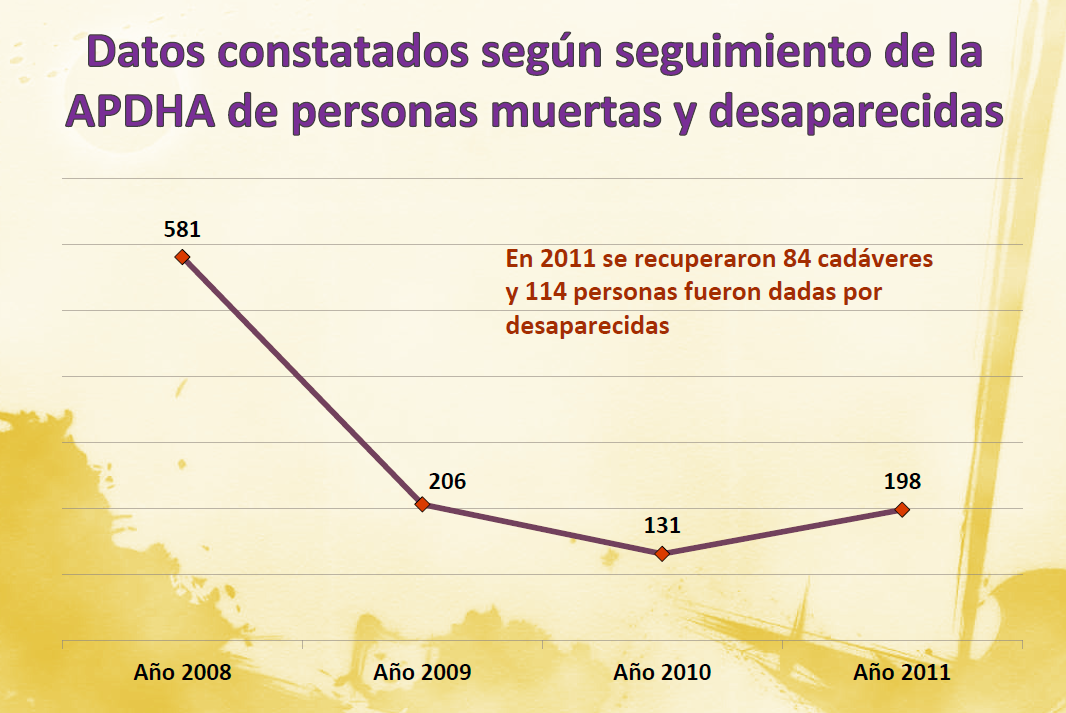
APDHA in its report  issued last month stated that it believed a larger number of migrants reached Spain.  The APDHA report was based on a survey of publicly available information.  It estimates that 8,867 people reached Spain (compared to the 5,443 reported by authorities).  APDHA also reported that 84 migrants are known to have died and at least 114 were known to be missing in 2011.

Click here and here for Spanish Ministerio del Interior report. (ES)

Click here and here for the Asociación Pro Derechos Humanos de Andalucía report. (ES)

Click here1, here2, here3, here4, here5, here6, here7, here8, here9, here10, here11, and here12 for additional articles.  (ES)

1 Comment

Filed under Algeria, Data / Stats, Eastern Atlantic, Frontex, Mauritania, Mediterranean, Morocco, News, Reports, Senegal, Spain

11 Dead, 34 Missing in Gulf of Aden – Smugglers Forced Passengers Into Sea

The UNHCR reported on 10 February that at least 11 persons drowned and 34 are missing after their boat capsized in the Gulf of Aden. The boat left Somalia for Yemen on 4 February, became disabled and drifted, and then capsized on 8 February in bad weather.  UNHCR reported that “[s]hocking details came to light [on 9 February] as survivors recounted to local authorities and our partners how smugglers forced 22 passengers overboard soon after the engine failed. … So far, 11 bodies have been recovered on beaches around the village of Ceelaayo some 30 kilometers west of Bossaso. Locals also found 13 survivors, including two women and a teenage boy and girl….”

This latest disaster occurs after an almost 100% increase in the number of refugees, asylum-seekers, and migrants crossing the Gulf of Aden and Red Sea from Africa to Yemen in 2011 compared to 2010.  103,000 migrants are estimated to have made the sea crossing in 2011 compared to an estimated 53,000 in 2010.  130 persons are known to have drowned in 2011.

Click here for UNHCR report.

Click here for my last post on the 2011 statistics.

Leave a comment

Filed under Gulf of Aden, News, Somalia, UNHCR, Yemen

Mare Deserto: RSI documentary about the failure to rescue and subsequent deaths of 60 migrants in the Mediterranean in March 2011

RSI LA1, the Swiss Italian-language television network, last month broadcasted a one hour documentary,  Mare deserto , produced by Emiliano Bos and Paul Nicol.  The documentary is in Italian.  It investigates the events that occurred between 25 March and 10 April 2011 when a disabled migrant boat attempting to travel from Libya to Italy drifted for days during which time approximately 60 persons died.  Survivors from the migrant boat reported that at various times military ships and helicopters ignored their requests for assistance.  The producers located and interviewed 9 of the known survivors in Italy, Tunisia and Norway.

Click here or here for a link to the documentary.  (IT)

Click here and here for some of my previous posts on the incident and the ongoing PACE investigation into the incident.

2 Comments

Filed under Council of Europe, Italy, Libya, Mediterranean, News, Reports, UNHCR

Il Diritto alla Protezione- Study on the state of the asylum system in Italy and proposals for its development

ASGI has issued a comprehensive study on the state of asylum in Italy focusing primarily on the 2008-2010 period.   The 400+ page report is in Italian, but its last Chapter, ”Final Considerations and Proposals for the Future of the Right of Asylum in Italy”, is written in English.

Excerpts from the announcement on the ASGI web site (Google translation):  “The research ‘The Right to Protection’  is a comprehensive study on the state of asylum in Italy, whose realization was made ​​possible by funding from a project of the European Refugee Fund 2008-2013, … produced by ASGI (leader), together with AICCRE (Associazione Italiana per il Consiglio dei Comuni e Regioni d’Europa), Caritas Italiana, Communitas Onlus, Ce.S.Pi. (Centro Studi politiche internazionali).

Research through the development and the intersection of many national and regional level data, as well as through meetings with a large number of witnesses between institutional actors and associations (over 300) has attempted to fill, at least partially, the gap in studies on the issue of asylum seekers in our country…

The multidisciplinary composition of the research team has made ​​it possible to combine the legal analysis of EU and national legislation, practices and application of the prevailing case law, by giving itself the objective sociological analysis to identify major problem areas is the examination procedure of asylum applications that the system of reception of asylum seekers and beneficiaries of international protection and humanitarian assistance, photographing the actual ‘health’” of the asylum system as a whole.

The research took as a reference span the period between 2008 (taking the news as a watershed in terms of reception introduced by Legislative Decree 25/08 and Legislative Decree 159/08) and the end of 2010, so you can draw an overall picture of the Italian asylum system in the crucial years of its evolution.

On the other hand, the tumultuous events that marked the political and social life of the Maghreb in 2011 have produced these effects in our country to make some essential supplement to the initial plan of research: therefore were then taken into consideration also the changes introduced in first half of 2011…

Each chapter of the report concludes with a section devoted to the display of detailed legislative proposals for overcoming the problems encountered in the more or less serious topic on which the chapter.

The reform proposals are divided into interventions that can be made ​​to existing legislation, practice and correcting erroneous applications and proposals for amending the primary rule or regulation.

Of particular significance is the chapter 13, of which the following chapter 14 is translated into English, which describes the main proposals contained in the various chapters, especially in light of proposals concerning the recasting of European directives and procedures as well as the Dublin Regulation II and offers a course of reform of the asylum in Italy, and the hospitality trade in particular, divided into ‘short-term actions’ and ‘medium-term actions.’”

Click here for Report. (IT) (Except for final Chapter 14 which is EN)

Click here for link to ASGI statement regarding Report. (IT)

2 Comments

Filed under Analysis, Data / Stats, European Union, Italy, Reports

Drones for Human Rights

The New York Times on Monday published an opinion article entitled “Drones for Human Rights” by Andrew Stobo Sniderman and Mark Hanis who are the co-founders of the Genocide Intervention Network.

They write that “[d]rones are not just for firing missiles in Pakistan….  It’s time we used the revolution in military affairs to serve human rights advocacy.”  They acknowledge the legal, political, and practical problems of using surveillance drones to monitor human rights abuses, but using the current situation in Syria as an example, argue that one “could record the repression in Syria with unprecedented precision and scope. The better the evidence, the clearer the crimes, the higher the likelihood that the world would become as outraged as it should be. … If human rights organizations can spy on evil, they should.”

Mark Kersten, writing on his Justice in Conflict blog, acknowledges the potential value of drone surveillance, but is generally critical of the proposal: “[I]n the context of ‘drones for human rights’, the risk is that the human gets removed from the experience and accounting of human rights violations. What would seem to matter is not personal experience but the particular configuration of pixels on a screen. This is folly. The process of victims, survivors and witnesses being involved shouldn’t be exchanged for the ‘unprecedented precision and scope’ of the photographs offered by drone technology. If anything, the role of victims, survivors and witnesses in the process of seeking and delivering justice should be enhanced.”

As the NY Times opinion articles points out, surveillance drones are deployed in a variety of non-military missions, including border control.  The U.S. Customs and Border Protection agency has deployed surveillance drones on the U.S.-Mexican border for years.  Frontex has been exploring the possible use of surveillance drones (unmanned aerial vehicles or UAV) for some period of time.  In January Frontex organised a 3 day live demonstration of UAVs at Greece’s Aktio Air Base where international manufacturers performed a series of test flights over the west coast of Greece.

Surveillance drones could certainly be used for search and rescue operations at sea and along remote international borders.  Could human rights organisations deploy their own drones in an effort to detect and monitor migrant boats as they embark on a dangerous trip across the Mediterranean?  Presumably this could happen, but practical problems, including the expense and legality of such missions, make such a possibility unlikely anytime soon.   But the use of drones by Frontex or national coastguards is not far off and it will be important to ensure that this new capability is used properly and not only as a border control tool to facilitate push-back operations at sea.

Click here for link to NY Times op-ed.

Click here for link to Justice in Conflict blog post.

Click here and here for links to Frontex research regarding drones.

Click here for Guardian article about the UAV industry’s plan for a “public relations effort to counter the negative image of the controversial aircraft.”

Leave a comment

Filed under Aegean Sea, Analysis, European Union, Frontex, Greece, Mediterranean

UNHCR: “Mediterranean takes record as most deadly stretch of water for refugees and migrants in 2011”

Full Text of UNHCR Briefing Note, 31 January:

“This is a summary of what was said by UNHCR spokesperson Sybella Wilkes – to whom quoted text may be attributed – at the press briefing, on 31 January 2012, at the Palais des Nations in Geneva.

According to UNHCR estimates, more than 1,500 people drowned or went missing while attempting to cross the Mediterranean to reach Europe in 2011. This makes 2011 the deadliest year for this region since UNHCR started to record these statistics in 2006. The previous high was in 2007 when 630 people were reported dead or missing.

Last year is also a record in terms of the massive number of arrivals in Europe via the Mediterranean, with more than 58,000 people arriving. The previous high was in 2008 when 54,000 people reached Greece, Italy and Malta. During 2009 and 2010, border control measures sharply reduced arrivals in Europe. The frequency of boat arrivals increased in early 2011 as the regimes in Tunisia and Libya collapsed.

Our teams in Greece, Italy, Libya and Malta, warn that the actual number of deaths at sea may be even higher. Our estimates are based on interviews with people who reached Europe on boats, telephone calls and e-mails from relatives, as well as reports from Libya and Tunisia from survivors whose boats either sank or were in distress in the early stages of the journey.

Survivors told UNHCR staff harrowing stories of being forced onboard by armed guards, particularly during April and May in Libya. The actual journey took place on unseaworthy vessels with refugee and migrant passengers often forced into having to skipper boats themselves. In addition, some survivors told UNHCR that fellow passengers beat and tortured them. Judicial investigations are ongoing in Italy following these reports.

The majority of last year’s arrivals by sea landed in Italy (56,000, of whom 28,000 were Tunisian) while Malta and Greece received 1,574 and 1,030 respectively. The vast majority arrived in the first half of the year. Most were migrants, not asylum-seekers. Only three boats landed from mid-August to the end of the year. In addition, according to Greek government figures, some 55,000 irregular migrants crossed the Greek-Turkish land border at Evros.

We are disturbed that since the beginning of 2012, despite high seas and poor weather conditions, three boats have attempted this perilous journey from Libya, with one going missing at sea. This boat, carrying at least 55 people raised the alarm on 14 January, warning of engine failure. Libyan coast guards informed UNHCR that 15 dead bodies, all identified as Somali, were found washed up on the beaches last week, including 12 women, two men and a baby girl. On Sunday, three more bodies were recovered. It was confirmed later that all those that perished were Somali residents of the makeshift site in Tripoli known as the Railway Project.

The other two boats that made it to Malta and Italy in January required rescuing. The first rescue of 72 Somali nationals by the Italian coast guard took place on 13 January. Those rescued included a pregnant woman and 29 children.

The second boat was rescued by the Maltese Armed Forces on 15 January with the support of the US Navy and a commercial vessel. In total 68 people were rescued from a dinghy found drifting some 56 nautical miles from Malta. A baby girl was born on one of the rescue vessels. Another woman reported a miscarriage during the voyage.

UNHCR welcomes the ongoing efforts of the Italian, Maltese and Libyan authorities to rescue boats in distress in the Mediterranean. We renew our call to all shipmasters in the Mediterranean, one of the busiest stretches of water in the world, to remain vigilant and to carry out their duty of rescuing vessels in distress.

For further information on this topic, please contact:

In Rome: Laura Boldrini on mobile +39 33 55 403 194

In Valetta: Fabrizio Ellul on mobile +356 99 69 0081

In Geneva: Sybella Wilkes on mobile +41 79 557 91 38”

Click here for link to statement.

Leave a comment

Filed under Data / Stats, European Union, Greece, Italy, Libya, Malta, Mediterranean, News, Statements, Tunisia, UNHCR

Libya Asks EU to Assist with Renovation of Migrant Detention Centres

At a press conference held last week, Libyan Interior Minister Fawzi Abdelali asked the European Union for assistance in dealing with new immigration flows and specifically requested assistance to renovate 19 existing migrant detention centres.  (Global Detention Project identified 27 dedicated immigration detention centres in Libya as of late 2009.)

Libyan officials have said recently that irregular migration flows are resuming.  AFP reported that Libyan interior ministry spokesman General Abdelmonem al-Tunsi said on 19 January “that illegal immigration had resumed since the end of the anti-Kadhafi revolt” and “thousands of people from … Syria were also entering through the Massad terminal on the border with Egypt, apart from Africans infiltrating through the southern borders.”

Italian Prime Minister Mario Monti traveled to Tripoli on 21 January to meet with the Libyan NTC.  Prior to his trip Amnesty International sent Monti a letter urging him to address numerous matters with the Libyans, including the eradication of torture, reforming the criminal justice system, and ratifying the Refugee Convention.

Amnesty also called upon Italy not to resume push-back operations at sea and to refrain from cooperating with Libya on other migration control practices until appropriate reforms are instituted within Libya.  There are fears that Italy is moving towards resuming coordination with Libya on immigration control matters.  Italian Interior Minister Anne Marie Cancellieri is reportedly scheduled to travel to Tripoli next month to discuss bilateral cooperation on immigration.

Translated excerpts from Amnesty’s press statement regarding the AI letter to PM Monti:

“With regard to cooperation on migration between Italy and Libya, Amnesty International calls on the Italian Government:

  • To desist from conducting any operation of ‘refoulement’ (deportation) at sea to Libya and cooperating with Libya to intercept migrants and reject them;
  • To set aside the Memorandum of Understanding on ‘migration control’, signed with the National Transitional Council (CNT) on June 17, 2011, until a thorough review is conducted of the impact on human rights agreements signed by the two countries in this area, and until the necessary changes have been introduced in order to ensure that the ‘immigration control’ is never carried out at the expense of human rights;
  • To ensure that all forms of cooperation with the Libyan authorities are absolutely transparent and subject to the commitment and ability of both parties to fully respect the human rights of asylum seekers, refugees and migrants, and are consistent with the international law of human rights and international refugee law….”

Click here for AI Letter. (IT)

Click here (EN), here (IT), here (EN), here (IT), and here (IT) for articles.

Leave a comment

Filed under European Union, Italy, Libya, Mediterranean, News

Report of Migrant Boat Sinking Off Libyan Coast – 15 Dead, 40 Missing

According to AFP , the Somali envoy in Tripoli has reported that a migrant boat carrying approximately 50 migrants sank off the coast of Misrata on Wednesday last week.   The boat was reportedly carrying about 55 migrants from Somalia.  15 bodies have been recovered.

Click here (EN) and here (IT) for articles.

Leave a comment

Filed under Libya, Mediterranean, News

Pillay: Extreme Concern Regarding Ill-Treatment of Detainees in Libya, Including Large Number of Sub-Saharan Africans

UN High Commissioner for Human Rights Navi Pillay addressed the UN Security Council on 25 January regarding the situation in Libya.  Pillay expressed extreme concern regarding the conditions of detention in Libya faced by thousands of detainees, including a large number of Sub-Saharan African nationals, and called for all detention centres to be brought under the control of the Ministry of Justice and the General Prosecutor’s Office.

Amnesty International and MSF have both just released additional reports documenting ongoing torture of detainees in Libya.

Excerpts from Pillay’s statement:

“The Interim Government still does not exercise effective control over the revolutionary brigades and this has human rights repercussions in a number of areas. …

A related area that I am extremely concerned about is the conditions of detention and treatment of detainees held by various revolutionary brigades. The ICRC visited over 8,500 detainees in approximately 60 places of detention between March and December 2011. The majority of detainees are accused of being Gaddafi loyalists and include a large number of sub-Saharan African nationals. The lack of oversight by the central authorities creates an environment conducive to torture and ill-treatment. My staff have received alarming reports that this is happening in places of detention that they have visited.

It is therefore urgent that all detention centres are brought under the control of the Ministry of Justice and the General Prosecutor’s Office. Moreover, a structure and process for judicial screening of detainees should be put in place immediately so that those detainees held without any legal basis can be released while others receive a fair trial. … However, detainees continue to be held in unacceptable circumstances outside any legal framework or the protection of the state….”

Click here for Pillay’s Statement.

Click here for AI Statement.

Click here for MSF Statement.

Leave a comment

Filed under Libya, News, OHCHR, Reports, Statements

UNHCR: Record Number of Refugees and Migrants Cross to Yemen in 2011

The UNHCR reports that there has been an almost 100% increase in the number of refugees, asylum-seekers, and migrants who crossed the Gulf of Aden and Red Sea from Africa to Yemen in 2011 compared to 2010.  103,000 migrants are estimated to have made the sea crossing in 2011 compared to an estimated 53,000 in 2010.  130 persons are known to have drowned.  Ethiopians now make up the largest nationality making the voyage, accounting for about 75% of the total.  Prior to 2009 Somalis were the largest group.

Click here (EN), here (EN) and here (FR) for UNHCR statements.

4 Comments

Filed under Data / Stats, Eritrea, Ethiopia, Gulf of Aden, News, Somalia, UNHCR, Yemen

Rescued Somali Asylum Seekers in Malta Describe Dangerous Conditions in Libya

The first group of rescued migrants for 2012 arrived in Malta on 15 January after being rescued by an Armed Forces of Malta patrol boat and an Italian cargo ship.  The 68 rescued migrants are Somali asylum seekers and had left Libya four days earlier.  Another boat carrying 72 migrants was rescued by the Italian coastguard on the 13th.  This boat is also believed to have departed from Libya.  UNHCR officials have interviewed the asylum seekers in Malta: “The new arrivals confirmed to UNHCR that the situation in Libya is still not stable and that it is particularly precarious for Sub-Saharan nationals. One Somali woman told UNHCR that they were afraid to go outside the house. Some even described the situation in parts of Libya as being similar to the lawlessness of Somalia. They explained that smugglers provided them with the only possible way out at this point.”  The Times of Malta reported that two of the asylum seekers said “they paid armed Libyan militiamen $400 each to facilitate their crossing of the Mediterranean.”

Click here, here, and here for articles.

Click here (IT) for article.

Leave a comment

Filed under Italy, Libya, Malta, Mediterranean, News, UNHCR

Statewatch Analysis: The Arab Spring and the death toll in the Mediterranean: the true face of Fortress Europe

Statewatch released an Analysis by Marie Martin entitled “The Arab Spring and the death toll in the Mediterranean: the true face of Fortress Europe.”

Excerpt: “Throughout the uprisings in North Africa, the EU has maintained a discourse of double standards: supporting calls for freedom and democracy but greeting resulting population displacement with hostility. This has contributed to a record number of people dying at Europe’s borders during the first seven months of 2011. It is all about numbers when it comes to migration; about how large a flow came in, how many people asked for protection and how many applicants were “failed” or “rejected.” Numbers quantify the “threat” (e.g. the “invasion” of irregular migrants) and serve as a bargaining tool with third countries (allowing the acceptance of the externalisation of border controls in exchange for facilitating the mobility of a specific number of nationals). Numbers demonstrate whether the target of “x” thousands of annual deportations of irregular migrants is met. Numbers released by public authorities are meant to justify the need for migration policies and to show how efficiently they are implemented. Yet hidden numbers question the legitimacy of these policies – the death toll of people dying at Europe’s borders is such an example. For several years, Gabriele del Grande has monitored the situation at the EU’s external borders and kept a record of the number of deaths occurring in the context of irregular bordercrossings [2] on the Fortress Europe website. According to the website’s latest update, the EU’s borders have never been so “murderous” [3]: there were 1,931 deaths during the first seven months of 2011. [4] In 2008, a petition was brought before the European Parliament by the ProAsyl organisation, denouncing the  deathtrap at the EU’s borders” [5]: it was a particularly “murderous” year, with 1,500 deaths. It is terrifying to realise that this toll was exceeded in the first seven months of 2011. …”

Click here for Analysis.

1 Comment

Filed under Algeria, Analysis, Egypt, European Union, France, Frontex, Italy, Libya, Malta, Mediterranean, Morocco, Spain, Tunisia, UK

Frontex Quarterly Report for 2011 Q3

The Frontex Risk Analysis Unit (RAU) released its 3rd Quarter Report (July-September) for 2011 on 18 January.  (See also  2nd Quarter Report (April-June 2011) and 1st Quarter Report (Jan-March 2011).) The reports contain a significant amount of information, graphs, and statistical tables regarding detections of illegal border crossings, irregular migration routes, detections of facilitators, detections of illegal stays, refusals of entry, asylum claims, and more.

The Report is based on data provided by Member States.  The Report states that “Frontex and the Member States are currently harmonising their illegal-migration data, a process that is not yet finalised. Therefore more detailed data and trends in this report should be interpreted with caution and, where possible, cross-referenced with information from other sources.”

Here are extensive excerpts from the Q3 Report:

Executive summary – In Q3 2011 most indicators monitored within FRAN community increased compared to a year ago. For example, detections of illegal border-crossing and refusals of entry both reached much higher levels than in Q3 2010. Moreover, more applications for international protection were submitted than in any other quarter since data collection began in 2008. Consistent with recent years, the majority of illegal border-crossings were limited to a small number of hotspots of irregular migration such as the Eastern and Central Mediterranean routes, accounting for 50% and 33% of the EU total, respectively. However, in Q3 2011 there was also a rise in the importance of the Western Mediterranean route, now representing nearly 10% of the EU total. At the EU level, the most commonly detected migrants were from Afghanistan, yet due to the recent increases in the number of migrants from Pakistan and Nigeria (by seven and ten times compared to Q3 2010, respectively) these nationalities have moved to the second and third position.

In Q3 2011 there were 19 266 detections of illegal border-crossing in the Eastern Mediterranean, a seasonal increase to a level almost exactly comparable with the same period in 2010. As was the case throughout 2010, detections were concentrated at the Greek land border with Turkey, where Afghans accounted for nearly half of all detected migrants. However, at this border section detections of migrants from Pakistan increased massively compared to last year and now rank second….

In contrast to the consistent wave of irregular migration in the Eastern Mediterranean, the situation in the Central Mediterranean has been volatile in 2011, dependent on the political developments and civil unrest across North Africa. For example, civil unrest in this region, particularly in Tunisia, led to a dramatic increase in detections in the Central Mediterranean early in 2011. Consequently, in March 2011 some 14 400 Tunisian migrants arrived in the Italian island of Lampedusa. In April an accelerated repatriation agreement was signed between Italy and Tunisia, which resulted in a 75% reduction in the flow of Tunisians, but the region was then inundated by large numbers of sub-Saharan migrants arriving in Lampedusa, Sicily and Malta, many having been forcibly expelled from Libya by the Gaddafi regime. Since the National Transitional Council successfully gained control of Libya, this flow stopped abruptly in August. However, in Q3 2011 there were 12 673 detections of illegal border-crossing on this route, where Tunisian and sub-Saharan migrants, particularly Nigerians, are still arriving in significant numbers.

In Q3 2011 there were more detections in the Western Mediterranean (3 568) since mid 2008. A wide range of migrants from North African and sub-Saharan countries were increasingly detected in this region. However, it is difficult to analyse the exact composition of the flow as the number of migrants of unknown nationality on this route doubled compared to the previous quarter. This may indicate an increasing proportion of nationalities that are of very similar ethnicity and/or geographic origin.

The flows of migrants arriving in the EU had a significant effect on the number of applications for international protection submitted: in Q3 2011 there were a massive 64 801 applications submitted across Member States. The largest increases in submitted applications were reported by Italy and involved nationals of Nigeria, Ghana, Mali and Pakistan. However, the applications submitted by nationals of Pakistan and Afghanistan also increased across a wide range of other Member States, such as Germany and Austria. In contrast to increasing applications for international protection were fewer detections of facilitators of irregular migration than ever before. This widespread and long decline may be because organized crime groups are increasingly recruiting would-be migrants by offering them legitimate entry to the EU with false or fraudulently obtained documentation. This is less risky and carries lower detection probability for facilitators than, for example, accompanying migrants across the border….

[***]

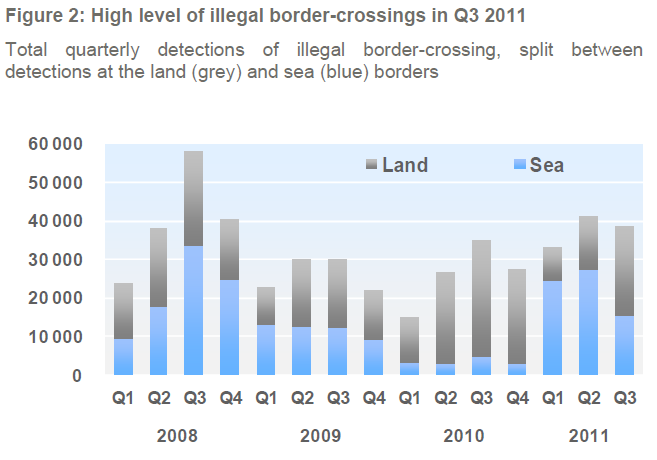
4.1 Detections of illegal border-crossing – [ … ] The third quarter of each year is usually associated with weather conditions favourable for approaching and illegally crossing the external border of the EU. Correspondingly, conditions that are favourable for illegal border-crossings are also more conducive to detecting them. The combination of these two effects resulted in the highest number of detections in each of the last few years being reported in Q3 2011. In contrast, in 2011 detections were higher in the second than in the third quarter, because of exceptionally high detections in the first half of 2011, rather than particularly low detections in Q3 2011. At the sea border, there were 15 418 detections which is a 44% reduction compared to Q2 2011, but a fivefold increase compared to Q3 2010. In contrast, there were 23 079 detections at the land border which was a 68% increase compared to the preceding quarter, but a 22% reduction compared to Q3 2010. Hence, detections decreased at the sea border, particularly in Italy, and increased at the land border to a level comparable to 2010….
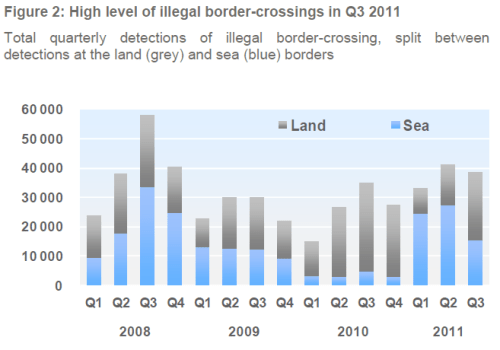
[… ] In the first half of 2011 the situational picture of irregular migration to the EU was dominated by illegal border-crossings reported by Italy. This influx was due to a surge of Tunisians in Q1 and sub-Saharan African migrants in Q2 arriving in the Italian island of Lampedusa in the wake of major civil unrest in North Africa (the so-called Arab Spring), which has now, to some extent, decipitated. Hence, in Q3 2011 detections in Italy halved compared to the previous two quarters yet remained some six times higher than during the same period last year.

At the EU level the most commonly detected migrants came from Afghanistan, constituting a quarter of all detections despite a 15% decrease compared to the previous year (Fig. 3). The majority of Afghan migrants were detected at the border between Greece and Turkey, with the remaining mostly detected at the southern Italian blue border. Throughout 2010 the most commonly detected migrants were from Albania (mostly circular migrants to Greece), representing 25–45% of the EU total, although in many cases individuals may have been detected several times within a given period. However, in Q3 2011 detections of Albanians fell to negligible levels following their visa-free status for travel to the EU granted in December 2010 (Fig. 3).

Without question, detections of migrants from Pakistan and Tunisia have increased more than any other nationality over the last year (Fig. 3). In the case of migrants from Pakistan, in Q3 2011 most were detected at the border between Greece and Turkey, followed by the southern Italian blue border. This detection profile almost exactly mirrors that of migrants from Afghanistan. In contrast, migrants from Tunisia are almost exclusively detected in Italy, followed by Greece. Although detections of migrants from Tunisia increased dramatically compared with a year ago, they fell massively compared to the peak in Q1 2011.

Another notable phenomenon is the increased rate of migrants from Nigeria detected at the blue border (Fig. 3) mostly in Italy, with some evidence for increasing numbers in southern Spain. In the former case most departed from Tunisia, while in Spain most departed from Morocco. This trend is related to the threefold increase in the number of asylum applications submitted by Nigerian migrants almost exclusively in Italy.

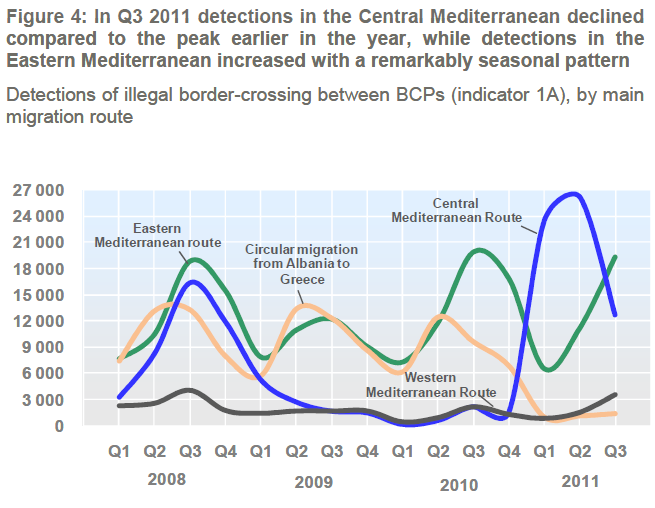
Routes – As illustrated in Figure 4, during the first half of 2011 detections of illegal bordercrossing on the Central Mediterranean route, which comprises the blue borders of Italy and Malta, dramatically increased and exceeded those reported from the  Eastern Mediterranean route, which is made up of the land and sea borders of Greece, Bulgaria and Cyprus. However, in Q3 2011 detections on the Eastern Mediterranean route, by following a remarkably seasonal pattern, similar to that of 2010, once more exceeded detections on the Central Mediterranean route, where detections fell dramatically compared with the peak in the first six months of 2011.

These routes not only differed in their trends over time but also in the composition of detected nationalities. For example, detections on the Eastern Mediterranean route have, for the last year at least, comprised of large numbers of Asian, North African and sub-Saharan nationalities including increased detections of migrants from Pakistan. In contrast, nationalities detected in the Central Mediterranean have evolved throughout 2011. In Q1 2011 mostly Tunisians were detected after they had departed from their own country; in Q2 2011 reduced but still significant numbers of Tunisians were joined by mix of sub-Saharan Africans, many of whom were forcibly expelled from Libya. In the current reporting period detections of Tunisians remained stable, yet the number of sub-Saharan Africans decreased. Figure 4 also shows that in Q3 2011 detections on the Western Mediterranean route increased, mostly of migrants of unknown nationalities but also of Algerians and Nigerians.
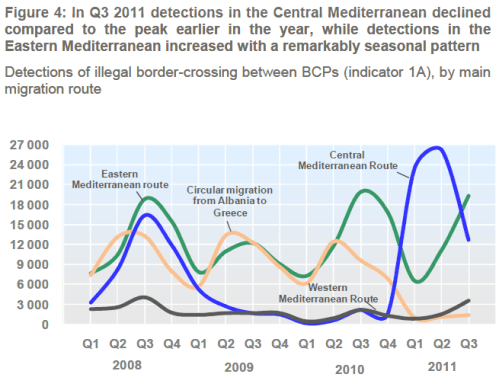
4.1.1 Eastern Mediterranean route – Since data collection began in early 2008, the Eastern Mediterranean has maintained its status as a hotspot of irregular migration. Detections have followed a remarkably seasonal pattern invariably peaking in the third quarter of each year, being concentrated at the border between Greece and Turkey with a shift from the sea border to the land border in early 2010. Afghan migrants have consistently featured highly on the list of most detected nationalities. In 2010 there was an increase in Algerian migrants that has since subsided, but more recently there has been a massive increase in the number of migrants from Pakistan detected on this route.

In the current reporting period, detections of illegal border-crossing on this route increased seasonally and in line with previous years, almost exclusively due to a massive increase in detections at the Greek land border with Turkey, where detections increased from 10 464 to 18 509 over the same period. Based on seasonal pattern of detections in previous years, the increase in pressure on this route during Q3 2011 was not entirely unexpected and reached a level almost exactly comparable to that of a year ago. Indeed, according to data collected during JO Poseidon the average number of detections per day immediately subsequent to the current reporting period exceed that during the same period in 2010, immediately prior to the deployment of the first JO RABIT 2010….

[***]

4.1.2 Central Mediterranean route – Irregular migration in the Central Mediterranean has fluctuated in size and composition during 2011, depending on the political and civil unrest across North Africa. Initially detections in the Central Mediterranean massively increased in early 2011 due to civil unrest in the region, particularly in Tunisia, Libya and, to a lesser extent, Egypt. As a result, in Q1 some 20 000 Tunisian migrants arrived on the Italian island of Lampedusa. In Q2 2011 the flow of Tunisian migrants was reduced by 75% following an accelerated repatriation agreement that was signed between Italy and Tunisia. However, the region was then inundated by large numbers of sub-Saharan migrants detected across the region, many claiming to have been forcibly expelled from Libya by the Gaddafi regime. In the current reporting period irregular migration in the region has eased somewhat due to democratic elections* in Tunisia and the National Transitional Council successfully gaining control of Libya. However in Q3 2011 arrivals increased from Egypt and subsequent to the reporting period there was some indication that the flow from Libya has been reinstated.

According to the FRAN data, in Q3 2011 there were more than 12 500 reported detections of illegal border-crossing on the Central Mediterranean route, a 50% decrease compared to the ‘peak’ reported during the first and second quarter of 2011, but still massively increased compared to the background detections throughout all of 2010. Most detections in the Central Mediterranean region were reported from the Italian Pelagic Islands, where detections also fell by a half compared to the previous quarter. In some areas the decrease was even more marked.  For example, in Sicily detections fell by 75% such that in Q3 2011 a stable trend of Egyptians and Tunisians constituted nearly all detections. Detections  ell to an even greater extent in Malta.

4.1.3 Western Mediterranean route – Irregular migration across the Western Mediterranean towards southern Spain was at a low level through most of 2010 averaging just over a thousand detections per quarter. However, pressure has been steadily increasing throughout 2011 until the current reporting period when there were more than 3 500 detections of illegal border-crossing – an increase of two thirds compared to Q3 2010. As a result, the Western Mediterranean is now the third largest point of entry for illegal bordercrossing into the EU. The most common and the most increasingly detected migrants were of unknown nationalities, followed by migrants local to the region from Algeria and Morocco. There were also significant increases in migrants from further afield such as Côte d’Ivoire, Guinea, Nigeria and Congo.

4.1.4 Western African route – The cooperation and bilateral agreements between Spain and the rest of the Western African countries (Mauritania, Senegal and Mali) are developing steadily. They are one of the main reasons for the decrease in arrivals on this route over the last year, as is the presence of patrolling assets near the African coast. Despite a slight increase in Q4 2010, detections on this route remained low and totalled at just 50 detections of exclusively Moroccan migrants in Q3 2011.

[***]”

Click here for Frontex Press Statement.

Click here for Q3 Report.

Click here for previous post on Q1 and Q2 Reports.

1 Comment

Filed under Aegean Sea, Analysis, Data / Stats, Eastern Atlantic, European Union, Frontex, Mediterranean, News