Tag Archives: Refugees

Deaths at Sea: Tourists and Migrants

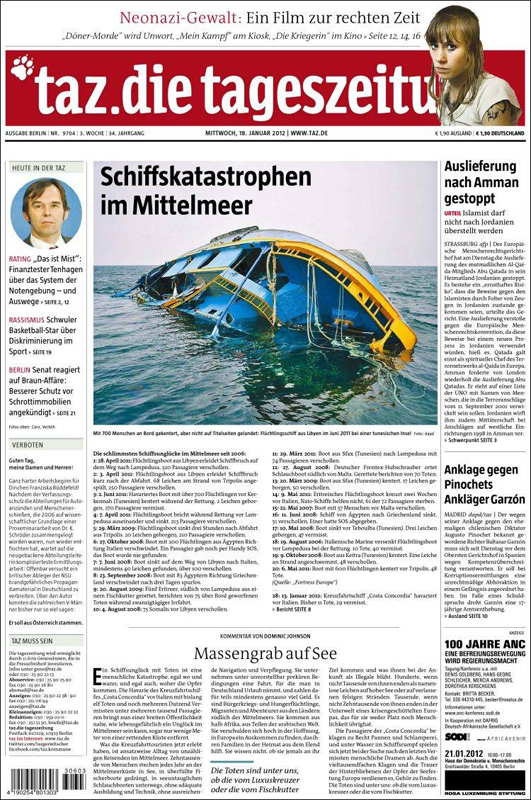
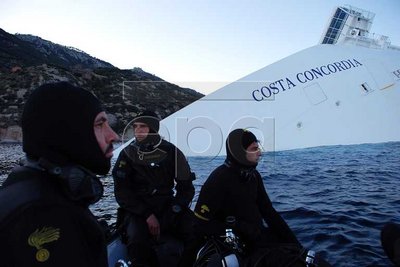
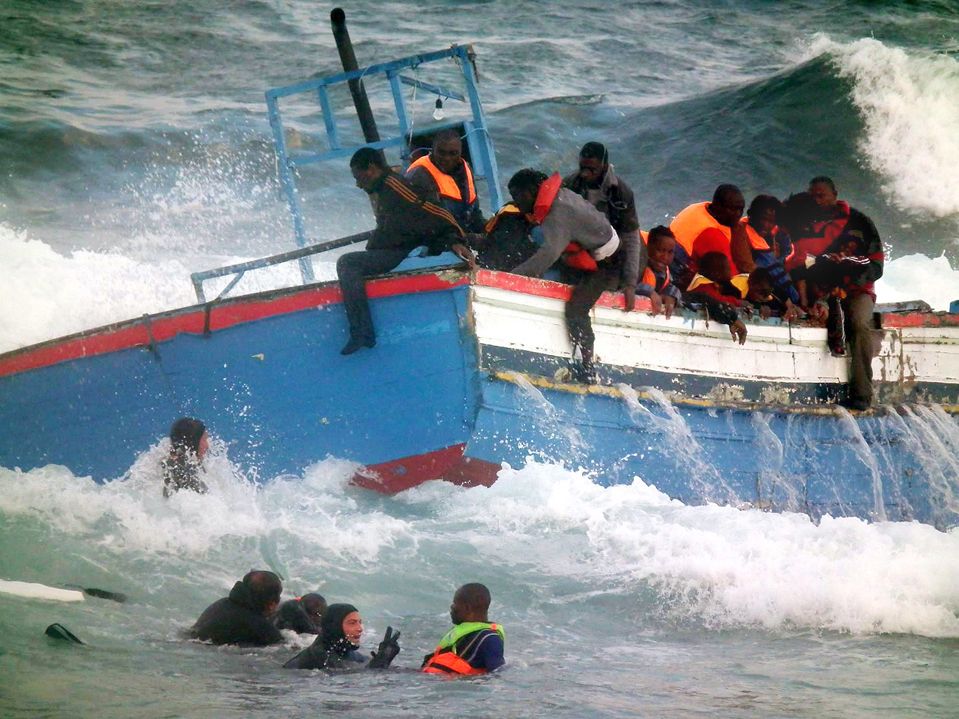
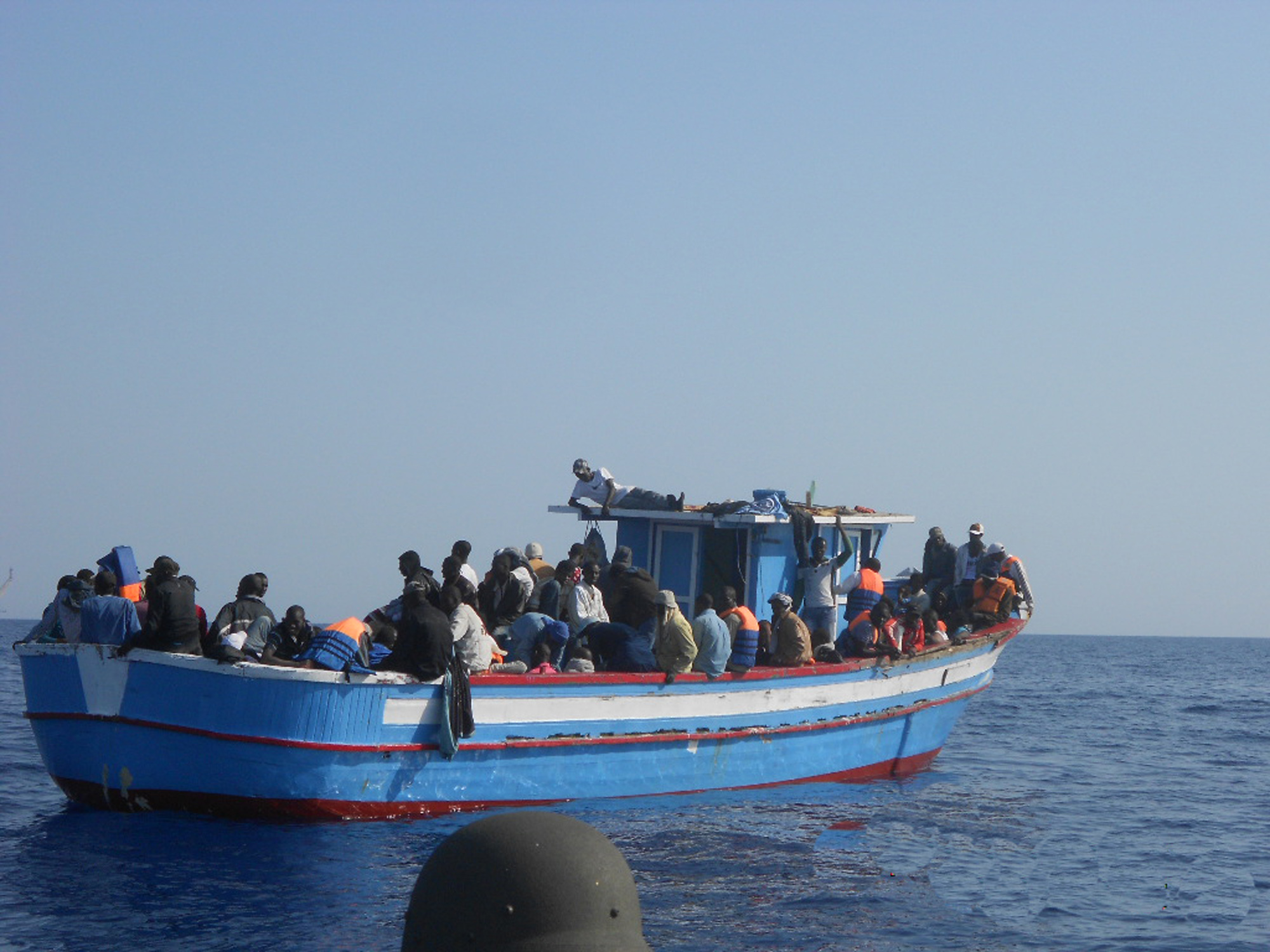
Presseurop reproduced a commentary article by Dominic Johnson from the Berlin newspaper Taz (Die Tageszeitung) contrasting the sinking of the Costa Concordia (and the extensive media coverage) with the more common and numerous sinking of migrant boats.  Without minimizing the loss of lives on board the Costa Concordia, and the ongoing efforts by Italian rescuers who continue to put their lives in danger as they search the wreckage, the striking contrast in the media coverage is worth noting.

Taz: “A boating accident with death is a human catastrophe, no matter where and when, and also no matter where the victims are from. … What happened to the cruise ship passengers is common to countless other travelers in the Mediterranean. Tens of thousands of people each year set out to sea on the Mediterranean, pushed into overcrowded fishing boats, inflatable boats, traveling in unseaworthy vessels, without adequate training or equipment without adequate navigation and catering.  They do the unimaginable under precarious conditions, a journey which we take as a holiday in Germany, and pay for it at least as much money. … They are civil war and famine refugees, migrants and others from the countries south of the Mediterranean. … Hundreds if not thousands of them end up as nameless corpses at sea or on deserted rocky beaches. Thousands if not tens of thousands of them end up in the underworld of a crisis-ridden Europe, which has left them no room for humanity yet. The passengers on the ‘Costa Concordia’ are right to complain about [what has happened].  But many thousands of times over, the grief of the bereaved families of the victims of the sea of fortress Europe also deserve to be heard. The dead are among us, whether from luxury cruisers or from the fishing boat.”  [Google translation from German]

Click here and here for articles from Die Tageszeitung. (DE)

Via European Pressphoto Agency- handout photo released by the Italian Police- EPA/ITALIAN POLICE HANDOUT EDITORIAL USE ONLY/NO SALES

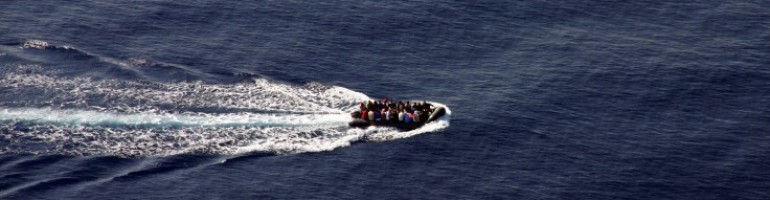
AFP PHOTO/ Francesco Malavolta/Getty Images

2 Comments

Filed under European Union, Italy, Mediterranean, News

Malmström: Europe Failed Refugees in 2011

Commissioner Cecilia Malmström wrote an opinion article in The Times of Malta of 19 January:  “Refugees: How Europe failed- European promises of solidarity with people in need were tested in 2011. It is worrying to note that Europe, collectively, did not pass the test. Now, all member states of the European Union must take responsibility and make sure that 2012 will be a better year for asylum matters. … In the first half of 2011, over 75 per cent of all asylum applications were made in only six EU member states. That leaves a long row of European countries that can and must do more. And as over 700,000 people were forced to flee the violence in Libya, many ended up in refugee camps in neighbouring countries. Of the 8,000 people identified by the UN as being in particular need of help, all EU member states only managed to promise to receive 400. Norway, a non EU-country, accepted nearly as many by itself.  Meanwhile, more than 50,000 migrants crossed the Mediterranean in rickety vessels to the EU. Far too many died trying. Others arrived at the Italian island of Lampedusa and Malta and, at a pledging conference last spring, European countries had the chance to show their solidarity. The result? A mere 300 refugees being relocated from Malta to other member states. …”

Click here for full article.


1 Comment

Filed under European Union, Italy, Libya, Malta, Mediterranean, News, Statements, Tunisia

Hundreds of Tunisians Who Sailed to Lampedusa in 2011 Remain Missing

Hundreds of Tunisians who departed Tunisia for Lampedusa by sea in early 2011 remain missing.  Some of the missing almost certainly died at sea, but family members remain hopeful that others survived the voyage and are now in Italy or elsewhere in Europe.  Earlier this week dozens of mothers of the missing demonstrated outside the Tunisian Ministry of Foreign Affairs during a visit by an Italian parliamentary delegation led by Margherita Boniver. The mothers have been holding daily demonstrations calling for assistance from Tunisian and Italian authorities.  The two governments have been asked to cross check fingerprint information.  Tunisia collects fingerprint information for national identity cards and Italian authorities have collected fingerprint information from arriving migrants.  There is speculation that some of the migrants may have used false names upon reaching Italy and as a result are more difficult to locate.

Click here (IT), here (IT), here (FR), and here (FR) for articles.

Click here for Facebook Page dedicated to finding missing Tunisians.

Click here for Storie Migranti Petition for missing Tunisian migrants / Appello per i migranti tunisini disperse / نداء من أجل التونسيين المهاجرين المفقودين / Appel pour les migrants tunisiens disparus.

Leave a comment

Filed under Italy, Mediterranean, News, Tunisia

Amnesty International Report: Year of Rebellion – The State of Human Rights in the Middle East and North Africa

Amnesty International this morning released a report entitled “Year of Rebellion – The State of Human Rights in the Middle East and North Africa” focusing on the events of 2011 in Tunisia, Egypt, Libya, Yemen, Syria, Bahrain, and Iraq.  Additional chapters in the Report address the “International response”, the “Failure to put human rights first”, “Protection of displaced people”, and “Arms transfers”, among other topics.

Excerpts:

“This report describes the events of this historic, tumultuous year, one which saw so much suffering and sadness but also spread so much hope within the region and beyond, to countries where other people face repression and everyday abuse of their human rights. Amnesty International too was challenged, as never before, to respond to the events by documenting the violations that were committed and, most of all, by mobilizing its members and supporters to extraordinary lengths in support and solidarity with the people in the streets of Cairo, Benghazi, Sana’a, Manama, Dera’a and elsewhere who were truly “in the frontline” in demanding reform, accountability and real guarantees for human rights. This report is dedicated to them, their suffering and their momentous achievements.”

“Protection of Displaced People- … Many of those who fled Libya sought safety in neighbouring countries, mainly in Egypt and Tunisia. However, around 5,000 sub-Saharan refugees and asylum-seekers remain stranded in desert camps in Tunisia and makeshift tents in Saloum, a remote border point in Egypt. When Amnesty International visited the camps in June and July, poor conditions and insecurity prevailed, making life extremely challenging for those living there. Unlike the thousands of migrants who were repatriated during the initial stages of the conflict, these people cannot return to their home countries because they would then be at risk of persecution. Nor can they remain in Egypt and Tunisia, which have been unwilling to offer long-term solutions to refugees. Returning to Libya is also not an option, despite the fall of the al-Gaddafi regime, as Libya cannot currently offer a safe haven for refugees. The only solution is for other countries where they would be safe to resettle them. How many are resettled and how quickly this happens depends on the speed and extent with which the international community fulfils its responsibility to them. So far, the international community’s response has been miserably poor, with European countries offering fewer than 800 resettlement places between them in response to a refugee crisis unfolding on Europe’s doorstep. Many of those who fled Libya attempted the dangerous sea-crossing to Europe, often in overcrowded and barely sea-worthy boats. Among them were people who initially fled from Libya to Tunisia, but then crossed back into Libya frustrated at the lack of durable solutions for refugees in the camps. At least 1,500 men, women and children are estimated to have drowned while attempting this journey. The true total was probably far higher. Governments and institutions failed to put in place effective mechanisms to prevent such deaths at sea, including by increasing search and rescue operations, and by ensuring that rescue operations comply fully with human rights and refugee law….”

Click here for Report.

Click here for AI Press Release.

2 Comments

Filed under Algeria, Egypt, Libya, Mediterranean, Morocco, Reports, Tunisia, Yemen

UNODC Issue Paper: Smuggling of Migrants by Sea

UNODC yesterday released an Issue Paper entitled “Smuggling of Migrants by Sea.” The paper, drafted by Ms Marika McAdam under the supervision of Ms Morgane Nicot (UNODC), is based largely on “answers received to questionnaires and discussions that took place in the context of an expert group meeting held in Vienna, Austria on the 13th to the 15th of September 2011.”

Excerpts from UNODC statement: “While the smuggling of migrants by sea accounts for only a small proportion of the total number of migrants smuggled worldwide, it accounts for the highest number of deaths among smuggled migrants. … The paper covers the international legal framework relating to the smuggling of migrants by sea, current responses to and challenges posed by such smuggling and recommendations to strengthen responses. … It is hoped that the practical experiences of responding to the smuggling of migrants by sea, addressed by the issue paper from the perspectives of countries of origin, countries of transit and countries of destination, will help other Member States in formulating their responses to suit their local contexts.”

Executive Summary: “Smuggling of migrants is defined by Article 3 of the Migrant Smuggling Protocol supplementing the United Nations Transnational Organized Crime Convention (UNTOC), as ‘…the procurement, in order to obtain, directly or indirectly, a financial or other material benefit, of the illegal entry of a person into a state party of which the person is not a national.’ The specific nature of the sea-based component of the smuggling journey resulted in a dedicated section on the issue in the Migrant Smuggling Protocol. While smuggling by sea accounts only for a small portion of overall migrant smuggling around the world, the particular dangers of irregular travel at sea make it a priority for response; though more migrant smuggling occurs by air, more deaths occur by sea.

The journey of the migrant smuggled by sea often starts a significant distance away from the coast of departure. Some journeys to the coast may take mere days, but others can take place over years during which the migrant must work en route to raise money for his passage. Arduous desert crossings and victimization by smugglers and other criminals en route mean that some do not survive overland journeys to the coast. Contrasted with these extreme experiences, economically empowered migrants can afford a higher level of smuggling service and may experience no particular hardship, simply travelling through various international airport hubs toward the coastal country from where their sea journey commences.

The type and size of vessel used to smuggle migrants by sea depends on the time, place and financial capacity of migrants undertaking the smuggling journey. In some countries, boats of only a handful of passengers are commonly intercepted by authorities, while in others vessels of several hundred people have been used. While voyages may be comfortable when conditions at sea are mild and the vessel is equipped with adequate food, water and sanitation, the journey is a harrowing one for the majority of migrants who report rough conditions, terrible cold and scarce food and water.

The nature of the crime and its relationship with smuggling of migrants by land and by air means that it is a successful crime type that yields high profits for smugglers with all the risks being borne by migrants. Indeed, migrant smuggling by sea can be understood as a criminal business, which is competitively run as such. Smuggling by sea is generally carried out by flexible criminal groups or individuals operating on the basis of repeated contractual arrangements, rather than by hierarchical organizations.

There are two methods used when vessels approach coasts of destination. One aims to reach land by evading detection by authorities, the other sets out to be detected and intercepted or rescued by authorities in territorial waters of destination coastal countries. In both situations, detecting smuggling vessels at sea is a key challenge for coastal states which may have limited resources and large search and rescue areas of responsibility.

Upon detecting vessels, the key challenge is to balance objectives with obligations at international law, including the Migrant Smuggling Protocol. Smugglers are generally well‐informed about states’ protection obligations and act to exploit them, instructing migrants what to do upon interception to increase their chances of gaining entry into and remaining in countries of destination. For instance, officials responsible for intercepting vessels at sea have been faced with situations of people sabotaging their own vessels to force authorities to carry out rescues. Suggestions made in respect of encountering migrant smuggling at sea include increased support of coastal states through joint patrols and provision of resources, and increased compliance with international legal standards and obligations in carrying out interceptions of smuggling vessels at sea.

While responding to the situation at hand and ensuring that persons on board are appropriately assisted, a key challenge is to seize evidentiary opportunities to investigate smuggling‐related crimes. The complex nature of migrant smuggling networks and their modus operandi means that smugglers cannot be identified purely by looking to smugglers who may be on board boats; the transnational criminal network itself must be traced from a smuggling vessel, back to the coast of embarkation, and from there back to countries of transit and origin. Suggestions made for improved investigation and prosecution of migrant smuggling by sea include harmonizing domestic legislation with the UNTOC and the Migrant Smuggling Protocol. Further it is suggested that sentences imposed for smuggling offences be publicized as a means of deterring would-be smugglers. Capacity building measures are also suggested so as to increase identification of smugglers on vessels, and to better link sea-based crimes with land-based smugglers.

Preventing migrant smuggling by sea requires states to balance their obligations in international law with their legitimate interests in protecting state sovereignty from violation by organized crime groups. But law enforcement efforts alone are not adequate to prevent migrant smuggling by sea; the Migrant Smuggling Protocol stresses that prevention efforts must address root causes that lead a person into the hands of smugglers in the first place. Suggestions made for preventing migrant smuggling at sea include raising awareness about the dangers of sea smuggling journeys and the criminality of smuggling. Suggestions are also made to raise awareness of those who influence political and policy decisions, so policies put in place protect state sovereignty, uphold international obligations, and are not vulnerable to exploitation by smugglers. Also emphasised is the responsibility of coastal states of departure to intercept smuggling vessels before they embark on sea journeys. Beyond this, comprehensive data collection, analysis and research are suggested to strengthen evidence-based responses.

Experts from countries of origin, transit and destination unanimously agree that the most essential ingredient for effective and comprehensive response to migrant smuggling by sea is strengthened international cooperation to remove areas of impunity for smugglers along smuggling routes. Suggestions made for cooperating in response to migrant smuggling at sea include aligning activities with the Migrant Smuggling Protocol and increasing the role of UNODC in facilitating cooperative response. The value of bilateral and regional cooperation arrangements is stressed, with emphasis on flexible cooperative networks for effective and efficient on-the-ground response. Regular coordination meetings and joint operations are suggested to improve strategic and operational interagency coordination, as is the empowerment of central designated authorities to address migrant smuggling by sea.

In short, while it is difficult to make generalizations about migrant smuggling by sea, two key points hold true around the world. Firstly, migrant smuggling by sea is the most dangerous type of smuggling for the migrants concerned, making it a priority concern for State response. Secondly, efforts to combat smuggling of migrants will be unsuccessful unless cooperation is strengthened not only between countries of sea departure and arrival, but also among the countries of origin, transit and destination along the entire smuggling route.”

Click here for Issue Paper.

Click here for UNODC statement.
2 Comments

Filed under Analysis, Reports, UNODC

PACE Rapporteur Completes Malta Trip

Ms Tineke Strik, the PACE Migration Committee rapporteur heading up the investigation into the deaths of boat people in the Mediterranean, completed a two day fact-finding visit to Malta.  From the Times of Malta reporting:  Ms Strik said that the “visit to Malta was important for my inquiry into who is responsible for lives lost in the Mediterranean Sea, and enabled me to piece together another part of the puzzle in the case of the ‘left-to-die boat’. … Nonetheless, the puzzle remains incomplete. Gaps remain and important questions still need to be answered. As time is precious in this kind of inquiry, I very much count on national authorities, NATO and the EU to provide me swiftly with the information I have requested.  … [T]he on-going dispute between Italy and Malta on their respective responsibility with regard to the disembarkation of boat people rescued at sea remains a cause of serious concern.”

Click here and here for articles.


Leave a comment

Filed under Council of Europe, European Union, Frontex, Italy, Libya, Malta, Mediterranean, News

Migrant Boat Reaches Lampedusa

A rubber dinghy carrying 69 sub-Saharan migrants landed on Saturday on Lampedusa without having been intercepted.  The migrants are believed to be Somali.  At least one media report states that the migrants are believed to have departed from Tunisia.  Several of the boat’s passengers were hospitalized.  The main migrant detention centre on Lampedusa remains closed.

Click here and here for articles. (IT)

Leave a comment

Filed under Italy, Mediterranean, News, Somalia, Tunisia

Transatlantic Trends: Immigration Survey 2011 / US and European Public Opinion

Transatlantic Trends has released a public opinion survey: “The results of the 2011 Transatlantic Trends: Immigration survey captures U.S. and European public opinion on a range of immigration and integration issues.  The most important highlights of this year’s survey show

  • 1) there is a remarkable stability of general immigration opinions over time,
  • 2) the public supports European Union burden-sharing on migration resulting from the Arab Spring and increasingly favors European responsibility for setting immigrant admissions numbers, and
  • 3) the public tends to favor highly educated immigrants but still prefers immigrants with a job offer.

Now in its fourth year, Transatlantic Trends: Immigration (TTI) measures public opinion on immigration and integration issues on both sides of the Atlantic. The countries included in the 2011 version of the survey were the United States, the United Kingdom, France, Germany, Italy, and Spain…. [***]

Key Findings of the Survey – General Perceptions – Stability in Public Opinion: Basic public stances on immigration have not changed notably in the last year, even in Europe where the perceived threat of movement resulting from the Arab Spring was a central issue. Immigration remained a second order concern for the public, following the economy and unemployment. Perceptions of immigration as a problem or opportunity have changed little since 2008, the first year of the survey. In 2011, 52% of Europeans and 53% of Americans polled saw immigration as more of a problem than an opportunity, with the strongest pessimism in the United Kingdom (68%)…. [***]

Forced Migration, the Arab Spring, and Burden-sharing – Sympathy for Forced Migration for Various Reasons. The public was sympathetic to the plight of migrants forced to flee their homes for a number of reasons: to avoid persecution, armed conflict, and natural disaster. Fewer but still a majority of respondents were also in favor of accepting migrants seeking to avoid poverty. Respondents in Spain (76%), Italy (68%), and the United States (64%) were the most supportive of those fleeing poor economic conditions, compared to a European average of 58%.

Key Findings of the Survey – Forced Migration, the Arab Spring, and Burden-Sharing – Dealing with the Arab Spring:  Europeans in general were very open to helping countries in North Africa and the Middle East experiencing the turmoil and aftermath of the Arab Spring with either trade (84% in favor) or development aid (79% in favor), though they were wary of opening their labor markets to migrants from the region (47% in favor) and would prefer that migrants who were admitted stay only temporarily. Eighty percent of European respondents supported European burden-sharing to cope with the flows emanating from the region….[***]”

Click here for TTI Key Findings statement.

Click here for TTI Report.

Click here for TTI Topline Data.

1 Comment

Filed under Analysis, Data / Stats, European Union, France, Germany, Italy, News, Reports, Spain, UK, United States

Australia-Bound Boat Sinks Off Java – Hundreds Feared Dead

A migrant boat attempting to reach Australia sank off the coast of Java on Saturday.  The boat was believed to be carrying about 250 persons from Afghanistan, Turkey, and Iran.  About 25 persons, including children, have been rescued.

Click here, here, and here for articles.

Leave a comment

Filed under Australia, Indian Ocean, Indonesia, News

PACE Rapporteur in Malta

Ms Tineke Strik, the PACE Migration Committee’s rapporteur who is heading up the investigation into the deaths of boat people in the Mediterranean, is in Malta today and tomorrow in connection with the ongoing inquiry.  PACE Press Statement:  Ms. Strik “will make a fact-finding visit to Malta from 15 to 16 December 2011.  During her visit, the rapporteur will meet refugees who arrived from Libya after January 2011 to gather testimony on their experiences, and will meet officials from the Maltese armed forces who are involved in organising rescues. She will also meet representatives of NGOs and European and UN officials dealing with refugee matters on the island, and the Maltese delegation to PACE. … Her report is expected in the spring of 2012.”

Click here for press statement.
 

Leave a comment

Filed under Council of Europe, Libya, Malta, Mediterranean, News

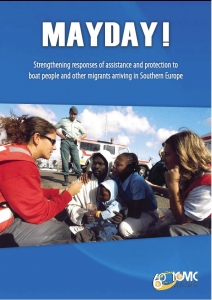
ICMC Europe Report: “MAYDAY! Strengthening responses of assistance and protection to boat people and other migrants arriving in Southern Europe”

ICMC has released a 150+ page report entitled “MAYDAY! Strengthening responses of assistance and protection to boat people and other migrants arriving in Southern Europe.”  I have just started reading the report and may post some additional excerpts in the coming days.  Here is an excerpt from the Foreword and Introduction:

“In the first months of 2011 alone, more than 2,000 migrants have died crossing the Mediterranean Sea. More than 2,500 unaccompanied children arrived just on Italian shores. Tragic, chronic figures like these are urgent and continuous reminders of the need for another approach to human mobility that goes far beyond simple enforcement and fundamentally recognises the rights to life and protection for all.

It is not so much the arrivals of migrants and refugees that should be put to question, but rather the response mechanisms which very often fail as much in the fields of prevention and rescue as in the processes deciding where and how people are permitted to move, disembark, stay or return. Protection today is provided only for a limited number of boat people who need it, and governed by systems of access and identification that are far too limited. Correct identification, differentiation and referral systems are needed for all migrants in distress and from the very moment of their arrival, not only because they are human beings, but also because such approaches reflect the quality of our societies….”

Scope of this report – Gathering the results of nearly a half thousand surveys of first responders and other actors as well as the migrants themselves, this report examines what happens—or does not happen— to identify migrants in need of protection and assistance upon their arrival in Europe. In particular, it sheds light on the mechanisms developed, and gaps both in practice and in policy in responses to boat people and other migrants arriving in mixed migratory movements in four countries at Europe’s Southern door: Greece, Italy, Malta and Spain.

Although rescue at sea at one end and voluntary or enforcement-related return at the other are highly relevant topics and areas of research per se, DRIVE has focused on the situation of migrants at point of arrival. As such, the project and this report look at first responses in the phase immediately upon and surrounding arrival, and then to identification, differentiation and referral mechanisms for legal protection and/or further assistance in subsequent phases following arrival.

The principal focus of the project was on boat arrivals, but the shift in routes in Greece during the project period and the sharp increase in land border crossings there compelled reflection upon responses to migrants crossing land borders as well as those arriving by sea. While the project maintained its focus on arrivals by sea, one of its findings is that most of the laws, policies, procedures and responses applicable to boat people pertain equally to those arriving across land borders—in particular, steps on identification, differentiation and referral for protection and assistance.

The DRIVE project set out to promote protection of the rights of all migrants in these situations, especially the most vulnerable, regardless of their immigration status. Nevertheless, the project has highlighted four groups whose members have come to be defined to a varying extent as having specific rights or special needs under international and European legal instruments: asylum seekers, victims of human trafficking, children, and victims of torture. It merits emphasising however, that other migrants also have special needs because of particular vulnerabilities,- notably people with serious health problems, disabled people, elderly people, pregnant women, single parents with minor children and persons who have been subjected to or witnessed torture, rape or other serious forms of psychological, physical or sexual violence.

Structure of this report – The report is composed of four main parts, plus annexes:

Part 1: Building policy responses to boat people and others arriving in mixed migration flows – Within this first part, Chapter 1 provides a brief history of the policy evolution and the organizations involved in the area of mixed migration. Chapter 2 gives an overview of legal obligations relating to the rights of the migrants composing these arrivals. The third chapter provides an analysis of the EU policy and legal framework with regards to mixed migration arrivals at its borders.

Part 2: A focus on post-arrival identification, differentiation and referral for assistance and protection – The first chapter explains what is meant and implied by “identification, differentiation and referral”in mixed migration contexts, the concept at the core of the DRIVE study. The second chapter seeks to focus on the legal obligations of member states to conduct identification of people in need of protection at the border, with in-depth legal analysis of the rights and state obligations that international and EU law articulate for asylum seekers, children, and victims of human trafficking and torture.

Part 3: What happens to people arriving irregularly by boat in Greece, Italy, Malta and Spain? – The first chapter gives a snapshot of the trends and figures of arrivals in the Mediterranean region. In Chapter 2, the summaries of the four country reports (each presented in its entirety in an annex) then provide a look at the procedures and practices on the ground for first reception, identification and referral. The third chapter presents the results of the extensive migrants surveys that the DRIVE project conducted in the four countries in an effort to give voice to the beneficiaries themselves. Chapter 4 concludes with a comparative analysis identifying the main gaps and challenges in those countries.

Part 4: Conclusions and recommendations – The focus on the four countries enabled consideration of practices and procedures which could either improve the quality of the process or prevent people from accessing protection and assistance. Recommendations therefore seek to address how identification, differentiation and referral can be improved in the Mediterranean, including how the international and European legal and policy framework can address this question in a more comprehensive manner.

Annexes: Detailed mapping of the situation in Greece, Italy, Malta and Spain are attached in the annexes, as well as a presentation of some relevant tools and guidelines….”

Click here for Report.

1 Comment

Filed under Analysis, Data / Stats, Eastern Atlantic, European Union, Greece, Italy, Malta, Mediterranean, Reports, Spain

ECRE Interview with Tineke Strik Regarding PACE Investigation into Migrants Deaths in Mediterranean

ECRE last week published an interview with Ms Tineke Strike regarding the PACE Migration Committee’s ongoing investigation into the almost 2000 migrant deaths that have occurred in the central Mediterranean this year.  The Committee is focusing in particular on the incident that occurred in late March 2011 when unknown ship(s) and aircraft observed and then failed to rescue a disabled migrant boat.  Approximately 60 persons subsequently died.

Excerpts from the ECRE interview:

“[***]  What are the main findings of your report on the death at the Mediterranean so far?

We have spoken with survivors and with the priest who received the request for assistance from the boat in distress, Italian border guards, and the Italian refugee agency, as well as the Italian Refugee Council (CIR), a Member of ECRE. We also talked to different people in Brussels, including NATO, the ambassador of the Council of Europe, Amnesty and several MEPs. Today, during the PACE hearing on November 30 in Paris, we had a discussion with a number of experts in international law, Frontex, UNHCR and ICRC. All in all a lot of information has been gathered.

We have already sent requests for information to find out via satellite maps and logs if there were boats near the distressed boat Once we know under which flags these boats were sailing, we will be able to track which governments might have been responsible and ask them whether they knew that the boat asking for help was in danger or not and how they acted upon that information.

We are actually still waiting for information for this information. It is unfortunate that it takes time to get this information but we are trying to get hold of it through different channels. We have approached High Representative Ashton and asked for her consent to provide us with information from the European Satellite Centre. We have already used this kind of information at the Council of Europe, for example to detect the illegal detention centres that the CIA was using. We therefore hope that Ashton once again will cooperate.

We also asked NATO to provide us with information and have asked all the countries who took part in the NATO action in Libya and who had ships in that region during that period to give us data on where their boats were and when. NATO has promised to request the Member States to provide us with this information, also if these boats were not under the command of NATO. If this does not succeed, we still have our own national parliamentarians that could push their governments in their own country if it is necessary to gather the information.

If countries were involved they might not want to admit that, which makes my position difficult. I am not a judge and I don’t have enforcement powers so I’m partly dependent on the cooperation of various parties.  But I think all parties can benefit from transparency on what has happened, in order to avoid such tragedies in the future.

[***]

How do you think the EU has responded to the turmoil and war in North Africa and, in particular, the following displacement of people in the region and the arrival of some of them to Europe?

In my report following the protests in North Africa, we see that by far the largest part of the people who have fled Libya went to Tunisia and Egypt. There was a lot of fuss in the EU about the 25,000 who eventually fled to Italy. Tunisia took half million, Egypt took a half a million which shows how big the contrast with the EU was, especially considering that Member States were reluctant to resettle refugees from camps in Tunisia. This while Tunisia and Egypt were in a very vulnerable position in the post-revolutionary period. If we really want to help and strengthen stability in the region, we must show these states that they are not alone. These countries generously opened their borders, they understood the situation of the people there and to a great extent we stood aside and just watched.

Then we failed to help out Italy and Malta, especially when countries like France and Denmark wanted to close their borders. This shows exactly how much we are still not politically ready for a common asylum system. We provide beautiful public statements but when it comes down to it, Member States do not want to lose their sovereignty or be troubled by developments elsewhere. I do not think you can have both: either you have a joint system and you show solidarity, or you close all the borders and reinvent the wheel.

Common policies go hand in hand with solidarity and in fact we should look beyond the European borders.  What you see now is that border controls at the external borders of the EU continue to shift to North Africa and sometimes even further. One cannot claim that our responsibilities only begin when people have reached our territory. I was therefore very disappointed when the European Commission replied to a question by MEP Hélène Flautre on this incident saying that the boat was in Libyan waters and therefore they had no power to get involved. If certain acts like push backs at high sea or bilateral agreements with unsafe third countries such as Libya, lead to death or inhumane treatment, EU member states or other countries of the Council of Europe are accountable for a violation of the European Convention on Human Rights. In that sense I have high expectations of the decision of the ECHR in the case of Hirsi and others v. Italy.

[***]

What do you think the impact of your work and the investigation will be?

I hope the report will raise the awareness of the international obligations and also the awareness of the importance of avoiding such tragedies. It is important that violating the obligation to rescue does not remain unmentioned or lead to impunity. If we succeed in proving which actors were wrong. Member States will be more careful and there will be more pressure to cooperate and share the responsibilities, and to establish practical and binding solutions. Being a parliamentary assembly of national parliamentarians, I also hope that the discussion will also take place in Member States. I find it really outrageous that such a tragedy can occur so close to our borders and that we have been so silent about it.

[***]”

Click here for full interview.

Click here for my last post on this topic.


Leave a comment

Filed under Council of Europe, European Union, Frontex, General, Italy, Libya, Malta, Mediterranean, News, Tunisia, UNHCR

Update Regarding PACE Investigation into Migrant Deaths in the Mediterranean

I have sought additional information from NATO and PACE regarding the 29 November hearing held in Paris by the PACE Migration Committee regarding the deaths of boat people in the Mediterranean.  I was informed by a PACE official that the minutes of the 29 November hearing will be released during or after the Committee’s next scheduled meeting which will take place in late January 2012.

In my previous post on this topic I incorrectly said that NATO officials attended the 29 November hearing.  Instead Ms Strik, the Committee’s rapporteur, met with a senior NATO official in Brussels on 28 November.  A NATO official informed me that “during the meeting [with Ms Strik], NATO offered to look into new details of the 28 March 2011 incident which were provided to NATO by Ms Strik. This process is ongoing and we will reply to the Council of Europe in due course.”

The NATO official reiterated to me that NATO ships were “fully aware of their responsibilities” to respond to vessels in distress and noted that during Operation Unified Protector “NATO ships have directly assisted in the rescue of more than 600 people in distress at sea.”  The official provided information about two incidents which have previously been reported on:

  • “[O]n 26 March 2011, NATO ships responded to information that two migrant ships with over 500 people on board were in distress, which were then provided direct assistance by the Italian authorities. That included a NATO ship using its helicopter to airlift two women and a newborn child to medical help”; and
  • “On 10 July 2011, a NATO ship responded to a vessel in distress approximately 75 miles off the coast of Libya. The NATO vessel provided medical support, food and offered mechanical assistance to the distressed migrants. In response to a deterioration of the humanitarian situation onboard, the 114 migrants were transferred onto the NATO ship in accordance with the Safety of Life at Sea (SOLAS) protocol and delivered to safety in Tunisia.”

The reference to the 26 March incident presumably relates in part to the Canadian warship, HMCS Charlottetown, which made contact with a disabled migrant boat carrying over 250 migrants on 25 March.  The Charlottetown provided food, waters, and repairs to the migrant boat and escorted it until 26 March when the Italian Coast Guard arrived on scene.  As far as I can tell from news reports from the time of this incident, there was only one migrant boat involved.   NATO’s current statement indicates there was a second migrant boat encountered by NATO at this time.

Click here and here for my previous posts on the March 2011 incident.

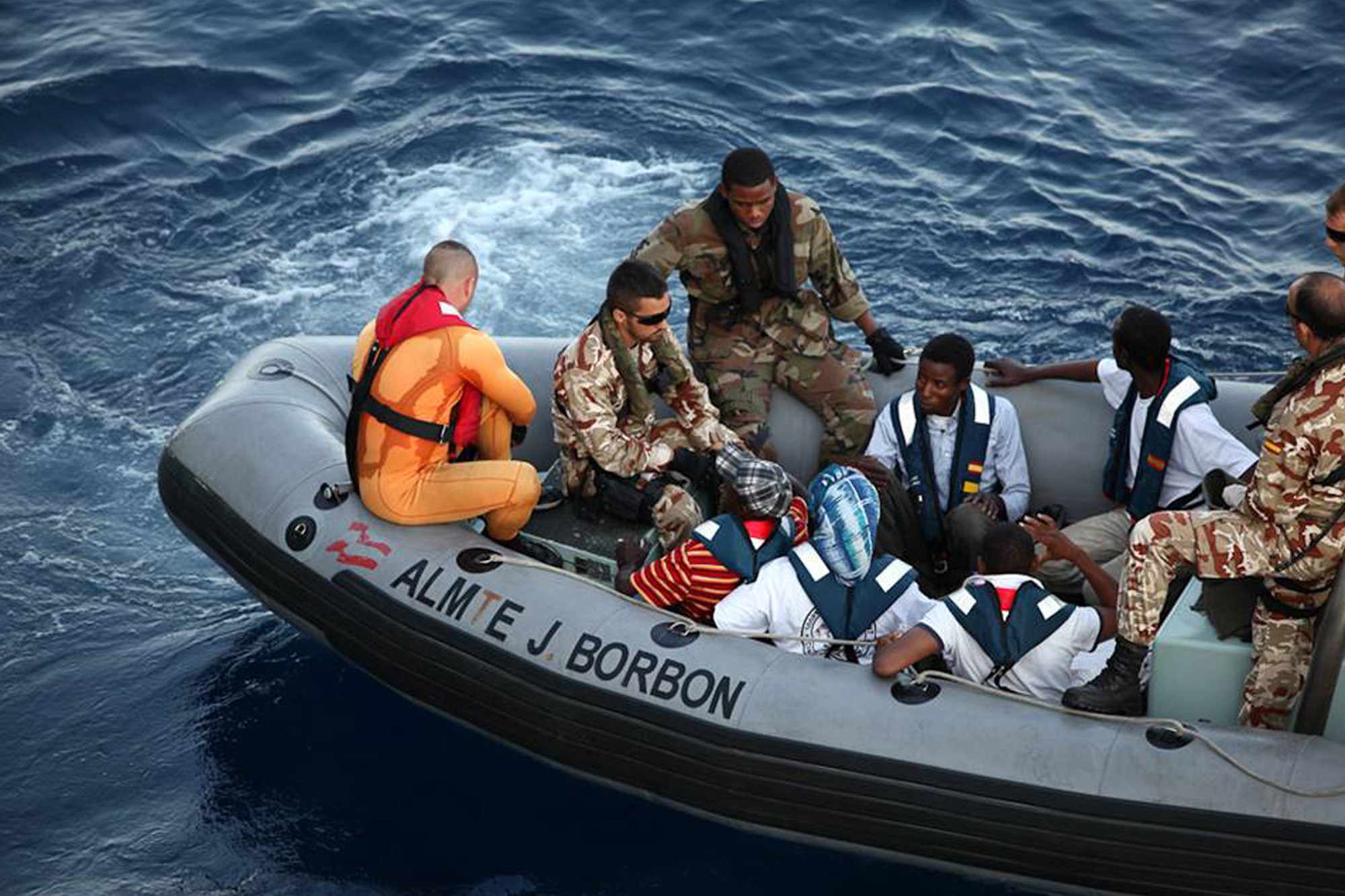
The 10 July incident relates to the rescue of over 100 migrants by the Spanish Navy frigate, the Almirante Juan de Borbón.  The rescued migrants remained onboard the Spanish frigate for six days after Malta and Italy refused to permit the NATO ship to enter port to disembark the rescued migrants.  The migrants were transferred to a Tunisian navy ship on 16 July and presumably then taken to Tunisia.

Click here and here for my previous posts on the July 2011 incident.

Neither of these two incidents relates to the events that occurred between 25 March and 10 April 2011 when a disabled migrant boat drifted for days during which time approximately 60 persons died.  Survivors from the migrant boat reported that at various times military ships and helicopters ignored their requests for assistance.  The Guardian reported extensively on this subject and the PACE Committee has been seeking information from NATO about this particular incident.

Click here and here for Guardian articles.

Click here for my last post of the PACE 29 Nov. hearing.

HMCS Charlottetown and migrant boat 25 March 2011.

Photo Credit: Lt(N) Michael McWhinnie, Department of National Defence and Canadian Forces

Spanish frigate Almirante Juan de Borbón rescuing migrant boat on 10 July 2011 and transferring migrants to Tunisian navy vessel on 16 July 2011.

Photo Credit: Ministerio de Defensa de España (mde.es)

Photo Credit: Ministerio de Defensa de España (mde.es)

2 Comments

Filed under Council of Europe, Italy, Libya, Malta, Mediterranean, News, Tunisia

EJML Article, B Nascimbene and A Di Pascale: “The ‘Arab Spring’ and the Extraordinary Influx of People who Arrived in Italy from North Africa”

The latest edition of the European Journal of Migration and Law, Volume 13, Number 4, contains an article by Bruno Nascimbene, Professor of European Union Law, Faculty of Law, University of Milan, and Alessia Di Pascale, Research Fellow, European Union Law, Faculty of Law, University of Milan, entitled “The ‘Arab Spring’ and the Extraordinary Influx of People who Arrived in Italy from North Africa”.

Abstract: “The ‘Arab spring’ which spread in early 2011 and the consequent exceptional influx of people that arrived on the Italian coasts from North Africa put the national reception and asylum systems under particular pressure, also raising the debate on the status to be attributed to these people. Faced with a situation out of the ordinary, Italy immediately addressed a request for help to the European Union, which has revealed the difference of views and mistrust existing between Member States in relation to these issues. This episode also calls into question the scope and effectiveness of the EU migration management framework, particularly in case of strong and unexpected pressure, and its implementation in a true spirit of solidarity.”

Click here for link.  (Subscription or payment required.)

1 Comment

Filed under Analysis, European Union, Frontex, Italy, Libya, Mediterranean, Tunisia, UNHCR

EU Will Not Fund Construction of Evros (Greece-Turkey) Border Fence

Of possible interest to some, Ekathimerni.com reports that the EU has made it clear it will not provide funding to the Greek government for the construction of a border fence along the Greek-Turkish border along the Evros river.  Greece has been planning the construction of the border fence for many months and was seeking €5 million from the EU.  Early proposals called for the construction of a fence over 200 km in length.  The fence that is now being built will be 12 km in length when completed.  “Responding to a question by Euro MP Giorgos Papanikolaou, who is affiliated with conservative New Democracy, European Commissioner for Home Affairs Cecilia [Malmström] said the bloc would not pay for the fence as it would not effectively discourage immigrants or smugglers who would simply seek alternative routes into the European Union, either via another section of Greece’s porous border with Turkey or through the border of another EU member state. [Malmström] reportedly said that the EU would be prepared to fund other measures if they are deemed to be an effective way of curbing illegal immigration into the bloc.”

Click here for current article.

Click here for older article.

Leave a comment

Filed under European Union, Frontex, Greece, News, Turkey