Tag Archives: Spain

Frontex Deployment, Repatriation Practices, and Diplomacy Are Responsible For Halting Migrant Arrivals in Canary Islands

From Europa Press: Juan Martinez, Chief Inspector of the Spanish National Police’s  Illegal Immigration Network and False Document Unit (UCRIF – Unidad Contra las Redes de Inmigración Ilegal y Falsedades Documentales), attributes the significant decline in the arrival of migrant boats in the Canary Islands to the deployment of Frontex, diplomatic management in the countries of origin, and repatriation policies.  The article notes the first migrant boat arrival in the Canaries in 1994, the peak years of 2006-2008, and the ensuing practices which have halted further migrant arrivals.

Click here (ES) for article.

Leave a comment

Filed under Eastern Atlantic, Frontex, News, Senegal, Spain

Interview with Frontex Deputy ED Gil Arias

EurActiv.es conducted an interview in Spanish with Frontex Deputy Executive Director Gil Arias where he speaks about several topics, including Frontex’s response to the current situation in North Africa, the possible implications for Spain should unrest spread to Algeria or Morocco, Frontex’s budget shortfall and need for supplemental funding, and the problems experienced by Frontex when it attempts to negotiate cooperation or training agreements with third countries.

Click here for interview. (ES)

Leave a comment

Filed under Egypt, European Union, Frontex, Greece, Italy, Libya, Malta, Mediterranean, News, Spain, Tunisia

600+ Migrants Reach Andalusian Coast in 2011

A total of 612 migrants in 24 different boats have reached the Andalusian coast of Spain (Almeria, Granada, Cadiz and Huelva) from Morocco and Algeria so far in 2011.

Click here for article (ES).

Leave a comment

Filed under Algeria, Data / Stats, Eastern Atlantic, Mediterranean, Morocco, News, Spain

Migrant Boat Capsized Off Spain – 18 Missing, 4 Dead

A boat believed to be carrying 51 sub-Saharan migrants attempting to sail from Morocco to Spain capsized south of Adra (Almería).  The boat reportedly left Morocco on 5 May.  The accident occurred late Thursday night to early Friday morning.  The boat was carrying men, women, and children.  29 people were rescued.  Four bodies have been recovered.  18 people remain missing and are assumed to be dead due to the sea temperature which according to authorities would allow someone to survive for a maximum of 10 hours.  Media reports suggest that the boat capsized after one of its floats ruptured which in turn caused the boat to capsize.

Click here (EN), here (ES) and here (ES) for articles.

Leave a comment

Filed under Mediterranean, Morocco, News, Spain

Spain’s Security Secretary Visited Mauritania to Strengthen Bilateral Immigration Cooperation

Spanish Secretary of State for Security, Antonio Camacho, travelled last week to Mauritania, Niger, and Mali to strengthen bilateral cooperation on illegal immigration and organised crime.

Spain and Mauritania agreed to strengthen their cooperation on immigration control and to expand cooperation to include efforts to combat drug smuggling using the same joint cooperation model currently being used for illegal migration.  Camacho said Spain is committed to continue providing material resources to the Mauritanian security forces to “further improve the tools at their disposal to deal with security threats and to strengthen their border control mechanisms.”  Camacho thanked Mauritania for its efforts to block illegal migration towards Spain and noted that only one boat (cayuco) reached the Canary Islands from Mauritania in 2010 and that no boats had so far reached the Canary Islands in 2011.  Spain and Mauritania began their close cooperation on immigration control in March 2006.

While in Mauritania, Camacho visited the 50 members of the Spanish National Police and Civil Guard who are stationed in Nouadhibou as part of Spain’s extraterritorial immigration control measures.

Click here (ES), here (ES), and here (FR) for articles.

Leave a comment

Filed under Eastern Atlantic, European Union, Mauritania, News, Niger, Spain

Cyprus, Greece, Italy, Malta, & Spain Issue Joint Communiqué Regarding Response to North African Migration

Ministers of Home Affairs and Internal Security from Cyprus, Greece, Italy, Malta, and Spain, met in Nicosia on 19 April and issued a Joint Communiqué.  Here is the full text (HT to EASO Monitor):

“Joint Communiqué II

(Nicosia, 19 April, 2011)

Following the meeting in Rome on the 23rd February 2011, the Home Affairs and Internal Security Ministers of Cyprus, Greece, Italy and Malta as well as the representative of the Minister of Interior of Spain, met again today in Nicosia and discussed the continuing dramatic developments in the Southern Mediterranean region. At the end of the meeting it was decided to issue the following Joint Communiqué.

The Home Affairs and Internal Security Ministers of the Mediterranean Member States of the EU:

Recalling our February 23rd,2011 Joint Communiqué, we have repeated our utmost concern for the unfolding events in relation to the humanitarian situation as well as to the massive illegal immigration flows and movements of possible beneficiaries of international protection that affect our countries;

Taking into account that the escalating events in countries of Northern Africa and the greater Middle East are destabilising the region and acknowledging that political reforms and democratic transitions will not take effect immediately and that their outcome is still uncertain;

Bearing in mind Europe’s longstanding tradition and commitment to the provision of international protection to people in need, in accordance with the Geneva Convention and in line with humanitarian principles and full respect of human rights;

Underlying that security and stability in the Mediterranean is directly linked to the security and stability of the EU as a whole and that effective response to this challenge requires joint efforts, commitment and solidarity from all EU Member States;

Stressing that the current emergency situation with regard to the massive illegal immigration flows and movements of possible beneficiaries of international protection brings upon the Mediterranean Member States additional social, economic, administrative and demographic burden, to that already prevailing;

Recalling the already existing intense and continuous migratory pressure at the south eastern external borders of the EU;

Expressing deep concern about the conflict in Libya and its consequences in terms of sufferings of countless human beings and growing number of displaced persons fleeing the war and taking into account that huge number of people in need of international protection could arrive at the most exposed Mediterranean Member States in the immediate future;

Emphasizing that the possible prolongation of such influxes of illegal migrants and asylum seekers to the Mediterranean Member States, cannot be managed without the concrete and substantial support and solidarity from the rest of the EU’s Member States; alternatively, the situation will seriously jeopardize our ability, and subsequently the Union’s ability, to manage the displaced persons and provide those in need with international protection as well as undermine our common security;

Stressing that the arising situation will challenge and undermine the efforts of those Member States to reform their overburdened national asylum systems;

Reaffirming the urgent necessity for EU to provide concrete and immediate support to Member States on the EU southern external borders;

Stressing the need for additional actions and policies with a view to implement the EU principle of solidarity and fair sharing of responsibility as expressed in the Treaty on the Functioning of the European Union and in line with the Stockholm Programme, the European Pact on Immigration and Asylum, the Global Approach to Migration, the relevant European Council Declaration of 11 March 2011 and Conclusions of 24 and 25 March 2011, the JHA Council Conclusions of 11and 12 April 2011 on the management of migration from the Southern Neighbourhood and the JHA Council Conclusions of 25 and 26 February 2010 on 29 measures for reinforcing the protection of the external borders and combating illegal immigration;

Therefore we, the Ministers of Home Affairs and Internal Security of the EU Mediterranean Countries, have adopted a common position on the emerging situation in our region and urge the European Union to practically offer operational as well as financial support to Member States which face mass and disproportionate mixed migration flows, by fully mobilizing all available EU assets, instruments and capabilities, either existing or additional ones,.

Particularly, as the competent Ministers of the EU Mediterranean Member States, urge the European Union to:

Urgently present and implement proposals on the Global Approach to Migration as well as on Mobility Partnerships, in a spirit of genuine cooperation with the countries of the Southern Neighbourhood Region, also to effectively control and manage the current and the anticipated mass migration flows as well as situation-specific schemes on return and readmission.

Call on FRONTEX to immediately implement the provisions set out in section 5 of the JHA Council Conclusions of 11 April 2011, to speed up negotiations with the countries of the region – and in particular with Tunisia – with a view to concluding operational working arrangements, and organising joint patrolling operations in cooperation with Tunisian authorities and in application of all relevant international Conventions, in particular the UN Convention on the Law of the Sea (“the Montego Bay Convention”).

Call on FRONTEX to intensify the monitoring of the situation based on risk analysis and encourage Member States to provide the Agency with further human and technical resources so as to continue its ongoing operations (Joint Operation Hermes, Joint Operation Poseidon Land and Sea and the possible deployment of a RABIT operation in Malta) in the light of the emerging situation. Furthermore, call FRONTEX to expand its operations, where and when necessary, to prevent illegal flows in the eastern Mediterranean area of Egypt and Syria. To this end, further adequate financing of FRONTEX should be considered so as to increase the Organization’s capabilities to fulfil successfully its tasks.

Enhance the operational capacity and the coordinating role of the FRONTEX Operational Office in Piraeus in order to effectively deal with the situation;

Accelerate work on the FRONTEX Amending Regulation with a view to an agreement by June 2011 which will strengthen its capacity, make it truly operational and improve its synergy with other bodies.

Promote practical cooperation with the countries of origin or transit of illegal migrants in the region in preventing and fighting illegal migration flows, inter alia by concluding Readmission Agreements, developing Voluntary Return Programmes, enhancing their capacity of border management and surveillance, expanding the Immigration Liaison Officers Network, promoting legal migration by exploring the possibility of concluding mobility partnerships;

Encourage Member States to expedite discussions on the proposal for recasting the Dublin II Regulation, including a mechanism to suspend the transfers to Member States facing particular pressure on their national asylum systems.

Urgently mobilize all available financial assistance through the External Borders Fund and European Refugee Fund and in addition, as section 4 of the JHA Council Conclusions of 11 April, 2011 reads, activate supplementary funds that can be made available to Member States or FRONTEX at short notice when needed. In this vein establish a special solidarity Fund, when necessary, to tackle exceptional emergency situations and humanitarian crisis.

Deploy every available possibility by the European Asylum Support Office to offer practical support to the Member States of the Mediterranean Region in need. A permanent specialised mechanism should be set up through the EASO, which, at exceptional emergency situations, will provide Member States in need with the necessary logistical and technical support.

As a matter of priority, present a proposal for implementing a coherent and comprehensive mechanism for distributing responsibilities, on a voluntary basis, specifically regarding the relocation of beneficiaries of international protection among member states, in case of European countries faced with particular pressures, as a consequence of their geographical or demographic situation, especially when facing the sudden arrival of third country nationals in need of international protection.

Commit to the work on establishing a Common European Asylum System with a view to respect the 2012 deadline.

We the Ministers of the Mediterranean Member States of the EU agreed to meet again soon, at a date to be agreed, in order to further coordinate our efforts before the European Council of June this year.”

Click here for document.
2 Comments

Filed under Cyprus, Egypt, European Union, Frontex, Greece, Italy, Libya, Malta, Mediterranean, News, Statements, Tunisia

España ha destinado al menos un 5% de la ayuda en África Occidental a control de fronteras e intereses comerciales

A new report from Entreculturas and Alboan:

“Casi 25 millones de euros de un total de 466 es la Ayuda Oficial al Desarrollo destinada a países de África Occidental cuestionada por contribuir más a intereses de la política de migraciones que al desarrollo humano y lucha contra la pobreza durante el periodo 2004-2008. Es una de las conclusiones del informe “Políticas de control migratorio y de cooperación al desarrollo entre España y África Occidental durante la ejecución del primer Plan África” presentado por Entreculturas y Alboan….”

Resumen: “En el marco de la coherencia de políticas a favor del desarrollo, y con el objetivo de investigar si la cooperación bilateral española está condicionada por intereses de control de los flujos migratorios, las ONG Alboan y Entreculturas presentan el informe Políticas de control migratorio y de cooperación al desarrollo entre España y África Occidental durante la ejecución del primer Plan África que analiza el destino de la ayuda oficial al desarrollo (AOD). España  durante los años 2004 – 2008 ha destinado 25 millones de euros de AOD a proyectos que tienen más relación con el control de fronteras e intereses comerciales que con el desarrollo humano y lucha contra la pobreza. Esto supone un 5,2% de del total de la ayuda de AOD bilateral en África Occidental.”

Click here (ES) or here (ES) for full report.

Click here (ES) for news article.

Leave a comment

Filed under Eastern Atlantic, ECOWAS, News, Reports, Senegal, Spain

Italy, France, Spain, Malta, Cyprus Call for Redistribution of Asylum Seekers

The Ministers of the Interior of Italy, France, Spain, Malta and Cyprus met in Rome on Wednesday in advance of today’s JHA Council meeting and agreed to ask the EU for assistance in regard to the expected flow of migrants from North Africa.  The Ministers will call for the creation of a special EU fund to provide financial support to the frontline states directly affected by significant numbers of migrants and for the redistribution or relocation of asylum seekers among all EU member states so that the states of first arrival do not experience an unfair burden.  Michele Cercone, spokesperson for Commissioner Cecilia Malmström, noted that current European standards do not provide a mechanism for the redistribution between member states of migrants seeking asylum, other than on a voluntary basis.

Click here (IT) for article.

1 Comment

Filed under Cyprus, European Union, France, Italy, Libya, Malta, Mediterranean, News, Spain, Tunisia

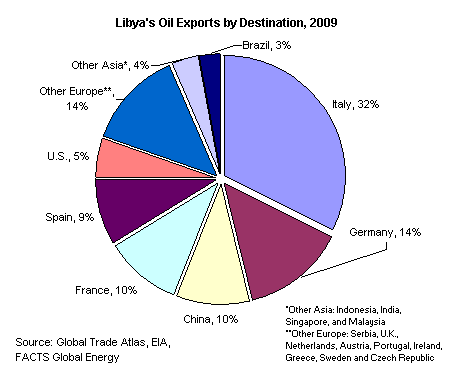
32% of Libya’s 2009 Oil Exports Went to Italy

From the US Energy Information Administration:

2009 Libyan Oil Exports:  “With domestic consumption of 280,000 bbl/d in 2009, Libya had estimated net exports (including all liquids) of 1.5 million bbl/d. According to 2009 official trade data as reported to the Global Trade Atlas, the vast majority of Libyan oil exports are sold to European countries like Italy (425,000 bbl/d), Germany (178,000 bbl/d), France (133,000 bbl/d), and Spain (115,000). With the lifting of sanctions against Libya in 2004, the United States has increased its imports of Libyan oil. According to EIA estimates, the United States imported an average of 80,000 bbl/d from Libya in 2009, up from 56,000 bbl/d in 2005 but, as a result of the U.S. economic downturn and subsequent decline in oil demand, 2009 levels were below 2007 highs of 117,000 bbl/d.”

Click here for link.

(HT to tweet by @johnwilcockson)

1 Comment

Filed under Data / Stats, European Union, France, Germany, Italy, Libya, Mediterranean, News, Spain

Times of Malta: Frontex Preparing for “Unprecedented” Migrant Flow from Libya

The Times of Malta reports today that Frontex “has been given instructions to start preparing for a possible unprecedented influx of immigrants and asylum seekers fleeing Libya towards the EU, particularly through Malta and Lampedusa.” “‘The fact that the Libyan regime does not seem to be in control of the huge expanse of the 2,000-km long Libyan coastline might already pose a big danger of a flood of asylum seekers crossing by rogue boats towards Malta, Lampedusa and Sicily,’ the sources said.”  According to the article the planned response to a massive flow would involve all 27 member states.  EU spokesman for Home Affairs Michele Cercone confirmed that Frontex was engaged in planning for a migrant flow from Libya, but said he would not “speculate on details and suppositions.”  The article also states that “six EU Mediterranean member states [Malta, France, Cyprus, Spain, Greece, and Italy] will meet in Rome tomorrow in an urgent minisummit to devise a common stance on the immigration crisis facing the southern Mediterranean region, a day before official talks of EU justice ministers in Brussels.”

Click here article.

1 Comment

Filed under Cyprus, European Union, France, Frontex, Greece, Italy, Libya, Malta, Mediterranean, News, Spain

Frontex’s Role to be One of Coordination

Consistent with its mandate and standard practice, Frontex’s role in the new Central Mediterranean joint operation will be one of coordination.  According to DI-VE, “[i]n the current situation, [Frontex] foresees its main role as coordinating border guards from among the member states, particularly with regard to second-line experts in the screening and debriefing of irregular migrants as well as in coordinating an appropriate operational response to the humanitarian needs in the area. In addition, the agency is investigating the most optimal means by which to adapt a range of technical assets engaged in sea border operations in the Mediterranean to the needs of the Italian authorities.”

Click here for article.

Leave a comment

Filed under European Union, France, Frontex, Italy, Libya, Malta, Mediterranean, Netherlands, News, Spain, Tunisia

Frontex Central Mediterranean Operation Likely to Begin Within Days; Dutch to Send Coast Guard Plane to Lampedusa; France and Spain Likely to Deploy Planes or Ships

The Dutch government has decided to deploy a Coast Guard surveillance plane to Italy to participate in the new Frontex joint operation.  The Dutch decision was announced by Immigration and Asylum Minister Gerd Leers on Friday.  The plane and two Dutch border guards are scheduled to be deployed for at least six weeks beginning 21 February.

The Financial Times reports today that the Frontex joint operation may be operational early next week and that details are being finalised at a meeting that is taking place today in Rome between European Commission and Italian officials.  According to the FT article, one topic under discussion is the situation in Libya and the possibility for a larger wave of migrants should the situation in Libya become more unstable or should Gaddafi’s government collapse.

Click here (EN) (FT registration may be required), here (NL), here (NL), and here (EN) for articles.

Leave a comment

Filed under European Union, France, Frontex, Italy, Libya, Malta, Mediterranean, Netherlands, News, Spain, Tunisia

WikiLeaks 2008 US Cable: Background Regarding EU-Libya Framework Agreement Negotiations

This cable provides the views of the US Embassy in Tripoli regarding the state of the EU-Libya Framework Agreement negotiations in July 2008.  It was written by the US Embassy’s Chargé d’Affaires, John Godfrey.  The cable is titled: “THE EU-LIBYA FRAMEWORK AGREEMENT: VENI, VISAS, VETO.”  The cable states that Libya views the EU Framework Agreement as “a ‘reward’ for Libya’s decision in July 2007 to release six [Bulgarian and Palestinian] health workers accused of intentionally infecting over 400 Libyan children with HIV/AIDS.”  The cable describes threats to veto the framework agreement by individual EU member states in an effort to secure bi-lateral concessions from Libya and describes Libya’s claim that the “draft language initialed by [EU] Commissioner Ferrero-Waldner ‘commits’ the EU …  to funding a ‘surveillance mechanism’ along Libya’s land and sea borders to combat illegal migration.”

Most of the cable’s text follows:

“(C)  Summary.  The Government of Libya (GOL) remains keenly interested in pursuing a European Union-Libya Framework Agreement and views a more formalized partnership with the European Union (EU) as a “reward” for Libya’s decision in July 2007 to release six foreign health workers accused of intentionally infecting over 400 Libyan children with HIV/AIDS. Certain EU members, unsure that a more formal cooperation mechanism would be beneficial and sensing Libya’s eagerness, have used the threat of a veto to push their bilateral agendas, particularly with respect to commercial and human rights issues.  One year after Libya and the EU agreed in principle to pursue an agreement, a sizeable perception gap exists between the two sides on the merits of a more formalized partnership.  Despite occasional differences with the EU, most recently over the French-backed Union for the Mediterranean proposal, the GOL will continue to seek an EU framework agreement, in large part because of Muammar al-Qadhafi’s desire to be taken seriously by European leaders. End summary.

BULGARIAN MEDICS CASE HAUNTS EUROPE

2.  (C)  Libya’s much-heralded decision in July 2007 to [release] six foreign health workers imprisoned since 1999 on charges of intentionally infecting children in Benghazi with the HIV/AIDS virus frames current discussions on an EU-Libya Framework Agreement.  Widely seen by Europeans in Libya as a successful alignment of European and Libyan interests, the denoument of the Bulgarian medics case – particularly their immediate pardon upon their arrival in Bulgaria – remains a lasting embarrassment for key elements of the Libyan regime.  The GOL, preoccupied with avoiding the public perception that it caved to foreign pressure to resolve the case, has trumpeted a putative EU framework agreement as a significant concession and a positive coup for Libyan diplomacy.  In an hours-long televised news conference just days after the medics left, Foreign Minister Abdulrahman Shalgham and Under Secretary for European Affairs Abdulati Obeidi boasted that a draft agreement, initialed by EU Commissioner for External Relations Benita Ferrero-Waldner during her July 2007 visit to Tripoli, would pave the way for easier access to Schengen visas for Libyan citizens and increased EU infrastructure investments in Libya. Ferrero-Waldner’s announcement in February 2008 that the EU Commission had submitted a recommendation to the Council of Ministers to grant a mandate to open negotiations with Libya stoked GOL hopes for rapid progress.

3.  (C)  French, Spanish, and German diplomats describe Libya’s primary objective in pursuing an EU framework agreement as reducing the mandatory waiting period for Schengen visas for Libyan nationals from the current 10 days to 48 hours.  …

4.  (C)  The July 2007 EU-Libya draft also lays out cooperation in the fields of human rights, health, and development.  U/S Obeidi informed French Ambassador Francois Gouyette in June 2008 that Libya agreed in principle to negotiate a human rights chapter within the framework agreement; however, Obeidi categorically refused to include discussions of individual human rights cases in the EU negotiations.  … In addition, the GOL has claimed that draft language initialed by Commissioner Ferrero-Waldner “commits” the EU …  to funding a “surveillance mechanism” along Libya’s land and sea borders to combat illegal migration.

VENI, VIDI, VETO

5.  (C)  Certain EU members, sensing Libya’s eagerness to move ahead, have threatened to block a framework agreement as a means by which to secure bilateral concessions, chiefly on commercial and human rights issues.  Italian Economic and Commercial Counselor Domenico Bellantone said that Italy is prepared to veto any framework agreement unless Libya ends a series of discriminatory commercial practices that target Italian firms operating in Libya.  …  French and Greek diplomats in Tripoli have hinted that they may also dangle a veto threat to resolve commercial disputes.  The Netherlands have approached certain EU members about a possible veto over Libya’s outstanding private debt to Dutch firms. Danish Consul-General George Wallen recently told EU Ambassadors in Tripoli that Denmark would veto a framework agreement with Libya unless the GOL lifts bans on Danish imports and Danish participation in infrastructure projects in Libya (prompted by a Danish magazine’s re-publishing in February 2008 of cartoons depicting the Prophet Muhammad).  Denmark also wants the GOL to release Jamal al-Hajj, a Danish-Libyan dual-national arrested on February 16, 2007 in connection with plans to hold a peaceful political demonstration.  Maltese diplomats have said Malta is considering a veto over dissatisfaction with Libya’s maritime patrols in its designated Search and Rescue (SAR) area and continuing concerns over the lack of cooperation by the GOL in efforts to stem the flow of irregular migrants from Libya to Europe.

6.  (C) European diplomats believe that apart from help in combating illegal migration from sub-Saharan Africa and South Asia through Libya to Europe, Europe has little to gain from a closer partnership with Tripoli.  In absence of a more formal agreement, some European countries have pursued bilateral cooperation that they privately assess as being more nimble and effective than broader cooperation under an EU framework agreement might be.  Italian diplomats characterized a recent donation of six vessels to Libya’s coast guard and an offer to train Libyan border security officials as Italy’s bilateral response to what they view as a lack of meaningful EU engagement on illegal migrant flows through Libya.  Greek DCM Ioannis Stamatekos lauded Italy’s move and said Greece may follow suit. Maltese Poloff Daniel Malina said that Malta, lacking resources to make a large equipment donation, hoped to keep the critical migration issue on the EU’s radar during Council deliberations over the Commission’s mandate to pursue the framework agreement.

DON’T RAIN ON MY CHARADE

7.  (C)  Twelve months have passed since Ferrero-Waldner initialed a draft memorandum on an EU-Libya framework agreement; however, a year of inaction does not appear to have dampened GOL perceptions that relations with Europe are on an up-swing. While senior European diplomats in Tripoli are quick to point out that formal negotiations with Libya on any kind of European-Libyan cooperation agreement have yet to even begin, many GOL officials speak of key Libyan negotiating positions, such as the 48-hour Schengen visa point, as if they’re already in place. …  A series of high-level European visits, most recently that of Spanish Foreign Minister Miguel Moratinos, have helped attenuate the GOL’s disappointment over what it perceives as slow progress on the framework agreement and on implementing commitments made during al-Qadhafi’s visits to Spain and France in December 2007.

8. (C) Comment: Libya’s interest in a closer partnership with Europe seems sincere; however, the GOL’s foreign policy, particularly at the senior levels, remains somewhat fickle. Libyan leader Muammar al-Qadhafi’s visit to Madrid and Paris last December sparked a surge of pro-European rhetoric in Tripoli – in one instance, Qadhafi threatened to pull Libyan investment from sub-Saharan Africa to redirect to his new European friends.  More recently, though, al-Qadhafi orchestrated a meeting of Arab Maghreb Union leaders in Tripoli to publicly disparage Sarkozy’s Union for the Mediterannean proposal (reftel).  Characterizing the proposed union as “insulting”, he claimed it would undermine Arab and African member states’ commitments to the Arab League and African Union, and told former British Prime Minister Tony Blair he was concerned that the proposal represented an effort by southern European states to create a North African bulwark against illegal migration from sub-Saharan Africa and to “further legitimize” Israel.  Despite such disagreements, Qadhafi’s interest in being taken seriously, particularly by his “friends Nicholas (Sarkozy) and Silvio (Berlusconi)”, will continue to drive the GOL’s keen interest in finalizing a framework agreement with the EU.  End comment.   GODFREY”

Click here or here for full cable.

6 Comments

Filed under Denmark, European Union, France, Germany, Greece, Italy, Libya, Malta, Mediterranean, Netherlands, News, Spain

Frontex 3rd Quarter Report

On 16 January the Frontex Risk Analysis Unit released its Report for the Third Quarter of 2010 (July-Sept.).  The report contains data, charts, and graphs detailing detections of migrants, asylum seekers, false document use, detections of facilitators, and other information.  The deployment of Frontex’s RABIT force to the Greek-Turkey border did not begin until 2 November 2010, so the effects of the RABIT deployment do not appear in the Third Quarter.

The Report notes that the “unprecedented peak in illegal border-crossings at the Greek land border with Turkey is the result of a shift from the sea to the land border” coupled with a “large increase in the absolute number of migrants” using Turkey as an EU entry point.  The Report states that there has been an eight-fold increase in the number Maghreb nationals detected at the Greek land border which “is thought to be the result of a displacement effect from the West Africa and Western Mediterranean routes.”

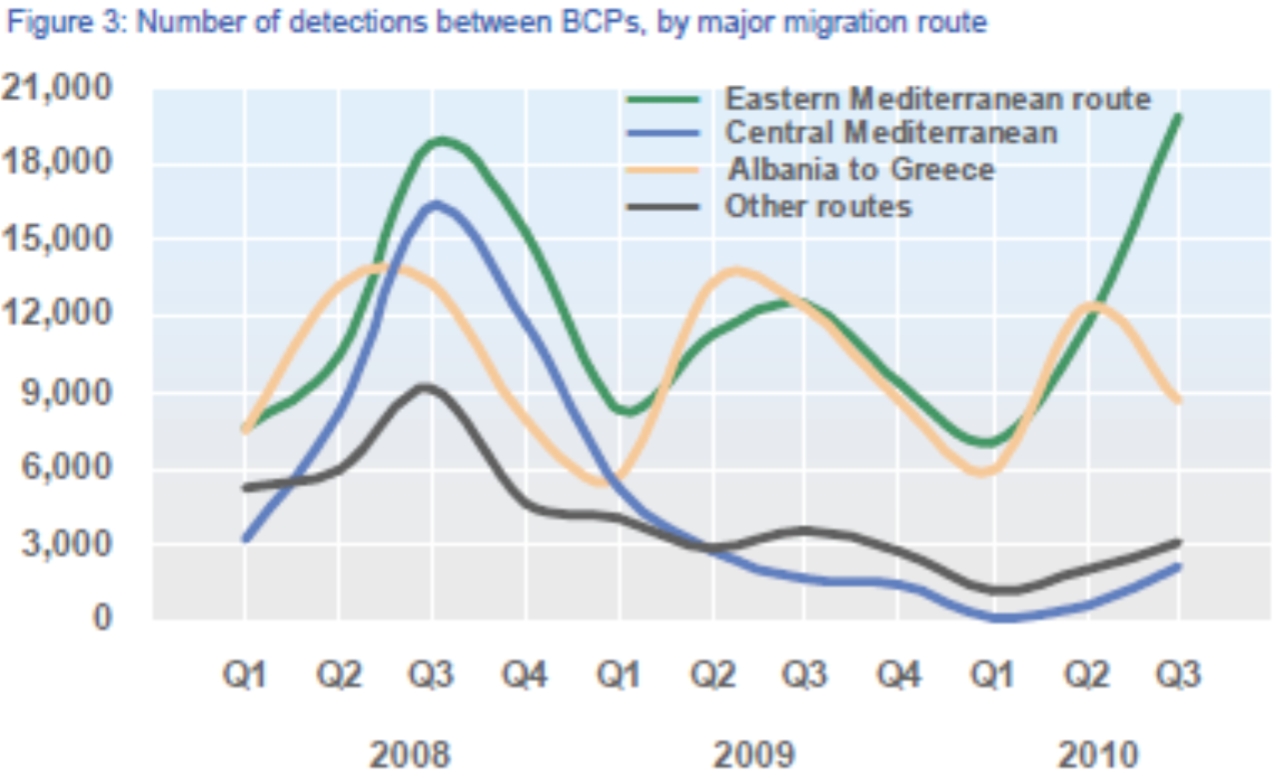
The Report also notes an increase in the number of detections on the Central and Western Mediterranean sea routes compared to Q2 which may be attributable to seasonal variations or “may be indicative of reorganized modi operandi in these areas in response to Frontex Joint Operations, more effective border controls and bilateral agreements implemented in 2008.”  See Figure 3 below.

Excerpts from the Report:

“Detections of illegal border-crossing”

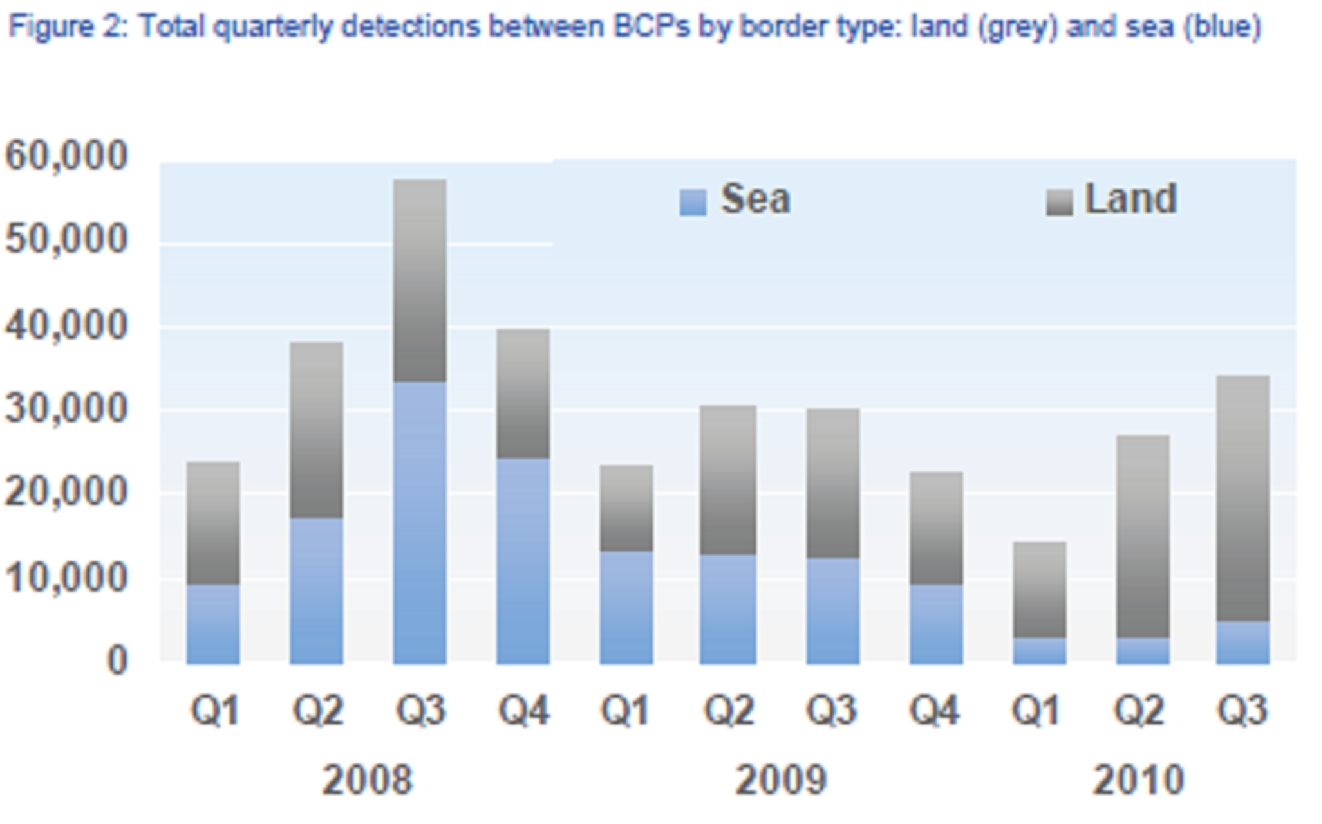
“…  Fig. 2 [see below] shows quarterly detections at the land and sea borders of the EU since the beginning of 2008. The 30% increase in the number of detections between the previous and present quarters is comprised of a 60% increase at the sea borders (although from a lower base) and a 23% increase at the land borders. This means that the shift from sea to land borders has not continued to same extent as in the previous quarters.  Nevertheless in Q3 2010, there were some 29 000 detections of illegal border-crossing at the external land border of the EU, which constitutes 85% of all the detections at the EU level, and the highest number of detections at the land border since data collection began in early 2008….”

“Eastern Mediterranean route”

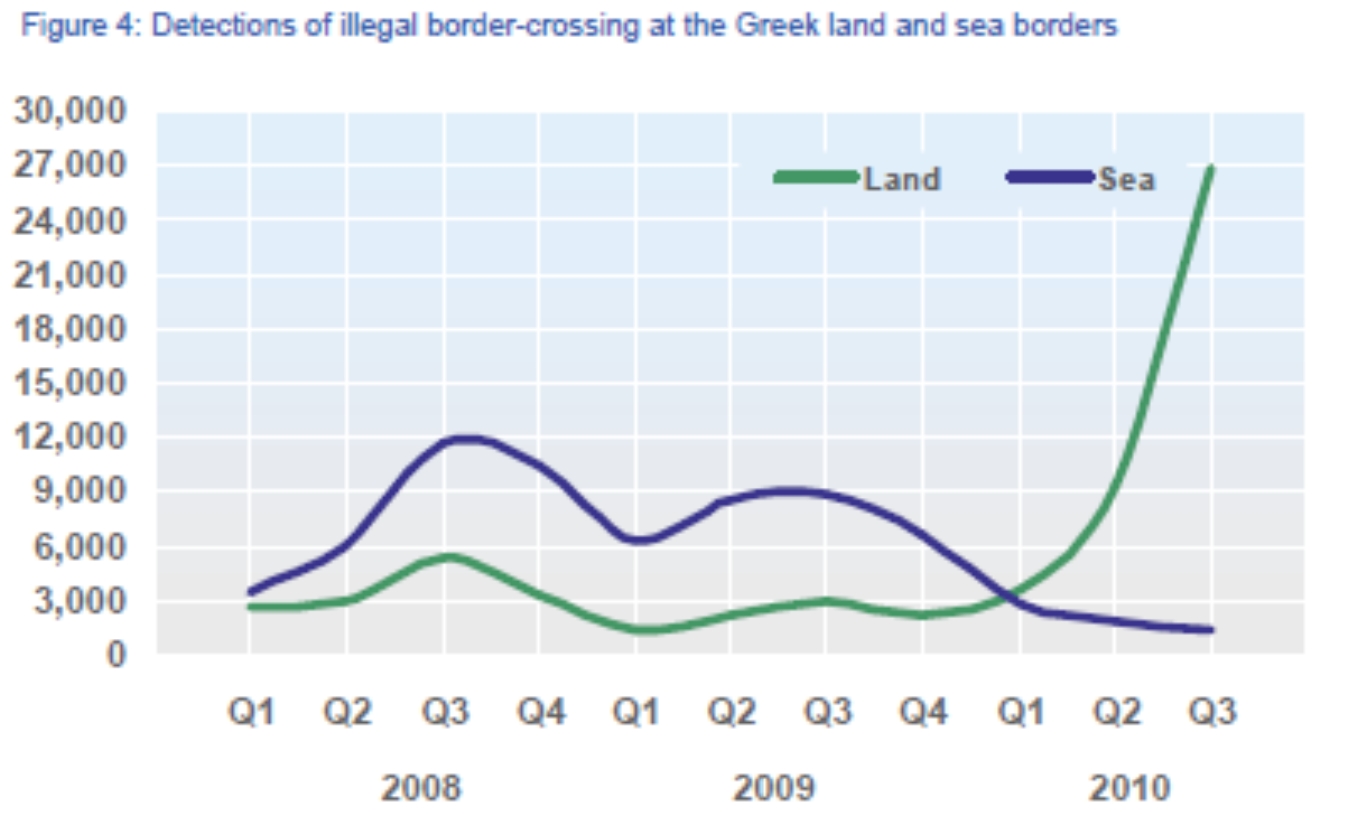
The Report observes that there has been a shift in illegal crossings from the Greece-Turkey maritime border to the Greece-Turkey land border and notes an increase in the number of nationals from Maghreb countries apprehended at the Greece-Turkey land border.  “This route [being taken by Maghreb nationals] is very indirect, but is thought to be the result of a displacement effect from the West Africa and Western Mediterranean routes….”

See Figure 4 below which shows that detections of illegal border crossers at the land border of Greece have exceeded detections at the sea border since Q1 of 2010.

“Central Mediterranean route”

“There were 2 157 detections of illegal border-crossing during Q3 2010. This is more than a three-fold increase compared to the previous quarter and a third higher than the same period last year. However despite this apparently large increase, detections still remain massively reduced compared to the peak of around 16 000 during the same period in 2008 (Fig. 3)….”

“The JO Hermes 2010 which was operational between June and October 2010, focused on illegal migratory flows departing from Algeria to the southern borders of the EU, specifically to Sardinia. In 2010, there were fewer detections than in previous years….”

“Departures from Libya also remained low. In June 2010, a new law was implemented to serve more severe punishments for facilitating illegal immigration. Ambassadors of the countries of origin were called into the Ministry of Foreign Affairs in Tripoli to be informed about the consequences of the new law, which suggests that this may be a serious implementation.”

“Western Mediterranean route”

“In general, irregular immigration to southern Spain has decreased massively since the beginning of 2006. However, in Q3 2010 there were 2 200 detections of illegal border crossing in the Western Mediterranean, more than twice that of the previous quarter and around a third higher than the same period in 2009. There is growth in the number of detections of a wide range of African nationalities, nine of which more than doubled in number between Q2 and Q3 2010. The most detected nationalities were Algerian, Moroccan, Cameroonian and Guinean.”

“Western Africa route”

“The cooperation and bilateral agreements between Spain and the rest of the Western African countries (Mauritania, Senegal and Mali) are developing steadily, and are one of the main reasons for the decrease in arrivals, as is the presence of patrolling assets near the African coast.”

“According to data collected during JO Hera, the numbers of arrivals in the Canary Islands and detections in West Africa are very low compared to the same time last year. The main nationality and place of departure is from Morocco, to where migrants are returned within a few days.”

Click here for the 3rd Quarter 2010 Report.

Click here for the 2nd Quarter 2010 Report.

Click here for the 1st Quarter 2010 Report.

Click here for my previous post regarding the 2nd Quarter Report.


Leave a comment

Filed under Aegean Sea, Algeria, Data / Stats, Eastern Atlantic, European Union, Frontex, General, Greece, Italy, Libya, Malta, Mauritania, Mediterranean, Morocco, News, Reports, Senegal, Spain, Tunisia, Turkey

Frontex Signs Cooperation Agreement with Cape Verde

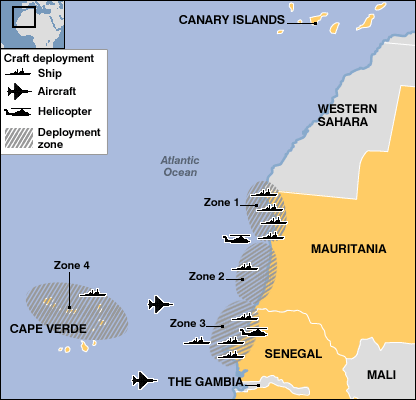
2006 BBC Map of Frontex Deployment

Frontex and Cape Verde signed a “Working Arrangement” on 14 January.  According to the Frontex press release, “the arrangement aims at promoting the development of broad cooperation on operational and technical border security/management matters between the Agency and the competent authorities of Cape Verde, with a view to working toward sustainable partnership. The intended cooperation in areas related to border security and management include exchange of best practices and strategic information, training, capacity-building and collaboration on relevant technologies as well as participation in joint operations. Information sharing regarding people-smuggling and trafficking in human beings is also foreseen as part of the arrangement.”

Frontex has coordinated operations with Cape Verde for many years pursuant to the provisions of bi-lateral agreements between Spain and Cape Verde.  In a September 2010 interview with EurAsylum, Frontex Director Laitinen said:  “In West Africa, Senegal, Mauritania and Cape Verde have all been integrated into Frontex operations for many years with good results, always demonstrating a willingness and capacity to work for the same aims and goals as their European colleagues. Although we do not have formal working arrangements in place yet with these countries, we are able to work together on the basis of their existing bi-lateral provisions with Spain. This cooperation has had measurable results in reducing people smuggling via the Canary Islands and in preventing the loss of human lives at sea.”

Click here for Frontex Press Release.

1 Comment

Filed under Eastern Atlantic, Frontex, News