Tag Archives: UNHCR

UNHCR Report: 2009 Global Refugee Trends & Guardian Data Map

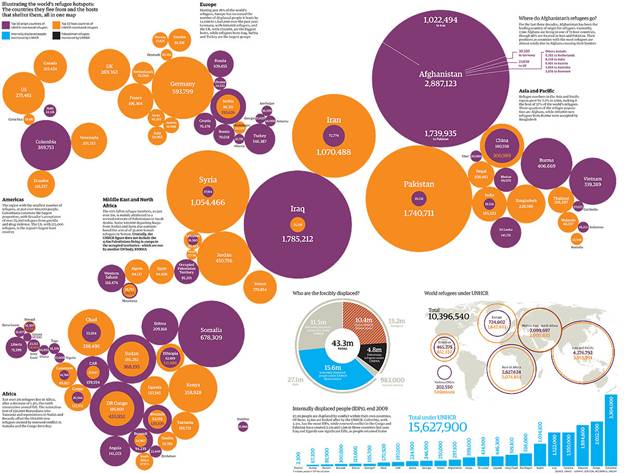
The UNHCR released its annual report this week for last year: “2009 Global Trends- Refugees, Asylum-seekers, Returnees, Internally Displaced and Stateless Persons.”

The UNHCR estimates that approximately 43.3 million people were forcibly displaced at the end of 2009.  South Africa continued in 2009 to be the destination country receiving the largest number of new asylum seekers (222,000).  The US and France were second and third with less than 50,000 new asylum seekers.

The Guardian’s Data Blog published an interesting graphic with the UNHCR statistics.

Click here for UNHCR web article.

Click here for link to the UNHCR Report.

Click here for link to the Guardian’s map.

[UNHCR refugee statistics mapped. Illustration: Paul Scruton for the Guardian.]

Leave a comment

Filed under Data / Stats, Reports, UNHCR

Side Meeting on Boat People at Upcoming UNHCR-NGO Consultations

The annual UNHCR-NGO consultations will take place beginning 29 June (registration is closed).  Various side-meetings will also be held, including one on 1 July: “A hearing on Boat People: Different people, different needs and rights to protection.” Palais des Nations, Geneva, 13h15 – 14h45, Room XXII

“A hearing on Boat People: Different people, different needs and rights to protection.

Brief description: What are the needs of today’s boat people—and how can these needs be differentiated and matched to rights and practical responses of protection and assistance—among boat people arriving in Europe or Yemen from Africa; in the US from Haiti; in various parts of south and southeast Asia and Australia from Burma or Sri Lanka, or following other sea crossings? This session is organized as a hearing, not a series of presentations. It will begin with a brief introduction of the importance of differentiating needs and rights to protection and assistance among all the people arriving, (i.e., refugees, victims of human trafficking and smuggling, victims of torture, children, etc.) Conclusions from an experts roundtable in Tunis last year will then be offered as a reference, which participants will be invited to comment upon and at the end of the session, consider supporting. During the bulk of the session however, panelists from UNHCR, IOM, IFRC and UNODC will serve as a hearing board: listening, probing and recording the experience, concrete practices and recommendations of NGO participants who respond to boat people, either in Europe or in other parts of the world. Input will then be organized and submitted to the international organizations and to government policy makers, including the European Union and Council of Europe through the new EU-funded NGO partnership “DRIVE” (Differentiation for Refugee Identification and Vulnerability Evaluation).”

Click here for full Side Meeting agenda.

Leave a comment

Filed under Colloques / Conferences, UNHCR

More on Libya’s Decision to Expel UNHCR

Libya’s decision to expel the UNHCR from Libya was made public during the seventh round of Framework Agreement talks between the EU and Libya.  The talks concluded yesterday in Tripoli.  “[Libya’s Deputy Foreign Minister Mohammed Tahar] Sayala said the main stumbling blocks to progress were illegal immigration and the International Criminal Court (ICC), which Libya does not recognise.  [Sayala] said Libya wanted financing and equipment [from the EU] for the surveillance of its borders, both on land and sea.”

Amnesty International criticized the decision to expel the UNHCR and called on Libya to reverse the decision:

“[***] The move to expel the UNHCR came against the backdrop of the 7th round of negotiations, which started on 6 June in Tripoli, between Libya and the EU over a Framework Agreement, which addresses bilateral cooperation in the control of irregular migration, among other issues, including potential readmission agreements for third-country nationals, who have transited through Libya on their way to Europe. EU member states, most notably Italy, have been seeking Libya’s assistance in decreasing the flow of arrivals of asylum-seekers and migrants to European shores. The expulsion of the UNHCR further casts doubt on Libya’s commitment to respect its obligations under the Organization of African Unity Convention Governing the Specific Aspects of Refugee Problems in Africa. It also shows how essential it is to include effective human rights safeguards and adequate standards of protection in any bilateral agreements with Libya in the field of the control of migration. [***]”

The European Commission also expressed “concern” with Libya’s decision “but sees it as one more reason to engage in ‘dialogue’ with General Gaddafi’s country on immigration and asylum.”

And as noted by Michèle Morel on International Law Observer, even though Libya is not a signatory to the UN Refugee Convention, Libya is bound by customary international law which prohibits refoulement to countries where there is a risk of torture, “[t]herefore, while Libya itself has no asylum system for the examination of asylum seekers’ situations, refusing to allow UNHCR to carry out its activities in Libya would amount to a violation of international human rights law.”

Click here, here, here (EN), and here (AR) for articles.

Click here for Amnesty International’s statement.

Click here for link to ILO post.

3 Comments

Filed under European Union, Libya, Mediterranean, News, UNHCR

Libya Orders UNHCR Office Closed – Possible Link to EU-Libya Talks on Partnership Accord

The Libyan government has ordered the UNHCR office in Libya to halt all activities and to close it office.  UNHCR has been working in Libya since 1991 even though Libya is not a signatory to the UN Refugee Convention.

The UNHCR said it was not given a reason for the Libyan decision.  Reuters reported that Libya’s Foreign Ministry considers the UNHCR presence within Libya to be illegal since Libya is not a signatory to the Refugee Convention.  Reuters also says that JANA, the Libyan news agency, accused a UNHCR official of carrying out an unspecified illegal activity.

The Libyan newspaper Oya and other reports say that the EU is pressuring Libya in the ongoing EU-Libya Partnership Talks to sign the Refugee Convention and that illegal immigration is one of the main areas of disagreement in the current negotiations.

The UNHCR said in a press release “[i]n the absence of a national asylum system, UNHCR has carried out registration and refugee status determination, visiting detention facilities and providing medical and humanitarian assistance to detainees.”  Among the asylum seekers detained in Libya over the past year are persons who were forcibly returned to Libya by Italian authorities pursuant to the Italy-Libya migration agreement.

Click here for UNHCR press release.

Click here for Oya article (AR).

Click here, here, and here for articles (EN).

2 Comments

Filed under European Union, Libya, Mediterranean, News, UNHCR

UNHCR Criticises Delay by Italy and Malta in Launching Search and Rescue of Migrant Boat

“UNHCR is concerned about delays in a search-and-rescue operation on Sunday and Monday [6-7 June]  involving a boat carrying more than 20 people, mostly Eritreans, near Malta. Distress calls were received on Sunday evening, including by UNHCR, and passed to Maltese and Italian maritime authorities. It is unclear which country had search-and-rescue responsibility when the distress calls were first sent. According to information made available to UNHCR, the boat was only rescued late on Monday, and by Libyan vessels.”

The persons on board the boat have reportedly been taken to Libya.

Click here for UNHCR statement.

Click here and here for articles.

Leave a comment

Filed under Italy, Libya, Malta, Mediterranean, News, UNHCR

UNHCR to Frontex: Information on Operational Activities at Sea Are Limited

UNHCR has had a liaison officer assigned to work with Frontex since 2007.  The current UNHCR senior liaison officer is Michele Simone.  In a Q&A interview posted on the UNHCR web site Mr Simone expressed some concerns about Frontex operations at sea (in addition to speaking on other topics):

“It remains difficult to evaluate the impact of [UNHCR’s asylum and protection] training [of border officials] while information on operational activities at the borders, especially at sea, remains rather limited.”

“Frontex operations should ensure disembarkation of those intercepted at sea to a place where they are not only safe physically, but where their basic rights – including the rights to seek asylum and receive protection – are respected. This is spelled out in the recently adopted European Union guidelines for maritime border operations. In any event, the operations should anticipate that some of those intercepted at sea will be particularly vulnerable, notably unaccompanied children, women and torture victims. At this time, we believe there are not enough qualified staff at sea or land entry points to identify and support such vulnerable cases. To assist border guards in this identification process, UNHCR is currently discussing with Frontex the elaboration of ad hoc protection guidelines for some selected joint operations.”

Click here for full interview.

1 Comment

Filed under Frontex, News, UNHCR

LIBE-Odysseus Network Round Table (26 April) and LIBE Meeting Agenda

A Round Table on “Towards a Common European Asylum System: A study on some horizontal issues” will be held on 26 April at 15.00 – 18.30. The meeting is organised by the LIBE Committee and the Policy Department Citizens’ Rights and Constitutional Affairs with the participation of the National Parliaments and the Odysseus Network.  The Round Table meeting precedes the two day meeting, 27-28 April, of the LIBE Committee which will be considering numerous agenda topics including:

  • Creation of an immigration liaison officers network;
  • The establishment of a joint EU resettlement programme;
  • Discussion concerning the European Refugee Fund; and
  • Institutional aspects of accession by the European Union to the European Convention for the Protection of Human Rights and Fundamental Freedoms.

The final agenda item is a Meeting with UN High Commissioner for Refugees, Antonió Guterres on matters relating to asylum policy, co-chaired by the Committee on Development and the Subcommittee on Human Rights.

Click here for Round Table agenda.

Click here for LIBE meeting documents.

Leave a comment

Filed under Colloques / Conferences, European Union, News, UNHCR

UNHCR Reports 50% Reduction in African Migrant Flow to Yemen

UNHCR reports a significant decline in the numbers of migrants travelling by sea from the Horn of Africa to Yemen.  UNHCR said that “violence within Somalia could be preventing many would-be migrants from reaching their port of departure.  An estimated 9,400 people from across the Horn of Africa have reached the shores of Yemen since the beginning of this year, compared to nearly 17,000 between January and March 2009….”

Click here for UNHCR statement.

Leave a comment

Filed under Data / Stats, Gulf of Aden, News, Somalia, UNHCR, Yemen

UNHCR Comments on Malta’s Decision Not to Host Frontex Missions

Times of Malta reports on comments made by the head of UNHCR’s Malta Office, Jon Hoisaeter, who said that “international law was not clearly defined when it came to the disembarkation of migrants after rescue operations.”

“There are situations when urgent health and safety considerations would require that those rescued are brought to the nearest safe port of call. In fact, even the new Frontex guidelines acknowledge this… Asylum seekers should be brought to a territory where their situation and claims can be individually assessed in a fair manner.  Of course, close cooperation among relevant states will often be crucial to successfully undertake rescue-at-sea operations.”

“The UNHCR supports the development of guidelines that can facilitate rescue and reduce the risk of lives being lost at sea. However, with or without support from Frontex, search and rescue operations are primarily the responsibility of states.”

Click here for article.

Leave a comment

Filed under Frontex, Malta, Mediterranean, News, UNHCR

UNHCR Report on EU Member State Implementation of the Asylum Procedures Directive

The UNHCR has released a comprehensive report entitled “Improving Asylum Procedures: Comparative Analysis and Recommendations for Law and Practice: A UNHCR research project on the application of key provisions of the Asylum Procedures Directive in selected Member States.”

From the Report’s introduction:

“In the exercise of its supervisory role under Article 35 of the 1951 Convention relating to the Status of Refugees … UNHCR has undertaken a wide-ranging comparative analysis of the transposition of key provisions of the [2005 Asylum Procedures Directive] into national law by selected EU Member States, and the practical application of those provisions….

The research and recommendations also aim to inform negotiations in the Council and the European Parliament on possible amendments to the APD, as put forward by the Commission in October 2009. They also seek to provide constructive input to preparations for the work of the European Asylum Support Office (EASO). The EASO has a mandate to facilitate practical cooperation on asylum among Member States, and Member States have underlined their interest in prioritizing the promotion of quality asylum decision-making among its tasks. In that context, this report will provide helpful material.

The research addressed 18 articles of the APD, as they are transposed in law and implemented in practice in the twelve participating states: Belgium, Bulgaria, Czech Republic, Finland, France, Germany, Greece, Italy, the Netherlands, Slovenia, Spain and the United Kingdom. As such, the research and recommendations do not address all provisions in the APD, nor the law and practice in every Member State bound by the Directive. This project does not seek to focus scrutiny on any particular Member State.  Where gaps or problematic practices have been observed, UNHCR hopes that this research provides an opportunity to discuss and address them, and to draw on the numerous good practices which have also been observed.”

The UNHCR press release states that the “study found not only that member states are applying the Asylum Procedures Directive in diverging ways, but, in some cases, in ways that may breach international refugee law. Researchers reported that applicants were not always afforded personal interviews, or were not given enough time to prepare for interviews or to explain their claims. Interpreters were not always available or qualified…. These and other practices, the study concludes, create the risk that protection needs are not properly identified and people may be sent back to countries where they face persecution or grave personal harm.  At the same time, the research identified many good practices, including the provision of clear information on how to appeal negative decisions, codes of conduct for interviewers and interpreters, careful recording of interviews and of decisions, and good cross-cultural communication skills on the part of interviewers.”

Click here or here for the Report.

Click here for UNHCR press release.

Leave a comment

Filed under European Union, Reports, UNHCR

UNHCR Files ECtHR Third Party Intervention in Hirsi v. Italy

The UNHCR submitted a third party intervention to the European Court of Human Rights in the case of Hirsi and others v Italy, Requête no 27765/09, which was filed on 26 May 2009 by 11 Somalis and 13 Eritreans who were among the first group of about 200 migrants interdicted by Italian authorities and summarily returned to Libya pursuant to Italy’s push-back practice.  The case was communicated by the Second Section of the Court on 17 November 2009.

The UNHCR’s intervention “addresses the practice and justification of ‘push-back’ operations by the Italian government, the conditions for reception and seeking asylum in Libya and the extraterritorial scope of the principle of non-refoulement and pursuant legal obligations concerning the rescue and interception of people at sea.”

Excerpts from the intervention:

“[***]  2.2.1  On 6 May 2009, the Italian government, in cooperation with the government of Libya, initiated the so-called “push-back policy” by intercepting people, including those who may be in need of international protection, on the high seas and returning them to Libya. This policy was a departure from the previous practice where Italian naval forces had regularly disembarked such persons in Lampedusa or Sicily. Based on UNHCR’s estimates, in 2008 some 75% of sea arrivals in Italy applied for asylum, and 50% of those who applied received some form of protection after their claims were assessed in the Italian asylum procedure.

2.2.2  According to the Italian authorities, from 6 May to 6 November 2009, a total of nine operations were carried out, returning a total of 834 persons to Libya. The precise modalities of the operations have not been made public and were not otherwise fully disclosed to UNHCR. …

4.1  The extraterritorial scope of the principle of non-refoulement under Article 33 (1) of the 1951 Convention…

4.1.2  The territorial scope of Article 33 (1) is not explicitly defined in the 1951 Convention. The meaning, purpose and intent of the provision demonstrate, in UNHCR’s view, its extraterritorial application, e.g., to situations where a state acts outside its territory or territorial waters. Furthermore, the extraterritorial applicability of human rights obligations contained in various instruments supports this position ….

4.2  The extraterritorial scope of the principle of non-refoulement in human rights law

4.2.1  The complementary and mutually reinforcing nature of international human rights law and international refugee law speak strongly in favour of delineating the same territorial scope for all expressions of the non-refoulement principle, whether developed under refugee or human rights law….

4.3  The principle of non-refoulement in the context of interception and search and rescue operations on the high seas

4.3.1  As stated earlier, the principle of non-refoulement applies whenever a state exercises jurisdiction. Jurisdiction can be based on de jure entitlements and/or de facto control. De jure jurisdiction on the high seas derives from the flag state jurisdiction.  De facto jurisdiction on the high seas is established when a state exercises effective control over persons. Whether there is effective control will depend on the circumstances of the particular case.

4.3.2  Where people are intercepted on the high seas, rescued and put on board a vessel of the intercepting state, the intercepting state is exercising de jure as well as de facto jurisdiction. While de jure jurisdiction applies when the people on board a ship are sailing under the flag of the intercepting state, it is also exercised – relevant to the case of “push-backs” – where the intercepting state has taken the persons on board its vessel, bringing them under its full (effective) control. In UNHCR’s view, as becomes clear from section 2.2 above, the Italian authorities were in full and effective control of the persons throughout the “push-back” operations until the formal hand-over to the Libyan authorities. Article 4 of the Italian Code of Navigation specifies that Italian ships on the high seas are considered as Italian territory.

4.3.3  When jurisdiction on the high seas has been established, the obligations deriving from it in relation to the principle of non-refoulement should be examined. The UNHCR’s Executive Committee has emphasized the fundamental importance of fully respecting this principle for people at sea, underlining that: ‘interception measures should not result in asylum-seekers and refugees being denied access to international protection, or result in those in need of international protection being returned, directly or indirectly, to the frontiers of territories where their life or freedom would be threatened on account of a Convention ground, or where the person has other grounds for protection based on international law.’

4.3.4  In UNHCR’s view, the situation in which a state exercises jurisdiction on the high seas over people on board its vessels requires respect for the principle of non-refoulement. It follows that states are obliged, inter alia, not to hand over those concerned to the control of a state where they would be at risk of persecution (direct refoulement), or from which they would be returned to another country where such a risk exists (indirect refoulement). The state exercising jurisdiction needs to ensure that asylum-seekers are able to access fair and effective asylum procedures in order to determine their needs for international protection….

4.3.6  For interception or rescue operations carried out by EU Member States, UNHCR has clarified that, “… disembarkation of people rescued in the Search and Rescue (SAR) area of an EU Member State should take place either on the territory of the intercepting/rescuing State or on the territory of the State responsible for the SAR. This will ensure that any asylum-seekers among those intercepted or rescued are able to have access to fair and effective asylum procedures. The disembarkation of such persons in Libya does not provide such an assurance”.

5.  Conclusion

5.1  UNHCR considers that the interception of persons on the high seas between Italy and Libya, their transfer from Italian to Libyan custody, and their return to Libya, may be at variance with the principle of non-refoulement and in contradiction to Article 3 of the ECHR. By returning persons to Libya without an adequate assessment of their protection needs, the Italian authorities appear not to have sufficiently taken into account the potential risk of refoulement, including indirect refoulement, and other possible violations of fundamental rights upon return of the affected persons to Libya. The lack of an asylum system in Libya means that there are not sufficient safeguards to ensure that persons in need of international protection will be recognized as such and accorded legal status and associated entitlements that could ensure their rights, including to protection against refoulement, are not violated. The risk of chain refoulement denying international protection, especially to Eritrea, cannot be excluded.”

Click here for the full text of the UNHCR intervention.

Click here for an earlier post on the case.

1 Comment

Filed under European Court of Human Rights, Italy, Judicial, Libya, Mediterranean, News, UNHCR

NGO Statement on Europe for UNHCR’s 47th Standing Committee Meeting

From the ICVA – International Council of Voluntary Agencies.   Excerpts from the NGO Statement:

“Executive Committee of the High Commissioner’s Programme

Standing Committee, 47th Meeting, 2-4 March 2010

NGO Statement on Europe

Agenda Item 3. (a) iii

This statement has been drafted in consultation with, and is delivered on behalf of, a wide range of NGOs and attempts to reflect the diversity of views within the NGO community.

[***] If we look at the asylum policies of the European Union (EU) and neighbouring countries, we detect a hesitation or shift away from the spirit of the 1951 Convention and 1967 Protocol.

In this statement, NGOs would like to draw attention to this trend in three policy areas. These are:

  • The limits on access to refugee protection in Europe;
  • The integration of refugees in European society; and
  • The externalisation of refugee protection.  [***]

Limits on Access to Protection in Europe

Access to territory

[***] EU border policies continue to be obsessed with security and combating irregular migration at the expense of providing access to those in need of international protection. There is now no legal way for an asylum-seeker to enter the EU. NGOs urges the Member States to collaborate with the European Commission, Parliament, Frontex, and the newly established European Asylum Support Office in developing guidelines on identifying those in need of international protection in mixed flows. UNHCR should be closely consulted in this process. [***]

Externalisation of Refugee Protection

[***] The Stockholm Programme raises the issue of external processing of asylum claims in transit countries. Careful consideration must be given to the potential role of UNHCR in joint processing and the responsibility of European countries in resettling those identified as in need of international protection. It should not be assumed that identified refugees will remain in the transit country. There remains significant concern from European NGOs regarding the legal, practical, and moral implications of such external processing if these trends continue.

Bilateral agreements, such as those between Spain and the West African countries of Senegal and Mauritania, do firmly place the burden of hosting refugees with the transit country. This trend is also visible in the agreements between Italy and Libya and the pushbacks in the Mediterranean.

What we can discern from these trends and those above, is that European policies favour refugees remaining in neighbouring regions rather than facilitating their access to Europe. These trends can only be met with condemnation as an obvious breach of human rights and States’ obligations. [***]

Closing Remark

Given the current negative trends in European refugee policies, it is important to look at initiatives that move in the opposite direction. NGOs are greatly supportive of the call in the Stockholm Programme for the EU to seek accession to the 1951 Refugee Convention and its 1967 Protocol. This is made possible through the adoption of the Lisbon Treaty that gives the EU a legal personality. As such, we look forward to the different agencies of the EU, including Frontex and European Asylum Support Office, seeking guidance from and collaborating with the UNHCR. [***]”

Click here for full Statement.

Click here for link to other related documents on ICVA web site.

Leave a comment

Filed under European Union, Frontex, Statements, UNHCR

Le HCR appele Paris à s’assurer que toutes les personnes arrivées clandestinement puissent demander l’asile

“Le Haut commissariat des Nations unies pour les réfugiés (HCR) a appelé Paris à ‘s’assurer que toutes les personnes’ arrivées clandestinement en Corse puissent demander l’asile et bénéficier d’un ‘examen complet et équitable’ de leur situation. Selon le HCR, les 124 personnes découvertes vendredi [le 22 janvier] sur une plage corse ont été dirigées samedi vers des centres de rétention à Rennes, Marseille, Toulouse, Lyon et Nîmes. … Le président de France Terre d’Asile, Pierre Henry, s’est lui aussi inquiété de la rapidité avec laquelle les clandestins ont été placés sous le régime de la rétention administrative.”

Click here for article.

Leave a comment

Filed under France, Mediterranean, News

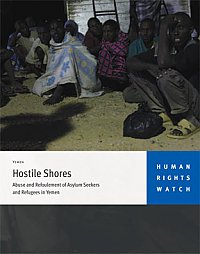
Human Rights Watch: Hostile Shores- Abuse and Refoulement of Asylum Seekers and Refugees in Yemen

Human Rights Watch has issued a new report detailing the treatment refugees arriving in Yemen from the Horn of Africa.

“This report documents the harsh treatment of refugees traveling to Yemen and calls on the Yemeni government to stop systematically arresting Ethiopian asylum seekers and forcibly returning them home. The 53-page report also calls on the United Nations High Commissioner for Refugees (UNHCR) to put more pressure on the Yemeni government to meet its obligations toward all asylum seekers and refugees.”

Click here for report.

Leave a comment

Filed under Gulf of Aden, Reports, UNHCR, Yemen

UNHCR Migration and Border Recommendations to the Incoming Spanish EU Presidency

UNHCR’s recommendations to the Spanish EU presidency include the following”

“Migration and border management

Spain has affirmed that reinforcing Frontex and ensuring that EU migration policy is accompanied by close cooperation with migrants’ countries of origin and transit will be priorities of its Presidency. A review of the Frontex mandate will take place in 2010.

UNHCR encourages the Spanish Presidency to pursue its migration agenda with due regard for international refugee and human rights norms. This includes:

a) Inclusion of refugee protection safeguards in migration control measures generally;

b) Development of clear guidance with respect to the disembarkation of persons intercepted at sea;

c) Attention to the potential protection needs of victims of trafficking;

d) With respect to the return of people found not to need international protection, measures to ensure that such return is safe, dignified and sustainable.

– calling for safeguards in border management activities, including under Frontex’s auspices, with the revision of that body’s mandate foreseen in early 2010;  a call for more focus on protection needs of victims of trafficking as part of anti-trafficking measures.”

Click here for full recommendations.

Leave a comment

Filed under European Union, Spain, Statements, UNHCR