Hundreds of Tunisians have continued to arrive in Italy on Lampedusa, and the islands of Pelagie and Pantelleria. A Tunisian newspaper reported that 12 boats have left Tunisia in recent days. 400 migrants have arrived in Lampedusa and other Italian islands over the past two days. EveryOne Group estimates that more than 1200 Tunisians have arrived on Italian territory over the past week.
Author Archives: Niels Frenzen
Hundreds of Tunisians Continue to Arrive in Lampedusa – ANSA: “Si e’ riaperta ‘l’autostrada del mare’ nel Canale di Sicilia”
Filed under Italy, Mediterranean, News, Tunisia
COE Seminar: Human rights dimensions of migration in Europe (Istanbul, 17-18 Feb)
Thomas Hammarberg, COE Commissioner for Human Rights, and the Turkish Chairmanship of the Council of Europe Committee of Ministers are holding a migration and human rights seminar in Istanbul, 17-18 February. From the Commissioner’s web site: The seminar “aims to exchange views on the most important discrepancies between European migration laws and practices and human rights standards, as well as on optimal ways to provide assistance to states in reflecting on and revisiting their migration policies.”
Three general topics will be addressed: Human rights challenges of migration in Europe, Unaccompanied migrant children, and Smuggling of migrants. Scheduled speakers and participants include:
- Karim Atassi, UNHCR Deputy Representative to Turkey;
- Tina Acketoft, PACE Committee on Migration, Refugees and Population;
- Emily Logan, Irish Ombudsman for Children;
- Rebecca O’Donnell, Save the Children, Brussels;
- Elisabet Fura, ECtHR Judge;
- Martin Fowke, Unit on Trafficking in Persons and Smuggling of Migrants, UNODC;
- Richard Ares Baumgartner, Frontex Senior External Relations Officer ;
- Professor Dr. Nuray Ekşi, Chair of Private International Law Department at the Law Faculty of ĺstanbul Kültür University;
- Professor Theodora Kostakopoulou;
Click here for draft programme.
Boats Carrying 200+ Tunisians Reach Lampedusa
Over 200 Tunisians reached Lampedusa during the night of 8-9 February in several boats. Approximately 500 Tunisians have reportedly arrived in Italy in less than one month. EveryOne Group has called upon the UNHCR and Italian officials to ensure that the newly arrived individuals be provided the right to apply for international protection or asylum. Italian Interior Minister Maroni said there “is tremendous pressure on the Tunisian coast: it is still red alert, but it can become and we are monitoring the situation closely.” («una fortissima pressione sulle coste tunisine: non è ancora allarme rosso, ma può diventarlo e stiamo monitorando attentamente la situazione».) Maroni also said “we are very concerned about the escape of criminals from jails in Tunisia for the risk of terrorist infiltration between the Tunisians who want to come to Europe in the guise of political refugees.” («Ci preoccupa molto la fuga di criminali dalle carceri della Tunisia per il rischio di infiltrazioni terroristiche tra i tunisini che vogliono venire in Europa sotto le spoglie di rifugiati politici. »)
Filed under Italy, Mediterranean, News, Tunisia, UNHCR
WikiLeaks 2008 US Cable: Death of Key Libyan Official Hampers Counter-Migration Efforts / Malta’s Efforts to Negotiate Readmission Agreement With Libya On Hold
This cable reports comments made by Malta’s Ambassador to Libya, Joseph Cassar, about the negative impact caused by the death of Fawzi Ghariba, Director of International Cooperation for Libya’s Port Authority-equivalent, on Maltese efforts to coordinate migration control and SAR operations with Libya. The cable was written in May 2008 by the US Embassy’s Chargé d’Affaires, Chris Stevens, and is titled: “Death of Key Libyan Official Hampers Counter-Migration Efforts.”
Ambassador Cassar was reported as saying that the death of Fawzi Ghariba six weeks earlier “had negatively impacted the GOL’s responsiveness on illegal migration issues at a critical time.” Cassar said Ghariba “played a key role in finalizing recent Malta-Libya and Italy-Malta bilateral cooperation agreements on migration issues [and that he] was an energetic and efficient operator and one of the only GOL officials who approached illegal migration with any sense of urgency. Cassar “said efforts to finalize … a readmission agreement under which migrants found to have entered Malta illegally could be returned to their country of departure (Libya) rather than their countries of origin, had been frozen since Ghariba’s death.”
Most of the Cable’s text follows:
“DEATH OF KEY LIBYAN OFFICIAL HAMPERS COUNTER-MIGRATION EFFORTS…
HIGH SEASON FOR ILLEGAL MIGRANTS
2.(SBU) Maltese Ambassador Joseph Cassar pulled P/E Chief aside for a conversation on illegal migration as the latter penned a message in the condolences book for the recently deceased Sir Anthony Mamo, the first President of Malta. Saying it had been “a bad week”, Cassar noted that more than 70 illegal migrants had made landfall and requested asylum in Malta during a single 48-hour period earlier this week. More than half of the 70 individuals claimed to have departed from Libya’s coast, prompting Valletta to task its embassy in Tripoli to reiterate requests that the GOL increase patrols in its Search and Rescue area (SAR). Cassar noted that more vessels transporting illegal migrants appear to be calling via satellite telephones to claim distress and request assistance immediately after entering Malta’s SAR. He suggested that they did so to mitigate the chance that they would founder before being rescued.
KEY OFFICIAL’S DEATH DIMINISHES LIBYA’S RESPONSIVENESS
3.(SBU) Cassar said the GOL’s response to the Maltese demarche had been “disappointing”. He noted that the unexpected death six weeks ago of Engineer Fawzi Ghariba, former Director of International Cooperation for Libya’s Port Authority-equivalent and a key interlocutor on counter-migration efforts, had negatively impacted the GOL’s responsiveness on illegal migration issues at a critical time. (Note: Launches from Libya of vessels transporting illegal migrants typically increase in spring/summer months to take advantage of improved weather and sea conditions. End note.) Describing Ghariba’s operating style as “American”, he said the late official played a key role in finalizing recent Malta-Libya and Italy-Malta bilateral cooperation agreements on migration issues (reftel). More importantly, Ghariba was an energetic and efficient operator and one of the only GOL officials who approached illegal migration with any sense of urgency. In several cases, Ghariba had galvanized the GOL to deal with migration issues and prompted disparate GOL entities to coordinate their efforts through the force of his personality. On instructions from Valletta, Cassar has asked the GOL several times when a successor to Ghariba might be identified; however, the GOL has demurred, saying it would be unseemly to rush to appoint a replacement.
BROADER EFFORTS ON TRAINING, READMISSION AGREEMENTS ALSO IMPACTED
4.(C) Cassar said Malta has focused on enhancing training for Libyan CG officials patrolling Libya’s SAR area. He said efforts to finalize an agreement to provide such training, as well as a readmission agreement under which migrants found to have entered Malta illegally could be returned to their country of departure (Libya) rather than their countries of origin, had been frozen since Ghariba’s death. (Comment: A number of European countries have been pursuing similar readmission agreements with the GOL. All have encountered significant difficulty in attempting to finalize those, suggesting that factors other than Ghariba’s death may bear on Malta’s efforts. End comment.) He encouraged the U.S. to continue focusing on training and material assistance for Libya’s CG. (Note: Two Libyan CG officers are scheduled to participate in upcoming training programs at a facility in Malta that uses a U.S. Coast Guard curriculum. End note.) Suggesting that he did not agree with Valletta’s position that equipment donations [i.e., by wealthier EU countries like Italy] to Libya to combat illegal migration be predicated on the GOL “taking greater responsibility” for its SAR, Cassar described the Libyan CG’s equipment needs as “considerable”….”
Filed under Italy, Libya, Malta, Mediterranean, News, United States
WikiLeaks 2009 US Cable: EU-Libya Framework Agreement Hangs on ICC, Trade, Migration
This cable provides the views of the US Embassy in Tripoli as of July 2009 regarding the EU-Libya Framework Agreement negotiations. A round of EU-Libya negotiations took place on 13-14 July 2009. The cable was written by the US Embassy’s Chargé d’Affaires at the time, Joan Polaschik, and is titled: “EU FRAMEWORK AGREEMENT HANGS ON ICC, TRADE, MIGRATION.”
According to the cable, Libyan negotiator Mohammed Siala “railed against language stating that the [EU and Libya] agreed to discuss crimes against humanity in an international context, angrily stating that any mention of the International Criminal Court (ICC) or text similar to that of the Rome Statute would cause a total breakdown of the framework negotiations.” Negotiations on migration issues however went more smoothly according to the cable: “the chief EC negotiator told EU diplomats that the negotiations [on migration] were a ‘step forward’ and that more progress was made than expected with no major objections from either side on the draft as presented….”
Excerpts from the cable:
“1.(C/NF) Summary: The latest round of EU-Libya Framework Agreement negotiations hit snags over sensitive political issues and were slowed by Libya’s inefficient technical bureaucracy. The Libyans denounced the International Criminal Court and decreed that any language similar to the Rome Statute was off limits. Trade talks stalled when the Libyans announced that they had not examined the draft paper (presented in early 2009) and were unable to produce trade statistics from 2007/2008 or provide data on the Libyan tariff system. Talks on migration went more smoothly than expected, but significant issues remain before the agreement could be given to member states for approval. EU diplomats in Tripoli are skeptical that the EC will be able to get an agreement that can be implemented by both sides within the remaining two rounds of talks….
POLITICAL DIALOGUE: THE EC DANCES ON LIBYA’S ‘RED LINE’
2.(C/NF) Representatives of the European Commission (EC) based in Brussels conducted the latest round of Framework Agreement negotiations July 13-14 in Tripoli with sessions focused on political dialogue, trade and commerce, and migration. Diplomats from EU member states — participating as observers to the EC-Libya negotiations — said that discussions on the political framework were particularly heated. Libyan negotiator Mohammed Siala railed against language stating that the two parties agreed to discuss crimes against humanity in an international context, angrily stating that any mention of the International Criminal Court (ICC) or text similar to that of the Rome Statute would cause a total breakdown of the framework negotiations. According to the UK embassy, nothing in the political dialogue paper is binding on either party and is merely agenda-setting for future discussions. EC negotiators were not/not pushing for Libya to accede to the ICC….
TRADE AND MIGRATION: HITS AND MISSES
4.(C) … On migration, the chief EC negotiator told EU diplomats that the negotiations were a “step forward” and that more progress was made than expected with no major objections from either side on the draft as presented….”
Click here or here for the full Cable.
Click here for a post regarding an earlier US cable discussing the state of EU-Libya framework negotiations in 2008.
Filed under European Union, Libya, Mediterranean, News, UK, United States
Call for papers–Workshop: Administrative actors and immigration professionals: articulating national, European and international dynamics (AFSP, SciencesPo/CEE)
A workshop, “Administrative actors and immigration professionals: articulating national, European and international dynamics,” sponsored by the public policy group of the Association Française de Science Politique and the Centre d’études européennes (Sara Casella-Colombeau and Nora El Qadim, Sciences Po/CEE) will be held 6-7 June at Sciences Po, Paris.
Call for papers – Submission details: Proposals with a comparative dimension will be of particular interest. They can be on European or international cases. Working languages: French and English. Deadline for proposals (no longer than 500 words): March 1st, 2011. Abstracts (with name and institution) should be sent to the organizers: sara.casella@sciences-po.org
From the announcement:
“Studies of migration policies “in the making” and their administrative actors have largely contributed to a revitalization of social sciences in the field of migration studies [Ellerman 2009 ; Laurens 2009 ; Spire, 2005 ; Weil 1991]. By focusing their work on the trajectories and practices of administrative actors, studies have highlighted the fundamental role played by these actors at various levels. From decision to implementation, they are the ones carrying out immigration policies, fashioning and shaping their evolution. Moreover, several authors have focused on the genesis and development of these policies at the supranational – in this case European – level [Guiraudon, 2000, 2003; Boswell, 2008, 2009]. However, analyses that attempt to link these various levels are scarce.
The objective of this workshop is to study the dynamics and mechanisms of migration policies involving the national, European and/or international levels. The purpose is to widen the perspective on migration policies by bridging approaches that generally centre on the national level and studies which emphasize the European integration or international dynamics….
This workshop will examine this theme from three main axes: 1. A first axis will look at bureaucracies in destination countries….; 2. A second axis will focus on the administrations related to migration policies in origin or transit countries….; 3. Finally, the third axis will focus on the international governance of migration flows, and on the appearance and reinforcement of an international bureaucracy of migration….”
(as noted on Migration Law by Egle Dagilyte.)
Filed under Colloques / Conferences, European Union, France
Euro-Africa Conference on Illegal Immigration, Human Trafficking, Drug Trafficking, and Terrorism (Napoli, 7-9 February)
The Italian Interior Ministry and the Direzione Centrale dell’Immigrazione e della Polizia delle Frontiere are conducting a three day conference, beginning today, in Napoli, 7-9 February. In attendance will be top police officials from 45 African countries, 25 EU countries as well as officials from agencies including Interpol, Europol, Frontex and, as observers, representatives of the US FBI and Dept. of Homeland Security. Among those scheduled to attend are Rodolfo Ronconi, Direttore Centrale dell’Immigrazione e della Polizia delle Frontiere, Interior Minister Roberto Maroni, INTERPOL Secretary General Ronald Noble, EUROPOL Director Rob Wainwright, and Frontex Director Ilkka Laitinen.
According to a draft agenda for the conference, discussion topics will include:
- Immigration Group – The African continent as a source and place of transit for migratory flows towards Europe across the Mediterranean Sea. Internal migration within African. Threat assessment, ongoing bilateral initiatives, multilateral initiatives, and methods of law enforcement;
- Group on human trafficking and organized crime – Criminal networks involved in smuggling: prevention and law enforcement investigative techniques, with particular reference to flows from Greece and Central Africa to Europe;
- Drug Trafficking Group – African continent: new narcotrafficking directed towards Europe;
- Group on Terrorism – Cyberspace as a new platform for radicalization: comparing experiences.
Original Italian:
- Gruppo Immigrazione – Il Continente africano quale origine e transito dei flussi migratory diretti in Europa attraverso il Mar Mediterraneo. I fenomeni migratori interni al Continente africano. Valutazione della minaccia, iniziative bilaterali, multilaterali e metodologie di contrasto;
- Gruppo Tratta degli esseri umani e criminalità organizzata sul tema “Le reti criminali coinvolte nel traffico di migranti: tecniche di investigazione preventiva e repressiva, con particolare riferimento ai flussi provenienti dalla Grecia e dal Centro Africa verso l’Europa”;
- Gruppo Traffico di Stupefacenti sul tema “Il Continente africano: nuovo crocevia del narcotraffico diretto verso l’Europa?”;
- Gruppo Terrorismo sul tema “Il Cyberspazio quale nuova piattaforma per la radicalizzazione: esperienze a confronto”;
Click here (IT) for short article.
Click here (IT) for draft agenda.
I would love to know more about the substance of the conference – if anyone has any information or documents to share, please do so. ( nfrenzen@law.usc.edu ).
Filed under Aegean Sea, Colloques / Conferences, European Union, Frontex, Greece, Italy, Mediterranean, News
WikiLeaks 2008 US Cable: Background Regarding EU-Libya Framework Agreement Negotiations
This cable provides the views of the US Embassy in Tripoli regarding the state of the EU-Libya Framework Agreement negotiations in July 2008. It was written by the US Embassy’s Chargé d’Affaires, John Godfrey. The cable is titled: “THE EU-LIBYA FRAMEWORK AGREEMENT: VENI, VISAS, VETO.” The cable states that Libya views the EU Framework Agreement as “a ‘reward’ for Libya’s decision in July 2007 to release six [Bulgarian and Palestinian] health workers accused of intentionally infecting over 400 Libyan children with HIV/AIDS.” The cable describes threats to veto the framework agreement by individual EU member states in an effort to secure bi-lateral concessions from Libya and describes Libya’s claim that the “draft language initialed by [EU] Commissioner Ferrero-Waldner ‘commits’ the EU … to funding a ‘surveillance mechanism’ along Libya’s land and sea borders to combat illegal migration.”
Most of the cable’s text follows:
“(C) Summary. The Government of Libya (GOL) remains keenly interested in pursuing a European Union-Libya Framework Agreement and views a more formalized partnership with the European Union (EU) as a “reward” for Libya’s decision in July 2007 to release six foreign health workers accused of intentionally infecting over 400 Libyan children with HIV/AIDS. Certain EU members, unsure that a more formal cooperation mechanism would be beneficial and sensing Libya’s eagerness, have used the threat of a veto to push their bilateral agendas, particularly with respect to commercial and human rights issues. One year after Libya and the EU agreed in principle to pursue an agreement, a sizeable perception gap exists between the two sides on the merits of a more formalized partnership. Despite occasional differences with the EU, most recently over the French-backed Union for the Mediterranean proposal, the GOL will continue to seek an EU framework agreement, in large part because of Muammar al-Qadhafi’s desire to be taken seriously by European leaders. End summary.
BULGARIAN MEDICS CASE HAUNTS EUROPE
2. (C) Libya’s much-heralded decision in July 2007 to [release] six foreign health workers imprisoned since 1999 on charges of intentionally infecting children in Benghazi with the HIV/AIDS virus frames current discussions on an EU-Libya Framework Agreement. Widely seen by Europeans in Libya as a successful alignment of European and Libyan interests, the denoument of the Bulgarian medics case – particularly their immediate pardon upon their arrival in Bulgaria – remains a lasting embarrassment for key elements of the Libyan regime. The GOL, preoccupied with avoiding the public perception that it caved to foreign pressure to resolve the case, has trumpeted a putative EU framework agreement as a significant concession and a positive coup for Libyan diplomacy. In an hours-long televised news conference just days after the medics left, Foreign Minister Abdulrahman Shalgham and Under Secretary for European Affairs Abdulati Obeidi boasted that a draft agreement, initialed by EU Commissioner for External Relations Benita Ferrero-Waldner during her July 2007 visit to Tripoli, would pave the way for easier access to Schengen visas for Libyan citizens and increased EU infrastructure investments in Libya. Ferrero-Waldner’s announcement in February 2008 that the EU Commission had submitted a recommendation to the Council of Ministers to grant a mandate to open negotiations with Libya stoked GOL hopes for rapid progress.
3. (C) French, Spanish, and German diplomats describe Libya’s primary objective in pursuing an EU framework agreement as reducing the mandatory waiting period for Schengen visas for Libyan nationals from the current 10 days to 48 hours. …
4. (C) The July 2007 EU-Libya draft also lays out cooperation in the fields of human rights, health, and development. U/S Obeidi informed French Ambassador Francois Gouyette in June 2008 that Libya agreed in principle to negotiate a human rights chapter within the framework agreement; however, Obeidi categorically refused to include discussions of individual human rights cases in the EU negotiations. … In addition, the GOL has claimed that draft language initialed by Commissioner Ferrero-Waldner “commits” the EU … to funding a “surveillance mechanism” along Libya’s land and sea borders to combat illegal migration.
VENI, VIDI, VETO
5. (C) Certain EU members, sensing Libya’s eagerness to move ahead, have threatened to block a framework agreement as a means by which to secure bilateral concessions, chiefly on commercial and human rights issues. Italian Economic and Commercial Counselor Domenico Bellantone said that Italy is prepared to veto any framework agreement unless Libya ends a series of discriminatory commercial practices that target Italian firms operating in Libya. … French and Greek diplomats in Tripoli have hinted that they may also dangle a veto threat to resolve commercial disputes. The Netherlands have approached certain EU members about a possible veto over Libya’s outstanding private debt to Dutch firms. Danish Consul-General George Wallen recently told EU Ambassadors in Tripoli that Denmark would veto a framework agreement with Libya unless the GOL lifts bans on Danish imports and Danish participation in infrastructure projects in Libya (prompted by a Danish magazine’s re-publishing in February 2008 of cartoons depicting the Prophet Muhammad). Denmark also wants the GOL to release Jamal al-Hajj, a Danish-Libyan dual-national arrested on February 16, 2007 in connection with plans to hold a peaceful political demonstration. Maltese diplomats have said Malta is considering a veto over dissatisfaction with Libya’s maritime patrols in its designated Search and Rescue (SAR) area and continuing concerns over the lack of cooperation by the GOL in efforts to stem the flow of irregular migrants from Libya to Europe.
6. (C) European diplomats believe that apart from help in combating illegal migration from sub-Saharan Africa and South Asia through Libya to Europe, Europe has little to gain from a closer partnership with Tripoli. In absence of a more formal agreement, some European countries have pursued bilateral cooperation that they privately assess as being more nimble and effective than broader cooperation under an EU framework agreement might be. Italian diplomats characterized a recent donation of six vessels to Libya’s coast guard and an offer to train Libyan border security officials as Italy’s bilateral response to what they view as a lack of meaningful EU engagement on illegal migrant flows through Libya. Greek DCM Ioannis Stamatekos lauded Italy’s move and said Greece may follow suit. Maltese Poloff Daniel Malina said that Malta, lacking resources to make a large equipment donation, hoped to keep the critical migration issue on the EU’s radar during Council deliberations over the Commission’s mandate to pursue the framework agreement.
DON’T RAIN ON MY CHARADE
7. (C) Twelve months have passed since Ferrero-Waldner initialed a draft memorandum on an EU-Libya framework agreement; however, a year of inaction does not appear to have dampened GOL perceptions that relations with Europe are on an up-swing. While senior European diplomats in Tripoli are quick to point out that formal negotiations with Libya on any kind of European-Libyan cooperation agreement have yet to even begin, many GOL officials speak of key Libyan negotiating positions, such as the 48-hour Schengen visa point, as if they’re already in place. … A series of high-level European visits, most recently that of Spanish Foreign Minister Miguel Moratinos, have helped attenuate the GOL’s disappointment over what it perceives as slow progress on the framework agreement and on implementing commitments made during al-Qadhafi’s visits to Spain and France in December 2007.
8. (C) Comment: Libya’s interest in a closer partnership with Europe seems sincere; however, the GOL’s foreign policy, particularly at the senior levels, remains somewhat fickle. Libyan leader Muammar al-Qadhafi’s visit to Madrid and Paris last December sparked a surge of pro-European rhetoric in Tripoli – in one instance, Qadhafi threatened to pull Libyan investment from sub-Saharan Africa to redirect to his new European friends. More recently, though, al-Qadhafi orchestrated a meeting of Arab Maghreb Union leaders in Tripoli to publicly disparage Sarkozy’s Union for the Mediterannean proposal (reftel). Characterizing the proposed union as “insulting”, he claimed it would undermine Arab and African member states’ commitments to the Arab League and African Union, and told former British Prime Minister Tony Blair he was concerned that the proposal represented an effort by southern European states to create a North African bulwark against illegal migration from sub-Saharan Africa and to “further legitimize” Israel. Despite such disagreements, Qadhafi’s interest in being taken seriously, particularly by his “friends Nicholas (Sarkozy) and Silvio (Berlusconi)”, will continue to drive the GOL’s keen interest in finalizing a framework agreement with the EU. End comment. GODFREY”
Filed under Denmark, European Union, France, Germany, Greece, Italy, Libya, Malta, Mediterranean, Netherlands, News, Spain
WikiLeaks 2009 US Cable: Italian Ambassador to Libya questions sincerity of Libya’s commitment to combatting illegal migration
This US Department of State cable, released by WikiLeaks on 1 Feb 2011, was written by Gene Cretz, US Ambassador to Libya. The cable is entitled “The Frogman Who Couldn’t Swim: A Cooperation Cautionary Tale.” (The cable’s title refers to an incident where Libya sent a member of its Public Security organization who was unable to swim to Italy for training in underwater explosives detection and demolition.)
The cable was written on 17 February 2009 in the same month that the provisions of the Italy-Libya agreement relating to Italy’s maritime push-back practice took effect and three months before the first major interceptions and forcible returns of hundreds of migrants to Libya which occurred in May 2009. If the US Ambassador’s reporting in the cable is accurate, it would suggest that Italy’s Ambassador to Libya at the time did not believe that Libya was about to begin cooperating with Italy on illegal migration. Though the cable does point out that comments made by the Italian Ambassador “pre-dated the early February visit to Libya by Italy’s Minister of the Interior, Roberto Maroni, who signed an MOU to implement earlier agreements on counter-migration and counterterrorism cooperation.”
Excerpts from the Cable:
“ITALY ALARMED BY INCREASE IN NUMBER OF ILLEGAL MIGRANTS TRANSITING LIBYA
¶2. (C) At a recent meeting hosted by the U.K. Ambassador to discuss counterterrorism engagement efforts, Italian Ambassador Francesco Trupiani expressed profound frustration with difficulties Italy had encountered in trying to cooperate with the GOL on counterterrorism and combatting illegal migration (Italy views the two issues as being linked). Italy was alarmed by the marked increase in the number of illegal migrants that had arrived in Italy – primarily on the island of Lampedusa – from Libya. By way of example, he offered that 1,300 Tunisian illegal migrants traveled from Libya to Italy in 2007. In 2008, 5,900 Tunisians made landfall in Italy after departing from Libya’s coast. The number of migrants from Somalia – “a derelict state” – who had arrived in Italy increased from 5,110 in 2007 to 31,764 in 2008. The number of Nigerians had increased threefold and featured a heavy contingent of prostitutes and narco-traffickers.
LIBYA DELAYING COOPERATION TO LEVERAGE EU FRAMEWORK NEGOTIATIONS?
¶3. (C) Noting that smuggling illegal migrants was highly profitable, that the GOL claimed to exercise tight control over travel within Libya, and that senior regime officials traditionally had a direct stake in highly lucrative enterprises (licit and otherwise), Trupiani said it was “implausible” that large numbers of illegal migrants had transited Libya without at least the tacit consent of GOL officials. The substantial increase in the number of illegal migrants meant a corresponding increase in the amount of money involved. He speculated that there could be a “logical nexus” between smuggling of illegal migrants, arms trafficking and movement of terrorists, and lamented that no one appeared to be holding the GOL accountable for its failure to more effectively address those inter-related problems. Worse, the GOL appeared to be deliberately delaying engagement with Italy and other European partners to leverage negotiations for a Libya-EU Framework Agreement (EU External Affairs Commissioner Benita Ferrero-Waldner was in Tripoli February 9-10 for the latest round of negotiations).
***
¶6. (C) Trupiani was not optimistic that bilateral cooperation would improve in the near term. (Note: Our exchange with Trupiani pre-dated the early February visit to Libya by Italy’s Minister of the Interior, Roberto Maroni, who signed an MOU to implement earlier agreements on counter-migration and counterterrorism cooperation (further details septel). End note.) He cited lack of human capacity and rampant corruption and nepotism as limited factors….”
Filed under European Union, General, Italy, Libya, Mediterranean, News, United States
Malta Again Declines to Participate in Frontex Central Mediterranean Joint Operation
The Times of Malta reported on Friday that Malta has for the second consecutive year informed Frontex that it will not host or participate in joint sea patrols in the Central Mediterranean, saying that there is no need for the patrols given the drastic reduction in the number of boat people attributable to Italy’s push-back practice with Libya which has been in effect since 2009. Only 47 migrants reached Malta in 2010 compared with 2,775 in 2008. Frontex’s Central Mediterranean joint operation, referred to as Operation Nautilus (renamed Operation Chronos last year), has in past years operated during the summer sailing months when sea conditions are most favourable for small boats.
Last year Malta initially said that it would not host the joint operation due to the then recently approved guidelines governing Frontex enforcement operations at sea which required that intercepted migrants be taken to the country hosting the mission under certain circumstances. A Maltese government spokesperson later said that the decision not to host the operation was not due to the new guidelines, but was due to Malta’s view that there was no longer a need for the operation because of the success of the Italy-Libya migration agreement. “The reason why we decided not to take part in [the 2010] mission is that we feel there is no need for this year’s EU patrol. We have noticed that, following the introduction of joint patrols by Libya and Italy last year, the number of illegal immigrants reaching Malta has dropped significantly. We feel that, as long as this operation remains in place, there is no real need for another anti-migration mission on behalf of the EU.”
Click here for article.
See my previous posts:
Italy and Malta question need for Frontex sea patrols (9 July 2010)
Malta says Frontex Chronos Mission not needed due to success of Italy-Libya push-back agreement (29 April 2010)
Filed under Data / Stats, European Union, Frontex, Italy, Libya, Malta, Mediterranean, News
EASO Issues Call for Seconded National Experts
As noted yesterday on the EASO Monitor blog, EASO has issued a call for multiple Seconded National Experts. The following list is probably incomplete and is based on information posted on the web site of the Slovenian Ministry of Public Administration and the web site of the Italian Ministry of Foreign Affairs.
Calls for SNE:
1) Main areas of responsibility : Support to the development of the asylum policy and European legislation, including for its implementation as well as to the different forms of practical cooperation and European solidarity, in connection with the European Asylum Support Office (EASO). The SNE will also contribute to the drafting of the Communication on the developments of Eurodac as a supporting tool for the entire Common European Asylum System foreseen in the Action Plan for the implementation of the Stockholm Programme. Click here for document.
2) Main areas of responsibility: Assisting the Executive Director in preparing all the steps necessary to transfer the EAC to the EASO; advising on the methodology and the priority milestones related to activities, staff, IT and financial issues; liaising with the EAC project manager, the members of the EAC steering committee, UNHCR and the European Commission; organising necessary meetings; coordinating the transfer activities. Click here for document.
3) Main areas of responsibility: Assisting the Executive Director in coordinating the Asylum Intervention Pool and updating the pool; drafting methodologies; acting as the Union contact point; acting as an interface between the EASO and Member States and members of the support teams; monitoring the deployment and reporting to the EASO on all aspects of the deployment; organising necessary meetings. Click here for document.
4) Main areas of responsibility: Assisting the Executive Director in coordinating the implementation of Operating Plans and Asylum Support Teams in Greece in support of the Greek Action Plan; working with the coordinator of the Asylum Intervention Pool in the activities linked to the interface between the EASO and Greece and members of the support teams; monitoring the deployment and reporting to the EASO on all aspects of the deployment; organising necessary meetings. Click here for document.
5) Main areas of responsibility: Assisting the Executive Director in coordinating the Interpreters Pool within the Asylum Intervention Pool and updating the pool; proposing and drafting methodologies, including on videoconferencing; coordinating the deployment/use of interpreters and reporting to the EASO, including within the context of the support to the Greek Action Plan; working with the coordinator of the Asylum Intervention Pool in the activities linked to the interface between the EASO and Greece and members of the support teams; organising necessary meetings. Click here for document.
6) Main areas of responsibility: Assisting the Executive Director in coordinating establishment of the COI function and the management of the COI Portal; proposing and drafting methodologies; reviewing the projects already undertaken; organising necessary meetings and workshops/working parties. Click here for document.
7) Main areas of responsibility: Assisting the Executive Director in coordinating the preparation of the first COI report on Afghanistan within the COI division; proposing and drafting methodologies; reviewing the projects already undertaken; organising and/or coordinating necessary meetings, missions and workshops/working parties; preparing the report. Click here for document.
Filed under European Union, General, Malta, News
COE CPT Completes Ad Hoc Mission to Greece
The Committee for the Prevention of Torture and Inhuman or Degrading Treatment or Punishment (CPT) released a statement yesterday that it had completed a one week (20-27 Jan.) ad hoc mission to Greece “to assess the concrete steps taken by the Greek authorities to implement long-standing recommendations, in particular those contained in the reports on the CPT’s visits of September 2005, February 2007, September 2008 and September 2009. In the course of the visit, the CPT’s delegation examined the treatment and conditions of detention of migrants held in aliens detention centres and in police and border guard stations, particularly in the Attica and Evros regions….” The CPT report to the Greek government is scheduled to be delivered in March 2011.
Among the detention centres visited by the CPT were several Border Guard stations in Evros and the “Filakio Special holding facility for illegal immigrants” where many of persons apprehended along the land border of Greece and Turkey are being detained in deplorable conditions. Doctors Without Borders released a press statement last week describing the conditions at the Greek detention centres in Evros as unbearable, inhumane, and having reached an emergency situation.
Click here for CPT Press Release.
Click here for Doctors Without Borders Press Release.
Frontex 3rd Quarter Report
On 16 January the Frontex Risk Analysis Unit released its Report for the Third Quarter of 2010 (July-Sept.). The report contains data, charts, and graphs detailing detections of migrants, asylum seekers, false document use, detections of facilitators, and other information. The deployment of Frontex’s RABIT force to the Greek-Turkey border did not begin until 2 November 2010, so the effects of the RABIT deployment do not appear in the Third Quarter.
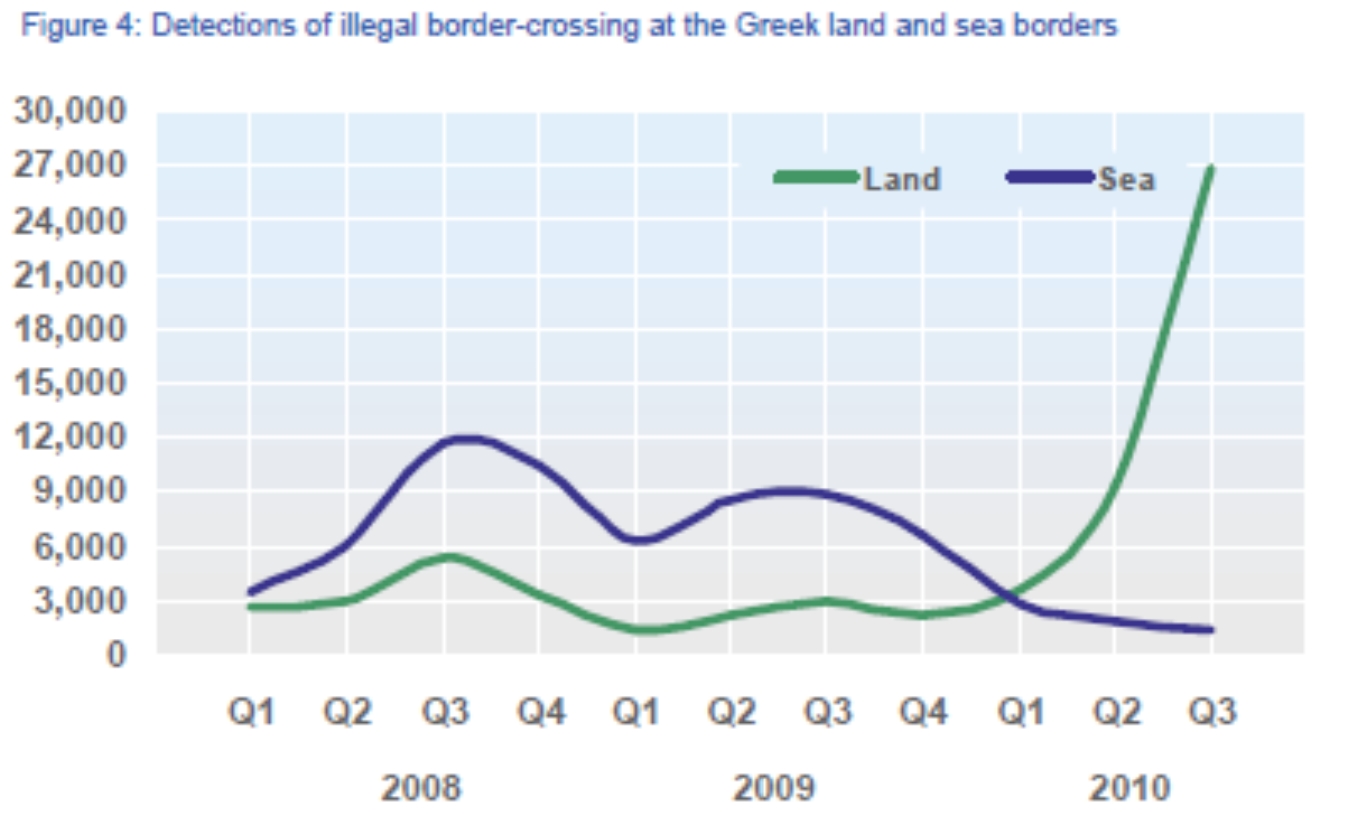
The Report notes that the “unprecedented peak in illegal border-crossings at the Greek land border with Turkey is the result of a shift from the sea to the land border” coupled with a “large increase in the absolute number of migrants” using Turkey as an EU entry point. The Report states that there has been an eight-fold increase in the number Maghreb nationals detected at the Greek land border which “is thought to be the result of a displacement effect from the West Africa and Western Mediterranean routes.”
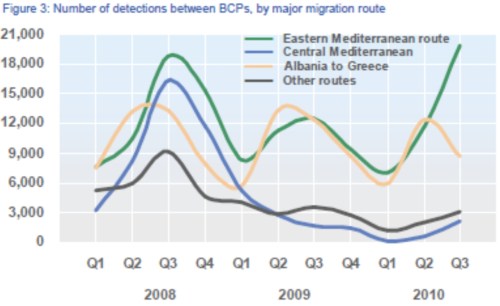
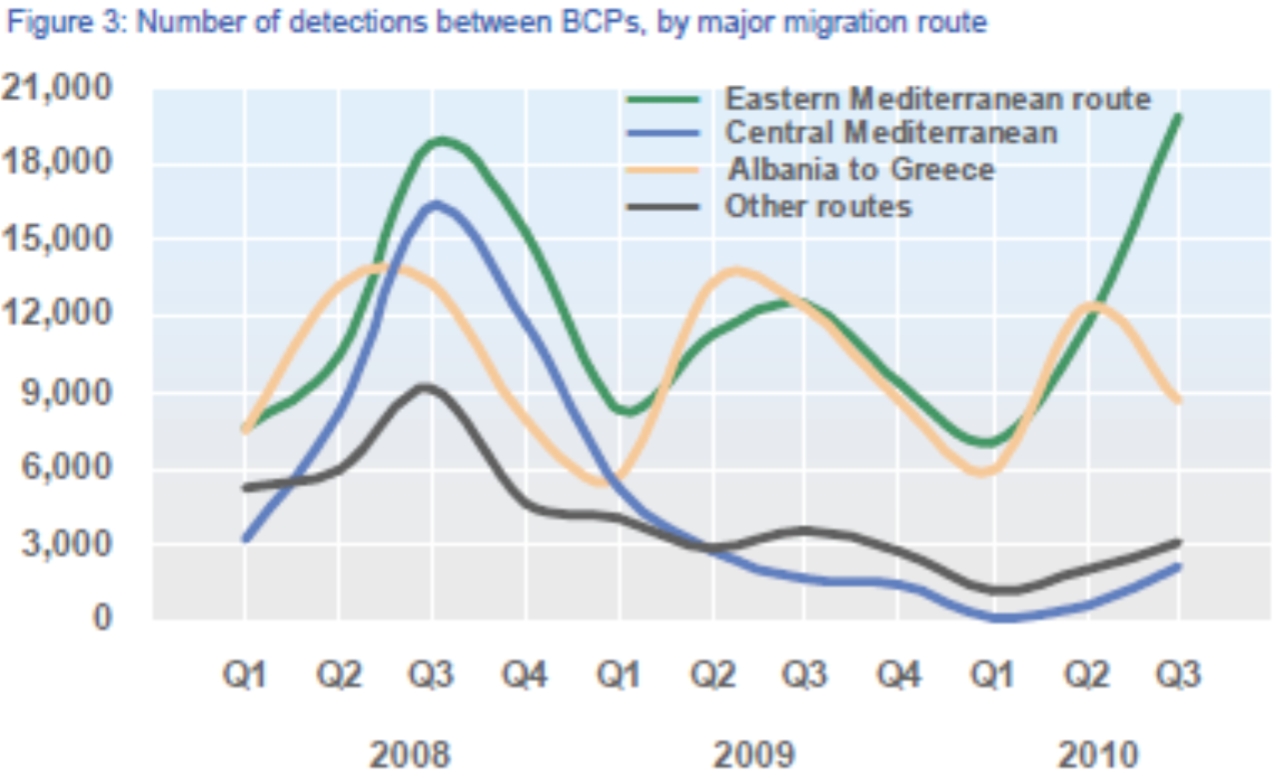
The Report also notes an increase in the number of detections on the Central and Western Mediterranean sea routes compared to Q2 which may be attributable to seasonal variations or “may be indicative of reorganized modi operandi in these areas in response to Frontex Joint Operations, more effective border controls and bilateral agreements implemented in 2008.” See Figure 3 below.
Excerpts from the Report:
“Detections of illegal border-crossing”
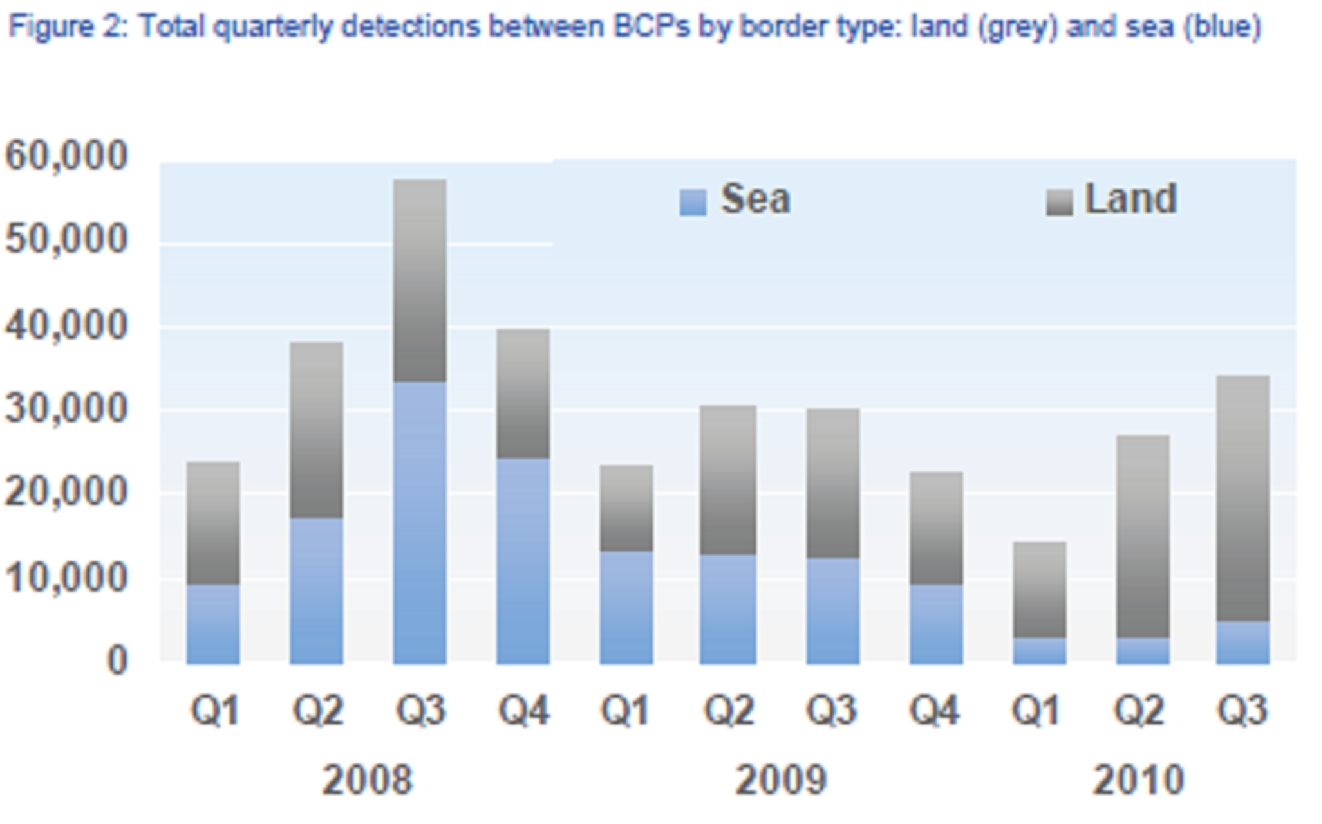
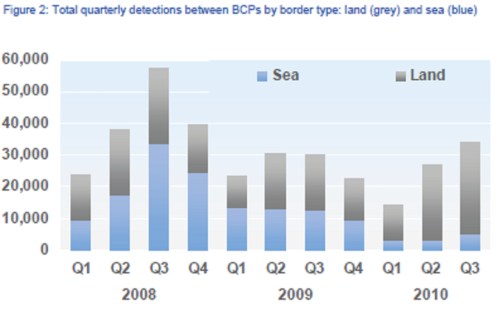
“… Fig. 2 [see below] shows quarterly detections at the land and sea borders of the EU since the beginning of 2008. The 30% increase in the number of detections between the previous and present quarters is comprised of a 60% increase at the sea borders (although from a lower base) and a 23% increase at the land borders. This means that the shift from sea to land borders has not continued to same extent as in the previous quarters. Nevertheless in Q3 2010, there were some 29 000 detections of illegal border-crossing at the external land border of the EU, which constitutes 85% of all the detections at the EU level, and the highest number of detections at the land border since data collection began in early 2008….”
“Eastern Mediterranean route”
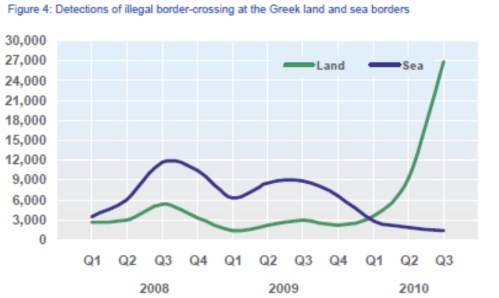
The Report observes that there has been a shift in illegal crossings from the Greece-Turkey maritime border to the Greece-Turkey land border and notes an increase in the number of nationals from Maghreb countries apprehended at the Greece-Turkey land border. “This route [being taken by Maghreb nationals] is very indirect, but is thought to be the result of a displacement effect from the West Africa and Western Mediterranean routes….”
See Figure 4 below which shows that detections of illegal border crossers at the land border of Greece have exceeded detections at the sea border since Q1 of 2010.
“Central Mediterranean route”
“There were 2 157 detections of illegal border-crossing during Q3 2010. This is more than a three-fold increase compared to the previous quarter and a third higher than the same period last year. However despite this apparently large increase, detections still remain massively reduced compared to the peak of around 16 000 during the same period in 2008 (Fig. 3)….”
“The JO Hermes 2010 which was operational between June and October 2010, focused on illegal migratory flows departing from Algeria to the southern borders of the EU, specifically to Sardinia. In 2010, there were fewer detections than in previous years….”
“Departures from Libya also remained low. In June 2010, a new law was implemented to serve more severe punishments for facilitating illegal immigration. Ambassadors of the countries of origin were called into the Ministry of Foreign Affairs in Tripoli to be informed about the consequences of the new law, which suggests that this may be a serious implementation.”
“Western Mediterranean route”
“In general, irregular immigration to southern Spain has decreased massively since the beginning of 2006. However, in Q3 2010 there were 2 200 detections of illegal border crossing in the Western Mediterranean, more than twice that of the previous quarter and around a third higher than the same period in 2009. There is growth in the number of detections of a wide range of African nationalities, nine of which more than doubled in number between Q2 and Q3 2010. The most detected nationalities were Algerian, Moroccan, Cameroonian and Guinean.”
“Western Africa route”
“The cooperation and bilateral agreements between Spain and the rest of the Western African countries (Mauritania, Senegal and Mali) are developing steadily, and are one of the main reasons for the decrease in arrivals, as is the presence of patrolling assets near the African coast.”
“According to data collected during JO Hera, the numbers of arrivals in the Canary Islands and detections in West Africa are very low compared to the same time last year. The main nationality and place of departure is from Morocco, to where migrants are returned within a few days.”
Click here for the 3rd Quarter 2010 Report.
Click here for the 2nd Quarter 2010 Report.
Click here for the 1st Quarter 2010 Report.
Click here for my previous post regarding the 2nd Quarter Report.
Filed under Aegean Sea, Algeria, Data / Stats, Eastern Atlantic, European Union, Frontex, General, Greece, Italy, Libya, Malta, Mauritania, Mediterranean, Morocco, News, Reports, Senegal, Spain, Tunisia, Turkey
Greece requests 2d extension of Frontex RABIT deployment due to events in Egypt
Kathimerini reported on 1 February that Greece requested an additional extension of the Frontex RABIT deployment in Greece due to the situation in Egypt and a fear that there may be a surge in migration towards Greece. The current RABIT deployment is scheduled to end on 3 March. The deployment was originally scheduled to end in November 2010 and was extended until March 2011. The Kathimerini article said that Frontex’s initial informal response to the requested extension was positive.
Filed under Aegean Sea, Egypt, European Union, Frontex, Greece, Mediterranean, News, Turkey
WikiLeaks 2009 US Cable: Libya takes back 500 Italy-bound migrants
This US Department of State cable, released by WikiLeaks on 31 Jan 2011, was written in May 2009 and describes the first major interdictions of migrants by Italy under the terms of the Italian-Libyan Friendship Agreement. The events described in the cable are the subject of the communicated case currently pending before the Second Section of the European Court of Human Rights, Hirsi and others v Italy, Requête no 27765/09. Click here for previous post on the Hirsi case.
Excerpts from the Cable:
“Implementation of a key component of the Italian-Libyan “friendship agreement” has begun, as Italy has returned approximately 500 migrants rescued and interdicted at sea to Libya over the past week. Libyan authorities have notified the local offices of IOM and UNHCR before returning boats arrive in Tripoli to facilitate medical screening, identification, and consular notification. The returnees are then placed in immigrant detention centers. UNHCR has interviewed a number of the detained returnees, noting that only “a handful” of the 500 are likely asylum seekers – mostly of Somali and Eritrean origin; the rest are economic migrants….”
“Libya has accepted the return of three tranches of migrants interdicted or rescued at sea by Italian authorities in recent days, beginning implementation of a key component of the Italian-Libyan “friendship agreement” signed last August aimed at reducing the flow of migrants from Libya to Italy. In each case, the Italians contacted the Libyan navy, which agreed to accept their return to Libya. The Libyan navy did not/not agree to take the migrants on Libyan vessels; rather, in one case, it instructed Italian energy company ENI, which operates an offshore platform in the area, to tow an African vessel to shore; in the other cases, it permitted the Italian navy to transport the migrants back to Tripoli. Once in Tripoli, according to the Italian Embassy, the migrants were processed in an orderly fashion and sent to a detention center.”
“The first group of 227 returnees arrived in Tripoli on May 7. A regional IOM team in Tripoli implementing a G/TIP-funded workshop to enhance Libya’s response to human smuggling and trafficking was on hand to help screen the arrivals and visit one of the three detention centers where the migrants were held….”
“IOM staff here characterized the recent returnees as “the usual suspects” of Nigerian, Nigerien, Ghanaian, and South Asian nationality. The UNHCR mission reportedly interviewed many of the returnees and found fewer than 10 migrants who were likely asylum seekers including “four or five” Somalis and “a handful” of Eritreans….”
Filed under European Court of Human Rights, European Union, Italy, Libya, Mediterranean, News, UNHCR