Category Archives: European Union

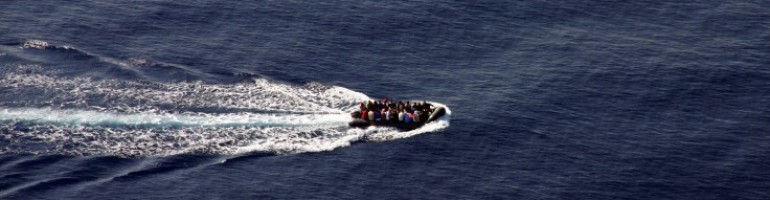
Guidelines for Frontex Operations at Sea

NB –I believe this document is the final version of the proposed guidelines approved by the Council on 25 January 2010, with Italy and Malta abstaining, and which has now been forwarded to the Parliament for scrutiny.  I will remove or amend this post if I discover this is not the final version approved by the Council.

What follows are relevant excerpts from Document COM(2009)658 (Brussels, 27.11.2009), the final Proposal for a COUNCIL DECISION supplementing the Schengen Borders Code as regards the surveillance of the sea external borders in the context of the operational cooperation coordinated by the European Agency for the Management of Operational Cooperation at the External Borders – Frontex.

As noted, Malta and Italy oppose these guidelines and have threatened to withdraw from future Frontex missions if these guidelines take effect.

Guidelines for Frontex operations at sea

1. GENERAL PRINCIPLES

1.1 Measures taken for the purpose of the surveillance operation should be conducted in a way that does not put at risk the safety of the persons intercepted or rescued as well as of the participating units.

1.2. The special needs of children, victims of trafficking, persons in need of urgent medical assistance, persons in need of international protection and other persons in a particularly vulnerable situation should be considered throughout all the operation.

1.3. These guidelines should be applied by Member States in accordance with fundamental rights. Member States should ensure that border guards participating in the surveillance operation are trained with regard to relevant provisions of human rights and refugee law, and are familiar with the international regime on search and rescue.

2. INTERCEPTION

2.1 Upon detection, the ship or other sea craft (“ship”) should be approached in order to observe its identity and nationality and, pending further measures, should be surveyed at a prudent distance. [***]

2.4. Measures taken in the course of the surveillance operation against ships or other sea craft with regard to which there are reasonable grounds for suspecting that they carry persons intending to circumvent the checks at border crossing points may include: [***]

(f) conducting the ship or persons on board to a third country or otherwise handing over the ship or persons on board to the authorities of a third country;

(g) conducting the ship or persons on board to the host Member State or to another Member State participating in the operation.

3. SEARCH AND RESCUE SITUATIONS ARISING IN THE COURSE OF THE OPERATION

3.1. Participating units shall provide assistance to any vessel or person in distress at sea. They shall do so regardless of the nationality or status of such a person or the circumstances in which that person is found.

3.2. When facing in the course of the operation a situation in which uncertainty or apprehension exists as to the safety of a ship or of any person on board, the participating unit should forward as soon as possible all available information to the Rescue Coordination Centre responsible for the search and rescue region where the situation is taking place.

In cases where the Rescue Coordination Centre of the third country responsible for the search and rescue region does not respond to the notification transmitted by the participating unit, the latter should contact the Rescue Coordination Centre of the host Member State that is geographically the closest to the emergency.

While awaiting instructions from the Rescue Coordination Centre, participating units should take all the appropriate measures to ensure the safety of the persons concerned. [***].

4. DISEMBARKATION

4.1. The operational plan should spell out the modalities for the disembarkation of the persons intercepted or rescued, in accordance with international law and any applicable bilateral agreements.

Subject to section 4.2, priority should be given to disembarkation in the third country from where the persons departed or through the territorial waters or search and rescue region of which the persons transited or, if this is not possible, to disembarkation in the geographically closest place where the safety of the persons can be ensured.

4.2. No person should be disembarked in or otherwise handed over to the authorities of a country with regard to which there are substantial grounds for believing that he or she would be subjected to persecution or to torture or to other forms of inhuman or degrading treatment or punishment, or from which there is a risk of expulsion or return towards such a country. The persons intercepted or rescued must be informed in an appropriate way so that they can express any reasons for believing that they would be subject to such treatment in the proposed place of disembarkation.

4.3. The coordination centre should be informed of the presence of persons within the meaning of paragraph 4.2, and should convey that information to the competent authorities of the host Member State.

Click here for full Document.

Click here for a “Note to the File” pertaining to the Draft Council Decision supplementing the Schengen Borders Code as regards sea border surveillance in the context of operational cooperation coordinated by FRONTEX (COM(2009)658) as amended by the Council on 25 January 2010.

1 Comment

Filed under European Union, Frontex, General, Italy, Malta, Mediterranean

Spanish EU Presidency: Frontex Needs More Resources and Clearer Rules

Spanish Interior Minister Alfredo Pérez Rubalcaba speaking at the 26th Frontex Management Board Meeting in Madrid called for providing Frontex with “more resources, clearer rules and specialist offices. … We are planning to promote FRONTEX, to equip it with more resources, its own resources, because when FRONTEX becomes more independent it will become more efficient; to provide it with mechanisms for jointly managing maritime operations, mechanisms that respect the laws and rights and clearly establish each country’s obligations. … FRONTEX has shown that it is probably the best tool we have for ensuring shared and jointly responsible border control.”

Click here for summary from Spanish EU Presidency web site.

Leave a comment

Filed under Aegean Sea, Eastern Atlantic, European Union, Frontex, Mediterranean, News, Spain

Proposed Changes to Interdiction Patrol Rules Jeopardise Malta and Italian Cooperation with Frontex

The Malta Times reports that “a Frontex official said [yesterday] the new [maritime interdiction] guidelines were specifically aimed at avoiding disputes such as the ones that broke out between Malta and Italy. In the past, immigrants were stuck on the high seas as the two countries were locked in a diplomatic wrangle on who was responsible for the people rescued. ‘Everyone recalls these incidents and the Commission’s intervention. Brussels ended up as a referee in these disputes and we don’t think that’s our role. This is specifically why we needed to have a specific code of conduct to guide future Frontex missions. This will put participating member states’ minds at rest,’ the official said.”

The proposed changes would require migrants to be taken to the country hosting the Frontex mission if it was not possible to return the migrants to their country of departure and could go into effect as early as April when Frontex interdiction patrols are scheduled to resume in the central Mediterranean under the new mission name of Operation Chronos.

“Both Malta and Italy objected strongly [to the proposed changes] on the basis of the fact that the guidelines go beyond international legal obligations, which say that migrants should be taken to the nearest safe port [which in Malta’s case] often meant the Italian island of Lampedusa.”

Click here for article.

1 Comment

Filed under European Union, Frontex, Italy, Malta, Mediterranean, News

Malta Objects to Proposed Changes in Frontex High-Seas Interception Guidelines

The Government of Malta has reportedly objected to proposed changes to Frontex operational guidelines and has threatened to possibly end its participation in patrols overseen by Frontex.

The proposed changes to the Frontex guidelines were made by the European Council and will be considered by the European Parliament.  The changes would require that migrants intercepted at sea be sent to the country hosting the Frontex mission if the migrants could not be returned to the country from which they last departed.  Currently intercepted migrants are to be taken to the nearest port.

“In terms of the new guidelines, should Malta host a Frontex mission, as it has done in the past two years, it will have to take all the immigrants rescued, even if they were picked up outside its search and rescue region and closer to other countries. ‘We will still continue to follow our international obligations to the letter as we’ve always done but we will not accept changes to these international obligations,’ a Malta government spokesman said.

Even if Frontex guidelines were to be changed, Italy will presumably continue its policy of forcibly returning to Libya migrants intercepted by Italian authorities.

Click here for full article.

Leave a comment

Filed under European Union, Frontex, Malta, Mediterranean, News

Le Monde, Point de vue: 2010, l’année du droit à migrer ?

“En annonçant que la centaine de boat people débarqués à Bonifacio le 22 janvier bénéficierait d’un examen individuel de situation, les autorités françaises ont laissé entendre que certains pourraient se voir reconnaître le droit d’asile. Au même moment, le ministre de l’immigration proposait pourtant “le déploiement immédiat de renforts opérationnels européens sous l’égide de l’agence européenne de surveillance des frontières (Frontex)”, pour éviter “que la Corse ne devienne une destination des candidats à l’immigration comme l’île italienne de Lampedusa”.  Autrement dit, d’empêcher qu’à l’avenir, d’autres personnes fuyant les persécutions ne trouvent protection en France. … ”

Click here for full Le Monde opinion article by Emmanuel Blanchard, Olivier Clochard et Claire Rodier , membres du réseau euro-africain Migreurop et ont coordonné l’Atlas des migrants en Europe. Géographie critique des politiques migratoires, Paris, Armand Colin, 2009.

Leave a comment

Filed under Analysis, European Union, France, Mediterranean

La Réponse d’Eric Besson au Débarquement en Corse

Conclusions de la réunion interministérielle du 25 janvier 2010:

“[Le débarqument en Corse] souligne une fois de plus l’urgence de mettre fin au trafic d’êtres humains en Méditerranée. Comme des centaines d’autres chaque année, les étrangers qui ont débarqué en Corse auraient pu perdre la vie dans leur dangereux périple.

La lutte contre les filières d’immigration clandestine nécessite de nouvelles mesures aux plans national, européen et international. J’ai donc pris les décisions suivantes :

1. Renforcer le contrôle de nos frontières nationales.

· La lutte contre l’immigration irrégulière constituera une priorité de la nouvelle fonction « gardes-côtes » créée par le comité interministériel de la mer du 8 décembre 2009.

– Dans les prochains jours, je soumettrai au Premier Ministre des propositions pour que la lutte contre les filières d’immigration clandestine soit placée au centre de l’action de l’Etat en Mer, sous l’autorité du Secrétaire général de la Mer et des préfets maritimes.

– Afin d’assurer la continuité des opérations en mer et à terre, je proposerai au Ministre de l’Intérieur que la direction centrale de la police aux frontières et la direction générale de la gendarmerie nationale participent au centre opérationnel de la fonction « gardescôtes ».

2. Renforcer le contrôle des frontières européennes.

· Dès le 22 janvier, j’ai demandé à la présidence espagnole de l’Union Européenne d’organiser un sommet de crise sur la lutte contre l’immigration irrégulière en Méditerranée. Tous les ministres des pays méditerranéens de l’Union Européenne m’ont immédiatement apporté leur soutien. Je souhaite que ce sommet prenne des décisions concrètes et immédiates pour :

– Généraliser les patrouilles conjointes entre pays riverains de l’Union Européenne en Méditerranée, sur le modèle de ce que nous mettons en oeuvre à terre dans le cadre du traité de Prüm.

– Déployer des renforts opérationnels européens sous l’égide de Frontex.

– Mettre en oeuvre de nouvelles capacités d’analyse des flux d’immigration irrégulière en Méditerranée.

· Afin d’avancer vers la création d’une police aux frontières européenne, j’ai présenté à l’ensemble des ministres européens, le 21 septembre 2009, un plan d’action pour le renforcement de l’agence européenne Frontex :

– Adoption de nouvelles règles d’engagement maritime tournées vers l’interception et la reconduite.

– Création d’un bureau de coordination des opérations de Frontex en Méditerranée.

– Renforcement de la coopération avec les Etats de transit, notamment pour l’organisation de patrouilles conjointes.

– Organisation de vols groupés pour des opérations de reconduite conjointes au niveau européen.

– Mise en place d’un programme européen de formation des gardes frontières.

En vue d’accélérer la mise en oeuvre de ce plan d’action dans le prolongement des décisions

prises par les Chefs d’Etat et de Gouvernement européens le 30 octobre dernier, je rencontrerai prochainement, avec Pierre Lellouche, la nouvelle commissaire européenne en charge des affaires intérieures, Mme Cécilia Malmström.

3. Développer le renseignement pour démanteler les filières internationales de l’immigration clandestine.

En accord avec les Ministres de l’Intérieur et de la Défense :

· J’inviterai chaque mois le directeur général de la sécurité extérieure et le directeur central de la police aux frontières, ainsi que le coordonnateur national du renseignement, à participer à un groupe « renseignement contre les filières d’immigration irrégulière » que je présiderai.

· Au cours des prochains mois, l’Office Central pour la Répression de l’Immigration irrégulière et de l’Emploi d’Etrangers Sans Titre (OCRIEST) généralisera ses coopérations avec les principaux pays d’origine des filières, en vue de s’attaquer à ces réseaux criminels à la source.

4. Enfin, je présenterai devant le Conseil des ministres, avant la fin du premier semestre 2010, un projet de loi sur l’immigration, qui comportera de puissantes mesures de lutte contre les filières clandestines.

Ce projet de loi prévoira en particulier des règles particulières permettant de mieux faire face à des situations d’urgence comme celle que nous avons vécue le 22 janvier à Bonifacio, mais aussi des mesures de dissuasion, comme l’interdiction de retour sur l’ensemble du territoire européen pendant une durée de 5 ans pour toutes les personnes ayant fait l’objet d’une mesure de reconduite.”

Click here for full document.

Click here for Le Point article.

Leave a comment

Filed under European Union, France, Frontex, Mediterranean, Statements

BLUEMASSMED: Project for Maritime Surveillance of the Mediterranean Area and the Atlantic Approaches

The Bluemassmed project is a new initiative from the European Commission designed to increase cooperation for maritime surveillance in the Mediterranean Sea and its Atlantic approaches, including surveillance of illegal immigration.  The inaugural meeting for the Project was held in Paris on 15 January 2010.

“France, Greece, Italy, Malta, Portugal and Spain [will] cooperate on this specific project to strengthen their common actions against illicit trafficking, illegal immigration and environmental pollution. It will also permit [the reinforcement of] the Search and Rescue efforts in the area. This pilot project granted by the European Commission and co-funded by 6 Member States countries (France, Greece, Italy, Malta, Portugal and Spain) is the first state-centred action to integrate such an important field between Member States countries.”

The project is a two year project “divided in two stages. The first one intends to define the requirements of the actors in terms of exchange of information and to submit a list of technical and legal proposals. The second stage will result in a demonstration, performed among partners and wider, with the help of a demonstrator prototype, connecting present information systems from partners, shaping a possible future network of State actors for maritime surveillance systems, in the framework of several realistic scenarios.”

“The [French] Secrétariat Général de la Mer is leader of the project. The Agenza Spaziale Italiana is Co-leader of the Steering group, composed by representatives from each Member States, which will define the strategic guidelines of the project.”

“BLUEMASSMED aims at being a catalyst for internal and external cooperation between Member States and maritime surveillance actors. The success of this project is directly linked to the involvement of the Partners, responsible to their governments. The prototype demonstrator will be carried out with the support of industry. Industrial involvement is considered as a key investment.”

Click here for Bluemassmed web site.

Click here for English Press Release or here for French Press Release from inaugural conference.

Click here for EC Directorate-General for Maritime Affairs and Fisheries Non-Paper on Maritime Surveillance, 13 Oct. 2008.

Leave a comment

Filed under Eastern Atlantic, European Union, France, Greece, Italy, Malta, Mediterranean, News, Portugal, Spain

Spanish EU Presidency seminar: Maritime Polices for a Safe Europe

The Spanish EU Presidency conducted a seminar on “Maritime Polices for a Safe Europe” which concluded on 29 January.  Participants included representatives from FRONTEX, EMSA (European Maritime Safety Agency), CFCA (Community Fisheries Control Agency), EUISS (European Union Institute for Security Studies), and the Chiefs of Naval Staff of France, Belgium, Portugal and Sweden and Admirals of the Fleet of Italy and Germany.

According to a press release, a “’reflection document’ is going to be drawn up that will be presented at the informal meeting of defence ministers planned for the end of February. The document will be structured around three central themes: the design of a common conceptual framework, information transfer and the efficient organisation of military operations.”

Click here for press release.

Click here for the Dossier de Prensa distributed by the Armada Española, Oficina de Comunicación Social de la Armada.

Leave a comment

Filed under European Union, Frontex, News, Spain

Besson appelle l’UE à accélérer le renforcement de l’agence européenne Frontex et la surveillance des frontières européennes

“Les corps de neuf migrants morts noyés en tentant de gagner la Grèce à partir de la Turquie ont été découverts depuis cinq jours au large du port grec d’Alexandroupolis….

“Alors que les frontières extérieures de l’Union Européenne sont soumises en Grèce à une pression sans précédent des filières d’immigration irrégulière, plus de la moitié des entrées illégales dans l’espace Schengen ayant été enregistrées en 2009 à la frontière turco-grecque, Eric BESSON appelle l’Union Européenne à renforcer la surveillance des frontières européennes notamment en Méditerranée.

“Eric BESSON interviendra dans les prochains jours auprès du Commissaire européen chargé de l’immigration pour demander que les décisions prises par les Chefs d’Etat et de Gouvernement européens pour le renforcement de l’agence européenne Frontex soient mises en oeuvre sans délai.

“Ces décisions, adoptées sur proposition de la France par le Conseil européen du 30 octobre 2009, portent en particulier sur :

  • L’adoption de règles d’engagement claires pour les opérations de contrôle maritimes.
  • Une coopération opérationnelle accrue entre Frontex et les pays d’origine et de transit, notamment la Libye et la Turquie.
  • La possibilité d’affréter régulièrement des vols conjoints financés par Frontex pour des opérations groupées d’éloignement au niveau européen.

“Eric BESSON demandera également que la coopération de la Turquie dans la lutte contre les filières d’immigration irrégulière soit placée au centre des relations entre l’Union Européenne et ce pays.

“Eric BESSON proposera enfin à la présidence espagnole de l’Union Européenne que la prochaine réunion des Ministres européens en charge de l’immigration, le 21 janvier à Tolède, permette de définir une feuille de route précise pour l’application des décisions du Conseil européen et les relations avec la Turquie dans le domaine de la circulation des personnes.”

Click here for full Statement.

Leave a comment

Filed under Aegean Sea, European Union, France, Frontex, Greece, Mediterranean, Statements, Turkey

IAI Analysis: Control of Illegal Immigration and Italian-EU Relations

An analysis by Bruno Nascimbene, with the Istituto Affari Internazionali (IAI), CONTROL OF ILLEGAL IMMIGRATION AND ITALIAN-EU RELATIONS:

“Controlling maritime borders and flows of illegal immigrants in the Mediterranean is an issue where sharp tensions have been evident for some months now at the national, EU and international levels. Tensions evidenced by the reactions and outcry provoked by operations involving Italian naval units which have intercepted boats carrying migrants and sent them back to their ports of departure, most notably in Libya. The migrants concerned were deemed to be illegal regardless of their possible asylum-seeker status. Such interventions have raised, and continue to raise, concerns over the fate of the persons involved, especially as regards the protection of their fundamental human rights.”

Click here for full article.

Leave a comment

Filed under Analysis, European Union, Italy, Libya, Mediterranean

EU-Funded IOM Project in Yemen

Saba, the Yemen News Agency reported that an 18 month € 2 million EU-funded project implemented by IOM will begin this month.

“The IOM-suggested project has been designed in response to humanitarian and security challenges caused by migration into Yemen, mainly through the Gulf of Aden, directly linked to organized crime, trading in human and instability in the region and Yemen, [project manager Fawzi al-Zayood] said. The [project] outcomes are expected to include a framework for legislation and policies for migration management, training about 800 employees working at the migration authority and Border Guard and establishing a fund to provide services for trafficking-victimized migrants under the supervision of the IOM.”

Click here for article.

2 Comments

Filed under European Union, Gulf of Aden, News, Yemen

Spanish EU Presidency’s Web Site and Work Programme

The Spanish EU Presidency’s web site is up and running.

Excerpts from a summary of the Presidency’s work programme:

“This will be the fourth occasion that Spain has held the Presidency of the European Union. On each of the previous occasions, it faced important challenges. But none, like now, have coincided with a global crisis like the one that is affecting the economy and at a time as strategic as now in the European transformation process. This gives our Presidency a unique significance and, at the same time, even greater responsibility.”

“Spain has worked very closely with Belgium and Hungary to prepare a joint program for the next 18 months, in accordance with the Treaty, which was presented to the Council of Ministers of Foreign Affairs on the 7th and 8th in Brussels.”

“These are the four main priorities of our Presidency:

• The first and essential priority for the development of the others is the full and effective application of the Lisbon Treaty.

• The second is to guarantee the economic recovery of Europe through greater co-ordination of every member state and the approval of the European strategy for sustainable growth for 2020.

• The third is to reinforce the presence and influence of the European Union in the new world order.

• Finally, the fourth is to place European citizens at the centre of EU policy, with initiatives designed to develop their rights and freedoms.”

“We are also going to encourage dialogue and co-operation with South Mediterranean countries, the stability and prosperity of which constitute a priority for Europe. The structure of the Union for the Mediterranean needs to be configured and its General Secretariat set up in Barcelona.”

“We will also initiate the process for the European Union’s accession to the Convention on Human Rights, and we will approve the Stockholm Programme Action Plan for the European Area of Freedom, Security and Justice, with measures that will have a considerable positive effect on the security of our citizens.”

“We know that dealing with immigration is one of Europe’s greatest challenges. We, who have contributed to the content of European policy on immigration over the last few years, are well aware of the situation.”

“Now we will deal with it in its different aspects, from integration and cooperation with the countries of origin and transit, to the tireless fight against the mafias that exploit the desperation of the less fortunate.”

Click here for full document.

Leave a comment

Filed under European Union, Spain

Le Maroc: Un cul-de- sac pour les migrants en quête d’une vie meilleure en Europe

Un article de La Libre (Belgique) sur les migrants subsahariens au Maroc:

“En contrepartie de son investissement pour bloquer les mouvements de populations subsahariennes, [le Maroc]  a obtenu des aides européennes non négligeables, soit 654 millions d’euros entre 2007 et 2010. Les organisations marocaines de défense des droits de l’homme s’en indignent, lui reprochant d’être ‘le gendarme ou l’arme de régulation de l’Europe’. Les responsables marocains préfèrent, quant à eux, garder le silence sur un dossier bien trop encombrant….”

“Les chiffres officiels font état de 10000 à 15000 migrants bloqués au Maroc, principalement originaires du Mali, du Sénégal, de Gambie, du Congo ou du Libéria. Difficile de donner un chiffre exact pour une population mobile qui évolue dans le cadre d’un système parallèle….”

“La politique restrictive et répressive de ‘bouclage’ des frontières, menée par les pays de l’Union européenne, a eu comme résultat prévisible d’enfermer à l’intérieur même du Maroc les candidats à l’émigration. Ils se retrouvent contraints de rester pour des périodes relativement longues dans une Afrique du Nord qui les dénigre, attendant qu’une occasion de traverser se présente….”

Click here for article.

1 Comment

Filed under European Union, Morocco, News

NGO Asylum Good Practice Recommendations to Spain, Belgium, and Hungary

CEAR (Spanish Refugee Council), the Flemish Refugee Action (Vluchtelingenwerk Vlaanderen), CIRE (Coordination et Initiatives pour Réfugiés et Etrangers),and the Hungarian Helsinki Committee (Magyar Helsinki Bizottság) have made a series of good practice recommendations to Spain, Belgium and Hungary.  These three countries are “the new Trio of States that will hold the Presidency of the European Union from January 2010 until June 2011, a crucial moment for the development of the EU policy and legislation in the field of asylum … The Trio will therefore play a key role in [the] implementation [of the Stockholm Programme] … The aim of [the recommendations is ] to complement ECRE’s positions and identify, from a more national perspective, those issues where the often diverse experiences of Spain, Belgium and Hungary can be employed to effectively address some of the main shortcomings of asy­lum systems in Europe.”

“As a general recommendation we urge the Trio of States to join their efforts in ensuring that the second phase of the Common European Asylum System will translate the best practices and highest protec­tion standards of the Member States’ national laws into EU legislation. The harmonisation on minimum standards, too often resulted in the lowest common denominators, should not be repeated.”

“[I]t must also be noted that in recent years a worrisome tendency has developed towards the exter­nalisation of responsibility for asylum claims outside the EU to neighbouring third countries. In this respect we recommend the Trio of States to support cooperation with third countries aimed at reinforcing their protection system. At the same time we urge the Trio of States to take a strong and clear position to make sure such cooperation does not become a way for the EU to escape its responsibility to protect under international and EU law.”

Click here for full document.

Leave a comment

Filed under Belgium, European Union, Hungary, Spain, Statements

Conference: ‘Explaining the Stockholm Programme: Changes and novelties on Immigration and Criminal Justice Cooperation and importance for the UK’ (29 Jan 2010)

“The Centre of European Law together with the generous support of the Representation of the European Commission in the UK are organising a major conference on the Stockholm Programme entitled ‘Explaining the Stockholm programme: Changes and novelties on Immigration and Criminal Justice Cooperation and importance for the United Kingdom.’

By December 2009, the European Council will have adopted the new multiannual programme on Justice and Home Affairs, better known as the Stockholm programme. This programme will have substituted the previous Hague programme adopted on 5 November 2004, which was itself a continuation of the Tampere programme adopted in 1999. The new Stockholm programme will have been adopted under the current Swedish Presidency.

The objective of this conference is to inform academics, practitioners, policy makers and the civil society in general about the Stockholm Programme. It will explore its strengths and weaknesses, particularly with regards to immigration and criminal justice co-operation, and on the role that the United Kingdom will play in these areas at a European level in the future.”

For further details of the programme click here.

“Friday 29 January 2010

Great Hall, Strand Campus, King’s College London 9.30 (registration from 9.00) Free of charge, all welcome

To Register please contact Christine Copping, Centre Manager, Centre of European Law christine.copping@kcl.ac.uk

The conference will be accredited for CPD with the Solicitor’s Regulation Authority and the Bar Standards Board.”

Leave a comment

Filed under Colloques / Conferences, European Union, UK
