Category Archives: European Union

Frontex FRAN Report for Q3 2012

In January of this year, the Frontex Risk Analysis Unit (RAU) released its 2012 Third Quarter Report (July – September 2012). (Frontex has since released Reports for Q4 2012 and Q1 2013; we will post summaries of these more recent Reports shortly.)  As in past quarters, the 70-page report provided in-depth information about irregular migration patterns at the EU external borders. The report is based on data provided by 30 Member State border-control authorities, and presents results of statistical analysis of quarterly variations in eight irregular migration indicators and one asylum  indicator.
FRAN Q3 2012 CoverDuring 2012 Q3 several FRAN indicators varied dramatically compared with previous reports, including a significant reduction in detections of illegal border-crossing compared with previous third quarters. In fact, there were fewer detections of illegal border-crossing than in any third quarter since data collection began in early 2008. Additionally, this quarter reported the largest number of applications for asylum since data collection began in early 2008, with Syrians ranking first among nationalities.

Here are some highlights from the Report focusing on the sea borders:

  • “There were 22,093 detections of illegal border-crossing at the EU level, which is considerably lower than expected based on previous reporting periods.”
  • “The majority of detections were at the EU external land (66%), rather than sea border, but this was the lowest proportion for some time due to an increase in detections at the Greek sea border with Turkey [***]. Nevertheless, the Greek land border with Turkey was still by far the undisputed hotspot for detections of illegal border-crossing.”
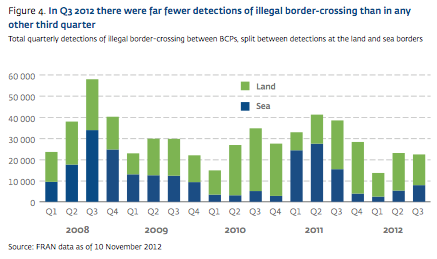
  • “Overall, in Q3 2012 there were fewer detections of illegal border-crossing than in any previous third quarter, following the launch of two Greek Operations: Aspida (Shield) …  and Xenios Zeus…. Perhaps somewhat predictably, there were increased detections of illegal border-crossing at both the Turkish sea border with Greece and land border with Bulgaria, indicative of weak displacement effects from the operational area.”
  • “[T]here were more than 3 500 reported detections of illegal border-crossing on the main Central Mediterranean route (Italian Pelagic Islands, Sicily and Malta), a significant decrease compared to the same reporting period in 2011 during the peak associated with the Arab Spring, but still the highest reported so far in 2012, and higher than the pre-Arab Spring peak of 2010.”
  • “[D]etections in Italy still constituted more than a fifth of all detections at the EU level. Detections in Apulia and Sicily were actually higher than in the Arab Spring period, and doubled in Lampedusa compared to the previous quarter.”
  • “In July 2012 the facilitation networks targeted Sicily instead of Pantelleria and Lampedusa, as it is harder for the migrants to reach the Italian mainland from the small islands. Migrants claim that the facilitators may start to focus on the southern coast of Sicily, as they expect lower surveillance there.”
  • “[T]here were some significant increases of various nationalities such as Tunisians and Egyptians departing from their own countries, and Somalis and Eritreans departing from Libya.”
  • “Several reports included details of how sub-Saharan migrants were often deceived, over-charged or even left to drown by their facilitators during the embarkation process.”
  • “For some time there has been a steady flow of Afghans and, to a lesser extent, Pakistanis arriving in the southern Italian blue borders of Calabria and Apulia with some very large increases observed during Q3 2012. In fact, according to the FRAN data there were more detections in this region than ever before.”
  • “JO EPN Aeneas 2012 started on 2 July. The operational plan defines two operational areas, Apulia and Calabria, covering the seashore along the Ionian Sea and part of the Adriatic Sea.”
  • “JO EPN Indalo 2012 started in [the Western Mediterranean] on 16 May covering five zones of the south-eastern Spanish sea border and extending into the Western Mediterranean.”
  • “Increased border surveillance along the Mauritanian coast generated by the deployment of joint Mauritanian-Spanish police teams and also joint maritime and aerial patrols in Mauritanian national waters has reduced departures towards the Canary Islands but also may have resulted in a displacement effect to the Western Mediterranean route from the Moroccan coast.”
  • “The good cooperation among the Spanish, Senegalese and Mauritanian authorities and the joint patrols in the operational sea areas and on the coastline of Senegal and Mauritania have resulted in a displacement of the departure areas of migrant boats towards the Canary Islands, with the reactivation of the Western African route (from north of Mauritania to the Western Sahara territory) used by the criminal networks operating in Mauritania.”

Here are excerpts from the Report focusing on the sea borders:

“Overall, in Q3 2012 there were fewer detections of illegal border-crossing than in any previous third quarter, following the launch of two Greek Operations: Aspida (Shield), which involved the deployment of ~1 800 Greek police officers to the Greek land border with Turkey, and Xenios Zeus, which focused on the inland apprehension of illegally staying persons. The much-increased surveillance and patrolling activities at the Greek-Turkish land border, combined with the lengthening of the detention period to up to 6 months, resulted in a drastic drop in the number of detections of irregular migrants from ~2 000 during the first week of August to below ten per week in each of the last few weeks of October. Perhaps somewhat predictably, there were increased detections of illegal border-crossing at both the Turkish sea border with Greece and land border with Bulgaria, indicative of weak displacement effects from the operational area….

Despite the clear impact of the Greek operational activities on the number of detections of illegal border-crossing, there is little evidence to suggest that the absolute flow of irregular migrants arriving in the region has decreased in any way. In fact, document fraud on flights from Istanbul increased once the Greek operations commenced. Hence, there remains a very significant risk of a sudden influx of migrants immediately subsequent to the end of the operations.”

[***]

4.1 Detections of Illegal border-crossing

“Overall, in Q3 2012 there were 22 093 detections of illegal border-crossing at the EU level, which is considerably lower than expected based on detections during previous quarters. In fact, there were fewer detections of illegal border-crossing than in any third quarter since data collection began in early 2008. The particularly low number of detections was due to vastly increased operational activity at the Greek land border with Turkey since 30 July 2012, and also to the overlapping effects of the end of the Arab Spring in its initial countries (Egypt, Libya, Tunisia) and far fewer detections of circular Albanian migrants illegally crossing the border into Greece.

The majority of detections were at the EU external land (66%), rather than sea border, but this was the lowest proportion for some time due to an increase in detections at the Greek sea border with Turkey – probably the result of a weak displacement effect from the land border. Nevertheless, the Greek land border with Turkey was still by far the undisputed hotspot for detections of illegal border-crossing.”

[***]

2012 Q3 Illegal Border Crossings“Figure 4 shows the evolution of the FRAN Indicator 1A – detections of illegal border- crossing, and the proportion of detections between the land and sea borders of the EU per quarter since the beginning of 2008. The third quarter of each year is usually influenced by weather conditions favourable for both approaching and illegally crossing the external border of the EU. Moreover, good conditions for illegal border-crossing also make it easier to detect such attempts. The combination of these two effects means that the third quarter of each year is usually the one with very high, and often the highest number of detections.”

[***]

4.2 Routes

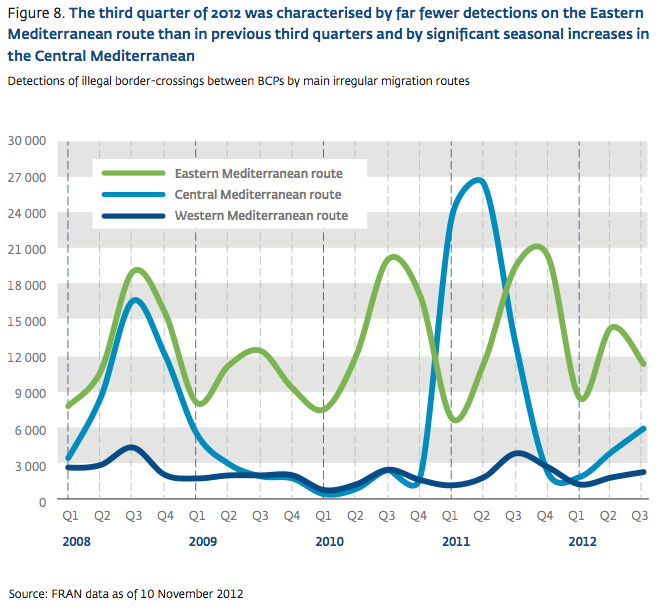
“… As illustrated in Figure 8, in the third quarter of 2012 the most detections of illegal border-crossings were reported on the Eastern and Central Mediterranean routes, which is consistent with the overall trend for most third quarters in the past. However, on the Eastern Mediterranean route the summer peak of detections, which has been remarkably consistent over recent years, was much lower than expected following increased operational activity in the area resulting in far fewer detections during the final month of the quarter.

In the Central Mediterranean, increased detections of several nationalities illegally crossing the blue border to Lampedusa and Malta, as well as increased landings in Apulia and Calabria from Greece and Turkey, combined to produce the highest number of detections both before and after the prominent peak reported during the Arab Spring in 2011.

In Q3 2012, there were 11 072 detections of illegal border-crossing on the Eastern Mediterranean route, a 75% reduction compared to the same period in 2011, and most other third quarters (Fig. 8). Nevertheless this route was still the undisputed hotspot for illegal entries to the EU during the current reporting period, mostly because of vastly increased detections of Syrian nationals.”
Screen Shot 2013-06-17 at 1.45.32 PM[***]

4.2.1 Eastern Mediterranean Route

“…Italian Ionian coast: For some time there has been a steady flow of Afghans and, to a lesser extent, Pakistanis arriving in the southern Italian blue borders of Calabria and Apulia with some very large increases observed during
Q3 2012. In fact, according to the FRAN data there were more detections in this region than ever before. The most commonly detected migrants were from Afghanistan, which is a significant but steady trend. In contrast detections of migrants from Pakistan, Bangladesh and Syria have increased very sharply since the beginning of 2012.

JO EPN Aeneas 2012 started on 2 July. The operational plan defines two operational areas, Apulia and Calabria, covering the seashore along the Ionian Sea and part of the Adriatic Sea. As mentioned in previous FRAN Quarterlies,
the detections at the Greek-Turkish land border are directly correlated with detections in the Ionian Sea. In 2011, it was estimated that more than 15% of migrants reported at the Greek-Turkish land border were afterwards detected in Apulia and Calabria.”

[***]

4.2.2 Central Mediterranean Route

“… According to FRAN data, in Q3 2012 there were just 3 427 reported detections of illegal border-crossing on the main Central Mediterranean route (Italian Pelagic Islands, Sicily and Malta), a significant decrease compared to the same reporting period in 2011. However, this figure was still the highest reported so far in 2012, and was higher than the peak in 2010. Additionally, there were some significant increases in various nationalities.

On the Central Mediterranean route, detections of migrants from Tunisia continued to in crease from 82 during the last quarter of 2011 to over 1 000 in Q3 2012. Tunisians were not the only North African nationality to feature in the top five most detected nationalities in the Central Mediterranean region, as Egyptians were also detected in significant and increasing numbers (287). The fact that fewer Egyptians than Tunisians were detected in the Central Mediterranean should be interpreted in light of Egypt being eight times more populous than Tunisia, which shows that irregular migration pressure from Egypt is proportionally much lower than that from Tunisia.

Also significant in the Central Mediterranean during the third quarter of 2012 were detections of Somalis (854) and, following recent increases, also Eritreans (411). Somalis have been detected in similarly high numbers during previous reporting periods (for example over 1 000 in Q2 2012) but there were more Eritreans detected in Q3 2012 than ever before.

Some Syrian nationals were also detected using the direct sea route from Turkey to Italy but these tended to arrive in Calabria…..”

[***]

4.2.3 Western Mediterranean Route

“In 2011, irregular migration in the Western Mediterranean region increased steadily from just 890 detections in Q1 2011 to 3 568 detections in the third quarter of the year. A year later in Q3 2012, detections dropped to just over 2 000 detections, which was, nevertheless, the highest level so far in 2012.

As has been the case for several years, most of the detections involved Algerians (859) followed by migrants of unknown nationality (524, presumed to be sub-Saharan Africans). Algerians were mostly detected in Almeria
and at the land border with Morocco, the migrants of unknown nationality were mostly reported from the land borders.

JO EPN Indalo 2012 started in this region on 16 May covering five zones of the south-eastern
Spanish sea border and extending into the Western Mediterranean.

In Q3 2012, there were far fewer Moroccan nationals detected (79) compared to Q3 2011. Most were detected just east of the Gibraltar Strait, between Tangiers and Ceuta. According to the migrants’ statements, the area between Ksar Sghir and Sidi Kankouche is the most popular departing area among Moroccans who want to cross the Gibraltar strait (10.15 NM distance). The boats used for the sea crossing were toy boats bought by the migrants in a supermarket for EUR ~100….

Increased border surveillance along the Mauritanian coast generated by the deployment of joint Mauritanian-Spanish police teams and also joint maritime and aerial patrols in Mauritanian national waters has reduced departures towards the Canary Islands but also may have resulted in a displacement effect to the Western Mediterranean route from the Moroccan coast.”

[***]

4.2.4 Western African Route

“In the third quarter of 2012, there were just 40 detections of illegal border-crossing in this region, almost exclusively of Moroccan nationals but with an influx of Senegalese nationals….

The good cooperation among the Spanish, Senegalese and Mauritanian authorities and the joint patrols in the operational sea areas and on the coastline of Senegal and Mauritania have resulted in a displacement of the
departure areas of migrant boats towards the Canary Islands, with the reactivation of the Western African route (from north of Mauritania to the Western Sahara territory) used by the criminal networks operating in Mauritania.”

[***]

——————-

Click here or here here for Frontex FRAN Report for Q3 2012.

Click here for previous post summarizing Frontex FRAN Report for Q2 2012.

2 Comments

Filed under Algeria, Analysis, Data / Stats, Egypt, Eritrea, Ethiopia, EU and EU Organizations, European Union, Frontex, General, Greece, Italy, Libya, Malta, Mauritania, Mediterranean, Morocco, Reports, Senegal, Spain, Syria, Tunisia, Turkey

24,000 Migrants Reach Italy by Sea Over Past 12 Months

Italian Interior Minister Angelino Alfano reported that 24,277 migrants have landed in Italy from 1 August 2012 to 10 August 2013.  8,932 persons have landed in the past 40 days – 1st July until 10th August 2013.

Click here , here  (IT), and here (EN) for articles.

4 Comments

Filed under Data / Stats, European Union, Italy, Mediterranean, News

Italy Conducted De Facto Push-Back of Migrants By Ordering Cargo Ship to Rescue and Transport Migrants to Libya

Just over a week ago Italian search and rescue authorities directed two commercial ships, an oil tanker and a cargo ship, to rescue two groups of migrants in distress off the Libyan coast.  After taking the migrants on board, both ships were ordered to transport the migrants to Libya.  One ship’s captain complied with the order and 96 migrants were turned over to Libyan authorities; the other captain refused and a several day stand-off between Malta and Italy resulted before Italy agreed to allow the migrants to be disembarked on Italian territory (see Malta Today: Malta blocks rescue ship from entering Malta waters; Malta orders ship to sail to Libya; Conditions on rescue ship worsen). 

The incident involving the two ships was by no means rare and what transpired raises a host of important issue. It is obviously good that one ship was permitted to disembark the rescued migrants on Italian territory.  But what transpired with the second ship that returned the rescued migrants to Libya is extremely problematic and amounted to a push-back.  Neither Italy nor Malta should be able to evade their responsibilities to consider asylum claims by ordering commercial ships to engage in rescue operations and then issuing orders to those commercial ships to return potential asylum seekers to a country such as Libya which is not a signatory to the Refugee Convention.

I copy below my recent commentary from Malta Today:

Was the captain of the Salamis right?

We asked Prof. Niels Frenzen about the legal implications of commercial ships effecting the rescue of migrants at sea on behalf of coastal states.

One week ago Italian search and rescue authorities directed two commercial ships, the Liberian-flagged oil tanker Salamis and the Turkish cargo ship Adakent, to divert from their courses to rescue two groups of migrants in distress off the Libyan coast.  Rescues like this take place almost daily, though most are conducted by national armed forces or coastguards.  Rescue operations conducted by commercial vessels raise different legal issues, one of the most important and problematic being where are the rescued persons to be disembarked.

And while disputes periodically arise between Italy and Malta when patrol boats belonging to the armed forces of one country have sought to disembark rescued persons in the other country – usually due to disagreement as to where the closest safe port is located in relation to the place of rescue – at the end of the day if the stand-off is not resolved, an AFM or Guardia di Finanza patrol boat is always able to disembark rescued survivors in their respective home ports.  This is not the case when commercial ships rescue survivors as was demonstrated by Malta’s decision not to permit the Salamis to enter Maltese waters for the purpose of disembarking the 102 rescued migrants.

Some government officials characterised the initial decision of the captain of the Salamis to attempt to disembark the rescued migrants in Malta as a violation of international law.  Such an assertion is inaccurate and fails to take into consideration the complicated framework of different international laws – search and rescue, human rights, and refugee – which come in to play when migrants are rescued or otherwise encountered in international waters, particularly when it is likely that there are asylum seekers or other persons in need of protection among the rescued persons. 

While Malta’s decision to bar the Salamis attracted significantly more international media attention than the events pertaining to the Adakent, these two incidents and the different resolutions highlight important legal issues.  After the two ships rescued and took on board the different groups of migrants, Italian authorities instructed both ships to disembark the rescued migrants in Libya because the migrants had departed from Libya.  The Adakent sailed to Tripoli – its planned destination before the rescue – and turned 96 rescued migrants over to Libyan authorities.  The captain of the Salamis disregarded Italy and Malta’s orders to sail to Libya and continued to sail towards Malta – its planned destination before the rescue.

Both ship captains properly carried out their clear legal obligation under international law to rescue the stranded migrants. The more difficult legal question is where should the rescued persons be taken once rescue operations are completed.  While international law does not explicitly answer the question, it does impose the obligation on a ship’s captain to disembark persons only in “a place of safety.” Since the 102 migrants rescued by the Salamis included Eritreans and Ethiopians it is clear that many of them were asylum seekers and therefore the captain was legally obligated to ignore the Italian and Maltese orders that the migrants be returned to Libya.

Assuming some or all of the 96 migrants rescued by the Adakent were also asylum seekers, the Adakent’s captain likewise should have disregarded Italian instructions to return the migrants to Libya.  Both the UNHCR and the International Maritime Organization (IMO) have issued guidelines to ship captains addressing the situations faced by the Salamis and Adakent.  The guidelines are based on the Search and Rescue Convention and the Refugee Convention and provide that if there is some reason to believe that a rescued person is an asylum seeker, the captain is obligated to take that fact into consideration when making a decision as to where to disembark the survivor.

Malta and Italy are well aware that many if not most migrants departing Libya by boat are asylum seekers and are also aware that many of the asylum claims will be granted if the asylum seeker is successful in lodging an application.  Had these two rescues been carried out by AFM or Guardia di Finanza patrol boats rather than the two commercial ships, the patrol boats would have been under a clear legal obligation to disembark the rescued migrants in a location where asylum or other claims for international protection could be properly considered.

The 2012 decision in the Hirsi v Italy case by the European Court of Human Rights condemned the Italian push-back practice which resulted in asylum seekers being returned to Libya without being given an opportunity to make asylum claims.  Neither Italy nor Malta can evade their responsibilities to consider asylum claims by diverting commercial ships to engage in rescue operations and then issuing orders to those commercial ships to return potential asylum seekers to a country such as Libya which is not a signatory to the Refugee Convention and does not provide an adequate alternate procedure to consider claims for protection.

There can be honest disagreement about where rescued migrants are to be disembarked as long as the survivors will be safe and protected when disembarked.  The Search and Rescue Convention obligates countries to coordinate and cooperate among themselves to permit rescuing ships to disembark rescued persons. Malta and Italy as sovereign countries have the right to control their borders, but this sovereign power has to be applied in manner that is consistent with international human rights and refugee law by which they have agreed to be bound.

4 Comments

Filed under Analysis, European Union, Italy, Libya, Malta, Mediterranean

At Least 20 Persons Dead After Migrant Boat Capsizes in Aegean Sea

A migrant boat attempting to sail from Turkey to Greece reportedly capsized near the Greek island of Lesvos on Thursday or Friday.  The boat was carrying about 28 persons.  At least 20 bodies have been recovered.  Only one survivor has been located.  Media reports describe the migrants as Iraqis or “of Asian origin.”  The boat’s captain was reportedly Turkish.

Click here (EN), here (EN) and here (GR) for articles.

3 Comments

Filed under Aegean Sea, European Union, Frontex, Greece, News, Turkey

UNODC Global Report on Trafficking in Persons 2012

UNODC released its 2012 Global Report on Trafficking in Persons on 10 December 2012.  The 98 page report “provides an overview of patterns and flows of trafficking in persons at global, regional and national levels, based on trafficking cases detected between 2007 and 2010 (or more recent). The report also includes a chapter on the worldwide response to trafficking in persons. The Country Profiles of the Global Report present a national level analysis for each of the 132 countries covered by this edition of the report.”

In regard to trafficked persons in Europe:

“Of the [trafficking] victims originating outside Europe, those from African countries are most prominently detected. About 18 per cent of the total number of victims detected in Western and Central Europe are African. Victims from West Africa, especially but not only Nigerians, comprise the vast majority. West Africans accounted for about 14 per cent of the total number of victims detected here….

In terms of trends, the proportion of West African victims among the total number of victims detected remained constant in Western and Central Europe during the reporting period. A detailed analysis at the country level, however, shows that a decreasing number of West African victims have been detected in a series of countries, while an increasing number have been detected in others. During the reporting period, fewer West African victims were detected in France and Italy, while they were increasingly detected in Austria and Germany. Similar contrasting trends can be noted among other destination countries in Western and Central Europe. The aggregated regional value is the result of compensation between opposite trends. This may indicate that the West African trafficking flow within the subregion may face some sort of displacement of destination.

Victims from the rest of sub-Saharan Africa accounted for a little more than 1 per cent of all victims detected in Western and Central Europe. As far as the North African victims are concerned, these were detected in or repatriated from 11 European countries, accounting for about 2.5 per cent of the victims detected during the reporting period, suggesting that these flows should not be underestimated.”

Click here full Report.

Click here for links to the Executive Summary and Country / Regional profiles.

Map 9, UNODC 2012 Global Report


2 Comments

Filed under Analysis, Data / Stats, European Union, Reports, UNODC

Guardian: Report of Syrians Having Been Turned Back on Evros River by Greek and Possibly Frontex Border Guards

A Guardian article today describes an incident which occurred earlier in the year which, if accurate, would indicate that Greek border guards and possibly border guards operating under Frontex Joint Operation Poseidon Land have returned Syrian asylum seekers (and migrants of other nationalities) to Turkish territory without registering and screening the migrants.

Excerpt: “This summer two people smugglers left 25 Syrian refugees to cross the Evros alone at night. There were two rubber dinghies. The first disappeared across the river into the night. The second …capsized. Most of the men, women and children could not swim. Some survived … The bedraggled Syrians who made it ashore [were detained].  After [irregular migrants are arrested], they are usually detained in administrative holding centres by the EU border police, Frontex, which has been deployed a few miles from the border since 2010. However, the group of Syrian refugees who made it across the Evros that night were not registered. Instead, they were arrested by officers in ‘blue uniforms’ and driven back to the river. ‘There were between 100 to 150 people by the river,’ said Farouk (not his real name), a 29-year-old from the Qamishli region in northern Syria. ‘They were of many nationalities, mainly Syrian. Some tried to make problems: they had paid a lot of money to get that far. When that happened, the police beat them. The police kicked and slapped them, including the women, they picked up children and threw them into the boat.’  The officers put people in small plastic boats, which they tied to larger, motorised boats, and returned them to Turkish territory.  … A UN High Commissioner for Refugees source said the organisation could not comment on Farouk’s story or illegal push-backs by Greek police in general. However, they acknowledged hearing similar accounts. ‘People say that there is a situation where people may enter the territory but are not registered as persons who are arrested in Greek territory. They are returned through use of force at night through the river. We think that these operations have been eliminated in the last two years.’ … Pasxalis Syritoudis, police chief of the northern Evros region, denied that his officers operated a push-back policy. … However, Syritoudis admitted that his main goal was to ‘prevent people entering Greek soil’. This meant sometimes his officers used boats to block migrants in dinghies from crossing the border. ‘We have 10 boats patrolling the river all the time. The boats are used to block people from crossing – to stop them getting to Greek territory.’…”

Click here for article.

2 Comments

Filed under European Union, Frontex, Greece, News, Turkey, UNHCR

UN Special Rapporteur on HR of Migrants expresses concern over plight of irregular migrants in Greece; calls for EU assistance; Frontex patrolling Greece-Italy sea border

The UN Special Rapporteur on the human rights of migrants, Prof. François Crépeau, has completed  a nine-day official visit to Greece, the fourth and last country visit in connection with a “a one-year comprehensive study to examine the rights of migrants in the Euro-Mediterranean region, focusing in particular on the management of the external borders of the European Union.”  The Special Rapporteur will present a thematic report on the human rights of migrants at the borders of the European Union to the UN Human Rights Council in May/ June 2013.  In addition to the visit to Greece, he previously conducted official visits to EU offices in Brussels, Tunisia, Turkey, and Italy.

One point of particular interest in the Special Rapporteur’s end-of-mission statement is that Frontex sea patrols in Greece are not along being used to patrol the external sea border of the EU (Greece-Turkey), but are also being used to patrol the sea border between Greece and Italy to prevent irregular migrants from leaving Greece.  (Is this within Frontex’s mandate?)  According to the end-of mission statement, Frontex Joint Operation Poseidon Sea “which used to cover the sea border between Greece and Turkey, was extended in 2012 to also cover the west coast of Greece, where migrants trying to reach Italy by boats operated by smugglers are intercepted and returned to Greece.”

The Special Rapporteur also notes “[t]he enhanced border controls at the Greek-Turkish land border under operation ‘Aspida’ (‘Shield’) initiated in August 2012, which included the deployment of approximately 1800 border police officers, coupled with the construction of a fence and the Frontex operation ‘Poseidon Land’ have resulted in a renewed influx of irregular migrants via the islands of the eastern Aegean Sea, with boats arriving on the different islands almost daily.”

Here are additional excerpts from the end-of-mission statement:

“[W]hile most EU countries have stopped returning asylum seekers to Greece under the Dublin II Regulation due to a decision of the European Court of Human Rights (M.S.S. vs Belgium and Greece), I was informed that there are still some returns to Greece based on this Regulation.”

“As the large number of irregular migrants stuck in Greece is mainly a result of EU policies and practices, there is a strong need for solidarity and responsibility-sharing within the EU in order to ensure full respect of the human rights of all these migrants.”

“While the role of the EU in managing the migration flows in Greece is crucial, the Greek government also needs to significantly step up its efforts in order to ensure that the rights of all migrants within its territory are fully respected.”

“I am deeply concerned about the widespread xenophobic violence and attacks against migrants in Greece, and I strongly condemn the inadequate response by the law enforcement agencies to curb this violence, and to punish those responsible.”

“I also deeply regret the Greek government’s new policy of systematically detaining everyone they detect irregularly entering the Greek territory, including unaccompanied children and families. I also regret the ‘sweep operations’ in the context of operation ‘Xenios Zeus’, which have led to widespread detention of migrants in different parts of the country, many of whom have lived and worked in Greece for years.”

Among the several preliminary recommendations to Greece and the EU was the recommendation that the EU “[e]nsure that the full protection of the human rights of all migrants, regardless of their status, is the primary consideration for its support to the Greek efforts in managing the migration flow entering the EU territory, including in relation to the activities undertaken by Frontex at the Greek borders.”

Click here for complete End-of-Mission Statement.

Click here for my previous post on the Special Rapporteur’s visits to other countries.

2 Comments

Filed under Aegean Sea, European Union, Frontex, Greece, Italy, OHCHR, Reports, Statements, Turkey

Frontex FRAN Report for Q2 2012

On 10 October Frontex released its FRAN (Frontex Risk Assessment Network) Quarterly Report for the Second Quarter of 2012 (April-June). As is always the case, the 70 page report contains a significant amount of information, graphs, and statistical tables regarding detections of illegal border crossings (land, air, and sea), irregular migration routes, detections of facilitators, detections of illegal stays, refusals of entry, asylum claims, returns, information regarding other illegal border activities, and more.  Here are some highlights (focusing on the sea borders):

Malta-  There was a significant increase in the number of Somalis reaching Malta. “Taking into account the professional planning of the trips, it is assumed that the modus operandi has changed and that Malta is now targeted on purpose, thereby replacing Italy as the preferred destination country for this nationality. The reason for this change has not yet been confirmed; however, in the past Malta resettled some Somali migrants in the United States and in some EU Member States, which might be acting as a pull factor.”

Spain-  “In this region there was a new modus operandi involving facilitators dropping off migrants in the Chafarinas Islands, a Spanish archipelago 2 nautical miles away from the Moroccan coastline.”

“As reported in the previous FRAN Quarterly, in February 2012 Moroccan and Spanish Ministers of Interior signed a police agreement to create two joint police stations in the Spanish (Algeciras) and Moroccan (Tangiers) territories to cooperate by exchanging operational information and best practices between different police services.”

Italy-  “Throughout the quarter, Italy and Tunisia cooperated efficiently to repatriate Tunisian nationals and so most migrants typically arrived undocumented to delay readmission.”

Central Mediterranean-    “[D]etections in the Central Mediterranean showed a seasonal increase but were much reduced (-86%) compared with the dramatic peak during the same period in 2011. Indeed, in the second quarter of 2012 detections in this region resembled the pre-Arab Spring levels reported during the summer of 2010. … The Central Mediterranean was recently affected by increased detections of Somalis, and a steady trend of Tunisians and Egyptians.”

“In Q2 2012, there were no Joint Operations running in the Central Mediterranean Sea, therefore Frontex and the FRAN community are unable to utilize intelligence obtained through the direct debriefing of migrants. However, valuable information has been obtained from interviews carried out by the Maltese authorities. Such preliminary interviews revealed that some of the Somali migrants arriving in Malta had been promised that they would be brought to Italy. They departed from an unknown location in Libya and travelled for up to three days in boats before either being intercepted by Maltese authorities or reaching the shore. The average fare was said to be around USD 1 000 per person.”

“Subsequent to the reporting period, JO Hermes 2012 was launched on 2 July and is currently planned to run until 31 October 2012 as a continuation of the deployment of JO Hermes Extension 2011, which ended just before the reporting period, on 31 March 2012. JO Hermes 2012 has been established to support the Italian authorities in tackling maritime irregular migration along the coasts of Sicily, Pantelleria and the Pelagic islands (Lampedusa, Linosa, Lampione).”

Western Mediterranean –   “Detections in the Western Mediterranean were almost equally comparable to Q2 2011…”

“JO EPN Indalo 2012 started on 16 May and is currently scheduled to run until 31 October 2012. So far the number of irregular migrants apprehended in the operational areas is almost double that of the same period in 2011. Analysis of the information provided by the Spanish authorities also indicates a new increasing trend in the number of Algerian and Moroccan migrants per boat since the beginning of 2012.”

Western Africa –  “[D]etections increased to a large degree, yet from lower bases, on the … Western African route (+29%).” “In the second quarter of 2012, there were just 31 detections of illegal border-crossing in this region, almost exclusively of Moroccan nationals.”

“As reported in previous FRAN Quarterlies, the Western African route from the north of Mauritania to the Western Sahara territory is being reopened by illegal migration facilitation networks. It has been inactive for years but recently an estimated 2 000 sub-Saharans (particularly from Senegal) settled in the Western Saharan coastal cities of El Aaioún and Dakhla and in the last few months ~20 000 Senegalese nationals have entered Mauritania along these routes to the north.”

“During the reporting period there was no Frontex operation relevant for the Western African Route.”

Eastern Mediterranean-  “Subsequent to the reporting period (July 2012), JO EPN Aeneas 2012 was launched and is currently scheduled to run until the end of October 2012. There are two operational areas, Apulia and Calabria, covering the seashore along the Ionian Sea and part of the Adriatic Sea.”

Here are extensive excerpts from the Report with a focus on the sea borders:

“Executive summary

Taken as a whole, in Q2 2012, detections of illegal border-crossing were reduced by nearly half compared to the same quarter in 2011 due to the simultaneous effects of the winding down of the Arab Spring and fewer Albanian circular migrants entering Greece. However, detections at the undisputed long-term hotspot for irregular migration – the Greek land border with Turkey – were some 25% higher than during the same period in 2011 due to increased detections of migrants from Bangladesh and particularly Syria. [***]

In the Central Mediterranean, where detections peaked in 2011 during the Arab Spring, migrants from Somalia were increasingly detected in Malta. Specifically, in May 2012 the arrival of Somali migrants in Malta increased significantly while Italy registered a decrease in the number of Somali migrants apprehended in Sicily and the Pelagic Islands. The detected Somalis were mainly young males many of whom had been imprisoned by police or military forces during their travels through Libya. Taking into account the professional planning of the trips, it is assumed that the modus operandi has changed and that Malta is now targeted on purpose, thereby replacing Italy as the preferred destination country for this nationality. The reason for this change has not yet been confirmed; however, in the past Malta resettled some Somali migrants in the United States and in some EU Member States, which might be acting as a pull factor. Also, there is some evidence that facilitation networks located in Malta have tried to forward migrants to Sicily. [***]

The Western Mediterranean route was apparently dominated by local migrants from Morocco and Algeria but with large numbers of unknown nationalities it is assumed that local migrants were also accompanied by long-distance migrants probably from sub-Saharan Africa. In this region there was a new modus operandi involving facilitators dropping off migrants in the Chafarinas Islands, a Spanish archipelago 2 nautical miles away from the Moroccan coastline. [***]

4.1 Detections of illegal border-crossing

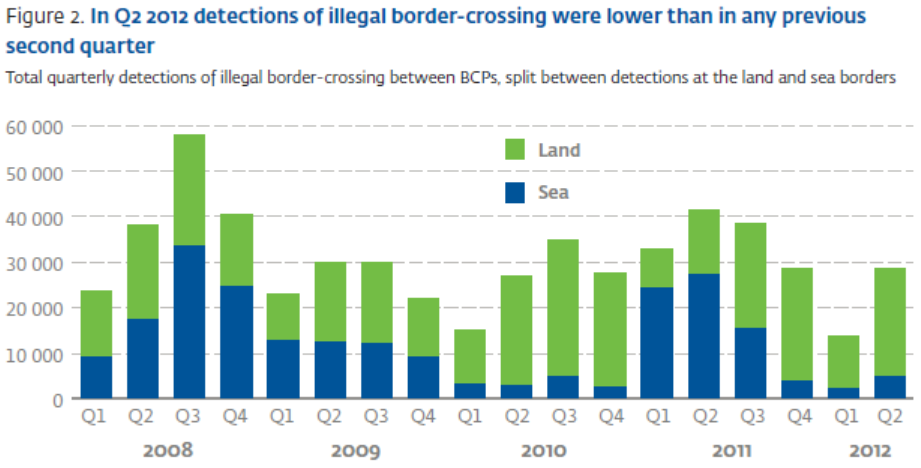
Overall, in Q2 2012 there were 23 092 detections of illegal border-crossing at the EU level, which is a considerable if somewhat expected seasonal increase compared to the previous quarter, and a 44% decrease compared to the same period in 2011 amidst the influx of migrants during the Arab Spring. Taken as a whole, detections of illegal border-crossing in Q2 2012 were lower than in any other second quarter since FRAN reporting began. Most probably, the low number of detections was due to the overlapping effects of the end of the Arab Spring in its initial countries (Egypt, Libya, Tunisia) and far fewer detections of circular Albanian migrants in Greece. The vast majority of detections were at the EU external land border (77%). [***]

[***] Ranked third among border sections [after the Greece-Turkey land border and the Greece-Albania border section] in Q2 2012 was the blue border of Sicily, where Tunisians, Egyptians and Somalis were increasingly detected. [***]

Figure 2 shows the evolution of the FRAN Indicator 1A – detections of illegal border-crossing, and the proportion of detections between the land and sea borders of the EU per quarter since the beginning of 2008. The second quarter of each year is usually associated with improving weather conditions more favourable for approaching and illegally crossing the external border of the EU. Moreover, conditions that are more favourable for illegal border-crossing are also more favourable for detection. The combination of these two effects tends to produce the highest number of detections during the second quarter of each year. [***]

 2012-10-10_Frontex_FRAN_Q2_2012-FIG_2

Without question, during the second quarter of 2012 the migrants that were detected with the most increasing frequency were those from Bangladesh (+35%), Somalia (+62%), Algeria (+88%) and Syria (+639%) (Fig. 5). In fact, more migrants from Syria were detected than ever before (2 024). Detections of most of these nationalities were concentrated at the Greek land border with Turkey, with the exception of Somalis, who were mostly detected in Malta. Indeed, Somalis were particularly notable in that their detections were distributed across a very wide range of locations; as well as Malta and the Greek land border with Turkey, they were also detected in Sicily, Lampedusa and the Slovakian land border with the Ukraine. [***]

[M]igrants from Algeria were not only increasingly detected at the Greek land bor[d]er with Turkey, but also in the Spanish maritime region of Almeria and at the Romanian land border with Serbia.The latter case is assumed to represent secondary movements through the Western Balkans region.

4.2 Routes

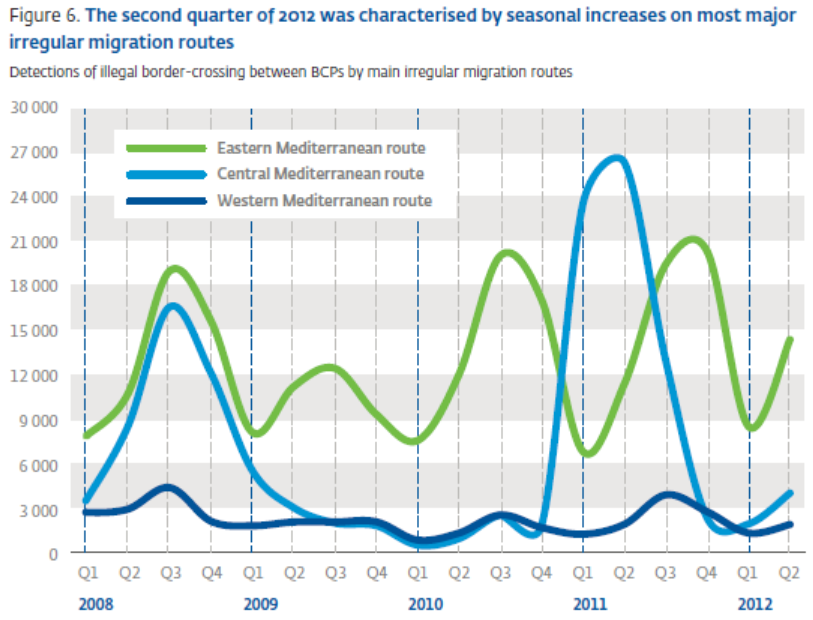
In 2011, detections of illegal border-crossing on the Central Mediterranean route peaked briefly during the period of turbulent sociopolitical developments in North Africa, known as the Arab Spring. In contrast, on the Eastern Mediterranean route, detections have followed a remarkably seasonal pattern over the last two years. Throughout 2011 detections in the Western Mediterranean (land and sea borders with Spain) steadily increased.

As illustrated in Figure 6, the Eastern and Central Mediterranean routes reported the most detections of illegal border-crossing in the second quarter of 2012, and were characterized with seasonal increases consistent with previous years, aside the Central Mediterranean region during the Arab Spring.

2012-10-10_Frontex_FRAN_Q2_2012-FIG_6

In Q2 2012, there were 14 125 detections of illegal border-crossing on the Eastern Mediterranean route, an increase of 27% compared to the same period in 2011 (Fig. 6) rendering this region the undisputed hotspot for illegal entries to the EU during the current reporting period. Elsewhere, detections in the Central Mediterranean showed a seasonal increase but were much reduced (-86%) compared with the dramatic peak during the same period in 2011. Indeed, in the second quarter of 2012 detections in this region resembled the pre-Arab Spring levels reported during the summer of 2010. Detections in the

Western Mediterranean were almost equally comparable to Q2 2011, whereas detections increased to a large degree, yet from lower bases, on the Eastern Borders route (+103%), Western Balkans route (+50%) and Western African route (+29%).

These routes not only differed in their magnitudes over time but also in the composition of detected nationalities. Consistent with previous periods, detections on the Eastern Mediterranean route were dominated by migrants from Afghanistan, and more recently Bangladesh, Algeria and Syria. The Central Mediterranean was recently affected by increased detections of Somalis, and a steady trend of Tunisians and Egyptians. [***]

[T]he Western Mediterranean route was apparently dominated by local migrants from Morocco and Algeria but with large numbers of unknown nationalities it is assumed that local migrants are also accompanied by other long-distance migrants probably from sub-Saharan Africa. The exception was the much less used Western African route, which was exclusively affected by local migrants from Morocco.

4.2.1. Eastern Mediterranean route

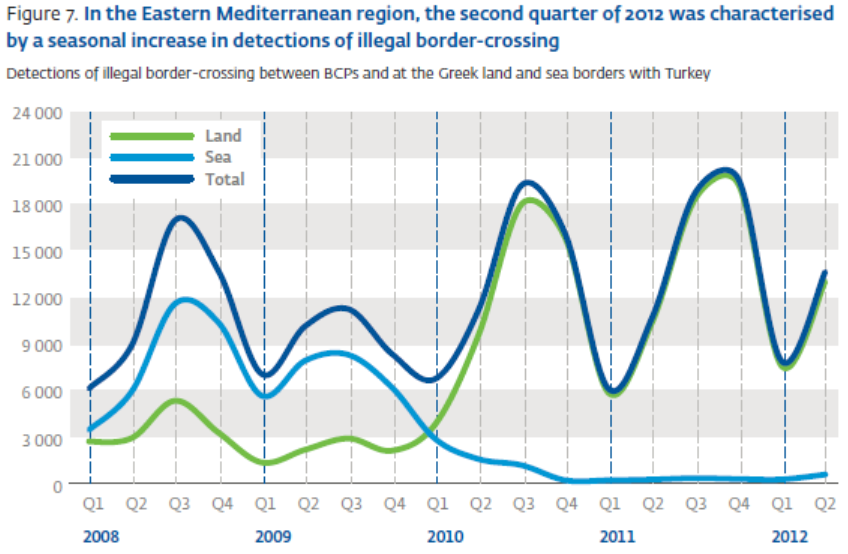
Since data collection began in early 2008, the Eastern Mediterranean has maintained its status as a major hotspot of irregular migration. Detections have followed a remarkably seasonal pattern invariably peaking in the third quarter of each year and concentrated at the border between Greece and Turkey, with a shift from the sea border to the land border visible in late 2009 (Fig. 7). Unusually, at the end of 2011 detections of illegal border- crossing on the Eastern Mediterranean rote remained almost constant between the third and final quarters of the year, resulting in the first recorded example of a sustained peak of detections at that time of year. This was due to an unexpected increase in detections at the Greek land border with Turkey, particularly in October. [***]

2012-10-10_Frontex_FRAN_Q2_2012-FIG_7

Italian Ionian Coast: For some time there has been a steady flow of Afghans and, to a lesser extent, Pakistanis arriving in the Southern Italian blue borders of Calabria and Apulia with some increases during Q2 2012.

Subsequent to the reporting period (July 2012), JO EPN Aeneas 2012 was launched and is currently scheduled to run until the end of October 2012. There are two operational areas, Apulia and Calabria, covering the seashore along the Ionian Sea and part of the Adriatic Sea.

According to Croatian open sources* in July, some 65 Asian and African migrants presumed to be heading to Italy were found drifting some 47 nautical miles south of Dubrovnik due to a broken engine (Fig. 12). They had been drifting for two days. The migrants, who had departed from Greece, did not want to be rescued by the Croatian authorities as they wanted to go to Italy. After several hours of negotiations, the authority for search and rescue towed the sailing boat to the nearest Croatian port.

There was also a recent increase in the numbers of Bangladeshis, Iraqis, Moroccans and Syrians arriving in Apulia from Greece but these detections were in much lower numbers than other nationalities. [***]

4.2.2. Central Mediterranean route

Irregular migration in the Central Mediterranean massively fluctuated in size and composition during 2011, largely due to the political and civil unrest across North Africa, particularly in Tunisia and Libya. Since Q4 2011, the situation has significantly improved following better cooperation between Italian and Tunisian authorities concerning the return of Tunisian nationals.

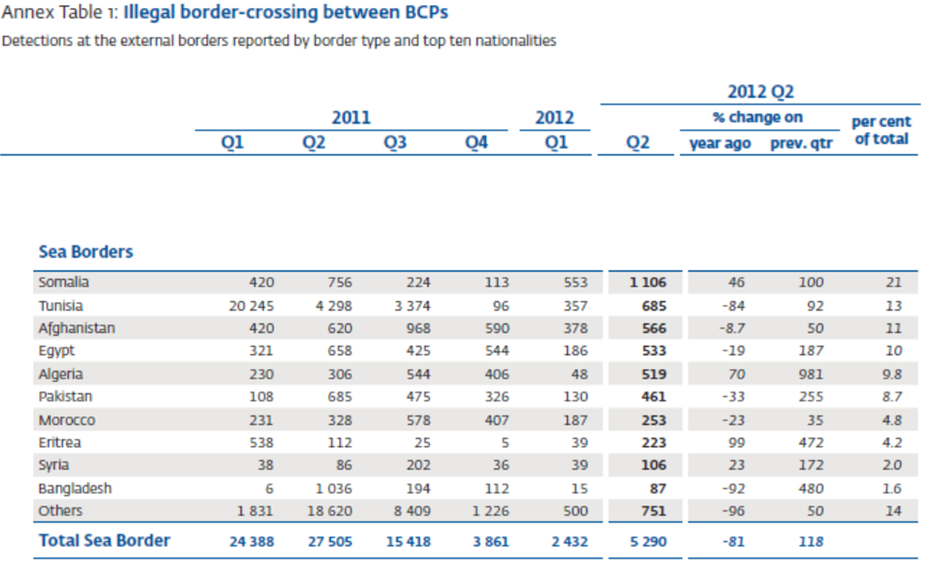
According to FRAN data, in Q2 2012 there were just 3 685 reported detections of illegal border-crossing on the Central Mediterranean route, a massive decrease compared to the peak in last year in Q2 2011 but an increase compared to late 2011 and early 2012. The increase was almost entirely due to more detections of migrants from Somalia (1 094) combined with a steady stream of migrants still arriving from Tunisia. Several nationalities previously detected in high numbers particularly in 2011 were not detected in significant numbers, including Bangladeshis (72) and Nigerians (19).

Migrants from Somalia – During May 2012, the arrival of Somali migrants in Malta increased significantly while

Italy registered a decrease in the number of Somali migrants apprehended in Sicily and the Pelagic Islands. In most cases, groups of males, females and minors (or families) were found on board rubber dinghies with outboard motors. A few of the boats were detected in Italian territorial waters in some distress after the migrants had called the Italian authorities for help using satellite telephones. The boats that recently headed for Malta were either intercepted by Maltese patrol boats or made it to the island without being intercepted.

Detected Somalis were mainly young males (aged 18–24) with secondary education and low or no income. The main reason for the migration was socio-economic, but in some cases it was military conflict. In Q2 2012, there were no Joint Operations running in the Central Mediterranean Sea, therefore Frontex and the FRAN community are unable to utilize intelligence obtained through the direct debriefing of migrants. However, valuable information has been obtained from interviews carried out by the Maltese authorities. Such preliminary interviews revealed that some of the Somali migrants arriving in Malta had been promised that they would be brought to Italy. They departed from an unknown location in Libya and travelled for up to three days in boats before either being intercepted by Maltese authorities or reaching the shore. The average fare was said to be around USD 1 000 per person.

Migrants from Tunisia – Most Tunisian migrants detected arriving in the Central Mediterranean Region were young (18–35 years) unmarried males with a primary level of education and low previous incomes (EUR 80–180 per month). All interviewed migrants declared to have relatives or friends already in the EU, especially in Italy, and they arrived on boats containing on average 20 migrants (Fig. 13).

Throughout the quarter, Italy and Tunisia cooperated efficiently to repatriate Tunisian nationals and so most migrants typically arrived undocumented to delay readmission. Subsequent to the reporting period, JO Hermes 2012 was launched on 2 July and is currently planned to run until 31 October 2012 as a continuation of the deployment of JO Hermes Extension 2011, which ended just before the reporting period, on 31 March 2012. JO Hermes 2012 has been established to support the Italian authorities in tackling maritime irregular migration along the coasts of Sicily, Pantelleria and the Pelagic islands (Lampedusa, Linosa, Lampione).

4.2.3. Western Mediterranean route

Irregular migration in the Western Mediterranean region increased throughout 2011 from just 890 detections in Q1 2011 to 3 568 detections in Q3. In Q2 2012, there were 1 549 detections which almost exactly corresponds to the number of detections the year before in Q2 2011 (1 569). As was the case a year ago, most detections were of Algerians followed by migrants of unknown nationalities (presumed to be sub-Saharan Africans) and Moroccans.

Recently, the size of the sub-Saharan population coming from Algeria has increased in different settlements adjacent to the Melilla border fence. Criminal networks operate more easily in this north eastern region of Morocco and the Spanish authorities treat a large-scale illegal crossing of the fence to the Spanish side as a real possibility. Attempts to cross have been made in the past involving groups of dozens or even hundreds.

JO EPN Indalo 2012 started on 16 May and is currently scheduled to run until 31 October 2012. So far the number of irregular migrants apprehended in the operational areas is almost double that of the same period in 2011. Analysis of the information provided by the Spanish authorities also indicates a new increasing trend in the number of Algerian and Moroccan migrants per boat since the beginning of 2012. The improvement of the weather and sea conditions during the reporting period impacted on the number of boats detected, with a gradual increase of the number of arrivals during the peak period, which according to data from the last two years is from May to October.

Migrants from Algeria – According to information gathered during interviews, most Algerians were single male adults aged 19–36 on average, but there were also a few females and minors in good health. Most migrants belonged to the lower middle class and, despite having a high level of education compared to sub-Saharan nationals, they suffered from a generalised lack of opportunities, welfare and access to public health services. Nearly all the Algerian migrants spoke Arabic with a few French and English speakers, but all were undocumented to avoid repatriation after arriving in Spain. The majority had relatives or friends in EU Member States, mainly in France and Spain, who could help them to find a job and settle within the ethnic communities already established in these countries.

4.2.4. Western African route

In the second quarter of 2012, there were just 31 detections of illegal border-crossing in this region, almost exclusively of Moroccan nationals.

As reported in the previous FRAN Quarterly*, in February 2012 Moroccan and Spanish Ministers of Interior signed a police agreement to create two joint police stations in the Spanish (Algeciras) and Moroccan (Tangiers) territories to cooperate by exchanging operational information and best practices between different police services. The goal of this cooperation is to strengthen the efforts and improve the results against organized crime operating on both sides of the Strait of Gibraltar involved in the smuggling of drugs, international terrorism, irregular migration and trafficking in human beings.

Following these developments, both International Police Cooperation Centres became operational during May 2012 (Fig. 14). The International Joint Police Stations are going to be integrated with National Police / Guardia Civil (Spain) and General Direction for National Security (Police) / Royal Gendarmerie (Morocco) staff for a rapid and effective exchange of information.

As reported in previous FRAN Quarterlies, the Western African route from the north of Mauritania to the Western Sahara territory is being reopened by illegal migration facilitation networks. It has been inactive for years but recently an estimated 2 000 sub-Saharans (particularly from Senegal) settled in the Western Saharan coastal cities of El Aaioún and Dakhla and in the last few months ~20 000 Senegalese nationals have entered Mauritania along these routes to the north.

During the reporting period there was no Frontex operation relevant for the Western African Route. [***]”

2012-10-10_Frontex_FRAN_Q2_2012-Annex Table 1_Sea Borders only

Click here or here for Report.

4 Comments

Filed under Aegean Sea, Analysis, Data / Stats, Eastern Atlantic, European Union, Frontex, Greece, Italy, Libya, Malta, Mauritania, Mediterranean, Morocco, Reports, Spain, Tunisia

European Commission’s Second Biannual Report on Schengen Area

The European Commission released its “Second biannual report on the functioning of the Schengen area” covering the period 1 May 2012-31 October 2012.  (COM(2012) 686 final, 23.11.2012)  The first reporton the Schengen area was released in May of this year.  (COM(2012) 230 final, 16.5.2012)

Here are a few excerpts from the 8 page document:

The Commission intends to present a legislative proposal in early 2013 to replace the Frontex sea border operations rule (Council Decision 2010/252/EU) that was annulled by the Court of Justice on 5 September 2012;

Subsequent to the issuance of a letter of formal notice to Greece in October 2009 in response to “allegations of serious difficulties faced by migrants in applying for asylum and ill-treatment of asylum-seekers, including the turning back of persons who may face serious harm or persecution”, the Commission is continuing to analyse the situation “in the light of constant developments, such as the progress made in the implementation of the Greek National Action Plan.”;

Subsequent to a Commission request to Italy in July 2009 “to provide information on the measures to avoid the risk of refoulement” and the February 2012 European Court of Human Rights decision in the Case of Hirsi v. Italy, “[a]gainst this background, the Commission is now analysing the implications of this ruling on border surveillance operations at sea and on the asylum acquis.

Click  here or here for Second Report.

Click here for First Report.

2 Comments

Filed under Aegean Sea, European Court of Human Rights, European Union, Frontex, Greece, Italy, Judicial, Libya, Mediterranean, Reports

UN Special Rapporteur on HR of Migrants expresses concern over Italy-Libya cooperation on migration

The UN Special Rapporteur on the human rights of migrants, Prof. François Crépeau, for the past six months has been conducting “a one-year comprehensive study to examine the rights of migrants in the Euro-Mediterranean region, focusing in particular on the management of the external borders of the European Union.”  The Special Rapporteur will present a thematic report on the human rights of migrants at the borders of the European Union to the UN Human Rights Council in June 2013.  To date he has concluded official visits to EU offices in Brussels, Tunisia, Turkey, and Italy; a nine-day visit to Greece began on 25 November.  The Special Rapporteur has issued preliminary conclusions at the end of each completed mission.  One common concern is that various actions of the EU and neighbouring countries are resulting in human rights considerations being overshadowed by migration control and security objectives.

At the conclusion of the most recent mission to Italy (30 September – 8 October 2012), the Special Rapporteur expressed concern over Italy’s (and the EU’s) ongoing cooperation with Libya:

“Another matter of paramount importance are the bilateral cooperation agreements negotiated between Italy and its neighbours on the question of migration. Although the EU has negotiated a number of EU wide readmission agreements, the absence of a clear regional framework for such agreements, including a lack of minimum human rights standards, has led to the creation of a number of bilateral readmission agreements between Italy and its neighbours which often do not appear to have human rights at their core.  Of particular concern is the Italy-Libya bilateral cooperation on migration. The 2008 agreement formalised cooperation to strengthen Libya`s capacity to intercept irregular migrants on Libyan territory or territorial waters, even though Libya’s record at effectively protecting the human rights of migrants was poor and reports of human rights abuses of migrants in Libya were frequent. In line with the decision of the European Court of Human Rights pronounced in the Hirsi case that such ‘push-backs’ by Italian authorities towards Libya were not acceptable, the agreement is currently suspended and the Hirsi-defined push-backs appear to have ceased. However, Italy-Libya migration cooperation was recently reinforced through a 2012 processo verbale. This new political framework however, contains very little concrete information on strengthening Libya’s normative framework and institutional capacities regarding the human rights of migrants.”

The Special Rapporteur also expressed concern that the current technical assistance in Search and Rescue capability being provided by Italy to Libya is in effect disguised migration control assistance:

 “Moreover, I have learnt of increased bilateral cooperation between Italian and Libyan authorities regarding search and rescue operations, including the provision of logistical and technical support to Libyan coast guards. Whilst increased search and rescue capacity in the Mediterranean is undoubtedly of paramount importance, I have observed that there appears to be a strong focus on strengthening the capacities of the Libyan authorities to intercept migrants hoping to reach Europe, on both their territory and in their territorial waters, and return them to Libya. In this context, I warn EU member states against a progressive ‘externalisation’ of border control. In particular, considering the on-going difficulties of the Libyan authorities and the reports of human rights abuses against migrants on Libyan territory, this migration cooperation with Libya should not lead to any migrant being returned to Libyan shores against their will, either by Italian coast guards or Guardia di Finanza, or by Libyan coast guards with the technical or logistical support of their Italian counterparts.”

While acknowledging the important support provided to Italy by Frontex, the Special Rapporteur expressed concern over certain Frontex activities in Italy:

“[  ] I am aware that the key focus of FRONTEX remains information and intelligence gathering. In Italy FRONTEX thus works predominantly with the Guarda di Finanza and the Border Police to combat irregular migration, migrant smuggling and other migration related crimes. I remain concerned that these security objectives still appear to overshadow human rights considerations. For example, I have learned that FRONTEX officers conduct interviews with migrants in Italian detention facilities in order to gather information on their journeys. However these interviews are conducted without any external supervision. It is thus essential that effective human rights standards be integrated into all departments and agencies related to border management.”

The Special Rapporteur made the following “Preliminary Recommendations to the Italian government”:

  • “Ensure that migration cooperation with Libya does not lead to any migrant being returned to Libyan shores against their will, either by Italian authorities, or by Libyan authorities with the technical or logistical support of their Italian counterparts.
  • Prohibit the practice of informal automatic “push-backs” to Greece.
  • Guarantee the full access by international organisations, including UNHCR and IOM, civil society organisations and lawyers to all areas where migrants are held or detained to identify protection concerns
  • Develop a nation-wide regulatory framework, with respect for human rights at its core, for the organisation and management of all migrant detention centres.
  • Develop a simpler and fairer appeal system for expulsion and detention orders that integrates human rights considerations at each procedural step.
  • Develop a speedier identification system, including commencing the identification of foreign inmates whilst in prison, in order to make sure that detention of migrants for identification purposes is limited to the shortest time possible, with a maximum of 6 months.”

Similar concerns were expressed by the Special Rapporteur after his missions to Tunisia and Turkey:

Tunisia, 8 June 2012: “… Nevertheless, I learned that a large majority of regional migration initiatives coming from the EU continue to be focused on issues of border control, and do not consider important issues such as the facilitation of regular migration channels. Thus I encourage the European authorities to develop, in the context of the Migration and Mobility Partnership currently being negotiated, and in conjunction with bilateral agreements of the Member States of the Union, a more nuanced policy of migration cooperation with Tunisia, which moves beyond security issues to develop new initiatives in consultation and in real partnership with Tunisian authorities, which place at their core the respect, protection and promotion of the human rights of migrants….”

Turkey, 29 June 2012:  “… While the EU and Turkey have developed a close cooperation on migration issues, which has led to some notable positive developments, the assistance offered to Turkey regarding migration management appears to focus largely on securitising the borders and decreasing irregular migration to the European common territory through focusing on projects related to the detention and removal of migrants in Turkey and the increased monitoring of the Turkish border. Often neglected from the equation, is an equivalent emphasis on the human rights of those most vulnerable and most affected by the migration process: the migrants themselves….”

The Special Rapporteur will likely issue preliminary observations at the conclusion of the current mission to Greece on or after 3 December.

Click here (Italy), here (Tunisia), and here (Turkey) for the Special Rapporteur’s statements.

Click here for the web site for the UN Special Rapporteur on the human rights of migrants.

3 Comments

Filed under Aegean Sea, European Union, Frontex, Greece, Human Rights Council, Italy, Libya, Mediterranean, News, Statements, Tunisia, Turkey, United Nations

EU Court of Justice Annuls Frontex Sea Borders Rule – EU Parliamentary Approval Required (28.11.2012 update)

[UPDATE 28 November 2012: The European Commission intends to present a legislative proposal in early 2013 to replace the annulled Frontex sea border operations rule (Council Decision 2010/252/EU).  See EC’s “Second biannual report on the functioning of the Schengen area” covering the period 1 May 2012-31 October 2012.  (COM(2012) 686 final, 23.11.2012)]

The EU Court of Justice, Grand Chamber, issued a judgment on 5 September 2012 annulling Council Decision 2010/252/EU of 26 April 2010 supplementing the Schengen Borders Code as regards the surveillance of the sea external borders in the context of operational cooperation coordinated by [Frontex] (OJ 2010 L 111, p. 20), i.e. the Frontex Sea Borders Rule.  ECJ Advocate General Paolo Mengozzi issued an Opinion on 17 April 2012 recommending that the Court annul the Rule.

The Court concluded that the provisions of the contested rule were not minor, non-essential provisions, but instead “constitute[d] a major [new] development in the [Schengen Borders Code] system” and which therefore required the consideration and approval of the European Parliament.

The Court stated that the Schengen Borders Code (“SBC”) as it currently stands “does not contain any rules concerning the measures which border guards are authorised to apply against persons or ships when they are apprehended….”  The contested rule “lays down the measures which border guards may take against ships [authorising] ships to be stopped, boarded, searched and seized…”  The contested rule “lays down rules on the disembarkation of the persons intercepted or rescued …stating that priority should be given to disembarkation in the third country from where the ship carrying the persons departed.”

The Court said the adoption of such rules conferring “enforcement powers on border guards …entails political choices falling within the responsibilities of the European Union legislature, in that it requires the conflicting interests at issue to be weighed up on the basis of a number of assessments. Depending on the political choices on the basis of which those rules are adopted, the powers of the border guards may vary significantly, and the exercise of those powers require authorisation, be an obligation or be prohibited, for example, in relation to applying enforcement measures, using force or conducting the persons apprehended to a specific location. In addition, where those powers concern the taking of measures against ships, their exercise is liable, depending on the scope of the powers, to interfere with the sovereign rights of third countries according to the flag flown by the ships concerned. Thus, the adoption of such rules constitutes a major development in the SBC system.”

The Court also noted that “the powers conferred in the contested [rule] mean that the fundamental rights of the persons concerned may be interfered with to such an extent that the involvement of the European Union legislature is required.”

For these reasons the Court decided that the “contested [rule] must be annulled in its entirety because it contains essential elements of the surveillance of the sea external borders of the Member States which go beyond the scope of the additional measures within the meaning of Article 12(5) of the SBC, and only the European Union legislature was entitled to adopt such a decision.”

The Court ordered “the effects of the contested [rule] [to]  be maintained until the entry into force, within a reasonable time, of new rules intended to replace the contested decision annulled by the present judgment.”

Click here or here for Judgment.

Extensive Excerpts from Judgment:

THE COURT (Grand Chamber), composed of V. Skouris, President, A. Tizzano, J.N. Cunha Rodrigues, K. Lenaerts, J.-C. Bonichot and A. Prechal, Presidents of Chambers, R. Silva de Lapuerta, K. Schiemann, E. Juhász, G. Arestis, T. von Danwitz (Rapporteur), M. Berger and E. Jarašiūnas, Judges,

Advocate General: P. Mengozzi,

having regard to the written procedure and further to the hearing on 25 January 2012, after hearing the Opinion of the Advocate General at the sitting on 17 April 2012, gives the following Judgment

1. By its action, the European Parliament seeks the annulment of Council Decision 2010/252/EU of 26 April 2010 supplementing the Schengen Borders Code as regards the surveillance of the sea external borders in the context of operational cooperation coordinated by [FRONTEX] (OJ 2010 L 111, p. 20, ‘the contested decision’).

2. [***] The Parliament submits that the provisions of the contested decision ought to have been adopted by the ordinary legislative procedure and not by the comitology procedure based on Article 12(5) of the SBC [Schengen Borders Code].

I – Legal context

A – Decision 1999/468/EC

3.-7. [***]

B – The SBC

8.-16.[***]

C – Regulation (EC) No 2007/2004

17.-21.[***]

D – The contested decision

22.-29.[***]

II – Forms of order sought by the parties and the procedure before the Court

30. The Parliament claims that the Court should:

– annul the contested decision;

– order that the effects of the contested decision be maintained until it is replaced, …

31. The Council contends that the Court should:

– dismiss the Parliament’s action as inadmissible;

– in the alternative, dismiss the action as unfounded, …

32.[***] the Commission was granted leave to intervene in support of the form of order sought by the Council and, in its statement in intervention, it requests the Court to dismiss the Parliament’s action …..

III – The action

A – The admissibility of the action

33.-40.[***]

41. It follows from the above that the action for annulment must be declared to be admissible.

B – Substance

1. Arguments of the parties

42. [***]

(a) As regards the principles governing the implementing powers

43. The Parliament submits that the regulatory procedure with scrutiny can have as its subject-matter the modification or removal of non-essential elements of a basic instrument or the addition of new non-essential elements, but not the modification of the essential elements of such an instrument. [***]

44.-45.[***]

46. The Commission contends that [it has] the power to put flesh on the bones of the essential elements which the co‑legislators have chosen not to detail in extenso . It is authorised to supplement those elements and to regulate new activities within the scope of the essential subject-matter and of the essential rules.

(b) As regards the contested decision

47. Although the Parliament does not challenge the objectives of the contested decision, it takes the view that its content ought to have been adopted by means of a legislative act and not by an implementing measure. That decision goes beyond the scope of the implementing powers referred to in Article 12(5) of the SBC because it introduces new essential elements into that code and alters essential elements of the SBC as well as the content of the Frontex Regulation.

(i) Introduction of new essential elements into the SBC

48. As regards the introduction of new essential elements into the SBC, the Parliament submits that Parts I and II to the Annex of the contested decision lay down measures which cannot be considered to be within the scope of border surveillance as defined by the SBC or to be a non‑essential element of that code.

49. Thus, …, paragraph 2.4 of Part I to the Annex of the contested decision does not merely lay down detailed practical rules of border surveillance but grants border guards far‑reaching powers. The SBC is silent as to the measures which might be taken against persons or ships. However, the contested decision lays down far-reaching enforcement measures, yet does not ensure the right of persons intercepted on the high seas to claim asylum and associated rights, whereas, in accordance with Article 13 of the SBC, returning the persons concerned to the country from where they came can only arise in the context of a formal refusal of entry.

50. In addition, the rules relating to activities such as search and rescue and disembarkation in Part II to the Annex of the contested decision do not, in the Parliament’s view, fall within the concept of surveillance. Even though the title of Part II contains the word ‘guidelines’, Part II is binding and is intended to produce legal effects as against Member States which participate in an operation coordinated by the Agency, due to its wording, the fact that it is contained in a legally binding instrument, and the fact that it forms part of an operational plan provided for by the Frontex Regulation. The contested decision thus contains essential elements of the SBC and could not therefore be regulated in an implementing measure.

51. In addition, the Parliament submits that the contested decision exceeds the territorial scope of the SBC . In accordance with Article 2(11) of the SBC, surveillance is limited to the surveillance of borders between border crossing points and the surveillance of border crossing points outside the fixed opening hours, whereas, in accordance with paragraph 2.5 of Part I to its Annex, the contested decision applies not only to territorial waters, but also to contiguous zones and to the high seas.

52. [***]

53. [***] The Council contends that the argument alleging an extension of the territorial scope of the SBC is unfounded, since that code does not define the concept of a sea border, which must be understood as applying also to border surveillance carried out in the contiguous zones as well as on the high seas.

54. [***] Admittedly, helping ships in distress is not a surveillance measure in the narrow sense. However, if such a situation were to occur during a surveillance operation coordinated by the Agency, it would be indispensable to coordinate in advance how the search and rescue was conducted by various participating Member States. In those circumstances, the Council takes the view that the contested decision does not introduce new elements into the SBC.

55. The Commission contends that border surveillance is an essential element of the SBC, but that the essential rules governing that matter are found in Article 12 of the SBC which lays down provisions regarding the content as well as the object and purpose of the surveillance without serving to regulate that surveillance extensively and exhaustively. The co-legislators conferred on the Commission the power to supplement those essential elements. The power to regulate new activities allows the Commission to regulate the content of border surveillance and to define what that activity entails.

56. The Commission contends that the contested decision does not introduce new essential elements into the SBC. Surveillance must, in the light of its purpose, not only encompass the detection of attempts to gain illegal entry into the European Union but also extend to positive steps such as intercepting ships which are suspected of trying to gain entry to the Union without submitting to border checks. Article 12(4) of the SBC specifically mentions one of the purposes of surveillance as being to apprehend individuals. In order to assess whether ‘search and rescue’ falls within the concept of surveillance, it is important to take into consideration the factual circumstances in which attempted illegal entries arise. In many instances, the surveillance operation will prompt the search and rescue situation, and it is not possible to draw a sharp distinction between those operations. The issue of whether or not the guidelines are binding does not arise, given that the measures which they lay down fall within the concept of surveillance.

(ii) Modification of essential elements of the SBC

57. As regards the modification of the essential elements of the SBC, the Parliament contends, in particular, that the contested decision alters Article 13 of the Code. Since that article applies to any form of interception, persons who have entered illegally into the territorial waters and contiguous zones cannot be forced back or asked to leave without a decision pursuant to Article 13 of the SBC. However, paragraph 2.4 of Part I to the Annex of the contested decision confers on border guards the power to order the ship to modify its course outside of the territorial waters, without a decision within the meaning of Article 13 being taken or without the persons concerned having the possibility to challenge the refusal of entry.

58. In that connection, the Council and the Commission contend that Article 13 of the SBC does not apply to border surveillance activities so that the contested decision does not amend that article.

(iii) Amendment of the Frontex Regulation

59. As regards the amendment of the Frontex Regulation, the Parliament contends that Article 12(5) of the SBC does not grant the Commission the power to lay down rules which amend the powers and obligations set out by the Frontex Regulation for the operations co-ordinated by the Agency. The contested decision is not the appropriate legal instrument for creating obligations in relation to those operations or for modifying the provisions of the Frontex Regulation.

60. However, the contested decision is intended to apply only within the context of operations coordinated by the Agency and is obligatory not only for the Member States but also for the Agency, in light of the fact that its Annex forms part of the operational plan for each operation, whilst Article 8e of the Frontex Regulation determines the main elements of that plan. The mandatory inclusion in the operational plan of the rules and guidelines set out in the Annex of the contested decision significantly amends the list of necessary elements for the implementation of that plan, such as the roles of border guards, the participating units and the Rescue Coordination Centre, respectively.

61. In that connection, the Council contends that the contested decision does not amend the tasks of the Agency, even though the Annex of that decision forms part of the operational plan. [***]

62. According to the Commission, the contested decision does not affect the operation of the Frontex Regulation. The requirement in Article 1 of the contested decision that both Parts to the Annex are to be part of the operational plan imposes a requirement not upon the Agency, but rather the Member States as the persons to whom that decision is addressed and responsible for ensuring that the Annex forms part of that plan. In those circumstances, the contested decision does not amend the Frontex Regulation.

2. Findings of the Court

63.-68. [***]

69. As to whether the Council was empowered to adopt the contested decision as a measure implementing Article 12 of the SBC on border surveillance, on the basis of Article 12(5) of that code, it is first of all necessary to assess the meaning of that article.

70.-72.[***]

73. Although the SBC, which is the basic legislation in the matter, states in Article 12(4) thereof, that the aim of such [border] surveillance is to apprehend individuals crossing the border illegally, it does not contain any rules concerning the measures which border guards are authorised to apply against persons or ships when they are apprehended and subsequently – such as the application of enforcement measures, the use of force or conducting the persons apprehended to a specific location – or even measures against persons implicated in human trafficking.

74. That said, paragraph 2.4 of Part I to the Annex of the contested decision lays down the measures which border guards may take against ships detected and persons on board. In that connection, paragraph 2.4 (b), (d), (f) and (g) allows, inter alia, ships to be stopped, boarded, searched and seized, the persons on board to be searched and stopped, the ship or persons on board to be conducted to another Member State, and thus enforcement measures to be taken against persons and ships which could be subject to the sovereignty of the State whose flag they are flying.

75. In addition, paragraph 1.1 of Part II to the Annex of the contested decision lays down, inter alia, the obligation of the units participating in sea external border operations coordinated by the Agency to provide assistance to any vessel or person in distress at sea. Paragraph 2 of Part II lays down rules on the disembarkation of the persons intercepted or rescued, the second subparagraph of paragraph 2.1 stating that priority should be given to disembarkation in the third country from where the ship carrying the persons departed.

76. First, the adoption of rules on the conferral of enforcement powers on border guards, referred to in paragraphs 74 and 75 above, entails political choices falling within the responsibilities of the European Union legislature, in that it requires the conflicting interests at issue to be weighed up on the basis of a number of assessments. Depending on the political choices on the basis of which those rules are adopted, the powers of the border guards may vary significantly, and the exercise of those powers require authorisation, be an obligation or be prohibited, for example, in relation to applying enforcement measures, using force or conducting the persons apprehended to a specific location. In addition, where those powers concern the taking of measures against ships, their exercise is liable, depending on the scope of the powers, to interfere with the sovereign rights of third countries according to the flag flown by the ships concerned. Thus, the adoption of such rules constitutes a major development in the SBC system.

77. Second, it is important to point out that provisions on conferring powers of public authority on border guards – such as the powers conferred in the contested decision, which include stopping persons apprehended, seizing vessels and conducting persons apprehended to a specific location – mean that the fundamental rights of the persons concerned may be interfered with to such an extent that the involvement of the European Union legislature is required.

78. Thus, the adoption of provisions such as those laid down in paragraph 2.4 of Part I, and paragraphs 1.1 and 2.1 of Part II, of the Annex to the contested decision, requires political choices to be made as referred to in paragraphs 76 and 77 above. Accordingly, the adoption of such provisions goes beyond the scope of the additional measures within the meaning of Article 12(5) of the SBC and, in the context of the European Union’s institutional system, is a matter for the legislature.

79. In those circumstances, it must be found that, as the Advocate General observed in points 61 and 66 of his Opinion, Parts I and II to the Annex of the contested decision contain essential elements of external maritime border surveillance.

80. The mere fact that the title of Part II to the Annex of the contested decision contains the word ‘guidelines’ and that the second sentence of Article 1 of that decision states that the rules and guidelines in Part II are ‘non-binding’ cannot affect their classification as essential rules.

81.-83. [***]

84. In those circumstances, the contested decision must be annulled in its entirety because it contains essential elements of the surveillance of the sea external borders of the Member States which go beyond the scope of the additional measures within the meaning of Article 12(5) of the SBC, and only the European Union legislature was entitled to adopt such a decision.

85. Consequently, the Parliament’s arguments to the effect that the contested decision amends the essential elements of the SBC and also the Frontex Regulation do not require to be examined.

IV – The application for the effects of the contested decision to be maintained

86. The Parliament requests the Court, should it annul the contested decision, to maintain its effects, pursuant to the second paragraph of Article 264 TFEU, until that decision is replaced.

87. The Parliament submits that it is necessary to maintain the effects of the contested decision, in the light of the importance of the objectives of the proposed measures in the context of the European Union’s policy on border control operations.

88. [***]

89. The annulment of the contested decision without maintaining its effects on a provisional basis could compromise the smooth functioning of the current and future operations coordinated by the Agency and, consequently, the surveillance of the sea external borders of the Member States.

90. In those circumstances, there are important grounds of legal certainty which justify the Court exercising the power conferred on it by the second paragraph of Article 264 TFEU. In the present case, the effects of the contested decision must be maintained until the entry into force, within a reasonable time, of new rules intended to replace the contested decision annulled by the present judgment.

V – Costs

91. [***]

On those grounds, the Court (Grand Chamber) hereby:

1. Annuls Council Decision 2010/252/EU of 26 April 2010 supplementing the Schengen Borders Code as regards the surveillance of the sea external borders in the context of operational cooperation coordinated by the European Agency for the Management of Operational Cooperation at the External Borders of the Member States of the European Union;

2. Maintains the effects of decision 2010/252 until the entry into force of new rules within a reasonable time;

3. Orders the Council of the European Union to pay the costs;

4. Orders the European Commission to bear its own costs.

2 Comments

Filed under European Union, Frontex, Judicial, News

Frontex to Increase Sea and Air Patrols in Aegean at Greece’s Request

Greek news reports say that Greek officials have made requests to Commissioner Malmström and Frontex for assistance to respond to “increasing migratory pressures on the islands of the Eastern Aegean.”  The Greek islands of Lesvos, Samos, Patmos, Leros and Symi in particular have reportedly seen an increase in the number of persons entering from nearby Turkish territory.  According to the media reports the assistance will include the deployment of “four aerial vehicle[s], four patrol boats, three mobile surveillance units and eight expert officers, whose costs will be covered by EU funds the agency and the European Commission.”

Click here and here for articles. (EL)

1 Comment

Filed under Aegean Sea, European Union, Frontex, Greece, Mediterranean, News, Turkey

HRW Briefing Paper: Hidden Emergency-Migrant deaths in the Mediterranean

Human Rights Watch released a briefing paper on 16 August entitled “Hidden Emergency-Migrant deaths in the Mediterranean.”  The briefing paper, written by Judith Sunderland, a senior researcher with HRW, reviews recent events in the Mediterranean, provides updates on new developments, including the EUROSUR proposal and IMO guidelines that are under consideration, and makes recommendations for how deaths can be minimized.

Excerpts from the Briefing Paper:

“The death toll during the first six months of 2012 has reached at least 170. … Unless more is done, it is certain that more will die.

Europe has a responsibility to make sure that preventing deaths at sea is at the heart of a coordinated European-wide approach to boat migration, not a self-serving afterthought to policies focused on preventing arrivals or another maneuver by northern member states to shift the burden to southern member states like Italy and Malta.

With admirable candor, EU Commissioner Cecilia Malmström said recently that Europe had, in its reaction to the Arab Spring, ‘missed the opportunity to show the EU is ready to defend, to stand up, and to help.’ Immediate, concerted efforts to prevent deaths at sea must be part of rectifying what Malmström called Europe’s ‘historic mistake.’

Europe’s Response to Boat Migration

[***]

European countries most affected by boat migration—Italy, Malta, Greece and Spain—have saved many lives through rescue operations. But those governments and the European Union as a whole have focused far more effort on seeking to prevent boat migration, including in ways that violate rights. Cooperation agreements with countries of departure for joint maritime patrols, technical and financial assistance for border and immigration control, and expedited readmission of those who manage to set foot on European soil have become commonplace.

The EU’s border agency Frontex has become increasingly active through joint maritime operations, some of which have involved coordination with countries of departure outside the EU such as Senegal. Even though in September 2011 the EU gave Frontex an explicit duty to respect human rights in its operations and a role in supporting rescue at sea operations, these operations have as a primary objective to prevent boats from landing on EU member state territories. This has also prevented migrants, including asylum seekers, from availing themselves of procedural rights that apply within EU territory.

[***]

Italy had suspended its cooperation agreements with Libya in February 2011, and has indicated it will respect the European Court’s ruling and will no longer engage in push-backs. However, past experience suggests that an immigration cooperation agreement signed with the Libyan authorities in April 2012, the exact contents of which have neither been made public nor submitted to parliamentary scrutiny, is unlikely to give migrants’ human rights the attention and focus they need if those rights are to be properly protected.

[***]

Preventing Deaths in the Mediterranean

It may be tempting to blame lives lost at sea on unscrupulous smugglers, the weather, or simple, cruel fate. However, many deaths can and should be prevented. UNHCR’s recommendation during the Arab Spring to presume that all overcrowded migrant boats in the Mediterranean need rescue is a good place to start.

[***]

Recognizing the serious dimensions of the problem, specialized United Nations agencies such as the UNHCR and the International Maritime Organization (IMO), have been working to produce clear recommendations. These include establishing a model framework for cooperation in rescue at sea and standard operating procedures for shipmasters. The latter should include a definition of distress triggering the obligation to provide assistance that takes into account risk factors, such as overcrowding, poor conditions on board, and lack of necessary equipment or expertise. UNHCR has also proposed that countries with refugee resettlement programs set aside a quota for recognized refugees rescued at sea.

The IMO has also been pursuing since 2010 a regional agreement among Mediterranean European countries to improve rescue and disembarkation coordination, as well as burden-sharing. The project, if implemented successfully, would serve as a model for other regions. A draft text for a memorandum of understanding is under discussion. Negotiations should be fast-tracked with a view to implementation as quickly as possible.

If Europe is serious about saving lives at sea, it also needs to amend the draft legislation creating EUROSUR. This new coordinated surveillance system should spell out clearly the paramount duty to assist boat migrants at sea, and its implementation must be subject to rigorous and impartial monitoring. Arguments that such a focus would create a ‘pull factor’ and encourage more migrants to risk the crossing are spurious. History shows that people on the move, whether for economic or political reasons, are rarely deterred or encouraged by external factors.

[***]”

From the HRW press statement:

The “briefing paper includes concrete recommendations to improve rescue operations and save lives:

  • Improve search and rescue coordination mechanisms among EU member states;
  • Ensure that EUROSUR has clear guidelines on the paramount duty of rescue at sea and that its implementation is rigorously monitored;
  • Clarify what constitutes a distress situation, to create a presumption in favor of rescue for overcrowded and ill-equipped boats;
  • Resolve disputes about disembarkation points;
  • Remove disincentives for commercial and private vessels to conduct rescues; and
  • Increase burden-sharing among EU member states.”

Click here or here for HRW Briefing Paper.

Click here for HRW press statement.

3 Comments

Filed under European Union, Frontex, Italy, Libya, Malta, Mediterranean, Reports, Spain, Tunisia

400 Migrants Reach Lampedusa Over Past Weekend; Detention Centre Over Capacity; Former Interior Minister Maroni Calls for Resumption of Italy’s Push-Back Practice

Two large migrant boats reached Lampedusa over the past weekend.  One of the boats was carrying about 250 persons, believed to be Sub-Saharan Africans, and is thought to have departed from Libya.  The boat was a 15 meter wooden fishing vessel and appears to be one of the first non-inflatable boats used in many months. A second boat carrying about 125 Tunisians arrived around the same time.  Smaller boats carrying mostly Tunisians have been steadily reaching Lampedusa in recent weeks.  In response to the apparent increase in the numbers of persons reaching Lampedusa, former Italian Interior Minister Roberto Maroni (Northern League) wrote on his Facebook page and called for a resumption of Italy’s Push-Back practice to halt new boats. (“Tornano i barconi a Lampedusa. RESPINGIMENTI, come facevo io, questo serve per fermare l’invasione.”)  Given the decision in the Hirsi case by the European Court of Human Rights, Italy is not likely to resume the push-back practice.  81 Sub-Saharan migrants on a disabled boat were rescued by Italian authorities on Monday.  The detention centre on Lampedusa is over its 350 person capacity and Italian authorities have begun to transfer migrants to facilities elsewhere.

Click here, here, and here for articles. (IT)

Leave a comment

Filed under European Union, Frontex, Italy, Libya, Mediterranean, News, Tunisia

6 Persons Die During Rescue Off Malta; 235 Migrants Reach Malta Over Past Week

A rescue operation that began last week off Malta was successful in saving 158 persons on board two separate migrant boats.  Six persons died.  Two fell into the sea and were lost while being transferred from their boat to a passing merchant ship, the Victoria VI.  Two died on board the migrant boat before the rescue.  And two died after the rescue.  The 68 survivors were rescued by the Victoria VI on 14 August.  They were then transferred to AFM vessels and taken to Malta.  An AFM patrol boat rescued 90 other migrants from a second boat on 15 August.  The migrants are reportedly from Somalia and Eritrea.

Click here, here, and here for articles.

A third boat carrying 77 migrants was rescued yesterday, 20 August, by the AFM.

Click here for AFM press statement and here for article.

Pictures below from 20 August 2012 rescue.

1 Comment

Filed under European Union, Libya, Malta, Mediterranean, News