Category Archives: Frontex

EP Report: “What system of burden-sharing between Member States for the reception of asylum seekers?”

At the beginning of March, a 200+ page report assessing the cost of asylum seekers on EU member states was released by the European Parliament’s Directorate General for Internal Policies, Policy Department C: Citizens’ Rights and Constitutional Affairs.

The report is entitled: “What system of burden-sharing between Member States for the reception of asylum seekers?”

Excerpts from the Executive Summary:

“Background –  [***] Moreover, although asylum figures today are higher than in the mid 1980s, the number of asylum applications has not been steadily increasing as many assume. … There has been increased concern in tackling irregular migration among the European Member States, which has led to an increasing focus on preventing irregular migrants from reaching the EU. Consequently, joint efforts at border management, under the auspices of FRONTEX, have exposed grey areas in the international protection regime. For example, the extent of States’ responsibilities towards asylum seekers rescued or intercepted in international waters has been subject to debate. Operation Nautilus in 2008 illustrated the difficulties Member States face in agreeing on who should be responsible for asylum seekers amongst irregular migrants intercepted at sea. Member States have also been hampered by the lack of an agreed protocol to assign responsibility for any asylum seekers amongst the irregular migrants.

Some Member States, notably Malta, have protested at the uneven distribution of asylum seekers between EU Member States, and their experiences of particular pressures resulting from their geographical situation. Linked to this, European parliamentarians, NGOs, some Member States and other stakeholders have repeatedly pointed out that the Dublin system allocates responsibility for asylum seekers without attempting to share it equitably. The pressures on EU border countries have been a particularly contentious part of this discussion, but the discussion is not limited to these. In the last six years, Sweden has for example received 40% of the 100,000 Iraqis who have claimed asylum in the EU8….

Aim of the study – The current study aims to provide information and evidence to inform the ongoing debates. This is largely based on three overarching questions:

• What are the asylum related costs borne by Member States?

• Which of these costs could be shared at European level?

• How could these costs be shared? [***]

Key Findings

• Overall refugee numbers in Europe are relatively low. In 2007 Europe only hosted 14 per cent of the world’s refugees or people in refugee-like situations. In 2007 about 220,000 asylum applications were received within the EU27, only just over half the 2001-02 peak of over 420,000 asylum seekers, and about a third of the peak of 1992. This is equivalent to less than one asylum seeker per 2200 European inhabitants.

• The total size of asylum spending reported by Member States is relatively low. The total size of direct spending by each Member State has generally not been more than the equivalent of 1/14th of the international aid target of 0.7 per cent of Gross National Income. At €4,160m EU wide, these total asylum-related costs to EU Member States in 2007 are less than what UK citizens spent on pets and pet food in the same year….

• Some countries face disproportionately high asylum costs, with the share of asylum spending in relation to GDP being 1000 times higher in some Member States (e.g. Malta) than others (e.g. Portugal) in 2007. When cost of living is taken into account, the differences remain large….

• If no additional responsibility sharing measures are introduced and current proposals are not implemented, there will continue to be a highly uneven distribution of asylum costs and pressures across Europe. This study shows that there are critical differences between Member States and the costs they carry for receiving asylum seekers….

• Only physical relocation of asylum seekers will make a significant contribution to a more equitable distribution of asylum costs across Member States. If this is to avoid generating significant human costs and additional costs to the Member States, it is crucial that this is based on a voluntary relocation of the asylum seeker….”

Click here for the full report.

Click here for EP Press Service article about the Report.

Leave a comment

Filed under Aegean Sea, Eastern Atlantic, European Union, Frontex, Malta, Mediterranean, Reports

First Meeting of EU Committee on Operational Cooperation on Internal Security – COSI

The Standing Committee on Operational Cooperation on Internal Security was established by the EU Council pursuant to Council decisions of 27 November 2009 (16515/09) and 5 February 2010 (5949/10) based on the guidelines established by the Treaty of Lisbon. Its stated objective is “to strengthen the co-ordination of the operational actions between EU Member States in relation to internal security.”

COSI met for the first time on 11 March in Brussels.  The Spanish EU Presidency’s web site states: “The Spanish Director General of the Police and Civil Guard, Francisco Javier Velázquez, chaired the first meeting of … COSI …which began the process of designing a joint strategy to deal with global threats. The meeting was attended by directors of police and heads of security forces in Europe, who examined joint measures for tackling terrorism, human trafficking, drug trafficking and cyber crime. …”

“In relation to drug trafficking, [COSI is] studying proposals from Member States, such as a French operational project to deal with trafficking from Africa, or the possibility of creating EU platforms in affected African countries.”

“Other tasks entrusted to COSI include co-ordinating the action of European agencies with responsibilities in areas of justice and home affairs, such as EUROPOL, EUROJUST, FRONTEX and CEPOL. It must also ensure that none of their activities overlap and that there is a real focus on their requirements.”

Click here for article posted on Spanish EU Presidency’s site.

Click here for article.

Leave a comment

Filed under European Union, Frontex, News, Spain

EU Conference on Space and Security

One of the decisions taken at last month’s meeting of the Council of Justice and Home Affairs (JHA) was a decision concerning EUROSUR (the European Surveillance System)  and GMES (Global Monitoring for Environment and Security) where the Council agreed “[…] To invite the Commission to report before the end of 2010 on how the conclusions of the Global Monitoring for Environment and Security (GMES) border surveillance group on common application of surveillance tools, such as satellites, could be implemented in the EU land and sea borders”.

On 10 and 11 March the Spanish EU Presidency is sponsoring a Conference on Space and Security in Madrid.  “The Conference seeks to facilitate a structured dialogue amongst all actors involved in Security-related Space matters embedded in two main programmes: GMES and SSA…. The aim is to build upon the status of discussions on these two programmes in Space Council Resolutions, in GMES Communications from the European Commission and in GMES-related Conferences of previous EU Presidencies (Graz, Munich, Lisbon, Portoroz, Lille, Prague and Stockholm).”

As noted in a Draft Input Paper posted on the Conference web site, one of the topics under discussion is a focus on the security aspects of space monitoring:  “[S]ince its inception, the security element of GMES focused on environmental applications and, to a much lesser extent, civilian security applications. Reflecting on current political dynamics, GMES stakeholders are now taking initiatives to strengthen the ‘S’ in GMES by creating synergies between civilian and military actors.”

“The 2008 EU Council Conclusions on GMES call on the Commission to foster the implementation of GMES security related services to support the related European Union policies. (Council Conclusions on Global Monitoring for Environment and Security (GMES): “Towards a GMES programme”, 16722/08 of 2 December 2008.)  Border surveillance, maritime surveillance and support to EU External Action have been identified as priority areas for action.”

Click here for the draft EC/ESA Joint Secretariat Input Paper on Space and Security, Feb. 2010.

Click here for ESA GMES page.

Leave a comment

Filed under Colloques / Conferences, European Union, Frontex, News, Spain

Malta’s MEP Will Try to Block EP’s Approval of Changes to Frontex Guidelines

“Nationalist MEP Simon Busuttil has told the European Parliament’s Civil Liberties Committee that the procedure used to draw up new [Frontex] guidelines for anti-immigration patrols are illegal and should not be approved. … The guidelines, recently approved by the EU Council despite the objections of Malta and Italy, need the EP’s consent to enter into force.

Intended to act as a new code of engagement for Frontex’s patrol missions, the regulations will place responsibility for rescued immigrants and asylum seekers on the country hosting the mission. … Frontex wants the new rules to come into force before the next anti-migration patrol mission off Malta, scheduled to start in April. However, the new position adopted by Dr Busuttil may derail the process….”

Click here for Times of Malta article.

Leave a comment

Filed under European Union, Frontex, Italy, Malta, Mediterranean, News

Commission Staff Working Document Impact Assessment re Proposal to Amend the Frontex Regulation

Click here for full Document.

COMMISSION STAFF WORKING DOCUMENT IMPACT ASSESSMENT accompanying the Proposal for a REGULATION OF THE EUROPEAN PARLIAMENT AND OF THE COUNCIL amending Council Regulation (EC) No 2007/2004 establishing a European Agency for the Management of Operational Cooperation at the External Borders of the Member States of the European Union (FRONTEX)

Brussels, 24.2.2010, SEC(2010) 149

{COM(2010) 61 final}

{SEC(2010) 150}

TABLE OF CONTENTS

1. PROCEDURAL ISSUES AND CONSULTATION OF INTERESTED PARTIES

1.1. Background and political context

1.2. Procedural issues and consultations with interested parties

2. PROBLEM DEFINITION

2.1. The legal framework

2.2. The context

2.3. What are the problems to be addressed?

2.3.1. Insufficient technical equipment put at the disposal by Member States

2.3.2. Insufficient human resources put at the disposal for joint operations by Member States; lack of uniform standards

2.3.3. Inefficient coordination and follow up of joint operations

2.3.4. Insufficient and inefficient cooperation with third countries

2.3.5. Collection, storage and processing of personal data

2.3.6. Return

2.3.7. No use of the expertise of the Agency to evaluate Member States’ performance in the area of border management

2.4. How would the problem evolve, all things being equal?

2.5. Right to act

3. OBJECTIVES

3.1. General objectives (cf Article 1 of the Regulation)

3.2. Specific objectives (cf Article 2 of the Regulation)

3.3. Operational objectives

4. POLICY OPTIONS

4.1. Assessment criteria

5. DESCRIPTION OF SUBOPTIONS AND ANALYSIS OF IMPACTS

5.1. Revising existing provisions on the use of technical equipment in joint operations, including the mechanisms for contributions from the Member States of such equipment

5.1.1. Do the suboptions address the general objectives?

5.1.2. Do the options have an impact on external countries/partners?

5.1.3. Can the involved costs be (or become) part of the FRONTEX budget and how high are they?

5.1.4. What are the possible impacts on fundamental rights?

5.1.5. Comparison of the suboptions

5.2. Mechanisms to improve the availability of border guards in joint operations

5.2.1. Do the suboptions address the general objectives?

5.2.2. Does the option have an impact on external countries/partners?

5.2.3. Can the involved costs be (or become) part of the FRONTEX budget and how high are they?

5.2.4. What are the possible impacts on fundamental rights?

5.2.5. Comparison of the suboptions

5.3. Revising the role of the Agency in preparing, coordinating and implementing operations, including with regard to the sharing of tasks between the Agency and the Member States

5.3.1. Do the suboptions address the general objectives?

5.3.2. Can the involved costs be (or become) part of the FRONTEX budget and how high are they?

5.3.3. What are the possible impacts on fundamental rights?

5.3.4. Comparison of the options

5.4. Expanding the mandate of the Agency in cooperating with third countries on border management

5.4.1. Do the suboptions address the general objectives?

5.4.2. Does the option/recommendation have an impact on external countries/partners?

5.4.3. Can the involved costs be (or become) part of the FRONTEX budget and how high are they?

5.4.4. What are the possible impacts on fundamental rights?

5.4.5. Comparison of the suboptions

5.5. Mandating the Agency to collect and process personal data

5.5.1. Do the suboptions address the general objectives?

5.5.2. Do the options have an impact on external countries/partners?

5.5.3. Can the involved costs be (or become) part of the FRONTEX budget and how high are they?

5.5.4. What are the possible impacts on fundamental rights?

5.5.5. Comparison of the options

5.6. Revising the mandate of the Agency as concerns return operations

5.6.1. Do the suboptions address the general objectives?

5.6.2. Does the option have an impact on external countries/partners?

5.6.3. Can the involved costs be (or become) part of the FRONTEX budget and how high are they?

5.6.4. What are the possible impacts on fundamental rights?

5.6.5. Comparison of the options

5.7. Mandating the Agency to evaluate Member States’ performance in the area of border management

5.7.1. Do the suboptions address the general objectives?

5.7.2. Does the option have an impact on external countries/partners?

5.7.3. Can the involved costs be (or become) part of the FRONTEX budget and how high are they?

5.7.4. What are the possible impacts on fundamental rights?

5.7.5. Comparison of the options

5.8. Subsidiarity and proportionality

6. ASSESSMENT OF THE PREFERRED POLICY OPTION

6.1. Summary of the preferred option

6.2. Overall assessment of impact of the preferred policy option

6.2.1. Subsidiarity and proportionality

6.2.2. Costs

7. MONITORING AND EVALUATION

Click here for full Document.

Leave a comment

Filed under Analysis, European Union, Frontex

Apdha: Nuevo Informe “Derechos Humanos en la Frontera Sur 2009”

La Asociación Pro Derechos Humanos de Andalucía viene realizando desde 1997 un seguimiento de la evolución de los flujos migratorios referidos a España y de las políticas desarrolladas por la Unión Europea y los sucesivos gobiernos españoles para abordarlos y en general reprimirlos y contenerlos….

Según los datos de la APDHA [Asociación Pro Derechos Humanos de Andalucía] viene, 8.728 personas han sido detenidas al llegar a las costas españolas durante el año 2009, trescientas más que las que recuenta el Ministerio del Interior. En todo caso, ello supone un descenso en las llegadas por esta vía de más del 45% con respecto a 2008, cuando las detenciones alcanzaron la cifra de 15.572 personas….

Sobre un 30% de las personas que intentan llegar a nuestro país, finalmente lo consiguen… Por tanto, las cifras de personas interceptadas sólo reflejan una parte de la realidad. … [L]as cifras aportadas por el Ministerio del Interior no se reflejan el número de personas interceptadas en las costas africanas. Estas son, cada vez más, otro de los resultados del control de los flujos migratorios que la política de externalización ha trasladado a los países africanos. Resulta difícil concluir cuántas personas son interceptadas en la aplicación de estas políticas de externalización en las costas africanas o aledaños.

La APDHA, con muchas dificultades, ha seguido informes de la operativa Frontex, de la Marina Nacional Argelina, de la Gendarmería marroquí y de su Gobierno, o de la policía costera mauritana. Pocas cifras proporciona la guardia costera de Senegal, por no referirnos a Guinea, Gambia o Cabo Verde. Pero de todo ello, desde la APDHA hemos llegado a la conclusión que no menos de 11.000 personas han sido detenidas en las costas africanas a lo largo de 2009, alcanzando así la cifra de 19.728 personas detenidas intentando llegar a España durante el 2009.

Insistimos en que todas estas cifras no son sino un reflejo de la realidad, que ponen de manifiesto dos cuestiones: un acusado descenso de los flujos migratorios que, paradójicamente, se solapan con un acusado incremento de las razones que obligan a la emigración….

La vigilancia de las costas es cada vez más férrea por parte de Mauritania, Senegal o Marruecos. Pero a ello hay que añadir el efecto de la implementación de crecientes y férreos controles en las fronteras que cercan el Sahel que tienen sin duda, a nuestro modesto entender, mayor importancia que los propios controles en las costas y aguas por parte de España y el Frontex….

En todo caso, no está de más resaltar aquí que esos procesos de externalización y creciente militarización de las fronteras africanas están provocando graves sufrimientos y violaciones de derechos en las mismas. La APDHA reivindica que el respeto a los derechos humanos, también en las fronteras, no puede obviarse por razones de control de las migraciones. Y entre ellos, sin duda, se encuentra el derecho a salir y regresar al propio país, tal como recoge el art. 13.2 de la Declaración Universal de los Derechos Humanos….”

Click here for full Report.

Click here for article about the Report.

Leave a comment

Filed under Data / Stats, Eastern Atlantic, European Union, Frontex, Gambia, Mauritania, Mediterranean, Morocco, Reports, Senegal, Spain

Conférence-Débat: Frontex : guerre aux migrants, 24 mars, Bruxelles

La Ligue des droits de l’Homme en collaboration avec Progress Lawyers Network présentent, conférence-débat Frontex : guerre aux migrants.

“Bien qu’opérationnelle depuis 2005, Frontex, dont les compétences et capacités sont sans cesse renforcées, reste pourtant méconnue du public. L’objectif de la conférence-débat tend dès lors à mettre en lumière son existence, ses compétences et les conséquences de ses opérations en termes de violation des droits fondamentaux des migrants.  Pour aller au-delà du simple constat, différentes pistes seront abordées, tant d’un point de vue juridique que politique, afin de mettre sur pied un plan d’action contre ce dispositif des plus inquiétants.

Une conférence-débat avec Selma Benkhelifa, avocate chez Progress Lawyers Network, Hélène Flautre, parlementaire européenne et membre de la Commission LIBE, Violeta Moreno Lax, chercheuse et doctorante à l’UCL et Claire Rodier, GISTI (France) et vice-présidente de Migreurop.”

Cliquez ici pour infos.

Leave a comment

Filed under Belgium, Colloques / Conferences, Frontex

NGO Statement on Europe for UNHCR’s 47th Standing Committee Meeting

From the ICVA – International Council of Voluntary Agencies.   Excerpts from the NGO Statement:

“Executive Committee of the High Commissioner’s Programme

Standing Committee, 47th Meeting, 2-4 March 2010

NGO Statement on Europe

Agenda Item 3. (a) iii

This statement has been drafted in consultation with, and is delivered on behalf of, a wide range of NGOs and attempts to reflect the diversity of views within the NGO community.

[***] If we look at the asylum policies of the European Union (EU) and neighbouring countries, we detect a hesitation or shift away from the spirit of the 1951 Convention and 1967 Protocol.

In this statement, NGOs would like to draw attention to this trend in three policy areas. These are:

  • The limits on access to refugee protection in Europe;
  • The integration of refugees in European society; and
  • The externalisation of refugee protection.  [***]

Limits on Access to Protection in Europe

Access to territory

[***] EU border policies continue to be obsessed with security and combating irregular migration at the expense of providing access to those in need of international protection. There is now no legal way for an asylum-seeker to enter the EU. NGOs urges the Member States to collaborate with the European Commission, Parliament, Frontex, and the newly established European Asylum Support Office in developing guidelines on identifying those in need of international protection in mixed flows. UNHCR should be closely consulted in this process. [***]

Externalisation of Refugee Protection

[***] The Stockholm Programme raises the issue of external processing of asylum claims in transit countries. Careful consideration must be given to the potential role of UNHCR in joint processing and the responsibility of European countries in resettling those identified as in need of international protection. It should not be assumed that identified refugees will remain in the transit country. There remains significant concern from European NGOs regarding the legal, practical, and moral implications of such external processing if these trends continue.

Bilateral agreements, such as those between Spain and the West African countries of Senegal and Mauritania, do firmly place the burden of hosting refugees with the transit country. This trend is also visible in the agreements between Italy and Libya and the pushbacks in the Mediterranean.

What we can discern from these trends and those above, is that European policies favour refugees remaining in neighbouring regions rather than facilitating their access to Europe. These trends can only be met with condemnation as an obvious breach of human rights and States’ obligations. [***]

Closing Remark

Given the current negative trends in European refugee policies, it is important to look at initiatives that move in the opposite direction. NGOs are greatly supportive of the call in the Stockholm Programme for the EU to seek accession to the 1951 Refugee Convention and its 1967 Protocol. This is made possible through the adoption of the Lisbon Treaty that gives the EU a legal personality. As such, we look forward to the different agencies of the EU, including Frontex and European Asylum Support Office, seeking guidance from and collaborating with the UNHCR. [***]”

Click here for full Statement.

Click here for link to other related documents on ICVA web site.

Leave a comment

Filed under European Union, Frontex, Statements, UNHCR

“Harraga: La menace de la prison n’a rien changé”

El Watan: “Un an après la loi du 25 février 2009 criminalisant la harga [en Algérie], ils sont nombreux à ne plus vouloir partir. Mais pas par crainte de finir en prison dans leur pays. …  Les passeurs exigent des sommes énormes ! Les prix pratiqués aujourd’hui peuvent atteindre les 400 000 DA pour l’Espagne à partir de Ghazaouet.”

“Hocine Zehouane, président de la Ligue algérienne des droits de l’homme, a publié, en 2009, un rapport accablant relatif à cette tragédie : 36 000 jeunes harraga et environ 4 000 Algériens croupiraient dans les prisons espagnoles. Sans parler des 600 corps dans les morgues d’Almeria (Espagne). … « Les Européens ont mis beaucoup d’argent dans le programme Frontex (agence dotée de moyens de détection, de surveillance de toute migration par terre, par mer et même par air) et ont financé les régimes autoritaires du Sud (Libye, Tunisie, Algérie, Maroc) pour bloquer ce type d’émigration clandestine. Je crois que si les jeunes ont furieusement envie d’émigrer, ils n’ont pas envie de mourir en mer, ils n’ont pas envie de traîner misérablement dans les centres de détention s’ils arrivent en vie, ils n’ont pas envie d’être ensuite expulsés vers leur pays. »”

“Kamel Belabed, porte-parole du collectif des familles de harraga disparus, est du même avis : « Les jeunes s’informent, lisent la presse et ont accès à Internet. Ils savent, pour la plupart, qu’il y a maintenant une ‘coopération’ avec l’Union européenne pour l’interception des barques de nos harraga. Nous savons que le programme MEDA [NF – Règlement (CE) n° 1488/96 du Conseil du 23 juillet 1996] décidé, semble-t-il, pour ‘un partenariat euromediterranéen afin de garantir la paix, la stabilité et la prospérité’ du bassin, cachait mal une finalité qui ne disait pas son nom : l’externalisation des frontières de l’Europe ! Le programme MEDA a porté le montant de l’aide à l’Algérie à 10 millions d’euros. Le principal bénéficiaire de cette aide a été la police algérienne des frontières… Ceci en 2005.”

“L’Union européenne est devenue une des sources des projets de loi au Maghreb jusqu’en Egypte. C’est sous sa houlette que la loi 09-01 a été adoptée comme ont été adoptées les mêmes lois dans chacun des pays sud-méditerranéens. »

“[D]’autres réfléchissent à de nouvelles pistes pour atteindre l’eldorado. A leurs yeux, moins coûteuses et moins risquées. Comme la Turquie, plus précisément Izmir, la luxueuse station balnéaire. « Pour moins de 150 000 DA, vous êtes en Italie ! confie Mourad, … refoulé d’Italie y a quelques mois. Le procédé est simple : on prend l’avion pour la Turquie, ensuite le train ou un ferry pour Izmir, où des passeurs nous attendent. Le coût de la traversée entre la Turquie et la Grèce est de 500 euros environ. Pour atteindre l’Italie, avec l’aide du même baron de l’immigration clandestine, vous devez payer 1000 euros environ. »”

Cliquez ici pour l’article complet.

Leave a comment

Filed under Algeria, European Union, Frontex, Italy, Mediterranean, News, Spain, Turkey

JHA Council Conclusions on 29 measures for Reinforcing External Borders and Combating Illegal Immigration

Here are excerpts from the Justice and Home Affairs Council conclusions adopted on 25 February 2010:

“Council conclusions on 29 measures for reinforcing the protection of the external borders and combating illegal immigration

2998th JUSTICE and HOME AFFAIRS Council meeting – Brussels, 25 and 26 February 2010

The Council adopted the following conclusions:

The Council:

a) Taking into account the momentum created for the further development of the area of freedom, security and justice represented by the entry into force of the Lisbon Treaty and by the political priorities included in the Stockholm Programme, the European Pact on Immigration and Asylum, the Global Approach to Migration and the European Council Conclusions of June and October 2009; [***]

d) Stressing the need to share and assess analysis of the continuing illegal arrivals of migrants at the southern maritime borders, as well as the eastern land borders, as shown in particular by recent events in the Mediterranean area, and of the smuggling of migrants and trafficking in human beings, which often have tragic consequences; and to take a series of measures immediately, in the short term and medium term, in order to address the challenges;

e) Underlining that all measures and actions taken as a consequence of these conclusions shall fully respect human rights, the protection of persons in need of international protection and the principle of non-refoulement; [***]

Concerning the activities of FRONTEX, the Council has agreed:

1. To seek agreement as a matter of urgency on the Commission proposal for a Regulation of the European Parliament and of the Council amending the FRONTEX Regulation, in order to reinforce the capabilities of the FRONTEX Agency. [***]

4. To improve operational cooperation with third countries of origin and transit, in order to improve joint patrolling on land and at sea, upon consent of the Member State concerned, return, and collection and exchange of relevant information within the applicable legal framework, and other effective preventive measures in the field of border management and illegal immigration.

5. To underline the importance of the role of the European Asylum Support Office (EASO) in developing methods to better identify those who are in need of international protection in mixed flows and in cooperating with FRONTEX where ever possible, and to welcome the development of the regional protection programs and the enhancement of the dialogue and cooperation on international protection with third countries. [***]

9. To invite FRONTEX to implement its decision to carry out a pilot project for the creation of an operational office in the eastern Mediterranean, in Piraeus, as soon as possible in 2010. The Council takes note that Frontex has agreed that, on the basis of an independent external evaluation, it may decide whether to pursue the pilot project and/or establish other Frontex operational offices as appropriate, and invites FRONTEX to report to Council on the matter.

Concerning the development of the European Surveillance System – EUROSUR, the Council has agreed:

10. To call on the Member States to implement the phases and steps laid down for the development of EUROSUR as soon as possible, in order to reinforce cooperation and Member States’ border surveillance capabilities. The Council invites the European Commission to report on EUROSUR progress on mid-2010.

11. To urge relevant Member States to establish or further develop a single national border surveillance system and a single national Coordination Centre. A network of national Coordination Centres, compatible with the FRONTEX Information System, and available on a 24/7 basis in real time, should be fully operational on a pilot basis as of 2011, involving as many Member States of the southern and eastern external borders as possible. The Commission is invited to present legislative proposals if necessary to consolidate the network of Member States by 2013.

12. To create a Common pre-frontier intelligence picture in order to provide the Coordination Centres with pre-frontier information provided by Member States, Frontex and third countries. To this end, the Council invites Frontex, in close cooperation with the Commission and the Member States to take the necessary measures to implement the study carried out by the Commission in 2009.

13. To encourage cooperation by neighbouring third countries in border surveillance. It is essential that within the territorial scope of EUROSUR and in the current financial framework, financial and logistic support from the European Union and its Member States be made available to the third countries whose cooperation could significantly contribute to controlling illegal immigration flows, in order to improve their capacity to manage their own borders.

14. To invite the Commission to report before the end of 2010 on how the conclusions of the Global Monitoring for Environment and Security (GMES) border surveillance group on common application of surveillance tools, such as satellites, could be implemented in the EU land and sea borders. [***]

Concerning solidarity and the integrated management of external borders by the Member States, the Council has agreed:

17. To request Frontex and the Member States concerned to further develop the European Patrols Network (EPN) in order to generalize bilateral joint maritime patrols, in particular between neighbouring Member States at the southern and eastern maritime borders, taking into account the experience gained on joint police patrols in the context of the Prüm Decision, and to ensure the full integration of the EPN in the EUROSUR network. [***]

Concerning the cooperation with third countries, the Council has agreed:

22. To ensure that the migration policy objectives are at the centre of the political dialogue with relevant third countries of origin and transit, with a view to the strategic, evidence based and systematic implementation of the Global Approach to Migration in all its dimensions, i.e. legal migration, illegal immigration and migration and development. This also requires, as a matter of principle, that all parties concerned assume their responsibilities in terms of return and readmission of migrants entering or staying illegally, including those migrants who have entered or tried to enter the European Union illegally from their territory. [***]

24. To enhance in particular the implementation of the Global Approach in the dialogue on migration with the main countries of origin and transit, such as, in accordance with the Stockholm Programme, those of the Mediterranean area, the East and South-Eastern Europe and Africa. This process may cover, on a case by case basis, all aspects of migration, including also cooperation on and support of border management, return and readmission, and, where appropriate, mobility issues. In doing so, the EU will promote human rights and the full respect for relevant international obligations. Dialogue and cooperation should be further developed also with other countries and regions such as those in Asia and Latin America on the basis of the identification of common interests and challenges.

25. To implement actively the European Council Conclusions of June and October 2009, including in particular by taking forward the dialogue on migration with Libya, with a view to setting up in the short term an effective cooperation. The Commission is invited to explore, as a matter of urgency, a cooperation agenda between the European Union and Libya with a view to including initiatives on maritime cooperation, border management (including possibilities for the development of an integrated surveillance system), international protection, effective return and readmission of irregular migrants and issues of mobility of persons.

26. To welcome the constructive resumption of the formal negotiations on a EU/Turkey readmission agreement, which makes provision for the return of third country nationals, and to call for its conclusion as a matter of urgency, and to stress that adequate implementation of already existing bilateral readmission agreements remains a priority. Building on the dialogue now under way with Turkey, the Council invites the Commission, the Member States and Turkey to further develop cooperation on migration, international protection and mobility issues. The Commission is also invited, in the context of the existing Instrument for Pre-accession Assistance (IPA) financial framework, to explore possibilities to provide adequate financial means to improve Turkish capacity to tackle illegal migration, including support to the implementation of the Turkish integrated border management system.

27. To underline the importance of swift finalisation of the negotiation of Article 13 of the Cotonou Agreement, the revision of which should seek to reinforce the three dimensions of the Global Approach, and in particular the effectiveness of readmission obligations.

28. To invite the Commission to identify the necessary means to support enhanced capacity building and infrastructures in relevant third countries, so that they can control efficiently their external borders and tackle illegal immigration, taking also into account the assessments made by FRONTEX.

29. To invite the Commission to report on the implementation of these Conclusions by the end of 2010.”

Click here for full Document.

Leave a comment

Filed under Aegean Sea, Eastern Atlantic, European Union, Frontex, Libya, Mediterranean, News, Turkey

NGOs Urge EU to Respect Refugee Rights

ECRE, CEAR, and Amnesty International have released a joint statement urging EU governments to respect refugee rights as efforts are made to strengthen Frontex.

“Bjarte Vandvik, ECRE Secretary General said: ‘States have a legitimate right to control their borders, but this is not an excuse to ignore the fact that persons fleeing war or persecution are entitled to protection under international, European and national laws. As Frontex is being strengthened, its operations need to be monitored to ensure that human rights are respected’.”

“Regardless of where border controls take place and of who implements them, methods to prevent unauthorized entry must leave room for the identification of persons in need of international protection so they are not returned to any country where they will face persecution. Member States’ obligations under international and European refugee and human rights law do not stop at the physical boundaries of the EU. This responsibility is not only moral and political but also legal. EU Member States cannot abdicate their principles, values and commitments by doing outside their borders what would not be permissible in their territories.”

Click here for full statement.

Leave a comment

Filed under Aegean Sea, Eastern Atlantic, European Union, Frontex, Mediterranean, Statements

Malmström: Expand Frontex Powers and Respect Rights

On the eve of the 25-26 February meeting of the Council of Justice and Home Affairs, EC Home Affairs Commissioner Cecilia Malmström in her first press conference as Commissioner presented the Commission’s proposal to expand Frontex’s powers in several areas including giving it the authority to co-lead enforcement operations with member states.  The proposal would also introduce “an explicit requirement for all border guards taking part in operations to have been trained in fundamental rights, with the aim to safeguard that all immigrants are met with full respect of fundamental rights and in particular the principle of non-refoulement.”

Speaking of Italy’s forcible migrant return policy, Malmström said “I don’t exclude at all that errors were committed in the past, that’s why I’m so keen to really reinforce that all the people involved in Frontex operations have the adequate education and know exactly what to do. Because of course, these people [the migrants] are not criminals, they are in the search for a better life and they have the right to be treated in a dignified way.”

Click here and here for articles.

Click here for JHA Council 25-26 February Meeting Agenda.

Click here for JHA Council Meeting Background Note.

Leave a comment

Filed under Aegean Sea, Eastern Atlantic, European Union, Frontex, Italy, Libya, Mediterranean, News

Frontex Programme of Work 2010

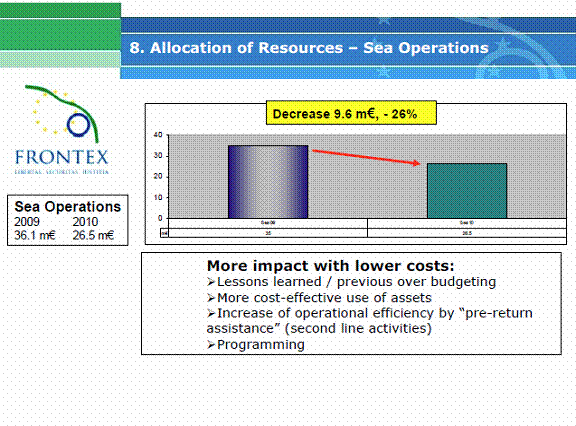
Frontex issued its 2010 Work Programme some time in late 2009.  I have not taken the time to closely read the full 90 page document, but it is worth noting that Frontex sea operations continue to constitute the largest share of the Frontex operational budget, over 26.5 M €.  Due to delayed payments from member states, Frontex is planning on cutting its sea operation budget by 9.7 M € in 2010.

Here are some excerpts from the Programme for Work relevant to sea operations:

“Executive Summary – Frontex’ Programme of Work 2010, as the output of a cyclical planning process, is the operative plan of the Agency to be used as reference for the governance process of assessing and evaluating operational activities carried out during 2010. Frontex’ Programme of Work also seeks to ensure the highest possible level of transparency towards the citizen of the European Union. [***]

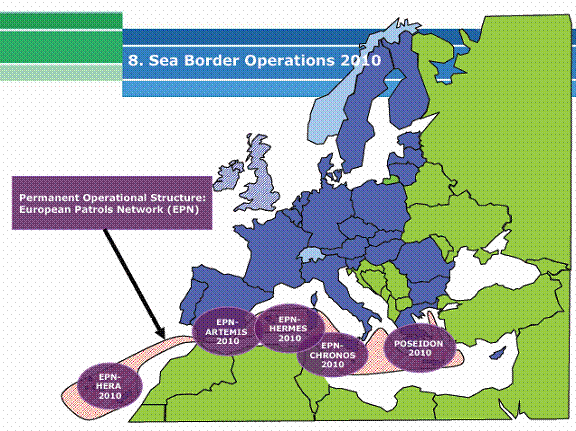
Sea Borders has the biggest share of the budget for operational activities: 26.5 M €. This is a decrease of 9.7 M €. Based on experiences from 2007 and 2008 the budget allocated to Sea Borders has been reduced as payments have been lagging seriously behind and it seems logical that the level of ambition has to be (at least temporarily) adjusted downward. However, the presently foreseen budget does give sufficient room for 7 to 9 projects within the EPN European Patrols Network and 6-7 joint operations in different geographical areas to decrease the illegal immigration flows and to detect facilitators (26.3 M €). Other activities carried out by Sea Borders will be:

– Improved working conditions and improved operational value of interrogation experts (0.1 M €);

– Improved level of awareness in ICCs and regional centers during JOs. (0.1 M €). [***]”

“1.6. Outlook for the situation at the external borders in 2010

General trends –  [***] In May 2009 Libya agreed to direct repatriation of illegal migrants, increasing in the process the deterrent effect of Frontex coordinated Joint Operations in the area. Likewise, Joint Operation Poseidon 2009 has introduced pilot measures to gauge the magnitude of the phenomenon of nationality swapping. When extended and systematized, this measure will facilitate return, determination of illegal migration routes correctly and spotting any displacement in a more timely manner. [***]”

“External maritime borders of the Member States – With significantly lower number of migrants departing from Libya and a decreasing trend of arrivals in the Canary Islands, the relative importance of Algeria, Morocco, Tunisia and possibly Egypt as departure points is likely to grow throughout 2009 and 2010. Efforts by authorities there against illegal migration will be crucial for limiting the flow towards Italy and Spain.  Gambia is expected to take over from Senegal the role of a major embarkation point on the West African coast. That said, in absolute numbers the Aegean Sea (at the border between Turkey and Greece) is expected to remain the main entry point at external sea borders in 2010 should cooperation with Turkey continue to be limited. With the strengthening of the southern EU maritime borders, migrants who initially considered sea crossing might opt for alternative way of entry. One of them might be the use of air borders, either with forged documents or after obtaining visa on false pretence.  At the moment, such a shift has not yet been detected and the risk is considered rather low for 2010, but the situation at the air border should nevertheless continue to be monitored with vigilance. [***]”

“1.7.1. Priority locations by border type

(1) At the external sea borders, operational cooperation should continue to focus on the southern maritime areas where large number of illegal migrants have been detected and where migrants’ life is most at risk, namely the maritime areas leading to: the Canary Islands, the Spanish south-eastern Mediterranean coast, the Island of Lampedusa, Malta—taking into account possible displacement to Sicily and/or Crete—, Sardinia and the Greek Islands close to the Turkish coasts (Lesvos, Chios, Samos, Patmos, Leros and Kos).

Even though decreases detections of illegal border crossing have been reported during the first semester 2009 on the West African and Central Mediterranean routes, operational cooperation should continue to include these areas, on the one hand because the decrease might only be temporary, and on the other because Frontex coordinated Joint Operations in these areas as one factor have contributed to the decrease. [***]”

“1.7.2.2. Recommendations for operational cooperation at the sea borders

(18) All efforts, from diplomatic to technical ones, should continue to be explored to break the deadlock situation of illegal migrants, as advised by facilitators, purposely turning sea surveillance patrols into rescue operations, thereby using surveillance measures as part of their modus operandi. As of mid-2009, such situation was still prevailing in the Aegean Sea.

(19) Joint Operations at the sea borders should aim at developing a permanent linguistic expertise pool, combined with debriefing techniques. Alternatively, language expertise could be outsourced to vetted private sector.

(20) At the sea borders where migrants arrive in big groups, special attention should be given to the rapid identification of victims of THB, especially women and children, with a view to gaining information leading to the identification and prosecution of the traffickers. In this process victim protection should be paramount. [***]”

Click here for a link to the full document.  Note that the document is 90 pages in length but for some reason the 90 page document available at this link is in triplicate, i.e. it is 270 pages in length.  But it is the same 90 page document thrice.

Click here for a link to Slides used by Frontex to summarize some aspects of the Programme.

Leave a comment

Filed under Aegean Sea, Eastern Atlantic, Frontex, Mediterranean, News, Reports

Frontex Presentation at European Defence Agency Annual Conference

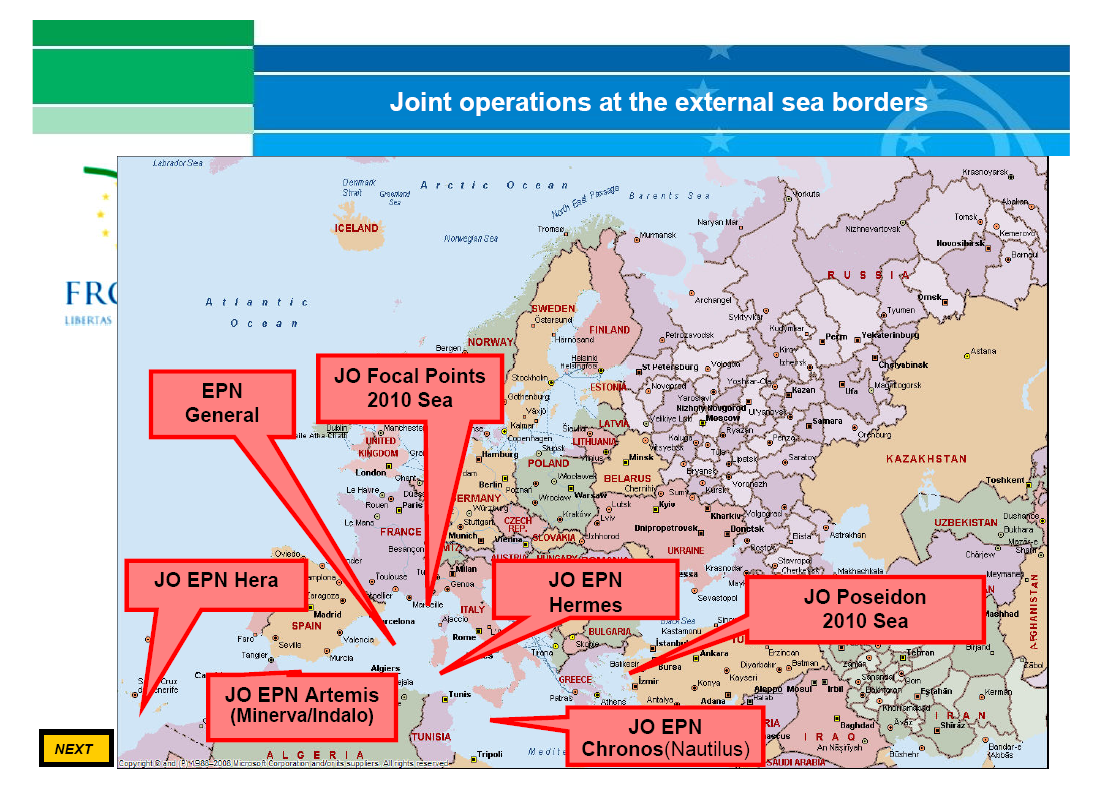
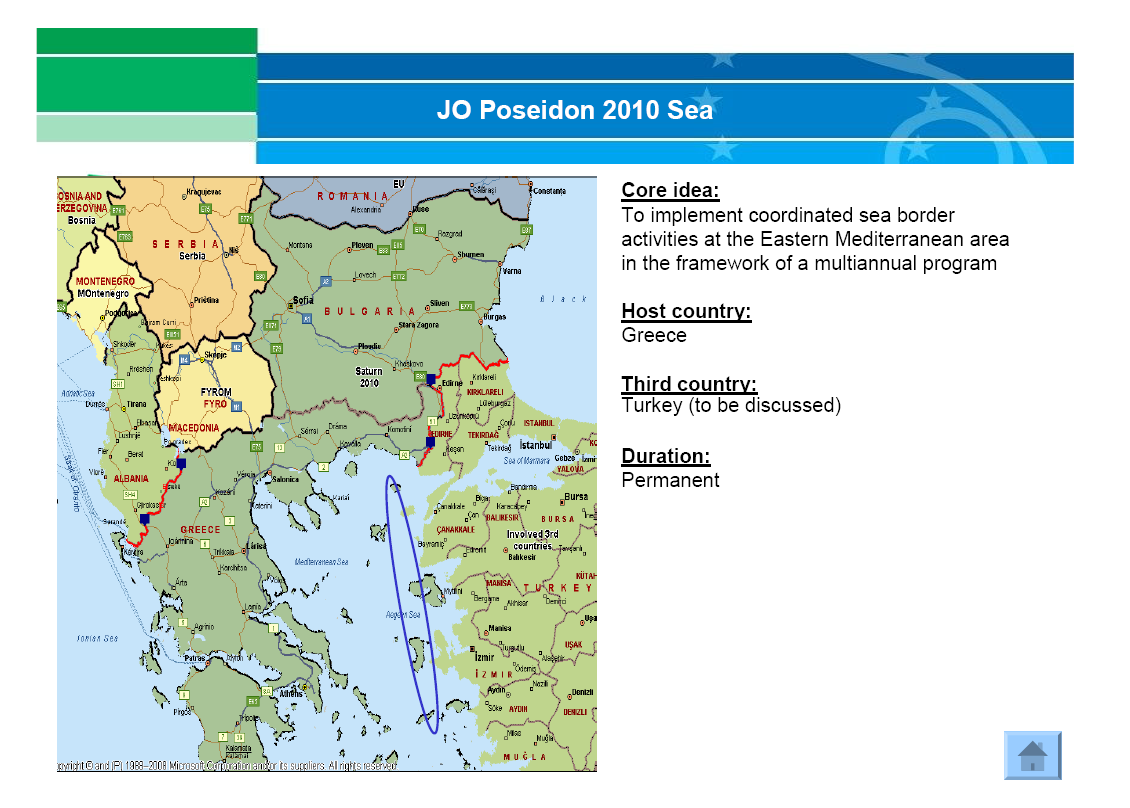
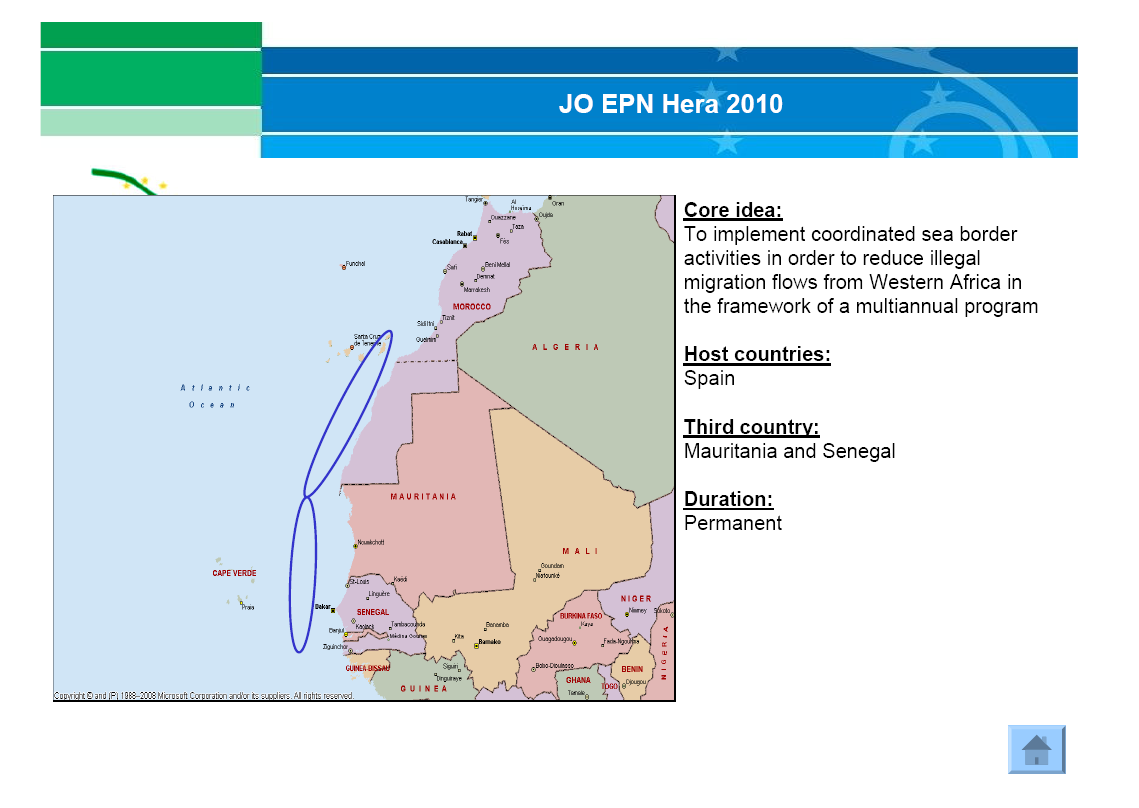
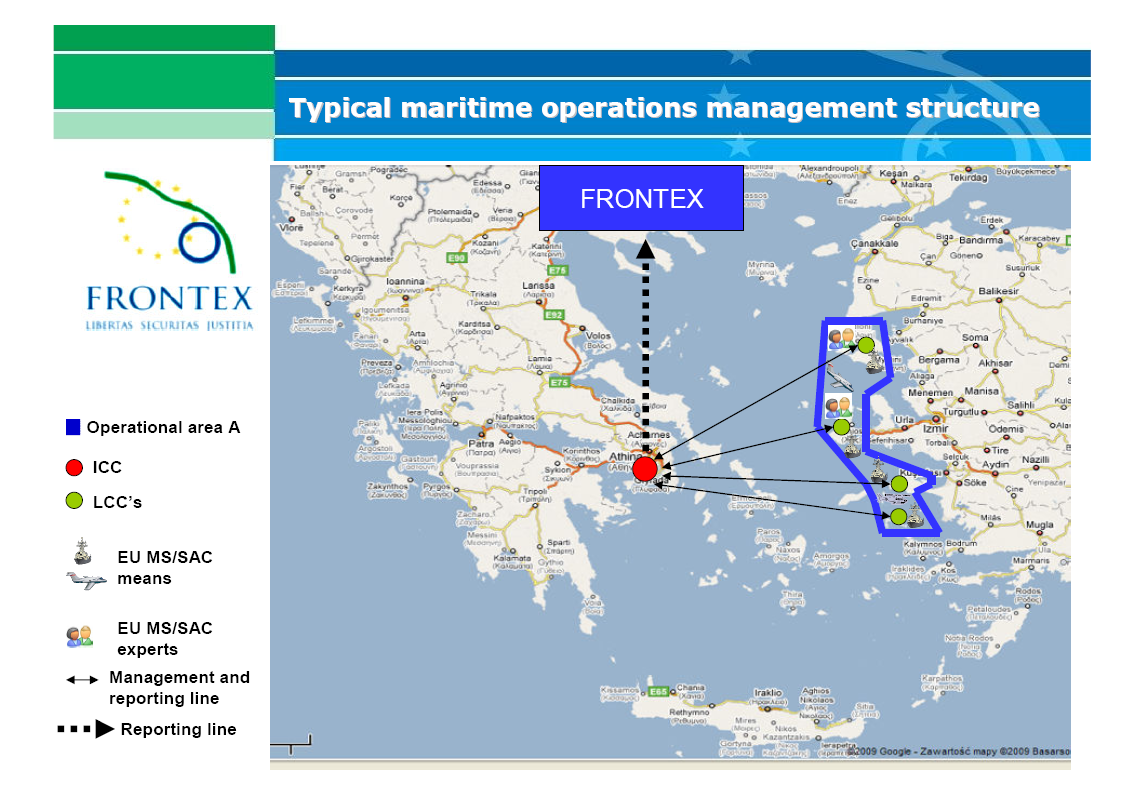
Rustamas Liubajevas, Head, Frontex Joint Operations Unit, presented a lecture entitled “Frontex within integrated Border management concept – Structural approach in planning capability” at the recent Annual Conference of the European Defence Agency.

Copies of some of his slides are reproduced here.

Click here for full slide presentation.

Leave a comment

Filed under Aegean Sea, Algeria, Colloques / Conferences, Eastern Atlantic, European Union, Frontex, Greece, Italy, Libya, Malta, Mauritania, Mediterranean, Morocco, News, Senegal, Spain, Turkey

Malta: New Frontex Guidelines for Operations at Sea Could Be Ignored

The new Armed Forces of Malta Commander, Brigadier Martin Xuereb, suggested in an interview with the Times of Malta that Frontex enforcement operations are governed by operational plans that “may or may not draw from the [newly approved Frontex] guidelines”.  “‘The guidelines also state that the modalities of the operation will be agreed upon in the operational plan decided by countries that participate in the mission,’ he says, insisting the operational plan superseded the [new] guidelines.”  Xuereb also said that it was too early to say whether Malta would decline to participate in future Frontext operations.

Click here for full article.

Leave a comment

Filed under European Union, Frontex, Malta, Mediterranean, News