Category Archives: EU and EU Organizations

Italy to Begin Two Daily Repatriation Flights to Tunisia; Frontex Also Seeking Agreement with Tunisia to Expedite Returns

Prime Minister Silvio Berlusconi said two daily repatriation flights to Tunisia will begin today, Monday.  Frontex Director Ilkka Laitinen said Frontex is “trying to put in place ‘as soon as possible’ a new protocol with Tunisia on sending back irregular migrants….  Laitinen told a group of journalists in Brussels on Friday (9 April) that: ‘For the time being there have been no joint returns to Tunisia co-ordinated by Frontex, as we have no working arrangement with the relevant authority.’”

Click here, (EN), here (EN), and here (IT) for articles.

Leave a comment

Filed under European Union, Frontex, Italy, Malta, Mediterranean, News

UNHCR Calls on EU to Improve Rescue at Sea Measures; NATO Should Also Actively Participate in Rescue at Sea in Regard to All Overcrowded Boats

UNHCR issued a statement on Friday, 8 April, calling “on the European Union to urgently put into place more reliable and effective mechanisms for rescue-at-sea” in the aftermath of last week’s disaster that saw “[m]ore than 220 Somali, Eritrean and Ivorian refugees drowned early on Wednesday morning when their boat capsized some 39 nautical miles south of the Italian island of Lampedusa. This is the worst such incident in the Mediterranean in recent years.  ‘It is hard to comprehend that at a time when tens of thousands are fleeing the Libyan conflict and pouring across the land borders into Tunisia and Egypt where they enjoy safety and receive shelter and aid, the protection of people fleeing via Libya’s maritime border does not appear to have the same priority’ said Assistant High Commissioner for Protection Erika Feller.” “‘We also appeal to shipmasters to continue to render assistance to those in distress at sea. Any overcrowded boat leaving Libya these days should be considered to be in distress’ [, said Feller.]”

While NATO was not mentioned in the UNHCR statement, the call for improved measures to save the lives of migrants who flee North Africa by boat should also be heard and considered by the NATO Maritime Command Naples which is conducting the maritime embargo of Libya known as Operation Unified Protector.   NATO has a significant naval force patrolling the area through which migrant boats leaving Libya are passing and this force should be actively engaged in protecting fleeing civilians.  (Click here for earlier post regarding NATO’s maritime embargo.)

While UN Security Council Resolution 1973 does not speak directly to this issue, it does call for the protection of civilians.  Relevant portions from Security Council Resolution 1973:

  • “Expressing [the Security Council’s] determination to ensure the protection of civilians and civilian populated areas and the rapid and unimpeded passage of humanitarian assistance and the safety of humanitarian personnel, [***];
  • Reiterating [the Security Council’s] concern at the plight of refugees and foreign workers forced to flee the violence in the Libyan Arab Jamahiriya, welcoming the response of neighbouring States, in particular Tunisia and Egypt, to address the needs of those refugees and foreign workers, and calling on the international community to support those efforts, [***];
  • Protection of civilians – 4. Authorizes Member States that have notified the Secretary-General, acting nationally or through regional organizations or arrangements, and acting in cooperation with the Secretary-General, to take all necessary measures, notwithstanding paragraph 9 of resolution 1970 (2011), to protect civilians and civilian populated areas under threat of attack in the Libyan Arab Jamahiriya,… [***].”

As with UNHCR’s call to EU states, NATO ships should also render assistance to any migrant boat detected by NATO forces – any overcrowded boat leaving Libya should be considered to be in distress.

Click here for UNHCR statement.

Click here for article.

Leave a comment

Filed under European Union, Italy, Libya, Malta, Mediterranean, News, UNHCR

France and Italy Agree to Joint Naval Patrols Along Tunisian Coast to Block Migrant Departures

French and Italian Interior Ministers Claude Guéant and Roberto Maroni today have announced an agreement for “joint air and naval patrols” off the Tunisian coast to block departures from Tunisia. Guéant is quoted by Le Figaro as saying that the new measures would be carried out with assistance from Frontex, but the report is unclear whether he is calling for Frontex participation or announcing that Frontex will participate.

While there are no specifics details being reported about this agreement, it seems to constitute a new push-back practice where there will be little or no opportunity for asylum seekers or other persons of concern to be identified and afforded the protection to which they are entitled.  It is simply not possible to intercept vessels at sea and adequately identify who is on board an overcrowded migrant boat and assess whether international protection is needed by anyone on board.

Click here (FR), here (IT) and here (FR) for articles.

1 Comment

Filed under France, Frontex, General, Italy, Mediterranean, News, Tunisia

Italy-Tunisia Reach Migration Agreement: 6 Month Residency Permits for Tunisians Already in Italy; Accelerated Return Procedures for Newly Arriving Tunisians

Italy and Tunisia reached a new migration agreement on Tuesday.  It was signed in Tunis by Interior Minister Roberto Maroni and Tunisian Minister Habib Essid.  Italy reportedly pressed Tunisia to quickly accept the repatriation of the 20,000 Tunisians who have arrived in Italy.  Tunisia refused to agree to the mass return of its nationals.

The compromise that was apparently reached will allow the 20,000 Tunisians who have already arrived in Italy to remain for at least six months with temporary residency permits and Tunisia in turn has apparently agreed to accelerated and simplified return procedures for newly arriving Tunisians that will not require fingerprinting or documentation.  Italy reportedly believes that the accelerated repatriation procedures, once implemented, will act as a deterrent to those Tunisians who may attempt to leave Tunisia after the agreement enters into force.

The accelerated return procedures are troubling in multiple respects.  While the overwhelming majority of persons who have reached Italy over the past two months are Tunisian nationals, over the past week or two for the first time there have been hundreds of non-Tunisians arriving in Italy and Malta.  Many are from Eritrea, Ethiopia, and Somalia and clearly have strong claims to international protection.  An accelerated return procedure will mean that persons with claims to asylum or who are in need of other forms of protection may not be properly identified.

Where will the accelerated return procedures be carried out?  Will migrants be rescued, brought to land, processed under the accelerated procedures, and then repatriated?  Or will Italy attempt to revive its push-back practice and attempt to turn boats around at sea?

The text of the agreement has apparently not been yet made public (at least I cannot find it), but various media reports suggest that its provisions include the following:

  • Six month temporary residency permits for Tunisian nationals who have already arrived in Italy (what happens when the six month period expires is not clear);
  • Temporary residency permits will allow free travel within the Schengen zone (but if the holder of the permit is outside of Italy when the permit expires, the person could apparently be returned to Italy);
  • Accelerated direct repatriation for newly arriving Tunisian nationals (the date on which the decree is signed will apparently determine whether a Tunisian receives the temporary permit or is subject to direct repatriation, the decree may be enacted as soon as today, Wednesday, 6 April);
  • Increased cooperation between Italy and Tunisia police / security forces;
  • Italy to provide 12 new and refurbished patrol boats and hundreds of off-road vehicles to Tunisia.

The announcement of this bi-lateral agreement comes one day after Frontex released its recently approved Fundamental Rights Strategy.  Click here for yesterday’s post about this strategy.  Note the following provisions within the strategy:

“14. [***] One particular objective in [Joint Operations] is ensuring that the right to international protection must not be hampered by the law enforcement action and that persons seeking protection are referred to the competent national authorities to assess their case.

15. [***] Corrective measures should be taken in case of breach or serious risk of breach of fundamental rights. As last resort, Frontex might terminate a JO if the conditions guaranteeing the respect for fundamental rights are no longer met. [***]”

It remains to be seen what Italy will do in regard to accelerated direct repatriations to Tunisia, but there is definitely the concern that the right to international protection may be hampered by Italy’s actions.  Frontex’s Joint Operation Hermes Extension is currently hosted by Italy.  Frontex may be obligated to act pursuant to its Fundamental Rights Strategy depending on what new practices are implemented by Italy.

Click here (IT), here (IT), here (IT), here (FR), here (FR), and here (EN) for articles.

6 Comments

Filed under European Union, Frontex, Italy, Mediterranean, News, Tunisia

Libyan Migrant Boats Carrying Over 400 People Missing; Reports of Deaths

There have been reports in recent days from the UNHCR and others about at least two boats that are believed to have left Libya over the past 10-14 days carrying persons from Eritrea, Ethiopia, Somalia, and possible other countries.  Family members and friends of people who are believed to be on the boats have been calling for assistance in searching for the boats.  Reuters reported that “[o]ne of the boats was reported to have left Libya on March 22 with 335 people on board.  Italian media said 68 people on the other boat had almost certainly died during the journey, although there was no official confirmation. The top Vatican official in Tripoli, Bishop Giovanni Innocenzo Martinelli, said 10 bodies of African migrants were at the capital’s morgue on [4 April]. … He said there were reports of ‘many more bodies’ of migrants washed up on the shores of Garaboulli, some 40 km from Tripoli.”  Father Mussie Zerai, who is based in Rome, “said he had last spoken to migrants on board the smaller boat, an inflatable, by satellite phone on 26 March before the line went dead.  ‘I have meanwhile had no contact with the larger boat, but family members of those on board have called us from Canada, Sweden and Switzerland to tell us they left.’”

Click here and here for articles. (EN)

There have been confirmed deaths among migrants who have left Tunisia in recent weeks.  At least 27 bodies had been recovered as of last week in Kerkennah.  The dead were probably on board boats that sank on the 13th and 27th of March off the Tunisian coast.

Click here for article.

UPDATE:  If you have information about a family member or friend who may be on a boat or if you are seeking information, please consider contacting the Agenzia Habeshia per la Cooperazione allo Sviluppo in Italy at this email address: agenzia_habeshia@yahoo.it .


4 Comments

Filed under European Union, Frontex, Italy, Libya, Mediterranean, News, Tunisia, UNHCR

Frontex Releases its “Fundamental Rights Strategy”

According to a Frontex press release, “Frontex’s Management Board endorsed the Agency’s Fundamental Rights Strategy during its most recent meeting, on March 31. The approved document sets out the objectives, legal and political context, operational implications and implementation plan for the strategy.”  “The new strategy will be elaborated into an Action Plan, which has been requested by the Management Board with a view to adopting it at the next meeting, scheduled for May 24.”

I have done a quick read of the 8 page document and overall had a positive reaction to the strategy.  One weakness, and there are probably others, is that in the end “Member States remain primarily responsible for the implementation of the relevant international, EU or national legislation and law enforcement actions undertaken in the context of Frontex coordinated joint operations…”  (See Para 13 below.)  There is not much that Frontex can do about this, unless Frontex is given authority to act independently from individual MS.

The strategy does contemplate that Frontex can terminate a Joint Operation if respect for fundamental rights can not be guaranteed.  (See Para 15 below.)  I try to imagine how this strategy would operate within the current Joint Operation Hermes if the influx of Tunisians were to continue and expand and if Italy were to begin unilateral returns of Tunisian nationals (or others) to Tunisia without adequate process.  Would Frontex discontinue Operation Hermes?  It is hard to imagine that happening given the current situation in North Africa.

Here are some excerpts from the strategy consisting of some of the provisions which jumped out at me – the full document however should be consulted:

“Preamble

Frontex considers that respect and promotion of fundamental rights are unconditional and integral components of effective integrated border management.

[***]

The Legal and Political Context

[***]

13. Member States remain primarily responsible for the implementation of the relevant international, EU or national legislation and law enforcement actions undertaken in the context of Frontex coordinated joint operations (JOs) and therefore also for the respect of fundamental rights during these activities. This does not relieve Frontex of its responsibilities as the coordinator and it remains fully accountable for all actions and decisions under its mandate. Frontex must particularly focus on creating the conditions for ensuring compliance with fundamental rights obligations in all its activities.

The Operationalisation

Joint Operations

14. [***] One particular objective in [Joint Operations] is ensuring that the right to international protection must not be hampered by the law enforcement action and that persons seeking protection are referred to the competent national authorities to assess their case.

15. [***] Corrective measures should be taken in case of breach or serious risk of breach of fundamental rights. As last resort, Frontex might terminate a JO if the conditions guaranteeing the respect for fundamental rights are no longer met. [***]

17. Frontex will put in place an effective reporting system to ensure that any incidents or serious risks regarding fundamental rights are immediately reported by any participating officer or Frontex staff member and can be acted upon. This reporting should be the basis for effective monitoring of all its operations. The monitoring effectiveness and credibility will rely heavily on the commitment of national border guard services to report but also on the involvement of external stakeholders. The Operational Plan shall set out the modalities for reporting, including how and to who report.

[***]

19. Alleged violations of human rights reported either by national or Frontex officers or third parties, when substantiated, will be followed up by Frontex by communicating and clarifying the situation in cooperation with the competent national authorities without prejudice to any resulting administrative or penal procedures. Member States should also inform Frontex on the follow-up measures.

[***]

21. In addition to pursuing a regular exchange of information with external partners engaged in fundamental rights protection activities, in particular the Fundamental Rights Agency (FRA), the European Asylum Support Office (EASO), the United Nations High Commissioner for Refugees (UNHCR), the International Organization for Migration (IOM) and the EU Anti-Trafficking Coordinator, Frontex will endeavour to ensure their regular involvement in the relevant operational activities in accordance with the Working Arrangements with these partners. The involvement of these external partners or others should be foreseen in the Operational Plan, which should also define the scope of the cooperation.

22. Frontex will also seek advice from its external partners on the relevant instructions or guidelines for officers taking part in Frontex activities. These instructions or guidelines, which should form an integral part of each Operational Plan, could relate to methods for better identifying people seeking international protection, proper treatment of vulnerable groups including potential victims of trafficking or fundamental rights monitoring of operational activities. The final aim is to promote the highest standards in compliance with fundamental rights by the development and promotion of best practices.

[***]

External Relations

28. Frontex cooperation with Third Countries’ border-guard services is conducted under the EU External Relations Policy and shall therefore be guided by the principle of the respect of human rights. Frontex is committed to adjusting its cooperation arrangements and activities to the EU foreign policy measures adopted as a consequence of the human rights situation in the partner Third Country.

[***]

The Implementation

[***]

38. In order to increase the transparency and credibility of this process, external third parties, in particular those representing civil society, shall be involved. Their concerns and perspectives must be taken into account for the evaluation and revision of the strategy. Frontex, national border-guard services, external partners and representatives of civil society shall therefore have the possibility to exchange views and suggest means of improvement for the strategy and the Action Plan in a consultative forum, to be convened periodically at Frontex Headquarters.

[***]”

Click here for the Frontex strategy document.

Click here for Frontex press release.

1 Comment

Filed under European Union, Frontex, News

Nationalities of Migrants Who Arrived in Malta from Libya Last Week

From the Times of Malta (sources: Home Affairs Ministry and parliamentary replies) and as noted on EASO Monitor:

Nationalities of migrants who arrived last week

  • Somalia – 411
  • Eritrea – 250
  • Ethiopia – 87
  • Ivory Coast – 26
  • Mali – 16
  • Pakistan – 14
  • Sudan – 6
  • Nigeria – 6
  • Yemen – 2
  • Mauritania – 1
  • Total: 819

Migrants in Malta before Libya crisis

  • Held in detention: 79
  • Living in open centres: 2,224
  • Living in the community: 1,400
  • Total: 3,703

Migrant arrivals in previous years

  • 2007: 1,702
  • 2008: 2,775
  • 2009: 1,397
  • 2010: 27

Click here for article.

Leave a comment

Filed under Data / Stats, Eritrea, Ethiopia, European Union, Frontex, Libya, Malta, Mediterranean, News, Somalia

Maltese Conditions for Hosting Frontex Mission Not Accepted by Frontex

The Times of Malta has posted copies of an exchange of correspondence between Home Affairs Minister Carmelo Mifsud Bonnici and Frontex Director Ilkka Laitinen.   The Times of Malta article does not identify the source of the correspondence.  It appears likely that the posted correspondence does not include all of the recent communications between Malta and Frontex.  However, that which has been made available by the Times of Malta provides additional background information regarding Malta’s refusal to host a Frontex mission.

According to the posted correspondence, on 10 March, Mifsud Bonnici made an urgent request to Frontex for a new Joint Operation and deployment of a Rapid Border Intervention Team.  Malta’s request however was conditioned upon Frontex agreeing to the establishment of a joint processing centre outside of Malta and an agreement not to follow the non-binding Guidelines pertaining to the surveillance of the sea external borders contained in Part II of the Annex to Council Decision 2010/252/EU.

On 29 March, Director Laitinen responded.  Laitinen said that on 22 March he took the decision to deploy a RABIT team to Malta and that a fact-finding visit to Malta took place 24-25 March, but that during the visit, the Frontex delegation was informed that Malta would agree to accept a RABIT deployment only if Malta’s requests for the creation of the joint external processing centre and the Joint Operation were organised simultaneously with the RABIT deployment.  Laitinen said that as of 28 March Frontex had received 10 official answers from Member States responding to Malta’s request for contribution to a possible Joint Operation and creation of the external processing centre; 9 of the answers were negative or questioned the concept of joint operation:  “According to the replies – and also indicted by the number of missing replies – it is obvious that the MS consider the establishment of a joint processing centre as an issue that needs discussion and agreement on political level.  It remains doubtful from legal point of view that a joint operation not applying the non-binding part of the Maritime guidelines – Council decision No 2010/252/EU – could be developed and implemented under Frontex coordination.”

Mifsud Bonnici’s initial letter was written before the first migrant boat from Libya arrived  in Malta on 28 March.  Presumably discussions between Malta, Frontex, and the Commission are ongoing.

Click here or on this link (Mifsud Bonnici Ltr – 10 March 2011 ) for the letter from Mifsud Bonnici to Laitinen.

Click here or on this link (Laitinen Ltr – 29 March 2011 ) for the letter from Laitinen to Mifsud Bonnici.

Click here for Times of Malta article.

A third letter from Commissioner Malmström was also posted by the Times of Malta.  It makes reference to the exchange discussed above.  More on this and on Malta’s call for triggering the Temporary Protection Instrument later.

Click here or on this link ( Malmström Ltr – 1 April 2011 ) for the letter from Malmström to Mifsud Bonnici.

1 Comment

Filed under European Union, Frontex, Libya, Malta, Mediterranean, News

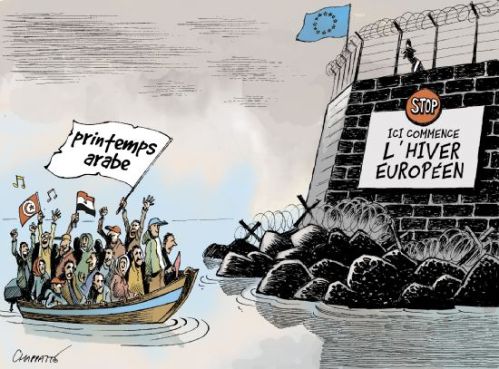
The Arab Spring meets the European Winter (by Chappatte)

© Chappatte - http://www.globecartoon.com - Used by Migrants At Sea with permission.


Leave a comment

Filed under Analysis, European Union, Frontex, Mediterranean

France Restores Border Controls at Italy-France Border to Block Entry by Tunisians

Growing numbers of Tunisians are arriving in the Italian border town of Ventimiglia (Vintimille), on the border with France, and are attempting to enter France.  3500 Tunisians have reportedly arrived in recent weeks.  Most of the newly arriving Tunisians appear to have passed through Lampedusa in recent weeks and were then relocated elsewhere in Italy to relieve the overcrowding on the island.  Many of the Tunisians arriving in Lampedusa have been very clear about their desire to continue on to France due to family or linguistic ties.

France has reinstituted some border controls in the area in an effort to block the entry of the Tunisians.  Additional controls are being instituted within French territory in Menton and Nice.  La Stampa reports that “[p]eople smugglers, who had largely disappeared when border checkpoints [in the Schengen area] were closed down, are now increasingly common. [Smugglers] seek out the migrants at the station [in Ventimiglia] and offer to take them to France…”  Le Point suggests that “by discretely allowing illegal immigrants to arrive in Ventimiglia, Italy is hoping that Europe will wake up and share the burden.  Italian Foreign Minister Franco Frattini on Wednesday criticised France for returning Tunisians to Italy after crossing the border, accusing France of a lack of solidarity.

Click here (EN), here (FR), and here (FR) for articles.

6 Comments

Filed under European Union, France, Italy, Mediterranean, News, Tunisia

Frattini Criticises EU for Failure to Assist Italy; Frattini and MEPs Call for Implementation of Temporary Protection Directive and Mandatory Burden Sharing

Italian Foreign Minister Franco Frattini has again criticised what he describes as the EU’s and European Commission’s failure to assist Italy with the migrant situation in Lampedusa. Minister Frattini singled out Commissioner Malmström for his criticism.  A statement on the Italian Foreign Ministry web site says that “Italy continues to solicit Europe’s help in confronting the immigration emergency, not only in terms of economic aid but also in terms of a plan for the distribution of the refugees among Member States. ‘Europe has been totally inert in this period’, Minister Frattini asserted and, commenting on EU Home Affairs Commissioner Cecilia Malmström[‘s] observation that Italy had already received European funding for managing the influx, specified: ‘This is the typical expression of a European bureaucracy that thinks money alone solves everything’, but it is not enough, ‘there need to be policy interventions’. …[I]n addition to funds it is necessary to ‘invoke a European law clearly establishing the adoption of an extraordinary plan with any sudden influx of refugees toward one or more Member States, which includes the distribution of the refugees among Members within the temporary timeframe necessary to repatriate those who are not refugees, as in the case of the Tunisians, who are simply economic immigrants’.”

MEPs Simon Busuttil (Malta) and Salvatore Iacolino (IT) issued a press release calling on the Commission “to activate the Solidarity Mechanism envisaged in EU law in cases of mass influx of displaced persons. … ‘EU law already provides for a solidarity mechanism that can be triggered in the event of a mass influx of displaced persons (Council Directive 2001-55-EC)’ [and ‘we call upon the Commission to activate it’] Busuttil and Iacolino said.”

Click here for Italian Foreign Ministry statement.

Click here for MEPs Busuttil and Iacolino press release.

Click here for link to Temporary Protection Directive.

1 Comment

Filed under European Union, Italy, Libya, Malta, Mediterranean, News, Statements, Tunisia

Malmström and Füle to Visit Tunisia for Migration Discussion

Commissioners Cecilia Malmström and Stefan Füle are scheduled to travel to Tunisia 30 and 31 March to assess the situation at the refugee camps along the Tunisia-Libya border, including the camp near Djerba, and for discussions with Tunisian Prime Minister Béji Caïd Essebsi and other officials.  Among the topics to be discussed will be the Tunisian nationals who have come to Italy in recent weeks, but who are not in need of international protection and who therefore are likely to be sent back to Tunisia by Italy. Malmström will be discussing with the Tunisian transitional government how the returns could possibly be carried out.

Click here (SV), here (SV), and here (FR) for articles.

Leave a comment

Filed under European Union, Italy, Libya, Mediterranean, News, Tunisia

Italy Issues Warning: If Tunisia Fails to Stop Migrants, Italy Will Begin Forced Repatriations

Italian Interior Minister Roberto Maroni said on Monday that “[i]f [the Tunisian Government] do[es] not send specific signals [and begin] keeping the promise of a commitment to stop the migration, Italy will proceed with the forced repatriations.” (“Se non manderà segnali concreti, mantenendo la promessa di un impegno per fermare i flussi migratori, l’Italia procederà con i rimpatri forzosi.”)  Maroni also said “Tunisia had promised an immediate commitment to stop migration, but the boats continue to arrive.  We are not subject to blackmail as with Libya for oil. [Tunisia is] dependent on us, especially in the tourism sector.”

Foreign Minister Frattini said that if Tunisian migrants do not agree to assisted returns to Tunisia, with the possible payment of €1500 using EU funds, “there is a second level of intervention for those who do not accept assisted repatriation, which is stated in the Bossi-Fini law: expulsion.”

Click here, here, here and here for articles. (IT)

Click here (EN), here (IT), and here (IT) for postings on the Foreign Ministry web site.

Leave a comment

Filed under Frontex, Italy, Mediterranean, News, Tunisia

2000 Migrant Arrivals Over Last 24 Hours; Lampedusa Residents Continue Protests and Blockade Port

Over 1900 migrants have reached Lampedusa over the past 24 hour period.  Approximately 3700 have arrived over the past 3 days.  Fishermen have placed four empty migrant boats across the entry to the main harbour on the island in an effort to prevent the entry of migrant boats or Coast Guard boats carrying migrants.  Officials say that by Wednesday of this week, ships with capacity to carry up to 10,000 people will arrive on Lampedusa in order to move many of the migrants now on the island to other locations.

Click here and here for articles. (IT)

Leave a comment

Filed under Frontex, Italy, Libya, Mediterranean, News, Tunisia

UNHCR Report: “2010 Asylum Levels and Trends in Industrialized Countries”; Levels Fall to Half of 2001 Levels

From UNHCR’s statement summarizing the report which was released this morning:

“Asylum figures fall in 2010 to almost half their 2001 levels-

GENEVA – The number of asylum-seekers in the industrialized world continued to fall in 2010, bringing the figure down to nearly half the level at the start of the millennium.

This was among the main findings as the UN refugee agency today released its 2010 statistical overview of asylum applications in 44 industrialized countries. The report deals with new asylum claims and does not show how many individuals were granted refugee status.

According to the report, 358,800 asylum applications were lodged in industrialized countries last year – down 5 per cent from 2009, and some 42 per cent lower than the decade’s peak in 2001, when almost 620,000 asylum applications were made…

Numbers fall in most regions

Last year’s total number of new asylum claims was the fourth lowest in the last decade. Year-on-year decreases were reported in most regions, including in Europe, North America and North Asia. Within Europe, the largest decline was seen in southern Europe, where claims fell by 33 per cent compared to 2009. This was mainly because fewer people requested protection in Malta, Italy and Greece. However, this decline was offset by increases elsewhere, especially in Germany (49%), Sweden (32%), Denmark (30%), Turkey (18%), Belgium (16%) and France (13%). In the Nordic countries, the increases in Denmark and Sweden were offset by substantial declines in Norway (-42 per cent) and Finland (-32 per cent)….

US tops recipient list

Among individual countries, the United States remained the largest asylum recipient for the fifth consecutive year, accounting for one out of every six asylum applications in the industrialized countries covered in the report. The US saw an increase of 6,500 applications, partly due to a rise in the number of Chinese and Mexican asylum-seekers.

France maintained its position as host to the second-largest number of new applications, with 47,800 in 2010, largely from Serbian, Russian and Congolese asylum-seekers. Germany became the third-largest recipient country with a 49-percent rise. The increases can partly be attributed to a rise in asylum seekers from Serbia and the former Yugoslav Republic of Macedonia. That development is widely attributed to the introduction of visa-free entry to the European Union for nationals of these two countries since December 2009.

Sweden and Canada ranked fourth and fifth respectively. Together, the top five countries of asylum accounted for more than half (56 per cent) of all asylum applications covered in this report.

Most claims from Serbia

In terms of places of origin, the largest group of asylum-seekers in 2010 were from Serbia (28,900, including Kosovo). The country saw a 54 per cent increase compared to 2009, when it ranked sixth. Interestingly, the number of asylum applications in 2010 was comparable to 2001, soon after the Kosovo crisis.

Afghanistan slid to second place with a decrease of 9 per cent compared to the previous year. Unlike in 2009, when Afghan claims were mainly lodged in Norway and the United Kingdom, in 2010 more claims were filed in Germany and Sweden. Chinese asylum-seekers made up the third-largest asylum group in 2010, partly due to a substantial drop in the number of new applications from Iraq and Somalia. For the first time since 2005, Iraq was not one of the top two countries of origin of asylum-seekers. It dropped to fourth place, followed by the Russian Federation. Somalia, which occupied the third spot in 2009, fell to sixth in 2010….”

Click here for full report.

Click here for key graphs from report.

Leave a comment

Filed under Data / Stats, European Union, News, Reports, UNHCR