Category Archives: General

More Assets Dedicated to Frontex Joint Operation “Hermes Extension”; More EU and NATO Naval Forces Present in Central Mediterranean

The assets dedicated to Joint Operation Hermes Extension continue to increase, although at present there are only two coastal patrol boats (Italian) participating in the Frontex  mission.  Ten surveillance aircraft will soon be deployed.  See the table with the list of resources below.

While the naval assets dedicated to JO Hermes Extension are minimal, there is a growing number of EU and NATO naval ships in the Central Mediterranean.  Nicolas Gros-Verheyde (writing on the Bruxelles2 blog (FR)) has counted 14 naval ships from EU states that are present in the waters near Libya; the ships consist of destroyers, frigates, electronic surveillance ships, and supply and support ships.   Additionally, Turkey has two naval ships in the area.

Some of the naval ships have already been used to evacuate European and other non-Libyan nationals from Libya.  What additional activity the EU ships may engage in remains to be seen.  They may become involved in military activities (presumably with UN authority (?)) and/or they may play a yet undetermined role should there be a sudden flow of migrants and asylum seekers from Libya.  If there is a sudden and significant migratory flow, the naval ships should function in a search and rescue manner, but there is always the possibility that if faced with large numbers of migrants, the navy vessels may be used to interdict, blockade, or otherwise to try to prevent migrants from leaving Libya.

Click here for link to Frontex update regarding deployed assets.

Click here and here for Bruxelles2 postings. (FR)

Table: Resources available to JO Hermes Extension 2011 as of February 25, 2011.

Italy (HMS) 2 Coastal Patrol Vessel, 1 aircraft, 5 experts, 2 cultural mediators
Austria 1 expert
Belgium 2 experts
Denmark 3-5 experts
France 10 experts, 1 aircraft
Germany 2 experts, 2 aircrafts
Hungary 2 experts
the Netherlands 1 aircraft, 2 experts
Portugal 7 experts, 1 aircraft
Romania 6 experts
Sweden 1 expert
Switzerland 2 experts
Spain 4 experts, 1 aircraft (at a later stage)

Leave a comment

Filed under Algeria, Data / Stats, European Union, Frontex, General, Italy, Libya, Malta, Mediterranean, News, Tunisia

Network Euro Mediterraneo per i Diritti dell’Uomo: Missione di raccolta informazioni in Tunisia e Italia e Raccomandazioni

From CIR:  “…[I]l Network Euro Mediterraneo per i Diritti dell’Uomo ha organizzato una missione di raccolta informazioni, che si è svolta dal 18 al 24 febbraio prima in Tunisia e poi in Italia. La missione era composta da rappresentanti di organizzazioni membro del Network e di partner e da esperti del Nord e del Sud del Mediterraneo. La missione ha potuto raccogliere testimonianze e informazioni dirette, tanto in Tunisia che in Italia.

La missione ha permesso di smentire sia la tesi della presenza massiva tra i migarnti arrivati in Italia di delinquenti di diritto comune evasi dalle carceri, sia quella di un complotto migratorio che sarebbe stato ordito dalla Libia e dai nostalgici di Ben Ali.

Nel corso della missione, le preoccupazione legate agli avvenimenti drammatici che sconvolgono la Libia hanno, in qualche maniera, soppiantato gli interrogativi che circondano i migranti tunisini.

Al termine di questa missione, il Network formula le seguenti raccomandazioni:

Alle autorità italiane:

  • Rispettare la dignità di tutti i migranti, quali che siano le loro motivazioni.
  • Sospendere l’applicazione dell’accordo bilaterale di riammissione con la Tunisia sotto il concluso con il regime di Ben Ali. Sospendere tutte le misure di espulsione forzata individuale o collettiva verso la Tunisia.
  • Richiedere all’Unione Europea l’attivazione del meccanismo di protezione temporanea.
  • Nell’attesa della protezione temporanea, accordare ai migranti una forma di protezione umanitaria che si traduca in un titolo di soggiorno legale in Italia. Misura che deve essere indicata dalle autorità centrali e che non deve essere in alcun modo delegata alla discrezionalità delle singole Questure e Commissioni Territoriali per il riconoscimento della protezione internazionale
  • Migliorare e razionalizzare le condizioni d’accoglienza, il ricorso allo stato d’urgenza umanitaria non può tradursi in un abbassamento degli standard di accoglienza.
  • Astenersi dal mettere in opera il progetto di raggruppamento del Villaggio Mineo, in Sicilia, di tutti i richiedenti asilo in corso di procedura in Italia, misura         che può provocare una situazione di ghetto ed esclusione sociale
  • Assicurare ai migranti che hanno fatto domanda d’asilo un esame individuale della domanda di protezione nel pieno rispetto delle direttive “procedure” e “qualifiche”
  • Astenersi da dichiarazioni allarmistiche e incendiarie che assimilano migranti, delinquenti e terroristi

Alle autorità tunisine

  • Garantire la libertà di tutte le persone di lasciare qualsiasi paese compreso il proprio ( Articolo 12, 2 del Patto internazionale relativo ai diritti civili e politici). Di conseguenza, astenersi di tutte le procedure penali per le persone fermate nel tentativo di lasciare la Tunisia via mare o per quanti sono rimpatriati forzatamente verso il Paese
  • Rispettare pienamente le obbligazioni marittime internazionali relative alla ricerca e al salvataggio in mare.
  • Aprire una inchiesta approfondita e imparziale sulle condizioni nelle quali una barca è affondata l’11 febbraio, in un incidente che è costato la vita ad almeno 5 persone, e perseguirne i responsabili
  • Sospendere l’applicazione dell’accordo bilaterale sul controllo dell’Immigrazione concluso con l’Italia. Esigerne la rinegoziazione e, nel futuro, escludere la possibilità di rimpatri massivi e la sua applicazione a cittadini di paesi terzi.

Alle autorità europee

  • Accompagnare gli Stati dell’Africa del Nord nel processo di transizione in corso, poiché la democrazia è la sola a poter garantire una reale stabilità nella regione, e quindi offrire ai giovani la possibilità di costruire il loro futuro in un paese nel quale possono progettare un avvenire.
  • Aiutare l’Egitto e la Tunisia che, contrariamente all’Europa, sono già stati chiamati ad accogliere rifugiati libici e stranieri, in provenienza dalla Libia. La solidarietà a cui si appellano gli Stati del Sud dell’Unione Europea deve esprimersi innanzitutto nei confronti di questi Stati in transizione
  • Astenersi da tutte le operazioni che avrebbero come conseguenza la dissuasione o l’impedimento dell’arrivo in Europa di persone che avrebbero bisogno di protezione
  • Prepararsi all’attivazione della direttiva sulla “protezione temporanea” nel caso si producano arrivi massivi dal Nord Africa.”

Click here (IT) for full CIR post.

See also CIR “Emergenza Nord Africa”.

Leave a comment

Filed under European Union, General, Italy, Libya, Mediterranean, Reports, Statements, Tunisia

ASIL Insight article about M.S.S. v. Belgium & Greece

ASIL has just published an Insight article about M.S.S. v. Belgium & Greece written by Tom Syring, Co-chair of the ASIL International Refugee Law Interest Group, who currently serves at the Norwegian Immigration Appeals Board.

Excerpt from the conclusion:  “Apart from criticizing Greece for the current conditions of detention and subsistence awaiting asylum seekers, and Belgium for ‘intentional blindness’ for failing to properly scrutinize the adequacy of protection against refoulement in Greece, despite the fact that circumstances had called for application of the sovereignty clause, the Grand Chamber’s judgment exposes flaws in the current European asylum regime.

The judgment acknowledges … challenges [posed by CEAS and the Dublin regulation], yet underlines that neither uneven burden-distribution (Greece) nor a state’s minimalist reading of the Dublin Regulation (Belgium) absolves Member States of their responsibilities vis-à-vis the Convention or other applicable international treaties, including the 1951 Refugee Convention. As long as the EU and CEAS are comprised of individual Member States, as opposed to a ‘United States of Europe,’ individual states will be held responsible for independently assessing each case for the risk of direct or indirect refoulement.   While the Grand Chamber judgment uncovered a number of deficiencies in the current European asylum system, solutions to CEAS may have to be found outside the ‘Dublin world.’”

Click here for full article.

1 Comment

Filed under Analysis, Belgium, European Union, General, Greece, Judicial

WikiLeaks 2009 US Cable: Italian Ambassador to Libya questions sincerity of Libya’s commitment to combatting illegal migration

This US Department of State cable, released by WikiLeaks on 1 Feb 2011, was written by Gene Cretz, US Ambassador to Libya.  The cable is entitled “The Frogman Who Couldn’t Swim: A Cooperation Cautionary Tale.”  (The cable’s title refers to an incident where Libya sent a member of its Public Security organization who was unable to swim to Italy for training in underwater explosives detection and demolition.)

The cable was written on 17 February 2009 in the same month that the provisions of the Italy-Libya agreement relating to Italy’s maritime push-back practice took effect and three months before the first major interceptions and forcible returns of hundreds of migrants to Libya which occurred in May 2009.  If the US Ambassador’s reporting in the cable is accurate, it would suggest that Italy’s Ambassador to Libya at the time did not believe that Libya was about to begin cooperating with Italy on illegal migration.  Though the cable does point out that comments made by the Italian Ambassador “pre-dated the early February visit to Libya by Italy’s Minister of the Interior, Roberto Maroni, who signed an MOU to implement earlier agreements on counter-migration and counterterrorism cooperation.”

Excerpts from the Cable:

“ITALY ALARMED BY INCREASE IN NUMBER OF ILLEGAL MIGRANTS TRANSITING LIBYA

2. (C) At a recent meeting hosted by the U.K. Ambassador to discuss counterterrorism engagement efforts, Italian Ambassador Francesco Trupiani expressed profound frustration with difficulties Italy had encountered in trying to cooperate with the GOL on counterterrorism and combatting illegal migration (Italy views the two issues as being linked).  Italy was alarmed by the marked increase in the number of illegal migrants that had arrived in Italy – primarily on the island of Lampedusa – from Libya.  By way of example, he offered that 1,300 Tunisian illegal migrants traveled from Libya to Italy in 2007.  In 2008, 5,900 Tunisians made landfall in Italy after departing from Libya’s coast.  The number of migrants from Somalia – “a derelict state” – who had arrived in Italy increased from 5,110 in 2007 to 31,764 in 2008.  The number of Nigerians had increased threefold and featured a heavy contingent of prostitutes and narco-traffickers.

LIBYA DELAYING COOPERATION TO LEVERAGE EU FRAMEWORK NEGOTIATIONS?

3. (C) Noting that smuggling illegal migrants was highly profitable, that the GOL claimed to exercise tight control over travel within Libya, and that senior regime officials traditionally had a direct stake in highly lucrative enterprises (licit and otherwise), Trupiani said it was “implausible” that large numbers of illegal migrants had transited Libya without at least the tacit consent of GOL officials.  The substantial increase in the number of illegal migrants meant a corresponding increase in the amount of money involved.  He speculated that there could be a “logical nexus” between smuggling of illegal migrants, arms trafficking and movement of terrorists, and lamented that no one appeared to be holding the GOL accountable for its failure to more effectively address those inter-related problems.  Worse, the GOL appeared to be deliberately delaying engagement with Italy and other European partners to leverage negotiations for a Libya-EU Framework Agreement (EU External Affairs Commissioner Benita Ferrero-Waldner was in Tripoli February 9-10 for the latest round of negotiations).

***

6. (C) Trupiani was not optimistic that bilateral cooperation would improve in the near term. (Note: Our exchange with Trupiani pre-dated the early February visit to Libya by Italy’s Minister of the Interior, Roberto Maroni, who signed an MOU to implement earlier agreements on counter-migration and counterterrorism cooperation (further details septel).  End note.)  He cited lack of human capacity and rampant corruption and nepotism as limited factors….”

Click here or here for the full cable.

1 Comment

Filed under European Union, General, Italy, Libya, Mediterranean, News, United States

EASO Issues Call for Seconded National Experts

As noted yesterday on the EASO Monitor blog, EASO has issued a call for multiple Seconded National Experts.  The following list is probably incomplete and is based on information posted on the web site of the Slovenian Ministry of Public Administration and the web site of the Italian Ministry of Foreign Affairs.

Calls for SNE:

1) Main areas of responsibility : Support to the development of the asylum policy and European legislation, including for its implementation as well as to the different forms of practical cooperation and European solidarity, in connection with the European Asylum Support Office (EASO). The SNE will also contribute to the drafting of the Communication on the developments of Eurodac as a supporting tool for the entire Common European Asylum System foreseen in the Action Plan for the implementation of the Stockholm Programme.   Click here for document.

2) Main areas of responsibility: Assisting the Executive Director in preparing all the steps necessary to transfer the EAC to the EASO; advising on the methodology and the priority milestones related to activities, staff, IT and financial issues; liaising with the EAC project manager, the members of the EAC steering committee, UNHCR and the European Commission; organising necessary meetings; coordinating the transfer activities.   Click here for document.

3) Main areas of responsibility: Assisting the Executive Director in coordinating the Asylum Intervention Pool and updating the pool; drafting methodologies; acting as the Union contact point; acting as an interface between the EASO and Member States and members of the support teams; monitoring the deployment and reporting to the EASO on all aspects of the deployment; organising necessary meetings.   Click here for document.

4)  Main areas of responsibility: Assisting the Executive Director in coordinating the implementation of Operating Plans and Asylum Support Teams in Greece in support of the Greek Action Plan; working with the coordinator of the Asylum Intervention Pool in the activities linked to the interface between the EASO and Greece and members of the support teams; monitoring the deployment and reporting to the EASO on all aspects of the deployment; organising necessary meetings.  Click here for document.

5) Main areas of responsibility: Assisting the Executive Director in coordinating the Interpreters Pool within the Asylum Intervention Pool and updating the pool; proposing and drafting methodologies, including on videoconferencing; coordinating the deployment/use of interpreters and reporting to the EASO, including within the context of the support to the Greek Action Plan; working with the coordinator of the Asylum Intervention Pool in the activities linked to the interface between the EASO and Greece and members of the support teams; organising necessary meetings.   Click here for document.

6) Main areas of responsibility: Assisting the Executive Director in coordinating establishment of the COI function and the management of the COI Portal; proposing and drafting methodologies; reviewing the projects already undertaken; organising necessary meetings and workshops/working parties.  Click here for document.

7)  Main areas of responsibility: Assisting the Executive Director in coordinating the preparation of the first COI report on Afghanistan within the COI division; proposing and drafting methodologies; reviewing the projects already undertaken; organising and/or coordinating necessary meetings, missions and workshops/working parties; preparing the report.  Click here for document.

1 Comment

Filed under European Union, General, Malta, News

Frontex 3rd Quarter Report

On 16 January the Frontex Risk Analysis Unit released its Report for the Third Quarter of 2010 (July-Sept.).  The report contains data, charts, and graphs detailing detections of migrants, asylum seekers, false document use, detections of facilitators, and other information.  The deployment of Frontex’s RABIT force to the Greek-Turkey border did not begin until 2 November 2010, so the effects of the RABIT deployment do not appear in the Third Quarter.

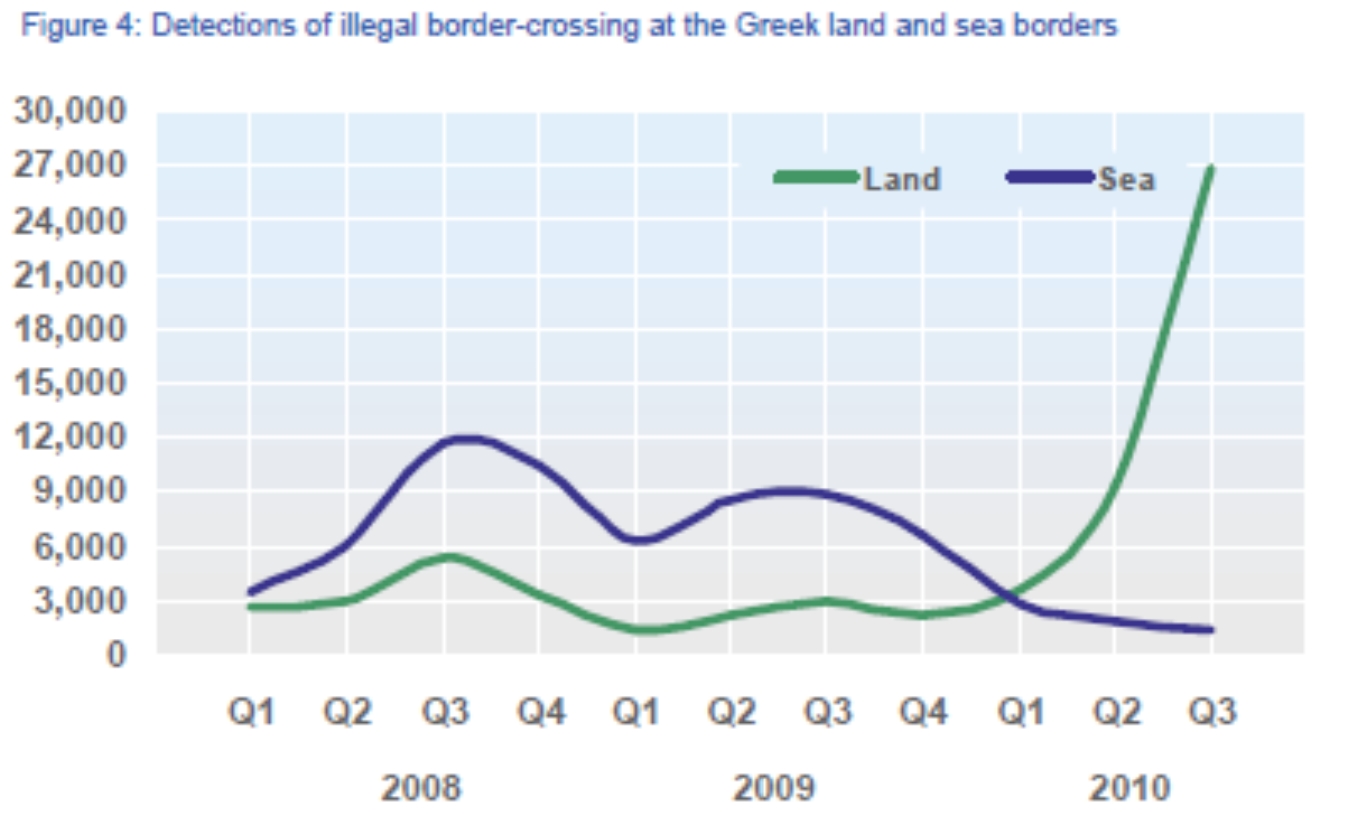
The Report notes that the “unprecedented peak in illegal border-crossings at the Greek land border with Turkey is the result of a shift from the sea to the land border” coupled with a “large increase in the absolute number of migrants” using Turkey as an EU entry point.  The Report states that there has been an eight-fold increase in the number Maghreb nationals detected at the Greek land border which “is thought to be the result of a displacement effect from the West Africa and Western Mediterranean routes.”

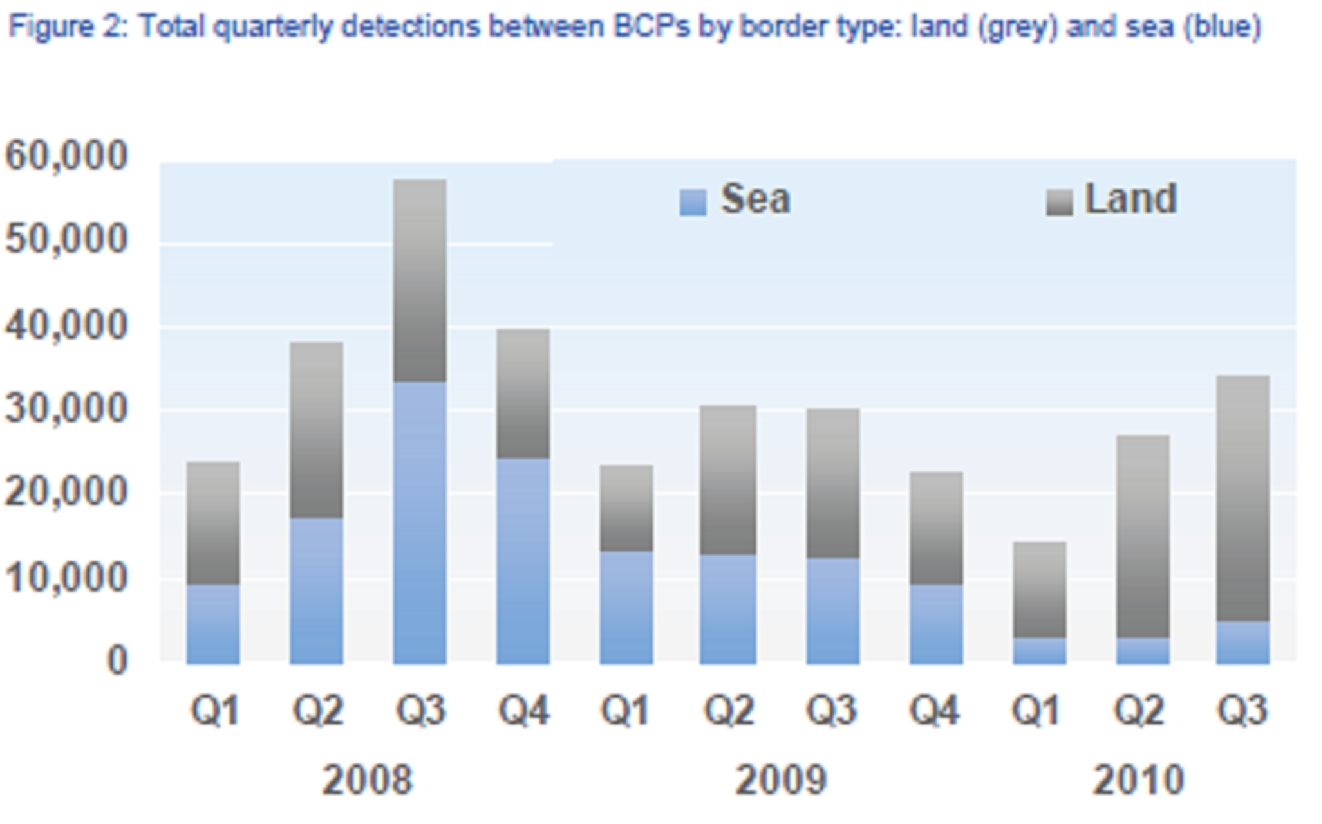
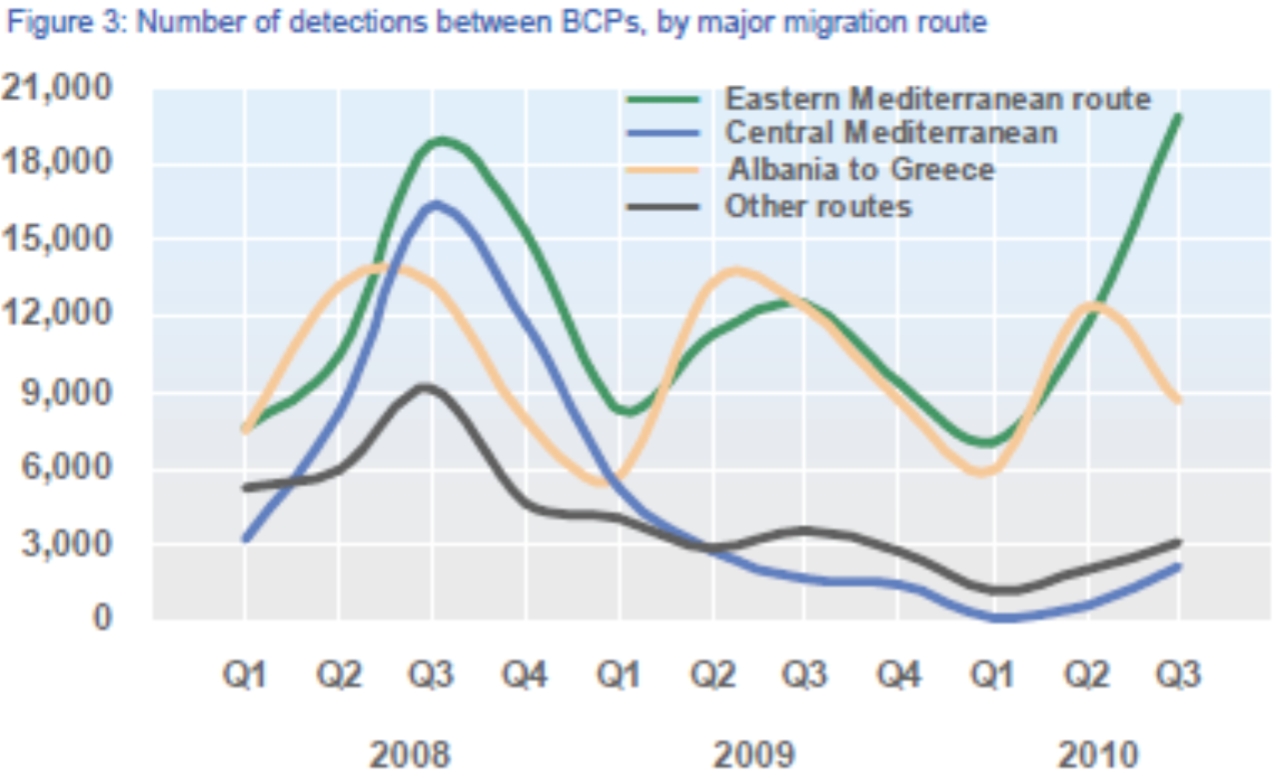
The Report also notes an increase in the number of detections on the Central and Western Mediterranean sea routes compared to Q2 which may be attributable to seasonal variations or “may be indicative of reorganized modi operandi in these areas in response to Frontex Joint Operations, more effective border controls and bilateral agreements implemented in 2008.”  See Figure 3 below.

Excerpts from the Report:

“Detections of illegal border-crossing”

“…  Fig. 2 [see below] shows quarterly detections at the land and sea borders of the EU since the beginning of 2008. The 30% increase in the number of detections between the previous and present quarters is comprised of a 60% increase at the sea borders (although from a lower base) and a 23% increase at the land borders. This means that the shift from sea to land borders has not continued to same extent as in the previous quarters.  Nevertheless in Q3 2010, there were some 29 000 detections of illegal border-crossing at the external land border of the EU, which constitutes 85% of all the detections at the EU level, and the highest number of detections at the land border since data collection began in early 2008….”

“Eastern Mediterranean route”

The Report observes that there has been a shift in illegal crossings from the Greece-Turkey maritime border to the Greece-Turkey land border and notes an increase in the number of nationals from Maghreb countries apprehended at the Greece-Turkey land border.  “This route [being taken by Maghreb nationals] is very indirect, but is thought to be the result of a displacement effect from the West Africa and Western Mediterranean routes….”

See Figure 4 below which shows that detections of illegal border crossers at the land border of Greece have exceeded detections at the sea border since Q1 of 2010.

“Central Mediterranean route”

“There were 2 157 detections of illegal border-crossing during Q3 2010. This is more than a three-fold increase compared to the previous quarter and a third higher than the same period last year. However despite this apparently large increase, detections still remain massively reduced compared to the peak of around 16 000 during the same period in 2008 (Fig. 3)….”

“The JO Hermes 2010 which was operational between June and October 2010, focused on illegal migratory flows departing from Algeria to the southern borders of the EU, specifically to Sardinia. In 2010, there were fewer detections than in previous years….”

“Departures from Libya also remained low. In June 2010, a new law was implemented to serve more severe punishments for facilitating illegal immigration. Ambassadors of the countries of origin were called into the Ministry of Foreign Affairs in Tripoli to be informed about the consequences of the new law, which suggests that this may be a serious implementation.”

“Western Mediterranean route”

“In general, irregular immigration to southern Spain has decreased massively since the beginning of 2006. However, in Q3 2010 there were 2 200 detections of illegal border crossing in the Western Mediterranean, more than twice that of the previous quarter and around a third higher than the same period in 2009. There is growth in the number of detections of a wide range of African nationalities, nine of which more than doubled in number between Q2 and Q3 2010. The most detected nationalities were Algerian, Moroccan, Cameroonian and Guinean.”

“Western Africa route”

“The cooperation and bilateral agreements between Spain and the rest of the Western African countries (Mauritania, Senegal and Mali) are developing steadily, and are one of the main reasons for the decrease in arrivals, as is the presence of patrolling assets near the African coast.”

“According to data collected during JO Hera, the numbers of arrivals in the Canary Islands and detections in West Africa are very low compared to the same time last year. The main nationality and place of departure is from Morocco, to where migrants are returned within a few days.”

Click here for the 3rd Quarter 2010 Report.

Click here for the 2nd Quarter 2010 Report.

Click here for the 1st Quarter 2010 Report.

Click here for my previous post regarding the 2nd Quarter Report.


Leave a comment

Filed under Aegean Sea, Algeria, Data / Stats, Eastern Atlantic, European Union, Frontex, General, Greece, Italy, Libya, Malta, Mauritania, Mediterranean, Morocco, News, Reports, Senegal, Spain, Tunisia, Turkey

EC Request for Services: “Technical Assistance for the Identification and Formulation of a Programme of Support to the Libyan Authorities in the field of Migration” (26 Nov Deadline)

This was just posted on the SRLAN listserve.  The deadline for an expression of interest has been extended to 26 November (but this date should be verified):

“Dear Sir,  I would like to inform you about a new EC funded project, entitled: ‘Technical Assistance for the Identification and Formulation of a Programme of Support to the Libyan Authorities in the field of Migration’.

We are looking for 2 Experts mastering English, from January 2011, with the following profile:

Expert in Migration/Team Leader:

  • Master Degree (or higher academic degree) in an area relevant to Migration (Law, Political Sciences, Humanities, Sociology, etc).
  • At least 10 years of professional experience in the field of Migration.
  • Thorough knowledge of migration policies and strategies, in particular the EU global approach to migration and the international set of rules, laws and conventions related to border management, migration and asylum.
  • Experience in the identification, formulation, and management of programmes of support or technical assistance in the framework of the EC external aid to third countries.
  • Fluency in written and spoken English.
  • Knowledge of development issues in North Africa and the Middle East and/or Sub-Saharan Africa.
  • Good understanding of the social and economic policies of the EU
  • Ability to manage and lead a team.
  • Excellent writing and communication skills
  • Knowledge of Arabic is considered an asset.

Expert in International Law (other field could be International Relations):

  • Master Degree (or higher academic degree) or equivalent professional experience in the field of International law, International Relations or Migration.
  • At least 10 years of professional experience in the field of migration.
  • Thorough knowledge of migration policies and strategies, in particular the EU global approach to migration and the international set of rules, laws and conventions related to border management, migration and asylum.
  • Fluency in written and spoken English.
  • Good knowledge and working experience in the Middle East and North Africa Region.
  • Experience in project management, identification, formulation, implementation and evaluation of similar EC funded projects.
  • A good understanding of the economic and social policies of the European Union.
  • Knowledge of Arabic is considered an asset.
  • Excellent writing and communication skills.

Please find attached the ToRs for further details.  Should you be interested in partaking in the offer please reply by return of mail and send me your updated Cv (according to the attached model) before 21/11/2010 and I will inform you about the application process.

Nadia Bedhiaf
Assistant Project Manager
+216 71 76 68 66
+216 71 76 69 66
www.ccm-cg.com

From the Terms of Reference: “… The assignment will provide the necessary information for the beneficiary of the EU contributions (Libyan Authorities responsible for the management of borders and mixed migration flows) and Delegation of the European Union to Libya (DEU) to formulate a Cooperation and Technical Assistance Programme between the EU and Libya on Migration related issues, including management of borders and mixed migration flows.

The identification and formulation of this programme will be divided in two parts:

i) Programme to Support the Libyan authorities to enhance the management of borders and migration flows (10 million Euros) [and] ii) Programme to support the Libyan authorities on migration related issues, risks and challenges (30 million Euros) [***]

The assignment will include:

1. An analysis of the sector and needs assessment of the migration sector in Libya, in relation to border management, the management of migratory flows, and international protection. In this sense it will identify the social, demographic, financial, legal or institutional constraints to the implementation of actions and the design of policies to effectively manage migration in Libya.

2. Support the consultation and dialogue process on the migration related issues and policy between the Government of Libya and the Delegation of the European Union to reach a common agreement on the areas of intervention of the programmes.

3. Present in a clear and exhaustive manner the objectives, the actions, the expected results and the possible indicators of the programmes being identified and formulated. [***]”

Click on this link- TofR_066810_1-1 -for Terms of Reference and on this link- CVtemplateEnglish -for CV template.

Leave a comment

Filed under European Union, General, Libya, Mediterranean

IMO Information Resources on Stowaways/Illegal Migrants/Treatment of Persons Rescued at Sea – update

The International Maritime Organization’s (IMO) Maritime Knowledge Centre updated in August its  Information Resources document on “Stowaways / Illegal Migrants / Treatment of Persons Rescued at Sea.”

The document contains information, citations, and links to IMO documents, publications, circulars, and reports, as well as non-IMO citations and / or links to many other resources, including relevant UN reports, resolutions, and treaties.

Click here for the document.

Leave a comment

Filed under General, Reports

Vacation Break

I am taking a break for a few weeks and will be back 14 August.

Leave a comment

Filed under General

France Agrees to Accept 92 Refugees from Malta for Resettlement

French Ambassador Daniel Rondeau announced that France will shortly accept 92 additional refugees from Malta as part of the EU voluntary resettlement programme.  The Times of Malta reports that the Ambassador said “These people are prepared to die to live anywhere except their country; so many die in the Mediterranean Sea. It is really a tragedy and Malta was affected by it… we have to share this tragedy with the Maltese and with the immigrants. It’s our sea and it’s at our door, we cannot look the other way.”  France resettled 95 refugees from Malta last year.  Several other countries, including Germany and the UK have voluntarily accepted refugees from Malta.

Click here for article.

1 Comment

Filed under European Union, France, General, Malta, Mediterranean, News

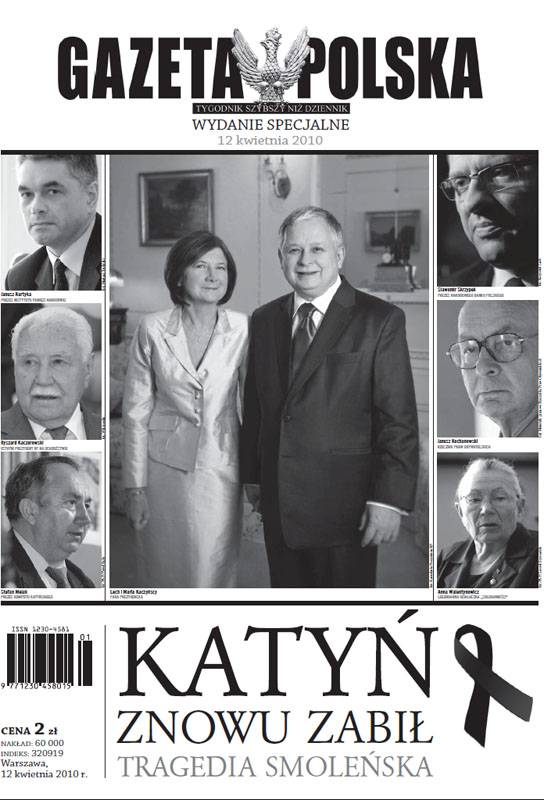
In Memoriam – Katyn


1 Comment

Filed under General

Guidelines for Frontex Operations at Sea

NB –I believe this document is the final version of the proposed guidelines approved by the Council on 25 January 2010, with Italy and Malta abstaining, and which has now been forwarded to the Parliament for scrutiny.  I will remove or amend this post if I discover this is not the final version approved by the Council.

What follows are relevant excerpts from Document COM(2009)658 (Brussels, 27.11.2009), the final Proposal for a COUNCIL DECISION supplementing the Schengen Borders Code as regards the surveillance of the sea external borders in the context of the operational cooperation coordinated by the European Agency for the Management of Operational Cooperation at the External Borders – Frontex.

As noted, Malta and Italy oppose these guidelines and have threatened to withdraw from future Frontex missions if these guidelines take effect.

Guidelines for Frontex operations at sea

1. GENERAL PRINCIPLES

1.1 Measures taken for the purpose of the surveillance operation should be conducted in a way that does not put at risk the safety of the persons intercepted or rescued as well as of the participating units.

1.2. The special needs of children, victims of trafficking, persons in need of urgent medical assistance, persons in need of international protection and other persons in a particularly vulnerable situation should be considered throughout all the operation.

1.3. These guidelines should be applied by Member States in accordance with fundamental rights. Member States should ensure that border guards participating in the surveillance operation are trained with regard to relevant provisions of human rights and refugee law, and are familiar with the international regime on search and rescue.

2. INTERCEPTION

2.1 Upon detection, the ship or other sea craft (“ship”) should be approached in order to observe its identity and nationality and, pending further measures, should be surveyed at a prudent distance. [***]

2.4. Measures taken in the course of the surveillance operation against ships or other sea craft with regard to which there are reasonable grounds for suspecting that they carry persons intending to circumvent the checks at border crossing points may include: [***]

(f) conducting the ship or persons on board to a third country or otherwise handing over the ship or persons on board to the authorities of a third country;

(g) conducting the ship or persons on board to the host Member State or to another Member State participating in the operation.

3. SEARCH AND RESCUE SITUATIONS ARISING IN THE COURSE OF THE OPERATION

3.1. Participating units shall provide assistance to any vessel or person in distress at sea. They shall do so regardless of the nationality or status of such a person or the circumstances in which that person is found.

3.2. When facing in the course of the operation a situation in which uncertainty or apprehension exists as to the safety of a ship or of any person on board, the participating unit should forward as soon as possible all available information to the Rescue Coordination Centre responsible for the search and rescue region where the situation is taking place.

In cases where the Rescue Coordination Centre of the third country responsible for the search and rescue region does not respond to the notification transmitted by the participating unit, the latter should contact the Rescue Coordination Centre of the host Member State that is geographically the closest to the emergency.

While awaiting instructions from the Rescue Coordination Centre, participating units should take all the appropriate measures to ensure the safety of the persons concerned. [***].

4. DISEMBARKATION

4.1. The operational plan should spell out the modalities for the disembarkation of the persons intercepted or rescued, in accordance with international law and any applicable bilateral agreements.

Subject to section 4.2, priority should be given to disembarkation in the third country from where the persons departed or through the territorial waters or search and rescue region of which the persons transited or, if this is not possible, to disembarkation in the geographically closest place where the safety of the persons can be ensured.

4.2. No person should be disembarked in or otherwise handed over to the authorities of a country with regard to which there are substantial grounds for believing that he or she would be subjected to persecution or to torture or to other forms of inhuman or degrading treatment or punishment, or from which there is a risk of expulsion or return towards such a country. The persons intercepted or rescued must be informed in an appropriate way so that they can express any reasons for believing that they would be subject to such treatment in the proposed place of disembarkation.

4.3. The coordination centre should be informed of the presence of persons within the meaning of paragraph 4.2, and should convey that information to the competent authorities of the host Member State.

Click here for full Document.

Click here for a “Note to the File” pertaining to the Draft Council Decision supplementing the Schengen Borders Code as regards sea border surveillance in the context of operational cooperation coordinated by FRONTEX (COM(2009)658) as amended by the Council on 25 January 2010.
1 Comment

Filed under European Union, Frontex, General, Italy, Malta, Mediterranean

Oxford Refugee Studies Centre: International Summer School in Forced Migration

International Summer School in Forced Migration: 5 – 23 July 2010

The Refugee Studies Centre’s International Summer School fosters dialogue between academics, practitioners and policymakers working to improve the situation of refugees and other forced migrants. It provides the time and space for them to reflect on their experiences and to think critically about some of the aims and assumptions underlying their work.

Who is the summer school for?

Policy makers and practitioners involved with humanitarian assistance and policy making for forced migrants. Participants typically include host government officials, intergovernmental and non-governmental agency personnel engaged in planning, administering and co-ordinating assistance.

Researchers specialising in the study of forced migration.

Click here for link.


Leave a comment

Filed under General, UK

US Committee for Refugees and Immigrants 2009 World Refugee Survey (Reports)

APTOPIX Indonesia Migrants

‘[In 2008] Out of about 67,000 people crossing to Europe by sea, some 35,000 arrived in Italy and 2,800 in Malta, mostly via Libya.  About three-quarters of those arriving in Italy applied for asylum and Italy granted around half of them refugee status or protection on other humanitarian grounds.  Nearly all who arrived irregularly by sea in Malta applied for asylum and Malta found some 60 percent to be in need of international protection.’

Click here for link to full Report.

Leave a comment

Filed under General, Reports