Category Archives: Libya

Libyan Interior Minister Met Commissioner Malmström on 15 Feb.

According to the EU Observer, Libya’s Interior Minister met last week with Commissioner Cecilia Malmström: “It emerged on Monday  [21 Feb.] that the Libyan interior minister, Abdel Fatah Younes, visited EU home affairs commissioner [Cecilia Malmström] last Tuesday (15 February) to discuss ‘how to put into practice’ an agreement reached in October on immigration co-operation.  The commission last year offered the country some €50 million euros to assist in efforts to prevent irregular migrants from reaching the Mediterranean’s northern shores. At the meeting, it is thought that a figure of 2 million refugees was brandished by Mr Younes.”

It is unclear from the article whether Libya used this meeting with Malmström to communicate a threat to halt cooperation on irregular immigration similar to the one that was communicated to the Hungarian Ambassador to Libya on 17 February or whether this was an otherwise routine meeting in furtherance of the EU-Libya framework agreement.

Click here for article.

1 Comment

Filed under European Union, Libya, Mediterranean, News

Frattini and Berlusconi Slow to Criticise Gaddafi

As reported by the EU Observer, while the EU and most member states are now condemning Libya’s actions, “[o]n the other side of the EU divide, Italy is horrified at the possible loss of a close ally. Foreign minister and ex-EU-commissioner Franco Frattini is trying to convince other European states that Mr Gaddafi has promised constitutional reforms and that the bloc should allow him to make good. ‘Italy as you know is the closest neighbour of both Tunisia and Libya so we are extremely concerned about the repercussions on the migratory situation in the southern Mediterranean,’ Mr Frattini told reporters on Sunday. The previous day, Prime Minister Silvio Berlusconi said he did not want to ‘disturb’ his long-time friend with appeals for restraint.”

Click here for article.

Leave a comment

Filed under European Union, Italy, Libya, Mediterranean, News

Correction-Libyan Govt Summoned Hungarian Ambassador, Not EU Rep

According to a more recent Reuters Africa report, the Libyan threat to halt cooperation on immigration was communicated this past Thursday to the Hungarian Ambassador in Tripoli.  This information was then released by the Hungarian EU Presidency.

Click here for article.

1 Comment

Filed under European Union, Hungary, Libya, Mediterranean, News

Libya Issues Immigration Threat to EU

The EU Hungarian Presidency announced earlier today that the Libyan government summoned the EU representative in Tripoli [UPDATE – it was reportedly the Hungarian Ambassador to Libya who was summoned this past Thursday] and informed the representative that Libya will halt cooperation on illegal migration if the European Union continues to “encourage” protests in Libya.  It is unclear whether there has been any response yet by the EU to the Libyan threat.

Click here and here for articles.  (IT)   [Click here (EN) for updated article.]

Leave a comment

Filed under European Union, Italy, Libya, Malta, Mediterranean, News

Frontex Press Release: Hermes 2011 Starts Tomorrow in Lampedusa

Frontex news release:  “Hermes 2011 Starts Tomorrow in Lampedusa, 19-02-2011

Joint Operation (JO) Hermes 2011 is due to start tomorrow with the deployment of additional aerial and maritime assets from Italy and Malta.  In the following days the second line activities will be activated with the deployment of debriefing/screening experts. Their task will be to gather information necessary needed for analysis, to make assumptions concerning migrants’ nationalities, and to enable early detection and prevention of possible criminal activities at the EU external borders.  Next important element of this operation will be to provide assistance at the following stage focusing on organising return operations to the countries of origin.  Frontex risk analysis experts will be supporting Italian authorities producing targeted risk analysis identifying vulnerabilities and security risks that might occur at the EU southern external border.

Background – Frontex received a formal request for assistance on February 15th from the Italian Ministry of Interior regarding the extraordinary migratory situation in the Pelagic Islands. The Italian Government requested assistance in strengthening the surveillance of the EU’s external borders in the form of a Joint Operation. Additionally, Italy requested a targeted risk analysis on the possible future scenarios of the increased migratory pressure in the region in the light of recent political developments in North Africa and the possibility of the opening up of a further migratory front in the Central Mediterranean area.

According to the Italian Ministry of Interior, approximately 6,000 irregular migrants, mostly of the Tunisian origin, have arrived on the Italian coast in the last month, of whom 3,000 have arrived since February 11th. Before February 11th, only 14 Tunisian nationals had arrived on the Italian coast in 2011.”

Click here for link.

Leave a comment

Filed under European Union, Frontex, Italy, Libya, Malta, Mediterranean, News, Statements, Tunisia

Frontex Operation Hermes to Begin on Sunday, 20 Feb.–Push-Back Practice Prohibited

Commissioner Cecilia Malmström announced today that the new Frontex mission, Operation Hermes, will begin operations tomorrow, 20 February.  According to AFP, the initial deployment will consist of about 30 personnel, aircraft, and several ships.  A dozen member states have expressed willingness to send assests to the new joint operation.

In an interview published earlier today, before the announcement of Operation Hermes, Commissioner Malmström clearly stated that the Frontex mission will be governed by European legislation and that the interdiction and push-back of migrants encountered at sea is not permitted.  In the earlier interview the Commissioner said that the mission will provide surveillance by air in support of the Italian authorities which will detect any new influx of migrants as soon as it occurs and sound the alarm for naval surveillance which will in turn lead migrant boats to “safe ports.”  (“Di sorveglianza dal cielo in supporto alle autorità italiane. Potranno individuare ogni nuovo flusso di migranti non appena si manifesti. E lanciare l’allarme ai mezzi di sorveglianza navale, facendo condurre i barconi verso porti sicuri.”)  When asked whether push-backs of migrant boats would occur, the Commissioner said that the push-back practice was prohibited by European norms. (“I respingimenti sono espressamente proibiti dalle norme europee.”)

Click here and here for articles.  (IT)

1 Comment

Filed under European Union, Frontex, Italy, Libya, Malta, Mediterranean, News, Tunisia

Frontex’s Role to be One of Coordination

Consistent with its mandate and standard practice, Frontex’s role in the new Central Mediterranean joint operation will be one of coordination.  According to DI-VE, “[i]n the current situation, [Frontex] foresees its main role as coordinating border guards from among the member states, particularly with regard to second-line experts in the screening and debriefing of irregular migrants as well as in coordinating an appropriate operational response to the humanitarian needs in the area. In addition, the agency is investigating the most optimal means by which to adapt a range of technical assets engaged in sea border operations in the Mediterranean to the needs of the Italian authorities.”

Click here for article.

Leave a comment

Filed under European Union, France, Frontex, Italy, Libya, Malta, Mediterranean, Netherlands, News, Spain, Tunisia

Frontex Central Mediterranean Operation Likely to Begin Within Days; Dutch to Send Coast Guard Plane to Lampedusa; France and Spain Likely to Deploy Planes or Ships

The Dutch government has decided to deploy a Coast Guard surveillance plane to Italy to participate in the new Frontex joint operation.  The Dutch decision was announced by Immigration and Asylum Minister Gerd Leers on Friday.  The plane and two Dutch border guards are scheduled to be deployed for at least six weeks beginning 21 February.

The Financial Times reports today that the Frontex joint operation may be operational early next week and that details are being finalised at a meeting that is taking place today in Rome between European Commission and Italian officials.  According to the FT article, one topic under discussion is the situation in Libya and the possibility for a larger wave of migrants should the situation in Libya become more unstable or should Gaddafi’s government collapse.

Click here (EN) (FT registration may be required), here (NL), here (NL), and here (EN) for articles.

Leave a comment

Filed under European Union, France, Frontex, Italy, Libya, Malta, Mediterranean, Netherlands, News, Spain, Tunisia

Frontex Begins Consultations for Emergency Joint Operation –2010 Frontex Sea Border Rule Should Govern Joint Operation

The European Voice reports that Frontex began consultations yesterday with member states to identify what equipment and personnel they will commit to a planned joint operation with Italy to deter migrants seeking to leave North Africa. “Naval vessels, surveillance aircraft and enhanced radar tracking are likely to be deployed….”

Assuming an emergency joint operation is deployed in the coming days, it may to some extent simply be a revival of Frontex’s Joint Operation Nautilus (slated to be renamed Operation Chronos).  Less than two weeks ago, on 4 February Malta for the second year running announced that it would not host or participate in Operation Nautilus this year due to the success of Italy’s push-back agreement with Libya which eliminated the movement of migrants in the Central Mediterranean.

Malta, however, also likely refused to host the Frontex mission due to the 2010 guidelines governing Frontex enforcement operations at sea which require that intercepted migrants be taken to the country hosting the Frontex mission under certain circumstances.  The validity of the Frontex sea border rule is currently under review by the European Court of Justice.  The legal challenge to the rule was brought by the European Parliament.  Maltese MEP Simon Busuttil initiated the challenge within the LIBE Committee.  It will be interesting to see what role Malta will be willing to play in any new emergency joint operation.  Even though the Frontex sea border rule is under review by the ECJ, the referral clearly requested the ECJ “to preserve the effects of the measure until a new legislative act has been adopted.”  The rule therefore remains in effect.

Click here for EV article.

Click here for the Council decision on the surveillance of  sea external borders (the Sea Border Rule).

Click here, here, here, here, and here for previous posts on the sea border rule and the ECJ challenge.

1 Comment

Filed under Egypt, European Union, Frontex, Italy, Libya, Malta, Mediterranean, News, Tunisia

WikiLeaks 2008 US Cable: Death of Key Libyan Official Hampers Counter-Migration Efforts / Malta’s Efforts to Negotiate Readmission Agreement With Libya On Hold

This cable reports comments made by Malta’s Ambassador to Libya, Joseph Cassar, about the negative impact caused by the death of Fawzi Ghariba, Director of International Cooperation for Libya’s Port Authority-equivalent, on Maltese efforts to coordinate migration control and SAR operations with Libya.  The cable was written in May 2008 by the US Embassy’s Chargé d’Affaires, Chris Stevens, and is titled:  “Death of Key Libyan Official Hampers Counter-Migration Efforts.

Ambassador Cassar was reported as saying that the death of Fawzi Ghariba six weeks earlier “had negatively impacted the GOL’s responsiveness on illegal migration issues at a critical time.”  Cassar said Ghariba “played a key role in finalizing recent Malta-Libya and Italy-Malta bilateral cooperation agreements on migration issues [and that he] was an energetic and efficient operator and one of the only GOL officials who approached illegal migration with any sense of urgency.  Cassar “said efforts to finalize … a readmission agreement under which migrants found to have entered Malta illegally could be returned to their country of departure (Libya) rather than their countries of origin, had been frozen since Ghariba’s death.”

Most of the Cable’s text follows:

“DEATH OF KEY LIBYAN OFFICIAL HAMPERS COUNTER-MIGRATION EFFORTS…

HIGH SEASON FOR ILLEGAL MIGRANTS

2.(SBU) Maltese Ambassador Joseph Cassar pulled P/E Chief aside for a conversation on illegal migration as the latter penned a message in the condolences book for the recently deceased Sir Anthony Mamo, the first President of Malta. Saying it had been “a bad week”, Cassar noted that more than 70 illegal migrants had made landfall and requested asylum in Malta during a single 48-hour period earlier this week. More than half of the 70 individuals claimed to have departed from Libya’s coast, prompting Valletta to task its embassy in Tripoli to reiterate requests that the GOL increase patrols in its Search and Rescue area (SAR). Cassar noted that more vessels transporting illegal migrants appear to be calling via satellite telephones to claim distress and request assistance immediately after entering Malta’s SAR. He suggested that they did so to mitigate the chance that they would founder before being rescued.

KEY OFFICIAL’S DEATH DIMINISHES LIBYA’S RESPONSIVENESS

3.(SBU) Cassar said the GOL’s response to the Maltese demarche had been “disappointing”. He noted that the unexpected death six weeks ago of Engineer Fawzi Ghariba, former Director of International Cooperation for Libya’s Port Authority-equivalent and a key interlocutor on counter-migration efforts, had negatively impacted the GOL’s responsiveness on illegal migration issues at a critical time. (Note: Launches from Libya of vessels transporting illegal migrants typically increase in spring/summer months to take advantage of improved weather and sea conditions. End note.) Describing Ghariba’s operating style as “American”, he said the late official played a key role in finalizing recent Malta-Libya and Italy-Malta bilateral cooperation agreements on migration issues (reftel). More importantly, Ghariba was an energetic and efficient operator and one of the only GOL officials who approached illegal migration with any sense of urgency. In several cases, Ghariba had galvanized the GOL to deal with migration issues and prompted disparate GOL entities to coordinate their efforts through the force of his personality. On instructions from Valletta, Cassar has asked the GOL several times when a successor to Ghariba might be identified; however, the GOL has demurred, saying it would be unseemly to rush to appoint a replacement.

BROADER EFFORTS ON TRAINING, READMISSION AGREEMENTS ALSO IMPACTED

4.(C) Cassar said Malta has focused on enhancing training for Libyan CG officials patrolling Libya’s SAR area. He said efforts to finalize an agreement to provide such training, as well as a readmission agreement under which migrants found to have entered Malta illegally could be returned to their country of departure (Libya) rather than their countries of origin, had been frozen since Ghariba’s death. (Comment: A number of European countries have been pursuing similar readmission agreements with the GOL. All have encountered significant difficulty in attempting to finalize those, suggesting that factors other than Ghariba’s death may bear on Malta’s efforts. End comment.) He encouraged the U.S. to continue focusing on training and material assistance for Libya’s CG. (Note: Two Libyan CG officers are scheduled to participate in upcoming training programs at a facility in Malta that uses a U.S. Coast Guard curriculum. End note.) Suggesting that he did not agree with Valletta’s position that equipment donations [i.e., by wealthier EU countries like Italy] to Libya to combat illegal migration be predicated on the GOL “taking greater responsibility” for its SAR, Cassar described the Libyan CG’s equipment needs as “considerable”….”

Click here and here for full Cable.

1 Comment

Filed under Italy, Libya, Malta, Mediterranean, News, United States

WikiLeaks 2009 US Cable: EU-Libya Framework Agreement Hangs on ICC, Trade, Migration

This cable provides the views of the US Embassy in Tripoli as of July 2009 regarding the EU-Libya Framework Agreement negotiations.  A round of EU-Libya negotiations took place on 13-14 July 2009.  The cable was written by the US Embassy’s Chargé d’Affaires at the time, Joan Polaschik, and is titled:  “EU FRAMEWORK AGREEMENT HANGS ON ICC, TRADE, MIGRATION.”

According to the cable, Libyan negotiator Mohammed Siala “railed against language stating that the [EU and Libya] agreed to discuss crimes against humanity in an international context, angrily stating that any mention of the International Criminal Court (ICC) or text similar to that of the Rome Statute would cause a total breakdown of the framework negotiations.”  Negotiations on migration issues however went more smoothly according to the cable: “the chief EC negotiator told EU diplomats that the negotiations [on migration] were a ‘step forward’ and that more progress was made than expected with no major objections from either side on the draft as presented….”

Excerpts from the cable:

“1.(C/NF) Summary: The latest round of EU-Libya Framework Agreement negotiations hit snags over sensitive political issues and were slowed by Libya’s inefficient technical bureaucracy. The Libyans denounced the International Criminal Court and decreed that any language similar to the Rome Statute was off limits. Trade talks stalled when the Libyans announced that they had not examined the draft paper (presented in early 2009) and were unable to produce trade statistics from 2007/2008 or provide data on the Libyan tariff system. Talks on migration went more smoothly than expected, but significant issues remain before the agreement could be given to member states for approval. EU diplomats in Tripoli are skeptical that the EC will be able to get an agreement that can be implemented by both sides within the remaining two rounds of talks….

POLITICAL DIALOGUE: THE EC DANCES ON LIBYA’S ‘RED LINE’

2.(C/NF) Representatives of the European Commission (EC) based in Brussels conducted the latest round of Framework Agreement negotiations July 13-14 in Tripoli with sessions focused on political dialogue, trade and commerce, and migration. Diplomats from EU member states — participating as observers to the EC-Libya negotiations — said that discussions on the political framework were particularly heated. Libyan negotiator Mohammed Siala railed against language stating that the two parties agreed to discuss crimes against humanity in an international context, angrily stating that any mention of the International Criminal Court (ICC) or text similar to that of the Rome Statute would cause a total breakdown of the framework negotiations. According to the UK embassy, nothing in the political dialogue paper is binding on either party and is merely agenda-setting for future discussions. EC negotiators were not/not pushing for Libya to accede to the ICC….

TRADE AND MIGRATION: HITS AND MISSES

4.(C) … On migration, the chief EC negotiator told EU diplomats that the negotiations were a “step forward” and that more progress was made than expected with no major objections from either side on the draft as presented….”

Click here or here for the full Cable.

Click here for a post regarding an earlier US cable discussing the state of EU-Libya framework negotiations in 2008.

Leave a comment

Filed under European Union, Libya, Mediterranean, News, UK, United States

WikiLeaks 2008 US Cable: Background Regarding EU-Libya Framework Agreement Negotiations

This cable provides the views of the US Embassy in Tripoli regarding the state of the EU-Libya Framework Agreement negotiations in July 2008.  It was written by the US Embassy’s Chargé d’Affaires, John Godfrey.  The cable is titled: “THE EU-LIBYA FRAMEWORK AGREEMENT: VENI, VISAS, VETO.”  The cable states that Libya views the EU Framework Agreement as “a ‘reward’ for Libya’s decision in July 2007 to release six [Bulgarian and Palestinian] health workers accused of intentionally infecting over 400 Libyan children with HIV/AIDS.”  The cable describes threats to veto the framework agreement by individual EU member states in an effort to secure bi-lateral concessions from Libya and describes Libya’s claim that the “draft language initialed by [EU] Commissioner Ferrero-Waldner ‘commits’ the EU …  to funding a ‘surveillance mechanism’ along Libya’s land and sea borders to combat illegal migration.”

Most of the cable’s text follows:

“(C)  Summary.  The Government of Libya (GOL) remains keenly interested in pursuing a European Union-Libya Framework Agreement and views a more formalized partnership with the European Union (EU) as a “reward” for Libya’s decision in July 2007 to release six foreign health workers accused of intentionally infecting over 400 Libyan children with HIV/AIDS. Certain EU members, unsure that a more formal cooperation mechanism would be beneficial and sensing Libya’s eagerness, have used the threat of a veto to push their bilateral agendas, particularly with respect to commercial and human rights issues.  One year after Libya and the EU agreed in principle to pursue an agreement, a sizeable perception gap exists between the two sides on the merits of a more formalized partnership.  Despite occasional differences with the EU, most recently over the French-backed Union for the Mediterranean proposal, the GOL will continue to seek an EU framework agreement, in large part because of Muammar al-Qadhafi’s desire to be taken seriously by European leaders. End summary.

BULGARIAN MEDICS CASE HAUNTS EUROPE

2.  (C)  Libya’s much-heralded decision in July 2007 to [release] six foreign health workers imprisoned since 1999 on charges of intentionally infecting children in Benghazi with the HIV/AIDS virus frames current discussions on an EU-Libya Framework Agreement.  Widely seen by Europeans in Libya as a successful alignment of European and Libyan interests, the denoument of the Bulgarian medics case – particularly their immediate pardon upon their arrival in Bulgaria – remains a lasting embarrassment for key elements of the Libyan regime.  The GOL, preoccupied with avoiding the public perception that it caved to foreign pressure to resolve the case, has trumpeted a putative EU framework agreement as a significant concession and a positive coup for Libyan diplomacy.  In an hours-long televised news conference just days after the medics left, Foreign Minister Abdulrahman Shalgham and Under Secretary for European Affairs Abdulati Obeidi boasted that a draft agreement, initialed by EU Commissioner for External Relations Benita Ferrero-Waldner during her July 2007 visit to Tripoli, would pave the way for easier access to Schengen visas for Libyan citizens and increased EU infrastructure investments in Libya. Ferrero-Waldner’s announcement in February 2008 that the EU Commission had submitted a recommendation to the Council of Ministers to grant a mandate to open negotiations with Libya stoked GOL hopes for rapid progress.

3.  (C)  French, Spanish, and German diplomats describe Libya’s primary objective in pursuing an EU framework agreement as reducing the mandatory waiting period for Schengen visas for Libyan nationals from the current 10 days to 48 hours.  …

4.  (C)  The July 2007 EU-Libya draft also lays out cooperation in the fields of human rights, health, and development.  U/S Obeidi informed French Ambassador Francois Gouyette in June 2008 that Libya agreed in principle to negotiate a human rights chapter within the framework agreement; however, Obeidi categorically refused to include discussions of individual human rights cases in the EU negotiations.  … In addition, the GOL has claimed that draft language initialed by Commissioner Ferrero-Waldner “commits” the EU …  to funding a “surveillance mechanism” along Libya’s land and sea borders to combat illegal migration.

VENI, VIDI, VETO

5.  (C)  Certain EU members, sensing Libya’s eagerness to move ahead, have threatened to block a framework agreement as a means by which to secure bilateral concessions, chiefly on commercial and human rights issues.  Italian Economic and Commercial Counselor Domenico Bellantone said that Italy is prepared to veto any framework agreement unless Libya ends a series of discriminatory commercial practices that target Italian firms operating in Libya.  …  French and Greek diplomats in Tripoli have hinted that they may also dangle a veto threat to resolve commercial disputes.  The Netherlands have approached certain EU members about a possible veto over Libya’s outstanding private debt to Dutch firms. Danish Consul-General George Wallen recently told EU Ambassadors in Tripoli that Denmark would veto a framework agreement with Libya unless the GOL lifts bans on Danish imports and Danish participation in infrastructure projects in Libya (prompted by a Danish magazine’s re-publishing in February 2008 of cartoons depicting the Prophet Muhammad).  Denmark also wants the GOL to release Jamal al-Hajj, a Danish-Libyan dual-national arrested on February 16, 2007 in connection with plans to hold a peaceful political demonstration.  Maltese diplomats have said Malta is considering a veto over dissatisfaction with Libya’s maritime patrols in its designated Search and Rescue (SAR) area and continuing concerns over the lack of cooperation by the GOL in efforts to stem the flow of irregular migrants from Libya to Europe.

6.  (C) European diplomats believe that apart from help in combating illegal migration from sub-Saharan Africa and South Asia through Libya to Europe, Europe has little to gain from a closer partnership with Tripoli.  In absence of a more formal agreement, some European countries have pursued bilateral cooperation that they privately assess as being more nimble and effective than broader cooperation under an EU framework agreement might be.  Italian diplomats characterized a recent donation of six vessels to Libya’s coast guard and an offer to train Libyan border security officials as Italy’s bilateral response to what they view as a lack of meaningful EU engagement on illegal migrant flows through Libya.  Greek DCM Ioannis Stamatekos lauded Italy’s move and said Greece may follow suit. Maltese Poloff Daniel Malina said that Malta, lacking resources to make a large equipment donation, hoped to keep the critical migration issue on the EU’s radar during Council deliberations over the Commission’s mandate to pursue the framework agreement.

DON’T RAIN ON MY CHARADE

7.  (C)  Twelve months have passed since Ferrero-Waldner initialed a draft memorandum on an EU-Libya framework agreement; however, a year of inaction does not appear to have dampened GOL perceptions that relations with Europe are on an up-swing. While senior European diplomats in Tripoli are quick to point out that formal negotiations with Libya on any kind of European-Libyan cooperation agreement have yet to even begin, many GOL officials speak of key Libyan negotiating positions, such as the 48-hour Schengen visa point, as if they’re already in place. …  A series of high-level European visits, most recently that of Spanish Foreign Minister Miguel Moratinos, have helped attenuate the GOL’s disappointment over what it perceives as slow progress on the framework agreement and on implementing commitments made during al-Qadhafi’s visits to Spain and France in December 2007.

8. (C) Comment: Libya’s interest in a closer partnership with Europe seems sincere; however, the GOL’s foreign policy, particularly at the senior levels, remains somewhat fickle. Libyan leader Muammar al-Qadhafi’s visit to Madrid and Paris last December sparked a surge of pro-European rhetoric in Tripoli – in one instance, Qadhafi threatened to pull Libyan investment from sub-Saharan Africa to redirect to his new European friends.  More recently, though, al-Qadhafi orchestrated a meeting of Arab Maghreb Union leaders in Tripoli to publicly disparage Sarkozy’s Union for the Mediterannean proposal (reftel).  Characterizing the proposed union as “insulting”, he claimed it would undermine Arab and African member states’ commitments to the Arab League and African Union, and told former British Prime Minister Tony Blair he was concerned that the proposal represented an effort by southern European states to create a North African bulwark against illegal migration from sub-Saharan Africa and to “further legitimize” Israel.  Despite such disagreements, Qadhafi’s interest in being taken seriously, particularly by his “friends Nicholas (Sarkozy) and Silvio (Berlusconi)”, will continue to drive the GOL’s keen interest in finalizing a framework agreement with the EU.  End comment.   GODFREY”

Click here or here for full cable.

6 Comments

Filed under Denmark, European Union, France, Germany, Greece, Italy, Libya, Malta, Mediterranean, Netherlands, News, Spain

WikiLeaks 2009 US Cable: Italian Ambassador to Libya questions sincerity of Libya’s commitment to combatting illegal migration

This US Department of State cable, released by WikiLeaks on 1 Feb 2011, was written by Gene Cretz, US Ambassador to Libya.  The cable is entitled “The Frogman Who Couldn’t Swim: A Cooperation Cautionary Tale.”  (The cable’s title refers to an incident where Libya sent a member of its Public Security organization who was unable to swim to Italy for training in underwater explosives detection and demolition.)

The cable was written on 17 February 2009 in the same month that the provisions of the Italy-Libya agreement relating to Italy’s maritime push-back practice took effect and three months before the first major interceptions and forcible returns of hundreds of migrants to Libya which occurred in May 2009.  If the US Ambassador’s reporting in the cable is accurate, it would suggest that Italy’s Ambassador to Libya at the time did not believe that Libya was about to begin cooperating with Italy on illegal migration.  Though the cable does point out that comments made by the Italian Ambassador “pre-dated the early February visit to Libya by Italy’s Minister of the Interior, Roberto Maroni, who signed an MOU to implement earlier agreements on counter-migration and counterterrorism cooperation.”

Excerpts from the Cable:

“ITALY ALARMED BY INCREASE IN NUMBER OF ILLEGAL MIGRANTS TRANSITING LIBYA

2. (C) At a recent meeting hosted by the U.K. Ambassador to discuss counterterrorism engagement efforts, Italian Ambassador Francesco Trupiani expressed profound frustration with difficulties Italy had encountered in trying to cooperate with the GOL on counterterrorism and combatting illegal migration (Italy views the two issues as being linked).  Italy was alarmed by the marked increase in the number of illegal migrants that had arrived in Italy – primarily on the island of Lampedusa – from Libya.  By way of example, he offered that 1,300 Tunisian illegal migrants traveled from Libya to Italy in 2007.  In 2008, 5,900 Tunisians made landfall in Italy after departing from Libya’s coast.  The number of migrants from Somalia – “a derelict state” – who had arrived in Italy increased from 5,110 in 2007 to 31,764 in 2008.  The number of Nigerians had increased threefold and featured a heavy contingent of prostitutes and narco-traffickers.

LIBYA DELAYING COOPERATION TO LEVERAGE EU FRAMEWORK NEGOTIATIONS?

3. (C) Noting that smuggling illegal migrants was highly profitable, that the GOL claimed to exercise tight control over travel within Libya, and that senior regime officials traditionally had a direct stake in highly lucrative enterprises (licit and otherwise), Trupiani said it was “implausible” that large numbers of illegal migrants had transited Libya without at least the tacit consent of GOL officials.  The substantial increase in the number of illegal migrants meant a corresponding increase in the amount of money involved.  He speculated that there could be a “logical nexus” between smuggling of illegal migrants, arms trafficking and movement of terrorists, and lamented that no one appeared to be holding the GOL accountable for its failure to more effectively address those inter-related problems.  Worse, the GOL appeared to be deliberately delaying engagement with Italy and other European partners to leverage negotiations for a Libya-EU Framework Agreement (EU External Affairs Commissioner Benita Ferrero-Waldner was in Tripoli February 9-10 for the latest round of negotiations).

***

6. (C) Trupiani was not optimistic that bilateral cooperation would improve in the near term. (Note: Our exchange with Trupiani pre-dated the early February visit to Libya by Italy’s Minister of the Interior, Roberto Maroni, who signed an MOU to implement earlier agreements on counter-migration and counterterrorism cooperation (further details septel).  End note.)  He cited lack of human capacity and rampant corruption and nepotism as limited factors….”

Click here or here for the full cable.

1 Comment

Filed under European Union, General, Italy, Libya, Mediterranean, News, United States

Malta Again Declines to Participate in Frontex Central Mediterranean Joint Operation

The Times of Malta reported on Friday that Malta has for the second consecutive year informed Frontex that it will not host or participate in joint sea patrols in the Central Mediterranean, saying that there is no need for the patrols given the drastic reduction in the number of boat people attributable to Italy’s push-back practice with Libya which has been in effect since 2009.  Only 47 migrants reached Malta in 2010 compared with 2,775 in 2008.  Frontex’s Central Mediterranean joint operation, referred to as Operation Nautilus (renamed Operation Chronos last year), has in past years operated during the summer sailing months when sea conditions are most favourable for small boats.

Last year Malta initially said that it would not host the joint operation due to the then recently approved guidelines governing Frontex enforcement operations at sea which required that intercepted migrants be taken to the country hosting the mission under certain circumstances.  A Maltese government spokesperson later said that the decision not to host the operation was not due to the new guidelines, but was due to Malta’s view that there was no longer a need for the operation because of the success of the Italy-Libya migration agreement. “The reason why we decided not to take part in [the 2010] mission is that we feel there is no need for this year’s EU patrol.  We have noticed that, following the introduction of joint patrols by Libya and Italy last year, the number of illegal immigrants reaching Malta has dropped significantly. We feel that, as long as this operation remains in place, there is no real need for another anti-migration mission on behalf of the EU.”

Click here for article.

See my previous posts:

Italy and Malta question need for Frontex sea patrols (9 July 2010)

Malta says Frontex Chronos Mission not needed due to success of Italy-Libya push-back agreement (29 April 2010)

2 Comments

Filed under Data / Stats, European Union, Frontex, Italy, Libya, Malta, Mediterranean, News

Frontex 3rd Quarter Report

On 16 January the Frontex Risk Analysis Unit released its Report for the Third Quarter of 2010 (July-Sept.).  The report contains data, charts, and graphs detailing detections of migrants, asylum seekers, false document use, detections of facilitators, and other information.  The deployment of Frontex’s RABIT force to the Greek-Turkey border did not begin until 2 November 2010, so the effects of the RABIT deployment do not appear in the Third Quarter.

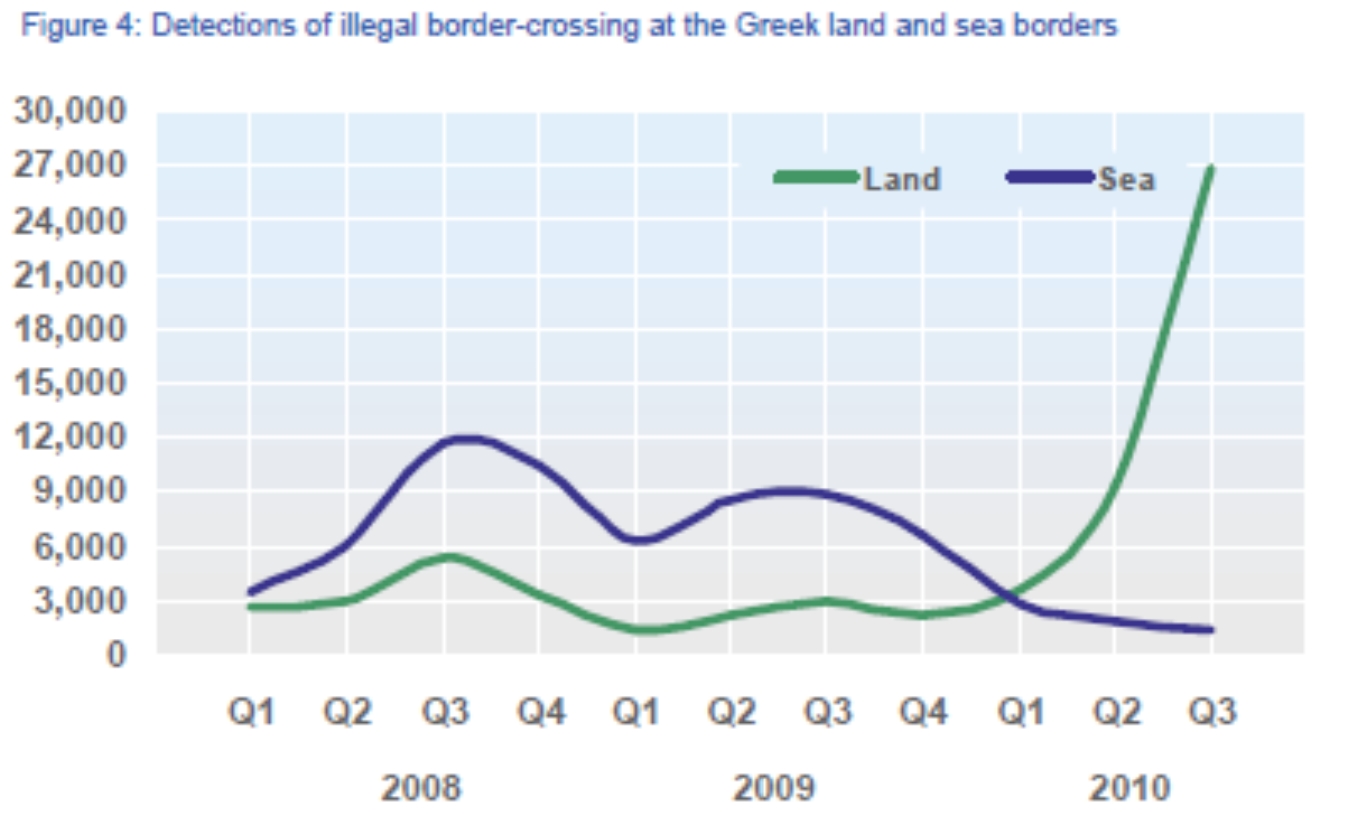
The Report notes that the “unprecedented peak in illegal border-crossings at the Greek land border with Turkey is the result of a shift from the sea to the land border” coupled with a “large increase in the absolute number of migrants” using Turkey as an EU entry point.  The Report states that there has been an eight-fold increase in the number Maghreb nationals detected at the Greek land border which “is thought to be the result of a displacement effect from the West Africa and Western Mediterranean routes.”

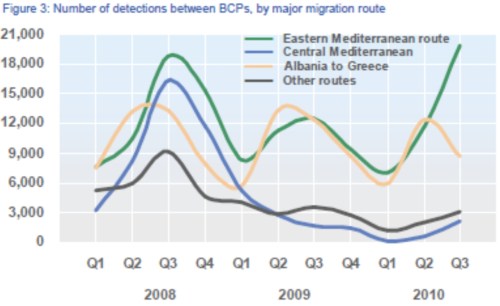
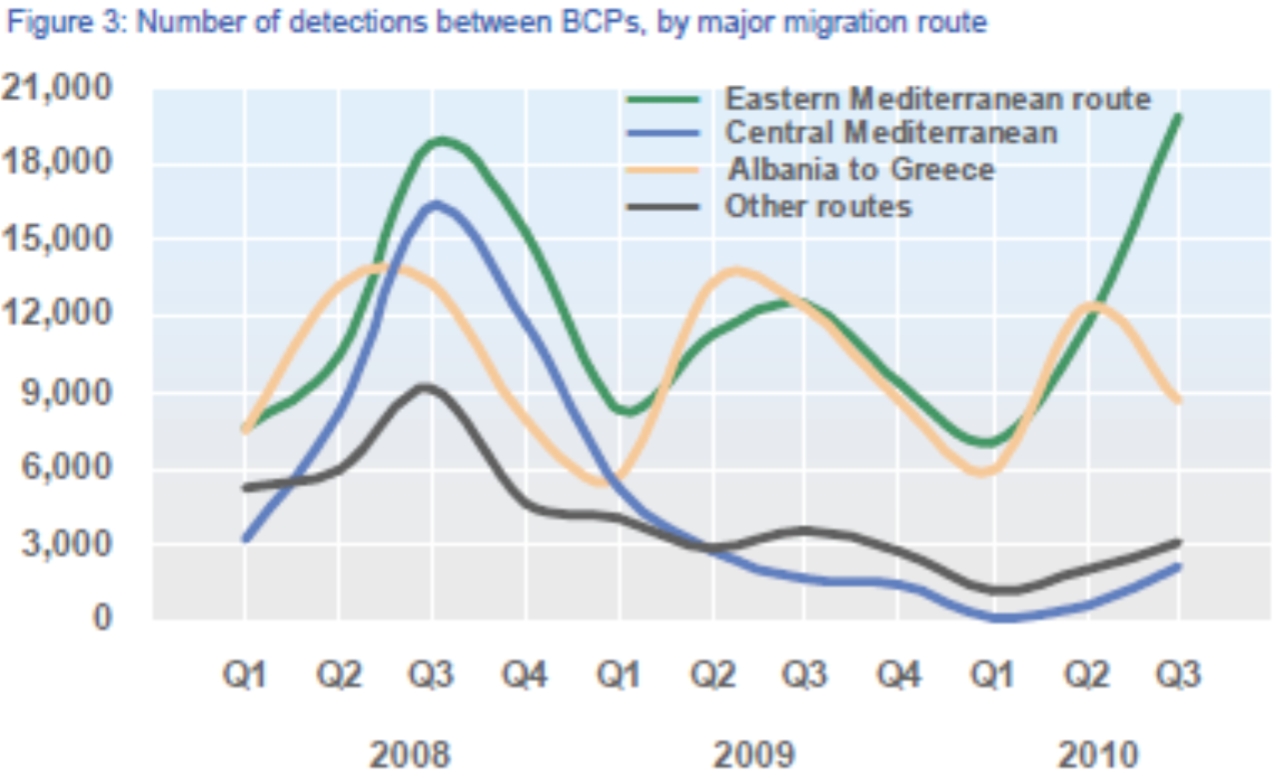
The Report also notes an increase in the number of detections on the Central and Western Mediterranean sea routes compared to Q2 which may be attributable to seasonal variations or “may be indicative of reorganized modi operandi in these areas in response to Frontex Joint Operations, more effective border controls and bilateral agreements implemented in 2008.”  See Figure 3 below.

Excerpts from the Report:

“Detections of illegal border-crossing”

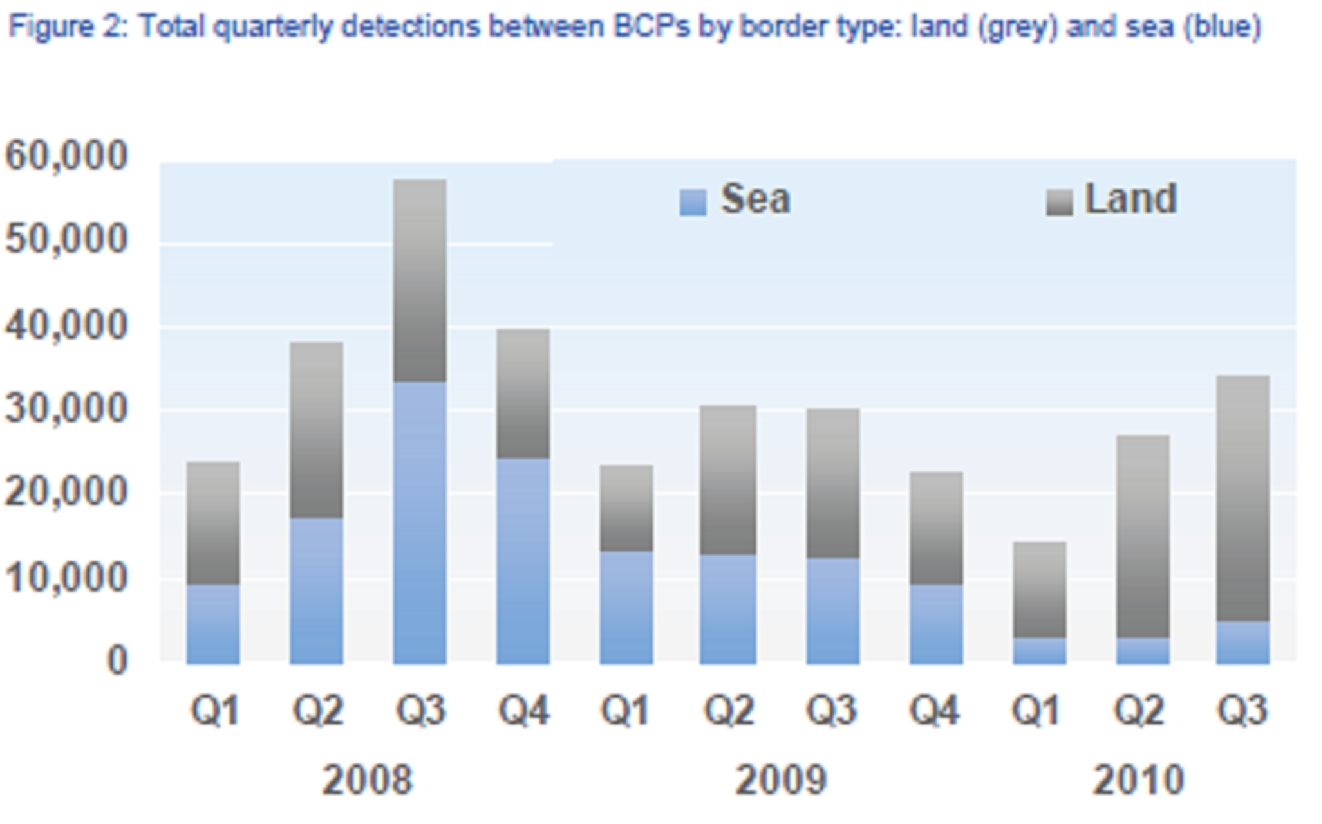
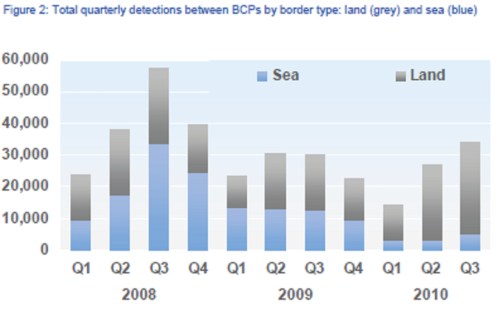
“…  Fig. 2 [see below] shows quarterly detections at the land and sea borders of the EU since the beginning of 2008. The 30% increase in the number of detections between the previous and present quarters is comprised of a 60% increase at the sea borders (although from a lower base) and a 23% increase at the land borders. This means that the shift from sea to land borders has not continued to same extent as in the previous quarters.  Nevertheless in Q3 2010, there were some 29 000 detections of illegal border-crossing at the external land border of the EU, which constitutes 85% of all the detections at the EU level, and the highest number of detections at the land border since data collection began in early 2008….”

“Eastern Mediterranean route”

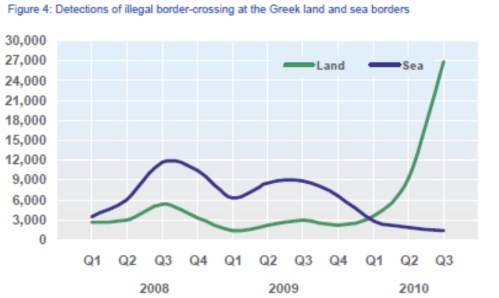
The Report observes that there has been a shift in illegal crossings from the Greece-Turkey maritime border to the Greece-Turkey land border and notes an increase in the number of nationals from Maghreb countries apprehended at the Greece-Turkey land border.  “This route [being taken by Maghreb nationals] is very indirect, but is thought to be the result of a displacement effect from the West Africa and Western Mediterranean routes….”

See Figure 4 below which shows that detections of illegal border crossers at the land border of Greece have exceeded detections at the sea border since Q1 of 2010.

“Central Mediterranean route”

“There were 2 157 detections of illegal border-crossing during Q3 2010. This is more than a three-fold increase compared to the previous quarter and a third higher than the same period last year. However despite this apparently large increase, detections still remain massively reduced compared to the peak of around 16 000 during the same period in 2008 (Fig. 3)….”

“The JO Hermes 2010 which was operational between June and October 2010, focused on illegal migratory flows departing from Algeria to the southern borders of the EU, specifically to Sardinia. In 2010, there were fewer detections than in previous years….”

“Departures from Libya also remained low. In June 2010, a new law was implemented to serve more severe punishments for facilitating illegal immigration. Ambassadors of the countries of origin were called into the Ministry of Foreign Affairs in Tripoli to be informed about the consequences of the new law, which suggests that this may be a serious implementation.”

“Western Mediterranean route”

“In general, irregular immigration to southern Spain has decreased massively since the beginning of 2006. However, in Q3 2010 there were 2 200 detections of illegal border crossing in the Western Mediterranean, more than twice that of the previous quarter and around a third higher than the same period in 2009. There is growth in the number of detections of a wide range of African nationalities, nine of which more than doubled in number between Q2 and Q3 2010. The most detected nationalities were Algerian, Moroccan, Cameroonian and Guinean.”

“Western Africa route”

“The cooperation and bilateral agreements between Spain and the rest of the Western African countries (Mauritania, Senegal and Mali) are developing steadily, and are one of the main reasons for the decrease in arrivals, as is the presence of patrolling assets near the African coast.”

“According to data collected during JO Hera, the numbers of arrivals in the Canary Islands and detections in West Africa are very low compared to the same time last year. The main nationality and place of departure is from Morocco, to where migrants are returned within a few days.”

Click here for the 3rd Quarter 2010 Report.

Click here for the 2nd Quarter 2010 Report.

Click here for the 1st Quarter 2010 Report.

Click here for my previous post regarding the 2nd Quarter Report.


Leave a comment

Filed under Aegean Sea, Algeria, Data / Stats, Eastern Atlantic, European Union, Frontex, General, Greece, Italy, Libya, Malta, Mauritania, Mediterranean, Morocco, News, Reports, Senegal, Spain, Tunisia, Turkey