Category Archives: States

Live Coverage, 1 March, 09:00, LIBE Meeting re Situation in the Central Mediterranean

LIBE will reconvene today, 1 March, 09:00-10:30, to discuss “the situation in the central Mediterranean…. They will consider the democratisation process in the region and its impact on migration flows and EU immigration and asylum policy. In attendance: Hungarian Presidency representative, H.E. Peter Györkös, Cecilia Malmström, Commissioner for Home Affairs and Ilkka Laitinen, Executive Director of Frontex, the EU border security agency.”

Click here for live coverage.

Leave a comment

Filed under European Union, Frontex, Italy, Libya, Malta, Mediterranean, News, Tunisia

Austria Would Accept Up To 6000 Refugees from Libya if Needed

Austrian Interior Minister Maria Fekter said that while she doubts there will be a massive flow of refugees from Libya, if necessary, Austria would be in a position to accept up to 6,000 asylum seekers.

Click here (EN) and here (DE) for articles.

Leave a comment

Filed under Austria, European Union, Italy, Libya, Malta, Mediterranean, News

EU migration control made by Gaddafi?

An article from OpenDemocracy by Prof. Gregor Noll (Lund University) and Mariagiulia Giuffré (doctoral candidate at the School of International Studies, University of Trento):

“[T]here is a far-reaching consensus that a government [such as the Gaddafi Government] that uses indiscriminate lethal force to retain power is, as the diplomatic phrasebook has it, “unacceptable”. Yet, over the past six years, it has been perfectly acceptable for EU governments to outsource its border protection to an authoritarian leader with a dismal human rights record…. We, the citizens of the EU, should also be reminded that for over three years now, we have relied on Gaddafi and his state apparatus to keep asylum seekers and other migrants away from our doors….”

Click here for article.

2 Comments

Filed under Analysis, European Union, Italy, Libya, Mediterranean

Blog du Monde Diplo: une démonstration de force navale; une petite armada converge en direction des côtes libyennes

Du blog de “Défense en ligne” écrit par Philippe Leymarie: “Guerre civile en Libye et options militaries.”

“Alors que le Conseil de sécurité de l’ONU réuni vendredi dernier a décidé d’un embargo sur les armes et de sanctions contre le régime Kadhafi, la violence de la répression en Libye a incité les pays européens, qui n’envisagent pas d’intervention militaire pour le moment, à entamer une démonstration de force… navale, qui a pris forme en quelques heures, avec une célérité inhabituelle. Une petite armada converge en direction des côtes libyennes, dans ce qui pourrait, à terme, devenir une véritable opération, mêlant la dissuasion à l’humanitaire. …

“Dans la pratique, le déploiement de cette petite armada pourrait également constituer un cordon de sécurité afin d’éviter une fuite en masse par la mer de Libyens ou d’immigrés africains vers l’Europe – donnant plus de consistance à l’opération de surveillance « Hermès », entamée (sous la pression notamment de l’Italie, en première ligne) par l’agence européenne Frontex….”

Cliquez ici pour l’article complet.

Leave a comment

Filed under Analysis, European Union, Frontex, Libya, Mediterranean, United Nations

Annual number of asylum applications in select countries, 2004-2009

From Migration Policy Institute’s MPI Data Hub: annual number of asylum applications in select countries.  I copied the data for years 2004-2009 below.  Click here for the data for the years 1980-2009, footnotes, and source information.

Countries of destination 2004 2005 2006 2007 2008 2009
Australia 3,201 3,204 3,515 3,980 4,771 6,170
Austria 24,634 22,461 13,349 11,921 12,841 15,830
Belgium 15,357 15,957 11,587 11,114 12,252 17,190
Canada 25,750 20,786 22,868 27,865 34,800 33,250
Denmark 3,235 2,260 1,918 1,852 2,360 3,750
Finland 3,861 3,574 2,324 1,505 4,016 5,910
France 58,545 49,733 30,748 29,387 35,404 41,980
Germany 35,613 28,914 21,029 19,164 22,085 27,650
Greece 4,469 9,050 12,267 25,113 19,884 15,930
Ireland 4,765 4,325 4,315 3,985 3,866 2,690
Italy 9,722 9,548 10,348 14,057 30,324 17,600
Netherlands 9,782 12,347 14,465 7,102 13,399 14,910
Norway 7,945 5,402 5,320 6,528 14,431 17,230
Spain 5,535 5,254 5,297 7,662 4,517 3,000
Sweden 23,161 17,530 24,322 36,373 24,353 24,190
United Kingdom 40,620 30,815 28,335 27,880 31,315 29,840
United States 44,972 39,240 41,101 40,449 39,362 38,968
             

Leave a comment

Filed under Australia, Belgium, Data / Stats, Denmark, European Union, France, Germany, Greece, Italy, Netherlands, Spain, Sweden, UK, United States

España ha destinado al menos un 5% de la ayuda en África Occidental a control de fronteras e intereses comerciales

A new report from Entreculturas and Alboan:

“Casi 25 millones de euros de un total de 466 es la Ayuda Oficial al Desarrollo destinada a países de África Occidental cuestionada por contribuir más a intereses de la política de migraciones que al desarrollo humano y lucha contra la pobreza durante el periodo 2004-2008. Es una de las conclusiones del informe “Políticas de control migratorio y de cooperación al desarrollo entre España y África Occidental durante la ejecución del primer Plan África” presentado por Entreculturas y Alboan….”

Resumen: “En el marco de la coherencia de políticas a favor del desarrollo, y con el objetivo de investigar si la cooperación bilateral española está condicionada por intereses de control de los flujos migratorios, las ONG Alboan y Entreculturas presentan el informe Políticas de control migratorio y de cooperación al desarrollo entre España y África Occidental durante la ejecución del primer Plan África que analiza el destino de la ayuda oficial al desarrollo (AOD). España  durante los años 2004 – 2008 ha destinado 25 millones de euros de AOD a proyectos que tienen más relación con el control de fronteras e intereses comerciales que con el desarrollo humano y lucha contra la pobreza. Esto supone un 5,2% de del total de la ayuda de AOD bilateral en África Occidental.”

Click here (ES) or here (ES) for full report.

Click here (ES) for news article.

Leave a comment

Filed under Eastern Atlantic, ECOWAS, News, Reports, Senegal, Spain

Italian Defence Minister: Italy-Libya Friendship Agreement is “Defunct, Inoperative, Suspended”

Italian Defence Minister Ignazio La Russa stated that “the Italy-Libya treaty is effectively defunct, inoperative, suspended.”  In addition to the migration control provisions, the treaty also contains provisions which forbade Italy from participating in military actions again Libya.

La Russa also said that the Italian Finance Police officers who under the terms of the treaty were assigned to Libyan patrol vessels engaged in anti-migrant patrols have been withdrawn and are present at the Italian embassy in Tripoli.

Click here (EN), here (EN) (WSJ registration required), here (IT), and here (IT) for articles.

Leave a comment

Filed under Italy, Libya, Mediterranean, News

Laitinen to Visit Malta to Discuss New Frontex Mission

The Malta Independent reported yesterday that Frontex Director Ilkka Laitinen will visit Malta shortly “with a view to organising a Frontex mission that would be hosted by Malta but, [Justice and Home Affairs Minister] Dr Mifsud Bonnici stresses, not under the infamous guidelines that are being disputed [before the European Court of Justice] by Malta, Italy and the European Parliament.”  Dr Mifsud Bonnici said “I have also made it a precondition that if we are to host this Frontex mission, it would not be under those guidelines and there is an agreement on that.”

Malta’s primary objection to the Frontex Sea Border Rule is likely due to provisions which require that intercepted migrants be taken to the country hosting the Frontex mission under certain circumstances.  The relevant provision provides:

“2. Disembarkation- 2.1. The operational plan should spell out the modalities for the disembarkation of the persons intercepted or rescued, in accordance with international law and any applicable bilateral agreements. The operational plan shall not have the effect of imposing obligations on Member States not participating in the operation.  Without prejudice to the responsibility of the Rescue Coordination Centre, and unless otherwise specified in the operational plan, priority should be given to disembarkation in the third country from where the ship carrying the persons departed or through the territorial waters or search and rescue region of which that ship transited and if this is not possible, priority should be given to disembarkation in the host Member State unless it is necessary to act otherwise to ensure the safety of these persons.”

Commissioner Cecilia Malmström has previously said that the Sea Border Rule guidelines can be negotiated by member states on a mission by mission basis and that before a mission starts participating member states can agree on different rules of engagement, which might include the sharing of responsibility where not all intercepted migrants would be brought to country hosting the mission.

Click here for Malta Independent article.

Click here for previous post regarding Malmström’s comments.

Leave a comment

Filed under European Union, Frontex, Libya, Malta, Mediterranean, News

More Assets Dedicated to Frontex Joint Operation “Hermes Extension”; More EU and NATO Naval Forces Present in Central Mediterranean

The assets dedicated to Joint Operation Hermes Extension continue to increase, although at present there are only two coastal patrol boats (Italian) participating in the Frontex  mission.  Ten surveillance aircraft will soon be deployed.  See the table with the list of resources below.

While the naval assets dedicated to JO Hermes Extension are minimal, there is a growing number of EU and NATO naval ships in the Central Mediterranean.  Nicolas Gros-Verheyde (writing on the Bruxelles2 blog (FR)) has counted 14 naval ships from EU states that are present in the waters near Libya; the ships consist of destroyers, frigates, electronic surveillance ships, and supply and support ships.   Additionally, Turkey has two naval ships in the area.

Some of the naval ships have already been used to evacuate European and other non-Libyan nationals from Libya.  What additional activity the EU ships may engage in remains to be seen.  They may become involved in military activities (presumably with UN authority (?)) and/or they may play a yet undetermined role should there be a sudden flow of migrants and asylum seekers from Libya.  If there is a sudden and significant migratory flow, the naval ships should function in a search and rescue manner, but there is always the possibility that if faced with large numbers of migrants, the navy vessels may be used to interdict, blockade, or otherwise to try to prevent migrants from leaving Libya.

Click here for link to Frontex update regarding deployed assets.

Click here and here for Bruxelles2 postings. (FR)

Table: Resources available to JO Hermes Extension 2011 as of February 25, 2011.

Italy (HMS) 2 Coastal Patrol Vessel, 1 aircraft, 5 experts, 2 cultural mediators
Austria 1 expert
Belgium 2 experts
Denmark 3-5 experts
France 10 experts, 1 aircraft
Germany 2 experts, 2 aircrafts
Hungary 2 experts
the Netherlands 1 aircraft, 2 experts
Portugal 7 experts, 1 aircraft
Romania 6 experts
Sweden 1 expert
Switzerland 2 experts
Spain 4 experts, 1 aircraft (at a later stage)

Leave a comment

Filed under Algeria, Data / Stats, European Union, Frontex, General, Italy, Libya, Malta, Mediterranean, News, Tunisia

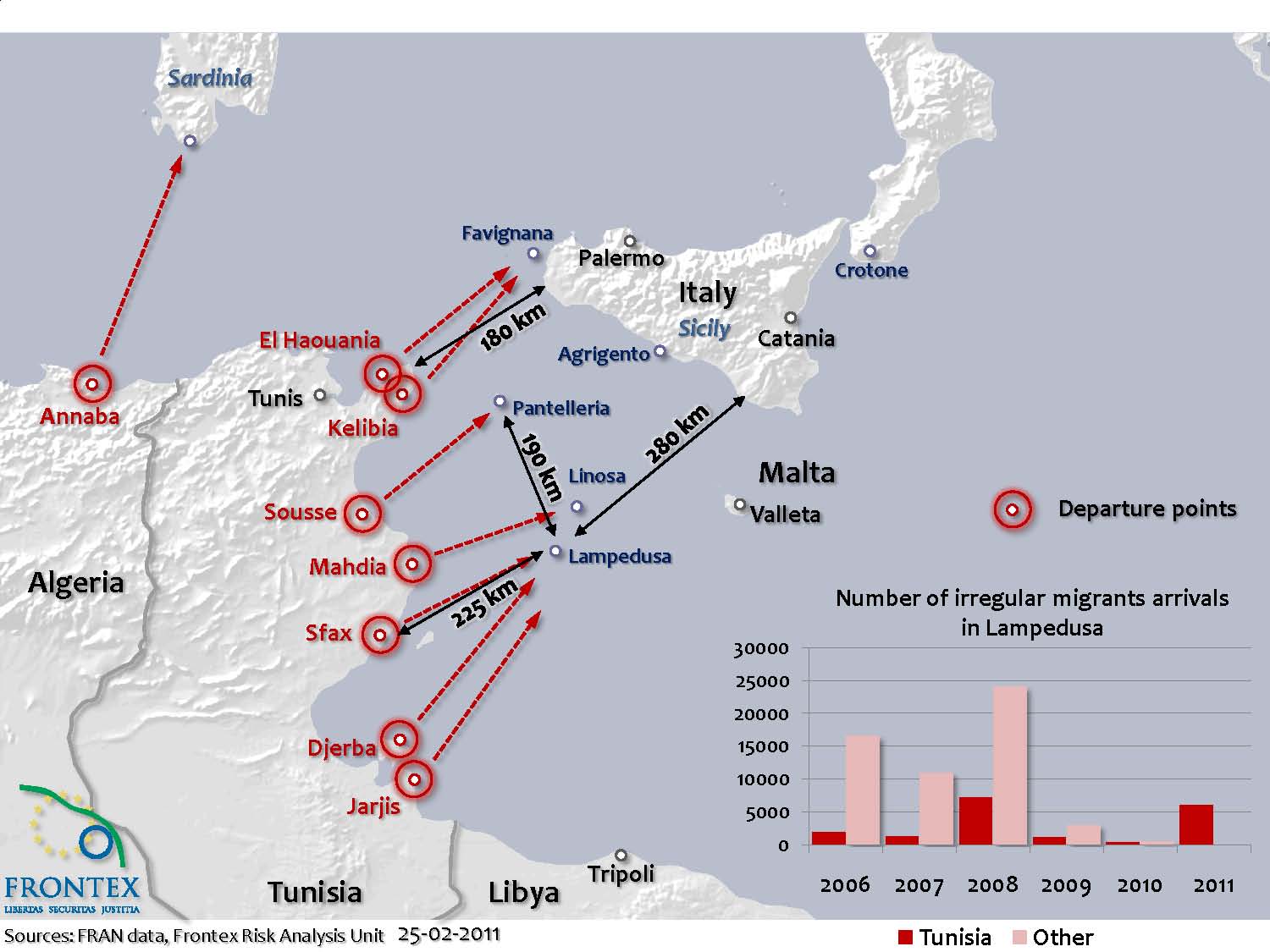
Frontex Lampedusa Situational Map

Frontex posted a situational map showing current and past information regarding migrant flows from Tunisia to Italy.  The map is dated 25 Feb. 2011.

1 Comment

Filed under Algeria, Data / Stats, European Union, Frontex, Italy, Malta, Mediterranean, News, Tunisia

LIBE Meets 28 Feb-1 March with Full Agenda

LIBE will meet on Monday and Tuesday with a full and timely agenda.  I’ll try to post summaries of several of the meeting documents which are now posted on the EP LIBE Meeting Document page later today or Sunday.

Here are some of the agenda items to be voted on or considered:

28 Feb. 2011, 15.00  (room PHS, Hemicycle)

Item 4. Adoption of Draft Opinion – Migration Flows arising from Instability: Scope and Role of the EU Foreign Policy

[Frenzen’s note – the draft opinion on which the vote will be taken is dated 14 January 2011 and was prepared before the current situation in North Africa became apparent].

Click here for Draft Opinion and here for Amendments 1-53.

Item 12. Consideration of Amendments – Minimum standards on procedures in Member States for granting and withdrawing international protection (recast)

Click here for Draft Report  and here for Amendments 54 – 286.

Click here for “Proposal for a DIRECTIVE OF THE EUROPEAN PARLIAMENT AND OF THE COUNCIL on minimum standards on procedures in Member States for granting and withdrawing international protection.”

Item 15. Consideration of Working Document – European Union’s Internal Security Strategy

Click here for Part 1 of the Working Document on the European Union’s internal security strategy and here for Part 2.

1 March 2011, 9.00 (Meeting with the Council and Commission – N.B. this part of the meeting will be held in meeting room JAN 4 Q 2)

Item 17. The democratic process in the central Mediterranean area, the impact on migration fluxes and the EU immigration and asylum policy.

Exchange of views in the presence of:

  • The Hungarian Presidency, H.E. Peter GYÖRKÖS, Permanent Representative of Hungary to the EU
  • European Commission representative (name to be confirmed)
  • Mr. Ilkka LAITINEN, Executive Director of Frontex (European Agency for the Management of Operational Cooperation at the External Borders of the Member States of the EU)

No documents for this item have been posted.

Click here for the Full Agenda of the LIBE meeting and here for the Meeting Documents page.

Leave a comment

Filed under European Union, Frontex, Libya, Mediterranean, News, Tunisia

Network Euro Mediterraneo per i Diritti dell’Uomo: Missione di raccolta informazioni in Tunisia e Italia e Raccomandazioni

From CIR:  “…[I]l Network Euro Mediterraneo per i Diritti dell’Uomo ha organizzato una missione di raccolta informazioni, che si è svolta dal 18 al 24 febbraio prima in Tunisia e poi in Italia. La missione era composta da rappresentanti di organizzazioni membro del Network e di partner e da esperti del Nord e del Sud del Mediterraneo. La missione ha potuto raccogliere testimonianze e informazioni dirette, tanto in Tunisia che in Italia.

La missione ha permesso di smentire sia la tesi della presenza massiva tra i migarnti arrivati in Italia di delinquenti di diritto comune evasi dalle carceri, sia quella di un complotto migratorio che sarebbe stato ordito dalla Libia e dai nostalgici di Ben Ali.

Nel corso della missione, le preoccupazione legate agli avvenimenti drammatici che sconvolgono la Libia hanno, in qualche maniera, soppiantato gli interrogativi che circondano i migranti tunisini.

Al termine di questa missione, il Network formula le seguenti raccomandazioni:

Alle autorità italiane:

  • Rispettare la dignità di tutti i migranti, quali che siano le loro motivazioni.
  • Sospendere l’applicazione dell’accordo bilaterale di riammissione con la Tunisia sotto il concluso con il regime di Ben Ali. Sospendere tutte le misure di espulsione forzata individuale o collettiva verso la Tunisia.
  • Richiedere all’Unione Europea l’attivazione del meccanismo di protezione temporanea.
  • Nell’attesa della protezione temporanea, accordare ai migranti una forma di protezione umanitaria che si traduca in un titolo di soggiorno legale in Italia. Misura che deve essere indicata dalle autorità centrali e che non deve essere in alcun modo delegata alla discrezionalità delle singole Questure e Commissioni Territoriali per il riconoscimento della protezione internazionale
  • Migliorare e razionalizzare le condizioni d’accoglienza, il ricorso allo stato d’urgenza umanitaria non può tradursi in un abbassamento degli standard di accoglienza.
  • Astenersi dal mettere in opera il progetto di raggruppamento del Villaggio Mineo, in Sicilia, di tutti i richiedenti asilo in corso di procedura in Italia, misura         che può provocare una situazione di ghetto ed esclusione sociale
  • Assicurare ai migranti che hanno fatto domanda d’asilo un esame individuale della domanda di protezione nel pieno rispetto delle direttive “procedure” e “qualifiche”
  • Astenersi da dichiarazioni allarmistiche e incendiarie che assimilano migranti, delinquenti e terroristi

Alle autorità tunisine

  • Garantire la libertà di tutte le persone di lasciare qualsiasi paese compreso il proprio ( Articolo 12, 2 del Patto internazionale relativo ai diritti civili e politici). Di conseguenza, astenersi di tutte le procedure penali per le persone fermate nel tentativo di lasciare la Tunisia via mare o per quanti sono rimpatriati forzatamente verso il Paese
  • Rispettare pienamente le obbligazioni marittime internazionali relative alla ricerca e al salvataggio in mare.
  • Aprire una inchiesta approfondita e imparziale sulle condizioni nelle quali una barca è affondata l’11 febbraio, in un incidente che è costato la vita ad almeno 5 persone, e perseguirne i responsabili
  • Sospendere l’applicazione dell’accordo bilaterale sul controllo dell’Immigrazione concluso con l’Italia. Esigerne la rinegoziazione e, nel futuro, escludere la possibilità di rimpatri massivi e la sua applicazione a cittadini di paesi terzi.

Alle autorità europee

  • Accompagnare gli Stati dell’Africa del Nord nel processo di transizione in corso, poiché la democrazia è la sola a poter garantire una reale stabilità nella regione, e quindi offrire ai giovani la possibilità di costruire il loro futuro in un paese nel quale possono progettare un avvenire.
  • Aiutare l’Egitto e la Tunisia che, contrariamente all’Europa, sono già stati chiamati ad accogliere rifugiati libici e stranieri, in provenienza dalla Libia. La solidarietà a cui si appellano gli Stati del Sud dell’Unione Europea deve esprimersi innanzitutto nei confronti di questi Stati in transizione
  • Astenersi da tutte le operazioni che avrebbero come conseguenza la dissuasione o l’impedimento dell’arrivo in Europa di persone che avrebbero bisogno di protezione
  • Prepararsi all’attivazione della direttiva sulla “protezione temporanea” nel caso si producano arrivi massivi dal Nord Africa.”

Click here (IT) for full CIR post.

See also CIR “Emergenza Nord Africa”.

Leave a comment

Filed under European Union, General, Italy, Libya, Mediterranean, Reports, Statements, Tunisia

Special web page – CIR “Emergenza Nord Africa”

Consiglio Italiano per i Rifugiati (CIR) created a special web page – Emergenza Nord Africa – which is tracking migration and other related aspects of the North African crisis.

Click here (IT).

Leave a comment

Filed under European Union, Italy, Libya, News, Tunisia

ECRE Statement: Safe haven for people fleeing bloodshed in Libya

ECRE issued a statement earlier today.  Here is the full statement:

As the situation in Libya is worsening and the world is watching the atrocities of Gaddafi’s regime, European governments are stepping up efforts to evacuate their citizens outside the country. The repression is brutal and just as British, Turkish, Egyptians and other foreigners, some Libyans and refugees from sub-Saharan countries unable to go back and stranded in Libya will need refuge from violence and human rights abuses.

At this historical moment, on the other side of the Mediterranean, the EU needs to live up to its obligations to protect those fleeing the violence.

With or without Frontex, border control operations carried out at sea cannot result in persons being returned to Libya without assessing in a fair asylum procedure whether they are in need of international protection.

Some European governments have warned of an exodus of biblical proportions. The truth is that what will happen is totally unpredictable. For the moment, those leaving the country seem to be travelling to Egypt or remaining elsewhere in the region. So far, according to the EU Border Agency Frontex, some 5.500 people, mainly Tunisians, arrived to Lampedusa in January and February. This is nowhere near the number that would make an asylum system of a country such as Italy collapse.

Even if the number of people arriving to Europe would increase dramatically, to the extent that an immediate and individual assessment of their protection needs would no longer be possible, the EU has already at its disposal the tools to ensure that people can reach a safe haven. The Temporary Protection Directive, adopted after the Kosovo crisis, allows Member States to grant immediately a protection status to persons who arrive in Europe in the context of so-called mass influx and makes it possible for Member States to better share responsibility through the relocation of refugees protected under this scheme to other EU countries.

In addition, the recently established European Asylum Support Office has the competence to deploy national asylum experts to EU Member States receiving high numbers of asylum seekers. Although the agency is not yet operational, ad hoc solutions can be found if need be.

Finally, the EU’s decision to suspend the negotiations with Libya on a framework agreement, which included cooperation in the field of immigration and asylum, is indeed the only sensible thing to do. Libya’s poor human rights record was well known when last year the European Commission agreed to offer the dictatorship € 50m over the next 3 years to reinforce Tripoli’s capacity to prevent migrants from entering the Southern border and from crossing the Mediterranean towards Europe. According to the European Commission, no money has been disbursed so far. The bloodshed in the country and the regime’s attempts to blackmail the EU by threatening with breaking its cooperation on controlling migration towards Europe, showed clearer than ever who the EU was willing to trust to control migration to Europe. This cannot go on.

Contact

Ana Fontal

Senior Press and Public Information Officer

Tel: +32 2 212 08 12

Mobile: + 32 (0) 486 531 676

www.ecre.org

Click here for link to statement.
Leave a comment

Filed under European Union, Frontex, Italy, Libya, Mediterranean, Statements, Tunisia

Most EU States View Italy’s Concerns Over Refugee Threat As Grossly Exaggerated

The JHA Council yesterday rejected Italy’s call for a stronger EU response to what it describes as an impending migrant flow from North Africa consisting of hundreds of thousands of migrants and asylum seekers.  Several EU governments described the Italian request as one that was based on exaggerated fears.  Hungary’s interior minister, Sandor Pinter, told reporters that “we shouldn’t paint the devil on the wall until he appears.”  German Interior Minister Thomas de Maiziere said “we shouldn’t be painting horror figures and encouraging refugees to come to Europe.”  Another accused Italy of “crying wolf.”

IOM spokeswoman Jemini Pandya said that while Italy should not shoulder a refugee burden on its own, no Libyans have arrived in Italy to date and she rejected the Italian estimates:  “I don’t think in any shape or form you are going to see one-and-a-half million migrants suddenly flood into Europe.  That is really not going to happen at all.  That would really be fear mongering to the extreme.”

Italy has done itself and neighbouring countries a disservice by repeatedly speaking of an “exodus of biblical proportions” and by suggesting that many hundreds of thousands of migrants are poised to take to the sea to try to reach Italy and Malta from Libya.  These estimates are in all likelihood grossly exaggerated.

But even if you agree that Italy’s feared numbers are exaggerations, the fact that no irregular migrant or asylum seeker has apparently yet left Libya by sea is not at all surprising.  Libya is in chaos and few people are likely to try to depart the country by sea until the level of violence begins to diminish.  Libya has (or had) a functioning network of human traffickers and they will be ready to begin exploiting the chaos and to take advantage of desperate people seeking to flee at some point in the future.  If Gaddafi manages to remain in power, once he is no longer concerned with his personal survival, his thoughts will at some point turn to revenge.  Libya will presumably cease cooperating with Italy on the bi-lateral pushback practice, and Gaddafi will tolerate or encourage irregular migration towards Europe.  So Italy is correct in that there is a real threat of significant numbers of migrants and asylum seekers leaving from Libya some time in the near future.  The numbers could easily and quickly surpass the 6,000 who have left Tunisia for Lampedusa.  Could the numbers surpass 30,000?  30,000 asylum seekers entered Sweden last year (population 9 million – Italy’s population is 50+ million) and Sweden has not received any extraordinary EU assistance as a result.  Could the numbers exceed the hundreds of thousands that fled the Balkan wars in the 1990s?  Possible, but probably not very likely.

Click here, here, here, here, and here for articles.  (EN)

2 Comments

Filed under Cyprus, European Union, France, Germany, Greece, Hungary, Italy, Libya, Malta, Mediterranean, News, Spain, Sweden, Tunisia