Category Archives: Spain

UNODC Report: The Role of Organized Crime in the Smuggling of Migrants from West Africa to the EU

UNODC released a report on 30 May: The Role of Organized Crime in the Smuggling of Migrants from West Africa to the European Union.  From the UNODC web page: “… The new report by the United Nations Office on Drugs and Crime (UNODC) investigates the involvement of organized criminal groups in the smuggling of migrants from West Africa towards the European Union (EU).  The involvement of organized crime in the smuggling of migrants is a sensitive and controversial issue in West African countries, as the report discusses at various points. The publication contributes to better understand the underlying mechanisms and actors involved in this criminal process as a basis for policy reforms in countries affected.

Information in the report was compiled by a team of researchers from West Africa and Europe using both documentary studies and field research conducted in Mali, the Niger, Nigeria and Spain. …  UNODC, as guardian of the Protocol against the Smuggling of Migrants by Land, Sea and Air, supplementing the United Nations Convention against Transnational Organized Crime, possesses specific expertise and experience that could be put at the service of all countries affected to support them in matters linked to prevention, legislation, operations or prosecution.”

From the Report’s Summary:  “The United Nations Office on Drugs and Crime (UNODC), through the European Union-funded ‘Law enforcement capacity-building to prevent and combat smuggling of migrants in the ECOWAS region and Mauritania (Impact)’, undertook to investigate the role played by organized criminal groups in the smuggling of migrants from West Africa to Europe.

The present report is aimed primarily at decision makers, law enforcement and judicial officials, but also at a wider audience interested in irregular migration. It contributes to a better understanding of the underlying mechanisms and actors involved in this criminal process as a basis for policy reforms in the West African countries concerned.  This report was prepared through desk and field research, conducted in Mali, Morocco, the Niger, Nigeria, Senegal and Spain. Interviews were conducted with over 200 people in Africa and Europe belonging to three main groups: migrants, national authorities and non-governmental organizations, and smugglers.

Four main findings can be mentioned:

• Transnational organized criminal groups are generally involved in the smuggling of migrants from West Africa to Europe. However, there are important differences among them in terms of specialization and professionalism. With regard to trafficking in persons and the smuggling of non-African irregular migrants, criminal groups are clearly well organized and structured, and keep close contacts with operatives in several countries. On the other hand, other would-be migrants in West Africa have to deal with loose networks that are not permanently structured. Various groups of actors usually collaborate for one particular operation, and there are no exclusive relationships between those criminal groups.

• Specialization and the building of transnational criminal networks usually come as a result of increased efficiency in border interdiction. Within West Africa, freedom of movement gives little incentive, if any, to engage in the smuggling of migrants. However, the situation changes when there are natural obstacles, such as the sea, or man-made obstacles, such as surveillance

• In most cases, smugglers are migrants themselves. Realizing that their knowledge acquired through (often painful) experience may be used by other migrants in exchange for remuneration, some migrants decide to enter the business of smuggling of migrants. They may then become specialized professional smugglers, or they use their knowledge to finance the completion of their journey to Europe.

• Irregular migrants generally do not see themselves as victims, and smugglers do not see themselves as criminals. A complex relationship exists between irregular migrants and smugglers. The latter have an interest in maintaining the flow and feeding youngsters with dreams of success. These dreams are also kept alive in some West African countries by families and circles where important social value is attached to those who decide to leave, as well as by those who have made it to Europe, be it legally or illegally, even though their situation in Europe is often worse than it was at home….”

Click here for Report.

Click here for article on UNDOC web page.

Leave a comment

Filed under Analysis, Eastern Atlantic, European Union, Mauritania, Mediterranean, Morocco, Niger, Reports, Senegal, Spain, United Nations, UNODC

Frontex Deployment, Repatriation Practices, and Diplomacy Are Responsible For Halting Migrant Arrivals in Canary Islands

From Europa Press: Juan Martinez, Chief Inspector of the Spanish National Police’s  Illegal Immigration Network and False Document Unit (UCRIF – Unidad Contra las Redes de Inmigración Ilegal y Falsedades Documentales), attributes the significant decline in the arrival of migrant boats in the Canary Islands to the deployment of Frontex, diplomatic management in the countries of origin, and repatriation policies.  The article notes the first migrant boat arrival in the Canaries in 1994, the peak years of 2006-2008, and the ensuing practices which have halted further migrant arrivals.

Click here (ES) for article.

Leave a comment

Filed under Eastern Atlantic, Frontex, News, Senegal, Spain

Interview with Frontex Deputy ED Gil Arias

EurActiv.es conducted an interview in Spanish with Frontex Deputy Executive Director Gil Arias where he speaks about several topics, including Frontex’s response to the current situation in North Africa, the possible implications for Spain should unrest spread to Algeria or Morocco, Frontex’s budget shortfall and need for supplemental funding, and the problems experienced by Frontex when it attempts to negotiate cooperation or training agreements with third countries.

Click here for interview. (ES)

Leave a comment

Filed under Egypt, European Union, Frontex, Greece, Italy, Libya, Malta, Mediterranean, News, Spain, Tunisia

600+ Migrants Reach Andalusian Coast in 2011

A total of 612 migrants in 24 different boats have reached the Andalusian coast of Spain (Almeria, Granada, Cadiz and Huelva) from Morocco and Algeria so far in 2011.

Click here for article (ES).

Leave a comment

Filed under Algeria, Data / Stats, Eastern Atlantic, Mediterranean, Morocco, News, Spain

Análisis del Real Instituto Elcano: La crisis en el Norte de África y su impacto en la inmigración irregular a la Unión Europea (by Frontex Dep. ED Gil Arias)

Real Instituto Elcano has published an analysis regarding the situation in North Africa and its impact on irregular immigration to the EU.  The analysis was written by Frontex’s Deputy Executive Director Gil Arias.

Of particular interest is the analysis regarding what Frontex believes might occur in regard to migrant flows from Libya under two different scenarios: Gadafi remaining in power or ultimately being removed from power (see Google translation of excerpt below):

“… En el caso de que el régimen de Gadafi recupere el control, la UE y sus Estados Miembros no podrán reanudar la cooperación con un régimen totalmente desacreditado. Se producirá el cese en la aplicación de acuerdos de cooperación policial que en el pasado (desde mayo de 2009) sirvieron para detener los flujos de inmigración irregular desde Libia hacia Italia y Malta. La posibilidad de que ciudadanos de otros países africanos bloqueados en Libia sean obligados o “ayudados” a emigrar a la UE no debe descartarse. De hecho, Gadafi ha amenazado con “abrir la puerta” de la inmigración ilegal hacia Europa.

La OIM estima la cifra de extranjeros presentes en Libia entre 0,5 y 1,5 millones. No obstante, no todos serian candidatos a la inmigración ilegal. Se trata fundamentalmente de trabajadores empleados por empresas extranjeras asentadas en el país, por lo que su intención primaria no sería la emigración a la UE y por otra parte una buena parte de ellos ya han abandonado Libia.

En el peor de los casos, la consecuencia de ese “abrir la puerta” sería la reactivación de los flujos por vía marítima hacia Lampedusa y Malta (eventualmente también Creta, que se encuentra a 200 km de distancia de la costa libia) en un escenario similar al de 2008 (40.000 inmigrantes llegaron a Italia y Malta, con origen en las costas libias) agravado por el efecto adicional de la inestabilidad en el país. Su destino principal serían los países con presencia importante de ciudadanos norteafricanos (Italia, Francia, España, Bélgica y el Reino Unido). El destino de los nacionales de países subsaharianos se encontraría más repartido por toda la UE.

Si Gadafi es derrocado resultará clave la capacidad y rapidez de la oposición para reorganizarse. La oposición se encuentra, por el momento, bastante desorganizada y es probable que se produzcan luchas internas por el poder, especialmente por el control de los campos petrolíferos. Ello podría conducir a un estado persistente de disturbios y a una ausencia de control por un largo periodo de tiempo.

La eventual reactivación de las rutas migratorias hacia la UE dependerá de la capacidad del nuevo régimen para imponer la ley y el orden en el país así como el control efectivo sobre los 2.000 km de costas y 4.000 km de fronteras terrestres libias. En el peor de los escenarios podría darse una situación similar a la de Somalia.

En este escenario, la economía libia puede deteriorarse y elevarse los niveles de desempleo. Actualmente se desconoce la tasa de desempleo en Libia, pero se presume baja. Previsiblemente, la mayoría de los trabajadores desempleados intentará regresar a sus países, pero parte de ellos (sobre todo los nacionales de países inseguros) buscaran otras oportunidades, entre ellas la emigración clandestina a la UE.

La ausencia de ley y orden, especialmente la ausencia de control sobre las fronteras marítimas, llevará rápidamente a las mafias al tráfico de inmigrantes hacia la UE. Los candidatos serían primariamente trabajadores desempleados no deseosos de volver a sus países (mayormente de África Occidental y Oriental, pero eventualmente también libios, egipcios, argelinos y tunecinos). Esta situación impediría, por otra parte, el retorno de quienes fuesen detectados cruzando ilegalmente las fronteras exteriores de la UE.

En tales circunstancias se puede prever un flujo constante de inmigración ilegal durante meses, mayoritariamente por vía marítima, pero también por vía aérea a través de Turquía. La duración en el tiempo de este escenario dependerá de la rapidez con la que la UE o los Estados Miembros y las nuevas autoridades sean capaces de restablecer la cooperación. En este sentido, serán determinantes los acuerdos de readmisión efectivos.

Por último, ha de tenerse también en cuenta el riesgo marginal de que los vencedores realicen acciones de persecución sobre los partidarios de Gadafi, lo que provocaría la huida de éstos del país en busca de refugio….”

Google translation of the above excerpts (NB – this is only a rough translation):

“…In the case of Qaddafi’s regime  regaining control, the EU and its Member States shall not resume cooperation with a discredited regime. Termination will occur in the implementation of agreements on police cooperation in the past (May 2009) served to stop the flow of illegal immigration from Libya to Italy and Malta. The possibility for citizens from other African countries locked in Libya are forced or “helped” to migrate to the EU can not be ruled out. In fact, Gaddafi has threatened to “open the door” of illegal immigration into Europe.

The IOM estimates the number of foreigners in Libya between 0.5 and 1.5 million. However, not all candidates would be illegal immigration. These are mainly employed by foreign companies settled in the country, so that their primary intention would not be the migration to the EU and, moreover, a good portion of them have already left Libya.

In the worst case, the consequence of this “open door” would be the reactivation of the flows by sea to Lampedusa and Malta (and possibly Crete, which is 200 km away from the Libyan coast) in a scenario similar to that of 2008 (40.000 immigrants arrived in Italy and Malta, departing from the Libyan coast) aggravated by the additional effect of instability in the country. Its main destination countries would be a significant presence of North African citizens (Italy, France, Spain, Belgium and the UK). The fate of the national sub-Saharan countries would be more distributed throughout the EU.

If Gadhafi is overthrown will be key capacity and speed of the opposition to regroup. The opposition is, at present, quite disorganized and is likely to produce internal power struggles, especially for control of the oilfields. This could lead to a persistent state of unrest and a lack of control over a long period of time.

The eventual recovery of migratory routes towards the EU depends on the ability of the new regime to impose law and order in the country as well as effective control over the 2,000 km of coastline and 4,000 km of land borders Libya. In the worst case scenario could be a situation similar to Somalia.

In this scenario, the Libyan economy may deteriorate and unemployment levels rise. Currently unknown unemployment rate in Libya, but presumably low. Predictably, most unemployed workers try to return to their countries, but some of them (especially insecure country nationals) to seek other opportunities, including illegal migration to the EU.

The absence of law and order, especially the lack of control over maritime borders, whisk the trafficking mafias immigrants into the EU. Candidates would be primarily unemployed workers eager to return to their countries (mostly from West and East Africa, but also possibly Libyans, Egyptians, Algerians and Tunisians). This would prevent, on the other hand, the return of those who were detected illegally crossing the external borders of the EU.

In such circumstances, can provide a steady flow of illegal immigration for months, mostly by sea, but also by air through Turkey. The long life of this scenario depends on the speed with which the EU or the Member States and the new authorities are able to restore cooperation. In this regard, will determine the effective readmission agreements.

Finally, it must also take into account the marginal risk that the winners perform acts of persecution on Gaddafi’s supporters, causing them to flee the country in search of refuge….”

Click here for the Analysis. (ES)

Leave a comment

Filed under Algeria, Analysis, Egypt, European Union, France, Frontex, Greece, Italy, Libya, Malta, Mediterranean, Morocco, Spain, Tunisia, Turkey

Migrant Boat Capsized Off Spain – 18 Missing, 4 Dead

A boat believed to be carrying 51 sub-Saharan migrants attempting to sail from Morocco to Spain capsized south of Adra (Almería).  The boat reportedly left Morocco on 5 May.  The accident occurred late Thursday night to early Friday morning.  The boat was carrying men, women, and children.  29 people were rescued.  Four bodies have been recovered.  18 people remain missing and are assumed to be dead due to the sea temperature which according to authorities would allow someone to survive for a maximum of 10 hours.  Media reports suggest that the boat capsized after one of its floats ruptured which in turn caused the boat to capsize.

Click here (EN), here (ES) and here (ES) for articles.

Leave a comment

Filed under Mediterranean, Morocco, News, Spain

Spain’s Security Secretary Visited Mauritania to Strengthen Bilateral Immigration Cooperation

Spanish Secretary of State for Security, Antonio Camacho, travelled last week to Mauritania, Niger, and Mali to strengthen bilateral cooperation on illegal immigration and organised crime.

Spain and Mauritania agreed to strengthen their cooperation on immigration control and to expand cooperation to include efforts to combat drug smuggling using the same joint cooperation model currently being used for illegal migration.  Camacho said Spain is committed to continue providing material resources to the Mauritanian security forces to “further improve the tools at their disposal to deal with security threats and to strengthen their border control mechanisms.”  Camacho thanked Mauritania for its efforts to block illegal migration towards Spain and noted that only one boat (cayuco) reached the Canary Islands from Mauritania in 2010 and that no boats had so far reached the Canary Islands in 2011.  Spain and Mauritania began their close cooperation on immigration control in March 2006.

While in Mauritania, Camacho visited the 50 members of the Spanish National Police and Civil Guard who are stationed in Nouadhibou as part of Spain’s extraterritorial immigration control measures.

Click here (ES), here (ES), and here (FR) for articles.

Leave a comment

Filed under Eastern Atlantic, European Union, Mauritania, News, Niger, Spain

Annual number of asylum applications in select countries, 2004-2009

From Migration Policy Institute’s MPI Data Hub: annual number of asylum applications in select countries.  I copied the data for years 2004-2009 below.  Click here for the data for the years 1980-2009, footnotes, and source information.

Countries of destination 2004 2005 2006 2007 2008 2009
Australia 3,201 3,204 3,515 3,980 4,771 6,170
Austria 24,634 22,461 13,349 11,921 12,841 15,830
Belgium 15,357 15,957 11,587 11,114 12,252 17,190
Canada 25,750 20,786 22,868 27,865 34,800 33,250
Denmark 3,235 2,260 1,918 1,852 2,360 3,750
Finland 3,861 3,574 2,324 1,505 4,016 5,910
France 58,545 49,733 30,748 29,387 35,404 41,980
Germany 35,613 28,914 21,029 19,164 22,085 27,650
Greece 4,469 9,050 12,267 25,113 19,884 15,930
Ireland 4,765 4,325 4,315 3,985 3,866 2,690
Italy 9,722 9,548 10,348 14,057 30,324 17,600
Netherlands 9,782 12,347 14,465 7,102 13,399 14,910
Norway 7,945 5,402 5,320 6,528 14,431 17,230
Spain 5,535 5,254 5,297 7,662 4,517 3,000
Sweden 23,161 17,530 24,322 36,373 24,353 24,190
United Kingdom 40,620 30,815 28,335 27,880 31,315 29,840
United States 44,972 39,240 41,101 40,449 39,362 38,968
             

Leave a comment

Filed under Australia, Belgium, Data / Stats, Denmark, European Union, France, Germany, Greece, Italy, Netherlands, Spain, Sweden, UK, United States

España ha destinado al menos un 5% de la ayuda en África Occidental a control de fronteras e intereses comerciales

A new report from Entreculturas and Alboan:

“Casi 25 millones de euros de un total de 466 es la Ayuda Oficial al Desarrollo destinada a países de África Occidental cuestionada por contribuir más a intereses de la política de migraciones que al desarrollo humano y lucha contra la pobreza durante el periodo 2004-2008. Es una de las conclusiones del informe “Políticas de control migratorio y de cooperación al desarrollo entre España y África Occidental durante la ejecución del primer Plan África” presentado por Entreculturas y Alboan….”

Resumen: “En el marco de la coherencia de políticas a favor del desarrollo, y con el objetivo de investigar si la cooperación bilateral española está condicionada por intereses de control de los flujos migratorios, las ONG Alboan y Entreculturas presentan el informe Políticas de control migratorio y de cooperación al desarrollo entre España y África Occidental durante la ejecución del primer Plan África que analiza el destino de la ayuda oficial al desarrollo (AOD). España  durante los años 2004 – 2008 ha destinado 25 millones de euros de AOD a proyectos que tienen más relación con el control de fronteras e intereses comerciales que con el desarrollo humano y lucha contra la pobreza. Esto supone un 5,2% de del total de la ayuda de AOD bilateral en África Occidental.”

Click here (ES) or here (ES) for full report.

Click here (ES) for news article.

Leave a comment

Filed under Eastern Atlantic, ECOWAS, News, Reports, Senegal, Spain

Most EU States View Italy’s Concerns Over Refugee Threat As Grossly Exaggerated

The JHA Council yesterday rejected Italy’s call for a stronger EU response to what it describes as an impending migrant flow from North Africa consisting of hundreds of thousands of migrants and asylum seekers.  Several EU governments described the Italian request as one that was based on exaggerated fears.  Hungary’s interior minister, Sandor Pinter, told reporters that “we shouldn’t paint the devil on the wall until he appears.”  German Interior Minister Thomas de Maiziere said “we shouldn’t be painting horror figures and encouraging refugees to come to Europe.”  Another accused Italy of “crying wolf.”

IOM spokeswoman Jemini Pandya said that while Italy should not shoulder a refugee burden on its own, no Libyans have arrived in Italy to date and she rejected the Italian estimates:  “I don’t think in any shape or form you are going to see one-and-a-half million migrants suddenly flood into Europe.  That is really not going to happen at all.  That would really be fear mongering to the extreme.”

Italy has done itself and neighbouring countries a disservice by repeatedly speaking of an “exodus of biblical proportions” and by suggesting that many hundreds of thousands of migrants are poised to take to the sea to try to reach Italy and Malta from Libya.  These estimates are in all likelihood grossly exaggerated.

But even if you agree that Italy’s feared numbers are exaggerations, the fact that no irregular migrant or asylum seeker has apparently yet left Libya by sea is not at all surprising.  Libya is in chaos and few people are likely to try to depart the country by sea until the level of violence begins to diminish.  Libya has (or had) a functioning network of human traffickers and they will be ready to begin exploiting the chaos and to take advantage of desperate people seeking to flee at some point in the future.  If Gaddafi manages to remain in power, once he is no longer concerned with his personal survival, his thoughts will at some point turn to revenge.  Libya will presumably cease cooperating with Italy on the bi-lateral pushback practice, and Gaddafi will tolerate or encourage irregular migration towards Europe.  So Italy is correct in that there is a real threat of significant numbers of migrants and asylum seekers leaving from Libya some time in the near future.  The numbers could easily and quickly surpass the 6,000 who have left Tunisia for Lampedusa.  Could the numbers surpass 30,000?  30,000 asylum seekers entered Sweden last year (population 9 million – Italy’s population is 50+ million) and Sweden has not received any extraordinary EU assistance as a result.  Could the numbers exceed the hundreds of thousands that fled the Balkan wars in the 1990s?  Possible, but probably not very likely.

Click here, here, here, here, and here for articles.  (EN)

2 Comments

Filed under Cyprus, European Union, France, Germany, Greece, Hungary, Italy, Libya, Malta, Mediterranean, News, Spain, Sweden, Tunisia

Italy, France, Spain, Malta, Cyprus Call for Redistribution of Asylum Seekers

The Ministers of the Interior of Italy, France, Spain, Malta and Cyprus met in Rome on Wednesday in advance of today’s JHA Council meeting and agreed to ask the EU for assistance in regard to the expected flow of migrants from North Africa.  The Ministers will call for the creation of a special EU fund to provide financial support to the frontline states directly affected by significant numbers of migrants and for the redistribution or relocation of asylum seekers among all EU member states so that the states of first arrival do not experience an unfair burden.  Michele Cercone, spokesperson for Commissioner Cecilia Malmström, noted that current European standards do not provide a mechanism for the redistribution between member states of migrants seeking asylum, other than on a voluntary basis.

Click here (IT) for article.

1 Comment

Filed under Cyprus, European Union, France, Italy, Libya, Malta, Mediterranean, News, Spain, Tunisia

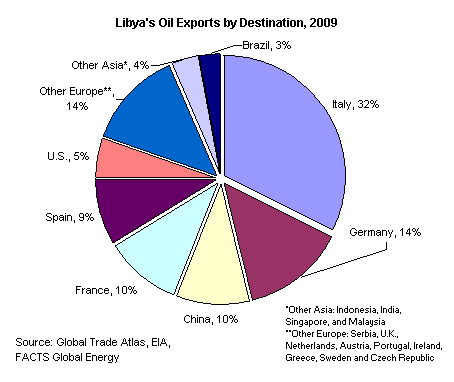
32% of Libya’s 2009 Oil Exports Went to Italy

From the US Energy Information Administration:

2009 Libyan Oil Exports:  “With domestic consumption of 280,000 bbl/d in 2009, Libya had estimated net exports (including all liquids) of 1.5 million bbl/d. According to 2009 official trade data as reported to the Global Trade Atlas, the vast majority of Libyan oil exports are sold to European countries like Italy (425,000 bbl/d), Germany (178,000 bbl/d), France (133,000 bbl/d), and Spain (115,000). With the lifting of sanctions against Libya in 2004, the United States has increased its imports of Libyan oil. According to EIA estimates, the United States imported an average of 80,000 bbl/d from Libya in 2009, up from 56,000 bbl/d in 2005 but, as a result of the U.S. economic downturn and subsequent decline in oil demand, 2009 levels were below 2007 highs of 117,000 bbl/d.”

Click here for link.

(HT to tweet by @johnwilcockson)

1 Comment

Filed under Data / Stats, European Union, France, Germany, Italy, Libya, Mediterranean, News, Spain

Times of Malta: Frontex Preparing for “Unprecedented” Migrant Flow from Libya

The Times of Malta reports today that Frontex “has been given instructions to start preparing for a possible unprecedented influx of immigrants and asylum seekers fleeing Libya towards the EU, particularly through Malta and Lampedusa.” “‘The fact that the Libyan regime does not seem to be in control of the huge expanse of the 2,000-km long Libyan coastline might already pose a big danger of a flood of asylum seekers crossing by rogue boats towards Malta, Lampedusa and Sicily,’ the sources said.”  According to the article the planned response to a massive flow would involve all 27 member states.  EU spokesman for Home Affairs Michele Cercone confirmed that Frontex was engaged in planning for a migrant flow from Libya, but said he would not “speculate on details and suppositions.”  The article also states that “six EU Mediterranean member states [Malta, France, Cyprus, Spain, Greece, and Italy] will meet in Rome tomorrow in an urgent minisummit to devise a common stance on the immigration crisis facing the southern Mediterranean region, a day before official talks of EU justice ministers in Brussels.”

Click here article.

1 Comment

Filed under Cyprus, European Union, France, Frontex, Greece, Italy, Libya, Malta, Mediterranean, News, Spain

Frontex’s Role to be One of Coordination

Consistent with its mandate and standard practice, Frontex’s role in the new Central Mediterranean joint operation will be one of coordination.  According to DI-VE, “[i]n the current situation, [Frontex] foresees its main role as coordinating border guards from among the member states, particularly with regard to second-line experts in the screening and debriefing of irregular migrants as well as in coordinating an appropriate operational response to the humanitarian needs in the area. In addition, the agency is investigating the most optimal means by which to adapt a range of technical assets engaged in sea border operations in the Mediterranean to the needs of the Italian authorities.”

Click here for article.

Leave a comment

Filed under European Union, France, Frontex, Italy, Libya, Malta, Mediterranean, Netherlands, News, Spain, Tunisia

Frontex Central Mediterranean Operation Likely to Begin Within Days; Dutch to Send Coast Guard Plane to Lampedusa; France and Spain Likely to Deploy Planes or Ships

The Dutch government has decided to deploy a Coast Guard surveillance plane to Italy to participate in the new Frontex joint operation.  The Dutch decision was announced by Immigration and Asylum Minister Gerd Leers on Friday.  The plane and two Dutch border guards are scheduled to be deployed for at least six weeks beginning 21 February.

The Financial Times reports today that the Frontex joint operation may be operational early next week and that details are being finalised at a meeting that is taking place today in Rome between European Commission and Italian officials.  According to the FT article, one topic under discussion is the situation in Libya and the possibility for a larger wave of migrants should the situation in Libya become more unstable or should Gaddafi’s government collapse.

Click here (EN) (FT registration may be required), here (NL), here (NL), and here (EN) for articles.

Leave a comment

Filed under European Union, France, Frontex, Italy, Libya, Malta, Mediterranean, Netherlands, News, Spain, Tunisia