Category Archives: Turkey

CARIM Mediterranean Migration 2008-2009 Report

Noted recently in the Newsletter of the Real Instituto Elcano:

CARIM MEDITERRANEAN MIGRATION 2008-2009 REPORT, Robert Schuman Centre for Advanced Studies, San Domenico di Fiesole (FI): European University Institute, October 2009, Edited by Philippe Fargues

MIGRATIONS MÉDITERRANÉENNES, RAPPORT 2008-2009, Octobre 2009, Sous la direction de Philippe Fargues

An excerpt:

“The period covered in this latest report, the years 2007 and 2008, is characterised by the accentuation of the migratory trends described in previous reports1: emigration from South and East Mediterranean countries (SEM) is continuing at a steady rate, while immigration to these countries is increasing, particularly in various irregular forms. [***]

Transit Migrants

Transit migrants in the SEM countries are people who cannot reach the destination of their choice (Europe) for lack of the required visa. They are waiting to find a way to reach this destination and over time their transit becomes stay. All the SEM countries, from Mauritania in the west to Turkey in the East, have, over the course of the last two decades, been transformed into transit countries for those travelling to Europe.

How many transit migrants are there in the SEM countries? The statistics in this area are even more inadequate than those for de facto refugees or irregular migrant workers. Aggregating figures provided by the police and various NGOs allows for a maximum estimation of 200,000 transit migrants in the region (Table 7).

Table 7: Transit migrants present in SEM countries around 2005

Country                        Estimated number

Algeria                           > 10,000

Turkey                           > 50,000

Libya                              > 10,000

Mauritania                   ± 30,000

Morocco                      > 10,000

Egypt, Israel, Jordan,

Lebanon, Palestine,

Syria, Tunisia              Not available

Total SEM                     < 200,000

Sources: CARIM, Irregular Migration Series http://www.carim.org/index.php?areaid=8&contentid=235&callTopic=7

According to data collected by an Italian NGO on deaths and disappearances at sea (Table 8), it would seem that the number of clandestine sea crossings from SEM countries to Europe is not increasing (in fact it may even have decreased in 2008) but the routes are changing. The most ancient route across the Straits of Gibraltar is being used less and less and has been successively replaced by that from Mauritania, or even Senegal, to the Canary Islands (on which traffic peaked in 2006), from Turkey to the Greek Islands of the Dodecanese (on which traffic peaked in 2007) and lastly from Libya to Italy on which traffic peaked in 2008).

How many transit migrants are there who attempt (sometimes successfully) the crossing to Europe? And for how many does transit in the SEM countries become a more long period of stay? The rare surveys carried out in the Maghreb or in Turkey do not allow us to assess this. With the extension of their stay in countries initially seen as a place of transit, transit migrants soon become mixed up with the more significant mass of migrant workers in irregular situation. On the other hand, it is not always possible to distinguish them from refugees. The two groups exist side by side in what the HCR calls flows of “mixed migration” where transit migrants and refugees, sometimes from the same countries of provenance, resort to the same smugglers and find themselves in the same circumstances.

Table 8: Dead and missing persons on sea routes of irregular migration from SEM to Europe 2000 – 2008

Year\ Route      Sicily +             Gibraltar +

Sardinia           Ceuta & Melilla

2000                   0                           127

2001                     8                           157

2002                     236                     106

2003                     413                     108

2004                     206                    64

2005                     437                    146

2006                     302                    215

2007                     621                    142

2008                     702                    216

Total                     2,925                1,281

Year\ Route      Canary              Aegean Sea

Islands

2000                   16                         32

2001                     40                        102

2002                     39                        94

2003                     130                      81

2004                     232                      103

2005                     185                      98

2006                     1,035                  73

2007                     745                      257

2008                      136                      181

Total                       2,558                 1,021

Year                Total All Routes

2000                 175

2001                   307

2002                   475

2003                   732

2004                   605

2005                   866

2006                   1,625

2007                   1,765

2008                   1,235

Total                  7,785

Source : http://fortresseurope.blogspot.com/

[***]”

Click here for link to full Report in both English and francais.

Leave a comment

Filed under Algeria, Data / Stats, Egypt, France, Greece, Italy, Libya, Malta, Mauritania, Mediterranean, Morocco, Portugal, Reports, Spain, Tunisia, Turkey

“Harraga: La menace de la prison n’a rien changé”

El Watan: “Un an après la loi du 25 février 2009 criminalisant la harga [en Algérie], ils sont nombreux à ne plus vouloir partir. Mais pas par crainte de finir en prison dans leur pays. …  Les passeurs exigent des sommes énormes ! Les prix pratiqués aujourd’hui peuvent atteindre les 400 000 DA pour l’Espagne à partir de Ghazaouet.”

“Hocine Zehouane, président de la Ligue algérienne des droits de l’homme, a publié, en 2009, un rapport accablant relatif à cette tragédie : 36 000 jeunes harraga et environ 4 000 Algériens croupiraient dans les prisons espagnoles. Sans parler des 600 corps dans les morgues d’Almeria (Espagne). … « Les Européens ont mis beaucoup d’argent dans le programme Frontex (agence dotée de moyens de détection, de surveillance de toute migration par terre, par mer et même par air) et ont financé les régimes autoritaires du Sud (Libye, Tunisie, Algérie, Maroc) pour bloquer ce type d’émigration clandestine. Je crois que si les jeunes ont furieusement envie d’émigrer, ils n’ont pas envie de mourir en mer, ils n’ont pas envie de traîner misérablement dans les centres de détention s’ils arrivent en vie, ils n’ont pas envie d’être ensuite expulsés vers leur pays. »”

“Kamel Belabed, porte-parole du collectif des familles de harraga disparus, est du même avis : « Les jeunes s’informent, lisent la presse et ont accès à Internet. Ils savent, pour la plupart, qu’il y a maintenant une ‘coopération’ avec l’Union européenne pour l’interception des barques de nos harraga. Nous savons que le programme MEDA [NF – Règlement (CE) n° 1488/96 du Conseil du 23 juillet 1996] décidé, semble-t-il, pour ‘un partenariat euromediterranéen afin de garantir la paix, la stabilité et la prospérité’ du bassin, cachait mal une finalité qui ne disait pas son nom : l’externalisation des frontières de l’Europe ! Le programme MEDA a porté le montant de l’aide à l’Algérie à 10 millions d’euros. Le principal bénéficiaire de cette aide a été la police algérienne des frontières… Ceci en 2005.”

“L’Union européenne est devenue une des sources des projets de loi au Maghreb jusqu’en Egypte. C’est sous sa houlette que la loi 09-01 a été adoptée comme ont été adoptées les mêmes lois dans chacun des pays sud-méditerranéens. »

“[D]’autres réfléchissent à de nouvelles pistes pour atteindre l’eldorado. A leurs yeux, moins coûteuses et moins risquées. Comme la Turquie, plus précisément Izmir, la luxueuse station balnéaire. « Pour moins de 150 000 DA, vous êtes en Italie ! confie Mourad, … refoulé d’Italie y a quelques mois. Le procédé est simple : on prend l’avion pour la Turquie, ensuite le train ou un ferry pour Izmir, où des passeurs nous attendent. Le coût de la traversée entre la Turquie et la Grèce est de 500 euros environ. Pour atteindre l’Italie, avec l’aide du même baron de l’immigration clandestine, vous devez payer 1000 euros environ. »”

Cliquez ici pour l’article complet.

Leave a comment

Filed under Algeria, European Union, Frontex, Italy, Mediterranean, News, Spain, Turkey

JHA Council Conclusions on 29 measures for Reinforcing External Borders and Combating Illegal Immigration

Here are excerpts from the Justice and Home Affairs Council conclusions adopted on 25 February 2010:

“Council conclusions on 29 measures for reinforcing the protection of the external borders and combating illegal immigration

2998th JUSTICE and HOME AFFAIRS Council meeting – Brussels, 25 and 26 February 2010

The Council adopted the following conclusions:

The Council:

a) Taking into account the momentum created for the further development of the area of freedom, security and justice represented by the entry into force of the Lisbon Treaty and by the political priorities included in the Stockholm Programme, the European Pact on Immigration and Asylum, the Global Approach to Migration and the European Council Conclusions of June and October 2009; [***]

d) Stressing the need to share and assess analysis of the continuing illegal arrivals of migrants at the southern maritime borders, as well as the eastern land borders, as shown in particular by recent events in the Mediterranean area, and of the smuggling of migrants and trafficking in human beings, which often have tragic consequences; and to take a series of measures immediately, in the short term and medium term, in order to address the challenges;

e) Underlining that all measures and actions taken as a consequence of these conclusions shall fully respect human rights, the protection of persons in need of international protection and the principle of non-refoulement; [***]

Concerning the activities of FRONTEX, the Council has agreed:

1. To seek agreement as a matter of urgency on the Commission proposal for a Regulation of the European Parliament and of the Council amending the FRONTEX Regulation, in order to reinforce the capabilities of the FRONTEX Agency. [***]

4. To improve operational cooperation with third countries of origin and transit, in order to improve joint patrolling on land and at sea, upon consent of the Member State concerned, return, and collection and exchange of relevant information within the applicable legal framework, and other effective preventive measures in the field of border management and illegal immigration.

5. To underline the importance of the role of the European Asylum Support Office (EASO) in developing methods to better identify those who are in need of international protection in mixed flows and in cooperating with FRONTEX where ever possible, and to welcome the development of the regional protection programs and the enhancement of the dialogue and cooperation on international protection with third countries. [***]

9. To invite FRONTEX to implement its decision to carry out a pilot project for the creation of an operational office in the eastern Mediterranean, in Piraeus, as soon as possible in 2010. The Council takes note that Frontex has agreed that, on the basis of an independent external evaluation, it may decide whether to pursue the pilot project and/or establish other Frontex operational offices as appropriate, and invites FRONTEX to report to Council on the matter.

Concerning the development of the European Surveillance System – EUROSUR, the Council has agreed:

10. To call on the Member States to implement the phases and steps laid down for the development of EUROSUR as soon as possible, in order to reinforce cooperation and Member States’ border surveillance capabilities. The Council invites the European Commission to report on EUROSUR progress on mid-2010.

11. To urge relevant Member States to establish or further develop a single national border surveillance system and a single national Coordination Centre. A network of national Coordination Centres, compatible with the FRONTEX Information System, and available on a 24/7 basis in real time, should be fully operational on a pilot basis as of 2011, involving as many Member States of the southern and eastern external borders as possible. The Commission is invited to present legislative proposals if necessary to consolidate the network of Member States by 2013.

12. To create a Common pre-frontier intelligence picture in order to provide the Coordination Centres with pre-frontier information provided by Member States, Frontex and third countries. To this end, the Council invites Frontex, in close cooperation with the Commission and the Member States to take the necessary measures to implement the study carried out by the Commission in 2009.

13. To encourage cooperation by neighbouring third countries in border surveillance. It is essential that within the territorial scope of EUROSUR and in the current financial framework, financial and logistic support from the European Union and its Member States be made available to the third countries whose cooperation could significantly contribute to controlling illegal immigration flows, in order to improve their capacity to manage their own borders.

14. To invite the Commission to report before the end of 2010 on how the conclusions of the Global Monitoring for Environment and Security (GMES) border surveillance group on common application of surveillance tools, such as satellites, could be implemented in the EU land and sea borders. [***]

Concerning solidarity and the integrated management of external borders by the Member States, the Council has agreed:

17. To request Frontex and the Member States concerned to further develop the European Patrols Network (EPN) in order to generalize bilateral joint maritime patrols, in particular between neighbouring Member States at the southern and eastern maritime borders, taking into account the experience gained on joint police patrols in the context of the Prüm Decision, and to ensure the full integration of the EPN in the EUROSUR network. [***]

Concerning the cooperation with third countries, the Council has agreed:

22. To ensure that the migration policy objectives are at the centre of the political dialogue with relevant third countries of origin and transit, with a view to the strategic, evidence based and systematic implementation of the Global Approach to Migration in all its dimensions, i.e. legal migration, illegal immigration and migration and development. This also requires, as a matter of principle, that all parties concerned assume their responsibilities in terms of return and readmission of migrants entering or staying illegally, including those migrants who have entered or tried to enter the European Union illegally from their territory. [***]

24. To enhance in particular the implementation of the Global Approach in the dialogue on migration with the main countries of origin and transit, such as, in accordance with the Stockholm Programme, those of the Mediterranean area, the East and South-Eastern Europe and Africa. This process may cover, on a case by case basis, all aspects of migration, including also cooperation on and support of border management, return and readmission, and, where appropriate, mobility issues. In doing so, the EU will promote human rights and the full respect for relevant international obligations. Dialogue and cooperation should be further developed also with other countries and regions such as those in Asia and Latin America on the basis of the identification of common interests and challenges.

25. To implement actively the European Council Conclusions of June and October 2009, including in particular by taking forward the dialogue on migration with Libya, with a view to setting up in the short term an effective cooperation. The Commission is invited to explore, as a matter of urgency, a cooperation agenda between the European Union and Libya with a view to including initiatives on maritime cooperation, border management (including possibilities for the development of an integrated surveillance system), international protection, effective return and readmission of irregular migrants and issues of mobility of persons.

26. To welcome the constructive resumption of the formal negotiations on a EU/Turkey readmission agreement, which makes provision for the return of third country nationals, and to call for its conclusion as a matter of urgency, and to stress that adequate implementation of already existing bilateral readmission agreements remains a priority. Building on the dialogue now under way with Turkey, the Council invites the Commission, the Member States and Turkey to further develop cooperation on migration, international protection and mobility issues. The Commission is also invited, in the context of the existing Instrument for Pre-accession Assistance (IPA) financial framework, to explore possibilities to provide adequate financial means to improve Turkish capacity to tackle illegal migration, including support to the implementation of the Turkish integrated border management system.

27. To underline the importance of swift finalisation of the negotiation of Article 13 of the Cotonou Agreement, the revision of which should seek to reinforce the three dimensions of the Global Approach, and in particular the effectiveness of readmission obligations.

28. To invite the Commission to identify the necessary means to support enhanced capacity building and infrastructures in relevant third countries, so that they can control efficiently their external borders and tackle illegal immigration, taking also into account the assessments made by FRONTEX.

29. To invite the Commission to report on the implementation of these Conclusions by the end of 2010.”

Click here for full Document.
Leave a comment

Filed under Aegean Sea, Eastern Atlantic, European Union, Frontex, Libya, Mediterranean, News, Turkey

Frontex Presentation at European Defence Agency Annual Conference

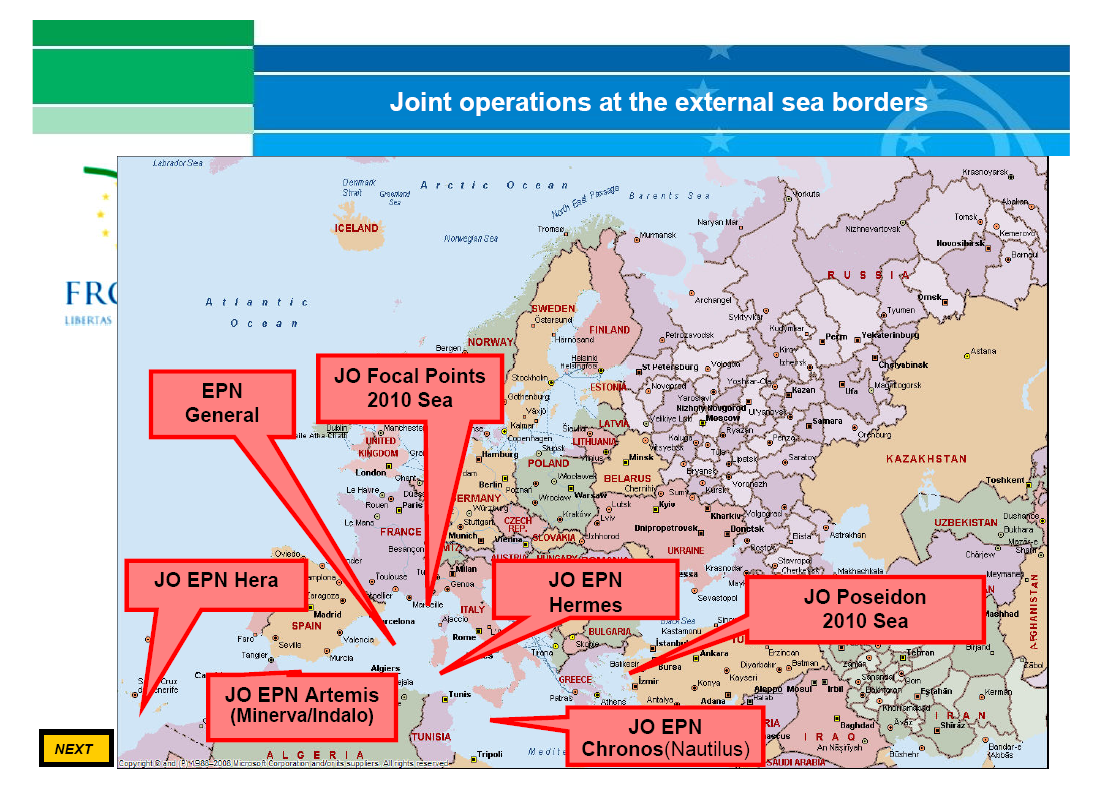
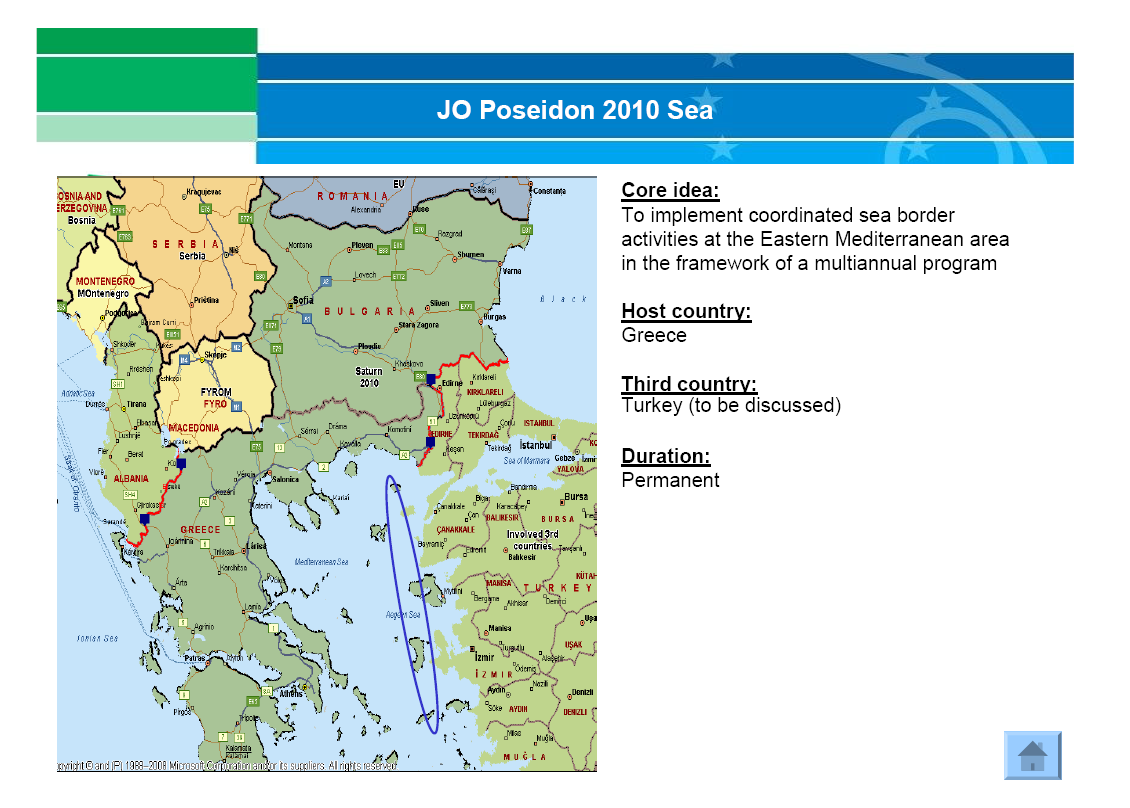
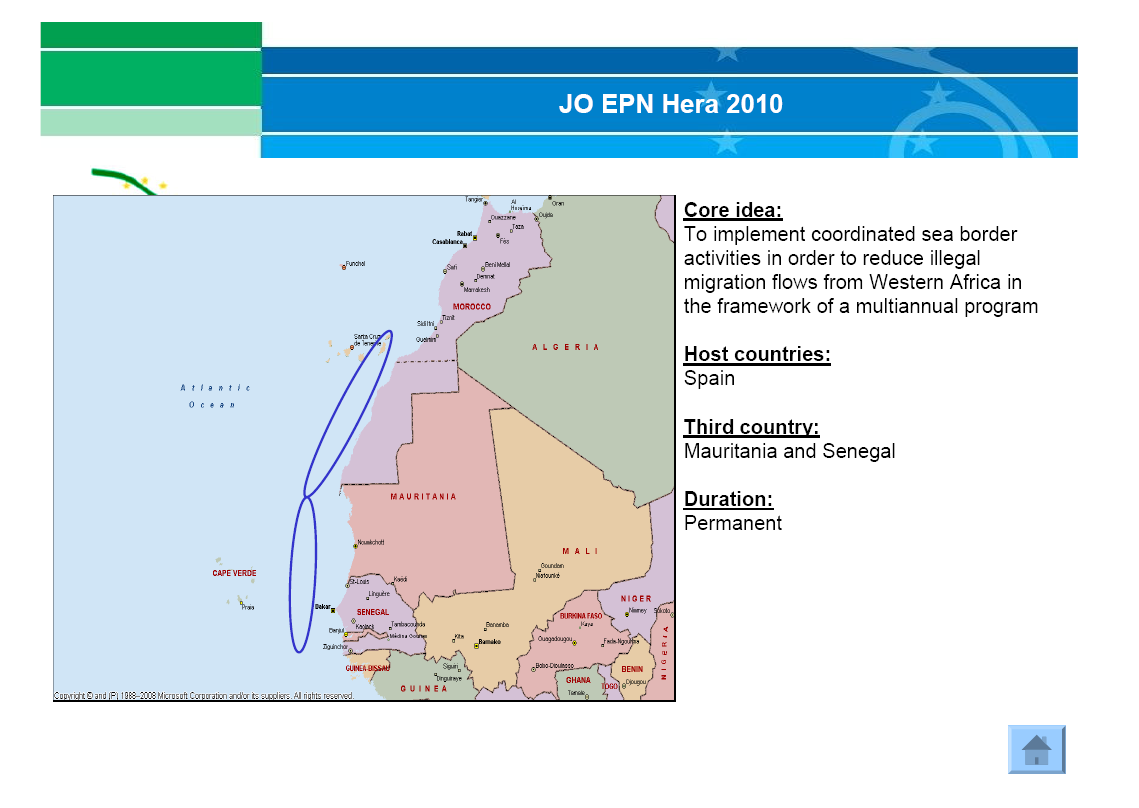
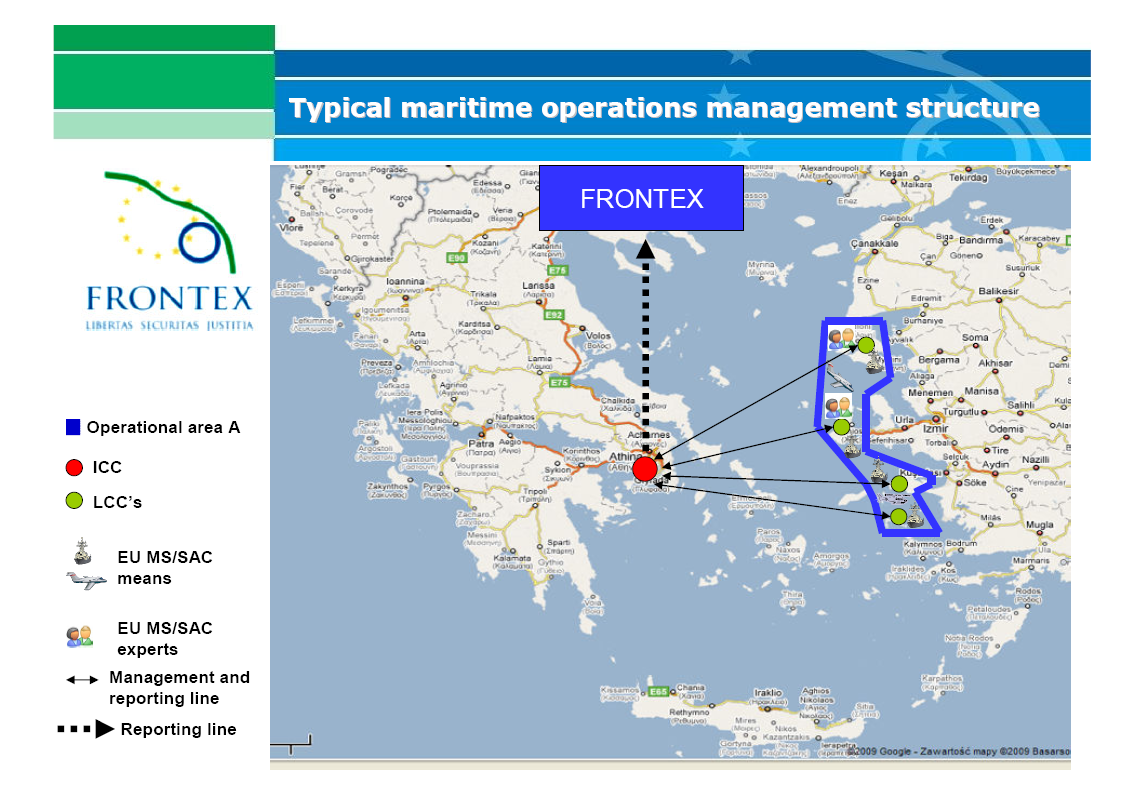
Rustamas Liubajevas, Head, Frontex Joint Operations Unit, presented a lecture entitled “Frontex within integrated Border management concept – Structural approach in planning capability” at the recent Annual Conference of the European Defence Agency.

Copies of some of his slides are reproduced here.

Click here for full slide presentation.

Leave a comment

Filed under Aegean Sea, Algeria, Colloques / Conferences, Eastern Atlantic, European Union, Frontex, Greece, Italy, Libya, Malta, Mauritania, Mediterranean, Morocco, News, Senegal, Spain, Turkey

First “Frontex Operational Office” to be Based in Greece

The Frontex Management Board has taken the decision to establish Frontex’s first Operational Office (“FOO”) in Piraeus, Greece.  According to the Frontex press release, the purpose of the office is to provide regionally-based support for Frontex coordinated activities such as joint operations and enhanced situational awareness.  If this pilot project is successful, it is expected that future FOOs would be established elsewhere such as the Western Mediterranean, the Western Balkans and Black Sea, and Eastern land borders.

According to the Frontex press release, Frontex Executive Director Laitinen said the establishment of this FOO “supports the possible enhancement of [the] Frontex mandate highlighted in the Stockholm Programme … I can even say this decision anticipates potential enlargement of the EU and Schengen zone. It gives Frontex a possibility to offer more support for the operational involvement of third countries, something that is essential for effective border management.”

Click here for Frontex statement.

Click here for the Final Report on the “Study on the feasibility of establishing specialised branches of Frontex.”  The specific functions of the new FOO are based in part on this feasibility study which was prepared in 2009.

Leave a comment

Filed under Aegean Sea, Frontex, Greece, Mediterranean, News, Turkey

Greece Seeks Talks With Turkey Over Migrants

Greek Citizen Protection Minister Michalis Chryssohoidis has written to Turkish Interior Minister Beşir Atalay asking for talks within the next month on the illegal immigration issue.

“ ‘Only systematic and close cooperation between Greece and Turkey can curb the flow of illegal immigration to the European Union,’ Chrysochoidis reportedly wrote in the letter. According to sources, Chrysochoidis has invited Atalay to Athens to discuss a set of proposals. These include the closer cooperation of Greek and Turkish coast guard officials to ensure that a bilateral pact for the repatriation of migrants is enforced. Turkish vessels currently make no effort to stop smuggling ships, the Greek coast guard says.”

Click here, here, and here for articles.

Leave a comment

Filed under Aegean Sea, Greece, News, Turkey

Besson appelle l’UE à accélérer le renforcement de l’agence européenne Frontex et la surveillance des frontières européennes

“Les corps de neuf migrants morts noyés en tentant de gagner la Grèce à partir de la Turquie ont été découverts depuis cinq jours au large du port grec d’Alexandroupolis….

“Alors que les frontières extérieures de l’Union Européenne sont soumises en Grèce à une pression sans précédent des filières d’immigration irrégulière, plus de la moitié des entrées illégales dans l’espace Schengen ayant été enregistrées en 2009 à la frontière turco-grecque, Eric BESSON appelle l’Union Européenne à renforcer la surveillance des frontières européennes notamment en Méditerranée.

“Eric BESSON interviendra dans les prochains jours auprès du Commissaire européen chargé de l’immigration pour demander que les décisions prises par les Chefs d’Etat et de Gouvernement européens pour le renforcement de l’agence européenne Frontex soient mises en oeuvre sans délai.

“Ces décisions, adoptées sur proposition de la France par le Conseil européen du 30 octobre 2009, portent en particulier sur :

  • L’adoption de règles d’engagement claires pour les opérations de contrôle maritimes.
  • Une coopération opérationnelle accrue entre Frontex et les pays d’origine et de transit, notamment la Libye et la Turquie.
  • La possibilité d’affréter régulièrement des vols conjoints financés par Frontex pour des opérations groupées d’éloignement au niveau européen.

“Eric BESSON demandera également que la coopération de la Turquie dans la lutte contre les filières d’immigration irrégulière soit placée au centre des relations entre l’Union Européenne et ce pays.

“Eric BESSON proposera enfin à la présidence espagnole de l’Union Européenne que la prochaine réunion des Ministres européens en charge de l’immigration, le 21 janvier à Tolède, permette de définir une feuille de route précise pour l’application des décisions du Conseil européen et les relations avec la Turquie dans le domaine de la circulation des personnes.”

Click here for full Statement.

Leave a comment

Filed under Aegean Sea, European Union, France, Frontex, Greece, Mediterranean, Statements, Turkey

Frontex to Expand Operations in Aegean Sea in 2010

Frontex’s director, Ilkka Laitinen, met with Greek Citizens’ Protection Minister Michalis Chrysochoidis and reportedly said that Frontex enforcement operations in the eastern Aegean Sea will be further expanded in 2010.

Minister Chrysochoidis stated that 75% of the arrests for illegal entry from the EU’s sea borders in 2009 year took place in the Aegean.

Director Laitinen said that “[Frontex Operation] Poseidon continues to be our most important operation” and that Frontex’s largest border monitoring operation will take place in the eastern Aegean in 2010.

Click here for article.

Leave a comment

Filed under Aegean Sea, Frontex, Greece, News, Turkey

EC Spokesperson Says Turks Did Not Warn Frontex Helicopter (News)

EU Commission spokesperson Amadeu Altafaj Tardio responded to Greek media reports earlier in the week that Turkey had interfered with or warned a Frontex helicopter operating on a patrol from Greek territory during Frontex’s ongoing Operation Poseidon 2009.

The statement said that the Frontex helicopter had  “never violated Turkish airspace” and that it “had never received threats from Turkish authorities.”  The statement said the Turkish radar controller “had tried to establish contact with the [Frontex] helicopter pilot and had been unable to do so due to the use of different radar frequencies.”

The spokesperson “added that the EU is still continuing negotiations with Turkey over a joint framework in operational cooperation in border management and that it had informed Turkish officials about operation Poseidon 2009.”

Click here for article

Leave a comment

Filed under Aegean Sea, Frontex, Greece, News, Turkey

Frontex Helicopter Warned by Turks (News)

The Turkish military warned a Latvian helicopter on a Frontex mission near the Greek island of Farmakonissi in the Aegean Sea to leave the area.  Turkish authorities presumably believed that the helicopter had entered Turkish airspace.

Click here for article.

Leave a comment

Filed under Aegean Sea, Frontex, Greece, News, Turkey

Turkey May Eliminate Geographic Restrictions on Asylum by 2012 (News)

The Turkish newspaper Zaman reports that Turkey is prepared to begin changes to its asylum laws to harmonize its immigration laws with those of the EU.

The Government reportedly plans to create an Asylum and Immigration Directorate within the Interior Ministry, to build “refugee shelters”, and to ratify the 1967 UN Refugee Protocol, thus eliminating the geographic restrictions (Europe only) that Turkey currently applies to asylum seekers.

Click here for full article.

Leave a comment

Filed under News, Turkey

Deaths in Aegean and Atlantic (Cadiz); Rescues in Mediterranean (News)

Several rescued, 1 dead, 1 missing in Aegean Sea off Turkish coast.  Click here for article.

14 Rescued off Algerian coast.  Click here for article.

At least 4 dead, others missing off of Cadiz.  AFP reports that up to 30 others may have been on a small boat that sank near Cadiz.

“At the start of June, the Spanish government pointed out no migrants had reached the Spanish Canary Islands, another major entry route for Africans into Europe, and cited agreements with several African countries.”

“A record 31,678 people from sub-Saharan Africa reached Spain’s Canary Islands in 2006 on small boats from Africa, but the figure dropped to 1,318 in the first quarter of 2009.”

Click here for article.

Leave a comment

Filed under Aegean Sea, Algeria, Data / Stats, Eastern Atlantic, Mediterranean, News, Spain, Turkey

Greek Dep. Foreign Minister’s ‘Six Point Plan for Illegal Migration in Agean’ (News)

Greek Deputy Foreign Minister Yannis G. Valinakis has written an article in an Athens daily paper proposing a “Six-point plan on illegal migration in the Aegean.”

The most troubling of the six points is a call for the use of “a ship of sufficient tonnage to be used as a first reception and transport centre [which would] sail near the islands of the Aegean where illegal migrants have been arrested, it will take them on board and carry them to the reception centres already in, or due to be put into, operation.”

Such a proposal is reminiscent of a similar practice used by the US Government in late 1991 when the US intercepted at sea thousands of Haitians fleeing a bloody military coup d’état.  In an effort to prevent the Haitians from reaching shore, US Coast Guard and US Naval ships detained Haitians on board large naval vessels in steadily worsening conditions.  Ultimately most of the Haitians were transferred to migrant detention camps at the US Naval Base at Guantanamo Bay, Cuba.

Other points proposed by the Deputy Foreign Minister include:

  • “Immediate relaunching of EU-Turkey negotiations on the conclusion of a readmission agreement and an immediate implementation of the existing Greek-Turkish Readmission Protocol.
  • “Use of a specific port on the Turkish coast for the return of illegal migrants who have reached [Greece] through Turkey.
  • “Intensification of joint operations on a permanent basis under FRONTEX … on the way towards the creation of a European Coastguard.
  • “Proposal for the creation of a specialised FRONTEX branch in Greece.”

Click here for the full text of the article on the Ministry’s web site.

Leave a comment

Filed under Aegean Sea, Frontex, Greece, News, Turkey

AI USA: Lives in danger as European governments deny refugees protection (Statements)

blog-ai usa logoAI USA Statement on World Refugee Day

19 June 2009

“[***]  Countries at Europe’s border are showing a flagrant disregard for their international obligations towards refugees:

“*Italy is intercepting refugees in international waters and physically transporting them, without assessing their protection needs, to Libya, where migrants, asylum-seekers and refugees are at risk of ill-treatment and forcible return to countries where they risk serious human rights abuses.

“*Turkey continues not to recognize people from outside Europe as refugees, meaning thousands of people are denied the protection they need.

“*Greece pushes back people at its land border and sea borders with Turkey without first assessing their asylum claims. For those that do enter the country there are many legal obstacles for refugees to gain protection.

“*Spain’s bilateral agreements with several countries in Africa are used to justify the arbitrary arrest, detention and deportation of refugees, asylum-seekers and migrants in these countries.

“*Other countries in the European Union (E.U.) turn a blind eye to the increasing lack of respect for the rights of refugees and asylum-seekers at the E.U.’s borders as they attempt to receive fewer refugees themselves. Every year, thousands of asylum seekers are transferred under the “Dublin II” system to countries where the rights of refugees and asylum-seekers are inadequately protected.

“On World Refugee Day, Amnesty International warns E.U. states that their actions are undermining the protection of refugees not only in their own countries but across the world, by sending a dangerous message on the treatment of refugees. All countries must meet their obligations towards refugees and asylum-seekers not only within their own borders but wherever they exercise effective control.

“Background

“Italy [***] Between May 6-11, approximately 500 people were intercepted by Italy [in international waters] after they sent rescue requests and were transported to Libya, where Italy claimed they could seek protection. They included people from Somalia, Eritrea and other African countries. [***]

“Turkey [***] Turkey is effectively the only state party to the Refugee Convention that does not recognize people from outside Europe as refugees, meaning thousands in need of protection are denied it. Asylum-seekers are often arbitrarily detained for extended periods in poor conditions, and subjected to ill-treatment. Further, forcible returns of individuals from Turkey to countries where they face serious human rights abuses are common. [***]

“Greece [***]  Currently Greece is attempting to amend domestic law to further restrict protection by eliminating the right to an effective substantive appeal in the asylum system, in breach of international and European law. Furthermore, serious concerns over the detention conditions of asylum-seekers and migrants continue to exist. [***]”

Click here for link to AI USA statement on their web page.

Click here for more detailed AI USA press release.

Leave a comment

Filed under Eastern Atlantic, European Union, Greece, Italy, Libya, Mediterranean, Spain, Statements, Turkey

UNHCR award to Captain and owner of Turkish ship (News)

Blog - UNHCR logoBlog - MV Pinar

UNHCR award to Captain and owner of Turkish ship which rescued migrants in Mediterranean

UNHCR’s Ankara office presents its first  “Hope Refugee Award” in celebration of 20 June World Refugee Day to the Captain and owner of the Panamanian flagged Turkish ship MV Pýnar which rescued 142 African migrants in April 2009.  The ship and the rescued migrants were the subject of an ensuing stand-off between the governments of Italy and Malta regarding who would receive the migrants.  (See BBC: Italy takes in stranded migrants.  Click here.)

‘Mr Tuygun and Mr Erdogdu earned the Award for demonstrating a great sense of responsibility to assist to those in distress at sea. This is a longstanding maritime tradition as well as an obligation enshrined in international law,’ said the UNHCR Turkey office spokesman. However, in recent similar situations, the disputes between states on who should allow the disembarkation of rescued people ‘has discouraged ships and fishing boats from helping, penalising both them and the migrants.’

Click here for Maritime Journal article.

Leave a comment

Filed under Italy, Malta, Mediterranean, News, Turkey, UNHCR