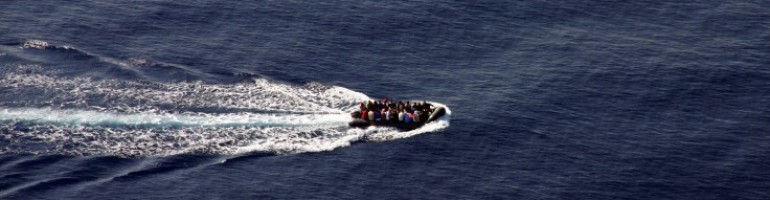
A total of 612 migrants in 24 different boats have reached the Andalusian coast of Spain (Almeria, Granada, Cadiz and Huelva) from Morocco and Algeria so far in 2011.
Click here for article (ES).
A total of 612 migrants in 24 different boats have reached the Andalusian coast of Spain (Almeria, Granada, Cadiz and Huelva) from Morocco and Algeria so far in 2011.
Click here for article (ES).
Filed under Algeria, Data / Stats, Eastern Atlantic, Mediterranean, Morocco, News, Spain
“The seventh working meeting of the CDDH informal working group on the accession of the European Union to the European Convention on Human Rights (CDDH UE) with the European Commission was held in Strasbourg on 10-13 May 2011” and the report of the meeting was released on 16 May. The meeting report includes a Draft Revised Accession Agreement (see Appendix III in meeting report). (HT to @echrnews.)
Click here for meeting report.
Click here for link to web page of CoE Informal Group on Accession of the European Union to the Convention (CDDH-UE).
Click here for submission by the AIRE Centre and Amnesty International to the working group.
Filed under Council of Europe, European Union, News
The European Voice reported last week that the European Commission will likely adopt a new Communication on migration when the Commission meets on 24 May. “A communication expected to be adopted by European commissioners … proposes that the countries of the region should receive increased assistance for managing migration in return for commitments to accept repatriated migrants and to tighten border controls. … [The new expected] communication follows a broader communication on migration adopted by the Commission on 4 May. A national diplomat said that the measures outlined in the two communications go ‘in the right direction’ but that the member states were now waiting for actual legislative proposals….”
Click here for EV article.
Click here for Communication on Migration of 4 May.
Click here for previous post regarding Communication of 4 May.
Filed under European Union, Frontex, Italy, Libya, Malta, Mediterranean, News, Tunisia
Real Instituto Elcano has published an analysis regarding the situation in North Africa and its impact on irregular immigration to the EU. The analysis was written by Frontex’s Deputy Executive Director Gil Arias.
Of particular interest is the analysis regarding what Frontex believes might occur in regard to migrant flows from Libya under two different scenarios: Gadafi remaining in power or ultimately being removed from power (see Google translation of excerpt below):
“… En el caso de que el régimen de Gadafi recupere el control, la UE y sus Estados Miembros no podrán reanudar la cooperación con un régimen totalmente desacreditado. Se producirá el cese en la aplicación de acuerdos de cooperación policial que en el pasado (desde mayo de 2009) sirvieron para detener los flujos de inmigración irregular desde Libia hacia Italia y Malta. La posibilidad de que ciudadanos de otros países africanos bloqueados en Libia sean obligados o “ayudados” a emigrar a la UE no debe descartarse. De hecho, Gadafi ha amenazado con “abrir la puerta” de la inmigración ilegal hacia Europa.
La OIM estima la cifra de extranjeros presentes en Libia entre 0,5 y 1,5 millones. No obstante, no todos serian candidatos a la inmigración ilegal. Se trata fundamentalmente de trabajadores empleados por empresas extranjeras asentadas en el país, por lo que su intención primaria no sería la emigración a la UE y por otra parte una buena parte de ellos ya han abandonado Libia.
En el peor de los casos, la consecuencia de ese “abrir la puerta” sería la reactivación de los flujos por vía marítima hacia Lampedusa y Malta (eventualmente también Creta, que se encuentra a 200 km de distancia de la costa libia) en un escenario similar al de 2008 (40.000 inmigrantes llegaron a Italia y Malta, con origen en las costas libias) agravado por el efecto adicional de la inestabilidad en el país. Su destino principal serían los países con presencia importante de ciudadanos norteafricanos (Italia, Francia, España, Bélgica y el Reino Unido). El destino de los nacionales de países subsaharianos se encontraría más repartido por toda la UE.
Si Gadafi es derrocado resultará clave la capacidad y rapidez de la oposición para reorganizarse. La oposición se encuentra, por el momento, bastante desorganizada y es probable que se produzcan luchas internas por el poder, especialmente por el control de los campos petrolíferos. Ello podría conducir a un estado persistente de disturbios y a una ausencia de control por un largo periodo de tiempo.
La eventual reactivación de las rutas migratorias hacia la UE dependerá de la capacidad del nuevo régimen para imponer la ley y el orden en el país así como el control efectivo sobre los 2.000 km de costas y 4.000 km de fronteras terrestres libias. En el peor de los escenarios podría darse una situación similar a la de Somalia.
En este escenario, la economía libia puede deteriorarse y elevarse los niveles de desempleo. Actualmente se desconoce la tasa de desempleo en Libia, pero se presume baja. Previsiblemente, la mayoría de los trabajadores desempleados intentará regresar a sus países, pero parte de ellos (sobre todo los nacionales de países inseguros) buscaran otras oportunidades, entre ellas la emigración clandestina a la UE.
La ausencia de ley y orden, especialmente la ausencia de control sobre las fronteras marítimas, llevará rápidamente a las mafias al tráfico de inmigrantes hacia la UE. Los candidatos serían primariamente trabajadores desempleados no deseosos de volver a sus países (mayormente de África Occidental y Oriental, pero eventualmente también libios, egipcios, argelinos y tunecinos). Esta situación impediría, por otra parte, el retorno de quienes fuesen detectados cruzando ilegalmente las fronteras exteriores de la UE.
En tales circunstancias se puede prever un flujo constante de inmigración ilegal durante meses, mayoritariamente por vía marítima, pero también por vía aérea a través de Turquía. La duración en el tiempo de este escenario dependerá de la rapidez con la que la UE o los Estados Miembros y las nuevas autoridades sean capaces de restablecer la cooperación. En este sentido, serán determinantes los acuerdos de readmisión efectivos.
Por último, ha de tenerse también en cuenta el riesgo marginal de que los vencedores realicen acciones de persecución sobre los partidarios de Gadafi, lo que provocaría la huida de éstos del país en busca de refugio….”
Google translation of the above excerpts (NB – this is only a rough translation):
“…In the case of Qaddafi’s regime regaining control, the EU and its Member States shall not resume cooperation with a discredited regime. Termination will occur in the implementation of agreements on police cooperation in the past (May 2009) served to stop the flow of illegal immigration from Libya to Italy and Malta. The possibility for citizens from other African countries locked in Libya are forced or “helped” to migrate to the EU can not be ruled out. In fact, Gaddafi has threatened to “open the door” of illegal immigration into Europe.
The IOM estimates the number of foreigners in Libya between 0.5 and 1.5 million. However, not all candidates would be illegal immigration. These are mainly employed by foreign companies settled in the country, so that their primary intention would not be the migration to the EU and, moreover, a good portion of them have already left Libya.
In the worst case, the consequence of this “open door” would be the reactivation of the flows by sea to Lampedusa and Malta (and possibly Crete, which is 200 km away from the Libyan coast) in a scenario similar to that of 2008 (40.000 immigrants arrived in Italy and Malta, departing from the Libyan coast) aggravated by the additional effect of instability in the country. Its main destination countries would be a significant presence of North African citizens (Italy, France, Spain, Belgium and the UK). The fate of the national sub-Saharan countries would be more distributed throughout the EU.
If Gadhafi is overthrown will be key capacity and speed of the opposition to regroup. The opposition is, at present, quite disorganized and is likely to produce internal power struggles, especially for control of the oilfields. This could lead to a persistent state of unrest and a lack of control over a long period of time.
The eventual recovery of migratory routes towards the EU depends on the ability of the new regime to impose law and order in the country as well as effective control over the 2,000 km of coastline and 4,000 km of land borders Libya. In the worst case scenario could be a situation similar to Somalia.
In this scenario, the Libyan economy may deteriorate and unemployment levels rise. Currently unknown unemployment rate in Libya, but presumably low. Predictably, most unemployed workers try to return to their countries, but some of them (especially insecure country nationals) to seek other opportunities, including illegal migration to the EU.
The absence of law and order, especially the lack of control over maritime borders, whisk the trafficking mafias immigrants into the EU. Candidates would be primarily unemployed workers eager to return to their countries (mostly from West and East Africa, but also possibly Libyans, Egyptians, Algerians and Tunisians). This would prevent, on the other hand, the return of those who were detected illegally crossing the external borders of the EU.
In such circumstances, can provide a steady flow of illegal immigration for months, mostly by sea, but also by air through Turkey. The long life of this scenario depends on the speed with which the EU or the Member States and the new authorities are able to restore cooperation. In this regard, will determine the effective readmission agreements.
Finally, it must also take into account the marginal risk that the winners perform acts of persecution on Gaddafi’s supporters, causing them to flee the country in search of refuge….”
Click here for the Analysis. (ES)
British RAF warplanes destroyed or severely damaged all (or most) of Libya’s navy which consisted of about 8 ships. The attacks occurred last Thursday. There are conflicting media reports about whether any of the destroyed vessels included Libyan coast guard patrol boats.
Click here and here for articles.
Filed under Libya, Mediterranean, News
Here is an op-ed article from Thursday’s New York Times by Hans Lucht, an anthropologist at the University of Copenhagen and author of the forthcoming “Darkness Before Daybreak: African Migrants Living on the Fringes in Southern Italy Today.” (Scheduled for release Dec. 2011.)
“…. In the long run, Europe should learn from the situation in Libya that paying dictators to make ‘problems’ disappear is not only morally bankrupt but also short-sighted. European leaders must seek commitments from any post-Qaddafi government to handle the challenges of international migration in an orderly and humane fashion. Instead of banishing asylum-seekers to detention camps in the desert, Europe should offer support to Tunisia and Egypt, which are struggling to assist refugees from Libya, and to southern European countries….”
Click here for article.
Filed under Analysis, European Union, Ghana, Italy, Libya, Mediterranean
The Sunday Times of Malta reports that Malta has again declined to host a Frontex mission because Malta objects to the rules of engagement for such missions which require under certain circumstances that intercepted migrants be brought to the territory of the Member State hosting the mission. “‘If Frontex changes its mind and manages to convince the other member states about the rules of engagement for the mission it wants to hold in Malta, we will reconsider our position. However, at this stage, we have ruled out the possibility of hosting a Frontex mission’ said [Home Affairs Minister Carmelo Mifsud Bonnici.]” “Frontex sources said other member states had been sounded out on Malta’s demand to have different rules for its mission based on the ‘closest safe port’ concept. However, the Warsaw-based agency failed to convince them.”
Click here for article.
Click here, here, and here for previous posts on the Malta–Frontex negotiations.
Filed under European Union, Frontex, Malta, Mediterranean, News
Maltese Justice and Home Affairs Minister Carm Mifsud Bonnici is quoted by AP as saying that migrant boats leaving Libya “have the right of passage and nobody can stop them, not even our forces or a NATO ship. As long as [the boats] are not in distress, then [there] is no issue.”
While Mifsud Bonnici’s observation about the right of passage in international waters is technically correct, given that all or virtually all of the migrant boats that have left Libya in recent weeks have been severely overloaded, all migrant boats leaving North Africa under the current situation should be considered to be in distress and in need of rescue. Migrant boats departing from Libya with few exceptions must pass through the Maltese Search and Rescue Area and Malta should not avoid its rescue at sea obligations under international law by claiming that it is respecting a vessel’s right of passage. The UNHCR has called upon “states, commercial shipping companies and others present in the Mediterranean to consider that all boats leaving Libya for Europe are likely to require assistance.”
Click here or here for AP article.
Click here for UNHCR statement.
Filed under Libya, Malta, Mediterranean, News, UNHCR
Tunisian Coast Guard and Army units (les unités de la garde maritime et de l’armée nationale) intercepted and rescued 222 people on board a migrant boat that left Libya and was attempting to sail to Italy. The incident occurred on Saturday, 14 May. The migrant boat was intercepted near Djerba and had reportedly made a distress call because it was taking on water. The people on board the boat were reportedly all sub-Saharan Africans and they have been taken to the Tunisian camp at Choucha (Shusha).
Click here (EN), here FR), here (FR), and here (IT) for articles.
Filed under Italy, Libya, Mediterranean, News, Tunisia
Not pertinent to Migrants At Sea, but of possible interest to many, Prof. William A. Schabas’ blog (PhD Studies in Human Rights) describes a developing situation at the ICC where witnesses have made asylum claims to the ICC: “Three Congolese witnesses, brought to The Hague at the request of the defence in the Katanga case, have presented the judges of the Trial Chamber with a claim for protection. The matter was considered in a Status Conference on Thursday, for which the transcript is available. There is also an account of this on the Hirondelle News Service….”
Click here for the blog post.

© Chappatte - http://www.globecartoon.com - Used by Migrants At Sea with permission.
Filed under Cartoon, European Union, France, Italy, Mediterranean, Tunisia
UNHCR today released more information from three Ethiopian survivors of the migrant boat that left Tripoli on 25 March with 72 passengers and which, after becoming disabled and running out of food and water, washed ashore in Libya over two weeks later with only nine survivors.
Additionally, the Bruxelles2 blog in a recent post, “Un navire de réfugiés non secouru ? Retour sur un drame non élucidé,” has provided detailed analysis regarding the possible identities of the helicopter and warships that failed to render assistance to the migrant boat after it had become disabled. (See more on this below.)
From UNHCR’s statement:
“[One surviving] refugee said that military vessels twice passed their boat without stopping, and that a military helicopter dropped food and water onto the boat at some point during the journey. The first boat refused their request to board. The second only took photos, he said. The man was not able to identify where the vessels came from.
UNHCR staff met with the three in Shousha camp in Tunisia. One spoke Arabic, while the others spoke Oromo. UNHCR interviewed the Arabic speaker. He said that they paid smugglers US$800 to make the journey. The passengers were expected to operate the boat on their own.
According to the refugee, when water ran out people drank sea water and their own urine. They ate toothpaste. One by one people started to die. He said that they waited for a day or two before dropping the bodies into the sea. There were 20 women and two small children on board. A woman with a two-year-old boy died three days before he died. The refugee described the anguish of the boy after his mother’s death.
After arrival on a beach near Zliten, between Tripoli and the Tunisian border, a woman died on the beach from exhaustion. The remaining 10 men walked to the town of Zliten where they were arrested by the Libyan police. They were taken to a hospital and then to a prison where they were given some water, milk and dates. After two days another survivor died.
After begging jail staff to take the remaining survivors back to hospital, they were taken to a hospital in al-Khums city. Doctors and nurses were said to have given the group water and told them to leave. They were returned to the prison and then taken to Twesha jail near Tripoli. Finally Ethiopian friends in Tripoli paid the prison US$900 to release the men. UNHCR is now providing them with assistance in Tunisia.”
Bruxelles2 notes that the survivors’ reports that the helicopter that dropped supplies had an “Army” marking on it would tend to suggest that the helicopter did not belong to France (“Marine”), Italy (“Marina”), the U.S. Navy (“Navy”), or the Royal Navy (“UK Navy”). Bruxelles2 believes it is plausible that an “army” helicopter belonging to the US or UK could have been operating in the area, but US Army helicopters tend to be marked “United States.” According to Bruxelles2 some British army helicopters do carry the “Army” marking. (One other possibility I would note is that the survivors could simply be mistaken about the marking – they recall clearly that a military helicopter hovered over them and dropped supplies, but incorrectly remember, misread, or assumed that the marking on the side of the helicopter said “Army”.)
Bruxelles2 also suggests that there are other warships that might appear to be an aircraft carrier, especially when viewed from a small migrant boat. Bruxelles2 points in particular to “the USS Kearsarge (LHD3), [an] amphibious ship [that] regularly hosts (and welcomed during the operations – which the U.S. Navy confirms) AV-8B Harrier vertical takeoff [aircraft].”
Bruxelles2 also notes that the time period when the migrant boat was disabled and drifting was a period when there was a shifting of commands for the multiple European and US naval and air forces operating off Libya. NATO took command of the maritime embargo on 23 March; the no fly zone and the air attacks were initially under the control of an ad hoc coalition (France, UK, USA, Canada, Belgium, Denmark); full command did not shift to NATO until 31 March and even then it took several days for the transfers of command to occur; and some military vessels continued (and continue to this day) to operate under independent national command.
In short, NATO may be fully correct when it says that a vessel under its command during the time period in question did not encounter the disabled migrant boat. Further investigation into responsibility is needed.
Click here for UNHCR statement.
Click here for Bruxelles2 post. (FR)
Filed under Analysis, France, Italy, Libya, Mediterranean, News, UK, United States
From a NATO press statement: “Naples, Italy. In the early hours of Thursday 12 May 2011, while conducting Embargo patrols in the waters off the coast of Libya, NATO warships participated in a coordinated defence against a small boat attack threatening the port city of Misrata. Beginning at approximately 2 a.m. the Canadian Frigate HMCS CHARLOTTETOWN acting in concert with the British Destroyer HMS LIVERPOOL and supported by a French warship not under NATO Command, thwarted an attack on the port of Misrata by a number of fast small boats. The boats were forced to abandon their attack and regime forces ashore covered their retreat with artillery and anti-aircraft canon fire directed towards the allied warships….”
Click here for full statement.
Filed under Libya, Mediterranean, News
An article in the Malta Independent says that Maltese Justice and Home Affairs Minister Carm Mifsud Bonnici believes it is unlikely that the asylum seekers who have reached Malta in recent weeks have been forced by anyone to flee Libya. His view is at odds with the statements being made by some of the migrants who have recently arrived in both Lampedusa and Malta.
Mifsud Bonnici “said that he doesn’t think the thousands who have fled from the north African country so far have done so because they were pushed by some people. ‘I don’t think there are any people who are benefiting from this exodus of immigrants to Europe. From the information we have, there is no evidence to suggest that people are being pushed into boats and sent towards Europe. Most immigrants have sought pastures new simply because they fear for their lives. As I have said time and time before, this latest wave of immigration is different to what we have experienced before. Quite a lot of the immigrants who have come to Europe by boat over the past few weeks came with their families, are university graduates, and have a lot of work experience behind them,’ Dr Mifsud Bonnici said.” The latest boat arrival in Malta carried mostly Libyan nationals. Over 1100 persons have landed in Malta over the past six weeks.
Click here for article.
Filed under European Union, Italy, Libya, Malta, Mediterranean, News
After the Pledging Conference on Relocation and Resettlement which was held by Commissioner Malmström in the margins of yesterday’s JHA Council meeting, it has been announced that at least ten EU member states (news reports have identified different countries – Germany, Romania, Spain, the Netherlands, Switzerland, Poland, Portugal, Bulgaria, Hungary, Denmark, Slovakia, and Luxembourg have been mentioned) as well several non-EU MS (news reports have mentioned Lichtenstein, Switzerland, and Norway), have agreed to resettle 323 asylum seekers who are currently in Malta. Germany will reportedly resettle 100 migrants. Most of the other resettlement pledges are for small token numbers. There are over 2500 asylum seekers, beneficiaries of international protection, and migrants currently in Malta.
The Commission will provide funding for the extension of the pilot project of relocation from Malta, as well as for resettlement directly from North Africa, undertaken on a voluntary basis by MS. Funding for the project has previously been provided through the European Refugee Fund. The pledging conference that was held yesterday was reportedly the first such conference held since the Maltese pilot project known as European Relocation Malta (Eurema) began in July 2009. The project was scheduled to end this year but has been extended for at least one more year given the current situation in Libya.
Click here, here, and here for articles.
Filed under European Union, Germany, Libya, Malta, Mediterranean, News


 MIGRANTS AT SEA