La Tribune (Algérie): La Libye met l’Union européenne au pied du mur

“L’Europe, l’obsession sécuritaire et l’immigration utilitaire – … Les négociations entre l’UE et la Libye semblent suggérer que les Européens sont prêts à aller très loin dans la volonté de faire des Etats du Sud les gendarmes luttant contre l’immigration clandestine. En effet, pour signer un accord d’association comprenant le volet immigration, la Libye exige la fermeture pure et simple du bureau du Haut-Commissariat aux réfugiés (HCR), en plus de moyens financiers supplémentaires et du matériel de surveillance des frontières terrestres et maritimes qui viendront s’ajouter aux nombreux dispositifs de contrôle déjà financés par l’UE dans ce pays depuis le début des années 2000. La politique européenne sur l’immigration inclut également l’ouverture sur le sol libyen de «points d’accueil», qui permettraient aux réfugiés de déposer leur demande d’asile sans prendre le risque d’une traversée de la Méditerranée. Le commissaire en charge des questions d’asile et d’immigration, Jacques Barrot, s’était rendu sur place pour étudier la possibilité d’un tel dispositif…..”

Cliquez ici pour télécharger l’article.

Leave a comment

Filed under Algeria, European Union, Libya, Mediterranean, News

EUROSTAT: 2009 EU27 Asylum Statistics and Characteristics of Asylum Seekers

Excerpts from the EUROSTAT asylum statistics press release issued on 18 June 2010:

The EU27 Member States granted protection to 78 800 asylum seekers in 2009 compared with 75 100 in 2008.

The largest groups of beneficiaries of protection status in the EU27 were citizens of Somalia (13 400 persons or 17% of the total number of persons granted protection status), Iraq (13 100 or 17%) and Afghanistan (7 100 or 9%).

In 2009, 317 500 decisions on asylum applications were made in the EU27, of which 228 600 were first instance decisions and 88 900 final decisions on appeal. Decisions made at the first instance resulted in 61 700 persons being granted protection status, while a further 17 100 received protection status on appeal.

The rate of recognition of asylum applicants, i.e. the share of positive decisions in the total number of decisions, was 27% for first instance decisions and 19% for final decisions on appeal.

In 2009, the highest number of persons granted protection status was registered in the United Kingdom (12 500), followed by Germany (12 100), France (10 400), Sweden (9 100), Italy (8 600) and the Netherlands (8 100). These Member States accounted for more than three quarters of all those granted protection status in the EU27.

The rate of recognition varies considerably among Member States…. The highest rates of recognition in the first instance were recorded in Malta (66%), Slovakia (56%), Portugal (51%), the Netherlands and Denmark (both 48%), and the lowest in Greece (1%), Ireland (4%), Spain (8%), France (14%) and Slovenia (15%).

Somalis were the single largest group of persons granted protection status in the EU27.

[M]inors accounted for 60 500 of the applicants [in 2009], of which 12 200 were unaccompanied.

Click here for the EUROSTAT Asylum Statistics document.

Click here for EUROSTAT Characteristics of asylum seekers in Europe report.

Click here for EU Commissioner for Home Affairs Cecilia Malmström’s statement on the EUROSTAT reports.

Leave a comment

Filed under Data / Stats, European Union, News

World Refugee Day 2010

UNHCR World Refugee Day 2010

Leave a comment

Filed under UNHCR

CEAR Releases 2010 Annual Report: La situación de las personas refugiadas en España

CEAR (Comisión Española de Ayuda al Refugiado) has released its 2010 annual report: “La situación de las personas refugiadas en España – INFORME 2010.”  The report is 350+ pages long.  I will try to review it and do an additional post on some portions of the Report in the coming days.

From CEAR’s web page: “Presentamos el octavo Informe Anual en un momento de grave preocupación por la garantía efectiva del derecho de asilo en España y en el mundo. En el año 2009 poco más de 3.000 personas solicitaron asilo en nuestro país, la cifra más baja desde que se contabilizan estos datos. Por el contrario, las demandas de protección internacional han aumentado en el ámbito de la Unión Europea y otros países industrializados. La pregunta clave es: ¿por qué no llegan refugiados a España? Pregunta que cobra aún más importancia si tenemos en cuenta que la situación en los países de origen de los solicitantes de asilo no ha mejorado, tal y como se analiza a lo largo de este Informe, como la situación de la R.D. Congo, América latina o Sri Lanka. La respuesta a este descenso de las solicitudes de asilo se desvela a lo largo del documento.

La publicación de este Informe Anual coincide con los primeros pasos para la puesta en práctica de la nueva Ley de Asilo, aprobada en octubre de 2009. CEAR volcó todos sus esfuerzos para hacer llegar a los grupos parlamentarios y a la sociedad sus propuestas para fortalecer el derecho de asilo como institución en España.

Uno de los mayores recortes de la nueva ley es la supresión de la vía diplomática para el acceso al asilo, por eso desde estas páginas CEAR realiza un recorrido por las últimas solicitudes por esta vía. También hace especial hincapié en el análisis de las demandas en frontera y de los Centros de Internamiento para Extranjeros (CIE). Por otro lado, la edición del octavo Informe coincide con la Presidencia española de la Unión Europea, por lo que se analizan las líneas políticas de actuación que ya se establecieron en el Pacto Europeo sobre Inmigración y Asilo de 2008. Este Informe presenta un completo recorrido desde la solicitud de asilo hasta la resolución de los casos, acompañado de un completo apéndice estadístico, sin prescindir de todo lo referente a la acogida, integración social e inserción sociolaboral de las personas refugiadas en España.”

Click here for the report (ES).

Leave a comment

Filed under Eastern Atlantic, European Union, Mediterranean, Reports, Spain

Frontex: Collaboration With African Countries Contributed to Reduction in Irregular Migrants in 2009

Speaking at a press conference in Athens earlier this week, Gil Arias Fernandez, Frontex’s deputy executive director, credited the global recession as the key factor in 2009 for the reduced numbers of migrants seeking to enter the EU.  He also credited “good collaboration from the African countries where immigrants usually depart[,]” referring to measures taken by Libya, Mauritania and Senegal to prevent migrants from leaving the countries.

Click here and here for articles.

Click here and here for earlier posts on Frontex’s 2009 General Report.

Leave a comment

Filed under Data / Stats, European Union, Frontex, Libya, Mauritania, News, Senegal, Statements

ECRE: Can EU Trust Libya With Refugee Protection?

ECRE issued a press release last week regarding Libya’s decision to expel the UNHCR:

“Bjarte Vandvik, Secretary General of the European Council on Refugees and Exiles (ECRE) said: ‘UNHCR’s expulsion from Libya will hopefully be temporary but it does reveal the unreliability of this regime, as well as its understanding of refugee protection. How will the EU ensure that Libya keeps its word regarding commitments towards human rights? How can the EU trust such a partner?’”

“ECRE calls on the EU to seriously reconsider its cooperation on asylum and refugee issues with Libya, a country that is not a party to the 1951 Geneva Refugee Convention. In particular, negotiations on an EU – Libya framework agreement must now be reviewed, as should any EU funding that supports Libyan authorities in intercepting refugees along their Southern border…. While UNHCR”s presence does not make Libya a safe place for refugees, the decision to prevent UNHCR from operating in the country once again illustrates the real intentions of the Libyan authorities when it comes to refugee protection. The EU cannot simply continue to ignore this reality but should make clear that the protection of refugees is still a fundamental value of the EU.”

(HT to Ana Lopez, ECRE’s Media and Information Officer).

Click here for full ECRE statement.

1 Comment

Filed under European Union, Libya, Mediterranean, Statements, UNHCR

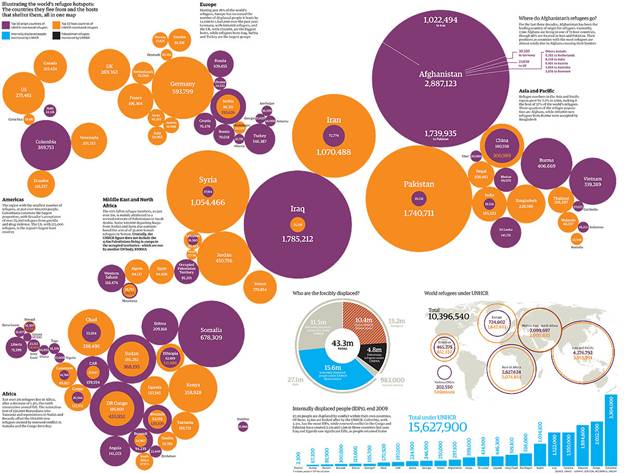
UNHCR Report: 2009 Global Refugee Trends & Guardian Data Map

The UNHCR released its annual report this week for last year: “2009 Global Trends- Refugees, Asylum-seekers, Returnees, Internally Displaced and Stateless Persons.”

The UNHCR estimates that approximately 43.3 million people were forcibly displaced at the end of 2009.  South Africa continued in 2009 to be the destination country receiving the largest number of new asylum seekers (222,000).  The US and France were second and third with less than 50,000 new asylum seekers.

The Guardian’s Data Blog published an interesting graphic with the UNHCR statistics.

Click here for UNHCR web article.

Click here for link to the UNHCR Report.

Click here for link to the Guardian’s map.

[UNHCR refugee statistics mapped. Illustration: Paul Scruton for the Guardian.]

Leave a comment

Filed under Data / Stats, Reports, UNHCR

Side Meeting on Boat People at Upcoming UNHCR-NGO Consultations

The annual UNHCR-NGO consultations will take place beginning 29 June (registration is closed).  Various side-meetings will also be held, including one on 1 July: “A hearing on Boat People: Different people, different needs and rights to protection.” Palais des Nations, Geneva, 13h15 – 14h45, Room XXII

“A hearing on Boat People: Different people, different needs and rights to protection.

Brief description: What are the needs of today’s boat people—and how can these needs be differentiated and matched to rights and practical responses of protection and assistance—among boat people arriving in Europe or Yemen from Africa; in the US from Haiti; in various parts of south and southeast Asia and Australia from Burma or Sri Lanka, or following other sea crossings? This session is organized as a hearing, not a series of presentations. It will begin with a brief introduction of the importance of differentiating needs and rights to protection and assistance among all the people arriving, (i.e., refugees, victims of human trafficking and smuggling, victims of torture, children, etc.) Conclusions from an experts roundtable in Tunis last year will then be offered as a reference, which participants will be invited to comment upon and at the end of the session, consider supporting. During the bulk of the session however, panelists from UNHCR, IOM, IFRC and UNODC will serve as a hearing board: listening, probing and recording the experience, concrete practices and recommendations of NGO participants who respond to boat people, either in Europe or in other parts of the world. Input will then be organized and submitted to the international organizations and to government policy makers, including the European Union and Council of Europe through the new EU-funded NGO partnership “DRIVE” (Differentiation for Refugee Identification and Vulnerability Evaluation).”

Click here for full Side Meeting agenda.

Leave a comment

Filed under Colloques / Conferences, UNHCR

Migreurop: What Price Will Europe Pay if Gaddafi Authorises UNHCR’s Return to Libya?

Migreurop takes the position that Libya’s recent decision to expel the UNHCR is a negotiating tactic that will be used to leverage more money and concessions from the European Union in the context of the ongoing EU-Libya partnership negotiations and poses the important question:  What Price Will Europe Pay if Gaddafi Again Authorises UNHCR’s Return to Libya?  The UNHCR’s presence in Libya has played an essential role in Europe’s immigration policy, specifically Europe’s migration management and border outsourcing:

“Thanks to UNHCR’s presence in Tripoli, Europe and Italy, which concluded its agreement with Libya in August 2008, were able to claim that the boat people who were forcibly returned to Libya could find a minimal level of security and protection. Everyone knows full well that this was a smokescreen: the conditions under which migrants are treated in Libya are well documented and well known to European authorities and institutions.”

“The presence of the UNHCR in Libya justified the policy of externalisation and deportation carried out by the EU. … Libya has now raised the stakes and the UNHCR is an accomplice in the sordid negotiations:  UNHCR’s return is already planned.…”

Click here or here for Migreurop’s full statement / analysis (FR).

Click here for previous post.

Leave a comment

Filed under Analysis, European Union, Italy, Libya, Mediterranean, UNHCR

More on Libya’s Decision to Expel UNHCR

Libya’s decision to expel the UNHCR from Libya was made public during the seventh round of Framework Agreement talks between the EU and Libya.  The talks concluded yesterday in Tripoli.  “[Libya’s Deputy Foreign Minister Mohammed Tahar] Sayala said the main stumbling blocks to progress were illegal immigration and the International Criminal Court (ICC), which Libya does not recognise.  [Sayala] said Libya wanted financing and equipment [from the EU] for the surveillance of its borders, both on land and sea.”

Amnesty International criticized the decision to expel the UNHCR and called on Libya to reverse the decision:

“[***] The move to expel the UNHCR came against the backdrop of the 7th round of negotiations, which started on 6 June in Tripoli, between Libya and the EU over a Framework Agreement, which addresses bilateral cooperation in the control of irregular migration, among other issues, including potential readmission agreements for third-country nationals, who have transited through Libya on their way to Europe. EU member states, most notably Italy, have been seeking Libya’s assistance in decreasing the flow of arrivals of asylum-seekers and migrants to European shores. The expulsion of the UNHCR further casts doubt on Libya’s commitment to respect its obligations under the Organization of African Unity Convention Governing the Specific Aspects of Refugee Problems in Africa. It also shows how essential it is to include effective human rights safeguards and adequate standards of protection in any bilateral agreements with Libya in the field of the control of migration. [***]”

The European Commission also expressed “concern” with Libya’s decision “but sees it as one more reason to engage in ‘dialogue’ with General Gaddafi’s country on immigration and asylum.”

And as noted by Michèle Morel on International Law Observer, even though Libya is not a signatory to the UN Refugee Convention, Libya is bound by customary international law which prohibits refoulement to countries where there is a risk of torture, “[t]herefore, while Libya itself has no asylum system for the examination of asylum seekers’ situations, refusing to allow UNHCR to carry out its activities in Libya would amount to a violation of international human rights law.”

Click here, here, here (EN), and here (AR) for articles.

Click here for Amnesty International’s statement.

Click here for link to ILO post.

3 Comments

Filed under European Union, Libya, Mediterranean, News, UNHCR

EU-Libya Resume Partnership Talks

The seventh round of negotiations on the EU-Libya partnership accord began on 8 June in Tripoli.  According to the AFP, EU negotiators hope to have a final agreement with Libya signed by the end of 2010.  The current EU delegation is led by Hugo Mingarelli, deputy head of the European Commission for foreign affairs.  The negotiations have been slow for a variety of reasons, one of them being disagreement over immigration topics and the reported pressure on Libya by the EU to sign the UN Refugee Convention.  (See my previous post on Libya’s sudden decision to close the UNHCR office in Tripoli.)

Click here and here (AR) for articles.

Click here for EC External Relations web page on Libya.

Leave a comment

Filed under European Union, Libya, Mediterranean, News

Libya Orders UNHCR Office Closed – Possible Link to EU-Libya Talks on Partnership Accord

The Libyan government has ordered the UNHCR office in Libya to halt all activities and to close it office.  UNHCR has been working in Libya since 1991 even though Libya is not a signatory to the UN Refugee Convention.

The UNHCR said it was not given a reason for the Libyan decision.  Reuters reported that Libya’s Foreign Ministry considers the UNHCR presence within Libya to be illegal since Libya is not a signatory to the Refugee Convention.  Reuters also says that JANA, the Libyan news agency, accused a UNHCR official of carrying out an unspecified illegal activity.

The Libyan newspaper Oya and other reports say that the EU is pressuring Libya in the ongoing EU-Libya Partnership Talks to sign the Refugee Convention and that illegal immigration is one of the main areas of disagreement in the current negotiations.

The UNHCR said in a press release “[i]n the absence of a national asylum system, UNHCR has carried out registration and refugee status determination, visiting detention facilities and providing medical and humanitarian assistance to detainees.”  Among the asylum seekers detained in Libya over the past year are persons who were forcibly returned to Libya by Italian authorities pursuant to the Italy-Libya migration agreement.

Click here for UNHCR press release.

Click here for Oya article (AR).

Click here, here, and here for articles (EN).

2 Comments

Filed under European Union, Libya, Mediterranean, News, UNHCR

UNHCR Criticises Delay by Italy and Malta in Launching Search and Rescue of Migrant Boat

“UNHCR is concerned about delays in a search-and-rescue operation on Sunday and Monday [6-7 June]  involving a boat carrying more than 20 people, mostly Eritreans, near Malta. Distress calls were received on Sunday evening, including by UNHCR, and passed to Maltese and Italian maritime authorities. It is unclear which country had search-and-rescue responsibility when the distress calls were first sent. According to information made available to UNHCR, the boat was only rescued late on Monday, and by Libyan vessels.”

The persons on board the boat have reportedly been taken to Libya.

Click here for UNHCR statement.

Click here and here for articles.

Leave a comment

Filed under Italy, Libya, Malta, Mediterranean, News, UNHCR

Spanish Court Rules that Schengen Treaty Prevents Asylees From Leaving Ceuta and Melilla

As noted on Diario de la Inmigración, a Spanish Court in Ceuta (el Juzgado Contencioso Administrativo número 2 de Ceuta) has ruled that persons granted asylum or subsidiary protection may not leave Ceuta for the Spanish peninsula.  The court agreed with the position of the Spanish government and ruled that the two autonomous cities of Ceuta and Melilla are not part of the Schengen area and that proper documentation is therefore required to enter the Schengen area from the cities.  The court concluded that the “yellow card” (“tarjeta amarilla”) issued to persons granted asylum or subsidiary protection is insufficient documentation to enter the Schengen area.

The UNHCR and CEAR have previously criticised the Spanish’s government new policy of restricting the free movement of persons in Ceuta and Melilla who have been granted asylum or subsidiary protection.  UNHCR believes that the restrictions on free movement violate article 5 of Spain’s 2009 asylum law (la ley 12/2009, de 30 de octubre).

Click here, here, and here for articles (all ES).

Leave a comment

Filed under European Union, Judicial, Mediterranean, News, Spain, UNHCR

EP Seminar on Combating and Preventing Trafficking in Human Beings (10 June, Brussels)

NB – Registration to attend must be emailed by 16.00, Monday, 7 June.

“On Thursday 10 June 2010 LIBE will hold jointly with the Women’s Rights and Gender Equality Committee (FEMM) a seminar on “Combating and preventing trafficking in human beings: the way forward” to have an exchange of views contributing to drafting a co-decision report by Anna HEDH (S&D, SE) (LIBE) and Edit BAUER (EPP, SK) (FEMM).”

“REGISTRATION – This Round Table meeting is open to the public. We would ask the participants to send their registration before Monday 7 June at 16.00.  For security reasons, participants who do not have a European Parliament access badge must obtain a pass in advance.  Please send the following information to the joint FEMM-LIBE mailbox: ip-femm-libe@europarl.europa.eu:

LAST NAME-First name-date of birth*-place of birth*-address*-company/institution/ organisation

It is essential to provide us with this information. Without it the Security Service will not provide entry passes. If you already have an entrance pass, indicate it in the e-mail. In this case the information marked with asterisk (*) is not needed.”

Click here for more information.


Leave a comment

Filed under Colloques / Conferences, European Union