
Tag Archives: European Union

EC Request for Services: “Technical Assistance for the Identification and Formulation of a Programme of Support to the Libyan Authorities in the field of Migration” (26 Nov Deadline)

This was just posted on the SRLAN listserve.  The deadline for an expression of interest has been extended to 26 November (but this date should be verified):

“Dear Sir,  I would like to inform you about a new EC funded project, entitled: ‘Technical Assistance for the Identification and Formulation of a Programme of Support to the Libyan Authorities in the field of Migration’.

We are looking for 2 Experts mastering English, from January 2011, with the following profile:

Expert in Migration/Team Leader:

  • Master Degree (or higher academic degree) in an area relevant to Migration (Law, Political Sciences, Humanities, Sociology, etc).
  • At least 10 years of professional experience in the field of Migration.
  • Thorough knowledge of migration policies and strategies, in particular the EU global approach to migration and the international set of rules, laws and conventions related to border management, migration and asylum.
  • Experience in the identification, formulation, and management of programmes of support or technical assistance in the framework of the EC external aid to third countries.
  • Fluency in written and spoken English.
  • Knowledge of development issues in North Africa and the Middle East and/or Sub-Saharan Africa.
  • Good understanding of the social and economic policies of the EU
  • Ability to manage and lead a team.
  • Excellent writing and communication skills
  • Knowledge of Arabic is considered an asset.

Expert in International Law (other field could be International Relations):

  • Master Degree (or higher academic degree) or equivalent professional experience in the field of International law, International Relations or Migration.
  • At least 10 years of professional experience in the field of migration.
  • Thorough knowledge of migration policies and strategies, in particular the EU global approach to migration and the international set of rules, laws and conventions related to border management, migration and asylum.
  • Fluency in written and spoken English.
  • Good knowledge and working experience in the Middle East and North Africa Region.
  • Experience in project management, identification, formulation, implementation and evaluation of similar EC funded projects.
  • A good understanding of the economic and social policies of the European Union.
  • Knowledge of Arabic is considered an asset.
  • Excellent writing and communication skills.

Please find attached the ToRs for further details.  Should you be interested in partaking in the offer please reply by return of mail and send me your updated Cv (according to the attached model) before 21/11/2010 and I will inform you about the application process.

Nadia Bedhiaf
Assistant Project Manager
+216 71 76 68 66
+216 71 76 69 66
www.ccm-cg.com

From the Terms of Reference: “… The assignment will provide the necessary information for the beneficiary of the EU contributions (Libyan Authorities responsible for the management of borders and mixed migration flows) and Delegation of the European Union to Libya (DEU) to formulate a Cooperation and Technical Assistance Programme between the EU and Libya on Migration related issues, including management of borders and mixed migration flows.

The identification and formulation of this programme will be divided in two parts:

i) Programme to Support the Libyan authorities to enhance the management of borders and migration flows (10 million Euros) [and] ii) Programme to support the Libyan authorities on migration related issues, risks and challenges (30 million Euros) [***]

The assignment will include:

1. An analysis of the sector and needs assessment of the migration sector in Libya, in relation to border management, the management of migratory flows, and international protection. In this sense it will identify the social, demographic, financial, legal or institutional constraints to the implementation of actions and the design of policies to effectively manage migration in Libya.

2. Support the consultation and dialogue process on the migration related issues and policy between the Government of Libya and the Delegation of the European Union to reach a common agreement on the areas of intervention of the programmes.

3. Present in a clear and exhaustive manner the objectives, the actions, the expected results and the possible indicators of the programmes being identified and formulated. [***]”

Click on this link- TofR_066810_1-1 -for Terms of Reference and on this link- CVtemplateEnglish -for CV template.

Leave a comment

Filed under European Union, General, Libya, Mediterranean

Commission Issues New “EU Internal Security Strategy”

Earlier today the Commission released a Communication entitled “The EU Internal Security Strategy in Action.” The Communication to the EP and Council contains 41 proposals in five general areas: organised crime, terrorism, cybercrime and cyber security, border management, and crises and disasters.  It contains a strategy which is described as an effort to identify, explain, and coordinate what the EU seeks to achieve in the area of internal security.  The accompanying Commission Press Release quotes Commissioner Malmström as stating that “EU internal security has traditionally been following a silo mentality, focusing on one area at a time. Now we take a common approach on how to respond to the security threats and challenges ahead. Terrorism, organised, cross-border and cyber crime, and crises and disasters are areas where we need to combine our efforts and work together in order to increase the security of our citizens, businesses, and societies across the EU. This strategy outlines the threats ahead and the necessary actions we must take in order to be able to fight them….”

Here are several excerpts (with some footnotes omitted) from Objective Number 4 entitled “Strengthen security through border management”:

“[***] In relation to movement of persons, the EU can treat migration management and the fight against crime as twin objectives of the integrated border management strategy. It is based on three strategic strands.

  • An enhanced use of new technology for border checks (the second generation of the Schengen Information System (SIS II), the Visa Information System (VIS), the entry/exit system and the registered traveller programme);
  • an enhanced use of new technology for border surveillance (the European Border Surveillance System, EUROSUR) with the support of GMES security services, and the gradual creation of a common information sharing environment for the EU maritime domain [25 Commission communication, ‘Towards the integration of maritime surveillance: A Common information environment for the EU maritime domain’, COM (2009) 538 ]; and
  • an enhanced coordination of Member States through Frontex.

[***]

Action 1: Exploit the full potential of EUROSUR

The Commission will present a legislative proposal to set up EUROSUR in 2011 to contribute to internal security and the fight against crime. EUROSUR will establish a mechanism for Member States’ authorities to share operational information related to border surveillance and for cooperation with each other and with Frontex at tactical, operational and strategic level. [27 Commission proposals for the development of the EUROSUR system and for the development of a common information sharing environment (CISE) for the EU maritime domain are set out in COM (2008) 68 and COM(2009) 538 respectively. A six step road map for establishing the CISE was recently adopted – COM(2010) 584.]  EUROSUR will make use of new technologies developed through EU funded research projects and activities, such as satellite imagery to detect and track targets at the maritime border, e.g. tracing fast vessels transporting drugs to the EU. In recent years, two major initiatives on operational cooperation at the maritime borders have been launched – one on human trafficking and human smuggling under the umbrella of Frontex and the second on drugs smuggling in the framework of MAOC-N [28 MAOC-N – Maritime Analysis and Operations Centre – Narcotics] and CeCLADM. [29 CeCLAD-M – Centre de Coordination pour la lutte antidrogue en Méditerranée.]

As part of the development of integrated and operational action at the EU’s maritime border, the EU will launch in 2011 a pilot project at its southern or south-western border, involving those two centres, the Commission, Frontex and Europol. This pilot project will explore synergies on risk analysis and surveillance data in common areas of interest concerning different types of threats, such as drugs and people smuggling. [30 This project will complement the other integrated maritime surveillance projects such as BlueMassMed and Marsuno, which aim to optimise the efficiency of maritime surveillance in the Mediterranean Sea, Atlantic and the northern European sea basins.]

Action 2: Enhancing the contribution of Frontex at the external borders

[***] From 2011 onwards, the Commission, with joint input from Frontex and Europol, will present a report by the end of each year on specific cross-border crimes such as human trafficking, human smuggling and smuggling of illicit goods. This annual report will serve as a basis for assessing the need for Frontex and its joint operations and joint operations between police, customs and other specialised law enforcement authorities to be carried out from 2012 onwards. [***]”

Click here for the complete Commission Document.

Click here for Commission’s Press Release.

Click here for the Feb 2010 Council Draft Internal Security Strategy.

Click here (SW) for comments on Commissioner Malmström’s blog.

Leave a comment

Filed under European Union, Frontex, News

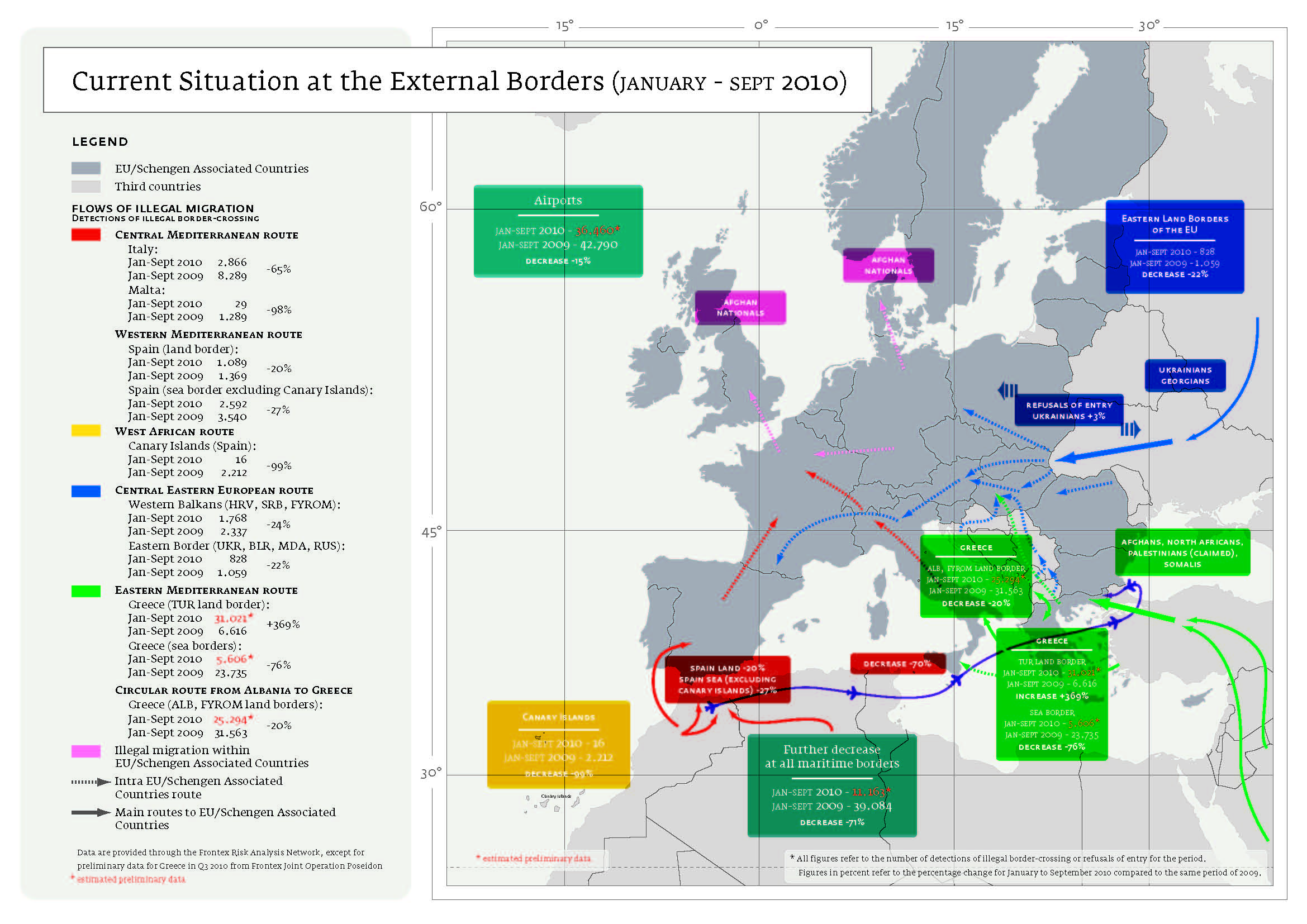
Frontex Map: Current Situation at the External Borders (JANUARY – SEPT 2010)

Frontex has released an updated Third Quarter map, January-September 2010, showing data regarding the situation at the external borders.   Note the information on the map pre-dates the deployment of the Frontex RABIT forces to the Greek border in October/November.  The data shows a 369% increase in detected irregular crossings along the Greek-Turkey land border over the first three quarters of 2010 compared to 2009.

The significant reduction in migrants detected at maritime borders continues:

  • Jan-Sept 2010:   11.163 (estimated preliminary data)
  • Jan-Sept 2009:   39.084
  • 71% reduction

Data by route:

Central Mediterranean route

  • Italy:
    • Jan-Sept 2010:     2.866
    • Jan-Sept 2009:    8.289
    • 65% reduction
  • Malta:
    • Jan-Sept 2010:    29
    • Jan-Sept 2009:    1.289
    • 98% reduction

Western Mediterranean route

Spain (land border):

  • Jan-Sept 2010:   1.089
  • Jan-Sept 2009:   1.369
  • 20% reduction

Spain (sea border excluding Canary Islands):

  • Jan-Sept 2010:   2.592
  • Jan-Sept 2009:   3.540
  • 27% reduction

West African route – Canary Islands (Spain):

  • Jan-Sept 2010:   16
  • Jan-Sept 2009:   2.212
  • 99% reduction

Eastern Mediterranean route

Greece (TUR land border):

  • Jan-Sept 2010:   31.021 (estimated preliminary data)
  • Jan-Sept 2009:   6.616
  • 369% increase

Greece (sea borders):

  • Jan-Sept 2010:   5.606 (estimated preliminary data)
  • Jan-Sept 2009:   23.735
  • 76% decrease

Click here to view Jan-Sept 2010 Map.

Click here for link to Jan-June 2010 Map.

Click here for link to 2009 Map.

1 Comment

Filed under Aegean Sea, Data / Stats, Eastern Atlantic, European Union, Frontex, Greece, Italy, Libya, Malta, Mediterranean, News, Spain, Turkey

Migreurop Report: European borders- Controls, detention and deportations

Migreurop has released its second report on Europe’s borders: “European borders- Controls, detention and deportations.”  Migreurop describes the report as a “[denunciation of] the « externalization » process of the European union migratory policy [which] shows how third countries are obliged, through the threat of the reconsideration of cooperation agreements and development aid, not only to readmit the migrants chased from Europe, but also to keep them on their own territory from travelling towards its doors.   From Calais area in France to the edge of Turkey and the Adriatic sea, from the surroundings of Gibraltar to the Sahel Saharan desert and the new member states of eastern Europe, a subcontracting of migratory control is carried out in series, sometimes very far away from the Union but also within its territory, especially when it deals with sending asylum seekers from country to country considered as unwanted. A large population of exiles, from both sides of the European borders, is subjected to arbitrary incarceration, wandering, and the constant humiliation of a hostile environment….”

Here is the Table of Contents:

Introduction

  • What have migrants become 3

Ceuta, a gilded prison

  • A murderous border 7
  • A legal limbo 8
  • The situation of migrants in detention 8
  • The situation of migrants in the CETI (open centre) 9
  • Deportations and expulsions 12
  • Surviving without resources 14

Sahel-Saharan countries, Europe’s new sentries

  • I – European interference in inter-African migrations – the case of Mauritania 18
    • The “crisis of the cayucos” 18
    • 1. Cooperation instigated by Europe 18
    • 2. Mauritania tramples on its own principles and conforms 21
    • 3. Subcontracting repression and endangering foreigners 22
  • II – Bargaining between Libya and Europe: migrants as an exchange currency –the case of Niger 33
    • 1. A reciprocal exploitation 34
    • 2. An increasingly repressive control of borders 37
    • 3. Arrests and detention in Libyan territory 39
    • 4. A deadly expulsion policy 42
  • Conclusion: the real face of Kadhafi’s pan-Africanism 44

Poland, Romania: how to be good state members in the enlarged EU

  • I – At the new frontiers: the screening of migration 47
    • 1. Reducing the transit and deserving Schengen 48
    • 2. The border police, Frontex and cooperation with other European states 48
  • II – Reception and detention centres 52
    • 1. The detention of foreigners 52
    • 2. Reception centres: isolating asylum seekers 60
    • 3. “Dublinized” asylum seekers 61
  • III – Returns 63
  • IV – Intolerance towards migrants and refugees 66
  • V – Embryonic mobilizations 70

The Ionian and Adriatic seas: forced returns between Italy and Greece

  • A new migration route at Europe’s gates 73
  • I – Controlling and blocking 75
    • 1. Controls in Greece 75
    • 2. Controls at sea 77
    • 3. Controls in Italian ports 78
  • II – Turning back and readmission 82
    • 1. Arbitrary practices and violation of rights 82
    • 2. The port of Venice: collective returns 83
    • 3. The port of Ancona 86
    • 4. Forced return to Greece 86
  • III – Detention 88
    • 1. At the borders and at sea: areas beyond legality 88
    • 2. Detention in Italy 89
    • 3. Detention in Greece 90
  • IV – Some cruel situations 93
    • 1. In Greece 93
    • 2. In Italy 96
  • V – Mobilizations 97
    • 1. In Venice 97
    • 2. In Ancona 97
    • 3. In Greece 98

Ping-pong at the Greco-Turkish border

  • Selective expulsions and random readmissions 106
  • Reactions to a degrading and sometimes murderous situation 107
  • Assistance, support, resistance 108

Dismantling the Calais jungle: a deceptive operation

  • I – The declared objectives of the 22 September 2009 operation 112
  • II – The real objectives of dismantling the jungle 113
  • III – The Modus Operandi: brutality and trickery 115
  • IV – What next? 116

Migreurop network 121

Annexes 122

  • Knocking down walls and defending the right to migrate 122
  • UNHCR-Libya : the bid is rising, migrants pay the price 124
  • All for the closure of camps for migrants, in Europe and beyond 125
  • Italia and Libya: hand in hand 127
  • Roma people victims of the French government xenophobia 128

Click here for the report (EN), or  here (FR), or here (ES).

Click here for article (ES) in Periodismo Humano about the report.

1 Comment

Filed under Aegean Sea, Eastern Atlantic, English Channel / La Manche, European Union, France, Frontex, Italy, Libya, Mauritania, Mediterranean, Morocco, Niger, Reports, Spain, Turkey, UNHCR

JHA Council 8 Nov. Meeting Results

The Justice and Home Affairs Council met on 8 November.  A Council press release containing the “provisional version” of the main results of the meeting includes the following summaries relating to the CEAS and FRONTEX:

“Common European Asylum System (CEAS) – Ministers continued work on the establishment of a Common European Asylum System (CEAS) on the basis of a discussion paper (15561/10). The CEAS includes a package of six legislative proposals which EU member states have committed to adopt by 2012.

The main focus of the debate was on the developments since the October Council, in particular as regards the four proposals that have been identified as priority instruments on the legislative side of the CEAS: the Directives on Qualification and on Long Term Residents and the Regulations on Dublin II and Eurodac. Furthermore, the Presidency identified a number of possible priority objectives, reflecting the discussion at the discussion at the Ministerial Conference on Asylum in September 2010, for the new European Asylum Support Office (EASO) . The EASO will soon be operational and is designed to become an important tool for practical cooperation and solidarity in the asylum area. …

FRONTEX regulation –  The [Mixed Committee (the EU plus Norway, Iceland, Liechtenstein and Switzerland)] discussed the state-of-play concerning revised rules for the external borders agency FRONTEX. Some of the issues outstanding include the development of a common integrated risk analysis model, the processing of personal data and the creation of a European system of border guards.

Council preparatory bodies will continue to discuss the text. Negotiations with the European Parliament have not yet started.

On 24 February 2010 the Commission submitted a proposal to amend Council Regulation (EC) No 2007/2004 (6898/10)….

Click here for Council press release.

Click here for Background paper for the JHA Council meeting.

Click here for the CEAS discussion paper.

1 Comment

Filed under European Union, Frontex, News

Libya Purchases Coastal Surveillance System

Libyan officials signed a €20 million contract on 14 October to purchase a national coastal surveillance system from Transas Marine, an Irish company.  According to the company’s press release, the system “will ensure continuous surveillance of the territorial waters, safety of navigation, reduction of illegal immigration and protection of the marine environment.”  The system is scheduled to become operational in 16 months.  Malta Today noted that the “deal was inked after the European Commission … offered Libya up to 50 million euros in aid to stop the flow of illegal migrants to Europe and to protect refugees.”

Click here for article.

Click here for Transas Marine press release.

2 Comments

Filed under European Union, Libya, Mediterranean, News

ECRE Critical of EU Migration Agreement with Libya

ECRE has posted a statement on its web site that is very critical of the recent EU-Libya Migration agreement.  Also posted is an interview with MEP Sylvie Guillaume (S&D, France) who is a member of the LIBE Committee where she discusses the human rights implications of the EU agreement.

Excerpts from ECRE’s Statement:  “It is difficult to understand why the EU is finalising a deal with the political dictatorship in Libya on issues that impact the fundamental rights of thousands of people. In June this year, Tripoli ordered the UN Refugee Agency, UNHCR, to close its offices in the country, a perfect illustration of Libya’s particular understanding of refugee protection and the unreliable nature of the regime under Colonel Gaddafi. Can we honestly think that refugees are safe in Libya? …

Through this ‘migration cooperation agenda’, the EU is trusting Libya to stop irregular migration towards Europe and to decide on the fate of those asylum seekers who will find it now even harder to reach safety in Europe. This follows last year’s highly questionable agreement between Rome and Tripoli to allow Italy to push back migrants to Libya without assessing their need for international protection. Since then, hardly any refugee has managed to reach Italy by sea. The EU Governments and the European Commission have so far turned a blind eye….

In particular, EU representatives have committed to assist Tripoli in reinforcing its capacity to prevent migrants from entering Libya through its Southern borders and in developing its patrolling capacities in its territorial waters and at high sea. The agreement also covers EU’s assistance to Libya in screening migrants in order to identify those in need of international protection. By setting up EU-sponsored asylum processing centres in Libya, EU States would evade their obligations to protect refugees and shift the responsibility to a country with an appalling human rights record….”

Click here for full statement.

Click here (EN) and here (FR) for interview with MEP Sylvie Guillaume.

1 Comment

Filed under European Union, Italy, Libya, Mediterranean, Statements, UNHCR

Bulgaria Prepares for Admission to Schengen Zone and Begins Patrols on Black Sea

The Sofia News Agency Novinite reports that Bulgaria has added five new coast guard ships which will soon begin patrolling Bulgaria’s Black Sea border.  The patrols are a requirement for Bulgaria’s impending admission to the Schengen Zone which is set to occur in March 2011.

The ships will reportedly be included in “Bulgaria’s integrated system for the observation of the sea border, which is part of the European External Border Surveillance System (EUROSUR)” and “will be taking part in operations of the Frontex Agency … under the European Patrol Network project.”

Click here for article.

Leave a comment

Filed under Black Sea, Bulgaria, European Union, Frontex, News

DIIS Seminar on Political Asylum in the 21st Century (19 October, Copenhagen)

DIIS (Danish Institute for International Studies) is holding a seminar on 19 October: Political Asylum in the 21st Century.

The seminar will be conducted by Carol Bohmer, Visiting Associate Professor at the Department of Government at Dartmouth, and Thomas Gammeltoft-Hansen, DIIS Project Researcher, external lecturer in international refugee law at the University of Copenhagen, and author of the forthcoming book entitled “Access to Asylum: International Refugee Law and the Globalisation of Migration Control” (April 2011).

Description: Few issues have remained as politicized as asylum in the past few decades. Most nations recognize the moral and legal obligation to accept people fleeing from persecution, but political asylum applicants in the twenty-first century face restrictive policies and cumbersome procedures. Competing discourses of protection and control are predominant in present day asylum rhetoric. Governments need to address the conflicting needs of the state to protect their citizens from terrorists and the influx of hordes of unwelcome economic migrants, while at the same time adhering to their legal, moral and treaty obligations to provide safe haven for those fleeing persecution. Satisfying these conflicting goals at the same time may ultimately prove impossible, yet states continue to struggle to find ways to appear to meet both. How do they do it?  This seminar will attempt to answer that question and illustrate the sometimes absurd effects of this process. The seminar will further compare different policy approaches, notably the cases of the United States, the United Kingdom, the European Union and Denmark.

Participation is free of charge, but registration is required. Register online no later than Monday, 18 October 2010 at 12.00 noon.

Click here for more information.

1 Comment

Filed under Colloques / Conferences, Denmark, European Union, UK, United States

Cecilia Malmström: Back From Libya

Commissioner Malmström writes her own blog, Cecilia Malmström Mitt Europa (My Europe).  Here is her most recent posting regarding her trip to Libya (translated from Swedish with Google Translate).  There are several points worth noting – and worrying about.  She notes that Libya is not a signatory to the 1951 Refugee Convention or 1967 Protocol.  (Though Libya is a signatory to the OAU Refugee Convention.)  She suggests that the new migration agreement between the EU and Libya will involve the UNHCR, but no insight is offered regarding whether or how the UNHCR might return to Libya.  She concedes that the European Commission does not know all of the details of the bi-lateral agreement between Italy and Libya which has resulted in the current push-back practice in the central Mediterranean.  And she seems to say that she was greatly troubled by what she saw when she visited one of the southern migrant detention centres in Libya during her official trip.

Translated excerpts:

“Just returned from Libya … I have been there to try to initiate a dialogue between the EU and Libya on issues relating to asylum, migration and international protection. … I believe it is necessary to have a dialogue with Libya.

Libya has not signed the Geneva Convention and the concept of asylum is not in Libyan law. … Since Italy and Libya signed an agreement, which we unfortunately do not know everything about, it has basically been that case that no boats are crossing the Mediterranean.

Against this background, I see it as progress that the first time we have agreed a text with Libya, a version of a plan for cooperation, which deals with issues of asylum and international protection…  Our aim is to identify people in need of international protection, while helping Libya to raise standards in the detention centres in order to provide decent conditions to people. We also address the issues of border control, labor migration and human smuggling in this plan for cooperation. From the EU side, we are prepared to put up 50 million euros over three years to support reforms. These will obviously not be given as a blank check to Libya but will be provided using the guidelines of the European Commission. For example, we support specific projects by various organizations, including the UNHCR.

Besides holding talks with Libyan ministers, I also visited Libya’s southern border in the middle of the desert, observed International Organisation for Migration activities in Libya, and visited one of the detention centres where many migrants have ended up. I had the opportunity to talk to some of the people there.  Several of these stories that I heard have kept both me and my staff awake at night. …”

Click here for the full posting.

3 Comments

Filed under European Union, Italy, Libya, Mediterranean, News, UNHCR

Frontex 2nd Quarter Report

The Frontex Risk Analysis Unit has released its Report for the Second Quarter of 2010 (April-June).  It is a 30+ page report containing data, charts, and graphs detailing entry routes, detections of migrants, detections of facilitators, and other information.

Excerpts from the Report’s Executive Summary:

Illegal migration pressure in the EU underwent a foreseeable seasonal increase during the second quarter of 2010, but is still clearly in a period of decline.…

The widespread decline in illegal migration pressure is probably due to two key factors. The first is decreased employment opportunities in the EU …  [and the] second is stricter migration and asylum policies in Member States, supported by much more effective collaboration with key third countries. For example, stricter migration and asylum policies in Norway and the UK have reduced the number of applications in these Member States…. Similarly, bilateral agreements between Italy and Libya, and between Spain and both Senegal and Mauritania, continue to control, for the time being at least, most illegal migration via the Central Mediterranean and West African routes, respectively.

Notwithstanding the general decline in detections, there were two emerging trends in the second quarter (Q2) of 2010: a continued and intensified shift from the Greek sea border to the Greek land border with Turkey….  In the beginning of 2009 illegal crossings of the EU external border between Greece and Turkey were divided roughly equally between the land and sea borders.  However, there has been a gradual and recently intensified shift to the land border. Reasons for this shift from sea to land borders are linked to the effectiveness of the Frontex activities in the Aegean Sea, combining surveillance activities with identification of illegal migrants, and opening the possibility of return to origin countries for detected migrants. ….

Main trends:

  • There is a general decline in illegal migration to the EU compared to a year ago;
  • For the time being, Turkey is the main transit country for illegal migration to the EU….;
  • In the Eastern Mediterranean route, there has been a gradual and recently intensified shift from the Greek-Turkish sea border to the land border, where 90% of detections were made….   At the Greek-Turkish land border around 60% of detections were made at the Border Control Unit (BCU) Orestiada which is under the biggest pressure. Air connections to Turkey are increasingly used by migrants from North Africa, who then illegally cross the EU external border with Turkey. As well as effective Frontex-coordinated joint operations at the sea border, potential explanations for this shift include cheaper facilitation costs, a lower risk crossing, lower detection rates…;
  • There were increased detections on the Central Mediterranean route, probably due to the recent re-organisation of criminal groups in response to effective bilateral agreements in the area. In June 2010 Libya expelled the United Nations High Commissioner for Refugees (UNHCR), with whom 9,000 refugees and 4,000 asylum-seekers were registered and who, in the absence of protection, may now attempt entry to the EU.

Click here for the 2nd Quarter Report.

Click here for the 1st Quarter Report.

2 Comments

Filed under Aegean Sea, Analysis, Data / Stats, Eastern Atlantic, European Union, Frontex, Greece, Italy, Libya, Malta, Mauritania, Mediterranean, News, Reports, Senegal, Spain, Turkey

Les pirogues de fortune – CARIM Note

A CARIM Analytic and Synthetic Note by Serigne Mansour TALL and Aly TANDIAN was issued in July entitled “Regards sur la migration irrégulière des Sénégalais : vouloir faire fortune en Europe avec des pirogues de fortune.”

Résumé – Ce papier met en exergue le voyage des sénégalais qui utilisent des pirogues de fortune dans l’espoir d’atteindre l’Europe via les îles canaries. L’auteur analyse les motivations sous-tendant ces itinéraires « irréguliers » ou « illégaux » et met en lumière les stratégies ainsi que les ressources que ces migrants utilisent pour partir.

[Abstract (the paper is only in French) – The paper focuses on the Senegalese who embark on “fortune seeking pirogues”, hoping to reach Europe via the Canary Islands. The author analyses the motivations of these ‘irregular’ or illegal migratory itineraries and sheds light on the strategies and resources that they employ in order to leave.]

Click  here (FR) or here (FR) for Note.

Leave a comment

Filed under Analysis, Eastern Atlantic, Reports, Senegal, Spain

RSQ Article: Refugees, Europe, Camps/State of Exception: “Into The Zone”, the EU and Extraterritorial Processing of Migrants, Refugees, and Asylum-seekers

The latest issue of Refugee Survey Quarterly has been released (2010; Vol. 29, No. 1).  An article by Dr. Carl Levy (Reader in European Politics, Department of Politics at Goldsmiths College, University of London) is of particular interest.

Here is the Abstract:  This article outlines the debate over extraterritorial processing in the European Union (EU) from the Treaty of Amsterdam (1997) to the Treaty of Lisbon (2009). It will briefly outline the historical precedents, the evolution of policy within the EU, and the role of other models (Australian, American, etc.). This article emphasizes the contested understandings of how these zones might be manifested in practice. It uses evidence from the political history and policy-making of the EU to question Giorgio Agamben’s concept of the state of exception. In fact, the promotion of extraterritorial zones was not merely sold as necessary, if unfortunate, choices. Likewise, the more sinister interpretation of these zones as a regression from the Liberal State to the universe of camps failed accurately to capture what was happening in reality. Firstly, supranational extraterritorial processing was beyond the constitutional or political capacity of the EU. Secondly, at times, the unintended consequences might have led to a liberalization of so-called “Fortress Europe” and caused certain politicians to become disenchanted precisely because the proposed form of extraterritorial processing threatened to institute a rigorous form of burden sharing.

Click here for link to Journal.  (Subscription required.)

Leave a comment

Filed under Analysis, European Union, Frontex

ECRE Statement Re EU Conference on Quality and Efficiency in the Asylum Process

ECRE released a statement at the conclusion of this week’s EU Ministerial Conference on Quality and Efficiency in the Asylum Process:

“… Since its peak in the early 1990s, the number of asylum applications lodged within the European Union has experienced a sharp decline, despite the increase in some individual Member States. However, a difficult political and economic environment in Europe is fuelling little appetite for welcoming foreigners, which is translated into a slow progress at the table of negotiations to build a Common European Asylum System.

ECRE believes that initiatives to increase practical cooperation, such as this conference and the establishment of a European Asylum Support Office, which will soon be up and running in Malta, will help to make the asylum system fairer and more efficient. For instance, yesterday’s discussions have provided examples of how to improve the treatment of children or traumatised asylum seekers. Also, pooling resources with regard to information about the home countries of asylum seekers, interpretation services and training can contribute to better decisions.

Bjarte Vandvik, ECRE’s Secretary General, said: ‘The current EU asylum system is failing both Member States and people who arrive to Europe fleeing war or persecution. Practical cooperation is part of the solution but will not be enough. European Member States also need to resolve the impasse in the negotiations and work together to agree on fairer common asylum rules’.

Asylum seekers still have hugely different chances of being granted international protection depending on the EU country that will examine their application. For instance, in 2009, virtually no Iraqis were recognised as refugees in Greece, while in Germany, 77% of Iraqi asylum seekers were granted international protection and could rebuild their lives. A harmonised asylum system with higher standards of protection would not be only fairer; it would also be more efficient and less costly in the longer term.”

Click here for information on the Conference organised by the Belgian Presidency.

Click here for Commissioner Cecilia Malmström’s statement at the conference.

Leave a comment

Filed under European Union, News, Statements

FRA Call for tender: Treatment of third country nationals at the EU’s external borders

The EU’s Fundamental Rights Agency has issued a call for tender.

From FRA:  The overall objective of the project is to examine the treatment of third-country nationals at the external borders of the European Union in light of the existing fundamental rights framework. The project will not cover all fundamental rights issues that may emerge in the context of management of external borders, but focus on 2 specific components.

The first component of the project focuses on the southern maritime borders of the European Union. The second component of the project will analyse the treatment of third-country nationals at border crossing points.”

The first part of the fieldwork (relating to interception and rescue at sea) will be carried out in Cyprus, Greece, Italy, Malta and Spain and the second part in 10 border crossing points to be identified among those with the highest number of entries of third country nationals into the Schengen area.

Duration: 23 months; Budget: 760.000,00 EUR;

Deadline for submission of proposals: 13 September 2010.

(Noted earlier today on the Migration and Law Network listserve.)

Click here for full information.

Leave a comment

Filed under Aegean Sea, European Union, Mediterranean, News