Tag Archives: European Union

Spanish EU Presidency’s Web Site and Work Programme

The Spanish EU Presidency’s web site is up and running.

Excerpts from a summary of the Presidency’s work programme:

“This will be the fourth occasion that Spain has held the Presidency of the European Union. On each of the previous occasions, it faced important challenges. But none, like now, have coincided with a global crisis like the one that is affecting the economy and at a time as strategic as now in the European transformation process. This gives our Presidency a unique significance and, at the same time, even greater responsibility.”

“Spain has worked very closely with Belgium and Hungary to prepare a joint program for the next 18 months, in accordance with the Treaty, which was presented to the Council of Ministers of Foreign Affairs on the 7th and 8th in Brussels.”

“These are the four main priorities of our Presidency:

• The first and essential priority for the development of the others is the full and effective application of the Lisbon Treaty.

• The second is to guarantee the economic recovery of Europe through greater co-ordination of every member state and the approval of the European strategy for sustainable growth for 2020.

• The third is to reinforce the presence and influence of the European Union in the new world order.

• Finally, the fourth is to place European citizens at the centre of EU policy, with initiatives designed to develop their rights and freedoms.”

“We are also going to encourage dialogue and co-operation with South Mediterranean countries, the stability and prosperity of which constitute a priority for Europe. The structure of the Union for the Mediterranean needs to be configured and its General Secretariat set up in Barcelona.”

“We will also initiate the process for the European Union’s accession to the Convention on Human Rights, and we will approve the Stockholm Programme Action Plan for the European Area of Freedom, Security and Justice, with measures that will have a considerable positive effect on the security of our citizens.”

“We know that dealing with immigration is one of Europe’s greatest challenges. We, who have contributed to the content of European policy on immigration over the last few years, are well aware of the situation.”

“Now we will deal with it in its different aspects, from integration and cooperation with the countries of origin and transit, to the tireless fight against the mafias that exploit the desperation of the less fortunate.”

Click here for full document.

Leave a comment

Filed under European Union, Spain

Le Maroc: Un cul-de- sac pour les migrants en quête d’une vie meilleure en Europe

Un article de La Libre (Belgique) sur les migrants subsahariens au Maroc:

“En contrepartie de son investissement pour bloquer les mouvements de populations subsahariennes, [le Maroc]  a obtenu des aides européennes non négligeables, soit 654 millions d’euros entre 2007 et 2010. Les organisations marocaines de défense des droits de l’homme s’en indignent, lui reprochant d’être ‘le gendarme ou l’arme de régulation de l’Europe’. Les responsables marocains préfèrent, quant à eux, garder le silence sur un dossier bien trop encombrant….”

“Les chiffres officiels font état de 10000 à 15000 migrants bloqués au Maroc, principalement originaires du Mali, du Sénégal, de Gambie, du Congo ou du Libéria. Difficile de donner un chiffre exact pour une population mobile qui évolue dans le cadre d’un système parallèle….”

“La politique restrictive et répressive de ‘bouclage’ des frontières, menée par les pays de l’Union européenne, a eu comme résultat prévisible d’enfermer à l’intérieur même du Maroc les candidats à l’émigration. Ils se retrouvent contraints de rester pour des périodes relativement longues dans une Afrique du Nord qui les dénigre, attendant qu’une occasion de traverser se présente….”

Click here for article.

1 Comment

Filed under European Union, Morocco, News

NGO Asylum Good Practice Recommendations to Spain, Belgium, and Hungary

CEAR (Spanish Refugee Council), the Flemish Refugee Action (Vluchtelingenwerk Vlaanderen), CIRE (Coordination et Initiatives pour Réfugiés et Etrangers),and the Hungarian Helsinki Committee (Magyar Helsinki Bizottság) have made a series of good practice recommendations to Spain, Belgium and Hungary.  These three countries are “the new Trio of States that will hold the Presidency of the European Union from January 2010 until June 2011, a crucial moment for the development of the EU policy and legislation in the field of asylum … The Trio will therefore play a key role in [the] implementation [of the Stockholm Programme] … The aim of [the recommendations is ] to complement ECRE’s positions and identify, from a more national perspective, those issues where the often diverse experiences of Spain, Belgium and Hungary can be employed to effectively address some of the main shortcomings of asy­lum systems in Europe.”

“As a general recommendation we urge the Trio of States to join their efforts in ensuring that the second phase of the Common European Asylum System will translate the best practices and highest protec­tion standards of the Member States’ national laws into EU legislation. The harmonisation on minimum standards, too often resulted in the lowest common denominators, should not be repeated.”

“[I]t must also be noted that in recent years a worrisome tendency has developed towards the exter­nalisation of responsibility for asylum claims outside the EU to neighbouring third countries. In this respect we recommend the Trio of States to support cooperation with third countries aimed at reinforcing their protection system. At the same time we urge the Trio of States to take a strong and clear position to make sure such cooperation does not become a way for the EU to escape its responsibility to protect under international and EU law.”

Click here for full document.

Leave a comment

Filed under Belgium, European Union, Hungary, Spain, Statements

Workshop: “The Human Costs of Border Control in the Context of EU Maritime Migration Systems”

VU University Amsterdam held a three day Exploratory Workshop in October 2009 on “The Human Costs of Border Control in the Context of EU Maritime Migration Systems.”

Executive Summary of the Workshop’s Goals:

“The ongoing European harmonisation of migration and border control policies has as a side-effect unclear, but definitely rising numbers of fatalities at European borders (different estimates suggest anything between 1.000 and 10.000 annually). This process has considerable consequences for EU institutions, governments, the administrations of EU Member States, for migrants and people assisting migrants, and neighbouring countries. The consequences are diverse in nature, concerning policy, institutions, social cohesion and conflict, and law. However, while these consequences of the Europeanisation of migration policy are the subject of numerous academic studies, until now, the human costs of border control has received only isolated academic attention. There are insufficient data, and a comprehensive analysis is lacking. This workshop aims at bringing together leading European academics from different disciplines working on this issue. The immediate aim of the workshop is to integrate the analyses of those academics, with a view to developing a comprehensive analysis. The ultimate aim is to create a network engaging in comprehensive data gathering and analysis, leading to concrete suggestions to limit the undesirable side-effects of European migration policies.”

Draft workshop papers (which are not to be quoted or cited to without prior consent of the author) included the following:

Martin Baldwin-Edwards
The Human Costs of Border Control: Greece

Anat Ben-Dor
The un-checked dangers of the Israeli-Egyptian Sinai border

Hein de Haas
Trans-Saharan and Trans-Mediterranean migration – Questioning the transit hypothesis

María Hernández-Carretero
Boat migrants’ perspectives on risk

Ernesto Kiza
The Human Costs of Border Control at the External EU Borders between 1999 and 2004

Silja Klepp
A double bind: Malta and the rescue of unwanted migrants at sea

Mehdi Lahlou
The Human and Political Costs of Irregular Migration: Morocco case

Jorrit J. Rijpma
Frontex: successful blame shifting of the Member States?

Click here for more of the Workshop’s working materials.

Leave a comment

Filed under Colloques / Conferences

Conference: ‘Explaining the Stockholm Programme: Changes and novelties on Immigration and Criminal Justice Cooperation and importance for the UK’ (29 Jan 2010)

“The Centre of European Law together with the generous support of the Representation of the European Commission in the UK are organising a major conference on the Stockholm Programme entitled ‘Explaining the Stockholm programme: Changes and novelties on Immigration and Criminal Justice Cooperation and importance for the United Kingdom.’

By December 2009, the European Council will have adopted the new multiannual programme on Justice and Home Affairs, better known as the Stockholm programme. This programme will have substituted the previous Hague programme adopted on 5 November 2004, which was itself a continuation of the Tampere programme adopted in 1999. The new Stockholm programme will have been adopted under the current Swedish Presidency.

The objective of this conference is to inform academics, practitioners, policy makers and the civil society in general about the Stockholm Programme. It will explore its strengths and weaknesses, particularly with regards to immigration and criminal justice co-operation, and on the role that the United Kingdom will play in these areas at a European level in the future.”

For further details of the programme click here.

“Friday 29 January 2010

Great Hall, Strand Campus, King’s College London 9.30 (registration from 9.00) Free of charge, all welcome

To Register please contact Christine Copping, Centre Manager, Centre of European Law christine.copping@kcl.ac.uk

The conference will be accredited for CPD with the Solicitor’s Regulation Authority and the Bar Standards Board.”

Leave a comment

Filed under Colloques / Conferences, European Union, UK

EMHRN Recommendations to the Incoming Spanish EU Presidency

The Euro-Mediterranean Human Rights Network (EMHRN) has conveyed a series of recommendations to the new Spanish EU Presidency regarding the Union for the Mediterranean and the European Neighbourhood Policy.

Relevant excerpts include:

“Migration and Asylum

[***]

In relation to asylum, the EMHRN wishes to underline the following elements:

Refugees and asylum seekers face great difficulties when trying to reach safe havens in the EU.  Due to push back operations and severe, indiscriminate border control policies, including EU supported operations in third countries, asylum seekers often find themselves trapped in North Africa and in the Middle East (MENA), that do not offer them any sort of protection despite the presence of the UNHCR.

Several countries of the region have not yet ratified the 1951 Geneva Convention on the status of refugees and none of the countries from the region has a proper asylum system. Refugees and asylum seekers face extreme vulnerability and are often prevented from accessing their most basic rights. …

In relation to border control, the EU and its member states are keen on promoting cooperation with third countries with the purpose of better controlling migratory flows. It remains that the EU has, until now, failed to properly integrate a human rights dimension to such cooperation policies.

Most countries of the region criminalize irregular migration. Migrants are being arbitrarily arrested and put in detention, with no possibility of appeal. They may face ill treatment and unlawful deportation.

The conclusion of readmission agreements is promoted by the EU and its members. Negotiations have been ongoing for several years between the EU and Morocco to conclude such an agreement. A mandate has also been given by the Member states to negotiate an agreement with Algeria.

The EMHRN believes that returning migrants to countries other than their own, or to countries where they have no anchor and no legal residency, may put them in danger.

Push back and interception operations, including at sea, are other policy instruments promoted by the EU and its member states. Several of these operations have resulted in endangering the security of migrants and asylum seekers and may have resulted in a violation of the ‘non refoulement’ principle.

The EMHRN acknowledges the right of a state to control its borders. However, the EMHRN calls on the Spanish Presidency to actively promote policies ensuring that

  • • cooperation with third countries from the region does not endanger migrants and refugees.
  • •cooperation policy in the field of border management considers the impact of such measures on the access of refugees to international protection mechanisms, including in Europe.
  • • the EU member states strictly respect the principle of ‘non refoulement’ as well as their obligation under article 3 of the European Convention on Human Rights (ECHR).
  • no person is returned to a country other than its own or where he/she has no legal residency.”

Click here for full recommendations.

Leave a comment

Filed under European Union, Mediterranean, Spain, Statements

Frontex and Other EU Agencies to Coordinate Maritime Surveillance

According to identical news releases issued by Frontex and the Community Fisheries Control Agency (CFCA), Frontex, the CFCA, and the European Maritime Safety Agency (EMSA) have entered into an agreement “with a view to cooperate, in accordance with their respective mandates, in the field of maritime surveillance that will be mutually beneficial for the three agencies.”

The press release goes on to state:

“The Cooperation Agreement will allow for the exchange of information and of expertise as well as of for the exploration of joint use of assets as relevant, optimising the functioning of the European Union as a whole regarding Maritime Surveillance. The cooperation will result in an improvement of the control of external maritime borders of the EU (competence of Frontex), an increase in the maritime safety (competence of EMSA) and an enhancement of the coordination of fisheries control and inspection activities by the Member States (competence of CFCA).

“The main activities comprised in the agreement are the following:

• Exchange of information and data on matters of common interest
• Explore synergies in the use of the maritime surveillance and information systems
• Explore the possibilities of joint use of assets
• Investigate potential cooperation in the field of maritime surveillance directed to the protection of external maritime borders and fisheries control
• Expand mutual collaboration between the Agencies in areas such as coordination of inspections, research and development, training, etc.

Contacts:

  • • EMSA: Pete Thomas, Senior Communication Officer
    Peter.THOMAS@emsa.europa.eu, Tel. +351 21 1209 281
  • • Frontex: Izabella Cooper, Spokesperson,
    izabella.cooper@frontex.europa.eu , Tel. +48 22 544 95 35
  • • CFCA: Patricia Sánchez Abeal, Communication Officer
    patricia.sanchezabeal@cfca.europa.eu , Tel. +34 986 12 06 17”

Click here and here for links to the press releases.

3 Comments

Filed under European Union, Frontex, News

UNHCR Migration and Border Recommendations to the Incoming Spanish EU Presidency

UNHCR’s recommendations to the Spanish EU presidency include the following”

“Migration and border management

Spain has affirmed that reinforcing Frontex and ensuring that EU migration policy is accompanied by close cooperation with migrants’ countries of origin and transit will be priorities of its Presidency. A review of the Frontex mandate will take place in 2010.

UNHCR encourages the Spanish Presidency to pursue its migration agenda with due regard for international refugee and human rights norms. This includes:

a) Inclusion of refugee protection safeguards in migration control measures generally;

b) Development of clear guidance with respect to the disembarkation of persons intercepted at sea;

c) Attention to the potential protection needs of victims of trafficking;

d) With respect to the return of people found not to need international protection, measures to ensure that such return is safe, dignified and sustainable.

– calling for safeguards in border management activities, including under Frontex’s auspices, with the revision of that body’s mandate foreseen in early 2010;  a call for more focus on protection needs of victims of trafficking as part of anti-trafficking measures.”

Click here for full recommendations.

Leave a comment

Filed under European Union, Spain, Statements, UNHCR

Stockholm Programme’s Web Site

The Swedish Presidency of the EU maintains a web site containing links to documents and information pertaining to the Stockholm Programme.

It is unclear whether this web site will be maintained after the Swedish Presidency concludes, but for the moment the site is avaialble here.

Leave a comment

Filed under EU and EU Organizations, European Union, News

EU Stockholm Programme Adopted

EU heads of state and government have adopted the framework for the Stockholm Programme to be implemented during the 2010-2014 period.

Portions of the newly adopted programme relevant to migrants include the following (emphasis added):

[***]

5. Access to Europe in a globalised world

5.1 Integrated management of the external borders

The Union must continue to facilitate legal access to the territory of the Member States while in parallel taking measures to counteract illegal immigration and cross-border crime and maintaining a high level of security. The strengthening of border controls should not prevent access to protection systems by those persons entitled to benefit from them, and especially people and groups that are in vulnerable situations. In this regard, priority will be given to the needs of international protection and reception of unaccompanied minors. It is essential that the activities of Frontex and of the European Asylum Support Office are coordinated when it comes to the reception of migrants at the EU’s external borders. The European Council calls for the further development of integrated border management, including the reinforcement of the role of Frontex in order to increase its capacity to respond more effectively to changing migration flows.

The European Council therefore

▪ requests the Commission to put forward proposals no later than early 2010 to clarify the mandate and enhance the role of FRONTEX, taking account of the results of the evaluation of the Agency and the role and responsibilities of the Member States in the area of border control. Elements of these proposals could contain preparation of clear common operational procedures containing clear rules of engagement for joint operations at sea, with due regard to ensuring protection for those in need who travel in mixed flows, in accordance with international law; increased operational cooperation between Frontex and countries of origin and transit and examination of the possibility of regular chartering financed by Frontex[.] In order to promote the proper enforcement of the applicable statutory framework for Frontex operations, the Commission should consider including a mechanism for reporting and recording incidents that can be satisfactorily followed up by the relevant authorities,

▪ invites FRONTEX itself to consider, within its mandate, establishing regional and/or specialised offices to take account of the diversity of situations, particularly for the land border to the East and the sea border to the South; creating such offices should on no account undermine the unity of the Frontex agency; before creating such offices, Frontex should report to the Council on its intentions,

▪ invites the Commission to initiate a debate on the long-term development of FRONTEX. This debate should include, as was envisaged in the Hague programme, the feasibility of the creation of a European system of border guards,

▪ invites the EASO to develop methods to better identify those who are in need of international protection in mixed flows, and to cooperate with Frontex wherever possible,

▪ considers that the evaluation of the Schengen area will continue to be of key importance and that it therefore should be improved by strengthening the role of Frontex in this field,

▪ invites the Council and the Commission to support enhanced capacity building in third countries so that they can control efficiently their external borders.

[***]

6. A Europe of responsibility, solidarity and partnership in migration and asylum matters

The European Council recognises both the opportunities and challenges posed by increased mobility of persons, and underlines that well-managed migration can be beneficial to all stakeholders. [***]  Furthermore, the European Council recalls that the establishment of a Common European Asylum System (CEAS) by 2012 remains a key policy objective for the EU.

The European Council calls for the development of a comprehensive and sustainable European migration and asylum policy framework, which in a spirit of solidarity can adequately and proactively manage fluctuations in migration flows and address situations such as the present one at the Southern external borders. Serious efforts are needed to build and strengthen dialogue and partnership between the EU and third countries, regions and organisations in order to achieve an enhanced and evidence-based response to these situations, taking into account that illegal immigration enters the Union also via other borders or through misuse of visa. An important objective is to avoid the recurrence of tragedies at sea. When tragic situations unfortunately happen, ways should be explored to better record and, where possible, identify migrants trying to reach the EU.

[***]

6.2 Asylum: a common area of protection and solidarity

The European Council remains committed to the objective of establishing a common area of protection and solidarity based on a common asylum procedure and a uniform status for those granted international protection. While the Common European Asylum System (CEAS) should be based on high protection standards, due regard should also be given to fair and effective procedures capable of preventing abuse. It is crucial that individuals, regardless of the Member State in which their application for asylum is lodged, are offered an equivalent level of treatment as regards reception conditions, and the same level as regards procedural arrangements and status determination. The objective should be that similar cases should be treated alike and result in the same outcome.

6.2.1 A common area of protection

There are still significant differences between national provisions and their application. In order to achieve a higher degree of harmonisation, the establishment of a Common European Asylum System (CEAS), should remain a key policy objective for the EU. Common rules, as well as a better and more coherent application of them, should prevent or reduce secondary movements within the EU, and increase mutual trust between Member States.

The development of a Common Asylum Policy should be based on a full and inclusive application of the Geneva Convention on the status of refugees and other relevant international treaties. Such a policy is necessary in order to maintain the long-term sustainability of the asylum system and to promote solidarity within the EU. Subject to a report from the Commission on the legal and practical consequences, the European Union should seek accession to the Geneva Convention and its 1967 Protocol.

[***]

6.2.3 The external dimension of asylum

The EU should act in partnership and cooperate with third countries hosting large refugee populations. A common EU approach can be more strategic and thereby contribute more efficiently to solving protracted refugee situations. Any development in this area needs to be pursued in close cooperation with the UNHCR and, if appropriate, other relevant actors. The European Asylum Support Office should be fully involved in the external dimension of the CEAS. In its dealings with third countries, the EU has the responsibility to actively convey the importance of acceding to, and implementing of, the 1951 Geneva Convention on Refugees and its Protocol.

Promoting solidarity within the EU is crucial but not sufficient to achieve a credible and sustainable common asylum policy. It is therefore important to further develop instruments to express solidarity with third countries in order to promote and help building capacity to handle migratory flows and protracted refugee situations in these countries.

The European Council invites

• the Council and the Commission to enhance capacity building in third countries, in particular their capacity to provide effective protection, and to further develop and expand the idea of Regional Protection Programmes, on the basis of the forthcoming evaluations. Such efforts should be incorporated into the Global Approach to Migration, and should be reflected in national poverty reduction strategies and not only be targeting refugees and internally displaced persons but also local populations.

▪ the Council, the European Parliament and the Commission to encourage the voluntary participation of Member States in the joint EU resettlement scheme and increase the total number of resettled refugees, taking into consideration the specific situation in each Member State,

▪ the Commission to report annually to the Council and the European Parliament on the resettlement efforts made within the EU, to carry out a mid-term evaluation during 2012 of the progress made, and to evaluate the joint EU resettlement programme in 2014 with a view to identifying necessary improvements,

▪ the Council and the Commission to find ways to strengthen EU support for the UNHCR,

▪ the Commission to explore, in that context and where appropriate, new approaches concerning access to asylum procedures targeting main transit countries, such as protection programmes for particular groups or certain procedures for examination of applications for asylum, in which Member States could participate on a voluntary basis.

[***]

7.3 Continued thematic priorities with new tools

The European Council considers that the key thematic priorities identified in the previous strategy remain valid, i.e. the fight against terrorism, organised crime, corruption, drugs, the exchange of personal data in a secure environment and managing migration flows. The fight against trafficking in human beings and smuggling of persons needs to be stepped up.

Building on the Strategy for Justice, Home Affairs and External Relations adopted in 2005 and other relevant acquis in this field, such as the Global Approach to Migration, EU external cooperation should focus on areas where EU activity provides added value, in particular:

– Migration and asylum, with a view to increasing EU dialogue and cooperation with countries of origin and transit in order to improve their capacity to carry out border control, to fight against illegal immigration, to better manage migration flows and to ensure protection as well as to benefit from the positive effects of migration on development; return and readmission is a priority in the EU’s external relations,

[***]

The European Council invites the Commission to

▪ examine whether ad hoc cooperation agreements with specific third countries to be identified by the Council could be a way of enhancing the fight against trafficking and smuggling of persons and making proposals to that end. In particular, such agreements could involve full use of all leverage available to the Union, including the use of existing financing programmes, cooperation in the exchange of information, judicial cooperation and migration tools.

[***]

7.5 Geographical priorities and international organisations

[***]

As regards the Union for the Mediterranean, it will be necessary to enhance the work started in the context of the Barcelona process and the Euro-Mediterranean Partnership, in particular regarding migration (maritime), border surveillance, preventing and fighting drug trafficking, civil protection, law enforcement and judicial cooperation. The European Council invites the Commission in cooperation with the High Representative to submit such a plan in 2010 and asks Coreper to prepare as soon as possible the decisions to be taken by the Council. The European Council will review the Plan by the end of 2012, and in particular to assess its impact on the ground.

As regards the situation in the Mediterranean area, the European Council considers that a stronger partnership with third countries of transit and origin is necessary, based on reciprocal requirements and operational support, including border control, fight against organised crime, return and readmission. Rapid action to face the challenges in this region is a priority.

[***]

The European Council notes that the 2007 EU-Africa Joint Strategy and Action Plan define the scope of cooperation in the areas of counter-terrorism, transnational crime and drug trafficking. Both within the EU-Africa Partnership on Mobility, Migration and Employment (MME) and the EU Global Approach to Migration, and the follow up process of the Rabat, Paris and Tripoli conferences, the dialogue on migration should be deepened and intensified with African Partners, focussing on countries along the irregular migration routes to Europe with a view to assisting those countries in their efforts to draw up migration policies and responding to illegal immigration at sea and on the borders. Efforts should be made to enhance cooperation, including the swift conclusion of re-admission agreements, with Algeria, Morocco and Egypt, and, in line with the European Council conclusions in October 2009, with Libya.

West Africa has recently developed into a major hub for drug trafficking from South America to Europe and will require enhanced attention and assistance to stem drug trafficking as well as other transnational crime and terrorism (within the Sahel).

[***]

Click here for full text.

Leave a comment

Filed under Communiqués, European Union, Frontex

Italy Responds to EC Request for Information on Push-Back Practice (News)

The Italian Government formally responded to the EC request for details regarding its push-back policy that has been in effect since May.  The response is contained in a letter dated 8 September and released to the media today.

Italy claims that none of the 757 migrants intercepted since May and subsequently forcibly returned to Libya made a request for asylum: none of the immigrants taken to Libya between May 6 and August 30 ”made any request for international protection or mention of persecution in their own country”.

The claim by Italy that not a single migrant asked for protection strains credulity.  It is inconsistent with among other things the incident in August when 75 Somali migrants who were intercepted by the Italians used a satellite telephone to call a BBC reporter in Italy to request help before they were turned over to Libyan authorities.  One caller told the BBC reporter ”we told the Italian military that we wanted to request asylum and asked them not to hand us over to the Libyans because we were afraid of going to jail, but they wouldn’t listen to us.”   Click here for the article regarding this incident.

The Italian letter also seeks to counter criticism that Libya does not protect the rights of asylum seekers and is not a signatory to the UN Refugee Protocol by noting that Libya has ratified an African Union Convention on refugees ”obliging it to guarantee protection of anyone facing persecution”.

Click here for article.

Leave a comment

Filed under European Union, Italy, Libya, Mediterranean, News

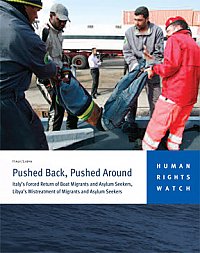
HRW Report: Italy’s Forced Return of Boat Migrants and Asylum Seekers, Libya’s Mistreatment of Migrants and Asylum Seekers (Reports)

Blog - HRW Cover

Human Rights Watch has released a report regarding Italy’s forcible push-back policy:

Pushed Back, Pushed Around – Italy’s Forced Return of Boat Migrants and Asylum Seekers, Libya’s Mistreatment of Migrants and Asylum Seekers

“On May 6, 2009, for the first time in the post-World War II era, a European state ordered its coast guard and naval vessels to interdict and forcibly return boat migrants on the high seas without doing any screening whatsoever to determine whether any passengers needed protection or were particularly vulnerable. The interdicting state was Italy; the receiving state was Libya.  Italian coast guard and finance guard patrol boats towed migrant boats from international waters without even a cursory screening to see whether some might be refugees or whether others might be sick or injured, pregnant women, unaccompanied children, or victims of trafficking or other forms of violence against women. The Italians disembarked the exhausted passengers on a dock in Tripoli where the Libyan authorities immediately apprehended and detained them.”

HRW’S Recommendations include:

“To the Government of Italy

  • Immediately cease interdicting and summarily returning boat migrants to Libya.
  • Investigate allegations that Italian naval personnel beat and used electric shocks to force interdicted boat migrants onto Libyan vessels and prosecute naval or coast guard officials who abused their authority, including those with command responsibility.
  • Stop cooperating with the Libyan authorities on the interdiction and interception of third-country nationals trying to leave Libya.
  • Make public all treaties and agreements between the governments of Italy and Libya.
  • Cease to fund or provide other bilateral support to Libya aimed at increasing that country’s effectiveness at intercepting asylum seekers and migrants before they take to the sea or before they reach Italian waters. Redirect such support into multilateral efforts, especially through UNHCR and OHCHR, to ensure that fundamental human rights standards relating to the treatment of such persons in Libya are observed.
  • Ensure access to full and fair asylum procedures, including the right to raise fear of treatment contrary to article 3 of the ECHR, for every person in the control of the Italian authorities, including those interdicted or rescued at sea.”

“To European Union Institutions and EU Member States

  • Demand that Italy not violate article 3 of the European Convention on Human Rights by its interdiction and summary return of migrants to a place where they are subjected to inhuman and degrading treatment.
  • Ensure access to full and fair asylum procedures, including the right to raise fear of treatment contrary to article 3 of the ECHR, for every person in the control of any EU member state, including those interdicted or rescued at sea.
  • Adopt clear, consistent, and binding rules on EU member states establishing responsibility for disembarking migrants rescued at sea.
  • Refrain from expelling third-country (non-Libyan) nationals to Libya, either directly or as partners in Frontex-coordinated operations, until Libya’s treatment of migrants, asylum seekers and refugees fully meets European standards in relation to persecution or risk of treatment contrary to article 3 ECHR. Under current conditions, the return of third-country nationals breaches European nonrefoulement obligations not to return people to inhuman or degrading treatment.
  • Encourage Libya to 1) ratify the 1951 Refugee Convention and its 1967 Protocol; 2) adopt a national asylum law; and 3) formally recognize UNHCR.
  • Display greater transparency in negotiations with Libya on all matters relating to migration and border controls.
  • Ensure  that the human rights clause in the Libya-EU Framework Agreement, being negotiated at the time of this writing, and in agreements flowing from it, contain explicit reference to the rights of asylum seekers and migrants as a prerequisite for any cooperation on migration-control schemes.
  • Refrain from encouraging Libya from establishing any reception regime which falls below the European reception condition standards
  • Quickly admit UNHCR-identified refugees in need of resettlement from Libya. Do so, however, only as a supplement rather than as a substitute for allowing spontaneous arrivals in EU territory to seek asylum.
  • Direct development assistance to improve respect for human rights and human dignity in migrants’ and asylum seekers’ countries of origin to address the root causes of forced migration.”

Click here for the report.

Leave a comment

Filed under European Union, Frontex, Italy, Libya, Mediterranean, Reports

Propondrá Besson a la UE Que Se Intercepten Inmigrantes en el Mar (News)

“Francia quiere que la UE dé su visto bueno para poder interceptar y repatriar inmigrantes ilegales en el mar, según informó hoy el ministro de Inmigración francés, Eric Besson, en una carta que envió a sus homólogos comunitarios.”

“Besson considera inaudita la presión que los traficantes de inmigrantes ilegales ejercen en las fronteras de la UE y considera que la [Frontex] precisa una nueva doctrina basada en la interceptación y repatriación, pero que al mismo tiempo respete el derecho de asilo.  El ministro francés propuso también una mayor cooperación entre Frontex y los países de los que parten los inmigrantes.”

Click here and here for articles.

Leave a comment

Filed under European Union, France, Frontex, Mediterranean, News

Besson Calls For Intercepting Migrants on High Seas (News)

Eric Besson, French immigration minister, has proposed five measures for reinforcing the EU border against irregular immigration, including:

-a new doctrine of engagement for maritime operations overseen by Frontex in the Mediterranean focusing on interception and return of migrants, with respect for international obligations; and

-increased operational cooperation between Frontex and departure countries so as to coordinate maritime control operations.

Besson will present the five measures at the EU council of ministers meeting in Brussels on 21 September.

Click here and here for articles.

Leave a comment

Filed under European Union, France, Frontex, Mediterranean, News

Besson propose une nouvelle doctrine d’engagement pour les opérations maritimes (News)

Eric Besson, ministre de l’Immigration de la France propose cinq mesures pour renforcer l’action de l’Union Européenne contre l’immigration irrégulière:

– L’élaboration d’une nouvelle doctrine d’engagement pour les opérations maritimes conduites par Frontex en Méditerranée, tournée vers l’interception et la reconduite, dans le respect des obligations internationales notamment en matière d’asile.

– Une coopération opérationnelle renforcée entre Frontex et les Etats de départ des migrants, afin de coordonner les actions de contrôle en mer.

– L’installation d’un état-major de Frontex en Méditerranée, pour coordonner les opérations de surveillance et de contrôle au plus près du terrain.

– L’affrètement par Frontex de vols groupés pour des opérations conjointes de reconduite à la frontière

– La création d’un programme « Erasmus » pour les gardes-frontières en Europe, coordonné par Frontex, afin de faire émerger progressivement une véritable communauté professionnelle à l’échelle de l’Europe.

Besson présentera ces mesures lors du prochain conseil des ministres, lundi 21 septembre à Bruxelles.

Click here for article.

Leave a comment

Filed under European Union, France, Frontex, Mediterranean, News