Tag Archives: Refugees

Besson et Frattini: renforcement des frontières “urgent”

“La France et l’Italie veulent un renforcement ‘urgent’ des frontières extérieures de l’UE afin de lutter contre les filières d’immigration clandestine…. Paris et Rome veulent un ‘développement des capacités opérationnelles de … Frontex en vue de mettre en place la police européenne aux frontières prévue par le Pacte européen sur l’immigration et l’asile’ et une ‘généralisation des accords de coopération opérationnelle et de réadmission avec les principaux Etats tiers d’origine et de transit’.”

“Les ministres de l’UE en charge de l’immigration doivent tenir le 25 février à Bruxelles une réunion extraordinaire convoquée par Eric Besson après la découverte de 123 Kurdes sur une plage corse en janvier.”

Cliquez ici pour l’article.

Leave a comment

Filed under European Union, France, Frontex, Italy, Mediterranean, News

Más patrullas para prevenir llegada de barcas neumáticas a la costa andaluza

“El Ministerio del Interior ha intensificado las patrullas de la Guardia Civil y las tareas de inteligencia para prevenir la llegada de embarcaciones neumáticas que cruzan el Estrecho de Gibraltar hasta las costas andaluzas, según consta en una respuesta aportada por el Gobierno al senador Eugenio Jesús Gonzalvez (PP), a la que tuvo acceso Europa Press….”

“Por otra parte, recuerda que en los meses de septiembre y octubre se puso en marcha el dispositivo Indalo, coordinado por la Agencia Europea de Fronteras (Frontex), consistente en el despliegue de medios marítimos y aéreos, complementado con personal de varios países en distintos puntos de la costa, entre las provincias de Murcia y Granada.”

“Asimismo, Interior indica que el Sistema Integral de Vigilancia Exterior (SIVE) se mantiene a la “máxima operatividad” en toda la costa del Mediterráneo, donde también continúa la realización de patrullas mixtas marítimas….”

Click here and here for articles.

Leave a comment

Filed under Eastern Atlantic, Frontex, Mediterranean, News, Spain

La primera embarcación de “sin papeles” que arriba a Canarias del año

“Un grupo de cuatro inmigrantes de origen africano arribó ayer a la isla de Gran Canaria a bordo de una pequeña lancha ….  Es la primera embarcación de «sin papeles» que arriba a Canarias en lo que llevamos de este año 2010, y llegó a las costas del Archipiélago sin ser detectada.”

“[L]a embarcación … no fue detectada por el Sistema Integrado de Vigilancia Exterior (SIVE)…”

Click here and here for articles.

Leave a comment

Filed under Data / Stats, Eastern Atlantic, News, Spain

Malmström: Non-Refoulement Must be Respected in the Mediterranean

Speaking at the first meeting of the new European Commission (Barroso 2), Cecila Malmström made remarks about Frontex:

“We have evaluated Frontex, how it works, we will strengthen it, we will increase the coordination capacities and make it a better tool in order to work with the Member States on handling irregular immigration but also on making sure that the rule of law and the principle of ‘non-refoulement’ is respected on the Mediterranean.”

“Nous avons évalué le dispositif Frontex, son fonctionnement, et nous allons le renforcer, a-t-elle déclaré. Nous allons augmenter les capacités de coordination et en faire un meilleur outil pour faire en sorte, avec les Etats, de contrôler l’immigration mais aussi pour s’assurer que la primauté du droit et que le principe de non-refoulement soient respectés autour de la Méditerranée.”

Click here for article in English.

Cliquez ici pour l’article en francais.

Leave a comment

Filed under European Union, Frontex, Italy, Mediterranean, News

New Statewatch Report: NeoConOpticon- The EU Security-Industrial Complex

Statewatch and the Transnational Institute have published a comprehensive new report.

The report, “NeoConOpticon, The EU Security-Industrial Complex”, is a “follow-up [to Arming Big Brother, 2006] [and] contains new research showing how the European Security Research Programme [ESRP] continues to be shaped by prominent transnational defence and security corporations and other vested interests. Though technically a Research and Development (R&D) programme, the ESRP is heavily focused on the application of security technologies (rather than objective research per se), and is increasingly aligned with EU policy in the fields of justice and home affairs (JHA, the ‘third pillar’), security and external defence (CFSP, the ‘second pillar’).”

The Report includes a discussion of maritime immigration enforcement.  Excerpt:

“Having fortified many of the traditional entry points to Europe, the focus of the ‘war on migration’ has shifted to the islands of the Mediterranean and the coastlines of Africa and the Middle East. For FRONTEX, the newly created EU border management agency, this ‘southern maritime frontier’ is the ‘first line of defence’ of ‘Europe’s borders’. Since 2003 FRONTEX has coordinated a host of joint police and naval missions to combat ‘illegal’ immigration by sea and is now in the process of setting up a permanent European Patrols Network for the Mediterranean and a corps of Rapid Border Intervention Teams (RABITs) for deployment to ‘illegal immigration hotspots’.

This militarised approach to immigration control is part of a broader EU maritime security and defence strategy. In 2005, following the lead of the USA’s ‘SeaPower21’ strategy, the Chiefs of European Navies (CHENS) launched a 20-year ‘Vision for the Future Role of European Maritime Forces’ to meet the demands of the European Security Strategy (2003) and enhanced NATO Maritime Joint Operations. The rationale behind the CHENS strategy is that the sea: ‘has already been used for terror attacks by boats armed with rockets and small arms’ and ‘for logistic support to terrorism’. The sea is also a potential conduit for CBRN material and “criminal activity including narcotics, human trafficking and piracy’, all of which is ‘increasing in sophistication and volume.’ …”

Click here for Executive Summary.

Click here for full report.

Leave a comment

Filed under Eastern Atlantic, European Union, Frontex, Mediterranean, Reports

Besson veut créer des zones d’attente ad hoc pour les clandestins

“Une nouvelle fois, la cinquième en six ans, le code de l’entrée et du séjour des étrangers (Ceseda) va être modifié. … Eric Besson s’apprête à faire voter une nouvelle loi. … Suite à l’arrivée sur les plages corses, le mois dernier, d’un groupe de 123 Kurdes, le ministre … avait annoncé une loi pour faire face à des «situations d’urgence» et des «afflux massifs» comme à Bonifacio…. ”

“L’article 1 prévoit que, «lorsqu’il est manifeste qu’un ou plusieurs étrangers viennent d’arriver à la frontière en dehors d’un point de passage frontalier», une zone d’attente sera créée qui s’étendra «du lieu de découverte des intéressés jusqu’au point de passage frontalier le plus proche où sont effectués les contrôles».”

“Pour Pierre Henry, directeur général de France terre d’asile (FTDA), «Eric Besson a vraiment un art de la mathématique assez incertain. Il trouve justification à un nouveau projet de loi dans l’arrivée de 123 Kurdes sur le territoire – qu’il qualifie de brutale et de massive – alors que la présence de milliers d’Afghans [à Paris et sur le littoral du Calaisis, ndlr] pour qui nous réclamons protection est jugée de peu d’ampleur». «On crée une fiction selon laquelle ces étrangers ne sont pas encore sur le territoire national»”

Cliquez ici et ici pour les articles complets.

Cliquez ici pour le position de France Terre d’Asile.

Leave a comment

Filed under France, Mediterranean, News

Yemen: We have a moral obligation to accept refugees

The Los Angeles Times has a new article on the refugee situation in Yemen.

“… The poorest country in the Arab world, Yemen can barely accommodate its own, much less the dispossessed from other lands. ‘Right now, we are torn,’ said Ali Muthana Hassan, Yemen’s deputy foreign minister. ‘We have many problems of our own in Yemen — we have war, Al Qaeda, our own citizens do not have jobs. But we have a moral obligation to accept them. And right now, we don’t have a choice. Next year, more will come. Many more will come.’”

Click here for Los Angeles Times article.

Leave a comment

Filed under Ethiopia, Gulf of Aden, News, Somalia, Yemen

Libya Opposes Blocking Peoples’ Freedom of Movement

Speaking at the 10 February ceremony in Gaeta, Italy marking the transfer of three patrol boats from Italy to Libya, The Libyan Ambassador to Italy reportedly said that  “Libya is against human trafficking and it is at the same time against the exploitation that stems from imposing any blockade on peoples’ freedom of movement around the world as it is a natural phenomenon throughout history.”

Click here for article and click here for link to earlier post with Italian Interior Minister Maroni’s comments made at the same ceremony.

Leave a comment

Filed under Italy, Libya, Mediterranean, News

L’exode vers le Yémen : un entretien avec le HCR, le PAM et l’OIM

Grotius.fr : “Au Yémen, l’année 2009 a été marquée par un record des flux migratoires en  provenance de la corne africaine : plus de 77.000 entrées sur le territoire, des Somaliens, mais un nombre d’Ethiopiens en forte augmentation. [***]

Et les migrants non somaliens devraient avoir beaucoup de difficultés à légaliser leur situation.  Les trois principales agences en charge de la question des migrants au Yémen, le PAM, le HCR et l’OIM, ont accepté d’aborder pour Grotius.fr ce dossier «brûlant».  Entretien réalisé à Sanaa par François-Xavier Trégan avec Gian Carlo Cirri, Directeur du Programme Alimentaire Mondial au Yémen, Samer Haddadin, Senior Protection Officer, Haut Commissariat pour les  Réfugiés au Yémen et Stefano Tamagnini, Directeur de l’Organisation Internationale pour les Migrations au Yémen.”

Cliquez ici pour l’article complet.

Leave a comment

Filed under Ethiopia, Gulf of Aden, News, Somalia, UNHCR, Yemen

Somalis Were Largest Group of Irregular Migrant Arrivals in Malta

According to an article appearing in DI-VE, over 35% of the 9,554 migrants who arrived in Malta over the past 5 years were Somali.  “The second largest group [was] from Eritrea (1,259), followed by Egypt (755), Nigeria (652) and Sudan (596).”

Total Irregular Migrant Arrivals in Malta:

2005 2006 2007 2008 2009 Total
1,822 1,780 1,702 2,775 1,475 9,554

Click here for article.

Leave a comment

Filed under Data / Stats, Malta, Mediterranean, News

New Patrol Boats for Libya and Malta

Italy has delivered to Libya three patrol boats pursuant to the terms of Italy’s bi-lateral agreement with Libya to control irregular immigration.  The three boats that were turned over to Libya in a ceremony attended by Italian Interior Minister Roberto Maroni supplement three patrol boats which were delivered by Italy earlier.

Maroni spoke at the ceremony and said “Italy and Libya alone cannot carry the burden of a migration problem that touches the whole of Europe.  … [The European Commission] has not done much to date [on the migration issue].  In recent days I travelled to Ghana and Niger to sign bilateral accords and it is the first time these countries sign such agreements [on immigration] with a European state. This shows Italy is taking a leading role.”

And unrelated to the new Libyan boats, four new Armed Forces of Malta patrol boats were scheduled to arrive on Wednesday in Malta from Australia.  The new patrol boats cost €9.3m and were funded in part by the EU.

Click here and here for articles.

Leave a comment

Filed under Italy, Libya, Malta, Mediterranean, News

Frattini, Ministre des Affaires étrangères: l’Italie est le pays le plus engagé à sauver la vie de ceux qui sont en danger en Méditerranée

Discours de Franco FRATTINI Ministre des Affaires étrangères de l’Italie le 26 janvier à l’occasion de la 1ère partie de la session ordinaire de 2010 de l’Assemblée parlementaire du Conseil de l’Europe (Strasbourg, 25-29 janvier 2010).

(Extrait du compte-rendu des débats)

M.. FRATTINI, ministre des Affaires étrangères de l’Italie (Interprétation):

“[***] [L]’immigration peut et doit être gérée pour bénéficier de toutes ses potentialités, minimiser le risque des chocs sociaux, et pour encourager au mieux une insertion harmonieuse des nouveaux arrivants dans nos pays.

Pour l’Italie, cela signifie qu’il convient d’adopter une double approche. Il convient d’un côté de lutter avec détermination, contre l’immigration clandestine, de l’autre, de gérer les flux migratoires, tout en définissant une stratégie à long terme pour préparer les parcours d’intégration des migrants en situation régulière.

Nous savons que les flux migratoires qui viennent de l’Afrique par la Méditerranée vers l’Europe représentent l’un des problèmes les plus complexes les plus urgents et les plus dramatiques de notre époque.

Ce défi exige une approche moderne qui tienne compte de l’aspect multidimensionnel de l‘immigration il suppose que tous les acteurs impliqués prennent leurs responsabilités : pays d’origine, pays de transit et pays de destination. En d’autres termes, il convient de mettre en place un véritable partenariat entre l’Europe et, principalement, les pays africains.

La question de l’immigration doit être abordée avec un mélange de fermeté et de sens de l’accueil, dans le plein respect de la légalité et des droits de l’homme, un respect profond pour les droits fondamentaux des migrants. Je dois dire que les opinions publiques européennes ne sont pas toujours pleinement informées du fait que l’Italie est une plate-forme facile à atteindre pour les immigrés clandestins et que lorsque nous accueillons des immigrés, c’est au nom de tous les pays de l’Union européenne. Nous sommes la porte de l’Europe.

C’est la raison pour laquelle l’Italie, malgré quelques vaines tentatives de communication, peut proclamer qu’elle est le pays qui s’est le plus engagé à sauver la vie de ceux qui sont en danger en Méditerranée, – et elle continuera de le faire.

Entre 2008 et 2009, nous avons secouru en mer plus de 40 000 migrants. Mais nous devons faire preuve de la plus grande sévérité à l’encontre des trafiquants d’êtres humains, car ces personnes étaient pour la grande majorité victimes d’un trafic bien organisé, nouvel esclavage du XXIe siècle.

Nous devons donc travailler sur la prévention, en encourageant le développement des pays d’origine. C’est ce que nous avons fait en situant l’Afrique parmi les priorités de la politique étrangère de l‘Italie.

La politique qui vise à gérer ce phénomène si complexe ne peut pas relever uniquement des pays qui sont le plus directement exposés en raison de leur situation géographique. C’est la raison pour laquelle l’Italie insiste pour que l’Europe s’engage davantage sur la question de l’immigration en Méditerranée. L’Union européenne doit faire plus et aborder ce défi dans un esprit de véritable solidarité entre les Etats membres. Une décision récente de l’union européenne, l’approbation du programme « Justice, liberté et sécurité », dénommé le programme de Stockholm, est un pas dans la bonne direction.

Les propositions de l’Italie ont été acceptées. Elles visaient à renforcer l’Agence Frontex, à mettre en place un Office européen de l’asile, à instaurer un régime commun d’asile dans le cadre européen et à développer la protection internationale en dehors du territoire européen. Enfin, l’initiative italienne visait à instaurer une coopération accrue avec les pays de la rive sud de la Méditerranée.  [***]”

Click here for full French text.

Click here for partial English translation of text.
Leave a comment

Filed under Council of Europe, Italy, Mediterranean, Statements

Haitians Prepare for Boat Journey to US

The Los Angeles Times reports on the construction of a boat in Cap Haitien, Haiti and preparations being made by some earthquake survivors to flee the country for the US.

“When builders finish the boat in a few days, it will set sail with … at least 40 others for the United States. If they survive the 600-mile crossing, and aren’t intercepted by the U.S. Coast Guard, they’ll soon be walking the streets of opportunity.  …  The boat is being built on a narrow, secluded waterway that feeds into the bay, out of sight of Haitian coast guard patrols and U.S. ships that [the ship’s builder] said he’s spotted on the shimmering blue sea just outside the bay.”

Click here for article and here for photos and audio.

Click here for Christian Science Monitor article regarding recent US preparations for possible surge of Haitian boat people.

Leave a comment

Filed under Caribbean - West Indies, Haiti, News, Turks and Caicos, United States

First “Frontex Operational Office” to be Based in Greece

The Frontex Management Board has taken the decision to establish Frontex’s first Operational Office (“FOO”) in Piraeus, Greece.  According to the Frontex press release, the purpose of the office is to provide regionally-based support for Frontex coordinated activities such as joint operations and enhanced situational awareness.  If this pilot project is successful, it is expected that future FOOs would be established elsewhere such as the Western Mediterranean, the Western Balkans and Black Sea, and Eastern land borders.

According to the Frontex press release, Frontex Executive Director Laitinen said the establishment of this FOO “supports the possible enhancement of [the] Frontex mandate highlighted in the Stockholm Programme … I can even say this decision anticipates potential enlargement of the EU and Schengen zone. It gives Frontex a possibility to offer more support for the operational involvement of third countries, something that is essential for effective border management.”

Click here for Frontex statement.

Click here for the Final Report on the “Study on the feasibility of establishing specialised branches of Frontex.”  The specific functions of the new FOO are based in part on this feasibility study which was prepared in 2009.

Leave a comment

Filed under Aegean Sea, Frontex, Greece, Mediterranean, News, Turkey

Hammarberg: Criminalising migration is the wrong answer to a complex social phenomenon

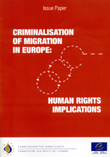
“‘Criminalising the irregular entry and presence of migrants in Europe corrodes established international law principles and causes many human tragedies without achieving its purpose of genuine control’ said Thomas Hammarberg, the Council of Europe Commissioner for Human Rights, presenting today in Brussels an Issue Paper on this topic.

‘I have observed with increasing concern this trend as part of a policy of migration management’ he said. ‘States have a legitimate interest to control their borders, but criminalisation is a disproportionate measure which causes further stigmatisation and marginalisation of migrants. Immigration offences should remain administrative in nature.’

This Issue Paper builds upon these concerns and examines systematically the human rights implications of the criminalisation of migration in Europe. It analyses the external border crossing, migrants’ residence and protection of their social rights including employment, as well as asylum and detention.

It concludes with a number of recommendations to Council of Europe member states, as a starting point to ensure the correct intersection of human rights standards and the treatment of foreign nationals.

Issue Papers are commissioned and published by the Commissioner for Human Rights for the purpose of contributing to debate or further reflection on a current and important human rights matter. The full text is available on the Commissioner’s web-site.”

Click here for Issue Paper.

Leave a comment

Filed under Council of Europe, Reports, Statements