Tag Archives: UNHCR

Update Regarding Migrant Boat Sinking Off Tunisian Coast

Tunisian authorities continue to recover the bodies of victims from the migrant boat that capsized off the coast of the Kerkennah islands  last week.  TAP reported that 26 additional bodies were recovered on Sunday, 5 June.  Poor weather conditions on Sunday made recovery operations difficult.  According to TAP, 577 persons were rescued from the boat and 200 to 270 persons are believed to have drowned.  There are conflicting media reports regarding the numbers of confirmed deaths.  Some reports indicate that at least 150 bodies have been recovered in addition to the 26 bodies reportedly recovered on 5 June.

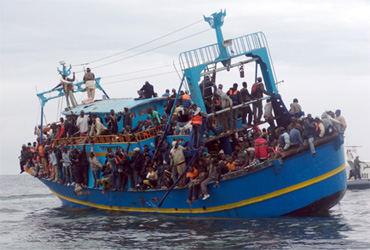
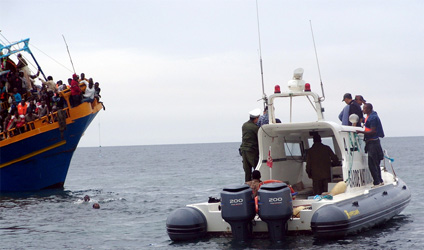
The boat, named The Wave, ran around last week, probably on Wednesday, 1 June.  The boat did not capsize until after rescue boats had arrived on the scene.   Tunisian coast guard and local fishing boats were involved in the rescue efforts.  The rescue boats did not have the capacity to rescue all of the migrants from the stranded migrant boat and some people jumped into the water and others moved to one side of the migrant boat causing it to capsize.  Media pictures show the vessel in an upright position with some rescue boats already on scene.  A France24 video report contains cell phone video shot immediately after the boat capsized.  (See pictures below.)

UNHCR and IOM staff have conducted interviews with some of the survivors.  According to UNHCR, the boat left Tripoli on 28 May with up to 850 people on board.  The passengers were primarily from West Africa, Pakistan, and Bangladesh. The crew was recruited on an ad hoc basis and had little or no maritime experience. The France24 video report states that survivors said Libyan military assisted them in leaving Libya.  The boat became lost after leaving Tripoli and on Wednesday, 1 June, it ran around near the Kerkennah islands.  UNHCR spokesman Adrian Edwards said that the boat “capsized as desperate passengers rushed to one side, seeking rescue by the Tunisian coast guard and fishing boats that had approached the vessel. Many fell into the water.”  IOM staff reported that at least one survivor said that during the boat’s voyage some people were thrown overboard alive.  The boat reportedly had run out of food and water.

Click here for a France24 video news report (EN) with cell phone video shot immediately after the migrant boat capsized.

Click here and here for UNHCR reports on the incident.

Click here for IOM Press Briefing Note.

Click here, here, here, and here for Tunisian articles. (FR)

Click here, here, and here for articles.  (EN)

Photo Agence Tunis Afrique Presse 04 juin 2011

La Garde maritime à Sfax au secours du chalutier libyen bloqué au large de Kerkennah (Photo AFP)

France24 03 June 2011 - Screen shot

France24 03 June 2011 - Screen Shot


1 Comment

Filed under Data / Stats, European Union, Italy, Libya, Mediterranean, News, Tunisia, UNHCR

Some Refugees Who Fled Libya Return in Effort to Board Boats to Europe

Last week, UNHCR reported that hundreds of people who recently fled Libya to Tunisia and Egypt are returning to Libya in an effort to board boats for Europe.  “Among them are refugees, including members of the Somali, Ethiopian and Eritrean communities in the camps at Choucha near Tunisia’s border with Libya.”  UNHCR is warning of the dangers of trying to reach Europe by sea and of returning to Libya.  “UNHCR has met with refugees in Tripoli who are planning to make the perilous sea journey. ‘They are all aware of the high death toll, but they told us that they feel they have nothing to lose. One Eritrean man told us he would rather die trying to reach safety than continue to live in danger,’ [UNHCR’s chief spokesperson, Melissa] Fleming said.”  “Fleming [also] said that UNHCR had learnt with sadness ‘that people on track for resettlement, following interviews last year in Libya, lost their lives while trying to reach Europe recently. People in the middle of the resettlement process and vulnerable cases are prioritized in our interview schedule.’”

Click here for UNHCR statement.

Leave a comment

Filed under Egypt, European Union, Italy, Libya, Mediterranean, News, Tunisia, UNHCR

Maltese JHA Minister: Migrant Boats Have Rights of Passage and Rescue Not Always Needed

Maltese Justice and Home Affairs Minister Carm Mifsud Bonnici is quoted by AP as saying that migrant boats leaving Libya “have the right of passage and nobody can stop them, not even our forces or a NATO ship.  As long as [the boats] are not in distress, then [there] is no issue.”

While Mifsud Bonnici’s observation about the right of passage in international waters is technically correct, given that all or virtually all of the migrant boats that have left Libya in recent weeks have been severely overloaded, all migrant boats leaving North Africa under the current situation should be considered to be in distress and in need of rescue.  Migrant boats departing from Libya with few exceptions must pass through the Maltese Search and Rescue Area and Malta should not avoid its rescue at sea obligations under international law by claiming that it is respecting a vessel’s right of passage.  The UNHCR has called upon “states, commercial shipping companies and others present in the Mediterranean to consider that all boats leaving Libya for Europe are likely to require assistance.”

Click here or here for AP article.

Click here for UNHCR statement.

Leave a comment

Filed under Libya, Malta, Mediterranean, News, UNHCR

Follow-Up Report and Analysis Regarding Failure to Rescue Disabled Migrant Boat Resulting in 61 Deaths

UNHCR today released more information from three Ethiopian survivors of the migrant boat that left Tripoli on 25 March with 72 passengers and which, after becoming disabled and running out of food and water, washed ashore in Libya over two weeks later with only nine survivors.

Additionally, the Bruxelles2 blog in a recent post, “Un navire de réfugiés non secouru ? Retour sur un drame non élucidé,” has provided detailed analysis regarding the possible identities of the helicopter and warships that failed to render assistance to the migrant boat after it had become disabled.  (See more on this below.)

From UNHCR’s statement:

“[One surviving] refugee said that military vessels twice passed their boat without stopping, and that a military helicopter dropped food and water onto the boat at some point during the journey. The first boat refused their request to board. The second only took photos, he said. The man was not able to identify where the vessels came from.

UNHCR staff met with the three in Shousha camp in Tunisia. One spoke Arabic, while the others spoke Oromo. UNHCR interviewed the Arabic speaker. He said that they paid smugglers US$800 to make the journey. The passengers were expected to operate the boat on their own.

According to the refugee, when water ran out people drank sea water and their own urine. They ate toothpaste. One by one people started to die. He said that they waited for a day or two before dropping the bodies into the sea. There were 20 women and two small children on board. A woman with a two-year-old boy died three days before he died. The refugee described the anguish of the boy after his mother’s death.

After arrival on a beach near Zliten, between Tripoli and the Tunisian border, a woman died on the beach from exhaustion. The remaining 10 men walked to the town of Zliten where they were arrested by the Libyan police. They were taken to a hospital and then to a prison where they were given some water, milk and dates. After two days another survivor died.

After begging jail staff to take the remaining survivors back to hospital, they were taken to a hospital in al-Khums city. Doctors and nurses were said to have given the group water and told them to leave. They were returned to the prison and then taken to Twesha jail near Tripoli. Finally Ethiopian friends in Tripoli paid the prison US$900 to release the men. UNHCR is now providing them with assistance in Tunisia.”

Bruxelles2 notes that the survivors’ reports that the helicopter that dropped supplies had an “Army” marking on it would tend to suggest that the helicopter did not belong to France (“Marine”), Italy (“Marina”), the U.S. Navy (“Navy”), or the Royal Navy (“UK Navy”).  Bruxelles2 believes it is plausible that an “army” helicopter belonging to the US or UK could have been operating in the area, but US Army helicopters tend to be marked “United States.”  According to Bruxelles2 some British army helicopters do carry the “Army” marking.  (One other possibility I would note is that the survivors could simply be mistaken about the marking – they recall clearly that a military helicopter hovered over them and dropped supplies, but incorrectly remember, misread, or assumed that the marking on the side of the helicopter said “Army”.)

Bruxelles2 also suggests that there are other warships that might appear to be an aircraft carrier, especially when viewed from a small migrant boat.  Bruxelles2 points in particular to “the USS Kearsarge (LHD3), [an] amphibious ship [that] regularly hosts (and welcomed during the operations – which the U.S. Navy confirms) AV-8B Harrier vertical takeoff [aircraft].”

Bruxelles2 also notes that the time period when the migrant boat was disabled and drifting was a period when there was a shifting of commands for the multiple European and US naval and air forces operating off Libya.  NATO took command of the maritime embargo on 23 March; the no fly zone and the air attacks were initially under the control of an ad hoc coalition (France, UK, USA, Canada, Belgium, Denmark); full command did not shift to NATO until 31 March and even then it took several days for the transfers of command to occur; and some military vessels continued (and continue to this day) to operate under independent national command.

In short, NATO may be fully correct when it says that a vessel under its command during the time period in question did not encounter the disabled migrant boat.  Further investigation into responsibility is needed.

Click here for UNHCR statement.

Click here for Bruxelles2 post. (FR)

Leave a comment

Filed under Analysis, France, Italy, Libya, Mediterranean, News, UK, United States

10+ Countries Agree to Accept 300+ Asylum Seekers from Malta

After the Pledging Conference on Relocation and Resettlement which was held by Commissioner Malmström in the margins of yesterday’s JHA Council meeting, it has been announced that at least ten EU member states (news reports have identified different countries – Germany, Romania, Spain, the Netherlands, Switzerland, Poland, Portugal, Bulgaria, Hungary, Denmark, Slovakia, and Luxembourg have been mentioned) as well several non-EU MS (news reports have mentioned Lichtenstein, Switzerland, and Norway), have agreed to resettle 323 asylum seekers who are currently in Malta.  Germany will reportedly resettle 100 migrants.  Most of the other resettlement pledges are for small token numbers.  There are over 2500 asylum seekers, beneficiaries of international protection, and migrants currently in Malta.

The Commission will provide funding for the extension of the pilot project of relocation from Malta, as well as for resettlement directly from North Africa, undertaken on a voluntary basis by MS.  Funding for the project has previously been provided through the European Refugee Fund.  The pledging conference that was held yesterday was reportedly the first such conference held since the Maltese pilot project known as European Relocation Malta (Eurema) began in July 2009.  The project was scheduled to end this year but has been extended for at least one more year given the current situation in Libya.

Click here, here, and here for articles.

1 Comment

Filed under European Union, Germany, Libya, Malta, Mediterranean, News

Guardian: Libya Official Admits Migrant Ships Being Allowed to Sail as Protest Against Nato

From today’s Guardian:  “The Libyan regime of Colonel Muammar Gaddafi is allowing thousands of sub-Saharan African migrants on to overcrowded, unseaworthy ships in an apparently calculated attempt to use migration as a weapon to pressure Nato and the EU countries backing Libya‘s rebels. [***] Officials said they were doing nothing to encourage the journeys to Italy, but could see no reason to stop them, because doing so would serve the interests of Nato member states bombing Libya.

‘We say to Europe that we can no longer do what we used to do,’ said the prime minister, al-Baghdadi Ali al-Mahmoudi. ‘And that’s because Nato has ruined our coastal defences.’ [***] [S]urvivors told the [UNHCR] that some ships were leaving Tripoli only for their captain to disembark once they were at sea and take a pilot boat back to shore.  ‘They [the migrants] are told, “here’s the compass, you go that way”,’ [UNHCR spokesperson Melissa] Fleming said. [***]”

Click here for Guardian article.

1 Comment

Filed under Libya, Mediterranean, News, UNHCR

Libya: Because of NATO Aggression, We Cannot Be Guards of Europe

From an AP story about the sinking of the migrant boat that left Tripoli last week, killing hundreds of persons:

“… International agencies say some recent migrants report being forced onto dangerously packed ships at gunpoint by Libyan soldiers. A spokesman for Moammar Gadhafi suggested that increased illegal immigration was the price European nations would pay for their military and political support of the rebels trying to topple Libya’s strongman. ‘Because of the NATO aggression against our country and because our coastal border guard is being hit daily … we are unable to deal with this situation and that is why Europe is being flooded with illegal immigration,’ government spokesman Moussa Ibrahim said. ‘We cannot be the guards of Europe at this moment.’…

The U.N. said migrants’ boats started leaving Libya for Europe again on March 25, the day NATO took over military operations. About 14,800 since have made the gruelling journey across the Mediterranean in rickety ships run by smugglers who rarely provide enough food and water. At least 800 people had been lost at sea in three boat sinkings before the latest ship went down with 600 aboard off Tripoli on Friday, the U.N. said.  Five boats carrying 2,400 people have arrived in recent days on the Italian island of Lampedusa, the closest European point to Libya. Every one of those boats needed to be rescued by the Italian coast guard and police, the U.N. said.

‘We know that the people running the boats are smugglers. But obviously you cannot have over 2,000 people leaving in a few short days without the government knowing and allowing it,’ U.N. refugee agency spokeswoman Sybella Wilkes said. ‘That port of Tripoli is under government control.’…”

Click here for full text of article.

1 Comment

Filed under European Union, Italy, Libya, Mediterranean, News, UNHCR

500 Migrants Rescued Off Lampedusa; Hundreds Likely Dead Off Libya

A boat from Libya carrying over 500 people from sub-Sahara Africa and Asia ran around off Lampedusa on Sunday. Italian rescuers saved everyone on board.  The survivors had to be brought ashore by rescuers in the water because rescue boats were unable to approach due to the shoals on which the migrant boat ran around.

In a separate incident, early Friday morning, 6 May, a migrant boat believed to be carrying over 600 people capsized or broke apart off the Libyan coast.  It is feared that most of the passengers have died.

Click here, here, and here for articles about the Lampedusa rescue. (EN)

Click here (EN) and here (IT) for article about the sinking off Libya.

Leave a comment

Filed under Italy, Libya, Mediterranean, News, UNHCR

Report: Military Ships Failed to Rescue or Render Aid and 61 Died at Sea

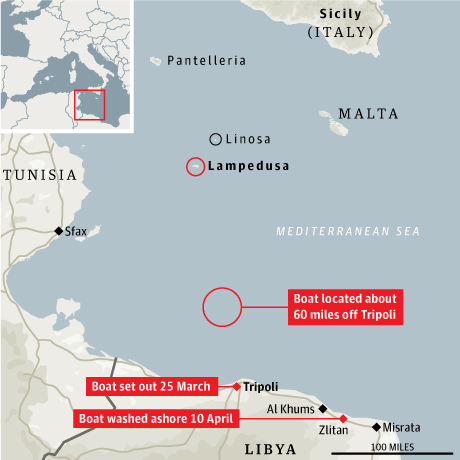
The Guardian on Sunday reported many more details about an incident that began on 25 March when a migrant boat left Libya carrying 72 asylum seekers and which ended 16 days later on 10 April when the disabled vessel washed ashore in Libya with only 11 survivors.  The survivors have described several incidents where military ships and planes ignored their pleas for rescue.  It is clear from the survivors’ descriptions that their disabled vessel was sighted because at one point a military helicopter dropped bottles of water and emergency food rations on the migrant boat.

The UNHCR and Father Mussie Zerai, an Eritrean priest in Rome who runs the refugee rights organisation Habeshia, have called for further investigations into why the boat’s passengers were not rescued.

From the Guardian article: “The Guardian’s investigation into the case of the boat of 72 migrants which set sail from Tripoli on 25 March established that it carried 47 Ethiopians, seven Nigerians, seven Eritreans, six Ghanaians and five Sudanese migrants. Twenty were women and two were small children, one of whom was just one year old. The boat’s Ghanaian captain was aiming for the Italian island of Lampedusa, 180 miles north-west of the Libyan capital, but after 18 hours at sea the small vessel began running into trouble and losing fuel.  Using witness testimony from survivors and other individuals who were in contact with the passengers during its doomed voyage, the Guardian has pieced together what happened next. The account paints a harrowing picture of a group of desperate migrants condemned to death by a combination of bad luck, bureaucracy and the apparent indifference of European military forces who had the opportunity to attempt a rescue….

The Guardian has made extensive inquiries to ascertain the identity of the Nato aircraft carrier, and has concluded that it is likely to have been the French ship Charles de Gaulle, which was operating in the Mediterranean on those dates.  French naval authorities initially denied the carrier was in the region at that time. After being shown news reports which indicated this was untrue, a spokesperson declined to comment.

A spokesman for Nato, which is co-ordinating military action in Libya, said it had not logged any distress signals from the boat and had no records of the incident. ‘Nato units are fully aware of their responsibilities with regard to the international maritime law regarding safety of life at sea,’ said an official. ‘Nato ships will answer all distress calls at sea and always provide help when necessary. Saving lives is a priority for any Nato ships.’”

Click here for full Guardian article.

Click here (IT) for earlier article.

The route of the boat - from guardian.co.uk

2 Comments

Filed under France, Italy, Libya, Malta, Mediterranean, News, UNHCR

ECJ Rules Italy May Not Criminally Punish Illegally Staying Migrants Who Fail to Depart

The First Chamber of the European Court of Justice issued a decision on 28 April ruling that the Italian law which punishes migrants who remain in Italy after being ordered to depart is precluded by EU Directive 2008/115 which established the procedure by which Member States may return illegally staying third country nationals.  The ruling was made in the case of Hassen El Dridi alias Soufi Karim, Case C‑61/11 PPU, 28 April 2011.

The Italian law in question was enacted in 2009 as part of a “security package” (“pacchetto sicurezza”) of immigration laws and punishes the act of illegally staying in Italy after being ordered to depart with 1 to 4 years imprisonment.  Italy has never transposed Directive 2008/115.  The deadline for doing so was 24 December 2010.

The Court’s ruling was as follows:

“Directive 2008/115/EC of the European Parliament and of the Council of 16 December 2008 on common standards and procedures in Member States for returning illegally staying third-country nationals, in particular Articles 15 and 16 thereof, must be interpreted as precluding a Member State’s legislation, such as that at issue in the main proceedings, which provides for a sentence of imprisonment to be imposed on an illegally staying third-country national on the sole ground that he remains, without valid grounds, on the territory of that State, contrary to an order to leave that territory within a given period.”

The Court suggested that penalties might be imposed by a Member State after the procedures required by the Directive had been exhausted: “[This] does not preclude the possibility for the Member States to adopt, with respect for the principles and objective of Directive 2008/115, provisions regulating the situation in which coercive measures have not resulted in the removal of a third-country national staying illegally on their territory.” Para. 60.

Interior Minister Roberto Maroni criticised the decision saying that it risks making expulsions difficult or impossible.  UNHCR spokeswoman Laura Boldrini said that the ECJ decision was consistent and in harmony with what has already been expressed by the Italian courts, specifically the Constitutional Court and the Supreme Court, and expressed the hope that the EU Directive would soon be implemented.

Click here for ECJ Decision.

Click here for ECJ Press Release.

Click here (EN), here (EN), here (IT), and here (IT) for articles.

The ECJ Press Release provides a summary of the ruling; here are some excerpts from the ruling:

[Facts and Procedural Background]

“[***]

18      Mr El Dridi is a third-country national who entered Italy illegally and does not hold a residence permit. A deportation decree was issued against him by the Prefect of Turin on 8 May 2004.

19      An order requiring his removal from the national territory, issued on 21 May 2010 by the Questore di Udine pursuant to that deportation decree, was notified to him on the same day….

20      A check carried out on 29 September 2010 revealed that Mr El Dridi had not complied with that removal order.

21      Mr El Dridi was sentenced at the conclusion of an expedited procedure by a single judge of the Tribunale di Trento (District Court, Trento) to one year’s imprisonment for the offence set out in Article 14(5b) of Legislative Decree No 286/1998.

22      He appealed against that decision before the Corte d’appello di Trento (Appeal Court, Trento).

[Referral of Questions to Court of Justice]

23      That [appeal] court is in doubt as to whether a criminal penalty may be imposed during administrative procedures concerning the return of a foreign national to his country of origin due to non-compliance with the stages of those procedures, since such a penalty seems contrary to the principle of sincere cooperation, to the need for attainment of the objectives of Directive 2008/115 and for ensuring the effectiveness thereof, and also to the principle that the penalty must be proportionate, appropriate and reasonable.

[***]

25      In those circumstances, the Corte d’appello di Trento … refer[ed] the following question to the Court of Justice for a preliminary ruling:

‘In the light of the principle of sincere cooperation, the purpose of which is to ensure the attainment of the objectives of the directive, and the principle that the penalty must be proportionate, appropriate and reasonable, do Articles 15 and 16 of Directive 2008/115… preclude:

—      the possibility that criminal penalties may be imposed in respect of a breach of an intermediate stage in the administrative return procedure, before that procedure is completed, by having recourse to the most severe administrative measure of constraint which remains available?

—      the possibility of a sentence of up to four years’ imprisonment being imposed in respect of a simple failure to cooperate in the deportation procedure on the part of the person concerned, in particular where the first removal order issued by the administrative authorities has not been complied with?’

[***]

[ECJ’s Rationale]

58      … the Member States may not, in order to remedy the failure of coercive measures adopted in order to carry out forced removal pursuant to Article 8(4) of [Directive 2008/115], provide for a custodial sentence, such as that provided for by Article 14(5b) of Legislative Decree No 286/1998, on the sole ground that a third-country national continues to stay illegally on the territory of a Member State after an order to leave the national territory was notified to him and the period granted in that order has expired; rather, they must pursue their efforts to enforce the return decision, which continues to produce its effects.

59      Such a penalty, due inter alia to its conditions and methods of application, risks jeopardising the attainment of the objective pursued by that directive, namely, the establishment of an effective policy of removal and repatriation of illegally staying third-country nationals. In particular, as observed by the Advocate General in point 42 of his View, national legislation such as that at issue in the main proceedings is liable to frustrate the application of the measures referred to in Article 8(1) of Directive 2008/115 and delay the enforcement of the return decision.

60      That does not preclude the possibility for the Member States to adopt, with respect for the principles and objective of Directive 2008/115, provisions regulating the situation in which coercive measures have not resulted in the removal of a third-country national staying illegally on their territory.

61      In the light of the foregoing, it will be for the national court, which is called upon, within the exercise of its jurisdiction, to apply and give full effect to provisions of European Union law, to refuse to apply any provision of Legislative Decree No 286/1998 which is contrary to the result of Directive 2008/115, including Article 14(5b) of that legislative decree (see, to that effect, Case 106/77 Simmenthal [1978] ECR 629, paragraph 24; Case C-462/99 Connect Austria [2003] ECR I-5197, paragraphs 38 and 40; and Joined Cases C‑188/10 and C‑189/10 Melki and Abdeli [2010] ECR I-0000, paragraph 43). In so doing, the referring court will have to take due account of the principle of the retroactive application of the more lenient penalty, which forms part of the constitutional traditions common to the Member States (Joined Cases C‑387/02, C‑391/02 and C‑403/02 Berlusconi and Others [2005] ECR I‑3565, paragraphs 67 to 69, and Case C‑420/06 Jager [2008] ECR I‑1315, paragraph 59).

62      Consequently, the answer to the question referred is that Directive 2008/115, in particular Articles 15 and 16 thereof, must be interpreted as precluding a Member State’s legislation, such as that at issue in the main proceedings, which provides for a sentence of imprisonment to be imposed on an illegally staying third-country national on the sole ground that he remains, without valid grounds, on the territory of that State, contrary to an order to leave that territory within a given period.

[***]

On those grounds, the Court (First Chamber) hereby rules:

Directive 2008/115/EC of the European Parliament and of the Council of 16 December 2008 on common standards and procedures in Member States for returning illegally staying third-country nationals, in particular Articles 15 and 16 thereof, must be interpreted as precluding a Member State’s legislation, such as that at issue in the main proceedings, which provides for a sentence of imprisonment to be imposed on an illegally staying third-country national on the sole ground that he remains, without valid grounds, on the territory of that State, contrary to an order to leave that territory within a given period.

2 Comments

Filed under Algeria, European Union, Italy, Judicial, News, UNHCR

COE Parliamentary Assembly Adopts Resolution Regarding North African Migrants & Asylum Seekers

Earlier today PACE approved a resolution based on a report by Tineke Strik (Netherlands, SOC) addressing the large influx of migrants and asylum seekers on Europe’s southern borders.  From the PACE press statement: the Assembly “welcomed the efforts so far of the ‘frontline states’ to provide humanitarian assistance in line with their international obligations, and urged other European countries to ‘show solidarity’ with them, including by agreeing to resettle refugees and other persons with international protection needs. Malta was in a ‘particularly difficult situation’ given its small size, high population and limited resources… If the current wave of arrivals in Europe increases because of an even greater exodus of persons from Libya, in particular Libyans fleeing terror from Colonel Gaddafi’s regime or an entrenched civil war, the EU should consider applying its temporary protection directive….”

Excerpts from PACE Resolution 1805 (2011):

The large-scale arrival of irregular migrants, asylum seekers and refugees on Europe’s southern shores

“[***]

6.       The Parliamentary Assembly recognises that one of the first priorities is to deal with the humanitarian and international protection needs of those who have arrived on Europe’s shores, primarily in Italy and Malta. Member states, the European Union, international organisations, civil society and others all have a contribution to make and need to show solidarity with the front-line states. This solidarity and willingness to share responsibility needs to extend to the coast of North Africa and the many thousands of refugees and displaced persons still seeking ways to return home after fleeing from Libya. It should also extend to those migrants and refugees who are trapped in Libya awaiting the chance to flee.

7.       The Assembly notes that while there has been a wave of arrivals, there has not yet been the feared total deluge. This distinction is important because it has not always been clearly made by politicians, the media and others, leading to heightened fear and misunderstanding among the general public and calls for exaggerated responses.

8.       The Assembly recognises the pressure that the front-line countries of the Council of Europe are under, and welcomes their efforts to provide humanitarian assistance in line with international obligations and encourages them to continue with these efforts. The Assembly reminds states of their international obligations not to push back boats which are carrying persons with international protection needs.

[***]

12.       The Assembly, recognising that events in North Africa are of concern to all member states of the Council of Europe, therefore calls on member states to:

12.1.        acknowledge that the arrival of a large number of irregular immigrants on the southern shores of Europe is the responsibility of all European states and requires a solution which envisages the need to share this responsibility collectively. The Assembly reminds member states of the repeated appeals of the Council of Europe Commissioner for Human Rights for the need for effective responsibility sharing;

12.2.       provide urgent humanitarian aid and assistance to all those persons arriving on Europe’s southern shores and other borders, including through the provision of adequate accommodation, shelter and health care, as highlighted previously in Assembly Resolution 1637 (2008) on Europe’s boat people: mixed migration flows by sea into southern Europe;

12.3.       refrain from automatic detention and have recourse to detention only where there is no other reasonable alternative, ensuring that conditions comply with minimum human rights standards as outlined in Assembly Resolution 1707 (2010) on detention of asylum seekers and irregular migrants in Europe;

12.4.       ensure that vulnerable persons, including women and children, victims of torture, victims of trafficking, and the elderly, are not detained and receive appropriate care and assistance;

12.5.       guarantee the right of asylum and non-refoulement through, inter alia:

12.5.1.       ensuring that states give access to their territory to persons in need of international protection;

12.5.2.       assuring the quality and consistency of asylum decisions in line with Assembly Resolution 1695 (2009) on improving the quality and consistency of asylum decisions in the Council of Europe member states;

12.6.       ensure that, in screening arrivals and carrying out asylum determinations, these are carried out without delay, but that speed is not given preference over fairness;

12.7.       provide full support to the Office of the United Nations High Commissioner for Refugees (UNHCR), International Organisation for Migration (IOM), International Committee of the Red Cross (ICRC) and other international and national organisations providing humanitarian and other assistance, both in North Africa and in the European countries of arrival, and generously take part in resettlement programmes for refugees stranded in North African countries;

12.8.       show solidarity in the challenges faced, which includes sharing responsibility with front-line states, including by:

12.8.1.       giving further support to the European Agency for the Management of Operational Cooperation at the External Borders of the Member States of the European Union (Frontex) and the newly established European Asylum Agency (EASO), and encouraging further use of European Union funding available through the External Borders Fund, the Return Fund, the European Refugee Fund and the Integration Fund;

12.8.2.       looking into the possibility of taking on commitments for resettlement of those with international protection needs from the European countries of arrival and on suspending the application of the Dublin Regulations or on considering other forms of responsibility sharing, through the use of existing mechanisms provided for in the Dublin Regulation, including the solidarity clause in Article 3(2) and the humanitarian clause in Article 15;

12.8.3.       working together, including with the European Union, on the issue of voluntary and forced returns, taking into account necessary human rights safeguards when relying on readmission agreements in line with Assembly Resolution 1741 (2010) on readmission agreements: a mechanism for returning irregular migrants;

12.8.4.        acknowledging the particularly difficult situation in which Malta finds itself, in view of the size of its territory, its high population density and limited human and material resources, and committing to the resettlement of those with international protection needs.

[***]

14.       If a mass exodus of Libyan refugees occurs because of increasing terror by Colonel Gaddafi or the emergence of a civil war, the Assembly encourages the European Union member states to consider applying the temporary protection directive (Council Directive 2001/55/EC of 20 July 2001 on minimum standards for giving temporary protection in the event of a mass influx of displaced persons and on measures promoting a balance of efforts between Member States in receiving such persons and bearing the consequences thereof). It is important, however, to ensure that no states are considering returning Libyans at this stage and that at least a form of temporary protection is provided in practice.

[***]”

Click here for Resolution. (Resolution 1805 (2011))

Click here for Recommendation. (REC 1967 (2011))

Click here for PACE press statement.

Click here for Report, Committee on Migration, Refugees and Population, Rapporteur: Ms Tineke STRIK, (Doc. 12581, 13 April 2011).


Leave a comment

Filed under Commissioner for Human Rights, Council of Europe, European Committee for the Prevention of Torture and Inhuman or Degrading Treatment or Punishment, European Union, Italy, Libya, Malta, Mediterranean, News, Tunisia, UNHCR

Statement: European Commission’s response to the migratory flows from North Africa

The European Commission released a statement on 8 April summarising its actions.  Excerpts:

“[***]

Measures addressing the migration flows towards the European Union

Urgent measures already undertaken

The massive displacement of populations from several North African countries has been putting the protection and reception systems of some of the EU Member States, in particular in Italy and Malta, under increasing strain. The European Union has responded to these serious challenges in a rapid and effective manner with the aim of stabilizing the situation.

Frontex has deployed the Joint Operation EPN Hermes Extension 2011 to assist the Italian authorities in managing the influx of migrants from North Africa, most of whom have been arriving on the island of Lampedusa. This mission was launched on 20 February 2011, only four days after receiving the official request from the Italian authorities, a clear signal of solidarity between Member States. FRONTEX stands ready to continue the mission as long as it will be necessary, and to expand it, provided that Member States will make available the necessary staff, vessels and equipment. In view of the above the Commission is launching the necessary procedures for reinforcing the FRONTEX 2011 budget with an additional EUR 30 million.

Europol has also deployed a team of experts to Italy in order to help the national authorities to assist in detecting and preventing possible criminal of trafficking of human beings.

Regarding the financial needs linked with the displacement, the Commission’s four migration-related funds (the External Borders Fund, Return Fund, Refugee Fund and Integration Fund) are available to Member States. For example, Italy, one of the major beneficiaries of these funds, has been allocated €55 million for 2010 and €75 million for 2011. Moreover, the Commission makes available an additional €25 million of emergency funding which can be quickly mobilised under the External Borders Funds and European Refugee Fund.

What measures could be undertaken in the short-term?

Should the inflow of irregular migrants and possible refugees continue, the Commission envisages a number of short-term measures that might be taken.

Reinforcing Frontex

  • 1) The Joint Operation EPN HERMES Extension coordinated by FRONTEX could be considerably strengthened, with additional technical resources made available by Member States, and adequate financial resources.
  • 2) It is essential that FRONTEX is finally given a stronger operational mandate through a revision of its legal basis, which the Commission tabled in February 2010 (IP/10/184)
  • 3) FRONTEX should speed up negotiations to conclude working arrangements with the countries of origin and transit of irregular migration in the Mediterranean in the region (for example, with Egypt, Morocco and Turkey), and receive a mandate to negotiate similar working arrangements with other relevant countries (for instance Tunisia)

Resettlement of third country nationals

The continuous and possible increase in the flow of refugees (e.g. Somalis, Eritreans etc.), in need of international protection, coming from Libyan territory is an issue of major concern. The EU will not only continue to provide humanitarian assistance through its humanitarian office (ECHO), but it is also ready to offer through the European Refugee Fund financial support in view of facilitating the resettlement of persons in need of international protection. Resettlement represents not only a life-saving measure for the refugees concerned, but is also an important responsibility-sharing gesture towards the countries hosting them. Showing solidarity with the countries neighbouring Libya that are under pressure through resettlement can help to maintain ‘protection space’, as well as contributing to dialogue and cooperation on other issues of migration and border management.

The Commission has therefore been encouraging EU Member States to offer resettlement places, in a spirit of responsibility-sharing and in close cooperation with the United Nations High Commissioner for Refugees (UNHCR). A meeting was held with Member States on 25 March at which details of the most urgent needs were explained by the UNHCR and the International Organisation for Migration (IOM), both of whom are actively engaged on the ground in the region.

The current crisis in the Mediterranean clearly demonstrates how imperative it is that the Council and the European Parliament make an effort to rapidly reach an agreement on the adoption of the Commission’s proposal for the establishment of an EU joint resettlement programme. This proposal would provide a structured basis for annual priority-setting, and linking those priorities with financial incentives, thereby encouraging more Member States to become involved in resettlement activities, and enhancing practical cooperation between Member States to that end.

Solidarity / Temporary Protection Directive

In the event of a massive inflow of persons who are likely to be in need of international protection, the Commission would expect Member States to demonstrate concrete solidarity with each other by directly assisting the States bearing the greatest burden. This could involve the relocation to other Member States of some persons seeking protection, or who have already received an international protection status.

Concrete assistance could likewise be provided by the newly-created European Asylum Support Office, one of whose central tasks is coordination of assistance to Member States whose asylum systems are under exceptional pressure. This could involve the deployment of so-called ‘asylum support teams’ to reinforce the capacities of a State to process asylum claims and to ensure appropriate reception conditions for asylum seekers.

The Commission would also be ready to consider proposing the use of the mechanism foreseen under the 2001 Temporary Protection Directive (2001/55/EC), if the conditions foreseen in the directive are met. Consideration could only be given to taking this step if it is clear that the persons concerned are likely to be in need of international protection, if they cannot be safely returned to their countries-of-origin, and if the numbers of persons arriving who are in need of protection are sufficiently great. Resort to this mechanism would allow for the immediate protection and reception in the territory of EU Member States for persons concerned, as well as offering a “breathing space” for the national asylum systems of the Member States most directly affected.

[***]”

Click here for full Statement.

1 Comment

Filed under European Union, Frontex, Italy, Libya, Malta, Mediterranean, News, Statements, Tunisia

UNHCR Calls on EU to Improve Rescue at Sea Measures; NATO Should Also Actively Participate in Rescue at Sea in Regard to All Overcrowded Boats

UNHCR issued a statement on Friday, 8 April, calling “on the European Union to urgently put into place more reliable and effective mechanisms for rescue-at-sea” in the aftermath of last week’s disaster that saw “[m]ore than 220 Somali, Eritrean and Ivorian refugees drowned early on Wednesday morning when their boat capsized some 39 nautical miles south of the Italian island of Lampedusa. This is the worst such incident in the Mediterranean in recent years.  ‘It is hard to comprehend that at a time when tens of thousands are fleeing the Libyan conflict and pouring across the land borders into Tunisia and Egypt where they enjoy safety and receive shelter and aid, the protection of people fleeing via Libya’s maritime border does not appear to have the same priority’ said Assistant High Commissioner for Protection Erika Feller.” “‘We also appeal to shipmasters to continue to render assistance to those in distress at sea. Any overcrowded boat leaving Libya these days should be considered to be in distress’ [, said Feller.]”

While NATO was not mentioned in the UNHCR statement, the call for improved measures to save the lives of migrants who flee North Africa by boat should also be heard and considered by the NATO Maritime Command Naples which is conducting the maritime embargo of Libya known as Operation Unified Protector.   NATO has a significant naval force patrolling the area through which migrant boats leaving Libya are passing and this force should be actively engaged in protecting fleeing civilians.  (Click here for earlier post regarding NATO’s maritime embargo.)

While UN Security Council Resolution 1973 does not speak directly to this issue, it does call for the protection of civilians.  Relevant portions from Security Council Resolution 1973:

  • “Expressing [the Security Council’s] determination to ensure the protection of civilians and civilian populated areas and the rapid and unimpeded passage of humanitarian assistance and the safety of humanitarian personnel, [***];
  • Reiterating [the Security Council’s] concern at the plight of refugees and foreign workers forced to flee the violence in the Libyan Arab Jamahiriya, welcoming the response of neighbouring States, in particular Tunisia and Egypt, to address the needs of those refugees and foreign workers, and calling on the international community to support those efforts, [***];
  • Protection of civilians – 4. Authorizes Member States that have notified the Secretary-General, acting nationally or through regional organizations or arrangements, and acting in cooperation with the Secretary-General, to take all necessary measures, notwithstanding paragraph 9 of resolution 1970 (2011), to protect civilians and civilian populated areas under threat of attack in the Libyan Arab Jamahiriya,… [***].”

As with UNHCR’s call to EU states, NATO ships should also render assistance to any migrant boat detected by NATO forces – any overcrowded boat leaving Libya should be considered to be in distress.

Click here for UNHCR statement.

Click here for article.

Leave a comment

Filed under European Union, Italy, Libya, Malta, Mediterranean, News, UNHCR

Libyan Migrant Boats Carrying Over 400 People Missing; Reports of Deaths

There have been reports in recent days from the UNHCR and others about at least two boats that are believed to have left Libya over the past 10-14 days carrying persons from Eritrea, Ethiopia, Somalia, and possible other countries.  Family members and friends of people who are believed to be on the boats have been calling for assistance in searching for the boats.  Reuters reported that “[o]ne of the boats was reported to have left Libya on March 22 with 335 people on board.  Italian media said 68 people on the other boat had almost certainly died during the journey, although there was no official confirmation. The top Vatican official in Tripoli, Bishop Giovanni Innocenzo Martinelli, said 10 bodies of African migrants were at the capital’s morgue on [4 April]. … He said there were reports of ‘many more bodies’ of migrants washed up on the shores of Garaboulli, some 40 km from Tripoli.”  Father Mussie Zerai, who is based in Rome, “said he had last spoken to migrants on board the smaller boat, an inflatable, by satellite phone on 26 March before the line went dead.  ‘I have meanwhile had no contact with the larger boat, but family members of those on board have called us from Canada, Sweden and Switzerland to tell us they left.’”

Click here and here for articles. (EN)

There have been confirmed deaths among migrants who have left Tunisia in recent weeks.  At least 27 bodies had been recovered as of last week in Kerkennah.  The dead were probably on board boats that sank on the 13th and 27th of March off the Tunisian coast.

Click here for article.

UPDATE:  If you have information about a family member or friend who may be on a boat or if you are seeking information, please consider contacting the Agenzia Habeshia per la Cooperazione allo Sviluppo in Italy at this email address: agenzia_habeshia@yahoo.it .


4 Comments

Filed under European Union, Frontex, Italy, Libya, Mediterranean, News, Tunisia, UNHCR

Frontex Releases its “Fundamental Rights Strategy”

According to a Frontex press release, “Frontex’s Management Board endorsed the Agency’s Fundamental Rights Strategy during its most recent meeting, on March 31. The approved document sets out the objectives, legal and political context, operational implications and implementation plan for the strategy.”  “The new strategy will be elaborated into an Action Plan, which has been requested by the Management Board with a view to adopting it at the next meeting, scheduled for May 24.”

I have done a quick read of the 8 page document and overall had a positive reaction to the strategy.  One weakness, and there are probably others, is that in the end “Member States remain primarily responsible for the implementation of the relevant international, EU or national legislation and law enforcement actions undertaken in the context of Frontex coordinated joint operations…”  (See Para 13 below.)  There is not much that Frontex can do about this, unless Frontex is given authority to act independently from individual MS.

The strategy does contemplate that Frontex can terminate a Joint Operation if respect for fundamental rights can not be guaranteed.  (See Para 15 below.)  I try to imagine how this strategy would operate within the current Joint Operation Hermes if the influx of Tunisians were to continue and expand and if Italy were to begin unilateral returns of Tunisian nationals (or others) to Tunisia without adequate process.  Would Frontex discontinue Operation Hermes?  It is hard to imagine that happening given the current situation in North Africa.

Here are some excerpts from the strategy consisting of some of the provisions which jumped out at me – the full document however should be consulted:

“Preamble

Frontex considers that respect and promotion of fundamental rights are unconditional and integral components of effective integrated border management.

[***]

The Legal and Political Context

[***]

13. Member States remain primarily responsible for the implementation of the relevant international, EU or national legislation and law enforcement actions undertaken in the context of Frontex coordinated joint operations (JOs) and therefore also for the respect of fundamental rights during these activities. This does not relieve Frontex of its responsibilities as the coordinator and it remains fully accountable for all actions and decisions under its mandate. Frontex must particularly focus on creating the conditions for ensuring compliance with fundamental rights obligations in all its activities.

The Operationalisation

Joint Operations

14. [***] One particular objective in [Joint Operations] is ensuring that the right to international protection must not be hampered by the law enforcement action and that persons seeking protection are referred to the competent national authorities to assess their case.

15. [***] Corrective measures should be taken in case of breach or serious risk of breach of fundamental rights. As last resort, Frontex might terminate a JO if the conditions guaranteeing the respect for fundamental rights are no longer met. [***]

17. Frontex will put in place an effective reporting system to ensure that any incidents or serious risks regarding fundamental rights are immediately reported by any participating officer or Frontex staff member and can be acted upon. This reporting should be the basis for effective monitoring of all its operations. The monitoring effectiveness and credibility will rely heavily on the commitment of national border guard services to report but also on the involvement of external stakeholders. The Operational Plan shall set out the modalities for reporting, including how and to who report.

[***]

19. Alleged violations of human rights reported either by national or Frontex officers or third parties, when substantiated, will be followed up by Frontex by communicating and clarifying the situation in cooperation with the competent national authorities without prejudice to any resulting administrative or penal procedures. Member States should also inform Frontex on the follow-up measures.

[***]

21. In addition to pursuing a regular exchange of information with external partners engaged in fundamental rights protection activities, in particular the Fundamental Rights Agency (FRA), the European Asylum Support Office (EASO), the United Nations High Commissioner for Refugees (UNHCR), the International Organization for Migration (IOM) and the EU Anti-Trafficking Coordinator, Frontex will endeavour to ensure their regular involvement in the relevant operational activities in accordance with the Working Arrangements with these partners. The involvement of these external partners or others should be foreseen in the Operational Plan, which should also define the scope of the cooperation.

22. Frontex will also seek advice from its external partners on the relevant instructions or guidelines for officers taking part in Frontex activities. These instructions or guidelines, which should form an integral part of each Operational Plan, could relate to methods for better identifying people seeking international protection, proper treatment of vulnerable groups including potential victims of trafficking or fundamental rights monitoring of operational activities. The final aim is to promote the highest standards in compliance with fundamental rights by the development and promotion of best practices.

[***]

External Relations

28. Frontex cooperation with Third Countries’ border-guard services is conducted under the EU External Relations Policy and shall therefore be guided by the principle of the respect of human rights. Frontex is committed to adjusting its cooperation arrangements and activities to the EU foreign policy measures adopted as a consequence of the human rights situation in the partner Third Country.

[***]

The Implementation

[***]

38. In order to increase the transparency and credibility of this process, external third parties, in particular those representing civil society, shall be involved. Their concerns and perspectives must be taken into account for the evaluation and revision of the strategy. Frontex, national border-guard services, external partners and representatives of civil society shall therefore have the possibility to exchange views and suggest means of improvement for the strategy and the Action Plan in a consultative forum, to be convened periodically at Frontex Headquarters.

[***]”

Click here for the Frontex strategy document.

Click here for Frontex press release.

1 Comment

Filed under European Union, Frontex, News