Author Archives: Niels Frenzen

Niels Frenzen's avatar

About Niels Frenzen

Clinical Professor of Law, Gould School of Law, University of Southern California, Los Angeles, USA. Contact: frenzen@usc.edu; @migrantsatsea

“Raïs Hamidou 10” – Exercice algéro-français de surveillance et de sécurité maritime

Du portail des sous marins:   “Dans le cadre général du renforcement de la coopération bilatérale entre l’Algérie et la France, l’exercice baptisé “Raïs Hamidou 10” se déroulera du 2 au 19 mars 2010 en Méditerranée Occidentale, entre l’Algérie et la France.”

“Cet exercice s’inscrit dans le cadre général de la dynamique de coopération et d’amitié entre les deux pays (accord de coopération dans le domaine de la défense signé le 21 juin 2008).  …  Il vise à permettre le développement et l’interopérabilité entre les unités et le partage des expériences et des connaissances, favorisant ainsi l’aptitude des deux parties à opérer conjointement et à répondre, le cas échéant à une situation de crise (pollution, sinistre en mer, trafic illicite etc.) ….”

Cliquez ici pour l’article.

Du site officel de la Préfecture maritime de la Méditerranée:

Complément d’information : Qui est le Raïs Hamidou ?  Raïs Hamidou Ben Ali naquit vers 1770 à Alger. Il fut le dernier des grands chefs de la marine algérienne de la période ottomane, et, à ce titre, il joua un rôle décisif dans la défense de la ville d’Alger. Les Européens ont reconnu dans leurs écrits l’intelligence peu commune et l’extrême habileté du Raïs.

Leave a comment

Filed under Algeria, France, Mediterranean, News

“Harraga: La menace de la prison n’a rien changé”

El Watan: “Un an après la loi du 25 février 2009 criminalisant la harga [en Algérie], ils sont nombreux à ne plus vouloir partir. Mais pas par crainte de finir en prison dans leur pays. …  Les passeurs exigent des sommes énormes ! Les prix pratiqués aujourd’hui peuvent atteindre les 400 000 DA pour l’Espagne à partir de Ghazaouet.”

“Hocine Zehouane, président de la Ligue algérienne des droits de l’homme, a publié, en 2009, un rapport accablant relatif à cette tragédie : 36 000 jeunes harraga et environ 4 000 Algériens croupiraient dans les prisons espagnoles. Sans parler des 600 corps dans les morgues d’Almeria (Espagne). … « Les Européens ont mis beaucoup d’argent dans le programme Frontex (agence dotée de moyens de détection, de surveillance de toute migration par terre, par mer et même par air) et ont financé les régimes autoritaires du Sud (Libye, Tunisie, Algérie, Maroc) pour bloquer ce type d’émigration clandestine. Je crois que si les jeunes ont furieusement envie d’émigrer, ils n’ont pas envie de mourir en mer, ils n’ont pas envie de traîner misérablement dans les centres de détention s’ils arrivent en vie, ils n’ont pas envie d’être ensuite expulsés vers leur pays. »”

“Kamel Belabed, porte-parole du collectif des familles de harraga disparus, est du même avis : « Les jeunes s’informent, lisent la presse et ont accès à Internet. Ils savent, pour la plupart, qu’il y a maintenant une ‘coopération’ avec l’Union européenne pour l’interception des barques de nos harraga. Nous savons que le programme MEDA [NF – Règlement (CE) n° 1488/96 du Conseil du 23 juillet 1996] décidé, semble-t-il, pour ‘un partenariat euromediterranéen afin de garantir la paix, la stabilité et la prospérité’ du bassin, cachait mal une finalité qui ne disait pas son nom : l’externalisation des frontières de l’Europe ! Le programme MEDA a porté le montant de l’aide à l’Algérie à 10 millions d’euros. Le principal bénéficiaire de cette aide a été la police algérienne des frontières… Ceci en 2005.”

“L’Union européenne est devenue une des sources des projets de loi au Maghreb jusqu’en Egypte. C’est sous sa houlette que la loi 09-01 a été adoptée comme ont été adoptées les mêmes lois dans chacun des pays sud-méditerranéens. »

“[D]’autres réfléchissent à de nouvelles pistes pour atteindre l’eldorado. A leurs yeux, moins coûteuses et moins risquées. Comme la Turquie, plus précisément Izmir, la luxueuse station balnéaire. « Pour moins de 150 000 DA, vous êtes en Italie ! confie Mourad, … refoulé d’Italie y a quelques mois. Le procédé est simple : on prend l’avion pour la Turquie, ensuite le train ou un ferry pour Izmir, où des passeurs nous attendent. Le coût de la traversée entre la Turquie et la Grèce est de 500 euros environ. Pour atteindre l’Italie, avec l’aide du même baron de l’immigration clandestine, vous devez payer 1000 euros environ. »”

Cliquez ici pour l’article complet.

Leave a comment

Filed under Algeria, European Union, Frontex, Italy, Mediterranean, News, Spain, Turkey

Vacancy for ED of the European Asylum Support Office

Since the European Parliament will likely soon act to adopt formally the Regulation establishing the European Asylum Support Office, the vacancy for Executive Director position has been announced.

The Closing Date for applications is 9 April 2010.

Vacancy for an Executive Director (Grade AD 14) of the European Asylum Support Office, Malta —COM/2010/10234 .

“[T}the Office shall be a Community body having legal personality. The Office will play a key role in helping to improve the implementation of the Common European Asylum System and in strengthening practical cooperation among Member States in asylum-related matters.”

“The Director will be the legal representative and public face of the Office. She/he shall be independent in the performance of her/his duties and shall be accountable for her/his activities to the Management Board, which will consist of 26 voting members appointed by the Member States bound by the Regulation, 2 voting members appointed by the Commission, with Denmark and the Office of the United Nations High Commissioner for Refugees (UNHCR) attending as non-voting members.”

“The Executive Director shall report to the European Parliament on the performance of her/his tasks when invited. The Council may invite the Executive Director to report on the performance of his/her tasks.”

“The Director will have a central role in setting up the Office, which shall be fully operational within one year of the entry into force of the founding Regulation. She/he will be responsible for establishing the administrative, operational and financial structures necessary for the proper operation of the Office, including the recruitment of key staff.”

“Closing date – Applications must be sent either by e-mail or by registered mail no later than 9/04/2010 (date of e-mail or date as postmark for registered mail).”

Click here for full document.

Leave a comment

Filed under Communiqués, European Union

Italy Warns that Libya May Suspend Bi-Lateral Migration Agreement

Italian Interior Minister Roberto Maroni said that the Swiss – Libya visa dispute which has resulted in a Libyan decision to stop issuing visas to nationals of the Schengen zone may result in Libya halting its cooperation with Italy under the terms of the two countries’ bi-lateral migration agreement.

“Speaking on the sidelines of a meeting of European Union interior ministers, …  Maroni said the row put the Schengen zone at risk and could further strain relations with Libya. Cooperation by Tripoli in controlling immigration to the EU was one issue, he said. ‘The fear is in part that … Libya could weaken its border controls concerning illegal immigration.’”

Click here and here for articles.

Leave a comment

Filed under European Union, Italy, Libya, Mediterranean, News

JHA Council Conclusions on 29 measures for Reinforcing External Borders and Combating Illegal Immigration

Here are excerpts from the Justice and Home Affairs Council conclusions adopted on 25 February 2010:

“Council conclusions on 29 measures for reinforcing the protection of the external borders and combating illegal immigration

2998th JUSTICE and HOME AFFAIRS Council meeting – Brussels, 25 and 26 February 2010

The Council adopted the following conclusions:

The Council:

a) Taking into account the momentum created for the further development of the area of freedom, security and justice represented by the entry into force of the Lisbon Treaty and by the political priorities included in the Stockholm Programme, the European Pact on Immigration and Asylum, the Global Approach to Migration and the European Council Conclusions of June and October 2009; [***]

d) Stressing the need to share and assess analysis of the continuing illegal arrivals of migrants at the southern maritime borders, as well as the eastern land borders, as shown in particular by recent events in the Mediterranean area, and of the smuggling of migrants and trafficking in human beings, which often have tragic consequences; and to take a series of measures immediately, in the short term and medium term, in order to address the challenges;

e) Underlining that all measures and actions taken as a consequence of these conclusions shall fully respect human rights, the protection of persons in need of international protection and the principle of non-refoulement; [***]

Concerning the activities of FRONTEX, the Council has agreed:

1. To seek agreement as a matter of urgency on the Commission proposal for a Regulation of the European Parliament and of the Council amending the FRONTEX Regulation, in order to reinforce the capabilities of the FRONTEX Agency. [***]

4. To improve operational cooperation with third countries of origin and transit, in order to improve joint patrolling on land and at sea, upon consent of the Member State concerned, return, and collection and exchange of relevant information within the applicable legal framework, and other effective preventive measures in the field of border management and illegal immigration.

5. To underline the importance of the role of the European Asylum Support Office (EASO) in developing methods to better identify those who are in need of international protection in mixed flows and in cooperating with FRONTEX where ever possible, and to welcome the development of the regional protection programs and the enhancement of the dialogue and cooperation on international protection with third countries. [***]

9. To invite FRONTEX to implement its decision to carry out a pilot project for the creation of an operational office in the eastern Mediterranean, in Piraeus, as soon as possible in 2010. The Council takes note that Frontex has agreed that, on the basis of an independent external evaluation, it may decide whether to pursue the pilot project and/or establish other Frontex operational offices as appropriate, and invites FRONTEX to report to Council on the matter.

Concerning the development of the European Surveillance System – EUROSUR, the Council has agreed:

10. To call on the Member States to implement the phases and steps laid down for the development of EUROSUR as soon as possible, in order to reinforce cooperation and Member States’ border surveillance capabilities. The Council invites the European Commission to report on EUROSUR progress on mid-2010.

11. To urge relevant Member States to establish or further develop a single national border surveillance system and a single national Coordination Centre. A network of national Coordination Centres, compatible with the FRONTEX Information System, and available on a 24/7 basis in real time, should be fully operational on a pilot basis as of 2011, involving as many Member States of the southern and eastern external borders as possible. The Commission is invited to present legislative proposals if necessary to consolidate the network of Member States by 2013.

12. To create a Common pre-frontier intelligence picture in order to provide the Coordination Centres with pre-frontier information provided by Member States, Frontex and third countries. To this end, the Council invites Frontex, in close cooperation with the Commission and the Member States to take the necessary measures to implement the study carried out by the Commission in 2009.

13. To encourage cooperation by neighbouring third countries in border surveillance. It is essential that within the territorial scope of EUROSUR and in the current financial framework, financial and logistic support from the European Union and its Member States be made available to the third countries whose cooperation could significantly contribute to controlling illegal immigration flows, in order to improve their capacity to manage their own borders.

14. To invite the Commission to report before the end of 2010 on how the conclusions of the Global Monitoring for Environment and Security (GMES) border surveillance group on common application of surveillance tools, such as satellites, could be implemented in the EU land and sea borders. [***]

Concerning solidarity and the integrated management of external borders by the Member States, the Council has agreed:

17. To request Frontex and the Member States concerned to further develop the European Patrols Network (EPN) in order to generalize bilateral joint maritime patrols, in particular between neighbouring Member States at the southern and eastern maritime borders, taking into account the experience gained on joint police patrols in the context of the Prüm Decision, and to ensure the full integration of the EPN in the EUROSUR network. [***]

Concerning the cooperation with third countries, the Council has agreed:

22. To ensure that the migration policy objectives are at the centre of the political dialogue with relevant third countries of origin and transit, with a view to the strategic, evidence based and systematic implementation of the Global Approach to Migration in all its dimensions, i.e. legal migration, illegal immigration and migration and development. This also requires, as a matter of principle, that all parties concerned assume their responsibilities in terms of return and readmission of migrants entering or staying illegally, including those migrants who have entered or tried to enter the European Union illegally from their territory. [***]

24. To enhance in particular the implementation of the Global Approach in the dialogue on migration with the main countries of origin and transit, such as, in accordance with the Stockholm Programme, those of the Mediterranean area, the East and South-Eastern Europe and Africa. This process may cover, on a case by case basis, all aspects of migration, including also cooperation on and support of border management, return and readmission, and, where appropriate, mobility issues. In doing so, the EU will promote human rights and the full respect for relevant international obligations. Dialogue and cooperation should be further developed also with other countries and regions such as those in Asia and Latin America on the basis of the identification of common interests and challenges.

25. To implement actively the European Council Conclusions of June and October 2009, including in particular by taking forward the dialogue on migration with Libya, with a view to setting up in the short term an effective cooperation. The Commission is invited to explore, as a matter of urgency, a cooperation agenda between the European Union and Libya with a view to including initiatives on maritime cooperation, border management (including possibilities for the development of an integrated surveillance system), international protection, effective return and readmission of irregular migrants and issues of mobility of persons.

26. To welcome the constructive resumption of the formal negotiations on a EU/Turkey readmission agreement, which makes provision for the return of third country nationals, and to call for its conclusion as a matter of urgency, and to stress that adequate implementation of already existing bilateral readmission agreements remains a priority. Building on the dialogue now under way with Turkey, the Council invites the Commission, the Member States and Turkey to further develop cooperation on migration, international protection and mobility issues. The Commission is also invited, in the context of the existing Instrument for Pre-accession Assistance (IPA) financial framework, to explore possibilities to provide adequate financial means to improve Turkish capacity to tackle illegal migration, including support to the implementation of the Turkish integrated border management system.

27. To underline the importance of swift finalisation of the negotiation of Article 13 of the Cotonou Agreement, the revision of which should seek to reinforce the three dimensions of the Global Approach, and in particular the effectiveness of readmission obligations.

28. To invite the Commission to identify the necessary means to support enhanced capacity building and infrastructures in relevant third countries, so that they can control efficiently their external borders and tackle illegal immigration, taking also into account the assessments made by FRONTEX.

29. To invite the Commission to report on the implementation of these Conclusions by the end of 2010.”

Click here for full Document.
Leave a comment

Filed under Aegean Sea, Eastern Atlantic, European Union, Frontex, Libya, Mediterranean, News, Turkey

NGOs Urge EU to Respect Refugee Rights

ECRE, CEAR, and Amnesty International have released a joint statement urging EU governments to respect refugee rights as efforts are made to strengthen Frontex.

“Bjarte Vandvik, ECRE Secretary General said: ‘States have a legitimate right to control their borders, but this is not an excuse to ignore the fact that persons fleeing war or persecution are entitled to protection under international, European and national laws. As Frontex is being strengthened, its operations need to be monitored to ensure that human rights are respected’.”

“Regardless of where border controls take place and of who implements them, methods to prevent unauthorized entry must leave room for the identification of persons in need of international protection so they are not returned to any country where they will face persecution. Member States’ obligations under international and European refugee and human rights law do not stop at the physical boundaries of the EU. This responsibility is not only moral and political but also legal. EU Member States cannot abdicate their principles, values and commitments by doing outside their borders what would not be permissible in their territories.”

Click here for full statement.

Leave a comment

Filed under Aegean Sea, Eastern Atlantic, European Union, Frontex, Mediterranean, Statements

Malmström: Expand Frontex Powers and Respect Rights

On the eve of the 25-26 February meeting of the Council of Justice and Home Affairs, EC Home Affairs Commissioner Cecilia Malmström in her first press conference as Commissioner presented the Commission’s proposal to expand Frontex’s powers in several areas including giving it the authority to co-lead enforcement operations with member states.  The proposal would also introduce “an explicit requirement for all border guards taking part in operations to have been trained in fundamental rights, with the aim to safeguard that all immigrants are met with full respect of fundamental rights and in particular the principle of non-refoulement.”

Speaking of Italy’s forcible migrant return policy, Malmström said “I don’t exclude at all that errors were committed in the past, that’s why I’m so keen to really reinforce that all the people involved in Frontex operations have the adequate education and know exactly what to do. Because of course, these people [the migrants] are not criminals, they are in the search for a better life and they have the right to be treated in a dignified way.”

Click here and here for articles.

Click here for JHA Council 25-26 February Meeting Agenda.

Click here for JHA Council Meeting Background Note.

Leave a comment

Filed under Aegean Sea, Eastern Atlantic, European Union, Frontex, Italy, Libya, Mediterranean, News

El SIVE sólo detectó cuatro de quince pateras

“El Gobierno ha reconocido en una respuesta parlamentaria en el Senado que el Sistema de Vigilancia Exterior -SIVE- sólo detectó cuatro de las quince pateras y embarcaciones de traficantes que llegaron a Alicante hasta Navidad.  …  El Gobierno recuerda que el SIVE ha sido diseñado para conseguir “una vigilancia más eficaz de la costa” mediante una red de radares y cámaras con sensores de infrarrojos. “Este sistema, no obstante, presenta también alguna limitación como la derivada del alcance de sus sensores y la existencia de zonas de sombra en ciertos puntos próximos a la costa, debido a la accidentalidad geográfica (que no se detallan por motivos de seguridad)”, apunta la respuesta.”

Click here for full article.

Leave a comment

Filed under Eastern Atlantic, Mediterranean, News, Spain

Frontex Programme of Work 2010

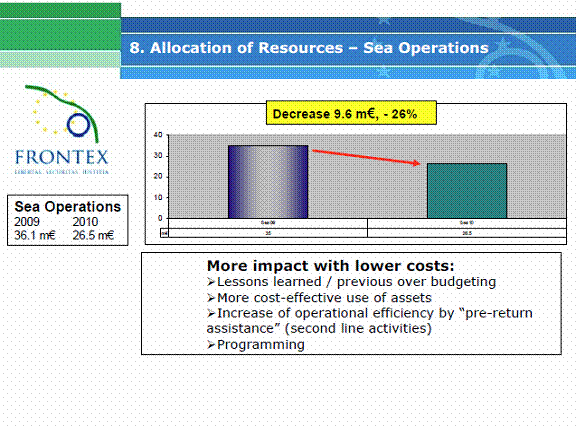
Frontex issued its 2010 Work Programme some time in late 2009.  I have not taken the time to closely read the full 90 page document, but it is worth noting that Frontex sea operations continue to constitute the largest share of the Frontex operational budget, over 26.5 M €.  Due to delayed payments from member states, Frontex is planning on cutting its sea operation budget by 9.7 M € in 2010.

Here are some excerpts from the Programme for Work relevant to sea operations:

“Executive Summary – Frontex’ Programme of Work 2010, as the output of a cyclical planning process, is the operative plan of the Agency to be used as reference for the governance process of assessing and evaluating operational activities carried out during 2010. Frontex’ Programme of Work also seeks to ensure the highest possible level of transparency towards the citizen of the European Union. [***]

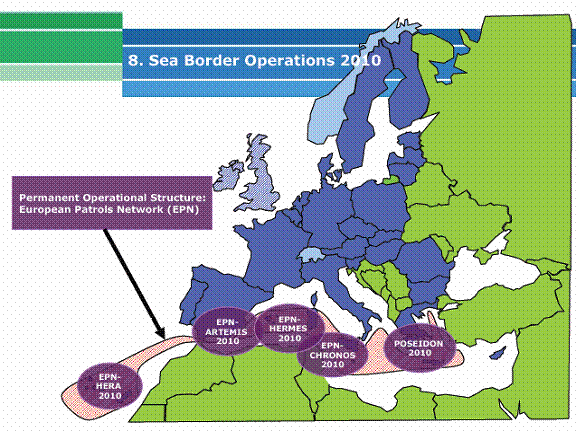
Sea Borders has the biggest share of the budget for operational activities: 26.5 M €. This is a decrease of 9.7 M €. Based on experiences from 2007 and 2008 the budget allocated to Sea Borders has been reduced as payments have been lagging seriously behind and it seems logical that the level of ambition has to be (at least temporarily) adjusted downward. However, the presently foreseen budget does give sufficient room for 7 to 9 projects within the EPN European Patrols Network and 6-7 joint operations in different geographical areas to decrease the illegal immigration flows and to detect facilitators (26.3 M €). Other activities carried out by Sea Borders will be:

– Improved working conditions and improved operational value of interrogation experts (0.1 M €);

– Improved level of awareness in ICCs and regional centers during JOs. (0.1 M €). [***]”

“1.6. Outlook for the situation at the external borders in 2010

General trends –  [***] In May 2009 Libya agreed to direct repatriation of illegal migrants, increasing in the process the deterrent effect of Frontex coordinated Joint Operations in the area. Likewise, Joint Operation Poseidon 2009 has introduced pilot measures to gauge the magnitude of the phenomenon of nationality swapping. When extended and systematized, this measure will facilitate return, determination of illegal migration routes correctly and spotting any displacement in a more timely manner. [***]”

“External maritime borders of the Member States – With significantly lower number of migrants departing from Libya and a decreasing trend of arrivals in the Canary Islands, the relative importance of Algeria, Morocco, Tunisia and possibly Egypt as departure points is likely to grow throughout 2009 and 2010. Efforts by authorities there against illegal migration will be crucial for limiting the flow towards Italy and Spain.  Gambia is expected to take over from Senegal the role of a major embarkation point on the West African coast. That said, in absolute numbers the Aegean Sea (at the border between Turkey and Greece) is expected to remain the main entry point at external sea borders in 2010 should cooperation with Turkey continue to be limited. With the strengthening of the southern EU maritime borders, migrants who initially considered sea crossing might opt for alternative way of entry. One of them might be the use of air borders, either with forged documents or after obtaining visa on false pretence.  At the moment, such a shift has not yet been detected and the risk is considered rather low for 2010, but the situation at the air border should nevertheless continue to be monitored with vigilance. [***]”

“1.7.1. Priority locations by border type

(1) At the external sea borders, operational cooperation should continue to focus on the southern maritime areas where large number of illegal migrants have been detected and where migrants’ life is most at risk, namely the maritime areas leading to: the Canary Islands, the Spanish south-eastern Mediterranean coast, the Island of Lampedusa, Malta—taking into account possible displacement to Sicily and/or Crete—, Sardinia and the Greek Islands close to the Turkish coasts (Lesvos, Chios, Samos, Patmos, Leros and Kos).

Even though decreases detections of illegal border crossing have been reported during the first semester 2009 on the West African and Central Mediterranean routes, operational cooperation should continue to include these areas, on the one hand because the decrease might only be temporary, and on the other because Frontex coordinated Joint Operations in these areas as one factor have contributed to the decrease. [***]”

“1.7.2.2. Recommendations for operational cooperation at the sea borders

(18) All efforts, from diplomatic to technical ones, should continue to be explored to break the deadlock situation of illegal migrants, as advised by facilitators, purposely turning sea surveillance patrols into rescue operations, thereby using surveillance measures as part of their modus operandi. As of mid-2009, such situation was still prevailing in the Aegean Sea.

(19) Joint Operations at the sea borders should aim at developing a permanent linguistic expertise pool, combined with debriefing techniques. Alternatively, language expertise could be outsourced to vetted private sector.

(20) At the sea borders where migrants arrive in big groups, special attention should be given to the rapid identification of victims of THB, especially women and children, with a view to gaining information leading to the identification and prosecution of the traffickers. In this process victim protection should be paramount. [***]”

Click here for a link to the full document.  Note that the document is 90 pages in length but for some reason the 90 page document available at this link is in triplicate, i.e. it is 270 pages in length.  But it is the same 90 page document thrice.

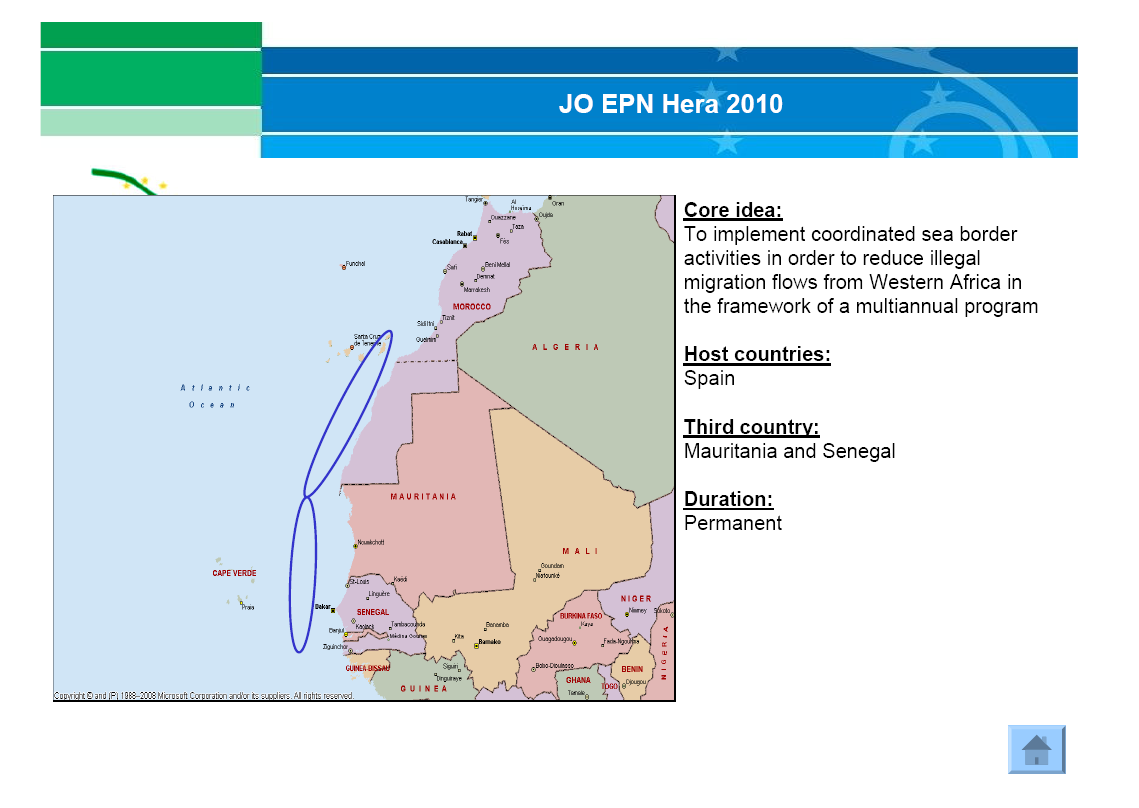
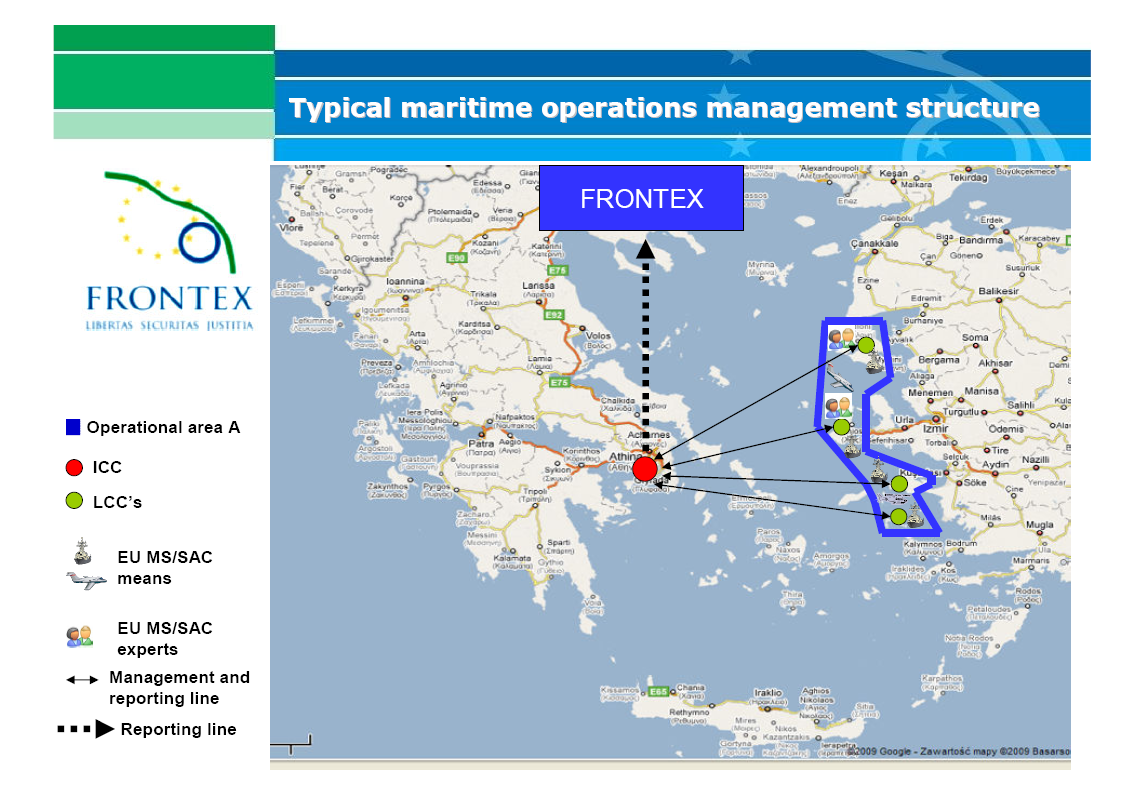
Click here for a link to Slides used by Frontex to summarize some aspects of the Programme.

Leave a comment

Filed under Aegean Sea, Eastern Atlantic, Frontex, Mediterranean, News, Reports

Frontex Presentation at European Defence Agency Annual Conference

Rustamas Liubajevas, Head, Frontex Joint Operations Unit, presented a lecture entitled “Frontex within integrated Border management concept – Structural approach in planning capability” at the recent Annual Conference of the European Defence Agency.

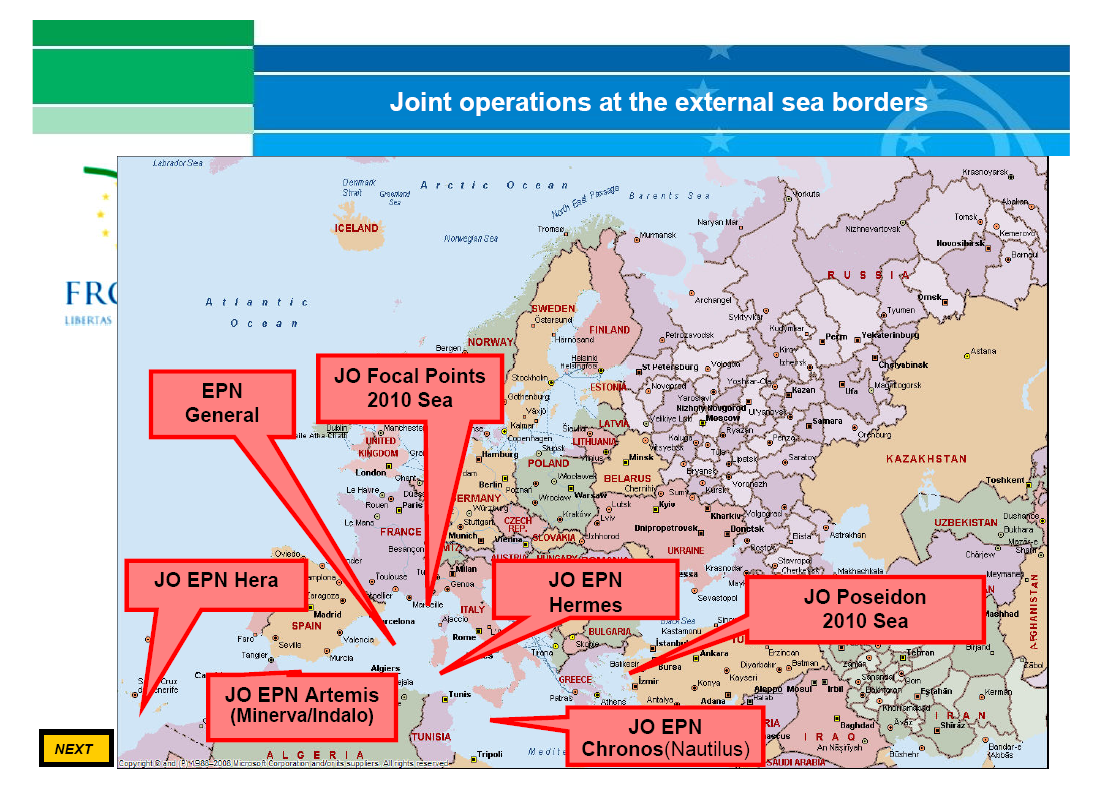
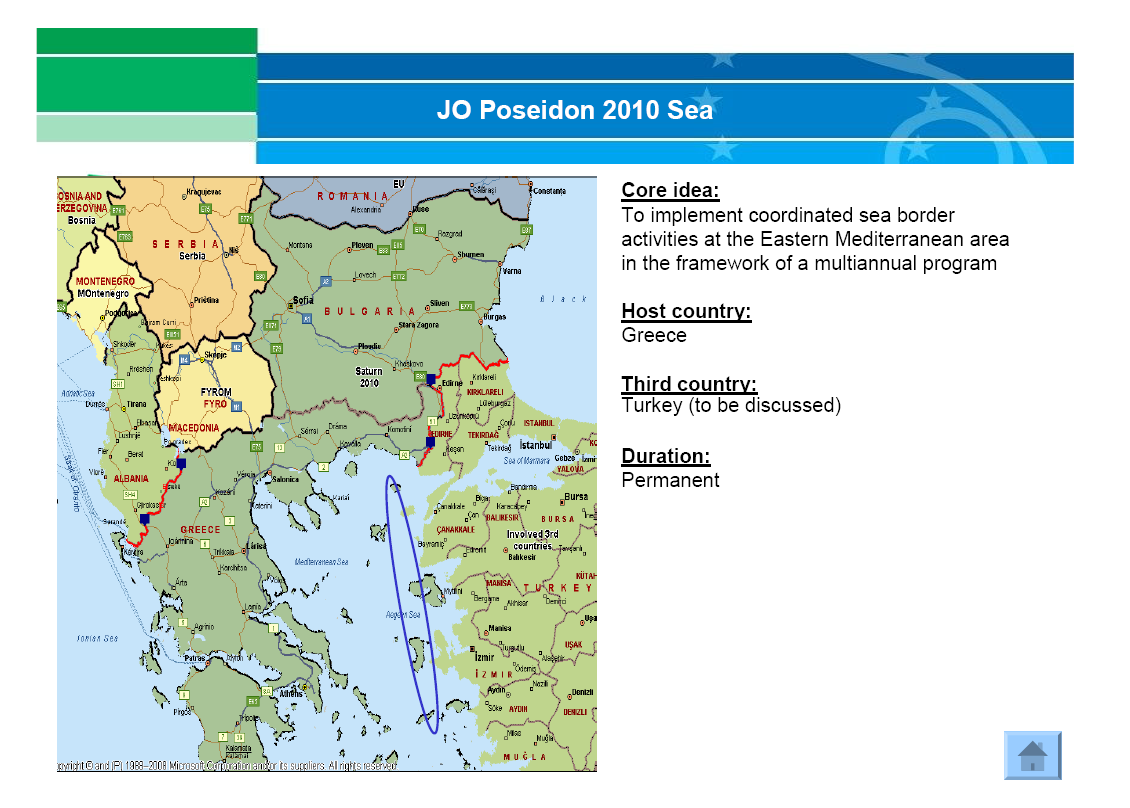
Copies of some of his slides are reproduced here.

Click here for full slide presentation.

Leave a comment

Filed under Aegean Sea, Algeria, Colloques / Conferences, Eastern Atlantic, European Union, Frontex, Greece, Italy, Libya, Malta, Mauritania, Mediterranean, Morocco, News, Senegal, Spain, Turkey

Malta: New Frontex Guidelines for Operations at Sea Could Be Ignored

The new Armed Forces of Malta Commander, Brigadier Martin Xuereb, suggested in an interview with the Times of Malta that Frontex enforcement operations are governed by operational plans that “may or may not draw from the [newly approved Frontex] guidelines”.  “‘The guidelines also state that the modalities of the operation will be agreed upon in the operational plan decided by countries that participate in the mission,’ he says, insisting the operational plan superseded the [new] guidelines.”  Xuereb also said that it was too early to say whether Malta would decline to participate in future Frontext operations.

Click here for full article.

Leave a comment

Filed under European Union, Frontex, Malta, Mediterranean, News

Conference de l’Ucad: «Migrations entre le Sénégal et l’Espagne: défis et opportunités»

“Les premières journées hispano-sénégalaises qui portaient sur le thème « Migrations entre le Sénégal et l’Espagne : défis et opportunités » ont été clôturées, … à Dakar. Une occasion saisie par le Pr. Saïdou Nourou Tall, vice doyen de la Faculté des Sciences juridiques et politiques de l’Ucad, par ailleurs coordonnateur du Master du droit des migrations pour faire le diagnostic du dispositif du Frontex (dispositif de lutte contre l’émigration clandestine)…. le Pr. Saïdou Nourou Tall a déclaré …« On a fait un diagnostic, beaucoup de choses ont été faites. Mais il existe un certain nombre de problèmes dans ce dispositif du Frontex qui nous interpelle tous », a-t-il précisé. Est-ce que les milliards que reçoivent nos gouvernants dans la lutte contre cette émigration clandestine atteignent les cibles », s’est-il interrogé. Pour lui, le constat illustre la recrudescence du phénomène de l’émigration clandestine. La solution, de l’avis du coordonnateur du Master des Migrations de la faculté de Droit, est de « promouvoir l’unité africaine ». Pour cela, a-t-il dit, « il faut faire de l’Afrique un grand marché où les Africains trouveront du travail sans être obligés de risquer leur vie sur des pirogues de fortune ».”

Cliquez ici pour l’article complet.

Leave a comment

Filed under Colloques / Conferences, Eastern Atlantic, Frontex, Senegal, Spain

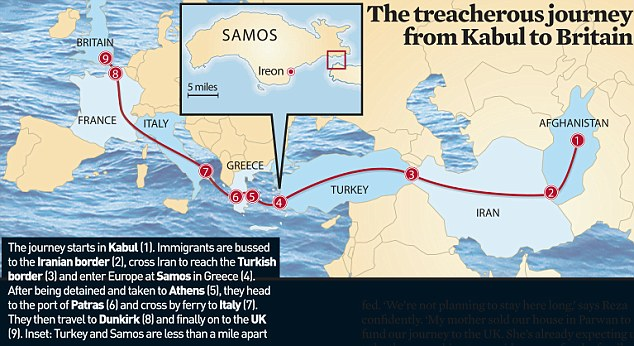
Daily Mail: from Kabul to the UK by way of Samos

The Daily Mail has a special report detailing the experiences and routes of irregular Afghan migrants traveling from Afghanistan to the UK by way of Turkey and Greece.

Click here for the full article.

Leave a comment

Filed under Aegean Sea, Greece, News, UK

Besson et Frattini: renforcement des frontières “urgent”

“La France et l’Italie veulent un renforcement ‘urgent’ des frontières extérieures de l’UE afin de lutter contre les filières d’immigration clandestine…. Paris et Rome veulent un ‘développement des capacités opérationnelles de … Frontex en vue de mettre en place la police européenne aux frontières prévue par le Pacte européen sur l’immigration et l’asile’ et une ‘généralisation des accords de coopération opérationnelle et de réadmission avec les principaux Etats tiers d’origine et de transit’.”

“Les ministres de l’UE en charge de l’immigration doivent tenir le 25 février à Bruxelles une réunion extraordinaire convoquée par Eric Besson après la découverte de 123 Kurdes sur une plage corse en janvier.”

Cliquez ici pour l’article.

Leave a comment

Filed under European Union, France, Frontex, Italy, Mediterranean, News

Más patrullas para prevenir llegada de barcas neumáticas a la costa andaluza

“El Ministerio del Interior ha intensificado las patrullas de la Guardia Civil y las tareas de inteligencia para prevenir la llegada de embarcaciones neumáticas que cruzan el Estrecho de Gibraltar hasta las costas andaluzas, según consta en una respuesta aportada por el Gobierno al senador Eugenio Jesús Gonzalvez (PP), a la que tuvo acceso Europa Press….”

“Por otra parte, recuerda que en los meses de septiembre y octubre se puso en marcha el dispositivo Indalo, coordinado por la Agencia Europea de Fronteras (Frontex), consistente en el despliegue de medios marítimos y aéreos, complementado con personal de varios países en distintos puntos de la costa, entre las provincias de Murcia y Granada.”

“Asimismo, Interior indica que el Sistema Integral de Vigilancia Exterior (SIVE) se mantiene a la “máxima operatividad” en toda la costa del Mediterráneo, donde también continúa la realización de patrullas mixtas marítimas….”

Click here and here for articles.

Leave a comment

Filed under Eastern Atlantic, Frontex, Mediterranean, News, Spain