Category Archives: EU and EU Organizations

Fortress Europe Calculates 1,931 Deaths in the Mediterranean During First 7 Months of 2011

According to calculations made by Fortress Europe, 2011 is the deadliest year in the Mediterranean since at least 1994.  1,931 people have died during the first seven months of 2011.  This number is higher than the total number of deaths in all of 2008, the year with the previous highest death toll of 1,274.  Fortress Europe estimates that 1,674 (87%) of the 1,931 deaths have occurred in the Sicilian Channel and that most of the deaths in the Sicilian Channel have involved migrants travelling from Libya towards Europe.

Click here for Fortress Europe post.  (IT)

Click here for Clandestina blog post.  (EN)

From Fortress Europe:

Vittime del Canale di Sicilia dal 2002 ai primi 7 mesi del 2011
Anno 2002 2003 2004 2005 2006 2007 2008 2009 2010 2011
Morti 236 413 206 437 302 556 1274 425 20 1674

Leave a comment

Filed under Data / Stats, European Union, Italy, Libya, Malta, Mediterranean, News, Tunisia

Issue Brief- Cutting Off the Flow: Extraterritorial Controls to Prevent Migration

An Issue Brief, “Cutting Off the Flow: Extraterritorial Controls to Prevent Migration,” written by Eleanor Taylor-Nicholson, has been published by the Warren Institute for Law and Social Policy, University of California, Berkeley.  The issue brief was written as a background paper for a conference held by the Warren Institute at UC Berkeley Law School on 22 April 2011.

Excerpt: “… This issue brief explores the extent to which the United States, Europe and European governments have implemented different extraterritorial controls. Although we hear of such controls in the media, how common are they? Who is overseeing them? What do they involve? What are concerns with their use? To answer these questions, this brief presents information on key actors, including individual nation-states and their agents, and on the range of mechanisms used by both. A comparison of two major immigration destinations is included to consider similarities and differences in the use of extraterritorial controls by states.

A review of the literature and media reports finds that extraterritorial controls include a diverse range of measures by different actors, some of which have been extremely controversial, such as maritime interdiction and offshore detention, and others that are more accepted or less understood, such as visa controls and disruption of organized immigration crime. Further, while such controls are now ubiquitous in both regions, their design and implementation generally lack public oversight and accountability mechanisms. They may protect states from security threats, have the potential to provide early protection to people in need, and save traveling migrants in distress. But, if used primarily as an immigration deterrence mechanism, they can cause harm. Indeed they may provide states a means to evade their international obligations or lead to violations of international refugee law and human rights law.

In light of this, we recommend governments conduct a comprehensive and public review of the extraterritorial controls they have in place, taking into consideration international refugee and human rights commitments. We also urge governments to increase the transparency of their immigration control agreements with third parties, including private actors and other states….”

Click here for Issue Brief.

Leave a comment

Filed under Analysis, European Union, Frontex

Call for a Humanitarian Flotilla to Stop Deaths in the Mediterranean

A coalition of migrants’ rights organisations, including Migeurop, Cimade, Gisti, FIDH, and others hope to organise a humanitarian “flotilla which will undertake maritime surveillance so that assistance is finally provided to people in danger. The participatory organisations call on European bodies and governments on both sides of the Mediterranean to establish relations within this common area on the basis of exchange and reciprocity. This flotilla will embark political figures, journalists, artists, and representatives of the organisations involved in the project.  Any organisation, trade-union, political representative, seafarer, journalist, artist or other individual interested in this initiative may join this mailing list : « Mediterranean Intervention ».” To subscribe to the mailing list, please send an email to migreurop07@yahoo.it.

Click here for full Migreurop statement.

Leave a comment

Filed under European Union, Frontex, Italy, Libya, Malta, Mediterranean, News, Statements, Tunisia

Italy and Malta Turn Back NATO Ship Carrying 100 Rescued Migrants

A political and diplomatic standoff is underway between Malta, Italy, Spain and NATO.  The Times of Malta is reporting that the Spanish frigate, the Almirante Juan de Borbón, carrying the 100 rescued migrants attempted to dock at Lampedusa after the rescue, “but the Italian authorities refused it entry  and directed the vessel to Malta, which also refused entry, arguing that Lampedusa was the nearest safe port.”  “The Spanish warship is now off Maltese waters while talks are held between Maltese, Italian and Spanish diplomats.  A meeting which included the Prime Minister and Home Affairs Minister Carm Mifsud Bonnici was being held this afternoon at the Auberge de Castille.  Nato is understood to have appealed to both Italy and Malta to accept the migrants.”  The Times of Malta also reported that a 10 month old baby was flown yesterday from the Spanish frigate to Malta for medical treatment and that a man and pregnant woman were airlifted to Malta today.

Click here for Times of Malta article.

Click here and here for previous posts.

1 Comment

Filed under European Union, Italy, Libya, Malta, Mediterranean, News

Malmström Makes Some Correspondence Public and Searchable Via Internet

I am not sure for how long this has been available, but Commissioner Malmström noted in a blog post yesterday that she is making some (emphasis on “some”) of her public correspondence available on-line: “… I am posting my correspondence online (the correspondence with private persons is excepted). I am trying to get more Commissioners to do the same and I am striving for a greater transparency throughout the Commission. There is much more to do in this respect….”

The correspondence is being made available via “CAROL“: “CAROL is a prototype register where you can find Commissioner Malmström’s correspondence. This site is a pilot project of the European Commission promoting transparency and access to information and is bound by the general rules on access to Commission documents.”

I have spent a little time searching and accessing a few of the posted documents. There appear to be at least 2,100 documents that have been identified as of 7 July, but for many of the listed documents there is no associated document that can be read. In these cases it is unclear whether a decision has been made to simply identify the existence and subject matter of the particular document without releasing the document itself or whether the document will be posted in the future once it is scanned – to be seen. The documents date from April 2010 to the present. This is clearly a positive step in the right direction and let’s hope that more documents will be made public and easily accessible.

Click here or here for links to the search pages. (Note that entering some search criteria on the first link will result in an advance search page appearing, where you can search using more specific criteria. Clicking on the second link should open the advanced search page.)

Here is a sample of what I reviewed when searching for documents relating to the EU-Libya Framework negotiations in 2010:

Letter from the Commissioner dated 15 July 2010 addressed to:

“Mr Michael SCHÖPF, Regional Director

Mr Stefan KEßLER, Senior Policy & Advocacy Officer

JESUIT REFUGEE SERVICE-EUROPE AISBL, BRUXELLES

[***]

As you may know, the European Council, in the context of the fight against irregular immigration and taking into consideration the global approach to migration, tasked last year the Commission to step up the dialogue and cooperation with transit countries in the Mediterranean, in particular Libya. The Commission considers that it is through dialogue and cooperation with Libya that the EU can improve the situation, in particular for persons in need of international protection.

We consider that the conclusion of the EU-Libya Framework Agreement, which will commit partners to respect a number of important principles and pave the way for a more structured dialogue with Libya, will provide a more effective framework for inter alia establishing an effective system of protection of persons in need of international protection in Libya.

Pending such outcome, the Commission intervenes in Libya by providing its financial support to UNHCR and its local partner organisations, which are active in visiting and screening migrants in detention centres, and in identifying and assisting those out of them that are in need of international protection.

Finally, in your letter you mention also the forced returns to Libya of migrants intercepted at high sea which were carried out by Italy from May 2009, asking the Commission to call on this Member State to suspend this activity. The Commission has already drawn the attention of the Italian authorities on the risks that forced returns embodied as regard the possibility to violate the principle of non-refoulement and the migrants’ human rights in case certain safeguards were not taken. On the basis of the information available to the Commission, since August 2009 no more forced returns have been carried out by Italian authorities, and the migrants that subsequently were intercepted or rescued at high sea by the latter were all brought to Italian territory.

Yours sincerely,

s/

Cecilia MALMSTRÖM”

Click here or here for links to the search pages. (Note that entering some search criteria on the first link will result in an advance search page appearing, where you can search using more specific criteria. Clicking on the second link should open the advanced search page.)

Click here for the Commissioner’s blog post.

Leave a comment

Filed under European Union, News

Head of Armed Forces of Malta Describes Malta’s Interpretation of Its SAR Responsibilities

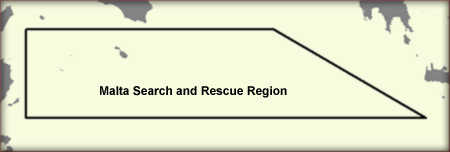
Brigadier Martin Xuereb, the head of the Armed Forces of Malta (AFM), spoke at a recent seminar sponsored by the European Parliament, “Europe’s new Mediterranean reality: Migration and asylum in Malta, Greece and Cyprus,” and summarised Malta’s interpretation of its search and rescue obligations.  Xuereb said that Malta is obligated to coordinate search and rescue operations within its SAR zone, but is not required to perform all rescue operations.

Xuereb said Malta believes rescued persons should be disembarked at the nearest place of safety which, given the size and location of the Maltese SAR, will sometimes mean that Italian territory, particularly Lampedusa, is closer.  Xuereb acknowledged that this interpretation is not shared by others.  Xuereb “said that Malta had consistently insisted that the arrangement that best represented the interests of rescued persons was one that saw them disembarked in the nearest place of safety.”  He said the Maltese Rescue Coordination Centre (RCC) has coordinated or assisted with 54 SAR cases so far this year.

Xuereb also confirmed that Malta would continue its refusal to host Frontex joint operations because of its objections to Frontex guidelines which are based “on a number of grounds, including the fact that [the guidelines] addressed matters deemed to be outside community competence and attempted to erode the rights that Malta enjoyed under the international legal framework. … In light of these guidelines, Malta considered the hosting of [Frontex] joint operations to be detrimental to its national interest.”  Malta objects to the guidelines because it believes they would require rescued migrants to be disembarked in the country hosting the joint operation.

Click here and here for articles.

Leave a comment

Filed under Frontex, Italy, Malta, Mediterranean, News

Klepp, Int J Refugee Law, “A Double Bind: Malta and the Rescue of Unwanted Migrants at Sea, a Legal Anthropological Perspective on the Humanitarian Law of the Sea”

An article by Silja Klepp (Research Associate, Research Center for Sustainability Studies (artec), University of Bremen) entitled “A Double Bind: Malta and the Rescue of Unwanted Migrants at Sea, a Legal Anthropological Perspective on the Humanitarian Law of the Sea” has been published as an online advance access article by the International Journal of Refugee Law.

Abstract: “This paper discusses research results from anthropological fieldwork carried out in Malta in 2007. The island, which is situated in the central Mediterranean Sea between Tunisia, Libya and Italy, is a focal point regarding the continuing refugee situation. One of the research aims was to investigate the situation at sea concerning Search and Rescue (SAR) operations for migrants and refugees crossing the Mediterranean by boat. In the year 2006, 556 missing and drowned migrants were registered in the central Mediterranean between Libya, Malta and Italy, this number increased to 642 in 2008.1 The goal of the research in Malta was therefore to understand why an increasing number of migrants were dying at sea and what role the European security forces play in this context.

After introducing the research perspective of this article, background information concerning migration movements in the Mediterranean Sea between Libya, Italy and Malta in recent years is provided. Due to European regulations, which are considered unfavourable for the island, and its population density, Malta feels under pressure from migrants arriving by boat across the Mediterranean. Different concepts regarding a ‘place of safety’ to disembark rescued boat migrants are debated. The ambiguities in the responsibilities cause problems for the captains who rescue migrants in distress at sea. These ambiguities may in turn lead to a weakening of the SAR regime. Following discussion of the legal and political quarrels on the place of safety, the SAR operations at sea of the Armed Forces of Malta is analysed. The findings show that it is not merely a case of enforcing legal norms created by international law. The process is much more complex: legal gaps are filled by regional actors, through informal or even illegal practices, asserting their own claims at their convenience. Thus, transnationalization processes of law, such as the international SAR regime, are a fragmented and ambiguous set of regulations, creating space for negotiation and manoeuvre.2

Click here for link.  (Subscription or payment required.)

Also by Klepp from 2010, European Journal of Migration and Law: “A Contested Asylum System: The European Union between Refugee Protection and Border Control in the Mediterranean Sea.”

Leave a comment

Filed under Analysis, European Union, Italy, Malta, Mediterranean, UNHCR

PACE Appoints Tineke Strik as Rapporteur to Investigate Mediterranean Sea Deaths

The Migration Committee of the Parliamentary Assembly of the Council of Europe has appointed Tineke Strik (Netherlands, SOC) to prepare a report on the deaths of boat people who have died in the Mediterranean since January 2011.

From the PACE press statement: “‘There have been allegations that migrants and refugees are dying after their appeals for rescue have been ignored,’ said Mrs Strik. ‘Such a grave allegation must be urgently investigated.  I intend to look into the manner in which these boats are intercepted – or not – by the different national coastguards, the EU’s border agency FRONTEX, or even military vessels. I also intend to speak to witnesses directly involved in reported incidents, and put questions to national authorities, the UNHCR, FRONTEX and NATO, among others.’  On 8 May, the Guardian newspaper reported that 61 boat people escaping from Libya had died after their appeals for rescue had been ignored by armed forces operating in the Mediterranean. The following day PACE President Mevlüt Çavusoglu called for ‘an immediate and comprehensive enquiry’ into the incident.”

Click here for PACE press statement.

1 Comment

Filed under Council of Europe, Frontex, Italy, Libya, Malta, Mediterranean, News, Tunisia

PACE Adopts Resolution and Recommendation Regarding the Interception and Rescue at Sea of Asylum Seekers, Refugees and Irregular Migrants

On 21 June 2011, PACE adopted Resolution 1821 and Recommendation 1974 both relating to “the interception and rescue at sea of asylum seekers, refugees and irregular migrants.” 

Here are extensive excerpts:

Provisional edition – The interception and rescue at sea of asylum seekers, refugees and irregular migrants – Resolution 1821 (2011)1

“1.       The surveillance of Europe’s southern borders has become a regional priority. The European continent is having to cope with the relatively large-scale arrival of migratory flows by boat from Africa, reaching Europe mainly through Italy, Malta, Spain, Greece and Cyprus.

[***]

5.       The Assembly notes that measures to manage these maritime arrivals raise numerous problems, of which five are particularly worrying:

5.1.       Despite several relevant international instruments satisfactorily setting out the rights and obligations of states and individuals applicable in this area, interpretations of their content appear to differ. Some states do not agree on the nature and extent of their responsibilities in specific situations and some states also call into question the application of the principle of non-refoulement on the high seas;

5.2.       While the absolute priority in the event of interception at sea is the swift disembarkation of those rescued to a “place of safety”, the notion of “place of safety” does not appear to be interpreted in the same way by all member states. Yet it is clear that the notion of “place of safety” should not be restricted solely to the physical protection of people, but necessarily also entails respect for their fundamental rights;

5.3.       Divergences of this kind directly endanger the lives of the persons to be rescued, in particular by delaying or preventing rescue measures, and are likely to dissuade seafarers from rescuing people in distress at sea. Furthermore, they could result in a violation of the principle of non-refoulement in respect of a number of persons, including some in need of international protection;

5.4.       Although the European Agency for the Management of Operational Cooperation at the External Borders of the Member states of the European Union (Frontex) plays an ever increasing role in interception at sea, the guarantees of respect for human rights and obligations arising under international and European Union law in the context of the joint operations it co-ordinates are inadequate;

5.5.       Finally, these sea arrivals place a disproportionate burden on the states located on the southern borders of the European Union. The goal of responsibilities being shared more fairly and greater solidarity in the migration sphere between European states is far from being attained.

6.       The situation is rendered more complex by the fact that these migratory flows are of a mixed nature and therefore call for specialised and tailored protection-sensitive responses in keeping with the status of those rescued. To respond to sea arrivals adequately and in line with the relevant international standards, the states must take account of this aspect in their migration management policies and activities.

[***]

8.       Finally and above all, the Assembly reminds the member states that they have both a moral and legal obligation to save persons in distress at sea without the slightest delay, and unequivocally reiterates the interpretation given by the Office of the United Nations High Commissioner for Refugees (UNHCR), which states that the principle of non-refoulement is equally applicable on the high seas. The high seas are not an area where states are exempt from their legal obligations, including those emerging from international human rights law and international refugee law.

9.       Accordingly, the Assembly calls on the member states, when conducting maritime border surveillance operations, whether in the context of preventing smuggling and trafficking in human beings or in connection with border management, be it in the exercise of de jure or de facto jurisdiction, to:

9.1.       fulfil without exception and without delay their obligation to save people in distress at sea;

9.2.       ensure that their border management policies and activities, including interception measures, recognise the mixed make-up of flows of individuals attempting to cross maritime borders;

9.3.       guarantee for all intercepted persons humane treatment and systematic respect for their human rights, including the principle of non-refoulement, regardless of whether interception measures are implemented within their own territorial waters, those of another state on the basis of an ad hoc bilateral agreement, or on the high seas;

9.4.       refrain from any practices that might be tantamount to direct or indirect refoulement, including on the high seas, in keeping with the UNHCR’s interpretation of the extraterritorial application of that principle and with the relevant judgements of the European Court of Human Rights;

9.5.       carry out as a priority action the swift disembarkation of rescued persons to a “place of safety” and interpret a “place of safety” as meaning a place which can meet the immediate needs of those disembarked and in no way jeopardises their fundamental rights, since the notion of “safety” extends beyond mere protection from physical danger and must also take into account the fundamental rights dimension of the proposed place of disembarkation;

9.6.       guarantee access to a fair and effective asylum procedure for those intercepted who are in need of international protection;

9.7.       guarantee access to protection and assistance, including to asylum procedures, for those intercepted who are victims of human trafficking or at risk of being trafficked;

9.8.       ensure that the placement in a detention facility of those intercepted – always excluding minors and vulnerable categories –, regardless of their status, is authorised by the judicial authorities and occurs only where necessary and on grounds prescribed by law, that there is no other suitable alternative and that such placement conforms to the minimum standards and principles set forth in Assembly Resolution 1707 (2010) on the detention of asylum seekers and irregular migrants in Europe;

9.9.       suspend any bilateral agreements they may have concluded with third states if the human rights of those intercepted are not appropriately guaranteed therein, particularly the right of access to an asylum procedure, and wherever these might be tantamount to a violation of the principle of non-refoulement, and conclude new bilateral agreements specifically containing such human rights guarantees and measures for their regular and effective monitoring;

9.10.       sign and ratify, if they have not already done so, the aforementioned relevant international instruments and take account of the Guidelines of the International Maritime Organisation (IMO) on the Treatment of Persons rescued at Sea;

9.11.       sign and ratify, if they have not already done so, the Council of Europe Convention on Action against Trafficking in Human Beings (CETS No. 197) and the so-called “Palermo Protocols” to the United Nations Convention against Transnational Organized Crime (2000);

9.12.       ensure that maritime border surveillance operations and border control measures do not affect the specific protection afforded under international law to vulnerable categories such as refugees, stateless persons, women and unaccompanied children, migrants, victims of trafficking or at risk of being trafficked, or victims of torture and trauma.

10.       The Assembly is concerned about the lack of clarity regarding the respective responsibilities of European Union states and Frontex and the absence of adequate guarantees for the respect of fundamental rights and international standards in the framework of joint operations co-ordinated by that agency. While the Assembly welcomes the proposals presented by the European Commission to amend the rules governing that agency, with a view to strengthening guarantees of full respect for fundamental rights, it considers them inadequate and would like the European Parliament to be entrusted with the democratic supervision of the agency’s activities, particularly where respect for fundamental rights is concerned.

[***]”

Provisional edition – The interception and rescue at sea of asylum seekers, refugees and irregular migrants – Recommendation 1974 (2011)1

“[***]

4.       [***] the Assembly reminds the Committee of Ministers of its dual responsibility: to support those member states that are in need, but also to make sure that all human rights obligations are complied with in the context of the interception and rescue at sea of asylum seekers, refugees and irregular migrants, including by guaranteeing to those intercepted access to a fair and efficient asylum procedure.

5.       The Assembly therefore calls on the Committee of Ministers to:

5.1.       include in the training material all necessary elements to enable the trained persons to proceed to a screening assessment of the international protection needs of intercepted persons and to ensure that staff involved in the operations of the European Agency for the Management of Operational Cooperation at the External Borders of the Member states of the European Union (Frontex) are trained accordingly;

5.2.       define, in close co-operation with the Office of the United Nations High Commissioner for Refugees (UNHCR), guidelines and standard operating procedures, when interception and rescue at sea takes place, determining minimum administrative procedures to guarantee that those persons with international protection needs are identified and provided with the appropriate protection;

5.3.       continue monitoring the situation of large-scale arrivals of irregular migrants and asylum seekers, and in particular the issue of interception and rescue at sea, including by holding extraordinary meetings on the situation, where appropriate, and use the good offices of the UNHCR with its representative at the Council of Europe, where relevant.”

Click here for full text of Resolution 1821 (2011).

Click here for full text of Recommendation 1974 (2011).

Click here  for speech by Tineke Strik (Netherlands, SOC) presenting the Resolution. (Scroll down page for the English text of speech.)

1 Comment

Filed under Aegean Sea, Council of Europe, Cyprus, Frontex, Greece, Italy, Libya, Malta, Mediterranean, News, Spain, Statements, UNHCR

Hirsi v Italy: Summary of Oral Submission made by Govt. of Italy to Grand Chamber ECtHR

I have watched a portion of the web cast of yesterday’s oral submissions before the ECtHR Grand Chamber in Hirsi and others v Italy, Requête no 27765/09.  Here is a summary of the oral submissions made on behalf of the Respondent Government of Italy by Mrs. Silvia Coppari, Co-Agent, and Mr. Giuseppe Albenzio, Adviser.  NB while I think my notes are accurate, do not rely on them for exact quotes of any of the oral remarks.

Oral Submission by Mrs. Silvia Coppari, Co-Agent, Government of Italy

Introductory Remarks Critical of Applicants:

Coppari began her oral submission by saying that the Italian government did not intend to enter into the controversy raised by Applicants in their written submissions where the Italian government and its representatives were insulted and provoked by the Applicants’ statements that the arguments relied upon by the Italian government were purely formal or quite absurd and tendentious.  Coppari described the Applicants’ written submission as a political and ideological manifesto against the government and its policy.

Questioning Why Italy Was Singled Out:

Coppari said that the issues raised by the Applicants related to European public policy in general and therefore all EU Member States should be involved in the case.  Italy’s policies and actions were adopted and carried out in a manner consistent with the guidelines, objectives, and guidance set by the EU to curb illegal migration.

Reminding Court that Case is Limited to the Events of 6 May 2009 and is Not a Challenge to Italy’s Migration Policies:

Coppari emphasised that the Application was lodged only with respect to the events that took place on 6 May 2009 when the push-back operation involving the Applicants occurred and that the Application does not deal with the public policy or practices of the Government.

Admissibility Challenge No. 1:

Coppari recalled that the allegations lacked specific supporting evidence and noted that the Applicants themselves have not testified in any domestic proceedings and have not otherwise personally participated in the case. Coppari expressed misgivings about the validity and authenticity of the authorisations given to the Applicants’ legal representatives.  Coppari said there was no certainty as to the identity of the Applicants and therefore no likelihood of individually assigning a particular alleged offence to them or a possible violation of their rights under Art. 34 of the Convention.

Admissibility Challenge No. 2:

Coppari made a second inadmissibility objection due to the failure of the Applicants to lodge an appeal with the Italian courts in line with Art. 13.  The pursuit of such domestic remedies would have given the Italian authorities the opportunity to check whether those who were rescuing illegal migrants on the high seas were possibly liable for any rights violations.  Coppari emphasised that at present there are criminal proceedings underway at the domestic level in cases very similar to the instant case and that these cases will determine whether there was compliance with national and international standards and whether there was effective access to procedures for international protection for unidentified migrants intercepted at high seas and transported to Italian vessels. The existence of these ongoing domestic cases proves that domestic remedies do exist which were not pursued by the Applicants.

The Events of 6 May 2009:

Coppari said that the operations carried out on 6 May 2009 to intercept 3 makeshift migrant vessels were done to protect the migrants from danger and to control the flows of illegal migration towards Europe.  The migrant vessels were in distress on high seas in the Maltese SAR zone.  The migrants were rescued and returned to Libya on board Italian military vessels.  There is no evidence suggesting that requests for international protection were made to Italian authorities.  The migrants were in fact welcomed upon arrival in Libya.  The returns did not breach any basic rights of the Applicants.

Prohibition Against Collective Expulsions Does Not Apply Extraterritorially:

Coppari said that prohibition of collective expulsions provided by Art. 4 of Protocol 4 is not applicable to the case.  Coppari said that the use of the word “expulsion” is an obstacle to its application in the case of extraterritorial exercise of state jurisdiction.  Not only is it an apparent obstacle, it is in fact a logical obstacle which cannot be circumvented because an “expulsion” can only happen to people who are already on national territory or who have illegally crossed the border.  The transfer to a vessel on the high seas cannot be equated with entry upon national territory or permanent residence on national territory.

Giuseppe Albenzio, Adviser, Government of Italy

Introductory Remarks – Italy’s Policies Consistent with EU Principles:

Italy has acted in respect of principles handed down by the EU. The European pact on immigration and asylum provides for limits on migratory flows, the need to control illegal immigration by ensuring that illegal immigrants are returned to the country of origin or to a country of transit, the need to make border controls more effective, and to make partnerships with countries of origin or transit.

At the Time of the Events in Question, Libya Was a Country with an Adequate Protection System in Place:

Italy’s bi-lateral agreements with Libya at the time they were implemented recalled the general principles of international law and of human rights and therefore in face of these principles recognised in the agreements, the misgivings regarding Libya’s non-subscription to the UN Refugee Convention should not exist and are not justified especially since Libya has signed the similar African Union Convention for refugees.  It should also be underlined that at the time of the events in question, the UNHCR and IOM were both active in Tripoli and the operations that were carried out in the months after the bilateral treaty was implemented should be seen in this context.

After the first phase of the implementation of the bi-lateral treaty when Italian authorities took note of the fact that Libyan authorities had ordered the UNHCR office in Tripoli to close, which in turn made it difficult to guarantee the protection of fundamental rights on its territory, Italy’s methods for rescuing migrants on the high seas were modified and people who were on vessels coming from Libya would be accompanied to Italian soil after rescue.

The web cast of the hearing is available here.  (I was able to view this with IE but not with Firefox.)

1 Comment

Filed under Council of Europe, European Court of Human Rights, European Union, Italy, Judicial, Libya, Mediterranean, News, UNHCR

1400 Migrant Landings in Malta in First 5 Months of 2011; 91% of Protection Applications Approved

According to information presented by Maltese Justice Minister Carmelo Mifsud Bonnici, 1,451 migrants have reached Malta during the first five months of 2011.  There were no arrivals during the first two months of the year.  819 people arrived in March, 288 in April, and 347 in May.  Most of the migrants were Somali (411) and Eritrean (280).

In a separate statement, Maltese Refugee Commissioner Mario Guido Friggieri said that a total of 1,530 migrants in seven boats have arrived in Malta to date in 2011.  This would suggest that there have been 79 migrant arrivals so far during the month of June.

Friggieri also reported that the Refugee Office has received 600 applications for protection of which 420 have been decided: 5 migrants have been granted refugee status, 370 granted subsidiary protection, 8 granted temporary humanitarian protection status, and 1 was granted “special protection.” 36 applications have been rejected.  91% of the applications for protection decided to date have been approved in some fashion.

As of the end of the month of April, there were 1,048 migrants being detained in detention centres and 2,294 in open centres.

Click here, here, and here for articles.

Leave a comment

Filed under Data / Stats, European Union, Libya, Malta, Mediterranean, News

Italy Surpasses Greek-Turkish Border as Main Entry Point to EU for Irregular Migrants

Frontex Deputy Executive Director Gil Arias announced today at a press conference that during the first quarter of 2011 most irregular migrants have entered the EU through Italy, primarily at Lampedusa.  In 2010 the Greek-Turkish border was the main entry point for irregular migrants.

A total of 32,906 irregular migrants were detected at the EU borders during the 1st Quarter 2011 compared with a total of 14,857 during the 1st Quarter of 2010.  Of the 32,906, 22,000 entered through Italy during the 1st Quarter, mostly at or around Lampedusa, and 7,200 entered the EU through Greece.

So far this year, January 1 to present, approximately 41,000 irregular migrants have entered the EU in the area around Lampedusa and other nearby islands.

Click here (EN), here (EN), here (IT), and here (IT) for articles.

1 Comment

Filed under Data / Stats, European Union, Frontex, Greece, Italy, Libya, Mediterranean, News, Tunisia, Turkey

Moreno-Lax, Int J Refugee Law, “Seeking Asylum in the Mediterranean: Against a Fragmentary Reading of EU Member States’ Obligations Accruing at Sea”

The latest edition of the International Journal of Refugee Law, contains an article by Violeta Moreno-Lax (PhD Candidate at Université catholique de Louvain; Visiting Fellow 2010-11 at Refugee Studies Centre, University of Oxford) entitled “Seeking Asylum in the Mediterranean: Against a Fragmentary Reading of EU Member States’ Obligations Accruing at Sea.”

Abstract: “Although both international and EU law impose a number of obligations on the EU Member States with regard to persons in distress at sea, their effective implementation is limited by the manner in which they are being interpreted. The fact that the persons concerned are migrants, who may seek asylum upon rescue, has given rise to frequent disputes and to episodes of non-compliance. Frontex missions and the Italian 2009 push-back campaign illustrate the issue. With the objective of clarifying the scope of common obligations and to establish minimum operational arrangements for joint maritime operations, the EU has adopted a set of common guidelines for the surveillance of the external maritime borders. On the basis of the principle of systemic interpretation, this article intends to contribute to the clarification of the main obligations in international and European law binding upon the EU Member States when they operate at sea.”

This is a revised and updated version of the paper presented at the 12th IASFM Conference held in Nicosia, 28 June-2 July 2009.  [The article was written and sent for typesetting before the various uprisings in North Africa – IJRL Editor, 4 March 2011]

Click here for link.  (Subscription or payment required.)

Leave a comment

Filed under Analysis, Eastern Atlantic, European Court of Human Rights, European Union, Frontex, Greece, Italy, Libya, Malta, Mauritania, Mediterranean, Senegal, Spain

Gisti Calls for NATO to Use Its Surveillance Capabilities to Prevent Migrant Deaths at Sea

From Gisti:

“…  Faced with hundreds of fatal wrecks in the Mediterranean, can we simply denounce the deafening silence in which lives are lost at our doors? Should we accept being powerless in the face of immigration politics which we cannot change? Those who have drowned are not the victims of natural disasters, but of political decisions carried out by persons whose responsibility must be marked. In response to these attacks on the most fundamental right – the right to life – we must ensure that procedures are undertaken and that justice is done. We must stop this carnage. [***] These wrecks, sinking boats transformed into floating coffins of men, women and children, deaths from exposure,  hunger and thirst after drifting at sea, have become commonplace.  [***] But things have changed since an international coalition and NATO forces intervened in Libya. Today, AWACS, drones, planes, helicopters, radar, and warships watch everything that moves in the Mediterranean. They can not fail to see the boats of exiles from sub-Saharan Africa who seek to flee from Libya. [***] By not intervening, they are guilty of failing to assist persons in danger. This can not go unpunished. [***]>>

<<[***] Face aux centaines de naufrages mortels en Méditerranée, peut-on se contenter de dénoncer le silence assourdissant dans lequel des vies disparaissent à nos portes ? Doit-on se résoudre à l’impuissance devant des politiques migratoires auxquelles on ne pourrait rien changer ? Ces noyées ne sont pas les victimes de catastrophes naturelles, mais de décisions politiques mises en œuvre par des exécutants dont les responsabilités doivent être pointées. Devant ces atteintes au droit le plus fondamental – le droit à la vie – il faut que des procédures soient engagées et que justice soit rendue. Il faut mettre fin à cette hécatombe. [***]  De ces naufrages, des épaves transformées en cercueils flottants d’hommes, de femmes et d’enfants morts d’épuisement, de faim et de soif après de longues dérives en mer, l’opinion a pris l’habitude. [***]  Mais la donne a changé depuis qu’une coalition internationale et les forces de l’OTAN interviennent en Libye. Aujourd’hui, awacs, drones, avions, hélicoptères, radars et bâtiments de guerre surveillent tout ce qui bouge en Méditerranée. Ils ne peuvent pas ne pas voir les bateaux des exilés originaires d’Afrique subsaharienne qui cherchent à fuir la Libye. [***] En n’intervenant pas, ils se rendent coupables de non-assistance à personne en danger. Ceci ne peut rester impuni. [***] >>

Click here for full statement.  (FR)

2 Comments

Filed under European Union, Frontex, Italy, Libya, Mediterranean, Statements, Tunisia

EU Council Resource Centre – Free Movement and Migration web site

A new resource from the EU Council:  “Check out our new online resource centre: http://www.eucouncilfiles.eu/.  It contains everything there is to know about free movement and migration….”

The site contains several folders for specific topics including:  Southern Neighbourhood (contains, among other things, updated statistics of migrants flows since the beginning of the current crisis);  Asylum, and  Migration.

Click here for main site.

1 Comment

Filed under Data / Stats, European Union, News