Category Archives: Eastern Atlantic

Spanish Parliamentary Delegation Visits Senegal to Discuss Immigration

A Spanish parliamentary delegation from the Foreign Affairs Committee has completed an official visit to Senegal where they visited the Spanish-Frontex mission based in Dakar and met with Senegalese government officials.  The Spanish delegation included Josep Antoni Duran i Lleida, Chair of the Standing Committee on Foreign Affairs of the Congress of Deputies, and Jorge Moragas, coordinator of the Presidency and International Relations for the Partido Popular.

Duran i Lleida noted that no boat has succeeded in reaching the Canary Islands in recent months and that this is due to the Spanish presence in Senegal in the form of the National Police and Civil Guard.  The Spanish presence in Senegal along with support from Frontex carries out ongoing surveillance and patrols known as Operation Hera.

Duran i Lleida is quoted as saying that “Thanks to the work of the Spanish National Police and Civil Guard and collaboration with security forces, Senegal has managed to curb illegal immigration.”  He writes on his blog (in Catalan) that “for many years, Senegal is a country that has exported more illegal immigration. … Spanish authorities decided to negotiate with Senegal the conditions for ending illegal immigration. … Here in Dakar there is a unit of the Guardia Civil and [Spanish] police force with naval and air means that control, in collaboration with the Senegalese, the possible departures of illegal immigrants.”

Click here (ES), here (ES), and here (ES) for articles.

1 Comment

Filed under Eastern Atlantic, Frontex, News, Senegal, Spain

Thomas More Institute: Towards a Sustainable Security in the Maghreb – An Opportunity for the Region

The Thomas More Institute has released a report, “Towards a Sustainable Security in the Maghreb –  An Opportunity for the Region, a Commitment for the European Union.”  The report was released on 7 April at the “Maghreb and the European Union: Enhancing the partnership for a sustainable security” conference in Brussels.

From the Executive Summary:  “The relationship between Europe and the Maghreb is a complex, multidimensional and somewhat passionate one. The two areas share a common history and are bound by common interests. United against a number of joint challenges (economic development, regional stability, fight against terrorism, migration, sustainable development), it is time for the two shores of the Mediterranean to reconsider the basis for their cooperation. [***] The EU is well aware of what is at stake and must now look for ways of making a more active commitment in the region, particularly on sensitive issues such as human rights and migration. [***] The question of migration, which extends as far as the Sahelian area, is another area of cooperation which needs to be looked into in more depth, since the EU’s policy of limiting migratory flows can no longer be restricted to the northern border of the Maghreb. Reinforcing the role of the European agency FRONTEX throughout the area, for example by opening regional offices and assigning resources, is one possible solution. Intensifying efforts to coordinate development assistance policies between the EU and Maghreb countries to help Sub-Saharan African countries that represent sources of immigration is another solution that should not be ignored.”

A further excerpt: “A need for increased cooperation between the European Union and the Maghreb – Europe’s policy on migration is based on the principle that the great era of mass migrations is over, replaced by a new international division of labour, whereby a foreign workforce is substituted for the national workforce, and by policies that involve returning and rehabilitating non-Europeans in their countries of origin and internal mobility for Europeans within an area with no interior borders. European countries – and the Community, followed by the EU – concentrated their efforts on border control, in a securitarian view dictated by the migratory risk and concerns about the challenges of integration. Schengen relegated the countries of the Maghreb, and others, to the status of “outsider countries”, with which human circulation is restricted. This logic was maintained by the militarisation of borders which started in 1988 when barriers were built around the Spanish enclaves of Ceuta and Melilla, then as of 2002 by the installation of the Integrated System of External Vigilance (SIVE) around Gibraltar and later along the Spanish coasts – including the Canary isles – comprising twenty-five detection points, a dozen mobile radar and ten or so patrol units. The attacks perpetrated on September 11th reinforced the security component and, following the creation of FRONTEX (European Agency for the Management of Operational Cooperation at the External Borders) in 2005, other areas were militarised, with preventive sea and air patrols in the Mediterranean and even in the Atlantic, near the Canary isles. The EU also provides its members with technical assistance. [***] The Maghreb has made a real effort to contribute and cooperate with the EU in the fight against immigration.  In February 2004, Morocco and Spain started joint patrols and in 2008, cooperation was reinforced by improving controls in the ports of Tangier and Algeciras.  According to the Spanish authorities, the result was an overall drop of 60% in illegal immigration originating in Morocco between 2007 and 2008.  The decrease in illegal Moroccans was reportedly around 38%. However, reinforced controls caused a shift in migratory routes. According to the Italian Ministry of the Interior, the number of illegal immigrants arriving in Italy by sea rose by 75% between 2007 and 2008. 14 000 people arrived in Italy illegally in 2007, whereas the figure was in excess of 40 000 in 2008. Following the signature of the Benghazi treaty between Italy and Libya on 30th August 2008, Italy obtained greater assistance from Tripoli in the form of bilateral cooperation on illegal immigration and the application of the December 2007 agreement on joint patrols off the Libyan coasts, plus the installation of radars by Finmeccanica at Libya’s southern borders.”

Click here for full Report.

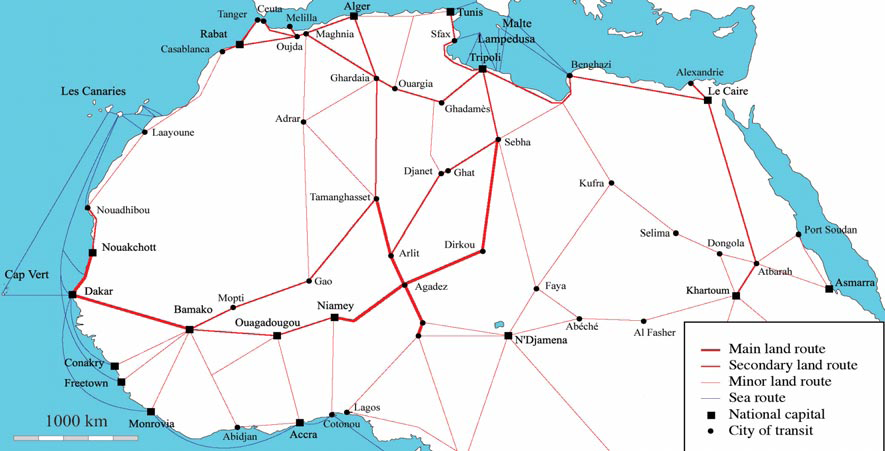
Main routes of present-day Trans-Saharan migrations

1 Comment

Filed under Algeria, Analysis, Data / Stats, Eastern Atlantic, European Union, Frontex, Italy, Libya, Malta, Mauritania, Mediterranean, Morocco, Spain

ECtHR Decision in Medvedyev and Others v France

The Grand Chamber of the European Court of Human Rights issued its decision in Case of Medvedyev and Others v. France (Application no. 3394/03) on 29 March.  The applicants in the case were crew members on a Cambodian ship intercepted by the French Navy near Cape Verde.  The crew members were brought to France where they were convicted of drug smuggling.  Proceedings were then brought by the crew members before the ECtHR to challenge, among other things, the legality of their detention at sea.

An analysis of the decision by Douglas Guilfoyle, Lecturer in Law at University College London, is posted on EJIL: Talk! – “ECHR Rights at Sea: Medvedyev and others v. France.

From the Registrar’s Press Release:

“Article 1- The Court had established in its case-law that the responsibility of a State Party to the European Convention on Human Rights could arise in an area outside its national territory when as a consequence of military action it exercised effective control of that area, or in cases involving the activities of its diplomatic or consular agents abroad and on board aircraft and ships registered in, or flying the flag of, the State concerned. France had exercised full and exclusive control over the [ship] and its crew, at least de facto, from the time of its interception, in a continuous and uninterrupted manner. Besides the interception of the [ship] by the French Navy, its rerouting had been ordered by the French authorities, and the [ship’s] crew had remained under the control of the French military throughout the voyage to Brest. Accordingly, the applicants had been effectively within France’s jurisdiction for the purposes of Article 1.

Article 5 § 1 – The applicants had been under the control of the special military forces and deprived of their liberty throughout the voyage, as the ship’s course had been imposed by the French military. The Court therefore considered that their situation after the ship was boarded had amounted to a deprivation of liberty within the meaning of Article 5. The Court was fully aware of the need to combat international drug trafficking and could see why States were so firm in that regard. However, while noting the special nature of the maritime environment, it took the view that this could not justify the creation of an area outside the law. [***] Accordingly, the deprivation of liberty to which the applicants had been subjected between the boarding of their ship and its arrival in Brest had not been “lawful”, for lack of a legal basis of the requisite quality to satisfy the general principle of legal certainty. The Court therefore held by ten votes to seven that there had been a violation of Article 5 § 1.

Article 5 § 3 – The Court reiterated that Article 5 was in the first rank of the fundamental rights that protected the physical security of an individual, and that three strands in particular could be identified as running through the Court’s case-law: strict interpretation of the exceptions, the lawfulness of the detention and the promptness or speediness of the judicial controls, which must be automatic and must be carried out by a judicial officer offering the requisite guarantees of independence from the executive and the parties and with the power to order release after reviewing whether or not the detention was justified. While the Court had already noted that terrorist offences presented the authorities with special problems, that did not give them carte blanche to place suspects in police custody, free from effective control. The same applied to the fight against drug trafficking on the high seas. [***] At the time of its interception the [ship] had been off the coast of the Cape Verde islands, and therefore a long way from the French coast. There was nothing to indicate that it had taken any longer than necessary to escort it to France, particularly in view of the weather conditions and the poor state of repair of the vessel, which made it impossible for it to travel any faster. In view of these “wholly exceptional circumstances”, it had been materially impossible to bring the applicants before the investigating judges any sooner, bearing in mind that they had been brought before them eight or nine hours after their arrival, a period which was compatible with the requirements of Article 5 § 3. The Court therefore held by nine votes to eight that there had been no violation of Article 5 § 3.”

Click here for the EJIL: Talk! analysis by Douglas Guilfoyle.

Click here for the Press Release from the Registrar.

Click here (EN) or here (FR) for the Decision of the Grand Chamber.

Leave a comment

Filed under Eastern Atlantic, European Court of Human Rights, France, Judicial

COE Committee of Ministers: “Europe’s boat people: mixed migration flows by sea into southern Europe”

The Council of Europe’s Committee of Ministers on 31 March adopted its Reply to COE Parliamentary Assembly Recommendation 1850 (2008) on“Europe’s boat people: mixed migration flows by sea into southern Europe.”

Comments from the COE European Committee for the Prevention of Torture and Inhuman or Degrading Treatment or Punishment are attached to the Rely as an Appendix.

The Reply contains an acknowledgement that the Committee of Ministers was not able to reach agreement on the recommendation that guidelines be prepared for minimum standards to be applied to the detention of irregular migrants:

“5. The Committee of Ministers has taken note of the proposal that guidelines be prepared for minimum standards to be applied to the detention of irregular migrants and asylum seekers. However, the Committee of Ministers has not, at the present time, reached a common position with regard to examining possibilities for Council of Europe action in this area. The Committee of Ministers underlines the importance of the relevant instruments of the Council of Europe, such as the European Convention on Human Rights and the recommendations adopted by the Committee of Ministers in this field (see paragraph 9 below), as well as those emerging from the work of the CPT and the Commissioner for Human Rights. It notes the ongoing work in the European Union in this field, including the revision under way of the 2003 directive laying down minimum standards for the reception of asylum seekers.”

Parliamentary Assembly Recommendation 1850 was issued in 2008 prior to the implementation in 2009 of Italy’s push-back practice and the Committee of Ministers’ Reply does not make explicit reference to Italy’s push-back policy.  The Recommendation and Reply are focused on the treatment of irregular migrants as they arrive on the shores of member states.

But there are several statements in the Reply which should apply implicitly to the irregular migrants whether encountered upon arrival on shore or intercepted or rescued in international waters.

For example:

“6. Particularly significant instruments in this field, also to be borne in mind in the framework of any possible activity in this area, include Committee of Ministers’ Recommendation No. R (98) 13 of 18 September 1998 on the right of rejected asylum seekers to an effective remedy against decisions on expulsion in the context of Article 3 of the European Convention on Human Rights, Recommendation No. R (98) 15 on the training of officials who first come into contact with asylum seekers, in particular at border points and Recommendation Rec(2003)5 on measures of detention of asylum seekers. The Committee of Ministers would also signal the “Twenty guidelines on forced return” adopted on 20 May 2005 and the Guidelines on human rights protection in the context of accelerated asylum procedures adopted on 1 July 2009.”

“7. The Committee of Ministers would also refer to other texts relevant in this area, such as its reply to Parliamentary Assembly Recommendation 1755 (2006) on “Human rights of irregular migrants” in which it draws attention to the minimum safeguards provided for in the European Convention on Human Rights that can be applied to irregular migrants. It also recalls its Recommendation No. R (2000) 3 to member states on the right to satisfaction of basic material needs of persons in situations of extreme hardship, which provides a minimum threshold of rights which should be recognised regardless of their status.”

“10. The Committee of Ministers would also draw attention to the extensive work of the Commissioner for Human Rights in this field and to his recommendations to member states and his appeals for solidarity within Europe with those countries that are on the frontline and facing a very difficult situation. It also refers to the regular exchanges of views that it holds with the Commissioner during the year. These exchanges are both of a general nature but also concern specific country reports in which he addresses, inter alia, the protection of human rights of immigrants and asylum seekers, including, where relevant, those arriving by sea. [***]”

Click here for the full Committee of Ministers Reply.

1 Comment

Filed under Aegean Sea, Commissioner for Human Rights, Committee of Ministers, Council of Europe, Eastern Atlantic, European Committee for the Prevention of Torture and Inhuman or Degrading Treatment or Punishment, Greece, Italy, Mediterranean, Spain, Statements

Analysis of the Real Instituto Elcano- Frontex: Successful Blame Shifting of the Member States?

Analysis of the Real Instituto Elcano: “Frontex: Successful Blame Shifting of the Member States?” by Jorrit J. Rijpma, PhD European University Institute, Florence, and Lecturer in EU law, Europa Instituut, Leiden University.

Excerpts:

“Frontex in Short – Frontex can be seen as the outcome of a ‘re-balancing’ of powers between the Member States, the Council and the Commission following the communitarisation of the policy on external borders after the Treaty of Amsterdam, constituting an important shift from the intergovernmental coordination of operational activity under the Council to a more Community-based approach. [***]

Joint Operations at Sea – [***] Currently, the most controversial practice is that of the diversion by national border guards of ships back to their point of departure. This practice entails not only a real risk to the life and safety of the passengers on board these often unseaworthy ships, but as regards possible asylum seekers on board, it also risks violating the right to claim asylum and the prohibition of refoulement. The Greek coast guard has the questionable reputation of regularly diverting boats back to the Turkish shores. Italy has openly admitted to the interception and return of irregular migrants and asylum seekers from Libya under its 2008 Treaty on Friendship, Partnership and Cooperation with the latter country. Both within and outside the Hera operations, Spain has been returning people to Senegal and Mauritania, but here at least the interceptions are formally cast in terms of rescue operations and transfer to the nearest place of safety.

Frontex: the Lesser Evil?- There are many reasons why Frontex can be subject to criticism. It could be argued that it is an instrument of an essentially flawed EU migration and asylum policy. [***] Finally, it could be said that the Agency reinforces a securitised perception of what is essentially a humanitarian problem through its one-sided mandate, the background of most of its staff in national law-enforcement agencies and its military-style operations. [***] However, it is important to realise that for the moment the Agency’s scope for independent action remains very limited, both in practical and in legal terms. Serious human-rights violations are more likely to occur in operations from national border guards removed from the public eye, than in relatively well-scrutinised joint operations. Frontex, being a Community body, is subject to numerous reporting and evaluation duties, as well rules on transparency. [***]

Conclusion: Efforts should focus on ensuring full respect of international rules regarding international protection and search and rescue and an authoritative interpretation of these rules in a broad sense. These are essentially political decisions. It is the Member States and the Community institutions, not Frontex, that are to be reproached for the failure to do so. [***]”

Click here for full Analysis.

Leave a comment

Filed under Aegean Sea, Analysis, Eastern Atlantic, European Union, Frontex, Greece, Italy, Libya, Malta, Mauritania, Mediterranean, Senegal, Spain, Turkey

Público: La llegada de inmigrantes en cayucos a España ha caído hasta mínimos históricos

«La llegada de inmigrantes en cayucos o pateras a España ha caído en los últimos meses hasta mínimos históricos. Entre enero y febrero de este año hubo sólo 126 detenciones, por 1.432 en el mismo periodo de 2009, lo que supone un 91,2% menos. Es el arranque de año con menor migración marítima desde que el Ministerio del Interior empezó a contabilizar losdesembarcos, en 1999. »

[“The arrival of immigrants in cayucos or pateras in Spain has fallen in recent months to historic lows. Between January and February of this year there were only 126 arrests compared with 1,432 during the same period in 2009, representing a 91.2% reduction.  These are the smallest numbers of beginning of year arrivals since the Interior Ministry began tracking arrivals in 1999.”]

Click here for article.

Leave a comment

Filed under Data / Stats, Eastern Atlantic, Mediterranean, News, Spain

New CARIM Migration Profile on Mauritania

CARIM has issued an updated migration profile for Mauritania.  Excerpts pertaining to irregular migration by sea include:

“Mauritania has worked with Spain and FRONTEX since 2006 to combat irregular emigration by readmitting foreign nationals who transited through the country and who are placed in detention camps before repatriation….”

“Due to Mauritania’s position as a juncture between Northern and Sub-Saharan Africa, its proximity with a peripheral part of EU territory (the Canary Islands) as well as its relatively lax border controls, today’s challenges include managing clandestine and transit migration, and sensitizing the local population and government officials to the human rights of asylum seekers and undocumented migrants. In spite of a flourishing civil society advocating democracy and a human-rightist approach towards migration governance, Mauritania has been severely criticized for its treatment of undocumented immigrants and refugees in the last years (Amnesty International Report 2008)….”

Click here for the full March 2010 profile.

Leave a comment

Filed under Analysis, Eastern Atlantic, Mauritania, Reports

EP Vote Allows New Guidelines for Frontex Operations at Sea to Take Effect

New guidelines governing Frontex enforcement operations at sea will now take effect even though the European Parliament voted on 25 March to reject the guidelines by a vote of 336 to 253 with 30 abstentions.  However, an absolute majority of all EP Members, 369 votes, was required in order to block the new guidelines.

Malta opposes the new guidelines.  The Times of Malta reported that “the European Commission and Council have managed to get their way and will be able to introduce new rules of engagement during this year’s anti-migration patrol missions coordinated by Frontex as the resolution to reject these rules approved by the Civil Liberties Committee last week didn’t manage to garner the necessary support of the Socialist group in the EP.”

“According to the new rules, all irregular immigrants and asylum seekers saved on the high-seas during a Frontex mission have to be taken to the mission’s host country and not to the closer safe port. This means that if Malta hosts a Frontex mission in the future, as it has done in the past two years, it will have to take all the illegal immigrants found at sea. Malta has already declared that it will not continue to take part in Frontex missions under these rules.”

An EP press release stated that the “EU guidelines say[]that border patrols have a moral duty to rescue migrants in distress at sea….  The guidelines cover ‘search and rescue situations and for disembarkation’ in the context of operations on the EU’s sea borders.  They state that Member States fleets operating under FRONTEX must render assistance to persons in distress at sea, regardless of their nationality or status, or the circumstances in which that person is found…. Disembarkation procedures should be carried out in line with international law and existing bilateral agreements between Member States and third countries.”

Click here for article.

Click here for EP Press Release.

Click here, here and here for earlier posts on the new Guidelines.

2 Comments

Filed under Aegean Sea, Eastern Atlantic, European Union, Frontex, Malta, Mediterranean, News

EP Report: “What system of burden-sharing between Member States for the reception of asylum seekers?”

At the beginning of March, a 200+ page report assessing the cost of asylum seekers on EU member states was released by the European Parliament’s Directorate General for Internal Policies, Policy Department C: Citizens’ Rights and Constitutional Affairs.

The report is entitled: “What system of burden-sharing between Member States for the reception of asylum seekers?”

Excerpts from the Executive Summary:

“Background –  [***] Moreover, although asylum figures today are higher than in the mid 1980s, the number of asylum applications has not been steadily increasing as many assume. … There has been increased concern in tackling irregular migration among the European Member States, which has led to an increasing focus on preventing irregular migrants from reaching the EU. Consequently, joint efforts at border management, under the auspices of FRONTEX, have exposed grey areas in the international protection regime. For example, the extent of States’ responsibilities towards asylum seekers rescued or intercepted in international waters has been subject to debate. Operation Nautilus in 2008 illustrated the difficulties Member States face in agreeing on who should be responsible for asylum seekers amongst irregular migrants intercepted at sea. Member States have also been hampered by the lack of an agreed protocol to assign responsibility for any asylum seekers amongst the irregular migrants.

Some Member States, notably Malta, have protested at the uneven distribution of asylum seekers between EU Member States, and their experiences of particular pressures resulting from their geographical situation. Linked to this, European parliamentarians, NGOs, some Member States and other stakeholders have repeatedly pointed out that the Dublin system allocates responsibility for asylum seekers without attempting to share it equitably. The pressures on EU border countries have been a particularly contentious part of this discussion, but the discussion is not limited to these. In the last six years, Sweden has for example received 40% of the 100,000 Iraqis who have claimed asylum in the EU8….

Aim of the study – The current study aims to provide information and evidence to inform the ongoing debates. This is largely based on three overarching questions:

• What are the asylum related costs borne by Member States?

• Which of these costs could be shared at European level?

• How could these costs be shared? [***]

Key Findings

• Overall refugee numbers in Europe are relatively low. In 2007 Europe only hosted 14 per cent of the world’s refugees or people in refugee-like situations. In 2007 about 220,000 asylum applications were received within the EU27, only just over half the 2001-02 peak of over 420,000 asylum seekers, and about a third of the peak of 1992. This is equivalent to less than one asylum seeker per 2200 European inhabitants.

• The total size of asylum spending reported by Member States is relatively low. The total size of direct spending by each Member State has generally not been more than the equivalent of 1/14th of the international aid target of 0.7 per cent of Gross National Income. At €4,160m EU wide, these total asylum-related costs to EU Member States in 2007 are less than what UK citizens spent on pets and pet food in the same year….

• Some countries face disproportionately high asylum costs, with the share of asylum spending in relation to GDP being 1000 times higher in some Member States (e.g. Malta) than others (e.g. Portugal) in 2007. When cost of living is taken into account, the differences remain large….

• If no additional responsibility sharing measures are introduced and current proposals are not implemented, there will continue to be a highly uneven distribution of asylum costs and pressures across Europe. This study shows that there are critical differences between Member States and the costs they carry for receiving asylum seekers….

• Only physical relocation of asylum seekers will make a significant contribution to a more equitable distribution of asylum costs across Member States. If this is to avoid generating significant human costs and additional costs to the Member States, it is crucial that this is based on a voluntary relocation of the asylum seeker….”

Click here for the full report.

Click here for EP Press Service article about the Report.

Leave a comment

Filed under Aegean Sea, Eastern Atlantic, European Union, Frontex, Malta, Mediterranean, Reports

Réaction du REMDH suite au Sommet UE-Maroc

“Réaction et commentaires du Réseau Euro-Méditerranéen des Droits de l’Homme (REMDH) suite à la Déclaration conjointe publiée lors du premier Sommet UE-Maroc qui s’est tenu les 6 et 7 Mars 2010 à Grenade:

Le REMDH note avec satisfaction que la déclaration conjointe réaffirme les droits de l’Homme comme étant « l’un des piliers fondamentaux du partenariat UE-Maroc ». Il salue l’accent mis sur la nécessité de mettre en œuvre toutes les recommandations de l’Instance Equité et Réconciliation (IER) ainsi que de poursuivre les réformes en matière de justice, de liberté d’expression, de presse et d’association.  Cependant, le REMDH regrette que la Déclaration ne mentionne pas explicitement les droits de l’Homme parmi les domaines qui requièrent une attention particulière comme la réforme de la justice ou les droits des migrants….

Le REMDH exprime par ailleurs sa plus vive inquiétude concernant la volonté réaffirmée de conclure dès que possible un accord de réadmission. La loi relative à l’entrée et au séjour des étrangers au Maroc ne garantit pas la protection des droits de l’Homme, en particulier, le droit à un recours effectif ainsi que la protection contre le retour forcé vers un pays où la sécurité de la personne ne serait pas assurée. Dans ce contexte, le REMDH estime que les droits des migrants, réfugiés et demandeurs d’asile ne sont pas garantis. Il demande à l’UE et au Maroc de respecter leurs engagements internationaux en la matière notamment en interrompant les négociations en cours en vue de la conclusion d’un accord de réadmission…..”

Cliquez ici pour le commentaire complet.

Leave a comment

Filed under Communiqués, Eastern Atlantic, European Union, Mediterranean, Morocco, Statements

Déclaration Conjointe Sommet UE-Maroc

Extraits de la Déclaration conjointe Sommet Union Européenne-Maroc Grenade, 7 mars 2010:

“[***] Le Sommet couronne une intense période d’accélération dans les relations UE-Maroc, initiée par l’entrée en vigueur de l’Accord d’association en mars 2000, renforcée par la mise en place du Plan d’Action, dans le cadre de la Politique Européenne de Voisinage, en juillet 2005 et par l’adoption du document conjoint sur le Statut Avancé lors du Conseil d’Association d’octobre 2008.

Ce partenariat qui traduit un processus intense de dialogue couvrant tous les domaines politiques, économiques, sociaux et humains, reflète les aspirations des deux Parties à consolider la spécificité de leur partenariat….

I. L’UNION EUROPEENNE ET LE MAROC PARTENAIRES DANS UN MONDE GLOBAL

[***]  En matière de migration, le Maroc et l’UE conviennent de renforcer les mécanismes de coopération entre les pays d’origine, de transit et de destination, à travers la poursuite du dialogue entre les deux Parties et l’appui au processus de renforcement des capacités des parties concernées en matière de lutte contre l’immigration illégale, promotion de la migration régulière, optimisation de la contribution des migrants au développement et traitement des causes profondes de la migration. Une telle approche globale et équilibrée des questions de migration, incluant aussi une coopération pour le retour et la réadmission des migrants en situation irrégulière, doit constituer un élément fondamental du partenariat entre l’UE et le Maroc.

Le Maroc et l’UE saluent les réalisations du processus euro-africain sur la migration et le développement, lancé à Rabat en juillet 2006 et renforcé à Paris en novembre 2008, processus dans lequel le Maroc a joué un rôle moteur….

II. PREMIERS PAS VERS LA CONSOLIDATION DU STATUT AVANCE

[***]  Dimension humaine.

[***]  Le Maroc et l’UE notent avec satisfaction le consensus qui émerge au niveau international sur la nécessité d’examiner les questions migratoires dans le cadre d’une approche globale basée sur la responsabilité partagée et l’action collective concertée et associant la lutte contre la migration irrégulière, la gestion de la migration régulière et le lien entre migration et le développement.

Le Maroc et l’UE ont convenu de la nécessité de conclure dès que possible la négociation de l’accord de réadmission. La conclusion de cet accord est de nature à développer leur coopération dans le domaine de la migration, leur objectif commun étant de lutter contre la migration irrégulière, de favoriser l’utilisation de canaux réguliers de mobilité et migration, et de promouvoir l’impact positif de la migration sur le développement. La finalisation de la négociation sur l’accord de réadmission permettra une coopération globale sur la migration incluant la facilitation des visas.

III. UN AGENDA OPERATIONNEL POUR L´AVENIR

[***] Nouvel instrument qui prendra le relais du Plan d’action UE-Maroc L’actuel Plan d’action UE-Maroc adopté en 2005 pour une période de 5 ans arrivant à son échéance, les deux parties soulignent l’importance de finaliser le nouvel instrument qui doit être adopté en 2010 et qui prendra le relais du Plan d’action actuel. Ce nouveau document devra donner un contenu opérationnel aux objectifs du Statut avancé en intégrant les réformes agréées et les actions prévues dans le cadre du Plan d’action qui n’ont pas encore été mises  en oeuvre, ainsi que les éléments nouveaux qui sont prévus dans le document conjoint. Il intégrera également les éléments du programme gouvernemental de convergence réglementaire….”

Cliquez ici pour la Déclaration complete.

Leave a comment

Filed under Eastern Atlantic, European Union, Mediterranean, Morocco, Statements

Lettre ouverte au Sommet UE-Maroc relative à l’accord de réadmission UE-Maroc

Une letter de la part des associations défendant les droits des migrants où on recommande l’arrêt de toute négociation allant dans le sens de la conclusion d’un accord de réadmission UE-Maroc:

“Depuis le début des années 2000, l’Union européenne tente d’imposer au Maroc la signature d’un accord de réadmission qui comprendrait la réadmission des ressortissants marocains en situation irrégulière en Europe ainsi que celle de tout étranger ayant transité par le Maroc avant de parvenir sur le sol européen.   A ce jour, le Maroc a pu résister aux pressions de l’Union européenne ….  En effet, les accords de réadmission sont un des instruments centraux de la politique migratoire de l’UE, réitérés dans le Pacte européen sur l’asile adopté par le Conseil européen le 16 octobre 2008. Les négociations entre l’UE et les différents pays se réalisent en général dans l’opacité la plus totale….

Suite à l’adoption du principe d’un Statut avancé pour le Maroc et dans le cadre du premier Sommet UE-Maroc, qui se déroule du 6 au 8 mars à Grenade, nous nous inquiétons des pressions de l’Union européenne sur le Maroc qui semblent de plus en plus fortes. En effet, bien que l’UE déclarait, au sujet du Statut avancé du Maroc, lors du 8ème conseil d’association,  que « ce partenariat renforcé entre l’UE et le Maroc traduit la volonté de l’UE de répondre positivement aux attentes et aux besoins spécifiques du Maroc, afin de l’accompagner dans son processus courageux de modernisation et de démocratisation (…) ». Il est pourtant clair que la signature de l’accord de réadmission UE-Maroc ne répond en rien aux attentes et aux besoins spécifiques du Maroc. Au contraire, l’UE à travers ses politiques migratoires restrictives, notamment celles des visas, a transformé les pays frontaliers de l’UE en pays de transit et cherche aujourd’hui à les ancrer dans ce rôle en expulsant vers ces territoires toute personne en situation irrégulière en Europe ayant transité par ces derniers. …

Nous dénonçons par ailleurs, le rôle ambigu de l’UE qui d’une part déclare encourager le Maroc dans son processus de démocratisation et de promotion des droits humains, tout en le poussant, d’autre part à mettre en place des mesures restrictives de contrôle des frontières et de réadmission qui mettent en péril le respect des droits humains et en particulier celui des migrants tant sur le territoire marocain qu’européen. Pour rappel, cela a été déjà le cas par le passé, notamment lors des événements de Ceuta et Melilla….”

Cliquez ici pour la letter complete.

Leave a comment

Filed under Eastern Atlantic, European Union, Mediterranean, Morocco, Statements

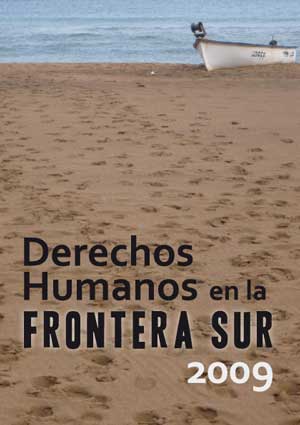
Apdha: Nuevo Informe “Derechos Humanos en la Frontera Sur 2009”

La Asociación Pro Derechos Humanos de Andalucía viene realizando desde 1997 un seguimiento de la evolución de los flujos migratorios referidos a España y de las políticas desarrolladas por la Unión Europea y los sucesivos gobiernos españoles para abordarlos y en general reprimirlos y contenerlos….

Según los datos de la APDHA [Asociación Pro Derechos Humanos de Andalucía] viene, 8.728 personas han sido detenidas al llegar a las costas españolas durante el año 2009, trescientas más que las que recuenta el Ministerio del Interior. En todo caso, ello supone un descenso en las llegadas por esta vía de más del 45% con respecto a 2008, cuando las detenciones alcanzaron la cifra de 15.572 personas….

Sobre un 30% de las personas que intentan llegar a nuestro país, finalmente lo consiguen… Por tanto, las cifras de personas interceptadas sólo reflejan una parte de la realidad. … [L]as cifras aportadas por el Ministerio del Interior no se reflejan el número de personas interceptadas en las costas africanas. Estas son, cada vez más, otro de los resultados del control de los flujos migratorios que la política de externalización ha trasladado a los países africanos. Resulta difícil concluir cuántas personas son interceptadas en la aplicación de estas políticas de externalización en las costas africanas o aledaños.

La APDHA, con muchas dificultades, ha seguido informes de la operativa Frontex, de la Marina Nacional Argelina, de la Gendarmería marroquí y de su Gobierno, o de la policía costera mauritana. Pocas cifras proporciona la guardia costera de Senegal, por no referirnos a Guinea, Gambia o Cabo Verde. Pero de todo ello, desde la APDHA hemos llegado a la conclusión que no menos de 11.000 personas han sido detenidas en las costas africanas a lo largo de 2009, alcanzando así la cifra de 19.728 personas detenidas intentando llegar a España durante el 2009.

Insistimos en que todas estas cifras no son sino un reflejo de la realidad, que ponen de manifiesto dos cuestiones: un acusado descenso de los flujos migratorios que, paradójicamente, se solapan con un acusado incremento de las razones que obligan a la emigración….

La vigilancia de las costas es cada vez más férrea por parte de Mauritania, Senegal o Marruecos. Pero a ello hay que añadir el efecto de la implementación de crecientes y férreos controles en las fronteras que cercan el Sahel que tienen sin duda, a nuestro modesto entender, mayor importancia que los propios controles en las costas y aguas por parte de España y el Frontex….

En todo caso, no está de más resaltar aquí que esos procesos de externalización y creciente militarización de las fronteras africanas están provocando graves sufrimientos y violaciones de derechos en las mismas. La APDHA reivindica que el respeto a los derechos humanos, también en las fronteras, no puede obviarse por razones de control de las migraciones. Y entre ellos, sin duda, se encuentra el derecho a salir y regresar al propio país, tal como recoge el art. 13.2 de la Declaración Universal de los Derechos Humanos….”

Click here for full Report.

Click here for article about the Report.

Leave a comment

Filed under Data / Stats, Eastern Atlantic, European Union, Frontex, Gambia, Mauritania, Mediterranean, Morocco, Reports, Senegal, Spain

EU-Morocco Summit Meeting

The first post-Lisbon Treaty summit meeting between the EU and another country will take place 6 and 7 March in Granada between the EU and Morocco.

Among the topics of discussion will be immigration and the Union for the Mediterranean.  Spanish Minister for Foreign Affairs, Miguel Ángel Moratinos, said  “…we will discuss immigration issues, which are very important. Morocco is a partner that assists European countries and source countries enormously to manage migratory flows co-responsibly, and it is therefore a key country for the strong and effective management of these flows….”

Click here and here for Spanish EU Presidency statements and here for an article (en francais).

Leave a comment

Filed under Eastern Atlantic, European Union, Mediterranean, Morocco, News, Spain

JHA Council Conclusions on 29 measures for Reinforcing External Borders and Combating Illegal Immigration

Here are excerpts from the Justice and Home Affairs Council conclusions adopted on 25 February 2010:

“Council conclusions on 29 measures for reinforcing the protection of the external borders and combating illegal immigration

2998th JUSTICE and HOME AFFAIRS Council meeting – Brussels, 25 and 26 February 2010

The Council adopted the following conclusions:

The Council:

a) Taking into account the momentum created for the further development of the area of freedom, security and justice represented by the entry into force of the Lisbon Treaty and by the political priorities included in the Stockholm Programme, the European Pact on Immigration and Asylum, the Global Approach to Migration and the European Council Conclusions of June and October 2009; [***]

d) Stressing the need to share and assess analysis of the continuing illegal arrivals of migrants at the southern maritime borders, as well as the eastern land borders, as shown in particular by recent events in the Mediterranean area, and of the smuggling of migrants and trafficking in human beings, which often have tragic consequences; and to take a series of measures immediately, in the short term and medium term, in order to address the challenges;

e) Underlining that all measures and actions taken as a consequence of these conclusions shall fully respect human rights, the protection of persons in need of international protection and the principle of non-refoulement; [***]

Concerning the activities of FRONTEX, the Council has agreed:

1. To seek agreement as a matter of urgency on the Commission proposal for a Regulation of the European Parliament and of the Council amending the FRONTEX Regulation, in order to reinforce the capabilities of the FRONTEX Agency. [***]

4. To improve operational cooperation with third countries of origin and transit, in order to improve joint patrolling on land and at sea, upon consent of the Member State concerned, return, and collection and exchange of relevant information within the applicable legal framework, and other effective preventive measures in the field of border management and illegal immigration.

5. To underline the importance of the role of the European Asylum Support Office (EASO) in developing methods to better identify those who are in need of international protection in mixed flows and in cooperating with FRONTEX where ever possible, and to welcome the development of the regional protection programs and the enhancement of the dialogue and cooperation on international protection with third countries. [***]

9. To invite FRONTEX to implement its decision to carry out a pilot project for the creation of an operational office in the eastern Mediterranean, in Piraeus, as soon as possible in 2010. The Council takes note that Frontex has agreed that, on the basis of an independent external evaluation, it may decide whether to pursue the pilot project and/or establish other Frontex operational offices as appropriate, and invites FRONTEX to report to Council on the matter.

Concerning the development of the European Surveillance System – EUROSUR, the Council has agreed:

10. To call on the Member States to implement the phases and steps laid down for the development of EUROSUR as soon as possible, in order to reinforce cooperation and Member States’ border surveillance capabilities. The Council invites the European Commission to report on EUROSUR progress on mid-2010.

11. To urge relevant Member States to establish or further develop a single national border surveillance system and a single national Coordination Centre. A network of national Coordination Centres, compatible with the FRONTEX Information System, and available on a 24/7 basis in real time, should be fully operational on a pilot basis as of 2011, involving as many Member States of the southern and eastern external borders as possible. The Commission is invited to present legislative proposals if necessary to consolidate the network of Member States by 2013.

12. To create a Common pre-frontier intelligence picture in order to provide the Coordination Centres with pre-frontier information provided by Member States, Frontex and third countries. To this end, the Council invites Frontex, in close cooperation with the Commission and the Member States to take the necessary measures to implement the study carried out by the Commission in 2009.

13. To encourage cooperation by neighbouring third countries in border surveillance. It is essential that within the territorial scope of EUROSUR and in the current financial framework, financial and logistic support from the European Union and its Member States be made available to the third countries whose cooperation could significantly contribute to controlling illegal immigration flows, in order to improve their capacity to manage their own borders.

14. To invite the Commission to report before the end of 2010 on how the conclusions of the Global Monitoring for Environment and Security (GMES) border surveillance group on common application of surveillance tools, such as satellites, could be implemented in the EU land and sea borders. [***]

Concerning solidarity and the integrated management of external borders by the Member States, the Council has agreed:

17. To request Frontex and the Member States concerned to further develop the European Patrols Network (EPN) in order to generalize bilateral joint maritime patrols, in particular between neighbouring Member States at the southern and eastern maritime borders, taking into account the experience gained on joint police patrols in the context of the Prüm Decision, and to ensure the full integration of the EPN in the EUROSUR network. [***]

Concerning the cooperation with third countries, the Council has agreed:

22. To ensure that the migration policy objectives are at the centre of the political dialogue with relevant third countries of origin and transit, with a view to the strategic, evidence based and systematic implementation of the Global Approach to Migration in all its dimensions, i.e. legal migration, illegal immigration and migration and development. This also requires, as a matter of principle, that all parties concerned assume their responsibilities in terms of return and readmission of migrants entering or staying illegally, including those migrants who have entered or tried to enter the European Union illegally from their territory. [***]

24. To enhance in particular the implementation of the Global Approach in the dialogue on migration with the main countries of origin and transit, such as, in accordance with the Stockholm Programme, those of the Mediterranean area, the East and South-Eastern Europe and Africa. This process may cover, on a case by case basis, all aspects of migration, including also cooperation on and support of border management, return and readmission, and, where appropriate, mobility issues. In doing so, the EU will promote human rights and the full respect for relevant international obligations. Dialogue and cooperation should be further developed also with other countries and regions such as those in Asia and Latin America on the basis of the identification of common interests and challenges.

25. To implement actively the European Council Conclusions of June and October 2009, including in particular by taking forward the dialogue on migration with Libya, with a view to setting up in the short term an effective cooperation. The Commission is invited to explore, as a matter of urgency, a cooperation agenda between the European Union and Libya with a view to including initiatives on maritime cooperation, border management (including possibilities for the development of an integrated surveillance system), international protection, effective return and readmission of irregular migrants and issues of mobility of persons.

26. To welcome the constructive resumption of the formal negotiations on a EU/Turkey readmission agreement, which makes provision for the return of third country nationals, and to call for its conclusion as a matter of urgency, and to stress that adequate implementation of already existing bilateral readmission agreements remains a priority. Building on the dialogue now under way with Turkey, the Council invites the Commission, the Member States and Turkey to further develop cooperation on migration, international protection and mobility issues. The Commission is also invited, in the context of the existing Instrument for Pre-accession Assistance (IPA) financial framework, to explore possibilities to provide adequate financial means to improve Turkish capacity to tackle illegal migration, including support to the implementation of the Turkish integrated border management system.

27. To underline the importance of swift finalisation of the negotiation of Article 13 of the Cotonou Agreement, the revision of which should seek to reinforce the three dimensions of the Global Approach, and in particular the effectiveness of readmission obligations.

28. To invite the Commission to identify the necessary means to support enhanced capacity building and infrastructures in relevant third countries, so that they can control efficiently their external borders and tackle illegal immigration, taking also into account the assessments made by FRONTEX.

29. To invite the Commission to report on the implementation of these Conclusions by the end of 2010.”

Click here for full Document.
Leave a comment

Filed under Aegean Sea, Eastern Atlantic, European Union, Frontex, Libya, Mediterranean, News, Turkey