Category Archives: Italy

Malmström: Migration Policy Should Not Be Event Driven

From Commissioner’s Cecilia Malmström blog:

“It’s important to prepare for what’s happening in Northern Africa and to have a long term strategy for the cooperation with our neighbouring countries. There’s however quite worrying tendencies in Member States to be too event-driven and calling for quick-fix measures. It’s important to remember that out of the approx. 25.000 migrants coming to the EU the last couple of months only a few thousands are refugees, seeking asylum in the EU. The others are economical migrants from Tunisia looking for work and a better life in Europe. These people are likely to be sent back to Tunisia. The few thousand refugees that have been coming the last months should also be seen in the right perspective – last year France alone received 48.000 asylum seekers and Sweden 32.000 – the total number of refugees coming to the EU last year was 236.000.

As I wrote in my previous blog entry, migration policy needs long term strategies and well thought through measures and mustn’t be driven by populist movements. Next week I’ll present a Strategy Paper presenting a holistic approach on migration to my colleagues in the Commission. The Strategy Paper addresses the urgent need for a common European asylum and migration policy and the need for solidarity with the European countries most exposed to migration flows (Italy and Malta at this point), but also with neighbouring countries, such as Tunisia and Egypt, where the lion part of the refugees from Libya have fled to.”

On a slightly related point, the link between anti-immigrant views and increasing support for some political parties such the Front National and Marine Le Pen in France and the Northern League in Italy are well know.  In Finland a populist party, the True Finns, has for the first time entered Government after its stunning third place finish in the 17 April parliamentary elections.  Many have described the True Finns as populist party that is most interested in the Euro crisis and the financial bailouts.  But recent public comments of new True Finn MP Teuvo Hakkarainen reveal the anti-immigrant and racist sentiments held by some party members.  According to YLE, Hakkarainen said that “Negros” would be arriving at Finland’s borders and warned that minarets would arise all over Helsinki.  Some credit is due to True Finns Party chair Timo Soini who has reprimanded Hakkarainen for his comments.  The new Government has just been formed and the True Finns will chair the parliamentary committees responsible for Foreign Affairs, Defence, and the Administration Committee which has responsibility for immigration issues.  Over 1000 people demonstrated in front of the Parliament building earlier in the week in support of tolerance and multiculturalism.

Click here (EN) and here (SV) for blog post.

Click here and here for YLE articles.

Leave a comment

Filed under European Union, France, Italy, Libya, Mediterranean, News, Tunisia

ECJ Rules Italy May Not Criminally Punish Illegally Staying Migrants Who Fail to Depart

The First Chamber of the European Court of Justice issued a decision on 28 April ruling that the Italian law which punishes migrants who remain in Italy after being ordered to depart is precluded by EU Directive 2008/115 which established the procedure by which Member States may return illegally staying third country nationals.  The ruling was made in the case of Hassen El Dridi alias Soufi Karim, Case C‑61/11 PPU, 28 April 2011.

The Italian law in question was enacted in 2009 as part of a “security package” (“pacchetto sicurezza”) of immigration laws and punishes the act of illegally staying in Italy after being ordered to depart with 1 to 4 years imprisonment.  Italy has never transposed Directive 2008/115.  The deadline for doing so was 24 December 2010.

The Court’s ruling was as follows:

“Directive 2008/115/EC of the European Parliament and of the Council of 16 December 2008 on common standards and procedures in Member States for returning illegally staying third-country nationals, in particular Articles 15 and 16 thereof, must be interpreted as precluding a Member State’s legislation, such as that at issue in the main proceedings, which provides for a sentence of imprisonment to be imposed on an illegally staying third-country national on the sole ground that he remains, without valid grounds, on the territory of that State, contrary to an order to leave that territory within a given period.”

The Court suggested that penalties might be imposed by a Member State after the procedures required by the Directive had been exhausted: “[This] does not preclude the possibility for the Member States to adopt, with respect for the principles and objective of Directive 2008/115, provisions regulating the situation in which coercive measures have not resulted in the removal of a third-country national staying illegally on their territory.” Para. 60.

Interior Minister Roberto Maroni criticised the decision saying that it risks making expulsions difficult or impossible.  UNHCR spokeswoman Laura Boldrini said that the ECJ decision was consistent and in harmony with what has already been expressed by the Italian courts, specifically the Constitutional Court and the Supreme Court, and expressed the hope that the EU Directive would soon be implemented.

Click here for ECJ Decision.

Click here for ECJ Press Release.

Click here (EN), here (EN), here (IT), and here (IT) for articles.

The ECJ Press Release provides a summary of the ruling; here are some excerpts from the ruling:

[Facts and Procedural Background]

“[***]

18      Mr El Dridi is a third-country national who entered Italy illegally and does not hold a residence permit. A deportation decree was issued against him by the Prefect of Turin on 8 May 2004.

19      An order requiring his removal from the national territory, issued on 21 May 2010 by the Questore di Udine pursuant to that deportation decree, was notified to him on the same day….

20      A check carried out on 29 September 2010 revealed that Mr El Dridi had not complied with that removal order.

21      Mr El Dridi was sentenced at the conclusion of an expedited procedure by a single judge of the Tribunale di Trento (District Court, Trento) to one year’s imprisonment for the offence set out in Article 14(5b) of Legislative Decree No 286/1998.

22      He appealed against that decision before the Corte d’appello di Trento (Appeal Court, Trento).

[Referral of Questions to Court of Justice]

23      That [appeal] court is in doubt as to whether a criminal penalty may be imposed during administrative procedures concerning the return of a foreign national to his country of origin due to non-compliance with the stages of those procedures, since such a penalty seems contrary to the principle of sincere cooperation, to the need for attainment of the objectives of Directive 2008/115 and for ensuring the effectiveness thereof, and also to the principle that the penalty must be proportionate, appropriate and reasonable.

[***]

25      In those circumstances, the Corte d’appello di Trento … refer[ed] the following question to the Court of Justice for a preliminary ruling:

‘In the light of the principle of sincere cooperation, the purpose of which is to ensure the attainment of the objectives of the directive, and the principle that the penalty must be proportionate, appropriate and reasonable, do Articles 15 and 16 of Directive 2008/115… preclude:

—      the possibility that criminal penalties may be imposed in respect of a breach of an intermediate stage in the administrative return procedure, before that procedure is completed, by having recourse to the most severe administrative measure of constraint which remains available?

—      the possibility of a sentence of up to four years’ imprisonment being imposed in respect of a simple failure to cooperate in the deportation procedure on the part of the person concerned, in particular where the first removal order issued by the administrative authorities has not been complied with?’

[***]

[ECJ’s Rationale]

58      … the Member States may not, in order to remedy the failure of coercive measures adopted in order to carry out forced removal pursuant to Article 8(4) of [Directive 2008/115], provide for a custodial sentence, such as that provided for by Article 14(5b) of Legislative Decree No 286/1998, on the sole ground that a third-country national continues to stay illegally on the territory of a Member State after an order to leave the national territory was notified to him and the period granted in that order has expired; rather, they must pursue their efforts to enforce the return decision, which continues to produce its effects.

59      Such a penalty, due inter alia to its conditions and methods of application, risks jeopardising the attainment of the objective pursued by that directive, namely, the establishment of an effective policy of removal and repatriation of illegally staying third-country nationals. In particular, as observed by the Advocate General in point 42 of his View, national legislation such as that at issue in the main proceedings is liable to frustrate the application of the measures referred to in Article 8(1) of Directive 2008/115 and delay the enforcement of the return decision.

60      That does not preclude the possibility for the Member States to adopt, with respect for the principles and objective of Directive 2008/115, provisions regulating the situation in which coercive measures have not resulted in the removal of a third-country national staying illegally on their territory.

61      In the light of the foregoing, it will be for the national court, which is called upon, within the exercise of its jurisdiction, to apply and give full effect to provisions of European Union law, to refuse to apply any provision of Legislative Decree No 286/1998 which is contrary to the result of Directive 2008/115, including Article 14(5b) of that legislative decree (see, to that effect, Case 106/77 Simmenthal [1978] ECR 629, paragraph 24; Case C-462/99 Connect Austria [2003] ECR I-5197, paragraphs 38 and 40; and Joined Cases C‑188/10 and C‑189/10 Melki and Abdeli [2010] ECR I-0000, paragraph 43). In so doing, the referring court will have to take due account of the principle of the retroactive application of the more lenient penalty, which forms part of the constitutional traditions common to the Member States (Joined Cases C‑387/02, C‑391/02 and C‑403/02 Berlusconi and Others [2005] ECR I‑3565, paragraphs 67 to 69, and Case C‑420/06 Jager [2008] ECR I‑1315, paragraph 59).

62      Consequently, the answer to the question referred is that Directive 2008/115, in particular Articles 15 and 16 thereof, must be interpreted as precluding a Member State’s legislation, such as that at issue in the main proceedings, which provides for a sentence of imprisonment to be imposed on an illegally staying third-country national on the sole ground that he remains, without valid grounds, on the territory of that State, contrary to an order to leave that territory within a given period.

[***]

On those grounds, the Court (First Chamber) hereby rules:

Directive 2008/115/EC of the European Parliament and of the Council of 16 December 2008 on common standards and procedures in Member States for returning illegally staying third-country nationals, in particular Articles 15 and 16 thereof, must be interpreted as precluding a Member State’s legislation, such as that at issue in the main proceedings, which provides for a sentence of imprisonment to be imposed on an illegally staying third-country national on the sole ground that he remains, without valid grounds, on the territory of that State, contrary to an order to leave that territory within a given period.

2 Comments

Filed under Algeria, European Union, Italy, Judicial, News, UNHCR

650 Tunisians Repatriated by Italy Since 6 April

650 Tunisians have been summarily repatriated by Italy to Tunisia under the terms of the Italy-Tunisia agreement which took effect on 5 April.  The agreement reportedly allows Italy to return up to 60 Tunisian nationals per day on two flights.  Amnesty International’s Briefing Paper of 21 April, “Amnesty International findings and recommendations to the Italian authorities following the research visit to Lampedusa and Mineo”, is highly critical of Italy’s expedited return practice.

Click here (EN) and here (IT) for articles.

Click here for AI’s Briefing Paper.

Leave a comment

Filed under Italy, Mediterranean, News, Tunisia

Tunisian Migrant Boats Stop Arriving in Italy (for the time being) – Amnesty Int’l Criticises “Collective Summary Removals”

Italy has been continuing to deport newly arriving Tunisian migrants pursuant to the terms of its new agreement with Tunisia, the terms of which have not been made public.  Under the agreement, Tunisia has apparently agreed to the expedited returns of its nationals from Italy.  300 Tunisians were flown to Tunisia from Italy last week.

The mayor of Lampedusa, Bernardino De Rubeis, declared that the “immigration crisis” on Lampedusa is over (only 27 migrants remain on the island as of 26 April). The mayor called for the 500 extra police and military personnel who were brought to the island to deal with the migrants to leave as soon as possible so that tourists can use the hotel rooms currently occupied by the security personnel.

Amnesty International issued a Briefing Paper on 21 April: “Amnesty International findings and recommendations to the Italian authorities following the research visit to Lampedusa and Mineo.”  Amnesty is highly critical of the expedited return practices that have been implemented by Italy.

Excerpts from the Briefing Paper:

“Collective summary removals, reportedly of Tunisian nationals, from Lampedusa, from 7 April 2011 onwards, following the signing of an agreement between the Italian and Tunisian authorities.

Amnesty International is extremely concerned by the enforced removal that began on 7 April from Lampedusa, following the recent signing of an agreement between the Tunisian and Italian authorities. At the time of writing these forcible returns were ongoing and had reportedly been carried out twice a day by air since 11 April.

On 6 April, the Italian Ministry of Interior announced that Italy had signed an agreement with Tunisia pursuant to which the latter committed itself to strengthening border controls with a view to preventing departures, and to accepting the speedy readmission of people who had recently arrived and who will be arriving in Italy. Amnesty International is particularly concerned that, according to the above-mentioned announcement, Tunisian migrants arriving onto Italian shores may be “repatriated directly” and with “simplified procedures”.

In the light of this announcement, and given, in particular, Amnesty International’s findings in relation to the total inadequacy of asylum procedures on Lampedusa, the organization believes that those people who have been subjected to “direct repatriations” following “simplified procedures” have been victims of collective summary removals.

As far as Amnesty International could ascertain, people have been removed from the island within one or two days of arrival. Thus, it appears highly unlikely that they would have had access to any meaningful or adequate opportunity to assert that they should not be returned to Tunisia on international protection or other grounds. In the circumstances those removals would amount to summary expulsions (cf. the judgments of the European Court of Human Rights in the case of Hassanpour-Omrani v Sweden and Jabari v Turkey). Such practices are strictly prohibited under international, regional and domestic human rights and refugee law and standards. Additionally human rights and refugee law and standards require that the removing state must provide an effective remedy against removal. Removing people without giving them the chance of exercising their right to challenge their removal through an effective procedure gives rise per se to a human rights violation. This is independent of whether removal would place the individuals concerned at a real risk of serious human rights violations, which, in turn, would constitute a breach of the non-refoulement principle.

Amnesty International calls on the government of Italy to:

  • disclose the agreement reached with the Tunisian authorities;
  • immediately desist from any further summary removals;
  • ensure that anyone arriving on Italian shores is adequately screened to assess any potential protection needs, and that they are provided with adequate information about their right to challenge removal on international protection or other human rights grounds; and
  • ensure access to fair and effective asylum procedures as well as access to procedures to challenge removal on other grounds.”

Click here and here for articles. (IT)

Click here for Amnesty’s Briefing Paper.

Leave a comment

Filed under Italy, Mediterranean, News, Reports, Tunisia

120 Tunisians Who Departed for Italy Remain Missing

Family members of missing Tunisian migrants held a sit-in at the Tunisian Ministry of Foreign Affairs on Monday of this week.  They are seeking assistance in learning the fate of their family members who left Tunisia by boat for Italy and who have not been heard of since their departures.  Among the missing are 40 migrants who left from Sfax on 14 March and a second group of 80 who left on 29 March.  Some of the families say that they have received reports that the migrant boats may have landed in Libya and not Italy.

Click here (FR), here (FR), here (EN), and here (IT) for articles.

Leave a comment

Filed under Italy, Libya, Mediterranean, News, Tunisia

Cyprus, Greece, Italy, Malta, & Spain Issue Joint Communiqué Regarding Response to North African Migration

Ministers of Home Affairs and Internal Security from Cyprus, Greece, Italy, Malta, and Spain, met in Nicosia on 19 April and issued a Joint Communiqué.  Here is the full text (HT to EASO Monitor):

“Joint Communiqué II

(Nicosia, 19 April, 2011)

Following the meeting in Rome on the 23rd February 2011, the Home Affairs and Internal Security Ministers of Cyprus, Greece, Italy and Malta as well as the representative of the Minister of Interior of Spain, met again today in Nicosia and discussed the continuing dramatic developments in the Southern Mediterranean region. At the end of the meeting it was decided to issue the following Joint Communiqué.

The Home Affairs and Internal Security Ministers of the Mediterranean Member States of the EU:

Recalling our February 23rd,2011 Joint Communiqué, we have repeated our utmost concern for the unfolding events in relation to the humanitarian situation as well as to the massive illegal immigration flows and movements of possible beneficiaries of international protection that affect our countries;

Taking into account that the escalating events in countries of Northern Africa and the greater Middle East are destabilising the region and acknowledging that political reforms and democratic transitions will not take effect immediately and that their outcome is still uncertain;

Bearing in mind Europe’s longstanding tradition and commitment to the provision of international protection to people in need, in accordance with the Geneva Convention and in line with humanitarian principles and full respect of human rights;

Underlying that security and stability in the Mediterranean is directly linked to the security and stability of the EU as a whole and that effective response to this challenge requires joint efforts, commitment and solidarity from all EU Member States;

Stressing that the current emergency situation with regard to the massive illegal immigration flows and movements of possible beneficiaries of international protection brings upon the Mediterranean Member States additional social, economic, administrative and demographic burden, to that already prevailing;

Recalling the already existing intense and continuous migratory pressure at the south eastern external borders of the EU;

Expressing deep concern about the conflict in Libya and its consequences in terms of sufferings of countless human beings and growing number of displaced persons fleeing the war and taking into account that huge number of people in need of international protection could arrive at the most exposed Mediterranean Member States in the immediate future;

Emphasizing that the possible prolongation of such influxes of illegal migrants and asylum seekers to the Mediterranean Member States, cannot be managed without the concrete and substantial support and solidarity from the rest of the EU’s Member States; alternatively, the situation will seriously jeopardize our ability, and subsequently the Union’s ability, to manage the displaced persons and provide those in need with international protection as well as undermine our common security;

Stressing that the arising situation will challenge and undermine the efforts of those Member States to reform their overburdened national asylum systems;

Reaffirming the urgent necessity for EU to provide concrete and immediate support to Member States on the EU southern external borders;

Stressing the need for additional actions and policies with a view to implement the EU principle of solidarity and fair sharing of responsibility as expressed in the Treaty on the Functioning of the European Union and in line with the Stockholm Programme, the European Pact on Immigration and Asylum, the Global Approach to Migration, the relevant European Council Declaration of 11 March 2011 and Conclusions of 24 and 25 March 2011, the JHA Council Conclusions of 11and 12 April 2011 on the management of migration from the Southern Neighbourhood and the JHA Council Conclusions of 25 and 26 February 2010 on 29 measures for reinforcing the protection of the external borders and combating illegal immigration;

Therefore we, the Ministers of Home Affairs and Internal Security of the EU Mediterranean Countries, have adopted a common position on the emerging situation in our region and urge the European Union to practically offer operational as well as financial support to Member States which face mass and disproportionate mixed migration flows, by fully mobilizing all available EU assets, instruments and capabilities, either existing or additional ones,.

Particularly, as the competent Ministers of the EU Mediterranean Member States, urge the European Union to:

Urgently present and implement proposals on the Global Approach to Migration as well as on Mobility Partnerships, in a spirit of genuine cooperation with the countries of the Southern Neighbourhood Region, also to effectively control and manage the current and the anticipated mass migration flows as well as situation-specific schemes on return and readmission.

Call on FRONTEX to immediately implement the provisions set out in section 5 of the JHA Council Conclusions of 11 April 2011, to speed up negotiations with the countries of the region – and in particular with Tunisia – with a view to concluding operational working arrangements, and organising joint patrolling operations in cooperation with Tunisian authorities and in application of all relevant international Conventions, in particular the UN Convention on the Law of the Sea (“the Montego Bay Convention”).

Call on FRONTEX to intensify the monitoring of the situation based on risk analysis and encourage Member States to provide the Agency with further human and technical resources so as to continue its ongoing operations (Joint Operation Hermes, Joint Operation Poseidon Land and Sea and the possible deployment of a RABIT operation in Malta) in the light of the emerging situation. Furthermore, call FRONTEX to expand its operations, where and when necessary, to prevent illegal flows in the eastern Mediterranean area of Egypt and Syria. To this end, further adequate financing of FRONTEX should be considered so as to increase the Organization’s capabilities to fulfil successfully its tasks.

Enhance the operational capacity and the coordinating role of the FRONTEX Operational Office in Piraeus in order to effectively deal with the situation;

Accelerate work on the FRONTEX Amending Regulation with a view to an agreement by June 2011 which will strengthen its capacity, make it truly operational and improve its synergy with other bodies.

Promote practical cooperation with the countries of origin or transit of illegal migrants in the region in preventing and fighting illegal migration flows, inter alia by concluding Readmission Agreements, developing Voluntary Return Programmes, enhancing their capacity of border management and surveillance, expanding the Immigration Liaison Officers Network, promoting legal migration by exploring the possibility of concluding mobility partnerships;

Encourage Member States to expedite discussions on the proposal for recasting the Dublin II Regulation, including a mechanism to suspend the transfers to Member States facing particular pressure on their national asylum systems.

Urgently mobilize all available financial assistance through the External Borders Fund and European Refugee Fund and in addition, as section 4 of the JHA Council Conclusions of 11 April, 2011 reads, activate supplementary funds that can be made available to Member States or FRONTEX at short notice when needed. In this vein establish a special solidarity Fund, when necessary, to tackle exceptional emergency situations and humanitarian crisis.

Deploy every available possibility by the European Asylum Support Office to offer practical support to the Member States of the Mediterranean Region in need. A permanent specialised mechanism should be set up through the EASO, which, at exceptional emergency situations, will provide Member States in need with the necessary logistical and technical support.

As a matter of priority, present a proposal for implementing a coherent and comprehensive mechanism for distributing responsibilities, on a voluntary basis, specifically regarding the relocation of beneficiaries of international protection among member states, in case of European countries faced with particular pressures, as a consequence of their geographical or demographic situation, especially when facing the sudden arrival of third country nationals in need of international protection.

Commit to the work on establishing a Common European Asylum System with a view to respect the 2012 deadline.

We the Ministers of the Mediterranean Member States of the EU agreed to meet again soon, at a date to be agreed, in order to further coordinate our efforts before the European Council of June this year.”

Click here for document.

2 Comments

Filed under Cyprus, Egypt, European Union, Frontex, Greece, Italy, Libya, Malta, Mediterranean, News, Statements, Tunisia

Italian Official Warns of New Migrant Threat from Libya

In obvious tension with my previous post (Van Rompuy Warns Migrant Danger Should Not be Exaggerated), Giorgio Piccirillo, the head of COPASIR, the Italian Parliamentary Committee for Security of the Republic (Comitato parlamentare per la sicurezza della Repubblica), said last Thursday that Libya may attempt to send towards Europe approximately 15,000 migrants recently released from detention centres in Libya.  The Times of Malta reported Saturday that “[a]ccording to Gen. Piccirillo the Libyan regime’s intention is to send these migrants to Italy by boat from the port city of Zuwarah, which is about 120 kilometres to the west of Tripoli. Zuwarah is one of the ports from where migrant traffickers operated in the past…”  No further details were reported.

Click here (EN) and here (IT) for articles.

Leave a comment

Filed under European Union, General, Italy, Libya, Mediterranean, News

Van Rompuy: Migration Danger Should Not Be Exaggerated; European Treaties Need to Be Respected

EU President Herman Van Rompuy said during an interview on Sunday that the danger of migration to Europe should not be exaggerated and that European migration treaties, including the Schengen agreement, need to be respected.  He said “[t]here is of course a migration danger, but do not overdo it.” (“Interrogé sur l’existence d’un danger migratoire lié à l’afflux de migrants depuis le début des révoltes dans le monde arabe, M. Van Rompuy a répondu : ‘Il y a bien sûr un danger migratoire mais il ne faut pas l’exagérer’, lors d’une émission d’une émission commune de la chaîne TV5Monde, la radio RFI et du journal Le Monde.”)  In regard to the Schengen agreement, he said “[n]either Italy nor France, until now, has done anything illegal. That said, there is a danger of not respecting the spirit of the Schengen Treaty…” (“Ni l’Italie, ni la France, jusqu’à présent, n’ont fait quelque chose d’illégal. Ceci dit, il y a un danger de ne pas respecter l’esprit du traité de Schengen…”)

Van Rompuy’s remarks are consistent with Jose Manuel Barroso’s statements last week reported by the EU Observer regarding the danger of the “immigration debate being hijacked by ‘populist and extremist’ forces in Europe.”  Barroso was quoted as saying “I don’t think it is in the interest of third countries [such as Tunisia] that there is a debate in Europe on such sensitive issues and that certain populist, extremist forces seek to take advantage of these problems.”

We got a small taste of the populist forces at work with yesterday’s results in Finland’s parliamentary elections and the strong third place showing of the True Finns led by Timo Soini.  While the True Finns are currently focused more on blocking the Portuguese financial bailout,  anti-immigrant sentiments within the party are strong.

Click here (FR), here (EN), and here (EN) for articles.

1 Comment

Filed under European Union, France, Italy, Libya, Mediterranean, News, Tunisia

French PM Fillon: Frontex Should Intercept and Return Migrants Directly to Tunisia

French Prime Minister Francois Fillon, after meeting yesterday with  EC President Jose Manuel Barroso, said that it does not make sense to intercept Tunisian migrants at sea and then bring them to Lampedusa; it would make better sense if the Frontex mission based in Italy intercepted Tunisian migrant boats at sea and returned them directly to Tunisia.

Fillon said: “There is no rule that provides for the reception and free movement on European territory of illegal economic migrants. A large portion of the Tunisian migrants who have arrived in Italy, are not destined, as some suggest, to be resettled in different European countries, they are destined to return to their country.” («Il n’y a aucune règle qui prévoit l’accueil sur le territoire européen et la libre circulation des immigrants économiques clandestins. Une grande partie des ressortissants tunisiens qui sont arrivés en Italie, n’ont pas vocation, comme certains le proposent, à être répartis dans les différents pays européens, ils ont vocation à retourner dans leur pays.»)  Italian Foreign Minister Franco Frattini praised Fillon’s proposal.

Click here (FR), here (IT), and here (IT) for articles.

Leave a comment

Filed under European Union, France, Frontex, Italy, Mediterranean, News, Tunisia

COE Parliamentary Assembly Adopts Resolution Regarding North African Migrants & Asylum Seekers

Earlier today PACE approved a resolution based on a report by Tineke Strik (Netherlands, SOC) addressing the large influx of migrants and asylum seekers on Europe’s southern borders.  From the PACE press statement: the Assembly “welcomed the efforts so far of the ‘frontline states’ to provide humanitarian assistance in line with their international obligations, and urged other European countries to ‘show solidarity’ with them, including by agreeing to resettle refugees and other persons with international protection needs. Malta was in a ‘particularly difficult situation’ given its small size, high population and limited resources… If the current wave of arrivals in Europe increases because of an even greater exodus of persons from Libya, in particular Libyans fleeing terror from Colonel Gaddafi’s regime or an entrenched civil war, the EU should consider applying its temporary protection directive….”

Excerpts from PACE Resolution 1805 (2011):

The large-scale arrival of irregular migrants, asylum seekers and refugees on Europe’s southern shores

“[***]

6.       The Parliamentary Assembly recognises that one of the first priorities is to deal with the humanitarian and international protection needs of those who have arrived on Europe’s shores, primarily in Italy and Malta. Member states, the European Union, international organisations, civil society and others all have a contribution to make and need to show solidarity with the front-line states. This solidarity and willingness to share responsibility needs to extend to the coast of North Africa and the many thousands of refugees and displaced persons still seeking ways to return home after fleeing from Libya. It should also extend to those migrants and refugees who are trapped in Libya awaiting the chance to flee.

7.       The Assembly notes that while there has been a wave of arrivals, there has not yet been the feared total deluge. This distinction is important because it has not always been clearly made by politicians, the media and others, leading to heightened fear and misunderstanding among the general public and calls for exaggerated responses.

8.       The Assembly recognises the pressure that the front-line countries of the Council of Europe are under, and welcomes their efforts to provide humanitarian assistance in line with international obligations and encourages them to continue with these efforts. The Assembly reminds states of their international obligations not to push back boats which are carrying persons with international protection needs.

[***]

12.       The Assembly, recognising that events in North Africa are of concern to all member states of the Council of Europe, therefore calls on member states to:

12.1.        acknowledge that the arrival of a large number of irregular immigrants on the southern shores of Europe is the responsibility of all European states and requires a solution which envisages the need to share this responsibility collectively. The Assembly reminds member states of the repeated appeals of the Council of Europe Commissioner for Human Rights for the need for effective responsibility sharing;

12.2.       provide urgent humanitarian aid and assistance to all those persons arriving on Europe’s southern shores and other borders, including through the provision of adequate accommodation, shelter and health care, as highlighted previously in Assembly Resolution 1637 (2008) on Europe’s boat people: mixed migration flows by sea into southern Europe;

12.3.       refrain from automatic detention and have recourse to detention only where there is no other reasonable alternative, ensuring that conditions comply with minimum human rights standards as outlined in Assembly Resolution 1707 (2010) on detention of asylum seekers and irregular migrants in Europe;

12.4.       ensure that vulnerable persons, including women and children, victims of torture, victims of trafficking, and the elderly, are not detained and receive appropriate care and assistance;

12.5.       guarantee the right of asylum and non-refoulement through, inter alia:

12.5.1.       ensuring that states give access to their territory to persons in need of international protection;

12.5.2.       assuring the quality and consistency of asylum decisions in line with Assembly Resolution 1695 (2009) on improving the quality and consistency of asylum decisions in the Council of Europe member states;

12.6.       ensure that, in screening arrivals and carrying out asylum determinations, these are carried out without delay, but that speed is not given preference over fairness;

12.7.       provide full support to the Office of the United Nations High Commissioner for Refugees (UNHCR), International Organisation for Migration (IOM), International Committee of the Red Cross (ICRC) and other international and national organisations providing humanitarian and other assistance, both in North Africa and in the European countries of arrival, and generously take part in resettlement programmes for refugees stranded in North African countries;

12.8.       show solidarity in the challenges faced, which includes sharing responsibility with front-line states, including by:

12.8.1.       giving further support to the European Agency for the Management of Operational Cooperation at the External Borders of the Member States of the European Union (Frontex) and the newly established European Asylum Agency (EASO), and encouraging further use of European Union funding available through the External Borders Fund, the Return Fund, the European Refugee Fund and the Integration Fund;

12.8.2.       looking into the possibility of taking on commitments for resettlement of those with international protection needs from the European countries of arrival and on suspending the application of the Dublin Regulations or on considering other forms of responsibility sharing, through the use of existing mechanisms provided for in the Dublin Regulation, including the solidarity clause in Article 3(2) and the humanitarian clause in Article 15;

12.8.3.       working together, including with the European Union, on the issue of voluntary and forced returns, taking into account necessary human rights safeguards when relying on readmission agreements in line with Assembly Resolution 1741 (2010) on readmission agreements: a mechanism for returning irregular migrants;

12.8.4.        acknowledging the particularly difficult situation in which Malta finds itself, in view of the size of its territory, its high population density and limited human and material resources, and committing to the resettlement of those with international protection needs.

[***]

14.       If a mass exodus of Libyan refugees occurs because of increasing terror by Colonel Gaddafi or the emergence of a civil war, the Assembly encourages the European Union member states to consider applying the temporary protection directive (Council Directive 2001/55/EC of 20 July 2001 on minimum standards for giving temporary protection in the event of a mass influx of displaced persons and on measures promoting a balance of efforts between Member States in receiving such persons and bearing the consequences thereof). It is important, however, to ensure that no states are considering returning Libyans at this stage and that at least a form of temporary protection is provided in practice.

[***]”

Click here for Resolution. (Resolution 1805 (2011))

Click here for Recommendation. (REC 1967 (2011))

Click here for PACE press statement.

Click here for Report, Committee on Migration, Refugees and Population, Rapporteur: Ms Tineke STRIK, (Doc. 12581, 13 April 2011).


Leave a comment

Filed under Commissioner for Human Rights, Council of Europe, European Committee for the Prevention of Torture and Inhuman or Degrading Treatment or Punishment, European Union, Italy, Libya, Malta, Mediterranean, News, Tunisia, UNHCR

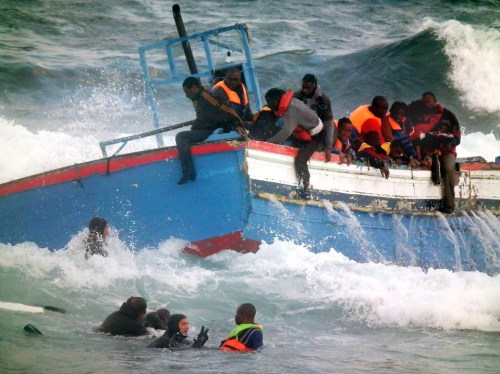
Migrant Boat From Libya Sinks Off Pantelleria – 2 Dead, 100+ Rescued

A migrant boat sank yesterday just off shore of Pantelleria, an Italian island approximately 150 km northwest of Lampedusa.  The boat was carrying approximately 250 people and ran around on rocks near the entrance to the port.  The boat had been intercepted earlier in the night by an Italian naval vessel and was being escorted to Pantelleria.  It is not clear why the migrant boat was unable to enter the harbour safely.  Two young women died.

Click here and here for articles.  (IT)

AFP PHOTO/ Francesco Malavolta/Getty Images

1 Comment

Filed under Frontex, Italy, Libya, Mediterranean, News

MEP Francesco Speroni: Italy Entitled to Use Weapons to Prevent Landings by Migrant Boats

Italian MEP Francesco Speroni (EFD, Northern League) today compared the Tunisian migrants arriving in Italy to an invading force: “Do not mistake the Tunisians. If someone invades the territorial waters of a sovereign country, that country is allowed to use weapons, this is international law…” (“Non sbagliano i tunisini. Se uno invade le acque territoriali di un Paese sovrano è lecito usare le armi, questo è diritto internazionale…”)  “We in Lebanon [and] in Afghanistan we are using the weapons, why do not we use them to defend our borders?” (“Noi in Libano, in Afghanistan stiamo usando le armi, perchè non dobbiamo usarle per difendere i nostri confini?”)  Speroni’s remarks follow remarks made yesterday by Italian Transportation Vice-Minister Roberto Castelli (Northern League) who said “With [arriving] immigrants, we can not use weapons, for now.” (“”Con gli immigrati non possiamo usare le armi, per ora.”)

Such remarks represent an unfortunate and dangerous development in the political debate within Italy.

Click here, here, here, and here for articles. (IT)

1 Comment

Filed under Italy, Mediterranean, News, Tunisia

COE Parliamentary Assembly to Hold Urgent Debate on Large-Scale Migrant Arrivals in Southern Europe

From PACE:  “Spring session: 11-15 April 2011 – Debates on the arrival of irregular migrants and asylum seekers on Europe’s southern shores and on the situation in Northern Africa.

Adopting the final agenda of its plenary Spring Session, the Assembly today [11 April] decided to hold, on Thursday 14 April, an urgent debate on the large-scale arrival of irregular migrants on Europe’s southern shores and a current affairs debate on the situation in Northern Africa…..”  Agenda Working documents

From the Agenda:

Thursday 14 April 2011

8.30 a.m. Committees
10 a.m. 1. Debate under urgent procedure: 

The large-scale arrival of irregular migrants, asylum seekers and refugees on Europe’s southern shores (Doc. )

Rapporteur of the Committee on Migration, Refugees and Population:

Deadline for tabling amendments: Wednesday 13 April at 12 noon

Debate and vote on a …

2. Current affairs debate: 

The situation in Northern Africa

Discussion

1 p.m. End of the sitting

Click here for link to PACE news page.

Leave a comment

Filed under Council of Europe, Italy, Libya, Malta, Mediterranean, News, Tunisia

Belgium Plans to Reintroduce Border Controls to Block Entry by Tunisians from Italy

Belgium announced earlier today at the conclusion of the JHA Council meeting that it plans to reintroduce border controls, joining France and Germany, in an effort to block the entry of Tunisian migrants granted temporary residency by Italy.  The announcement was made by Melchior Wathelet, Secretary of State for Asylum and Migration. Wathelet also suggested that Austria and the Netherlands , as countries of “final destination,” were supportive of the move to reintroduce border controls within the Schengen Area.

Click here (FR), here (NL), and here (FR) for articles.

Leave a comment

Filed under Belgium, European Union, France, Germany, Italy, Libya, Mediterranean, News

JHA Council Conclusions on the management of migration from the Southern Neighbourhood – 11 April 2011

Excerpts from today’s JHA Council Conclusions:

[***]

5. The Council calls on FRONTEX to continue to monitor the situation and prepare detailed risk analyses on possible scenarios with a view to identifying the most effective responses to them, and also invites FRONTEX to speed up negotiations with the countries of the region – and in particular with Tunisia – with a view to concluding operational working arrangements, and organising joint patrolling operations in cooperation with Tunisian authorities and in application of all relevant international Conventions, in particular the UN Convention on the Law of the Sea (“the Montego Bay Convention”).

6. The Council urges Member States to provide further human and technical resources to support the Agency’s operations, and in particular the existing Joint Operations Hermes, Poseidon Land and Sea and the possible deployment of a RABIT operation in Malta, in accordance with needs identified by the Agency in the light of the developing situation.

7. In order to rapidly strengthen the competences of FRONTEX and put more effective tools at its disposal, the Council agrees to accelerate negotiations on amending the FRONTEX Regulation, in cooperation with the European Parliament, with a view to reaching agreement by June 2011.

8. The Council underlines the need to promote all relevant forms of cooperation on a performance-based approach in the field of migration, mobility and security with the countries of the region that are sufficiently advanced in their reform progresses, and that effectively cooperate with the EU and its Member States in preventing illegal migration flows, managing their borders and cooperating in the return and readmission of irregular migrants. The Council stresses the need for early progress in the area of return and readmission in the case of relevant third countries, and recalls in particular that all States have an obligation to readmit their own nationals.

[***]

10. The Council welcomes the outcome of the visits of the Presidency and the Commission to Egypt and Tunisia and the intention of the Commission to follow-up these visits by setting up dialogues with the authorities of these countries at senior officials’ level, in which Member States will also participate, and which will be aimed at promoting the swift development of cooperation on the management of migration flows. This dialogue should in first instance, focus on the identification and promotion of measures which can contribute in a concrete and effective way to the prevention of illegal migration, to the effective management and control of their external borders, to the facilitation of the return and readmission of irregular migrants, and to the development of protection in the region for those in need, including through regional protection programmes. Subsequently, this dialogue could explore the possibilities for facilitating people-to-people contacts using instruments such as mobility partnerships.

11. The Council stresses the importance of offering durable protection solutions to those in need of international protection present in the countries of the Southern Neighbourhood, and, in this respect, calls on the Commission and the Council’s preparatory bodies to examine the possibility of assisting those countries in capacity building in the area of international protection, including by activating existing regional protection programmes, and assessing the need for additional programmes in the region.

12. The Council recalls that resettlement of refugees on a voluntary basis, in particular those living for some years in a situation of protracted displacement and vulnerability, and having no other perspective, can represent a durable solution for them. The Council takes note of the willingness of certain Member States to consider offering resettlement opportunities for the refugees present in the region. The Council invites Member States to continue supporting UNHCR in the development of resettlement programmes and calls on the Commission to identify solutions for supporting financially such resettlement actions.

13. The Council underlines that the measures mentioned in the paragraphs above represent the immediate answer to the crisis situation in the Mediterranean, but that it is also crucial to put in place a more long-term sustainable strategy to address international protection, migration, mobility and security in general, and taking also the secondary movements to other Member States into account.

14. The Council welcomes the Commission’s intention to come forward for that purpose with proposals in response to the Declaration of the Extraordinary European Council of 11 March and the Conclusions of the European Council of 24-25 March, and notes that the Presidency stands ready to convene an extraordinary meeting of the Council on 12 May if necessary in the light of developments and to further consider these matters.”

Click here for full document.

Leave a comment

Filed under European Union, Frontex, Italy, Libya, Malta, Mediterranean, News, Statements, Tunisia, UNHCR