Category Archives: Spain

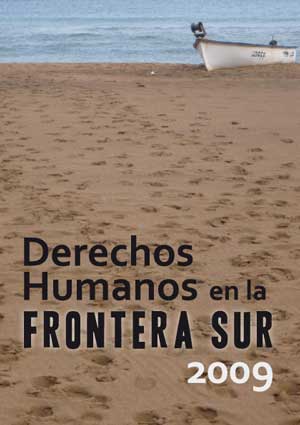
Apdha: Nuevo Informe “Derechos Humanos en la Frontera Sur 2009”

La Asociación Pro Derechos Humanos de Andalucía viene realizando desde 1997 un seguimiento de la evolución de los flujos migratorios referidos a España y de las políticas desarrolladas por la Unión Europea y los sucesivos gobiernos españoles para abordarlos y en general reprimirlos y contenerlos….

Según los datos de la APDHA [Asociación Pro Derechos Humanos de Andalucía] viene, 8.728 personas han sido detenidas al llegar a las costas españolas durante el año 2009, trescientas más que las que recuenta el Ministerio del Interior. En todo caso, ello supone un descenso en las llegadas por esta vía de más del 45% con respecto a 2008, cuando las detenciones alcanzaron la cifra de 15.572 personas….

Sobre un 30% de las personas que intentan llegar a nuestro país, finalmente lo consiguen… Por tanto, las cifras de personas interceptadas sólo reflejan una parte de la realidad. … [L]as cifras aportadas por el Ministerio del Interior no se reflejan el número de personas interceptadas en las costas africanas. Estas son, cada vez más, otro de los resultados del control de los flujos migratorios que la política de externalización ha trasladado a los países africanos. Resulta difícil concluir cuántas personas son interceptadas en la aplicación de estas políticas de externalización en las costas africanas o aledaños.

La APDHA, con muchas dificultades, ha seguido informes de la operativa Frontex, de la Marina Nacional Argelina, de la Gendarmería marroquí y de su Gobierno, o de la policía costera mauritana. Pocas cifras proporciona la guardia costera de Senegal, por no referirnos a Guinea, Gambia o Cabo Verde. Pero de todo ello, desde la APDHA hemos llegado a la conclusión que no menos de 11.000 personas han sido detenidas en las costas africanas a lo largo de 2009, alcanzando así la cifra de 19.728 personas detenidas intentando llegar a España durante el 2009.

Insistimos en que todas estas cifras no son sino un reflejo de la realidad, que ponen de manifiesto dos cuestiones: un acusado descenso de los flujos migratorios que, paradójicamente, se solapan con un acusado incremento de las razones que obligan a la emigración….

La vigilancia de las costas es cada vez más férrea por parte de Mauritania, Senegal o Marruecos. Pero a ello hay que añadir el efecto de la implementación de crecientes y férreos controles en las fronteras que cercan el Sahel que tienen sin duda, a nuestro modesto entender, mayor importancia que los propios controles en las costas y aguas por parte de España y el Frontex….

En todo caso, no está de más resaltar aquí que esos procesos de externalización y creciente militarización de las fronteras africanas están provocando graves sufrimientos y violaciones de derechos en las mismas. La APDHA reivindica que el respeto a los derechos humanos, también en las fronteras, no puede obviarse por razones de control de las migraciones. Y entre ellos, sin duda, se encuentra el derecho a salir y regresar al propio país, tal como recoge el art. 13.2 de la Declaración Universal de los Derechos Humanos….”

Click here for full Report.

Click here for article about the Report.

Leave a comment

Filed under Data / Stats, Eastern Atlantic, European Union, Frontex, Gambia, Mauritania, Mediterranean, Morocco, Reports, Senegal, Spain

Las Constantes Averías del SIVE Obligan a Revisar Toda la Red de Radares en Alicante

ABC:  “Las constantes averías detectadas desde su puesta en marcha han obligado a la Guardia Civil a pedir a la empresa Amper que realice una exhaustiva puesta a punto de los cuatro radares SIVE instalados en las costas alicantinas.

Los responsables de este servicio han remitido a la Dirección General de la Guardia Civil en Madrid un informe en el que enumeran los fallos e incidencias registrados en estos dispositivos desde su instalación, el pasado mes de septiembre. A raíz de este informe, ingenieros de la multinacional Amper están revisando toda la red del Sistema Integral de Vigilancia Exterior (SIVE) en la provincia, con el objetivo de reducir su elevado índice de error….”

Click here for full article.

Leave a comment

Filed under Mediterranean, News, Spain

EU-Morocco Summit Meeting

The first post-Lisbon Treaty summit meeting between the EU and another country will take place 6 and 7 March in Granada between the EU and Morocco.

Among the topics of discussion will be immigration and the Union for the Mediterranean.  Spanish Minister for Foreign Affairs, Miguel Ángel Moratinos, said  “…we will discuss immigration issues, which are very important. Morocco is a partner that assists European countries and source countries enormously to manage migratory flows co-responsibly, and it is therefore a key country for the strong and effective management of these flows….”

Click here and here for Spanish EU Presidency statements and here for an article (en francais).

Leave a comment

Filed under Eastern Atlantic, European Union, Mediterranean, Morocco, News, Spain

CARIM Mediterranean Migration 2008-2009 Report

Noted recently in the Newsletter of the Real Instituto Elcano:

CARIM MEDITERRANEAN MIGRATION 2008-2009 REPORT, Robert Schuman Centre for Advanced Studies, San Domenico di Fiesole (FI): European University Institute, October 2009, Edited by Philippe Fargues

MIGRATIONS MÉDITERRANÉENNES, RAPPORT 2008-2009, Octobre 2009, Sous la direction de Philippe Fargues

An excerpt:

“The period covered in this latest report, the years 2007 and 2008, is characterised by the accentuation of the migratory trends described in previous reports1: emigration from South and East Mediterranean countries (SEM) is continuing at a steady rate, while immigration to these countries is increasing, particularly in various irregular forms. [***]

Transit Migrants

Transit migrants in the SEM countries are people who cannot reach the destination of their choice (Europe) for lack of the required visa. They are waiting to find a way to reach this destination and over time their transit becomes stay. All the SEM countries, from Mauritania in the west to Turkey in the East, have, over the course of the last two decades, been transformed into transit countries for those travelling to Europe.

How many transit migrants are there in the SEM countries? The statistics in this area are even more inadequate than those for de facto refugees or irregular migrant workers. Aggregating figures provided by the police and various NGOs allows for a maximum estimation of 200,000 transit migrants in the region (Table 7).

Table 7: Transit migrants present in SEM countries around 2005

Country                        Estimated number

Algeria                           > 10,000

Turkey                           > 50,000

Libya                              > 10,000

Mauritania                   ± 30,000

Morocco                      > 10,000

Egypt, Israel, Jordan,

Lebanon, Palestine,

Syria, Tunisia              Not available

Total SEM                     < 200,000

Sources: CARIM, Irregular Migration Series http://www.carim.org/index.php?areaid=8&contentid=235&callTopic=7

According to data collected by an Italian NGO on deaths and disappearances at sea (Table 8), it would seem that the number of clandestine sea crossings from SEM countries to Europe is not increasing (in fact it may even have decreased in 2008) but the routes are changing. The most ancient route across the Straits of Gibraltar is being used less and less and has been successively replaced by that from Mauritania, or even Senegal, to the Canary Islands (on which traffic peaked in 2006), from Turkey to the Greek Islands of the Dodecanese (on which traffic peaked in 2007) and lastly from Libya to Italy on which traffic peaked in 2008).

How many transit migrants are there who attempt (sometimes successfully) the crossing to Europe? And for how many does transit in the SEM countries become a more long period of stay? The rare surveys carried out in the Maghreb or in Turkey do not allow us to assess this. With the extension of their stay in countries initially seen as a place of transit, transit migrants soon become mixed up with the more significant mass of migrant workers in irregular situation. On the other hand, it is not always possible to distinguish them from refugees. The two groups exist side by side in what the HCR calls flows of “mixed migration” where transit migrants and refugees, sometimes from the same countries of provenance, resort to the same smugglers and find themselves in the same circumstances.

Table 8: Dead and missing persons on sea routes of irregular migration from SEM to Europe 2000 – 2008

Year\ Route      Sicily +             Gibraltar +

Sardinia           Ceuta & Melilla

2000                   0                           127

2001                     8                           157

2002                     236                     106

2003                     413                     108

2004                     206                    64

2005                     437                    146

2006                     302                    215

2007                     621                    142

2008                     702                    216

Total                     2,925                1,281

Year\ Route      Canary              Aegean Sea

Islands

2000                   16                         32

2001                     40                        102

2002                     39                        94

2003                     130                      81

2004                     232                      103

2005                     185                      98

2006                     1,035                  73

2007                     745                      257

2008                      136                      181

Total                       2,558                 1,021

Year                Total All Routes

2000                 175

2001                   307

2002                   475

2003                   732

2004                   605

2005                   866

2006                   1,625

2007                   1,765

2008                   1,235

Total                  7,785

Source : http://fortresseurope.blogspot.com/

[***]”

Click here for link to full Report in both English and francais.

Leave a comment

Filed under Algeria, Data / Stats, Egypt, France, Greece, Italy, Libya, Malta, Mauritania, Mediterranean, Morocco, Portugal, Reports, Spain, Tunisia, Turkey

Informal Meeting of European Union Defence Ministers

An Informal Meeting of EU Defence Ministers was held in Mallorca last week to discuss the EU Common Security and Defence Policy (CSDP) established by the Treaty of Lisbon.

A decision was taken at the meeting to expand the objectives of Operation Atalanta to include the surveillance and control of Somali ports where pirate ships are based.  This decision will be implemented later in the month of March as weather conditions in the region improve.  The decision represents a potentially significant expansion of the EU’s anti-piracy operations.

Also attending the Informal Meeting were the ministers of defence from Algeria, Libya, Morocco, Mauritania and Tunisia.  A side meeting was conducted with regard to improving co-operation in matters of security in the Euro-Mediterranean zone.  The side talks pertained to the so-called “5+5 Western Mediterranean Defence Initiative” or more simply the “5 + 5 Initiative”.

Spanish Minister of Defence, Carme Chacón, who chaired the Informal Meeting said in regard to the meetings with the defence ministers from the five Maghreb countries:

“Spain is very clear on the fact that the Mediterranean is a sea of opportunities, but if we let our guard down then it can become a sea of problems – and we share this vision with all the associations we are involved in. At the moment it is a sea of peace and tranquillity, but both North and South must work together to tackle the dangers and new threats of the 21st Century, such as international terrorism, drug smuggling and organised crime. We must put our surveillance and maritime safety capacities into action in order to combat these threats, which could become an area of concern or a problem if we do not deal with them properly. And Spain will not forget this. In terms of the initiative of bringing together the countries of Europe and the Maghreb, we would like it to be not just the Spanish Presidency that sees to hold these meetings, but for the EU to be able to sit down regularly with these countries to discuss issues relating to the Mediterranean Sea, which must carry on being a source of opportunities rather than one of concern.”

Click here, here, here, and here for Press Releases from the Informal Meeting.

Cliquez ici pour un article (blog post) en francais.

Leave a comment

Filed under Algeria, European Union, Gulf of Aden, Indian Ocean, Libya, Mauritania, Mediterranean, Morocco, News, Somalia, Spain, Tunisia

“Harraga: La menace de la prison n’a rien changé”

El Watan: “Un an après la loi du 25 février 2009 criminalisant la harga [en Algérie], ils sont nombreux à ne plus vouloir partir. Mais pas par crainte de finir en prison dans leur pays. …  Les passeurs exigent des sommes énormes ! Les prix pratiqués aujourd’hui peuvent atteindre les 400 000 DA pour l’Espagne à partir de Ghazaouet.”

“Hocine Zehouane, président de la Ligue algérienne des droits de l’homme, a publié, en 2009, un rapport accablant relatif à cette tragédie : 36 000 jeunes harraga et environ 4 000 Algériens croupiraient dans les prisons espagnoles. Sans parler des 600 corps dans les morgues d’Almeria (Espagne). … « Les Européens ont mis beaucoup d’argent dans le programme Frontex (agence dotée de moyens de détection, de surveillance de toute migration par terre, par mer et même par air) et ont financé les régimes autoritaires du Sud (Libye, Tunisie, Algérie, Maroc) pour bloquer ce type d’émigration clandestine. Je crois que si les jeunes ont furieusement envie d’émigrer, ils n’ont pas envie de mourir en mer, ils n’ont pas envie de traîner misérablement dans les centres de détention s’ils arrivent en vie, ils n’ont pas envie d’être ensuite expulsés vers leur pays. »”

“Kamel Belabed, porte-parole du collectif des familles de harraga disparus, est du même avis : « Les jeunes s’informent, lisent la presse et ont accès à Internet. Ils savent, pour la plupart, qu’il y a maintenant une ‘coopération’ avec l’Union européenne pour l’interception des barques de nos harraga. Nous savons que le programme MEDA [NF – Règlement (CE) n° 1488/96 du Conseil du 23 juillet 1996] décidé, semble-t-il, pour ‘un partenariat euromediterranéen afin de garantir la paix, la stabilité et la prospérité’ du bassin, cachait mal une finalité qui ne disait pas son nom : l’externalisation des frontières de l’Europe ! Le programme MEDA a porté le montant de l’aide à l’Algérie à 10 millions d’euros. Le principal bénéficiaire de cette aide a été la police algérienne des frontières… Ceci en 2005.”

“L’Union européenne est devenue une des sources des projets de loi au Maghreb jusqu’en Egypte. C’est sous sa houlette que la loi 09-01 a été adoptée comme ont été adoptées les mêmes lois dans chacun des pays sud-méditerranéens. »

“[D]’autres réfléchissent à de nouvelles pistes pour atteindre l’eldorado. A leurs yeux, moins coûteuses et moins risquées. Comme la Turquie, plus précisément Izmir, la luxueuse station balnéaire. « Pour moins de 150 000 DA, vous êtes en Italie ! confie Mourad, … refoulé d’Italie y a quelques mois. Le procédé est simple : on prend l’avion pour la Turquie, ensuite le train ou un ferry pour Izmir, où des passeurs nous attendent. Le coût de la traversée entre la Turquie et la Grèce est de 500 euros environ. Pour atteindre l’Italie, avec l’aide du même baron de l’immigration clandestine, vous devez payer 1000 euros environ. »”

Cliquez ici pour l’article complet.

Leave a comment

Filed under Algeria, European Union, Frontex, Italy, Mediterranean, News, Spain, Turkey

El SIVE sólo detectó cuatro de quince pateras

“El Gobierno ha reconocido en una respuesta parlamentaria en el Senado que el Sistema de Vigilancia Exterior -SIVE- sólo detectó cuatro de las quince pateras y embarcaciones de traficantes que llegaron a Alicante hasta Navidad.  …  El Gobierno recuerda que el SIVE ha sido diseñado para conseguir “una vigilancia más eficaz de la costa” mediante una red de radares y cámaras con sensores de infrarrojos. “Este sistema, no obstante, presenta también alguna limitación como la derivada del alcance de sus sensores y la existencia de zonas de sombra en ciertos puntos próximos a la costa, debido a la accidentalidad geográfica (que no se detallan por motivos de seguridad)”, apunta la respuesta.”

Click here for full article.

Leave a comment

Filed under Eastern Atlantic, Mediterranean, News, Spain

Frontex Presentation at European Defence Agency Annual Conference

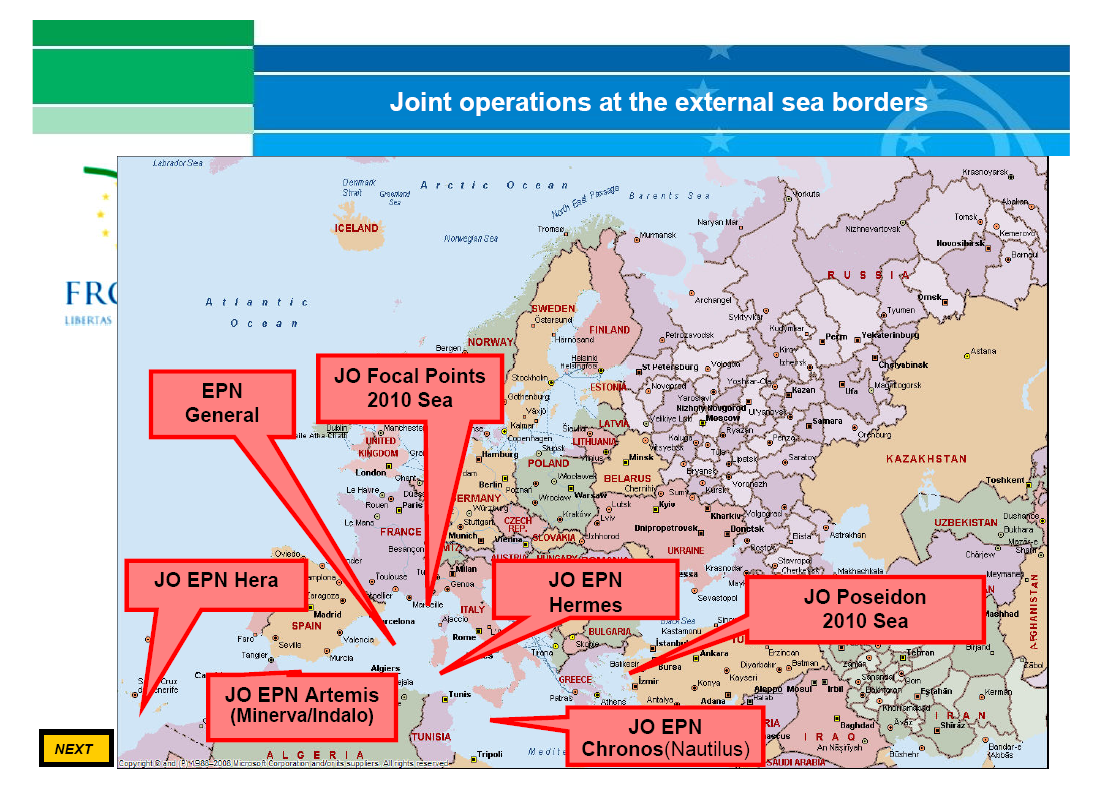
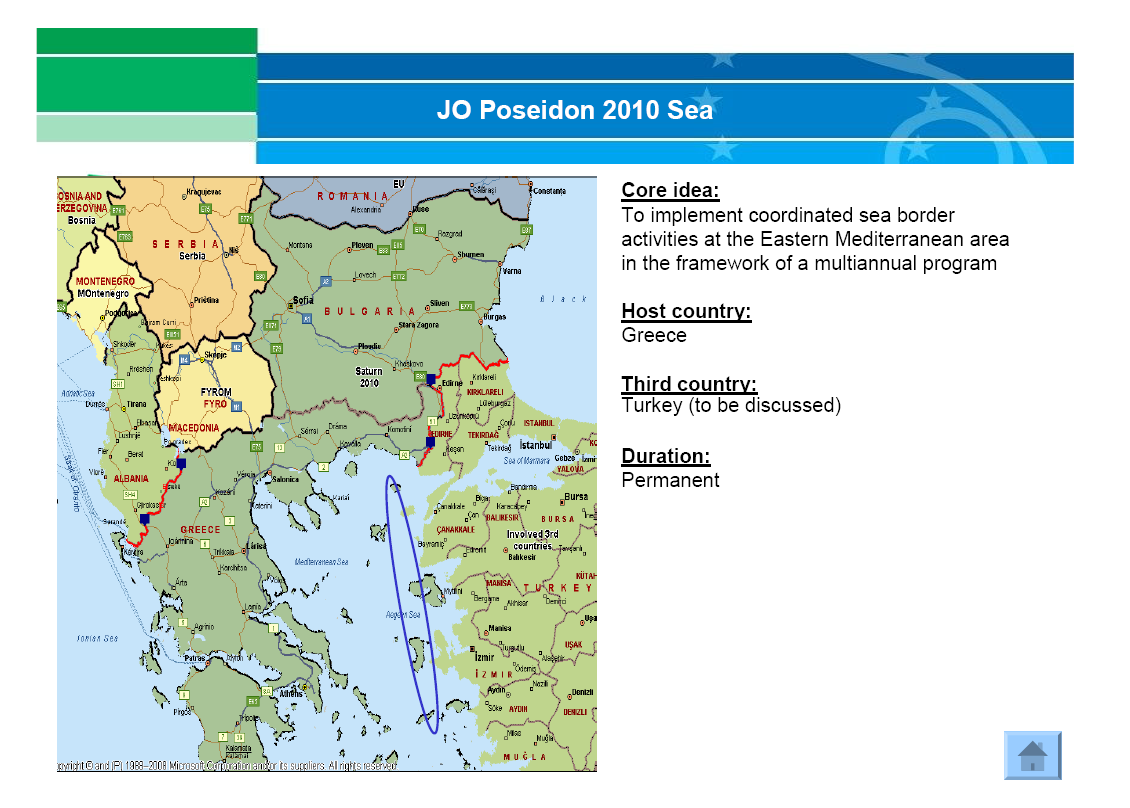
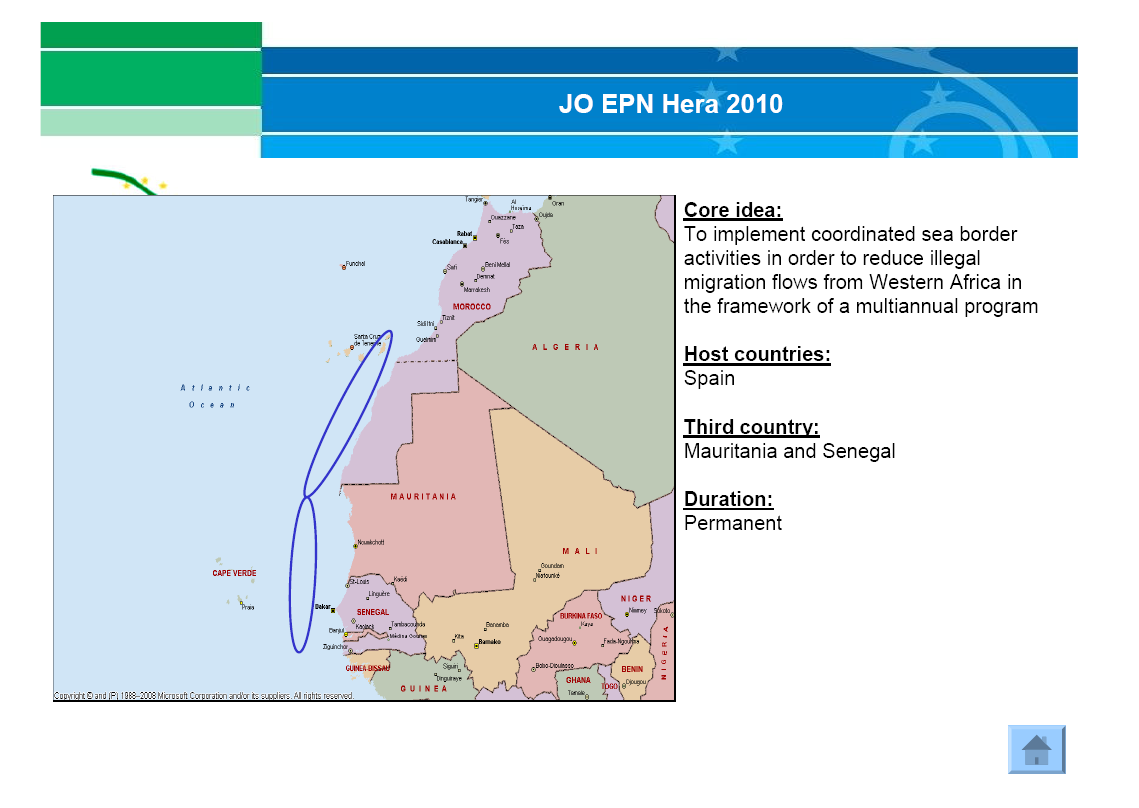
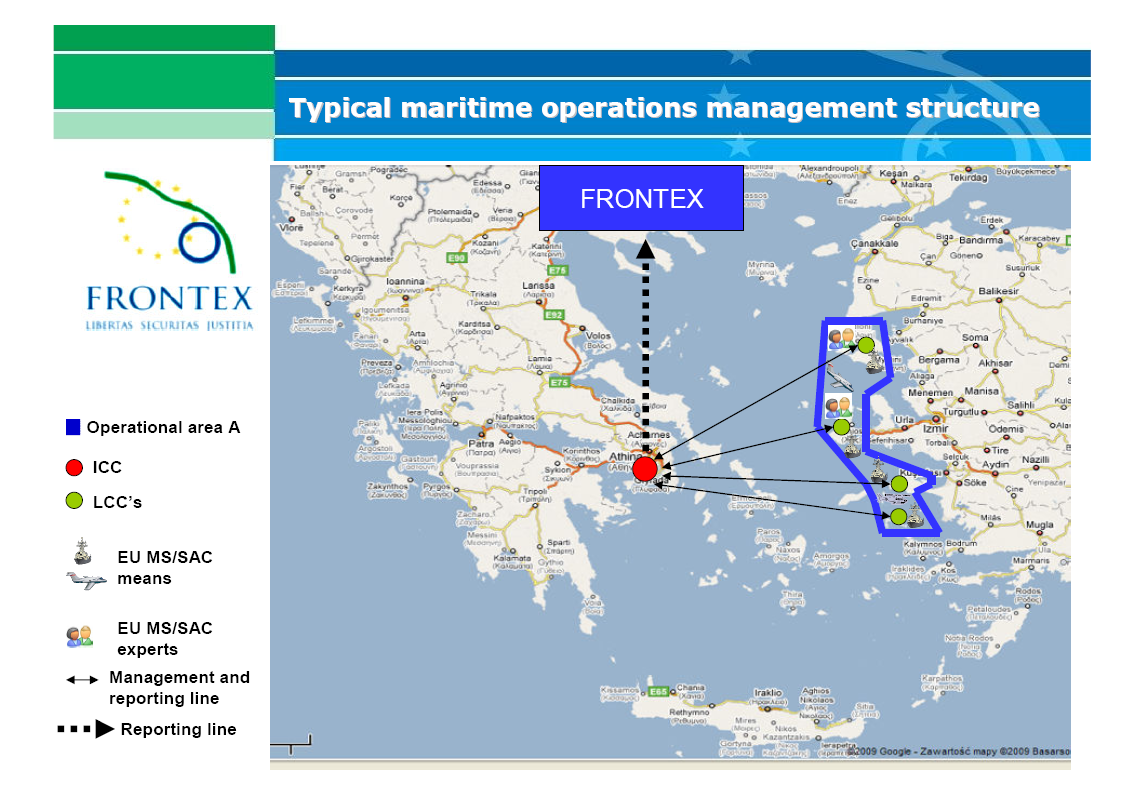
Rustamas Liubajevas, Head, Frontex Joint Operations Unit, presented a lecture entitled “Frontex within integrated Border management concept – Structural approach in planning capability” at the recent Annual Conference of the European Defence Agency.

Copies of some of his slides are reproduced here.

Click here for full slide presentation.

Leave a comment

Filed under Aegean Sea, Algeria, Colloques / Conferences, Eastern Atlantic, European Union, Frontex, Greece, Italy, Libya, Malta, Mauritania, Mediterranean, Morocco, News, Senegal, Spain, Turkey

Conference de l’Ucad: «Migrations entre le Sénégal et l’Espagne: défis et opportunités»

“Les premières journées hispano-sénégalaises qui portaient sur le thème « Migrations entre le Sénégal et l’Espagne : défis et opportunités » ont été clôturées, … à Dakar. Une occasion saisie par le Pr. Saïdou Nourou Tall, vice doyen de la Faculté des Sciences juridiques et politiques de l’Ucad, par ailleurs coordonnateur du Master du droit des migrations pour faire le diagnostic du dispositif du Frontex (dispositif de lutte contre l’émigration clandestine)…. le Pr. Saïdou Nourou Tall a déclaré …« On a fait un diagnostic, beaucoup de choses ont été faites. Mais il existe un certain nombre de problèmes dans ce dispositif du Frontex qui nous interpelle tous », a-t-il précisé. Est-ce que les milliards que reçoivent nos gouvernants dans la lutte contre cette émigration clandestine atteignent les cibles », s’est-il interrogé. Pour lui, le constat illustre la recrudescence du phénomène de l’émigration clandestine. La solution, de l’avis du coordonnateur du Master des Migrations de la faculté de Droit, est de « promouvoir l’unité africaine ». Pour cela, a-t-il dit, « il faut faire de l’Afrique un grand marché où les Africains trouveront du travail sans être obligés de risquer leur vie sur des pirogues de fortune ».”

Cliquez ici pour l’article complet.

Leave a comment

Filed under Colloques / Conferences, Eastern Atlantic, Frontex, Senegal, Spain

Más patrullas para prevenir llegada de barcas neumáticas a la costa andaluza

“El Ministerio del Interior ha intensificado las patrullas de la Guardia Civil y las tareas de inteligencia para prevenir la llegada de embarcaciones neumáticas que cruzan el Estrecho de Gibraltar hasta las costas andaluzas, según consta en una respuesta aportada por el Gobierno al senador Eugenio Jesús Gonzalvez (PP), a la que tuvo acceso Europa Press….”

“Por otra parte, recuerda que en los meses de septiembre y octubre se puso en marcha el dispositivo Indalo, coordinado por la Agencia Europea de Fronteras (Frontex), consistente en el despliegue de medios marítimos y aéreos, complementado con personal de varios países en distintos puntos de la costa, entre las provincias de Murcia y Granada.”

“Asimismo, Interior indica que el Sistema Integral de Vigilancia Exterior (SIVE) se mantiene a la “máxima operatividad” en toda la costa del Mediterráneo, donde también continúa la realización de patrullas mixtas marítimas….”

Click here and here for articles.

Leave a comment

Filed under Eastern Atlantic, Frontex, Mediterranean, News, Spain

La primera embarcación de “sin papeles” que arriba a Canarias del año

“Un grupo de cuatro inmigrantes de origen africano arribó ayer a la isla de Gran Canaria a bordo de una pequeña lancha ….  Es la primera embarcación de «sin papeles» que arriba a Canarias en lo que llevamos de este año 2010, y llegó a las costas del Archipiélago sin ser detectada.”

“[L]a embarcación … no fue detectada por el Sistema Integrado de Vigilancia Exterior (SIVE)…”

Click here and here for articles.

Leave a comment

Filed under Data / Stats, Eastern Atlantic, News, Spain

Le Temps d’Algérie: Les maffias de l’immigration clandestine en Afrique de l’ouest se tournent vers le narcotrafic

“Les ministres de l’Intérieur des pays d’Afrique occidentale se réunissent aujourd’hui [14 février] à Dakar avec leurs homologues de France et d’Espagne pour examiner la délicate question de l’ouverture, dans cette région située dans le prolongement direct du Sahel, d’une «nouvelle route» spécialisée dans le narcotrafic. … Cette région était jusque-là considérée, exclusivement, comme la «route» de l’immigration clandestine vers l’Europe. … Près de 40 000 Subsahariens ont pu atteindre les côtes espagnoles. Mais le dispositif mis en place par l’Espagne dès 2007, avec le concours les unités du Frontex …a sensiblement découragé ce phénomène. Cette «route» a progressivement cessé d’être rentable pour ces maffias de l’immigration clandestine en Afrique de l’Ouest. … Les maffias de l’immigration clandestine auraient alors choisi de se tourner vers une activité plus risquée mais beaucoup plus rentable, le narcotrafic.”

Cliquez ici pour l’article complet.

Cliquez ici pour un autre article: “Lutte contre la drogue en Afrique de l’ouest : La France met sa marine à la disposition de la sous-région.”

Leave a comment

Filed under Eastern Atlantic, France, News, Senegal, Spain

Presentation Materials from EU Conference on “Maritime Policies for a Prosperous and Secure Europe”

The Spanish EU Presidency conducted a conference on “MARITIME POLICIES FOR A PROSPEROUS AND SECURE EUROPE – Towards a Comprehensive 21st-Century Civil-Military Approach” in January 2010 during which multiple presentations were given by representatives from Frontex, military representatives, and others.

The PowerPoint presentations used by some of the presenters are posted on the internet (See http://www.eutrio.eu/export/sites/presidencia/comun/descargas/ [xxx] )

Links to two of the presentations are provided here.

“European Border Surveillance”, Erik Berglund, Director of Capacity Building, Frontex.

Click here.

“Integration of Maritime Surveillance Systems as a Keystone for Maritime Security”, Bg. Gen. José María Orea Malo, Head Operations Division Spanish Air Force Staff.

Click here.

Leave a comment

Filed under European Union, Frontex, Spain

Analysis of the Real Instituto Elcano: Controlling Migration in Southern Europe

Analysis of the Real Instituto Elcano: Controlling Migration in Southern Europe, Part 1: Fencing Strategies and Part 2: Gate-keeping Strategies by Anna Triandafyllidou.

“Part 1 Summary: Dealing with irregular migration has emerged as a policy priority at both the national and the EU level, although EU countries are not all affected by this phenomenon in the same way. Countries at the geographical periphery of the Union, and, in particular, southern EU member states that are close to important migration source and transit countries, face significant inflows from their land and sea borders.

This ARI discusses critically the policies adopted by different countries in southern Europe (Italy, Spain and Greece) for managing irregular migration, with a view to showing that reducing irregular migration cannot be achieved by tougher border controls only. Discourses of politicians and the media in announcing ‘floods’ or ‘waves’ of irregular migrants crossing the EU’s external borders and, on the basis of these ‘floods’, considering or indeed approving tougher border enforcement measures as the main means to effectively combat irregular migration need to be questioned by voters as well as by experts.”

Excerpt: “It is interesting to note that while sea-border patrolling and the related FRONTEX operation in the Atlantic Ocean in 2006 did not have substantial results (Triandafyllidou, 2007), the Spanish government’s diplomatic ‘offensive’ in West Africa did. Thus, during the last two years Spain has managed to sign re-admission agreements with Cape Verde, Mali, Guinea Conakry, Guinea Bissau and Nigeria and varied forms of cooperation agreements with other states in the region, with the result of a notable improvement in border management and hence a notable decrease of irregular arrivals from Africa (González Enríquez, 2009). Apprehensions of irregular migrants arriving at the Canary Islands have fallen from over 30,000 in 2006 to approximately 12,000 in 2007 (data from the Spanish Ministry of the Interior cited in Arango & Finotelli, 2008). This decrease is to some extent attributable to the intensification of sea-border patrols and joint FRONTEX operations in the area which led migrants and smugglers to try alternative routes.”

Click here for Part 1 and here for Part 2.

Leave a comment

Filed under Aegean Sea, Analysis, Eastern Atlantic, Greece, Italy, Mediterranean, Spain

Spanish EU Presidency: Frontex Needs More Resources and Clearer Rules

Spanish Interior Minister Alfredo Pérez Rubalcaba speaking at the 26th Frontex Management Board Meeting in Madrid called for providing Frontex with “more resources, clearer rules and specialist offices. … We are planning to promote FRONTEX, to equip it with more resources, its own resources, because when FRONTEX becomes more independent it will become more efficient; to provide it with mechanisms for jointly managing maritime operations, mechanisms that respect the laws and rights and clearly establish each country’s obligations. … FRONTEX has shown that it is probably the best tool we have for ensuring shared and jointly responsible border control.”

Click here for summary from Spanish EU Presidency web site.

Leave a comment

Filed under Aegean Sea, Eastern Atlantic, European Union, Frontex, Mediterranean, News, Spain