Category Archives: Spain

“Un échec total’’ – Trois tentatives de traverser la Méditerrané

“Oumar Baldé, [un sénégalais] de 36 ans, fait partie des candidats à à l’émigration revenus dans son Fouladou natal après avoir, comme il le dit, ‘’essuyé un échec total’’ dans sa tentative de rejoindre l’Espagne.  Parti du Sénégal par voie terrestre en 2000, en passant par le Mali, le Burkina Faso, le Niger, traversant le Sahara pour se retrouver en Libye…. “Ce fut un échec total’’, souligne Baldé, précisant avoir travaillé pendant 18 mois en Lybie avant de se retrouver en Algérie, puis au Maroc où il est resté pendant six ans, avec trois tentatives de traverser la Méditerranée, sans succès.”

“’On payait 8000 dirhams (500 000 francs CFA) [ €750 ] par traversée, poursuit-il, à des Arabes pour nous faire traverser la rive, ils nous amenaient jusqu’en pleine mer et on se perdait, il ne nous rester qu’à retourner et d’être pris par les gardes côtes marocaines qui nous jeter à la frontière algérienne’.  De guère lasse et ne disposant plus de moyens … Oumar Baldé s’est résigné à rentrer [en Sénégal]…”

“D’après le président du Conseil de la jeunesse de Dioulacolon, Abdoulaye Baldé, l’exemple de Oumar Baldé, n’est qu’une goutte d’eau dans l’océan. … ‘Il arrive qu’une famille dépêche deux à trois enfants pour tenter l’aventure. Et deux ou trois mois après, elles sont informées qu’ils sont tous morts en mer, entre la Mauritanie et l’Espagne’, se désole Abdoulaye Baldé.”

Click here for full article.

Leave a comment

Filed under Algeria, Libya, Mediterranean, Morocco, News, Senegal, Spain

BLUEMASSMED: Project for Maritime Surveillance of the Mediterranean Area and the Atlantic Approaches

The Bluemassmed project is a new initiative from the European Commission designed to increase cooperation for maritime surveillance in the Mediterranean Sea and its Atlantic approaches, including surveillance of illegal immigration.  The inaugural meeting for the Project was held in Paris on 15 January 2010.

“France, Greece, Italy, Malta, Portugal and Spain [will] cooperate on this specific project to strengthen their common actions against illicit trafficking, illegal immigration and environmental pollution. It will also permit [the reinforcement of] the Search and Rescue efforts in the area. This pilot project granted by the European Commission and co-funded by 6 Member States countries (France, Greece, Italy, Malta, Portugal and Spain) is the first state-centred action to integrate such an important field between Member States countries.”

The project is a two year project “divided in two stages. The first one intends to define the requirements of the actors in terms of exchange of information and to submit a list of technical and legal proposals. The second stage will result in a demonstration, performed among partners and wider, with the help of a demonstrator prototype, connecting present information systems from partners, shaping a possible future network of State actors for maritime surveillance systems, in the framework of several realistic scenarios.”

“The [French] Secrétariat Général de la Mer is leader of the project. The Agenza Spaziale Italiana is Co-leader of the Steering group, composed by representatives from each Member States, which will define the strategic guidelines of the project.”

“BLUEMASSMED aims at being a catalyst for internal and external cooperation between Member States and maritime surveillance actors. The success of this project is directly linked to the involvement of the Partners, responsible to their governments. The prototype demonstrator will be carried out with the support of industry. Industrial involvement is considered as a key investment.”

Click here for Bluemassmed web site.

Click here for English Press Release or here for French Press Release from inaugural conference.

Click here for EC Directorate-General for Maritime Affairs and Fisheries Non-Paper on Maritime Surveillance, 13 Oct. 2008.

Leave a comment

Filed under Eastern Atlantic, European Union, France, Greece, Italy, Malta, Mediterranean, News, Portugal, Spain

Spanish EU Presidency seminar: Maritime Polices for a Safe Europe

The Spanish EU Presidency conducted a seminar on “Maritime Polices for a Safe Europe” which concluded on 29 January.  Participants included representatives from FRONTEX, EMSA (European Maritime Safety Agency), CFCA (Community Fisheries Control Agency), EUISS (European Union Institute for Security Studies), and the Chiefs of Naval Staff of France, Belgium, Portugal and Sweden and Admirals of the Fleet of Italy and Germany.

According to a press release, a “’reflection document’ is going to be drawn up that will be presented at the informal meeting of defence ministers planned for the end of February. The document will be structured around three central themes: the design of a common conceptual framework, information transfer and the efficient organisation of military operations.”

Click here for press release.

Click here for the Dossier de Prensa distributed by the Armada Española, Oficina de Comunicación Social de la Armada.

Leave a comment

Filed under European Union, Frontex, News, Spain

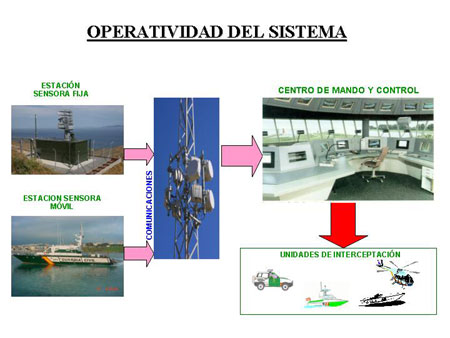
La Guardia Civil espera una avalancha de pateras con los radares del Sistema de Vigilancia Exterior (SIVE) averiado

“…Según fuentes de la Guardia Civil consultadas por ABC, los agentes que se encargan de la vigilancia marítima en Alicante -un servicio mermado por las bajas- esperan que en la segunda quincena del mes de enero se produzca una auténtica «avalancha» de pateras lanzadas desde las costas de Argelia y Marruecos.

Dos factores explican el estado de alerta de la Guardia Civil. De un lado, la llegada de las primeras pateras del año a las costas de Motril y Cartagena, este fin de semana. Y de otro, el hecho de que a partir del 15 de enero empiecen las calmas en el mar Mediterráneo, que facilitan el tránsito de pateras desde el norte de África.

La certeza de la futura llegada de nuevas pateras a las costas alicantinas se conjuga, además, con la desalentadora realidad de que el SIVE, un sistema cuya implantación en Alicante -donde existen cuatro radares fijos y uno móvil conectados a la Comandancia de la Guardia Civil- ha costado 8,5 millones de euros, es incapaz de detectar la llegada de la mayoría de embarcaciones….”

Click here and here for articles.

Click here for more information from la Guardia Civil y el Sistema Integrado de Vigilancia Exterior (SIVE)

Leave a comment

Filed under Mediterranean, News, Spain

Somet Algérie–Espagne, 7-8 janvier

“Initialement prévu en février 2008, le sommet Zapatero-Bouteflika, dont la tenue était suspendue à l’aval d’Alger, … se déroulera en fin de compte cette semaine dans la capitale espagnole. …  Ce sommet est devenu possible après que l’Espagne eut assoupli ses positions dans un certain nombre de dossiers, notamment l’énergie, le Sahara occidental et l’immigration, qui constitueront d’ailleurs les principales questions que traiteront les deux responsables….”

“L’immigration clandestine, point sur lequel divergeaient les deux parties, sera également au centre des entretiens entre Bouteflika et Zapatero, qui tenteront d’aplanir leur différend sur le sujet, notamment concernant le traitement réservé aux immigrants clandestins par les autorités ibériques….”

Click here or here for the article.

Leave a comment

Filed under Algeria, Mediterranean, News, Spain

Canary Islands – Migrant arrivals at 10 year low

2,242 migrants arrived in the Canary Islands in 2009 compared with approximately 9,000 in 2008.  This was the lowest number of migrant arrivals since 1999 when 2,165 migrants arrived. There were 32 confirmed migrant deaths in 2009 compared to 45 in 2008.

The largest number of migrant arrivals took place in 2006 when 31,859 migrants arrived.  Coordinated Frontex operations were expanded beginning in May 2006.  Since 1994 there have been over 96,000 recorded arrivals.

Click here (EN), here (FR) and here (ES) for articles.

Leave a comment

Filed under Data / Stats, Eastern Atlantic, Frontex, News, Spain

Spanish EU Presidency’s Web Site and Work Programme

The Spanish EU Presidency’s web site is up and running.

Excerpts from a summary of the Presidency’s work programme:

“This will be the fourth occasion that Spain has held the Presidency of the European Union. On each of the previous occasions, it faced important challenges. But none, like now, have coincided with a global crisis like the one that is affecting the economy and at a time as strategic as now in the European transformation process. This gives our Presidency a unique significance and, at the same time, even greater responsibility.”

“Spain has worked very closely with Belgium and Hungary to prepare a joint program for the next 18 months, in accordance with the Treaty, which was presented to the Council of Ministers of Foreign Affairs on the 7th and 8th in Brussels.”

“These are the four main priorities of our Presidency:

• The first and essential priority for the development of the others is the full and effective application of the Lisbon Treaty.

• The second is to guarantee the economic recovery of Europe through greater co-ordination of every member state and the approval of the European strategy for sustainable growth for 2020.

• The third is to reinforce the presence and influence of the European Union in the new world order.

• Finally, the fourth is to place European citizens at the centre of EU policy, with initiatives designed to develop their rights and freedoms.”

“We are also going to encourage dialogue and co-operation with South Mediterranean countries, the stability and prosperity of which constitute a priority for Europe. The structure of the Union for the Mediterranean needs to be configured and its General Secretariat set up in Barcelona.”

“We will also initiate the process for the European Union’s accession to the Convention on Human Rights, and we will approve the Stockholm Programme Action Plan for the European Area of Freedom, Security and Justice, with measures that will have a considerable positive effect on the security of our citizens.”

“We know that dealing with immigration is one of Europe’s greatest challenges. We, who have contributed to the content of European policy on immigration over the last few years, are well aware of the situation.”

“Now we will deal with it in its different aspects, from integration and cooperation with the countries of origin and transit, to the tireless fight against the mafias that exploit the desperation of the less fortunate.”

Click here for full document.

Leave a comment

Filed under European Union, Spain

Le nombre de clandestins arrivés en Espagne soit retombé à 7.000

“Le chef du gouvernement espagnol José Luis Rodriguez Zapatero s’est félicité … que le nombre de clandestins arrivés en Espagne soit retombé à 7.000 en 2009 contre 14.000 en 2008, estimant être en train de ‘gagner le combat’ contre l’immigration illégale.”

“Selon des statistiques encore provisoires, le nombre des clandestins subsahariens arrivés cette année dans des embarcations de fortune sur le seul l’archipel espagnol des Canaries, au large de l’Afrique, est retombé à environ 2.250, contre plus de 9.000 en 2008 et un record de 31.600 en 2006.  Le nombre de clandestins arrivés cette année sur les côtes d’Andalousie, en provenance notamment du Maghreb, a en revanche augmenté.”

Zapatero “a attribué cette baisse globale aux accords de coopération conclus avec les pays d’origine en Afrique et au renforcement des moyens de lutte contre l’immigration clandestine, notamment le dispositif européen Frontex au large des côtes africaines.”

Click here for article.

Leave a comment

Filed under Data / Stats, Eastern Atlantic, Frontex, Mediterranean, News, Spain

España: La llegada de inmigrantes ilegales se ha reducido a la mitad

Conferencia de prensa del Presidente del Gobierno, José Luis Zapatero, después de la reunión del Consejo de Ministros:

“ *** En el campo de la seguridad colectiva debería, como antes referí, hacer una referencia a la política de inmigración ilegal, que en alguna de mis comparecencias de esta naturaleza ha sido tema central, también para expresar nuestra satisfacción porque la llegada de inmigrantes ilegales durante 2009 se ha reducido a la mitad en relación con 2008: hemos pasado de catorce mil a siete mil. Se está ganando el combate a la inmigración ilegal después de haber sufrido, como saben, especialmente en 2006 y 2007, años extraordinariamente difíciles. Y se está haciendo gracias a un despliegue amplísimo de política de cooperación con los países de origen, la mayoría de ellos países africanos, y con un refuerzo de todos los medios personales y materiales en la lucha contra la inmigración ilegal. No vamos a bajar la guardia, sabemos que puede haber momento de repunte; pero, afortunadamente, un tema de gran calado y de gran preocupación está en una dirección muy adecuada. *** “

Click here for transcript of Press Conference.

Leave a comment

Filed under News, Spain

NGO Asylum Good Practice Recommendations to Spain, Belgium, and Hungary

CEAR (Spanish Refugee Council), the Flemish Refugee Action (Vluchtelingenwerk Vlaanderen), CIRE (Coordination et Initiatives pour Réfugiés et Etrangers),and the Hungarian Helsinki Committee (Magyar Helsinki Bizottság) have made a series of good practice recommendations to Spain, Belgium and Hungary.  These three countries are “the new Trio of States that will hold the Presidency of the European Union from January 2010 until June 2011, a crucial moment for the development of the EU policy and legislation in the field of asylum … The Trio will therefore play a key role in [the] implementation [of the Stockholm Programme] … The aim of [the recommendations is ] to complement ECRE’s positions and identify, from a more national perspective, those issues where the often diverse experiences of Spain, Belgium and Hungary can be employed to effectively address some of the main shortcomings of asy­lum systems in Europe.”

“As a general recommendation we urge the Trio of States to join their efforts in ensuring that the second phase of the Common European Asylum System will translate the best practices and highest protec­tion standards of the Member States’ national laws into EU legislation. The harmonisation on minimum standards, too often resulted in the lowest common denominators, should not be repeated.”

“[I]t must also be noted that in recent years a worrisome tendency has developed towards the exter­nalisation of responsibility for asylum claims outside the EU to neighbouring third countries. In this respect we recommend the Trio of States to support cooperation with third countries aimed at reinforcing their protection system. At the same time we urge the Trio of States to take a strong and clear position to make sure such cooperation does not become a way for the EU to escape its responsibility to protect under international and EU law.”

Click here for full document.

Leave a comment

Filed under Belgium, European Union, Hungary, Spain, Statements

EMHRN Recommendations to the Incoming Spanish EU Presidency

The Euro-Mediterranean Human Rights Network (EMHRN) has conveyed a series of recommendations to the new Spanish EU Presidency regarding the Union for the Mediterranean and the European Neighbourhood Policy.

Relevant excerpts include:

“Migration and Asylum

[***]

In relation to asylum, the EMHRN wishes to underline the following elements:

Refugees and asylum seekers face great difficulties when trying to reach safe havens in the EU.  Due to push back operations and severe, indiscriminate border control policies, including EU supported operations in third countries, asylum seekers often find themselves trapped in North Africa and in the Middle East (MENA), that do not offer them any sort of protection despite the presence of the UNHCR.

Several countries of the region have not yet ratified the 1951 Geneva Convention on the status of refugees and none of the countries from the region has a proper asylum system. Refugees and asylum seekers face extreme vulnerability and are often prevented from accessing their most basic rights. …

In relation to border control, the EU and its member states are keen on promoting cooperation with third countries with the purpose of better controlling migratory flows. It remains that the EU has, until now, failed to properly integrate a human rights dimension to such cooperation policies.

Most countries of the region criminalize irregular migration. Migrants are being arbitrarily arrested and put in detention, with no possibility of appeal. They may face ill treatment and unlawful deportation.

The conclusion of readmission agreements is promoted by the EU and its members. Negotiations have been ongoing for several years between the EU and Morocco to conclude such an agreement. A mandate has also been given by the Member states to negotiate an agreement with Algeria.

The EMHRN believes that returning migrants to countries other than their own, or to countries where they have no anchor and no legal residency, may put them in danger.

Push back and interception operations, including at sea, are other policy instruments promoted by the EU and its member states. Several of these operations have resulted in endangering the security of migrants and asylum seekers and may have resulted in a violation of the ‘non refoulement’ principle.

The EMHRN acknowledges the right of a state to control its borders. However, the EMHRN calls on the Spanish Presidency to actively promote policies ensuring that

  • • cooperation with third countries from the region does not endanger migrants and refugees.
  • •cooperation policy in the field of border management considers the impact of such measures on the access of refugees to international protection mechanisms, including in Europe.
  • • the EU member states strictly respect the principle of ‘non refoulement’ as well as their obligation under article 3 of the European Convention on Human Rights (ECHR).
  • no person is returned to a country other than its own or where he/she has no legal residency.”

Click here for full recommendations.

Leave a comment

Filed under European Union, Mediterranean, Spain, Statements

African migrants and their desperate ploy for a better life – Times Online

From The Sunday Times Magazine, 22 November 2009:

“Meet the survivors, bereaved families from Gambia and Senegal, and a man who smuggles the people — at a colossal price.”

“… The routes [African migrants] take are many and varied. From west Africa, migrants trek through the pitiless Sahara to Libya, from there to brave the Mediterranean — or, more perilous yet, strike out for the Canary Islands in fragile canoes known as ‘pirogues’.  If they then cross to the Spanish mainland they will probably do so in tiny, open Spanish fishing boats. An estimated one in every eight migrants who try to travel across the ocean to Europe don’t make it, their bodies carried out into the cold Atlantic. Those who perish are identified only by chance, their skeletons dredged from the sea by Italian and Spanish trawlers, or their bodies washed on to beaches used by holidaymakers…”

Full article:  African migrants and their desperate ploy for a better life – Times Online.

Leave a comment

Filed under Eastern Atlantic, Gambia, Italy, Libya, Malta, Mediterranean, News, Senegal, Spain

UNHCR Migration and Border Recommendations to the Incoming Spanish EU Presidency

UNHCR’s recommendations to the Spanish EU presidency include the following”

“Migration and border management

Spain has affirmed that reinforcing Frontex and ensuring that EU migration policy is accompanied by close cooperation with migrants’ countries of origin and transit will be priorities of its Presidency. A review of the Frontex mandate will take place in 2010.

UNHCR encourages the Spanish Presidency to pursue its migration agenda with due regard for international refugee and human rights norms. This includes:

a) Inclusion of refugee protection safeguards in migration control measures generally;

b) Development of clear guidance with respect to the disembarkation of persons intercepted at sea;

c) Attention to the potential protection needs of victims of trafficking;

d) With respect to the return of people found not to need international protection, measures to ensure that such return is safe, dignified and sustainable.

– calling for safeguards in border management activities, including under Frontex’s auspices, with the revision of that body’s mandate foreseen in early 2010;  a call for more focus on protection needs of victims of trafficking as part of anti-trafficking measures.”

Click here for full recommendations.

Leave a comment

Filed under European Union, Spain, Statements, UNHCR

Perejil Survivors Expelled from Morocco (News)

The 11 rescued survivors from the boat that sank near the Spanish island of Perejil this past Saturday have been deported from Morocco.  AFP quoted a Moroccan official saying “By order of the prosecutor, the 11 African escapees left Tangiers at about 2100 GMT (on Sunday) during an expulsion operation.”  The survivors, from Niger and Senegal, were probably expelled into Algeria.  While Moroccan officials believe there were 42 migrants on the boat, the Spanish Red Cross estimates the number at approximately 60.

Click here for article.

Leave a comment

Filed under Mediterranean, Morocco, News, Spain

Migrant Boat Sinks Between Morocco and Spain (News)

A migrant boat carrying between 40 to 60 migrants sank near Perejil, off the northern coast of Morocco.  More than five bodies have been recovered; more than 20 persons are presumed dead.  Rescued survivors have been taken by Spanish rescuers to Morocco.

Click here, here, and here for articles.

Leave a comment

Filed under Mediterranean, Morocco, News, Spain