Category Archives: Tunisia

Frattini: Italy is facing migration emergency

Italian Foreign Minister Franco Frattini released a statement describing the recent arrivals by Tunisians as an immigration emergency and calling for a “Marshall Plan” for immigration from the south.  The statement also says that Tunisia’s new Foreign Minister will visit Italy next week to reaffirm cooperation agreements between Italy and Tunisia.

Full statement:

11 Febbraio 2011

“Per l’immigrazione dal Sud del mondo serve un ‘piano Marshall’ e cioè una visione strategica un po’ più di medio termine”. Lo ha detto il Ministro Franco Frattini, soffermandosi, a Trieste, sui nuovi sbarchi di clandestini a Lampedusa. “E’ un allarme vero e noi lo avevamo previsto – ha detto Frattini – Per questo la prossima settimana sarà in Italia il nuovo ministro degli Esteri della Tunisia per riconfermare gli accordi di collaborazione”.

Per Frattini “siamo in presenza di una vera e propria emergenza migratoria e noi non possiamo immaginare che l’Italia sia il luogo dove tutti arrivano e tutti restano. Con la Tunisia avevamo una eccellente collaborazione e la dobbiamo confermare con il nuovo ministro”.

Sul concetto di ‘piano Marshall’ per l’immigrazione, Frattini ha quindi spiegato che “significa avere una visione un po’ più di medio termine, vuol dire non limitarsi all’emergenza. Vuol dire che questi Paesi – Tunisia, Algeria, Egitto ma anche altri – richiedono una strategia in cui l’Europa metta a disposizione fondi assai più sostanziosi per lo sviluppo economico, per i giovani, per gli studenti, per l’università”. In pratica, ha concluso il Ministro, “un piano Marshall per evitare che la disperazione innesti flussi di immigrazioni. Questo è il pericolo”.

Or click here (IT) for the statement.

Leave a comment

Filed under Italy, Mediterranean, News, Tunisia

Hundreds of Tunisians Continue to Arrive in Lampedusa – ANSA: “Si e’ riaperta ‘l’autostrada del mare’ nel Canale di Sicilia”

Hundreds of Tunisians have continued to arrive in Italy on Lampedusa, and the islands of Pelagie and Pantelleria.  A Tunisian newspaper reported that 12 boats have left Tunisia in recent days.  400 migrants have arrived in Lampedusa and other Italian islands over the past two days.  EveryOne Group estimates that more than 1200 Tunisians have arrived on Italian territory over the past week.

Click here, here, here, and here for articles.  (IT).

1 Comment

Filed under Italy, Mediterranean, News, Tunisia

Boats Carrying 200+ Tunisians Reach Lampedusa

Over 200 Tunisians reached Lampedusa during the night of 8-9 February in several boats.  Approximately 500 Tunisians have reportedly arrived in Italy in less than one month.  EveryOne Group has called upon the UNHCR and Italian officials to ensure that the newly arrived individuals be provided the right to apply for international protection or asylum.  Italian Interior Minister Maroni said there “is tremendous pressure on the Tunisian coast: it is still red alert, but it can become and we are monitoring the situation closely.” («una fortissima pressione sulle coste tunisine: non è ancora allarme rosso, ma può diventarlo e stiamo monitorando attentamente la situazione».)  Maroni also said “we are very concerned about the escape of criminals from jails in Tunisia for the risk of terrorist infiltration between the Tunisians who want to come to Europe in the guise of political refugees.” («Ci preoccupa molto la fuga di criminali dalle carceri della Tunisia per il rischio di infiltrazioni terroristiche tra i tunisini che vogliono venire in Europa sotto le spoglie di rifugiati politici. »)

Click here (IT), here (IT), and here (EN) for articles.

Leave a comment

Filed under Italy, Mediterranean, News, Tunisia, UNHCR

Frontex 3rd Quarter Report

On 16 January the Frontex Risk Analysis Unit released its Report for the Third Quarter of 2010 (July-Sept.).  The report contains data, charts, and graphs detailing detections of migrants, asylum seekers, false document use, detections of facilitators, and other information.  The deployment of Frontex’s RABIT force to the Greek-Turkey border did not begin until 2 November 2010, so the effects of the RABIT deployment do not appear in the Third Quarter.

The Report notes that the “unprecedented peak in illegal border-crossings at the Greek land border with Turkey is the result of a shift from the sea to the land border” coupled with a “large increase in the absolute number of migrants” using Turkey as an EU entry point.  The Report states that there has been an eight-fold increase in the number Maghreb nationals detected at the Greek land border which “is thought to be the result of a displacement effect from the West Africa and Western Mediterranean routes.”

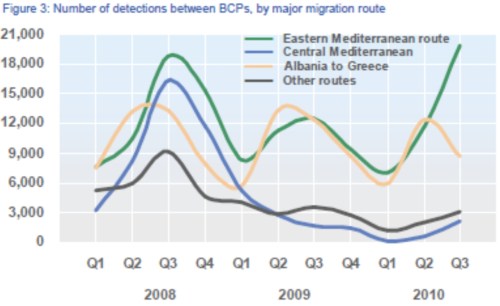
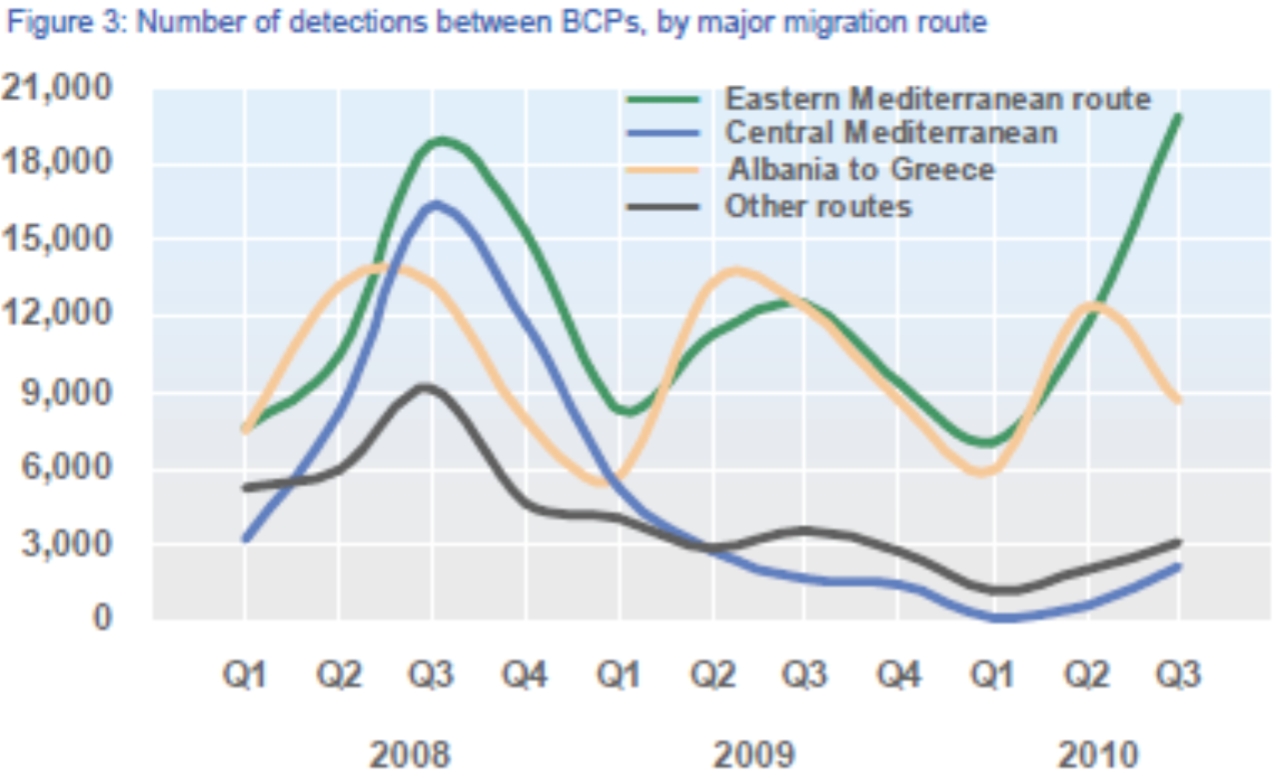
The Report also notes an increase in the number of detections on the Central and Western Mediterranean sea routes compared to Q2 which may be attributable to seasonal variations or “may be indicative of reorganized modi operandi in these areas in response to Frontex Joint Operations, more effective border controls and bilateral agreements implemented in 2008.”  See Figure 3 below.

Excerpts from the Report:

“Detections of illegal border-crossing”

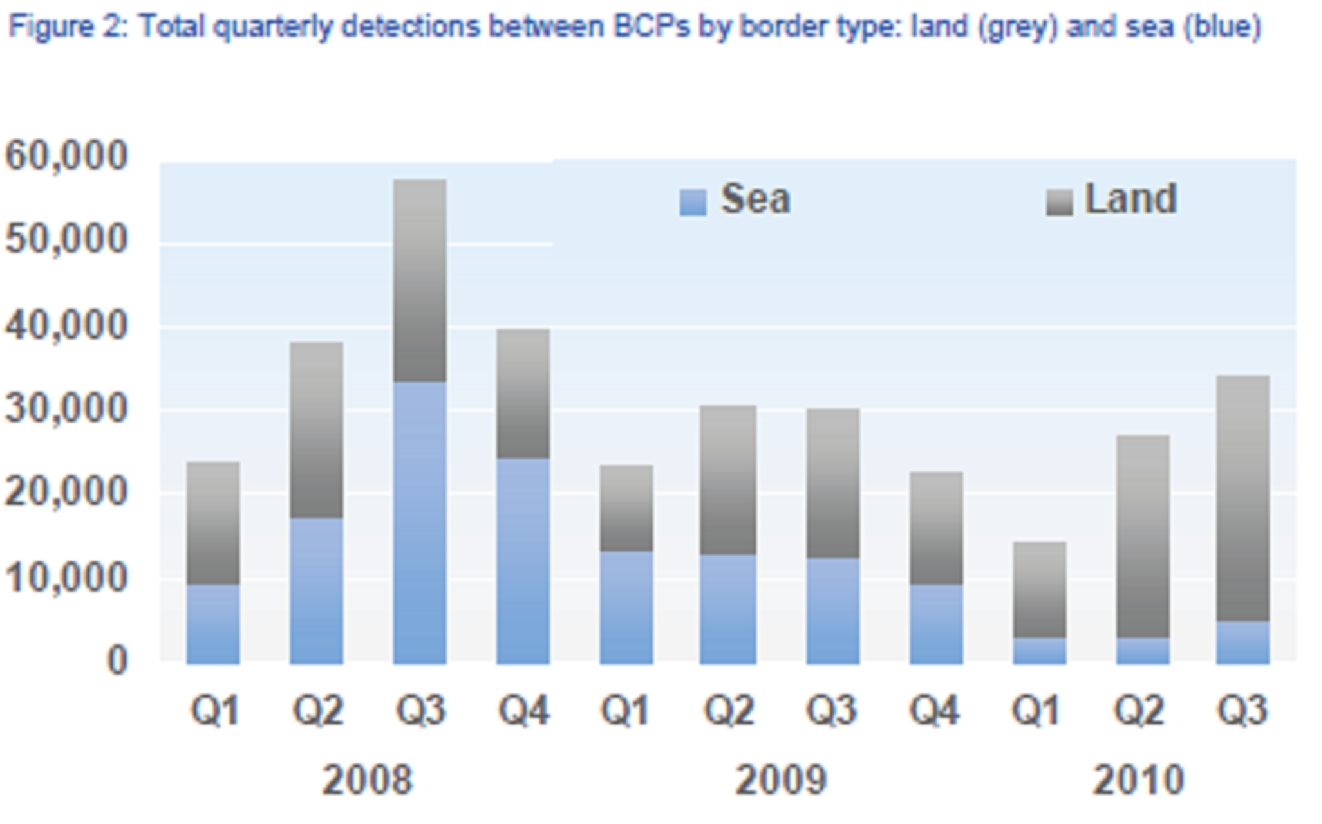
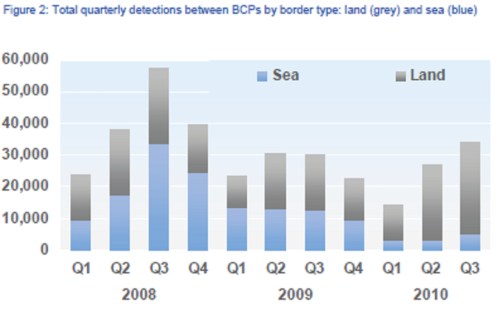
“…  Fig. 2 [see below] shows quarterly detections at the land and sea borders of the EU since the beginning of 2008. The 30% increase in the number of detections between the previous and present quarters is comprised of a 60% increase at the sea borders (although from a lower base) and a 23% increase at the land borders. This means that the shift from sea to land borders has not continued to same extent as in the previous quarters.  Nevertheless in Q3 2010, there were some 29 000 detections of illegal border-crossing at the external land border of the EU, which constitutes 85% of all the detections at the EU level, and the highest number of detections at the land border since data collection began in early 2008….”

“Eastern Mediterranean route”

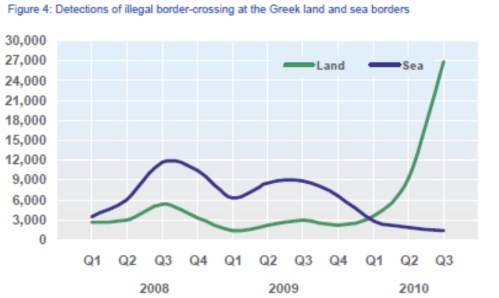
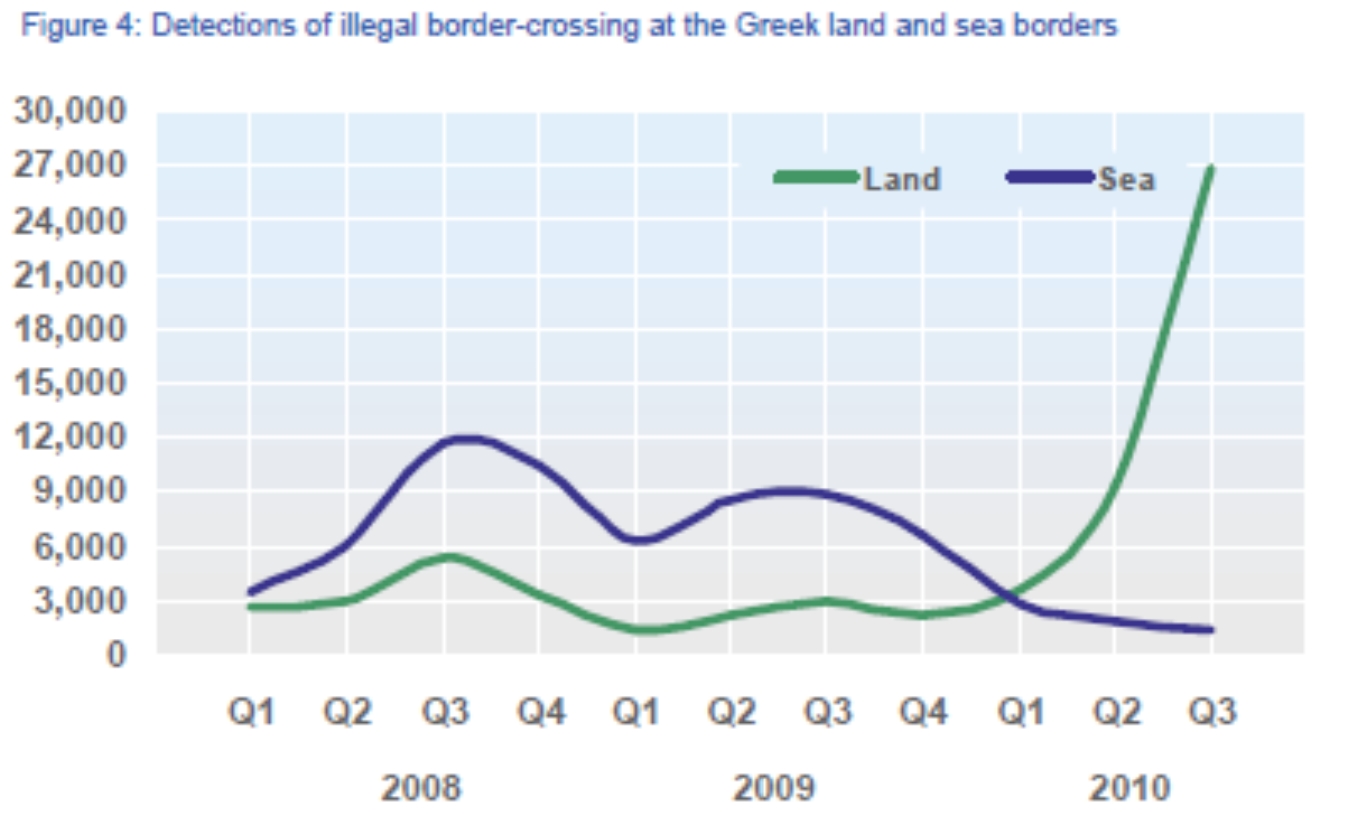
The Report observes that there has been a shift in illegal crossings from the Greece-Turkey maritime border to the Greece-Turkey land border and notes an increase in the number of nationals from Maghreb countries apprehended at the Greece-Turkey land border.  “This route [being taken by Maghreb nationals] is very indirect, but is thought to be the result of a displacement effect from the West Africa and Western Mediterranean routes….”

See Figure 4 below which shows that detections of illegal border crossers at the land border of Greece have exceeded detections at the sea border since Q1 of 2010.

“Central Mediterranean route”

“There were 2 157 detections of illegal border-crossing during Q3 2010. This is more than a three-fold increase compared to the previous quarter and a third higher than the same period last year. However despite this apparently large increase, detections still remain massively reduced compared to the peak of around 16 000 during the same period in 2008 (Fig. 3)….”

“The JO Hermes 2010 which was operational between June and October 2010, focused on illegal migratory flows departing from Algeria to the southern borders of the EU, specifically to Sardinia. In 2010, there were fewer detections than in previous years….”

“Departures from Libya also remained low. In June 2010, a new law was implemented to serve more severe punishments for facilitating illegal immigration. Ambassadors of the countries of origin were called into the Ministry of Foreign Affairs in Tripoli to be informed about the consequences of the new law, which suggests that this may be a serious implementation.”

“Western Mediterranean route”

“In general, irregular immigration to southern Spain has decreased massively since the beginning of 2006. However, in Q3 2010 there were 2 200 detections of illegal border crossing in the Western Mediterranean, more than twice that of the previous quarter and around a third higher than the same period in 2009. There is growth in the number of detections of a wide range of African nationalities, nine of which more than doubled in number between Q2 and Q3 2010. The most detected nationalities were Algerian, Moroccan, Cameroonian and Guinean.”

“Western Africa route”

“The cooperation and bilateral agreements between Spain and the rest of the Western African countries (Mauritania, Senegal and Mali) are developing steadily, and are one of the main reasons for the decrease in arrivals, as is the presence of patrolling assets near the African coast.”

“According to data collected during JO Hera, the numbers of arrivals in the Canary Islands and detections in West Africa are very low compared to the same time last year. The main nationality and place of departure is from Morocco, to where migrants are returned within a few days.”

Click here for the 3rd Quarter 2010 Report.

Click here for the 2nd Quarter 2010 Report.

Click here for the 1st Quarter 2010 Report.

Click here for my previous post regarding the 2nd Quarter Report.


Leave a comment

Filed under Aegean Sea, Algeria, Data / Stats, Eastern Atlantic, European Union, Frontex, General, Greece, Italy, Libya, Malta, Mauritania, Mediterranean, Morocco, News, Reports, Senegal, Spain, Tunisia, Turkey

UNODC Publication: Smuggling of Migrants into, through and from North Africa

UNODC has issued a new publication entitled “Smuggling of Migrants into, through and from North Africa: A thematic review and annotated bibliography of recent publications.”  Most of the reviewed literature and data are from 2008 and earlier dates and therefore the publication does not include references to more recent events, e.g. the Italy-Libya migration agreement.  But it is a comprehensive and useful publication.  The 16 page Annotated Bibliography is a very good resource.

According to the UNODC web site, the publication “focuses primarily on the patterns and dynamics of migrant smuggling, as it concerns the North African region. Recognizing, however, that irregular migration and smuggling flows are transnational in nature, the review goes beyond North Africa, to also cover sub- Saharan African and European countries affected along the various smuggling routes.  The aim of the review is twofold: to describe major findings on smuggling of migrants; into, through and from North Africa, and to highlight the need for further research on specific issues that have not yet been studied.”

Table of Contents:

  • I. Introduction
  • II. Quantifying irregular migration and smuggling of migrants
  • III. Migrant smuggling routes
  • IV. Profiles and characteristics of smuggled migrants
  • V. Smuggler-migrant relationships
  • VI. Organizational structures of migrant-smuggling networks
  • VII. Modus operandi of migrant smuggling
  • VIII. Smuggling fees
  • IX. The human and social costs of smuggling
  • X. Summary of findings
  • XI. Annotated bibliography

Click here for the publication.

Leave a comment

Filed under Aegean Sea, Algeria, Analysis, Data / Stats, Eastern Atlantic, Egypt, France, Greece, Italy, Libya, Malta, Mauritania, Mediterranean, Morocco, Reports, Senegal, Spain, Tunisia, Turkey, UNODC

Maroni: Italy’s Push-Back Agreement with Libya Has Resolved Italy’s Migrant Problem

Roberto Maroni, Italy’s Interior Minister, speaking to the Italian Parliament’s Schengen Committee, said that as a result of Italy’s 2009 push-back agreement with Italy, migratory flows have been mostly diverted to the west to Spain and to the east to Greece.  According to Maroni, to the extent that migrants are reaching Italy by sea, they are doing so by routes from Tunisia and other countries, but not from Libya.  Maroni said that “this resolves Italy’s problem, but not Europe’s problem.” [“Questo risolve i problemi dell’Itala, ma non dell’Europa.”]

According to Maroni there has been a 96% decrease in the arrival of irregular migrants in Italy over the first three months of 2010 compared with the same period last year: from 1 January to 4 April there have reportedly been 170 arrivals compared with 4,573 arrivals over the same period in 2009.

Maroni praised the push-back agreement by saying “We’ve had 28,000 fewer arrivals [since its May 2009 implementation] and we’ve saved countless lives. It’s an unprecedented and concrete achievement which is the result of Berlusconi’s diplomacy and the agreement he struck with Libya.”.

Click here (IT) and here (EN) for articles.

Leave a comment

Filed under Data / Stats, Greece, Italy, Libya, Mediterranean, News, Spain, Tunisia

8th Conference of the Foreign Ministers of the Western Mediterranean (“5+5”)

Foreign Ministers from the so-called “5+5” countries, France, Spain, Italy, Malta, Portugal, Morocco, Algeria, Libya, Mauritania, and Tunisia, are meeting this week in Tunis to discuss a variety of issues including migration, which will be discussed at the plenary session on 16 April.

Click here (FR) and here (FR) for articles.

Leave a comment

Filed under Algeria, France, Italy, Libya, Malta, Mauritania, Mediterranean, Morocco, News, Portugal, Spain, Tunisia

CARIM Mediterranean Migration 2008-2009 Report

Noted recently in the Newsletter of the Real Instituto Elcano:

CARIM MEDITERRANEAN MIGRATION 2008-2009 REPORT, Robert Schuman Centre for Advanced Studies, San Domenico di Fiesole (FI): European University Institute, October 2009, Edited by Philippe Fargues

MIGRATIONS MÉDITERRANÉENNES, RAPPORT 2008-2009, Octobre 2009, Sous la direction de Philippe Fargues

An excerpt:

“The period covered in this latest report, the years 2007 and 2008, is characterised by the accentuation of the migratory trends described in previous reports1: emigration from South and East Mediterranean countries (SEM) is continuing at a steady rate, while immigration to these countries is increasing, particularly in various irregular forms. [***]

Transit Migrants

Transit migrants in the SEM countries are people who cannot reach the destination of their choice (Europe) for lack of the required visa. They are waiting to find a way to reach this destination and over time their transit becomes stay. All the SEM countries, from Mauritania in the west to Turkey in the East, have, over the course of the last two decades, been transformed into transit countries for those travelling to Europe.

How many transit migrants are there in the SEM countries? The statistics in this area are even more inadequate than those for de facto refugees or irregular migrant workers. Aggregating figures provided by the police and various NGOs allows for a maximum estimation of 200,000 transit migrants in the region (Table 7).

Table 7: Transit migrants present in SEM countries around 2005

Country                        Estimated number

Algeria                           > 10,000

Turkey                           > 50,000

Libya                              > 10,000

Mauritania                   ± 30,000

Morocco                      > 10,000

Egypt, Israel, Jordan,

Lebanon, Palestine,

Syria, Tunisia              Not available

Total SEM                     < 200,000

Sources: CARIM, Irregular Migration Series http://www.carim.org/index.php?areaid=8&contentid=235&callTopic=7

According to data collected by an Italian NGO on deaths and disappearances at sea (Table 8), it would seem that the number of clandestine sea crossings from SEM countries to Europe is not increasing (in fact it may even have decreased in 2008) but the routes are changing. The most ancient route across the Straits of Gibraltar is being used less and less and has been successively replaced by that from Mauritania, or even Senegal, to the Canary Islands (on which traffic peaked in 2006), from Turkey to the Greek Islands of the Dodecanese (on which traffic peaked in 2007) and lastly from Libya to Italy on which traffic peaked in 2008).

How many transit migrants are there who attempt (sometimes successfully) the crossing to Europe? And for how many does transit in the SEM countries become a more long period of stay? The rare surveys carried out in the Maghreb or in Turkey do not allow us to assess this. With the extension of their stay in countries initially seen as a place of transit, transit migrants soon become mixed up with the more significant mass of migrant workers in irregular situation. On the other hand, it is not always possible to distinguish them from refugees. The two groups exist side by side in what the HCR calls flows of “mixed migration” where transit migrants and refugees, sometimes from the same countries of provenance, resort to the same smugglers and find themselves in the same circumstances.

Table 8: Dead and missing persons on sea routes of irregular migration from SEM to Europe 2000 – 2008

Year\ Route      Sicily +             Gibraltar +

Sardinia           Ceuta & Melilla

2000                   0                           127

2001                     8                           157

2002                     236                     106

2003                     413                     108

2004                     206                    64

2005                     437                    146

2006                     302                    215

2007                     621                    142

2008                     702                    216

Total                     2,925                1,281

Year\ Route      Canary              Aegean Sea

Islands

2000                   16                         32

2001                     40                        102

2002                     39                        94

2003                     130                      81

2004                     232                      103

2005                     185                      98

2006                     1,035                  73

2007                     745                      257

2008                      136                      181

Total                       2,558                 1,021

Year                Total All Routes

2000                 175

2001                   307

2002                   475

2003                   732

2004                   605

2005                   866

2006                   1,625

2007                   1,765

2008                   1,235

Total                  7,785

Source : http://fortresseurope.blogspot.com/

[***]”

Click here for link to full Report in both English and francais.

Leave a comment

Filed under Algeria, Data / Stats, Egypt, France, Greece, Italy, Libya, Malta, Mauritania, Mediterranean, Morocco, Portugal, Reports, Spain, Tunisia, Turkey

Informal Meeting of European Union Defence Ministers

An Informal Meeting of EU Defence Ministers was held in Mallorca last week to discuss the EU Common Security and Defence Policy (CSDP) established by the Treaty of Lisbon.

A decision was taken at the meeting to expand the objectives of Operation Atalanta to include the surveillance and control of Somali ports where pirate ships are based.  This decision will be implemented later in the month of March as weather conditions in the region improve.  The decision represents a potentially significant expansion of the EU’s anti-piracy operations.

Also attending the Informal Meeting were the ministers of defence from Algeria, Libya, Morocco, Mauritania and Tunisia.  A side meeting was conducted with regard to improving co-operation in matters of security in the Euro-Mediterranean zone.  The side talks pertained to the so-called “5+5 Western Mediterranean Defence Initiative” or more simply the “5 + 5 Initiative”.

Spanish Minister of Defence, Carme Chacón, who chaired the Informal Meeting said in regard to the meetings with the defence ministers from the five Maghreb countries:

“Spain is very clear on the fact that the Mediterranean is a sea of opportunities, but if we let our guard down then it can become a sea of problems – and we share this vision with all the associations we are involved in. At the moment it is a sea of peace and tranquillity, but both North and South must work together to tackle the dangers and new threats of the 21st Century, such as international terrorism, drug smuggling and organised crime. We must put our surveillance and maritime safety capacities into action in order to combat these threats, which could become an area of concern or a problem if we do not deal with them properly. And Spain will not forget this. In terms of the initiative of bringing together the countries of Europe and the Maghreb, we would like it to be not just the Spanish Presidency that sees to hold these meetings, but for the EU to be able to sit down regularly with these countries to discuss issues relating to the Mediterranean Sea, which must carry on being a source of opportunities rather than one of concern.”

Click here, here, here, and here for Press Releases from the Informal Meeting.

Cliquez ici pour un article (blog post) en francais.

Leave a comment

Filed under Algeria, European Union, Gulf of Aden, Indian Ocean, Libya, Mauritania, Mediterranean, Morocco, News, Somalia, Spain, Tunisia

Camps d’enfermement de harraga en Tunisie (News)

From Al Watan:

“[300 harraga] sont actuellement détenus dans des centres de rétention secrets. Ces centres seraient au nombre de 11 puisqu’en contrepartie de sa coopération dans la lutte contre l’immigration clandestine, l’Italie s’était engagée à aider son partenaire tunisien et ce, dans le cadre du premier accord bilatéral sur l’immigration qu’ils ont signé en 1998.

“… 13 camps d’enfermement [ont été construits] dont un près de Tunis, un autre entre Gabes et la frontière libyenne. « Où sont les 11 autres camps ? » Cela a toujours été un secret….

” [D]ans [un second accord signé le 27 janvier 2009], il est question de la définition d’un plan qui permet la simplification et l’accélération des procédures d’identification des migrants tunisiens enfermés dans les centres de rétention italiens et l’expulsion « graduelle et constante » des migrants….  En réalité, indiquent ces sources, Tunis a accepté l’expulsion de 500 migrants, à la condition qu’elle soit étalée dans le temps 150 migrants expulsés par mois les deux premiers mois succédant l’entrée en vigueur de l’accord, ensuite 100 personnes par mois par petits groupes de 7 personnes maximum.

“Le nombre de personnes expulsées dans le cadre de cet accord n’est pas clair, vu qu’aucun chiffre officiel n’est donné. …

“[L]’un des points de l’accord … prévoient … la réadmission, par la Tunisie, de ses citoyens mais aussi de ressortissants de pays tiers entrés illégalement sur le territoire italien en provenance des côtes tunisiennes… ainsi que l’intensification des contrôles des forces de l’ordre des deux pays le long des côtes tunisiennes. ”

Click here for article.

Leave a comment

Filed under Algeria, Italy, Mediterranean, News, Tunisia