Van Rompuy: Migration Danger Should Not Be Exaggerated; European Treaties Need to Be Respected

EU President Herman Van Rompuy said during an interview on Sunday that the danger of migration to Europe should not be exaggerated and that European migration treaties, including the Schengen agreement, need to be respected.  He said “[t]here is of course a migration danger, but do not overdo it.” (“Interrogé sur l’existence d’un danger migratoire lié à l’afflux de migrants depuis le début des révoltes dans le monde arabe, M. Van Rompuy a répondu : ‘Il y a bien sûr un danger migratoire mais il ne faut pas l’exagérer’, lors d’une émission d’une émission commune de la chaîne TV5Monde, la radio RFI et du journal Le Monde.”)  In regard to the Schengen agreement, he said “[n]either Italy nor France, until now, has done anything illegal. That said, there is a danger of not respecting the spirit of the Schengen Treaty…” (“Ni l’Italie, ni la France, jusqu’à présent, n’ont fait quelque chose d’illégal. Ceci dit, il y a un danger de ne pas respecter l’esprit du traité de Schengen…”)

Van Rompuy’s remarks are consistent with Jose Manuel Barroso’s statements last week reported by the EU Observer regarding the danger of the “immigration debate being hijacked by ‘populist and extremist’ forces in Europe.”  Barroso was quoted as saying “I don’t think it is in the interest of third countries [such as Tunisia] that there is a debate in Europe on such sensitive issues and that certain populist, extremist forces seek to take advantage of these problems.”

We got a small taste of the populist forces at work with yesterday’s results in Finland’s parliamentary elections and the strong third place showing of the True Finns led by Timo Soini.  While the True Finns are currently focused more on blocking the Portuguese financial bailout,  anti-immigrant sentiments within the party are strong.

Click here (FR), here (EN), and here (EN) for articles.

1 Comment

Filed under European Union, France, Italy, Libya, Mediterranean, News, Tunisia

UNHCR: 16 Drowning Deaths in Gulf of Aden

UNHCR reports on the most recent known deaths in the Gulf of Aden over the past week.  The victims were mostly Somalis attempting to reach Yemen.  In one incident involving a sinking of a boat at least 15 are known to have died.  “The survivors say that during the voyage they saw a cargo vessel and foreign naval ship. They say that the naval ship approached their boat but ignored their cries for help. This is disturbing. UNHCR appeals to all shipmasters in the Gulf of Aden to uphold the longstanding tradition of rescue at sea and helping vessels in distress.”

“UNHCR is alarmed by a growing number of deaths in the Gulf of Aden this year. Eighty-nine people are known to have drowned in January and February alone – compared to 15 only during the whole of 2010. We also note with the great concern the resurgence of violence and inhumane treatment by smugglers of the refugees, asylum seekers, and migrants that they are transporting. The deadly record for the first three months is a stark manifestation of this trend.  More than 6,500 Somalis and 18,800 Ethiopians have arrived in Yemen by boat so far this year.”

Click here for UNHCR statement.

Leave a comment

Filed under Gulf of Aden, News, Somalia, UNHCR, Yemen

French PM Fillon: Frontex Should Intercept and Return Migrants Directly to Tunisia

French Prime Minister Francois Fillon, after meeting yesterday with  EC President Jose Manuel Barroso, said that it does not make sense to intercept Tunisian migrants at sea and then bring them to Lampedusa; it would make better sense if the Frontex mission based in Italy intercepted Tunisian migrant boats at sea and returned them directly to Tunisia.

Fillon said: “There is no rule that provides for the reception and free movement on European territory of illegal economic migrants. A large portion of the Tunisian migrants who have arrived in Italy, are not destined, as some suggest, to be resettled in different European countries, they are destined to return to their country.” («Il n’y a aucune règle qui prévoit l’accueil sur le territoire européen et la libre circulation des immigrants économiques clandestins. Une grande partie des ressortissants tunisiens qui sont arrivés en Italie, n’ont pas vocation, comme certains le proposent, à être répartis dans les différents pays européens, ils ont vocation à retourner dans leur pays.»)  Italian Foreign Minister Franco Frattini praised Fillon’s proposal.

Click here (FR), here (IT), and here (IT) for articles.

Leave a comment

Filed under European Union, France, Frontex, Italy, Mediterranean, News, Tunisia

COE Parliamentary Assembly Adopts Resolution Regarding North African Migrants & Asylum Seekers

Earlier today PACE approved a resolution based on a report by Tineke Strik (Netherlands, SOC) addressing the large influx of migrants and asylum seekers on Europe’s southern borders.  From the PACE press statement: the Assembly “welcomed the efforts so far of the ‘frontline states’ to provide humanitarian assistance in line with their international obligations, and urged other European countries to ‘show solidarity’ with them, including by agreeing to resettle refugees and other persons with international protection needs. Malta was in a ‘particularly difficult situation’ given its small size, high population and limited resources… If the current wave of arrivals in Europe increases because of an even greater exodus of persons from Libya, in particular Libyans fleeing terror from Colonel Gaddafi’s regime or an entrenched civil war, the EU should consider applying its temporary protection directive….”

Excerpts from PACE Resolution 1805 (2011):

The large-scale arrival of irregular migrants, asylum seekers and refugees on Europe’s southern shores

“[***]

6.       The Parliamentary Assembly recognises that one of the first priorities is to deal with the humanitarian and international protection needs of those who have arrived on Europe’s shores, primarily in Italy and Malta. Member states, the European Union, international organisations, civil society and others all have a contribution to make and need to show solidarity with the front-line states. This solidarity and willingness to share responsibility needs to extend to the coast of North Africa and the many thousands of refugees and displaced persons still seeking ways to return home after fleeing from Libya. It should also extend to those migrants and refugees who are trapped in Libya awaiting the chance to flee.

7.       The Assembly notes that while there has been a wave of arrivals, there has not yet been the feared total deluge. This distinction is important because it has not always been clearly made by politicians, the media and others, leading to heightened fear and misunderstanding among the general public and calls for exaggerated responses.

8.       The Assembly recognises the pressure that the front-line countries of the Council of Europe are under, and welcomes their efforts to provide humanitarian assistance in line with international obligations and encourages them to continue with these efforts. The Assembly reminds states of their international obligations not to push back boats which are carrying persons with international protection needs.

[***]

12.       The Assembly, recognising that events in North Africa are of concern to all member states of the Council of Europe, therefore calls on member states to:

12.1.        acknowledge that the arrival of a large number of irregular immigrants on the southern shores of Europe is the responsibility of all European states and requires a solution which envisages the need to share this responsibility collectively. The Assembly reminds member states of the repeated appeals of the Council of Europe Commissioner for Human Rights for the need for effective responsibility sharing;

12.2.       provide urgent humanitarian aid and assistance to all those persons arriving on Europe’s southern shores and other borders, including through the provision of adequate accommodation, shelter and health care, as highlighted previously in Assembly Resolution 1637 (2008) on Europe’s boat people: mixed migration flows by sea into southern Europe;

12.3.       refrain from automatic detention and have recourse to detention only where there is no other reasonable alternative, ensuring that conditions comply with minimum human rights standards as outlined in Assembly Resolution 1707 (2010) on detention of asylum seekers and irregular migrants in Europe;

12.4.       ensure that vulnerable persons, including women and children, victims of torture, victims of trafficking, and the elderly, are not detained and receive appropriate care and assistance;

12.5.       guarantee the right of asylum and non-refoulement through, inter alia:

12.5.1.       ensuring that states give access to their territory to persons in need of international protection;

12.5.2.       assuring the quality and consistency of asylum decisions in line with Assembly Resolution 1695 (2009) on improving the quality and consistency of asylum decisions in the Council of Europe member states;

12.6.       ensure that, in screening arrivals and carrying out asylum determinations, these are carried out without delay, but that speed is not given preference over fairness;

12.7.       provide full support to the Office of the United Nations High Commissioner for Refugees (UNHCR), International Organisation for Migration (IOM), International Committee of the Red Cross (ICRC) and other international and national organisations providing humanitarian and other assistance, both in North Africa and in the European countries of arrival, and generously take part in resettlement programmes for refugees stranded in North African countries;

12.8.       show solidarity in the challenges faced, which includes sharing responsibility with front-line states, including by:

12.8.1.       giving further support to the European Agency for the Management of Operational Cooperation at the External Borders of the Member States of the European Union (Frontex) and the newly established European Asylum Agency (EASO), and encouraging further use of European Union funding available through the External Borders Fund, the Return Fund, the European Refugee Fund and the Integration Fund;

12.8.2.       looking into the possibility of taking on commitments for resettlement of those with international protection needs from the European countries of arrival and on suspending the application of the Dublin Regulations or on considering other forms of responsibility sharing, through the use of existing mechanisms provided for in the Dublin Regulation, including the solidarity clause in Article 3(2) and the humanitarian clause in Article 15;

12.8.3.       working together, including with the European Union, on the issue of voluntary and forced returns, taking into account necessary human rights safeguards when relying on readmission agreements in line with Assembly Resolution 1741 (2010) on readmission agreements: a mechanism for returning irregular migrants;

12.8.4.        acknowledging the particularly difficult situation in which Malta finds itself, in view of the size of its territory, its high population density and limited human and material resources, and committing to the resettlement of those with international protection needs.

[***]

14.       If a mass exodus of Libyan refugees occurs because of increasing terror by Colonel Gaddafi or the emergence of a civil war, the Assembly encourages the European Union member states to consider applying the temporary protection directive (Council Directive 2001/55/EC of 20 July 2001 on minimum standards for giving temporary protection in the event of a mass influx of displaced persons and on measures promoting a balance of efforts between Member States in receiving such persons and bearing the consequences thereof). It is important, however, to ensure that no states are considering returning Libyans at this stage and that at least a form of temporary protection is provided in practice.

[***]”

Click here for Resolution. (Resolution 1805 (2011))

Click here for Recommendation. (REC 1967 (2011))

Click here for PACE press statement.

Click here for Report, Committee on Migration, Refugees and Population, Rapporteur: Ms Tineke STRIK, (Doc. 12581, 13 April 2011).
 

Leave a comment

Filed under Commissioner for Human Rights, Council of Europe, European Committee for the Prevention of Torture and Inhuman or Degrading Treatment or Punishment, European Union, Italy, Libya, Malta, Mediterranean, News, Tunisia, UNHCR

Migrant Boat From Libya Sinks Off Pantelleria – 2 Dead, 100+ Rescued

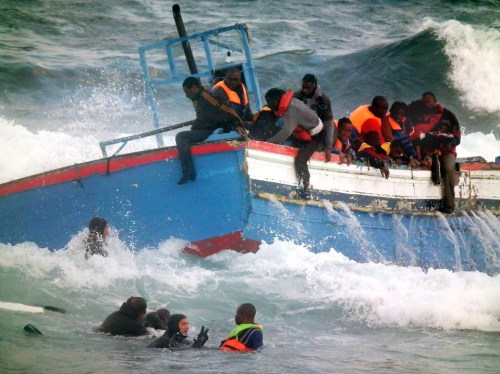
A migrant boat sank yesterday just off shore of Pantelleria, an Italian island approximately 150 km northwest of Lampedusa.  The boat was carrying approximately 250 people and ran around on rocks near the entrance to the port.  The boat had been intercepted earlier in the night by an Italian naval vessel and was being escorted to Pantelleria.  It is not clear why the migrant boat was unable to enter the harbour safely.  Two young women died.

Click here and here for articles.  (IT)

AFP PHOTO/ Francesco Malavolta/Getty Images

1 Comment

Filed under Frontex, Italy, Libya, Mediterranean, News

MEP Francesco Speroni: Italy Entitled to Use Weapons to Prevent Landings by Migrant Boats

Italian MEP Francesco Speroni (EFD, Northern League) today compared the Tunisian migrants arriving in Italy to an invading force: “Do not mistake the Tunisians. If someone invades the territorial waters of a sovereign country, that country is allowed to use weapons, this is international law…” (“Non sbagliano i tunisini. Se uno invade le acque territoriali di un Paese sovrano è lecito usare le armi, questo è diritto internazionale…”)  “We in Lebanon [and] in Afghanistan we are using the weapons, why do not we use them to defend our borders?” (“Noi in Libano, in Afghanistan stiamo usando le armi, perchè non dobbiamo usarle per difendere i nostri confini?”)  Speroni’s remarks follow remarks made yesterday by Italian Transportation Vice-Minister Roberto Castelli (Northern League) who said “With [arriving] immigrants, we can not use weapons, for now.” (“”Con gli immigrati non possiamo usare le armi, per ora.”)

Such remarks represent an unfortunate and dangerous development in the political debate within Italy.

Click here, here, here, and here for articles. (IT)

1 Comment

Filed under Italy, Mediterranean, News, Tunisia

COE Parliamentary Assembly to Hold Urgent Debate on Large-Scale Migrant Arrivals in Southern Europe

From PACE:  “Spring session: 11-15 April 2011 – Debates on the arrival of irregular migrants and asylum seekers on Europe’s southern shores and on the situation in Northern Africa.

Adopting the final agenda of its plenary Spring Session, the Assembly today [11 April] decided to hold, on Thursday 14 April, an urgent debate on the large-scale arrival of irregular migrants on Europe’s southern shores and a current affairs debate on the situation in Northern Africa…..”  Agenda Working documents

From the Agenda:

Thursday 14 April 2011

8.30 a.m. Committees
10 a.m. 1. Debate under urgent procedure: 

The large-scale arrival of irregular migrants, asylum seekers and refugees on Europe’s southern shores (Doc. )

Rapporteur of the Committee on Migration, Refugees and Population:

Deadline for tabling amendments: Wednesday 13 April at 12 noon

Debate and vote on a …

2. Current affairs debate: 

The situation in Northern Africa

Discussion

1 p.m. End of the sitting

Click here for link to PACE news page.

Leave a comment

Filed under Council of Europe, Italy, Libya, Malta, Mediterranean, News, Tunisia

Belgium Plans to Reintroduce Border Controls to Block Entry by Tunisians from Italy

Belgium announced earlier today at the conclusion of the JHA Council meeting that it plans to reintroduce border controls, joining France and Germany, in an effort to block the entry of Tunisian migrants granted temporary residency by Italy.  The announcement was made by Melchior Wathelet, Secretary of State for Asylum and Migration. Wathelet also suggested that Austria and the Netherlands , as countries of “final destination,” were supportive of the move to reintroduce border controls within the Schengen Area.

Click here (FR), here (NL), and here (FR) for articles.

Leave a comment

Filed under Belgium, European Union, France, Germany, Italy, Libya, Mediterranean, News

JHA Council Conclusions on the management of migration from the Southern Neighbourhood – 11 April 2011

Excerpts from today’s JHA Council Conclusions:

[***]

5. The Council calls on FRONTEX to continue to monitor the situation and prepare detailed risk analyses on possible scenarios with a view to identifying the most effective responses to them, and also invites FRONTEX to speed up negotiations with the countries of the region – and in particular with Tunisia – with a view to concluding operational working arrangements, and organising joint patrolling operations in cooperation with Tunisian authorities and in application of all relevant international Conventions, in particular the UN Convention on the Law of the Sea (“the Montego Bay Convention”).

6. The Council urges Member States to provide further human and technical resources to support the Agency’s operations, and in particular the existing Joint Operations Hermes, Poseidon Land and Sea and the possible deployment of a RABIT operation in Malta, in accordance with needs identified by the Agency in the light of the developing situation.

7. In order to rapidly strengthen the competences of FRONTEX and put more effective tools at its disposal, the Council agrees to accelerate negotiations on amending the FRONTEX Regulation, in cooperation with the European Parliament, with a view to reaching agreement by June 2011.

8. The Council underlines the need to promote all relevant forms of cooperation on a performance-based approach in the field of migration, mobility and security with the countries of the region that are sufficiently advanced in their reform progresses, and that effectively cooperate with the EU and its Member States in preventing illegal migration flows, managing their borders and cooperating in the return and readmission of irregular migrants. The Council stresses the need for early progress in the area of return and readmission in the case of relevant third countries, and recalls in particular that all States have an obligation to readmit their own nationals.

[***]

10. The Council welcomes the outcome of the visits of the Presidency and the Commission to Egypt and Tunisia and the intention of the Commission to follow-up these visits by setting up dialogues with the authorities of these countries at senior officials’ level, in which Member States will also participate, and which will be aimed at promoting the swift development of cooperation on the management of migration flows. This dialogue should in first instance, focus on the identification and promotion of measures which can contribute in a concrete and effective way to the prevention of illegal migration, to the effective management and control of their external borders, to the facilitation of the return and readmission of irregular migrants, and to the development of protection in the region for those in need, including through regional protection programmes. Subsequently, this dialogue could explore the possibilities for facilitating people-to-people contacts using instruments such as mobility partnerships.

11. The Council stresses the importance of offering durable protection solutions to those in need of international protection present in the countries of the Southern Neighbourhood, and, in this respect, calls on the Commission and the Council’s preparatory bodies to examine the possibility of assisting those countries in capacity building in the area of international protection, including by activating existing regional protection programmes, and assessing the need for additional programmes in the region.

12. The Council recalls that resettlement of refugees on a voluntary basis, in particular those living for some years in a situation of protracted displacement and vulnerability, and having no other perspective, can represent a durable solution for them. The Council takes note of the willingness of certain Member States to consider offering resettlement opportunities for the refugees present in the region. The Council invites Member States to continue supporting UNHCR in the development of resettlement programmes and calls on the Commission to identify solutions for supporting financially such resettlement actions.

13. The Council underlines that the measures mentioned in the paragraphs above represent the immediate answer to the crisis situation in the Mediterranean, but that it is also crucial to put in place a more long-term sustainable strategy to address international protection, migration, mobility and security in general, and taking also the secondary movements to other Member States into account.

14. The Council welcomes the Commission’s intention to come forward for that purpose with proposals in response to the Declaration of the Extraordinary European Council of 11 March and the Conclusions of the European Council of 24-25 March, and notes that the Presidency stands ready to convene an extraordinary meeting of the Council on 12 May if necessary in the light of developments and to further consider these matters.”

Click here for full document.

Leave a comment

Filed under European Union, Frontex, Italy, Libya, Malta, Mediterranean, News, Statements, Tunisia, UNHCR

Malmström Tells Italy that Temporary Residence Permits Do Not Allow Free Movement in Schengen Area; Germany Threatens to Reinstate Border Controls

Commission Cecilia Malmström has notified Italian Interior Minister Roberto Maroni in a letter that the temporary residence permits being issued by Italy to Tunisian migrants will not automatically allow free movement within the Schengen area.  Over the weekend Germany joined France and said that it will consider instituting border controls to prevent the entry of Tunisians in possession of the temporary residence permits from entering German territory.

Click here (EN), here (IT), here (IT), and here (IT) for articles.

1 Comment

Filed under European Union, France, Germany, Italy, Mediterranean, News, Tunisia

Thousands of Refugees Stranded in Misrata

ICRC expressed its concern over the situation in Misrata where six to seven thousand foreign migrants and refugees are stranded and living in the open. The city is completely surround by Gaddafi forces.  An ICRC delegation was able to enter the city over the weekend to deliver humanitarian supplies.

“Michael Mann, spokesperson for EU foreign policy Chief Catherine Ashton, said [last week before the ICRC delegation arrived in Misrata] that a decision adopted on 1 April allowed the EU to use military equipment for a humanitarian operation [to evacuate civilians] in a situation such the one in Misrata.  ‘We can launch this as soon as we receive a request from OCHA,’ the UN Office for the Coordination of Humanitarian Aid, Mann said.”

Click here, here, here, and here for articles.

Leave a comment

Filed under European Union, Libya, Mediterranean, News, OCHA

Statement: European Commission’s response to the migratory flows from North Africa

The European Commission released a statement on 8 April summarising its actions.  Excerpts:

“[***]

Measures addressing the migration flows towards the European Union

Urgent measures already undertaken

The massive displacement of populations from several North African countries has been putting the protection and reception systems of some of the EU Member States, in particular in Italy and Malta, under increasing strain. The European Union has responded to these serious challenges in a rapid and effective manner with the aim of stabilizing the situation.

Frontex has deployed the Joint Operation EPN Hermes Extension 2011 to assist the Italian authorities in managing the influx of migrants from North Africa, most of whom have been arriving on the island of Lampedusa. This mission was launched on 20 February 2011, only four days after receiving the official request from the Italian authorities, a clear signal of solidarity between Member States. FRONTEX stands ready to continue the mission as long as it will be necessary, and to expand it, provided that Member States will make available the necessary staff, vessels and equipment. In view of the above the Commission is launching the necessary procedures for reinforcing the FRONTEX 2011 budget with an additional EUR 30 million.

Europol has also deployed a team of experts to Italy in order to help the national authorities to assist in detecting and preventing possible criminal of trafficking of human beings.

Regarding the financial needs linked with the displacement, the Commission’s four migration-related funds (the External Borders Fund, Return Fund, Refugee Fund and Integration Fund) are available to Member States. For example, Italy, one of the major beneficiaries of these funds, has been allocated €55 million for 2010 and €75 million for 2011. Moreover, the Commission makes available an additional €25 million of emergency funding which can be quickly mobilised under the External Borders Funds and European Refugee Fund.

What measures could be undertaken in the short-term?

Should the inflow of irregular migrants and possible refugees continue, the Commission envisages a number of short-term measures that might be taken.

Reinforcing Frontex

  • 1) The Joint Operation EPN HERMES Extension coordinated by FRONTEX could be considerably strengthened, with additional technical resources made available by Member States, and adequate financial resources.
  • 2) It is essential that FRONTEX is finally given a stronger operational mandate through a revision of its legal basis, which the Commission tabled in February 2010 (IP/10/184)
  • 3) FRONTEX should speed up negotiations to conclude working arrangements with the countries of origin and transit of irregular migration in the Mediterranean in the region (for example, with Egypt, Morocco and Turkey), and receive a mandate to negotiate similar working arrangements with other relevant countries (for instance Tunisia)

Resettlement of third country nationals

The continuous and possible increase in the flow of refugees (e.g. Somalis, Eritreans etc.), in need of international protection, coming from Libyan territory is an issue of major concern. The EU will not only continue to provide humanitarian assistance through its humanitarian office (ECHO), but it is also ready to offer through the European Refugee Fund financial support in view of facilitating the resettlement of persons in need of international protection. Resettlement represents not only a life-saving measure for the refugees concerned, but is also an important responsibility-sharing gesture towards the countries hosting them. Showing solidarity with the countries neighbouring Libya that are under pressure through resettlement can help to maintain ‘protection space’, as well as contributing to dialogue and cooperation on other issues of migration and border management.

The Commission has therefore been encouraging EU Member States to offer resettlement places, in a spirit of responsibility-sharing and in close cooperation with the United Nations High Commissioner for Refugees (UNHCR). A meeting was held with Member States on 25 March at which details of the most urgent needs were explained by the UNHCR and the International Organisation for Migration (IOM), both of whom are actively engaged on the ground in the region.

The current crisis in the Mediterranean clearly demonstrates how imperative it is that the Council and the European Parliament make an effort to rapidly reach an agreement on the adoption of the Commission’s proposal for the establishment of an EU joint resettlement programme. This proposal would provide a structured basis for annual priority-setting, and linking those priorities with financial incentives, thereby encouraging more Member States to become involved in resettlement activities, and enhancing practical cooperation between Member States to that end.

Solidarity / Temporary Protection Directive

In the event of a massive inflow of persons who are likely to be in need of international protection, the Commission would expect Member States to demonstrate concrete solidarity with each other by directly assisting the States bearing the greatest burden. This could involve the relocation to other Member States of some persons seeking protection, or who have already received an international protection status.

Concrete assistance could likewise be provided by the newly-created European Asylum Support Office, one of whose central tasks is coordination of assistance to Member States whose asylum systems are under exceptional pressure. This could involve the deployment of so-called ‘asylum support teams’ to reinforce the capacities of a State to process asylum claims and to ensure appropriate reception conditions for asylum seekers.

The Commission would also be ready to consider proposing the use of the mechanism foreseen under the 2001 Temporary Protection Directive (2001/55/EC), if the conditions foreseen in the directive are met. Consideration could only be given to taking this step if it is clear that the persons concerned are likely to be in need of international protection, if they cannot be safely returned to their countries-of-origin, and if the numbers of persons arriving who are in need of protection are sufficiently great. Resort to this mechanism would allow for the immediate protection and reception in the territory of EU Member States for persons concerned, as well as offering a “breathing space” for the national asylum systems of the Member States most directly affected.

[***]”

Click here for full Statement.

1 Comment

Filed under European Union, Frontex, Italy, Libya, Malta, Mediterranean, News, Statements, Tunisia

Frontex Will Not Participate in Joint Italian-French Naval Patrols Along Tunisian Coast

Frontex Director Ilkka Laitinen said at a Friday press conference that Frontex will not participate in the naval patrols that France and Italy have said they will carry out along the Tunisian coast in an effort to block the departures of migrant boats from Tunisia.  Laitinen said Frontex could not enter Tunisian territorial waters without a specific agreement with Tunisia and no such agreement exists.

A statement on the Italian Foreign Ministry web site seems to suggest that France and Italy are contemplating joint naval patrols along the North African coast in general, not just along the Tunisian coast: France and Italy will conduct patrols “on the North African coast, especially Tunisia, to stop the departures.”  (sulle coste nordafricane, in particolare quelle tunisine, per bloccare le partenze.)

Click here (IT) for article.

Click here (IT) for statement on Italian Foreign Ministry web site.

Leave a comment

Filed under France, Frontex, Italy, Mediterranean, News, Tunisia

Italy to Begin Two Daily Repatriation Flights to Tunisia; Frontex Also Seeking Agreement with Tunisia to Expedite Returns

Prime Minister Silvio Berlusconi said two daily repatriation flights to Tunisia will begin today, Monday.  Frontex Director Ilkka Laitinen said Frontex is “trying to put in place ‘as soon as possible’ a new protocol with Tunisia on sending back irregular migrants….  Laitinen told a group of journalists in Brussels on Friday (9 April) that: ‘For the time being there have been no joint returns to Tunisia co-ordinated by Frontex, as we have no working arrangement with the relevant authority.’”

Click here, (EN), here (EN), and here (IT) for articles.

Leave a comment

Filed under European Union, Frontex, Italy, Malta, Mediterranean, News

Italy Refused to Allow Maltese Patrol Boat to Disembark Rescued Migrants in Lampedusa

On Thursday last week, a Maltese AFM patrol boat searching for survivors from Wednesday’s sinking of the migrant boat near Lampedusa encountered another migrant boat with 171 migrants and removed the migrants from the overcrowded boat.  The rescue occurred approximately 54 nautical miles from Lampedusa and 91 nautical miles from Malta.  The Maltese patrol boat attempted to disembark the migrants at the closer port in Lampedusa but was denied entry into the port.  The migrants were then taken to Malta – an eight hour sail from Lampedusa.  Carmelo Mifsud Bonnici, Malta’s Interior Minister, accused Italy of reneging on its “legal and humanitarian obligations” due to its failure to allow the migrants to be taken to the closer port.  The migrants involved have said they are Eritrean and Libyan.  If accurate, these may be the first Libyans to have been detected leaving by sea.

Click here, here, and here for articles.

1 Comment

Filed under Eritrea, Italy, Libya, Malta, Mediterranean, News