Tag Archives: Deaths at sea

PACE Appoints Tineke Strik as Rapporteur to Investigate Mediterranean Sea Deaths

The Migration Committee of the Parliamentary Assembly of the Council of Europe has appointed Tineke Strik (Netherlands, SOC) to prepare a report on the deaths of boat people who have died in the Mediterranean since January 2011.

From the PACE press statement: “‘There have been allegations that migrants and refugees are dying after their appeals for rescue have been ignored,’ said Mrs Strik. ‘Such a grave allegation must be urgently investigated.  I intend to look into the manner in which these boats are intercepted – or not – by the different national coastguards, the EU’s border agency FRONTEX, or even military vessels. I also intend to speak to witnesses directly involved in reported incidents, and put questions to national authorities, the UNHCR, FRONTEX and NATO, among others.’  On 8 May, the Guardian newspaper reported that 61 boat people escaping from Libya had died after their appeals for rescue had been ignored by armed forces operating in the Mediterranean. The following day PACE President Mevlüt Çavusoglu called for ‘an immediate and comprehensive enquiry’ into the incident.”

Click here for PACE press statement.

1 Comment

Filed under Council of Europe, Frontex, Italy, Libya, Malta, Mediterranean, News, Tunisia

PACE Adopts Resolution and Recommendation Regarding the Interception and Rescue at Sea of Asylum Seekers, Refugees and Irregular Migrants

On 21 June 2011, PACE adopted Resolution 1821 and Recommendation 1974 both relating to “the interception and rescue at sea of asylum seekers, refugees and irregular migrants.” 

Here are extensive excerpts:

Provisional edition – The interception and rescue at sea of asylum seekers, refugees and irregular migrants – Resolution 1821 (2011)1

“1.       The surveillance of Europe’s southern borders has become a regional priority. The European continent is having to cope with the relatively large-scale arrival of migratory flows by boat from Africa, reaching Europe mainly through Italy, Malta, Spain, Greece and Cyprus.

[***]

5.       The Assembly notes that measures to manage these maritime arrivals raise numerous problems, of which five are particularly worrying:

5.1.       Despite several relevant international instruments satisfactorily setting out the rights and obligations of states and individuals applicable in this area, interpretations of their content appear to differ. Some states do not agree on the nature and extent of their responsibilities in specific situations and some states also call into question the application of the principle of non-refoulement on the high seas;

5.2.       While the absolute priority in the event of interception at sea is the swift disembarkation of those rescued to a “place of safety”, the notion of “place of safety” does not appear to be interpreted in the same way by all member states. Yet it is clear that the notion of “place of safety” should not be restricted solely to the physical protection of people, but necessarily also entails respect for their fundamental rights;

5.3.       Divergences of this kind directly endanger the lives of the persons to be rescued, in particular by delaying or preventing rescue measures, and are likely to dissuade seafarers from rescuing people in distress at sea. Furthermore, they could result in a violation of the principle of non-refoulement in respect of a number of persons, including some in need of international protection;

5.4.       Although the European Agency for the Management of Operational Cooperation at the External Borders of the Member states of the European Union (Frontex) plays an ever increasing role in interception at sea, the guarantees of respect for human rights and obligations arising under international and European Union law in the context of the joint operations it co-ordinates are inadequate;

5.5.       Finally, these sea arrivals place a disproportionate burden on the states located on the southern borders of the European Union. The goal of responsibilities being shared more fairly and greater solidarity in the migration sphere between European states is far from being attained.

6.       The situation is rendered more complex by the fact that these migratory flows are of a mixed nature and therefore call for specialised and tailored protection-sensitive responses in keeping with the status of those rescued. To respond to sea arrivals adequately and in line with the relevant international standards, the states must take account of this aspect in their migration management policies and activities.

[***]

8.       Finally and above all, the Assembly reminds the member states that they have both a moral and legal obligation to save persons in distress at sea without the slightest delay, and unequivocally reiterates the interpretation given by the Office of the United Nations High Commissioner for Refugees (UNHCR), which states that the principle of non-refoulement is equally applicable on the high seas. The high seas are not an area where states are exempt from their legal obligations, including those emerging from international human rights law and international refugee law.

9.       Accordingly, the Assembly calls on the member states, when conducting maritime border surveillance operations, whether in the context of preventing smuggling and trafficking in human beings or in connection with border management, be it in the exercise of de jure or de facto jurisdiction, to:

9.1.       fulfil without exception and without delay their obligation to save people in distress at sea;

9.2.       ensure that their border management policies and activities, including interception measures, recognise the mixed make-up of flows of individuals attempting to cross maritime borders;

9.3.       guarantee for all intercepted persons humane treatment and systematic respect for their human rights, including the principle of non-refoulement, regardless of whether interception measures are implemented within their own territorial waters, those of another state on the basis of an ad hoc bilateral agreement, or on the high seas;

9.4.       refrain from any practices that might be tantamount to direct or indirect refoulement, including on the high seas, in keeping with the UNHCR’s interpretation of the extraterritorial application of that principle and with the relevant judgements of the European Court of Human Rights;

9.5.       carry out as a priority action the swift disembarkation of rescued persons to a “place of safety” and interpret a “place of safety” as meaning a place which can meet the immediate needs of those disembarked and in no way jeopardises their fundamental rights, since the notion of “safety” extends beyond mere protection from physical danger and must also take into account the fundamental rights dimension of the proposed place of disembarkation;

9.6.       guarantee access to a fair and effective asylum procedure for those intercepted who are in need of international protection;

9.7.       guarantee access to protection and assistance, including to asylum procedures, for those intercepted who are victims of human trafficking or at risk of being trafficked;

9.8.       ensure that the placement in a detention facility of those intercepted – always excluding minors and vulnerable categories –, regardless of their status, is authorised by the judicial authorities and occurs only where necessary and on grounds prescribed by law, that there is no other suitable alternative and that such placement conforms to the minimum standards and principles set forth in Assembly Resolution 1707 (2010) on the detention of asylum seekers and irregular migrants in Europe;

9.9.       suspend any bilateral agreements they may have concluded with third states if the human rights of those intercepted are not appropriately guaranteed therein, particularly the right of access to an asylum procedure, and wherever these might be tantamount to a violation of the principle of non-refoulement, and conclude new bilateral agreements specifically containing such human rights guarantees and measures for their regular and effective monitoring;

9.10.       sign and ratify, if they have not already done so, the aforementioned relevant international instruments and take account of the Guidelines of the International Maritime Organisation (IMO) on the Treatment of Persons rescued at Sea;

9.11.       sign and ratify, if they have not already done so, the Council of Europe Convention on Action against Trafficking in Human Beings (CETS No. 197) and the so-called “Palermo Protocols” to the United Nations Convention against Transnational Organized Crime (2000);

9.12.       ensure that maritime border surveillance operations and border control measures do not affect the specific protection afforded under international law to vulnerable categories such as refugees, stateless persons, women and unaccompanied children, migrants, victims of trafficking or at risk of being trafficked, or victims of torture and trauma.

10.       The Assembly is concerned about the lack of clarity regarding the respective responsibilities of European Union states and Frontex and the absence of adequate guarantees for the respect of fundamental rights and international standards in the framework of joint operations co-ordinated by that agency. While the Assembly welcomes the proposals presented by the European Commission to amend the rules governing that agency, with a view to strengthening guarantees of full respect for fundamental rights, it considers them inadequate and would like the European Parliament to be entrusted with the democratic supervision of the agency’s activities, particularly where respect for fundamental rights is concerned.

[***]”

Provisional edition – The interception and rescue at sea of asylum seekers, refugees and irregular migrants – Recommendation 1974 (2011)1

“[***]

4.       [***] the Assembly reminds the Committee of Ministers of its dual responsibility: to support those member states that are in need, but also to make sure that all human rights obligations are complied with in the context of the interception and rescue at sea of asylum seekers, refugees and irregular migrants, including by guaranteeing to those intercepted access to a fair and efficient asylum procedure.

5.       The Assembly therefore calls on the Committee of Ministers to:

5.1.       include in the training material all necessary elements to enable the trained persons to proceed to a screening assessment of the international protection needs of intercepted persons and to ensure that staff involved in the operations of the European Agency for the Management of Operational Cooperation at the External Borders of the Member states of the European Union (Frontex) are trained accordingly;

5.2.       define, in close co-operation with the Office of the United Nations High Commissioner for Refugees (UNHCR), guidelines and standard operating procedures, when interception and rescue at sea takes place, determining minimum administrative procedures to guarantee that those persons with international protection needs are identified and provided with the appropriate protection;

5.3.       continue monitoring the situation of large-scale arrivals of irregular migrants and asylum seekers, and in particular the issue of interception and rescue at sea, including by holding extraordinary meetings on the situation, where appropriate, and use the good offices of the UNHCR with its representative at the Council of Europe, where relevant.”

Click here for full text of Resolution 1821 (2011).

Click here for full text of Recommendation 1974 (2011).

Click here  for speech by Tineke Strik (Netherlands, SOC) presenting the Resolution. (Scroll down page for the English text of speech.)
1 Comment

Filed under Aegean Sea, Council of Europe, Cyprus, Frontex, Greece, Italy, Libya, Malta, Mediterranean, News, Spain, Statements, UNHCR

PACE Migration Committee to Designate Rapporteur to Conduct Inquiry into Deaths of Boat People

PACE President Mevlüt Cavusoglu announced today that the PACE Migration Committee will conduct an inquiry into the incident that occurred in April when 61 migrants died at sea after leaving Libya.  Survivors from the boat reported that several ships, including naval ships, ignored their calls for assistance.  The Committee will designate a Rapporteur this week who will look into this incident as well as “other cases where better interception and rescue co-ordination could have saved human lives.”

Click here and here for PACE press statements.

Click here and here for previous posts.

Leave a comment

Filed under Council of Europe, Libya, Mediterranean, News

HRC Adopts Resolution on Migrants and Asylum Seekers Fleeing North Africa; Calls for Inquiry Into Allegations of Failures to Rescue Boats in Distress

The UN Human Rights Council, 17th Session, on Friday, 17 June, adopted a resolution (A/HRC/17/L.13) on Migrants and Asylum Seekers Fleeing from Events in North Africa.  The Resolution recalls states’ obligations under human rights, humanitarian, and refugee law, including the obligation of non-refoulement and called for ships patrolling the Mediterranean Sea to provide assistance to non-seaworthy boats leaving North Africa.

The Resolution also calls for “a comprehensive inquiry into the very troubling allegations that sinking vessels carrying migrants and asylum seekers fleeing the events in North Africa were abandoned to their fate despite the alleged ability of European ships in the vicinity to rescue them, and welcomes the call made by the Council of Europe in this regard on 9 May 2011.”  [NB – this quoted text is taken from a 15 June version of the Resolution and may not reflect the final approved language. frenzen]

The Resolution was adopted by a vote of 32 in favour, 14 against, and no abstentions:

In favour (32): Angola; Argentina; Bahrain; Bangladesh; Brazil; Burkina Faso; Cameroon; Chile; China; Cuba; Djibouti; Ecuador; Gabon; Ghana; Guatemala; Jordan; Kyrgyzstan; Malaysia; Maldives; Mauritania; Mauritius; Mexico; Nigeria; Pakistan; Qatar; Russian Federation; Saudi Arabia; Senegal; Thailand; Uganda; Uruguay and Zambia.

Against (14): Belgium; France; Hungary; Japan; Norway; Poland; Republic of Korea; Republic of Moldova; Slovakia; Spain; Switzerland; Ukraine; United Kingdom and United States.

Excerpts from the Afternoon 17 June summary of the HRC meeting:

“OSITADINMA ANAEDU (Nigeria), introducing draft resolution L.13, said the African Group recognized that due to the recent crisis situation in North Africa, migrants had suffered great hardship. Migrants were fleeing, not flowing out of North Africa. People were running away because their lives were at risk. Other root causes for migration did not apply in this case.  This resolution had been difficult to establish. Nigeria thanked all partners for their efforts in developing the draft resolution. The information emanating from North Africa was such that while neighboring countries did quite a lot in accommodating migrants, there were substantial difficulties in traveling from North Africa. Some people had even died at sea. Nigeria took note that some countries did provide assistance through their offices of migration or other mechanisms. The hardship suffered by migrants should be investigated in order to clarify the problems that arose and ensure this situation was not repeated. Nigeria believed that the Special Rapporteur, working with the High Commissioner, would be able to provide information about how to deal with such a situation in the future. The African Group would appreciate if the draft resolution would be approved by consensus.

[***]

ANDRAS DEKANY (Hungary), speaking on behalf of the European Union in an explanation of the vote before the vote, noted that the European Union had assisted greatly with the humanitarian effort in Libya. From the outset the European Union had been at the forefront of humanitarian response. The European Union had been active in repatriating third country nationals.  This had been vital in reducing the stress on neighboring countries. The draft text was circulated late. The European Union had engaged in a constructive spirit on the text, while retaining a specific focus that would address the issue at stake in a more balanced and legally accurate manner, notably when referring to issues related to refugee law and law of the sea. It noted that this was particularly true with regard to PP7 and operative paragraphs, which introduced new language that was not consistent with public international law. The resolution did not capture the multi-dimensional aspects of the problem. There was no reference to the overall human rights situation in the region, and therefore the root causes of the plight of migrants.  The resolution did not refer to the responsibility of criminal traffickers and continued to characterize the situation in an unbalanced way. The European Union and its Member States had continued to observe the principle of non-refoulement. Not a single refugee had been subjected to refoulement. The European Union called for a vote and noted that it would vote against the resolution.

EILEEN CHAMBERLAIN (United States), speaking in an explanation of the vote before the vote on L. 13, said the United States shared concern for the migrants and asylum seekers fleeing the violence in Libya. A resolution requiring countries to recognize their obligations under international law and support victims of violence and migrants from Libya was important.  However, this resolution assigned the sole responsibility to countries of destination and avoided reference to the root causes of the problem. The draft resolution used language that misconstrued State obligations and responsibilities regarding those migrants and asylum seekers. The sponsors had delayed introduction of the draft resolution, thus allowing only a restricted period to review and provide comments on the draft resolution. The United States regretted that the manner the resolution was developed belied its importance and sent the wrong message to the Gaddafi forces.”

Click here for UN News Centre summary.

Click here for the AFTERNOON 17 June 2011 summary of the HRC meeting.

Click here or on this link [ L.13 Document As Received ] for Resolution “document as received.”

Click here for Resolution “document as issued.” [NB – this may not be the final approved version.]

Click here  or on this link [ L.13 Oral Revision ] for Resolution “oral revision.”

Click herehere or here for final versions of resolutions when available.  [HRC Extranet registration may be required.]

1 Comment

Filed under Hungary, Libya, Mediterranean, News, OHCHR, Statements, United Nations, United States

Gisti Calls for NATO to Use Its Surveillance Capabilities to Prevent Migrant Deaths at Sea

From Gisti:

“…  Faced with hundreds of fatal wrecks in the Mediterranean, can we simply denounce the deafening silence in which lives are lost at our doors? Should we accept being powerless in the face of immigration politics which we cannot change? Those who have drowned are not the victims of natural disasters, but of political decisions carried out by persons whose responsibility must be marked. In response to these attacks on the most fundamental right – the right to life – we must ensure that procedures are undertaken and that justice is done. We must stop this carnage. [***] These wrecks, sinking boats transformed into floating coffins of men, women and children, deaths from exposure,  hunger and thirst after drifting at sea, have become commonplace.  [***] But things have changed since an international coalition and NATO forces intervened in Libya. Today, AWACS, drones, planes, helicopters, radar, and warships watch everything that moves in the Mediterranean. They can not fail to see the boats of exiles from sub-Saharan Africa who seek to flee from Libya. [***] By not intervening, they are guilty of failing to assist persons in danger. This can not go unpunished. [***]>>

<<[***] Face aux centaines de naufrages mortels en Méditerranée, peut-on se contenter de dénoncer le silence assourdissant dans lequel des vies disparaissent à nos portes ? Doit-on se résoudre à l’impuissance devant des politiques migratoires auxquelles on ne pourrait rien changer ? Ces noyées ne sont pas les victimes de catastrophes naturelles, mais de décisions politiques mises en œuvre par des exécutants dont les responsabilités doivent être pointées. Devant ces atteintes au droit le plus fondamental – le droit à la vie – il faut que des procédures soient engagées et que justice soit rendue. Il faut mettre fin à cette hécatombe. [***]  De ces naufrages, des épaves transformées en cercueils flottants d’hommes, de femmes et d’enfants morts d’épuisement, de faim et de soif après de longues dérives en mer, l’opinion a pris l’habitude. [***]  Mais la donne a changé depuis qu’une coalition internationale et les forces de l’OTAN interviennent en Libye. Aujourd’hui, awacs, drones, avions, hélicoptères, radars et bâtiments de guerre surveillent tout ce qui bouge en Méditerranée. Ils ne peuvent pas ne pas voir les bateaux des exilés originaires d’Afrique subsaharienne qui cherchent à fuir la Libye. [***] En n’intervenant pas, ils se rendent coupables de non-assistance à personne en danger. Ceci ne peut rester impuni. [***] >>

Click here for full statement.  (FR)

2 Comments

Filed under European Union, Frontex, Italy, Libya, Mediterranean, Statements, Tunisia

CoE HR Commissioner: Europe should increase air surveillance to spot and rescue migrant boats

Council of Europe Human Rights Commissioner Thomas Hammarberg issued a new Comment, “African migrants are drowning in the Mediterranean,” in which he voices the concern that “preventing migrants from coming [to Europe] has become more important than saving lives” and calls for a dramatic increase in “surveillance – from the air – along the Libyan coast and further out in order to spot any fragile [migrant] vessels at sea and safely prepare a rescue.”

Excerpts:

“The drowning tragedies in the Mediterranean are not a new phenomenon; … [European deterrent measures] ha[ve] not prevented people from trying to reach Europe, but it has made the journey more dangerous and given the smugglers a reason to increase their prices. The boats have become more and more overcrowded and more of them have capsized.  Smugglers have a responsibility; they take on board much too many migrants in much too unsuitable boats – and thereby put lives at risk. …

Europe has a role in this. The imperative principle of ‘rescue at sea’ must not only be respected for those close to a sinking ship; there is also a need to increase dramatically surveillance – from the air – along the Libyan coast and further out in order to spot any fragile vessels at sea and safely prepare a rescue.  In view of the ongoing military operations it would be difficult to argue that there are no resources for such reconnaissance activity. Indeed, the escalation of the armed conflict has contributed to the acute situation of the sub-Saharan migrants.

European governments and institutions have more responsibility for this crisis than they have demonstrated so far. Their silence and passivity are difficult to accept. When preventing migrants from coming has become more important than saving lives, something has gone dramatically wrong.”

Click here (EN) or here (FR) for full statement.

Leave a comment

Filed under Council of Europe, Italy, Libya, Malta, Mediterranean, Statements, Tunisia

Update Regarding Migrant Boat Sinking Off Tunisian Coast

Tunisian authorities continue to recover the bodies of victims from the migrant boat that capsized off the coast of the Kerkennah islands  last week.  TAP reported that 26 additional bodies were recovered on Sunday, 5 June.  Poor weather conditions on Sunday made recovery operations difficult.  According to TAP, 577 persons were rescued from the boat and 200 to 270 persons are believed to have drowned.  There are conflicting media reports regarding the numbers of confirmed deaths.  Some reports indicate that at least 150 bodies have been recovered in addition to the 26 bodies reportedly recovered on 5 June.

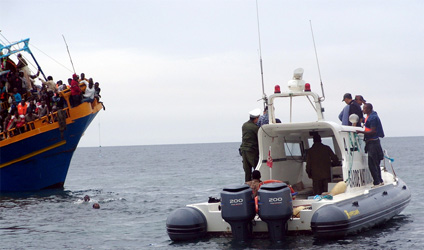
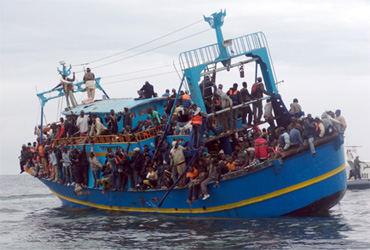
The boat, named The Wave, ran around last week, probably on Wednesday, 1 June.  The boat did not capsize until after rescue boats had arrived on the scene.   Tunisian coast guard and local fishing boats were involved in the rescue efforts.  The rescue boats did not have the capacity to rescue all of the migrants from the stranded migrant boat and some people jumped into the water and others moved to one side of the migrant boat causing it to capsize.  Media pictures show the vessel in an upright position with some rescue boats already on scene.  A France24 video report contains cell phone video shot immediately after the boat capsized.  (See pictures below.)

UNHCR and IOM staff have conducted interviews with some of the survivors.  According to UNHCR, the boat left Tripoli on 28 May with up to 850 people on board.  The passengers were primarily from West Africa, Pakistan, and Bangladesh. The crew was recruited on an ad hoc basis and had little or no maritime experience. The France24 video report states that survivors said Libyan military assisted them in leaving Libya.  The boat became lost after leaving Tripoli and on Wednesday, 1 June, it ran around near the Kerkennah islands.  UNHCR spokesman Adrian Edwards said that the boat “capsized as desperate passengers rushed to one side, seeking rescue by the Tunisian coast guard and fishing boats that had approached the vessel. Many fell into the water.”  IOM staff reported that at least one survivor said that during the boat’s voyage some people were thrown overboard alive.  The boat reportedly had run out of food and water.

Click here for a France24 video news report (EN) with cell phone video shot immediately after the migrant boat capsized.

Click here and here for UNHCR reports on the incident.

Click here for IOM Press Briefing Note.

Click here, here, here, and here for Tunisian articles. (FR)

Click here, here, and here for articles.  (EN)

Photo Agence Tunis Afrique Presse 04 juin 2011

La Garde maritime à Sfax au secours du chalutier libyen bloqué au large de Kerkennah (Photo AFP)

France24 03 June 2011 - Screen shot

France24 03 June 2011 - Screen Shot


1 Comment

Filed under Data / Stats, European Union, Italy, Libya, Mediterranean, News, Tunisia, UNHCR

Migrant Boat(s) Sink Off Tunisian Coast / 250+ Feared Dead, 550+ Rescued

Tunisian authorities report that one or more migrant boats that had departed from Libya capsized and sank near the Tunisian coast on Tuesday near the Tunisian island of Kerkennah.  There are currently conflicting media reports on the number of boats involved.  The boat(s) are is thought to have been carrying approximately 800 people in total.  Over 500 people have reportedly been saved.  Approximately 270 are missing and assumed dead.

Click here, here, and here for articles.

Leave a comment

Filed under Italy, Libya, Mediterranean, News, Tunisia

Some Refugees Who Fled Libya Return in Effort to Board Boats to Europe

Last week, UNHCR reported that hundreds of people who recently fled Libya to Tunisia and Egypt are returning to Libya in an effort to board boats for Europe.  “Among them are refugees, including members of the Somali, Ethiopian and Eritrean communities in the camps at Choucha near Tunisia’s border with Libya.”  UNHCR is warning of the dangers of trying to reach Europe by sea and of returning to Libya.  “UNHCR has met with refugees in Tripoli who are planning to make the perilous sea journey. ‘They are all aware of the high death toll, but they told us that they feel they have nothing to lose. One Eritrean man told us he would rather die trying to reach safety than continue to live in danger,’ [UNHCR’s chief spokesperson, Melissa] Fleming said.”  “Fleming [also] said that UNHCR had learnt with sadness ‘that people on track for resettlement, following interviews last year in Libya, lost their lives while trying to reach Europe recently. People in the middle of the resettlement process and vulnerable cases are prioritized in our interview schedule.’”

Click here for UNHCR statement.

Leave a comment

Filed under Egypt, European Union, Italy, Libya, Mediterranean, News, Tunisia, UNHCR

62 Bodies Recovered on Tunisian Beaches in First Week of May

While irregular departures from Tunisia have been significantly reduced in number since Tunisian authorities resumed efforts to prevent or discourage such departures, bodies from earlier departures and accidents continue to wash ashore.  The Financial Times reports that “62 bodies [were] found [during the first week of May] near Sfax, Kerkennah and Chaffar, up the coastline from Zarzis, apparently from boats lost weeks earlier.”  58 bodies were discovered during the month of April.  FT also reported that “[u]nder the previous regime, would-be illegal migrants risked a fortnight in jail for ‘infringement of frontiers’; now there are no penalties imposed on those who attempted the illegal crossing.”

Click here for FT article (free access, but registration may be required).

Click here for previous post.

Leave a comment

Filed under European Union, Italy, Mediterranean, News, Tunisia

EJML Article, Stefanie Grant: “Recording and Identifying European Frontier Deaths”

The latest edition of the European Journal of Migration and Law, Volume 13, Number 2, contains an article by Stefanie Grant, University of Sussex, entitled “Recording and Identifying European Frontier Deaths.”

Abstract: “Migrant deaths at EU maritime borders have more often been seen in the context of national border control, than in terms of migrant protection and human rights. The 2009 Stockholm Programme accepted the need for action to avoid tragedies at sea, and to `record’ and `identify’ migrants trying to reach the EU. But it did not specify how this should be done. There are parallels between these migrant deaths, and deaths which occur in conflict and humanitarian disaster. The principles of human rights and humanitarian law which apply in these situations should be developed to create legal and policy frameworks for use in the case of migrants who are missing or who die on EU sea frontiers. The purpose would be to enable evidence of identity to be preserved, to protect the rights of families to know the fate of their relatives, and to create common national and international procedures.”

“This article draws on publications by the author, including: ‘Migration and frontier deaths: a right to identity’, in Marie Bénédicte-Dembour and Tobias Kelly (eds.), Are Human Rights for Migrants?: Critical Reflections on the Status of Irregular Migrants in Europe and the United States, Abingdon, Routledge, 2011 [in press]; ‘The Legal Protection of Stranded Migrants’, in Ryszard Cholewinski, Richard Perruchoud and Euan Macdonald (eds.), International Migration Law: Developing Paradigms and Key Challenges, The Hague, T.M.C. Asser Press, 2007, pp. 29–48; and ‘International Migration and Human Rights’; expert paper for the Global Commission on International Migration (GCIM), 2005.”

Click here for link.  (Subscription or payment required.)

Leave a comment

Filed under Analysis, Eastern Atlantic, European Union, Mediterranean

NY Times Commentary: The Killing Seas

Here is an op-ed article from Thursday’s New York Times by Hans Lucht, an anthropologist at the University of Copenhagen and author of the forthcoming “Darkness Before Daybreak: African Migrants Living on the Fringes in Southern Italy Today.” (Scheduled for release Dec. 2011.)

“…. In the long run, Europe should learn from the situation in Libya that paying dictators to make ‘problems’ disappear is not only morally bankrupt but also short-sighted. European leaders must seek commitments from any post-Qaddafi government to handle the challenges of international migration in an orderly and humane fashion. Instead of banishing asylum-seekers to detention camps in the desert, Europe should offer support to Tunisia and Egypt, which are struggling to assist refugees from Libya, and to southern European countries….”

Click here for article.

Leave a comment

Filed under Analysis, European Union, Ghana, Italy, Libya, Mediterranean

Follow-Up Report and Analysis Regarding Failure to Rescue Disabled Migrant Boat Resulting in 61 Deaths

UNHCR today released more information from three Ethiopian survivors of the migrant boat that left Tripoli on 25 March with 72 passengers and which, after becoming disabled and running out of food and water, washed ashore in Libya over two weeks later with only nine survivors.

Additionally, the Bruxelles2 blog in a recent post, “Un navire de réfugiés non secouru ? Retour sur un drame non élucidé,” has provided detailed analysis regarding the possible identities of the helicopter and warships that failed to render assistance to the migrant boat after it had become disabled.  (See more on this below.)

From UNHCR’s statement:

“[One surviving] refugee said that military vessels twice passed their boat without stopping, and that a military helicopter dropped food and water onto the boat at some point during the journey. The first boat refused their request to board. The second only took photos, he said. The man was not able to identify where the vessels came from.

UNHCR staff met with the three in Shousha camp in Tunisia. One spoke Arabic, while the others spoke Oromo. UNHCR interviewed the Arabic speaker. He said that they paid smugglers US$800 to make the journey. The passengers were expected to operate the boat on their own.

According to the refugee, when water ran out people drank sea water and their own urine. They ate toothpaste. One by one people started to die. He said that they waited for a day or two before dropping the bodies into the sea. There were 20 women and two small children on board. A woman with a two-year-old boy died three days before he died. The refugee described the anguish of the boy after his mother’s death.

After arrival on a beach near Zliten, between Tripoli and the Tunisian border, a woman died on the beach from exhaustion. The remaining 10 men walked to the town of Zliten where they were arrested by the Libyan police. They were taken to a hospital and then to a prison where they were given some water, milk and dates. After two days another survivor died.

After begging jail staff to take the remaining survivors back to hospital, they were taken to a hospital in al-Khums city. Doctors and nurses were said to have given the group water and told them to leave. They were returned to the prison and then taken to Twesha jail near Tripoli. Finally Ethiopian friends in Tripoli paid the prison US$900 to release the men. UNHCR is now providing them with assistance in Tunisia.”

Bruxelles2 notes that the survivors’ reports that the helicopter that dropped supplies had an “Army” marking on it would tend to suggest that the helicopter did not belong to France (“Marine”), Italy (“Marina”), the U.S. Navy (“Navy”), or the Royal Navy (“UK Navy”).  Bruxelles2 believes it is plausible that an “army” helicopter belonging to the US or UK could have been operating in the area, but US Army helicopters tend to be marked “United States.”  According to Bruxelles2 some British army helicopters do carry the “Army” marking.  (One other possibility I would note is that the survivors could simply be mistaken about the marking – they recall clearly that a military helicopter hovered over them and dropped supplies, but incorrectly remember, misread, or assumed that the marking on the side of the helicopter said “Army”.)

Bruxelles2 also suggests that there are other warships that might appear to be an aircraft carrier, especially when viewed from a small migrant boat.  Bruxelles2 points in particular to “the USS Kearsarge (LHD3), [an] amphibious ship [that] regularly hosts (and welcomed during the operations – which the U.S. Navy confirms) AV-8B Harrier vertical takeoff [aircraft].”

Bruxelles2 also notes that the time period when the migrant boat was disabled and drifting was a period when there was a shifting of commands for the multiple European and US naval and air forces operating off Libya.  NATO took command of the maritime embargo on 23 March; the no fly zone and the air attacks were initially under the control of an ad hoc coalition (France, UK, USA, Canada, Belgium, Denmark); full command did not shift to NATO until 31 March and even then it took several days for the transfers of command to occur; and some military vessels continued (and continue to this day) to operate under independent national command.

In short, NATO may be fully correct when it says that a vessel under its command during the time period in question did not encounter the disabled migrant boat.  Further investigation into responsibility is needed.

Click here for UNHCR statement.

Click here for Bruxelles2 post. (FR)

Leave a comment

Filed under Analysis, France, Italy, Libya, Mediterranean, News, UK, United States

Guardian: Libya Official Admits Migrant Ships Being Allowed to Sail as Protest Against Nato

From today’s Guardian:  “The Libyan regime of Colonel Muammar Gaddafi is allowing thousands of sub-Saharan African migrants on to overcrowded, unseaworthy ships in an apparently calculated attempt to use migration as a weapon to pressure Nato and the EU countries backing Libya‘s rebels. [***] Officials said they were doing nothing to encourage the journeys to Italy, but could see no reason to stop them, because doing so would serve the interests of Nato member states bombing Libya.

‘We say to Europe that we can no longer do what we used to do,’ said the prime minister, al-Baghdadi Ali al-Mahmoudi. ‘And that’s because Nato has ruined our coastal defences.’ [***] [S]urvivors told the [UNHCR] that some ships were leaving Tripoli only for their captain to disembark once they were at sea and take a pilot boat back to shore.  ‘They [the migrants] are told, “here’s the compass, you go that way”,’ [UNHCR spokesperson Melissa] Fleming said. [***]”

Click here for Guardian article.

1 Comment

Filed under Libya, Mediterranean, News, UNHCR

58 Bodies Discovered in April on Tunisian Beaches

The Tunisian Interior Ministry released a communiqué reporting that authorities during the month of April recovered a total of 58 bodies that had been washed ashore.   The bodies were mostly those of men and were found along beaches in Skhira, Chaffar, and Kerkennah, in the department of Sfax, and in Gabès, Djerba, and Mahdia.  The dead are believed to be persons who attempted to reach Italy by boat.

Click here and here for articles (FR)

1 Comment

Filed under Italy, Mediterranean, News, Tunisia