Tag Archives: Refugees

Tunisia Categorically Rejects Maroni’s Call for Deployment of Italian Police in Tunisia

The Tunisian Foreign Ministry on Sunday responded to Italian Interior Minister Roberto Maroni’s rather unusual call for the deployment of Italian police in Tunisia for the purpose of controlling illegal departures from Tunisia.  Not surprisingly, the Tunisian statement expressed shock at the Italian suggestion and categorically rejected it:  “As much as Tunisia is strongly committed to preserving and strengthening its excellent relationship of friendship and cooperation with Italy,  Tunisia must also express its shock with Italy’s position and categorically rejects any interference with its internal affairs or efforts to undermine its sovereignty.” (“Autant la Tunisie est fortement attachée à préserver les excellentes relations d’amitié et de coopération établies avec l’Italie et à les promouvoir davantage, autant elle exprime son étonnement face à cette position et affirme son rejet catégorique de toute ingérence dans ses affaires intérieures ou de porter atteinte à sa souveraineté.”)

The statement also said that Tunisia reaffirmed its intent to cooperate on matters of irregular immigration and that this cooperation would be based on respect for human rights and dignity.  (“La Tunisie, ajoute le communiqué, réitère sa disposition à coopérer avec les pays frères afin d’identifier les solutions idoines au phénomène de l’émigration clandestine, fondées sur le respect des droits et de la dignité humaine, et sur le principe du développement solidaire.”)

According to Tunisian newspapers, Tunisian authorities have arrested large numbers of Tunisians attempting to leave Tunisia by boat.  Tunisian media also suggests that human smugglers have taken advantage of the unstable conditions in Tunisia to organise and facilitate the thousands of departures that have occurred in recent days.

Click here (AR), here (AR), here (FR), or here (EN) for articles.

1 Comment

Filed under Italy, Mediterranean, News, Tunisia

Italy Requests Urgent Deployment of Frontex Patrols to Coast of Tunisia

Italy on Friday requested an urgent meeting of the EU Justice and Home Affairs Council to address the immigration situation that is developing with Tunisia and the arrivals in Italy of over 2000 Tunisians over the past two days.  Interior Minister Maroni said that the bilateral cooperation agreement between Italy and Tunisia that has in the past controlled departures from Tunisia is not being implemented due to the crisis within Tunisia. (“Il problema è che l’accordo bilaterale che abbiamo con la Tunisia che ha permesso finora di gestire in modo efficace l’immigrazione clandestina, non viene attuato da Tunisi per la situazione di crisi. C’è una incapacità di fronteggiare la situazione da parte dell’autorità tunisina”.)

Click here (IT), here (IT), and here (EN) for articles.

1 Comment

Filed under European Union, Frontex, Italy, Mediterranean, News, Tunisia

Frattini: Italy is facing migration emergency

Italian Foreign Minister Franco Frattini released a statement describing the recent arrivals by Tunisians as an immigration emergency and calling for a “Marshall Plan” for immigration from the south.  The statement also says that Tunisia’s new Foreign Minister will visit Italy next week to reaffirm cooperation agreements between Italy and Tunisia.

Full statement:

11 Febbraio 2011

“Per l’immigrazione dal Sud del mondo serve un ‘piano Marshall’ e cioè una visione strategica un po’ più di medio termine”. Lo ha detto il Ministro Franco Frattini, soffermandosi, a Trieste, sui nuovi sbarchi di clandestini a Lampedusa. “E’ un allarme vero e noi lo avevamo previsto – ha detto Frattini – Per questo la prossima settimana sarà in Italia il nuovo ministro degli Esteri della Tunisia per riconfermare gli accordi di collaborazione”.

Per Frattini “siamo in presenza di una vera e propria emergenza migratoria e noi non possiamo immaginare che l’Italia sia il luogo dove tutti arrivano e tutti restano. Con la Tunisia avevamo una eccellente collaborazione e la dobbiamo confermare con il nuovo ministro”.

Sul concetto di ‘piano Marshall’ per l’immigrazione, Frattini ha quindi spiegato che “significa avere una visione un po’ più di medio termine, vuol dire non limitarsi all’emergenza. Vuol dire che questi Paesi – Tunisia, Algeria, Egitto ma anche altri – richiedono una strategia in cui l’Europa metta a disposizione fondi assai più sostanziosi per lo sviluppo economico, per i giovani, per gli studenti, per l’università”. In pratica, ha concluso il Ministro, “un piano Marshall per evitare che la disperazione innesti flussi di immigrazioni. Questo è il pericolo”.

Or click here (IT) for the statement.

Leave a comment

Filed under Italy, Mediterranean, News, Tunisia

Hundreds of Tunisians Continue to Arrive in Lampedusa – ANSA: “Si e’ riaperta ‘l’autostrada del mare’ nel Canale di Sicilia”

Hundreds of Tunisians have continued to arrive in Italy on Lampedusa, and the islands of Pelagie and Pantelleria.  A Tunisian newspaper reported that 12 boats have left Tunisia in recent days.  400 migrants have arrived in Lampedusa and other Italian islands over the past two days.  EveryOne Group estimates that more than 1200 Tunisians have arrived on Italian territory over the past week.

Click here, here, here, and here for articles.  (IT).

1 Comment

Filed under Italy, Mediterranean, News, Tunisia

COE Seminar: Human rights dimensions of migration in Europe (Istanbul, 17-18 Feb)

Thomas Hammarberg, COE Commissioner for Human Rights, and the Turkish Chairmanship of the Council of Europe Committee of Ministers are holding a migration and human rights seminar in Istanbul, 17-18 February.  From the Commissioner’s web site:  The seminar “aims to exchange views on the most important discrepancies between European migration laws and practices and human rights standards, as well as on optimal ways to provide assistance to states in reflecting on and revisiting their migration policies.”

Three general topics will be addressed: Human rights challenges of migration in Europe, Unaccompanied migrant children, and Smuggling of migrants.  Scheduled speakers and participants include:

  • Karim Atassi, UNHCR Deputy Representative to Turkey;
  • Tina Acketoft, PACE Committee on Migration, Refugees and Population;
  • Emily Logan, Irish Ombudsman for Children;
  • Rebecca O’Donnell, Save the Children, Brussels;
  • Elisabet Fura, ECtHR Judge;
  • Martin Fowke, Unit on Trafficking in Persons and Smuggling of Migrants, UNODC;
  • Richard Ares Baumgartner, Frontex Senior External Relations Officer ;
  • Professor Dr. Nuray Ekşi, Chair of Private International Law Department at the Law Faculty of ĺstanbul Kültür University;
  • Professor Theodora Kostakopoulou;

Click here for draft programme.

2 Comments

Filed under Aegean Sea, Colloques / Conferences, Commissioner for Human Rights, Committee of Ministers, Council of Europe, European Court of Human Rights, Frontex, Turkey, UNHCR, UNODC

Boats Carrying 200+ Tunisians Reach Lampedusa

Over 200 Tunisians reached Lampedusa during the night of 8-9 February in several boats.  Approximately 500 Tunisians have reportedly arrived in Italy in less than one month.  EveryOne Group has called upon the UNHCR and Italian officials to ensure that the newly arrived individuals be provided the right to apply for international protection or asylum.  Italian Interior Minister Maroni said there “is tremendous pressure on the Tunisian coast: it is still red alert, but it can become and we are monitoring the situation closely.” («una fortissima pressione sulle coste tunisine: non è ancora allarme rosso, ma può diventarlo e stiamo monitorando attentamente la situazione».)  Maroni also said “we are very concerned about the escape of criminals from jails in Tunisia for the risk of terrorist infiltration between the Tunisians who want to come to Europe in the guise of political refugees.” («Ci preoccupa molto la fuga di criminali dalle carceri della Tunisia per il rischio di infiltrazioni terroristiche tra i tunisini che vogliono venire in Europa sotto le spoglie di rifugiati politici. »)

Click here (IT), here (IT), and here (EN) for articles.

Leave a comment

Filed under Italy, Mediterranean, News, Tunisia, UNHCR

Euro-Africa Conference on Illegal Immigration, Human Trafficking, Drug Trafficking, and Terrorism (Napoli, 7-9 February)

The Italian Interior Ministry and the Direzione Centrale dell’Immigrazione e della Polizia delle Frontiere are conducting a three day conference, beginning today, in Napoli, 7-9 February.  In attendance will be top police officials from 45 African countries, 25 EU countries as well as officials from agencies including Interpol, Europol, Frontex and, as observers, representatives of the US FBI and Dept. of Homeland Security.  Among those scheduled to attend are Rodolfo Ronconi, Direttore Centrale dell’Immigrazione e della Polizia delle Frontiere, Interior Minister Roberto Maroni, INTERPOL Secretary General Ronald Noble, EUROPOL Director Rob Wainwright, and Frontex Director Ilkka Laitinen.

According to a draft agenda for the conference, discussion topics will include:

  • Immigration Group – The African continent as a source and place of transit for migratory flows towards Europe across the Mediterranean Sea.  Internal migration within African. Threat assessment, ongoing bilateral initiatives, multilateral initiatives, and methods of law enforcement;
  • Group on human trafficking and organized crime – Criminal networks involved in smuggling: prevention and law enforcement investigative techniques, with particular reference to flows from Greece and Central Africa to Europe;
  • Drug Trafficking Group – African continent: new narcotrafficking directed towards Europe;
  • Group on Terrorism – Cyberspace as a new platform for radicalization: comparing experiences.

Original Italian:

  • Gruppo Immigrazione – Il  Continente africano quale origine e transito dei flussi migratory diretti in Europa attraverso il Mar Mediterraneo.  I fenomeni migratori interni al Continente africano.  Valutazione della minaccia, iniziative bilaterali, multilaterali e metodologie di contrasto;
  • Gruppo Tratta degli esseri umani e criminalità organizzata sul tema “Le reti criminali coinvolte nel traffico di migranti: tecniche di investigazione preventiva e repressiva, con particolare riferimento ai flussi provenienti dalla Grecia e dal Centro Africa verso l’Europa”;
  • Gruppo Traffico di Stupefacenti sul tema “Il Continente africano: nuovo crocevia del narcotraffico diretto verso l’Europa?”;
  • Gruppo Terrorismo sul tema “Il Cyberspazio quale nuova piattaforma per la radicalizzazione: esperienze a confronto”;

Click here (IT) for short article.

Click here (IT) for draft agenda.

I would love to know more about the substance of the conference – if anyone has any information or documents to share, please do so. ( nfrenzen@law.usc.edu ).

2 Comments

Filed under Aegean Sea, Colloques / Conferences, European Union, Frontex, Greece, Italy, Mediterranean, News

EASO Issues Call for Seconded National Experts

As noted yesterday on the EASO Monitor blog, EASO has issued a call for multiple Seconded National Experts.  The following list is probably incomplete and is based on information posted on the web site of the Slovenian Ministry of Public Administration and the web site of the Italian Ministry of Foreign Affairs.

Calls for SNE:

1) Main areas of responsibility : Support to the development of the asylum policy and European legislation, including for its implementation as well as to the different forms of practical cooperation and European solidarity, in connection with the European Asylum Support Office (EASO). The SNE will also contribute to the drafting of the Communication on the developments of Eurodac as a supporting tool for the entire Common European Asylum System foreseen in the Action Plan for the implementation of the Stockholm Programme.   Click here for document.

2) Main areas of responsibility: Assisting the Executive Director in preparing all the steps necessary to transfer the EAC to the EASO; advising on the methodology and the priority milestones related to activities, staff, IT and financial issues; liaising with the EAC project manager, the members of the EAC steering committee, UNHCR and the European Commission; organising necessary meetings; coordinating the transfer activities.   Click here for document.

3) Main areas of responsibility: Assisting the Executive Director in coordinating the Asylum Intervention Pool and updating the pool; drafting methodologies; acting as the Union contact point; acting as an interface between the EASO and Member States and members of the support teams; monitoring the deployment and reporting to the EASO on all aspects of the deployment; organising necessary meetings.   Click here for document.

4)  Main areas of responsibility: Assisting the Executive Director in coordinating the implementation of Operating Plans and Asylum Support Teams in Greece in support of the Greek Action Plan; working with the coordinator of the Asylum Intervention Pool in the activities linked to the interface between the EASO and Greece and members of the support teams; monitoring the deployment and reporting to the EASO on all aspects of the deployment; organising necessary meetings.  Click here for document.

5) Main areas of responsibility: Assisting the Executive Director in coordinating the Interpreters Pool within the Asylum Intervention Pool and updating the pool; proposing and drafting methodologies, including on videoconferencing; coordinating the deployment/use of interpreters and reporting to the EASO, including within the context of the support to the Greek Action Plan; working with the coordinator of the Asylum Intervention Pool in the activities linked to the interface between the EASO and Greece and members of the support teams; organising necessary meetings.   Click here for document.

6) Main areas of responsibility: Assisting the Executive Director in coordinating establishment of the COI function and the management of the COI Portal; proposing and drafting methodologies; reviewing the projects already undertaken; organising necessary meetings and workshops/working parties.  Click here for document.

7)  Main areas of responsibility: Assisting the Executive Director in coordinating the preparation of the first COI report on Afghanistan within the COI division; proposing and drafting methodologies; reviewing the projects already undertaken; organising and/or coordinating necessary meetings, missions and workshops/working parties; preparing the report.  Click here for document.

1 Comment

Filed under European Union, General, Malta, News

COE CPT Completes Ad Hoc Mission to Greece

The Committee for the Prevention of Torture and Inhuman or Degrading Treatment or Punishment (CPT) released a statement yesterday that it had completed a one week (20-27 Jan.) ad hoc mission to Greece “to assess the concrete steps taken by the Greek authorities to implement long-standing recommendations, in particular those contained in the reports on the CPT’s visits of September 2005, February 2007, September 2008 and September 2009.   In the course of the visit, the CPT’s delegation examined the treatment and conditions of detention of migrants held in aliens detention centres and in police and border guard stations, particularly in the Attica and Evros regions….”  The CPT report to the Greek government is scheduled to be delivered in March 2011.

Among the detention centres visited by the CPT were several Border Guard stations in Evros and the “Filakio Special holding facility for illegal immigrants” where many of persons apprehended along the land border of Greece and Turkey are being detained in deplorable conditions.  Doctors Without Borders released a press statement last week describing the conditions at the Greek detention centres in Evros as unbearable, inhumane, and having reached an emergency situation.

Click here for CPT Press Release.

Click here for Doctors Without Borders Press Release.

1 Comment

Filed under Aegean Sea, Council of Europe, European Committee for the Prevention of Torture and Inhuman or Degrading Treatment or Punishment, Frontex, Greece, News, Turkey

Frontex 3rd Quarter Report

On 16 January the Frontex Risk Analysis Unit released its Report for the Third Quarter of 2010 (July-Sept.).  The report contains data, charts, and graphs detailing detections of migrants, asylum seekers, false document use, detections of facilitators, and other information.  The deployment of Frontex’s RABIT force to the Greek-Turkey border did not begin until 2 November 2010, so the effects of the RABIT deployment do not appear in the Third Quarter.

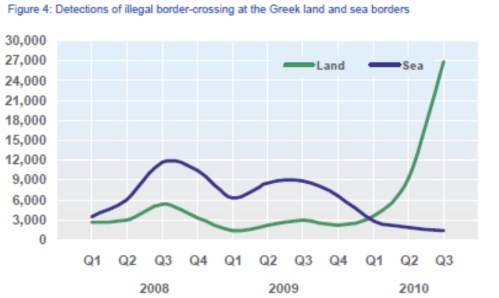
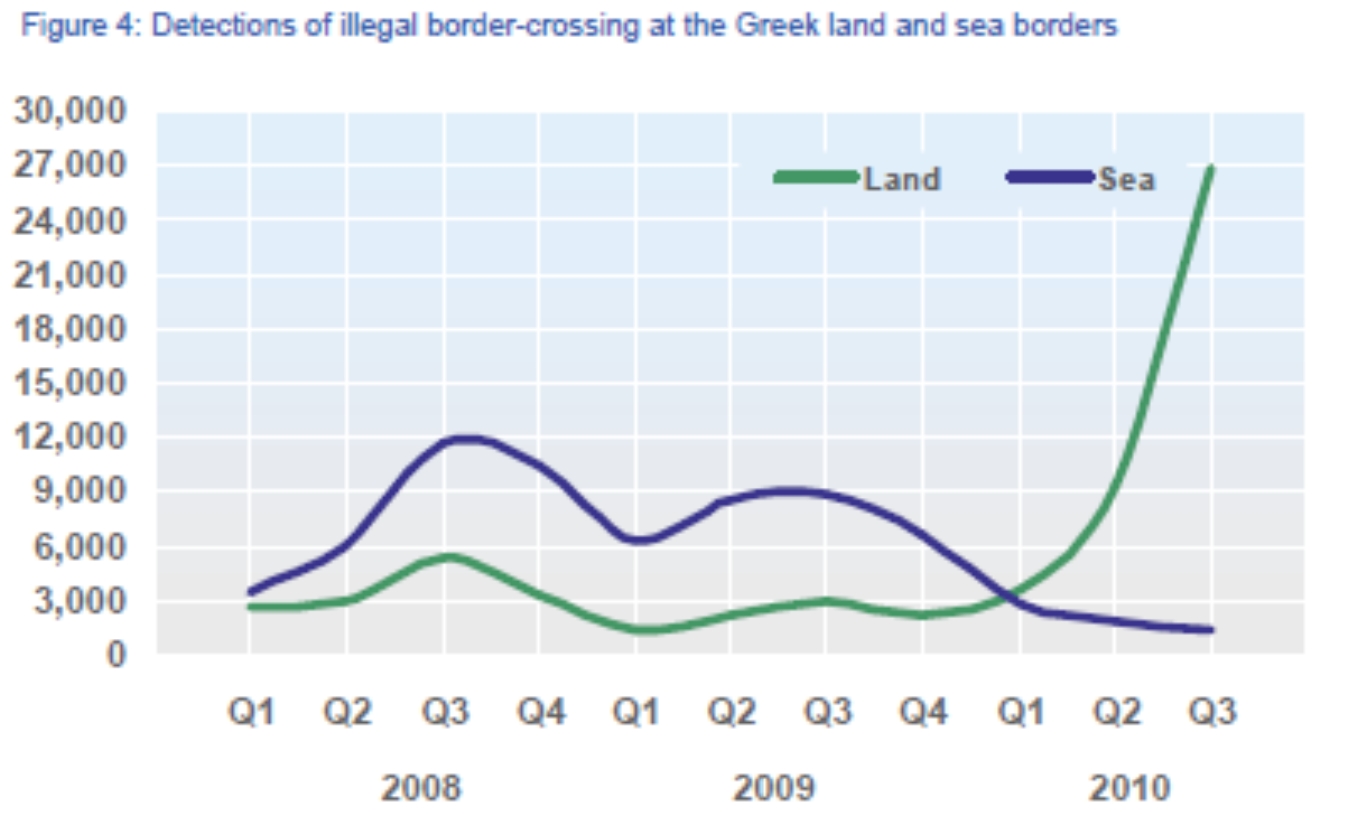
The Report notes that the “unprecedented peak in illegal border-crossings at the Greek land border with Turkey is the result of a shift from the sea to the land border” coupled with a “large increase in the absolute number of migrants” using Turkey as an EU entry point.  The Report states that there has been an eight-fold increase in the number Maghreb nationals detected at the Greek land border which “is thought to be the result of a displacement effect from the West Africa and Western Mediterranean routes.”

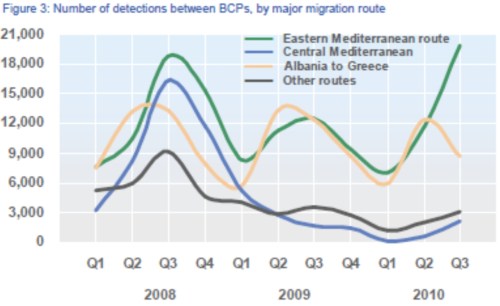
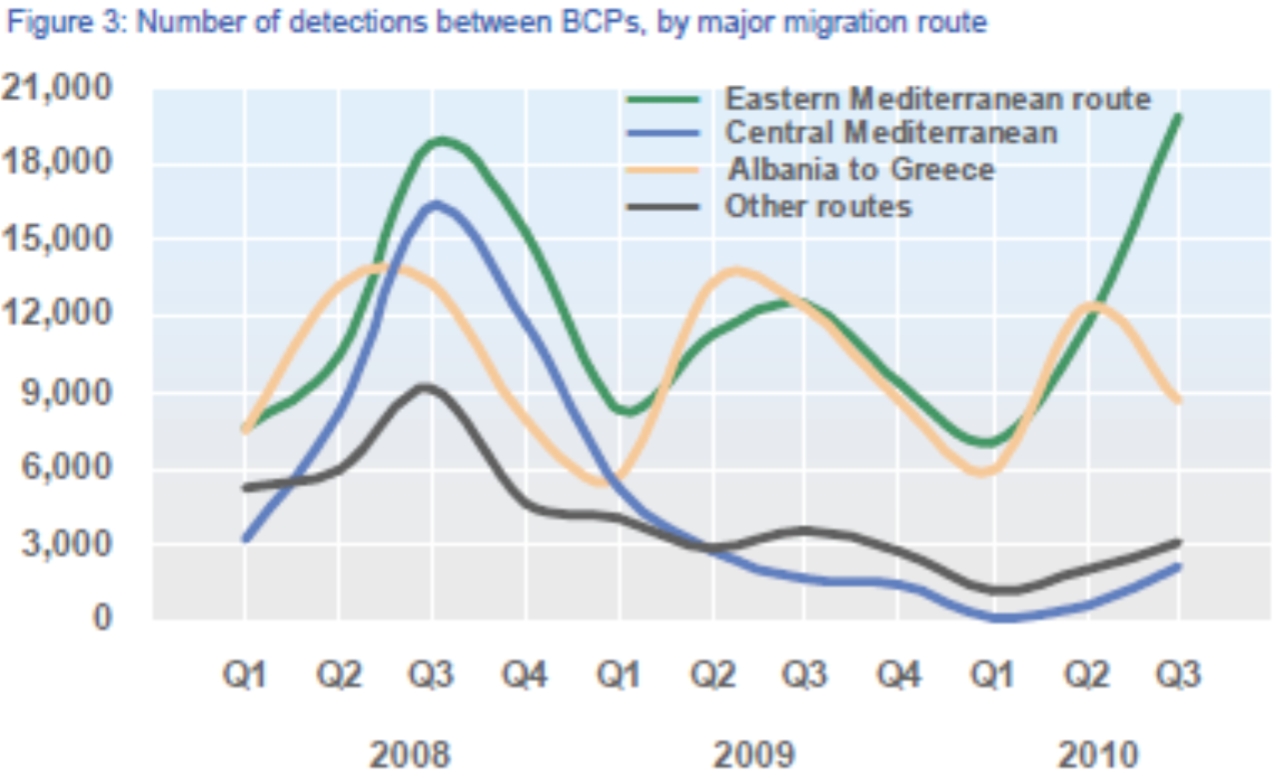
The Report also notes an increase in the number of detections on the Central and Western Mediterranean sea routes compared to Q2 which may be attributable to seasonal variations or “may be indicative of reorganized modi operandi in these areas in response to Frontex Joint Operations, more effective border controls and bilateral agreements implemented in 2008.”  See Figure 3 below.

Excerpts from the Report:

“Detections of illegal border-crossing”

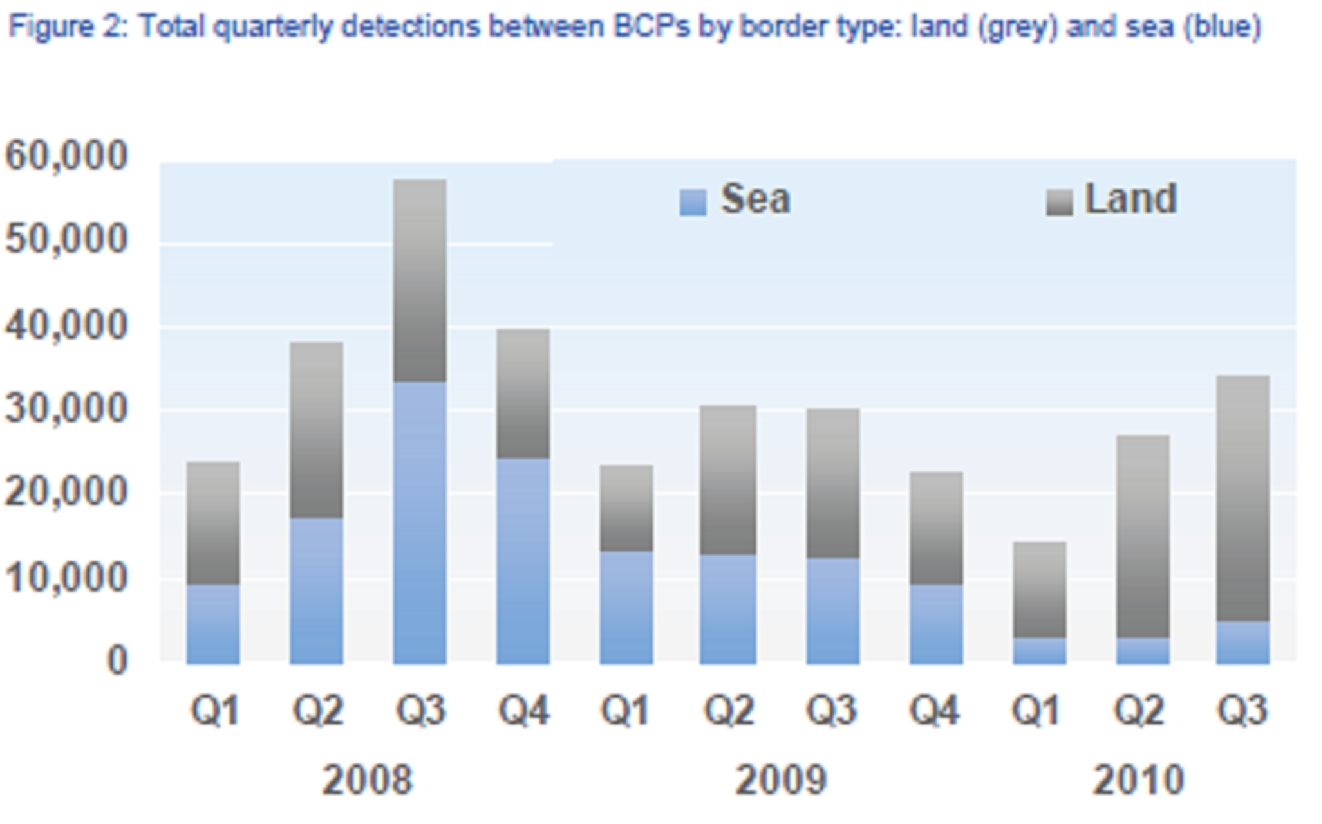
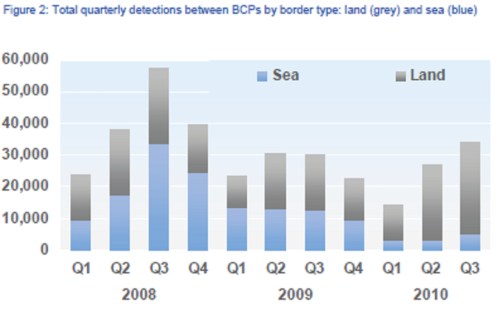
“…  Fig. 2 [see below] shows quarterly detections at the land and sea borders of the EU since the beginning of 2008. The 30% increase in the number of detections between the previous and present quarters is comprised of a 60% increase at the sea borders (although from a lower base) and a 23% increase at the land borders. This means that the shift from sea to land borders has not continued to same extent as in the previous quarters.  Nevertheless in Q3 2010, there were some 29 000 detections of illegal border-crossing at the external land border of the EU, which constitutes 85% of all the detections at the EU level, and the highest number of detections at the land border since data collection began in early 2008….”

“Eastern Mediterranean route”

The Report observes that there has been a shift in illegal crossings from the Greece-Turkey maritime border to the Greece-Turkey land border and notes an increase in the number of nationals from Maghreb countries apprehended at the Greece-Turkey land border.  “This route [being taken by Maghreb nationals] is very indirect, but is thought to be the result of a displacement effect from the West Africa and Western Mediterranean routes….”

See Figure 4 below which shows that detections of illegal border crossers at the land border of Greece have exceeded detections at the sea border since Q1 of 2010.

“Central Mediterranean route”

“There were 2 157 detections of illegal border-crossing during Q3 2010. This is more than a three-fold increase compared to the previous quarter and a third higher than the same period last year. However despite this apparently large increase, detections still remain massively reduced compared to the peak of around 16 000 during the same period in 2008 (Fig. 3)….”

“The JO Hermes 2010 which was operational between June and October 2010, focused on illegal migratory flows departing from Algeria to the southern borders of the EU, specifically to Sardinia. In 2010, there were fewer detections than in previous years….”

“Departures from Libya also remained low. In June 2010, a new law was implemented to serve more severe punishments for facilitating illegal immigration. Ambassadors of the countries of origin were called into the Ministry of Foreign Affairs in Tripoli to be informed about the consequences of the new law, which suggests that this may be a serious implementation.”

“Western Mediterranean route”

“In general, irregular immigration to southern Spain has decreased massively since the beginning of 2006. However, in Q3 2010 there were 2 200 detections of illegal border crossing in the Western Mediterranean, more than twice that of the previous quarter and around a third higher than the same period in 2009. There is growth in the number of detections of a wide range of African nationalities, nine of which more than doubled in number between Q2 and Q3 2010. The most detected nationalities were Algerian, Moroccan, Cameroonian and Guinean.”

“Western Africa route”

“The cooperation and bilateral agreements between Spain and the rest of the Western African countries (Mauritania, Senegal and Mali) are developing steadily, and are one of the main reasons for the decrease in arrivals, as is the presence of patrolling assets near the African coast.”

“According to data collected during JO Hera, the numbers of arrivals in the Canary Islands and detections in West Africa are very low compared to the same time last year. The main nationality and place of departure is from Morocco, to where migrants are returned within a few days.”

Click here for the 3rd Quarter 2010 Report.

Click here for the 2nd Quarter 2010 Report.

Click here for the 1st Quarter 2010 Report.

Click here for my previous post regarding the 2nd Quarter Report.


Leave a comment

Filed under Aegean Sea, Algeria, Data / Stats, Eastern Atlantic, European Union, Frontex, General, Greece, Italy, Libya, Malta, Mauritania, Mediterranean, Morocco, News, Reports, Senegal, Spain, Tunisia, Turkey

Greece requests 2d extension of Frontex RABIT deployment due to events in Egypt

Kathimerini reported on 1 February that Greece requested an additional extension of the Frontex RABIT deployment in Greece due to the situation in Egypt and a fear that there may be a surge in migration towards Greece.  The current RABIT deployment is scheduled to end on 3 March.  The deployment was originally scheduled to end in November 2010 and was extended until March 2011.  The Kathimerini article said that Frontex’s initial informal response to the requested extension was positive.

Click here (EL) and here (EN) for articles.

1 Comment

Filed under Aegean Sea, Egypt, European Union, Frontex, Greece, Mediterranean, News, Turkey

WikiLeaks 2009 US Cable: Libya takes back 500 Italy-bound migrants

This US Department of State cable, released by WikiLeaks on 31 Jan 2011, was written in May 2009 and describes the first major interdictions of migrants by Italy under the terms of the Italian-Libyan Friendship Agreement.  The events described in the cable are the subject of the communicated case currently pending before the Second Section of the European Court of Human Rights, Hirsi and others v Italy, Requête no 27765/09.  Click here for previous post on the Hirsi case.

Excerpts from the Cable:

“Implementation of a key component of the Italian-Libyan “friendship agreement” has begun, as Italy has returned approximately 500 migrants rescued and interdicted at sea to Libya over the past week. Libyan authorities have notified the local offices of IOM and UNHCR before returning boats arrive in Tripoli to facilitate medical screening, identification, and consular notification. The returnees are then placed in immigrant detention centers. UNHCR has interviewed a number of the detained returnees, noting that only “a handful” of the 500 are likely asylum seekers – mostly of Somali and Eritrean origin; the rest are economic migrants….”

“Libya has accepted the return of three tranches of migrants interdicted or rescued at sea by Italian authorities in recent days, beginning implementation of a key component of the Italian-Libyan “friendship agreement” signed last August aimed at reducing the flow of migrants from Libya to Italy. In each case, the Italians contacted the Libyan navy, which agreed to accept their return to Libya. The Libyan navy did not/not agree to take the migrants on Libyan vessels; rather, in one case, it instructed Italian energy company ENI, which operates an offshore platform in the area, to tow an African vessel to shore; in the other cases, it permitted the Italian navy to transport the migrants back to Tripoli. Once in Tripoli, according to the Italian Embassy, the migrants were processed in an orderly fashion and sent to a detention center.”

“The first group of 227 returnees arrived in Tripoli on May 7. A regional IOM team in Tripoli implementing a G/TIP-funded workshop to enhance Libya’s response to human smuggling and trafficking was on hand to help screen the arrivals and visit one of the three detention centers where the migrants were held….”

“IOM staff here characterized the recent returnees as “the usual suspects” of Nigerian, Nigerien, Ghanaian, and South Asian nationality. The UNHCR mission reportedly interviewed many of the returnees and found fewer than 10 migrants who were likely asylum seekers including “four or five” Somalis and “a handful” of Eritreans….”

Click here or here for the full cable.

Leave a comment

Filed under European Court of Human Rights, European Union, Italy, Libya, Mediterranean, News, UNHCR

WikiLeaks 2009 US Cable: UN Official says Libya, Italy shirking HR responsibilities

Several US State Department cables discussing Libya, Italy, Malta, and the EU have been released over the past several days by WikiLeaks.  I will post several of the memos over the next day or so.

Among the cables released by WikiLeaks on 31 January 2011, is a Cable written in August 2009 by Gene Cretz, US Ambassador to Libya.  The cable is headed: “UN OFFICIAL SAYS LIBYA, ITALY SHIRKING HUMAN RIGHTS RESPONSIBILITIES.” Excerpts from the cable:

“In a July 28 [2009] meeting with Pol/Econ chief and Poloff, UNHCR Chief of Mission Mohammed al-Wash complained that Italy was breaking its commitments to support UN and EU charters on human rights by returning asylum seekers to Libya with other economic migrants, and strongly denounced the Italian Coast Guard’s tactics while forcing migrants to return. He cited the example of the return of 80 migrants — including several refugees registered with UNHCR in Tripoli, Addis Ababa, and Cairo — interdicted by Italy on or around July 1 who later related their story to UNHCR staff. When the vessel carrying the migrants was stopped, three Eritrean representatives reportedly asked to speak with the Italian ship’s commander to inform him of their refugee status. Several on the boat produced their UNHCR attestations for the commander. Replying that he was under strict orders from his government to return migrants to Libya, the Italian commander reportedly ordered that all migrants – including those registered with UNHCR — be removed from their vessel for transport to Libya. Some of the migrants refused, leading to physical altercations between the migrants and the Italian crew that ended with the Italians beating some Africans with plastic and metal batons, leaving at least six injured. Migrants on the boat reportedly filmed the incident with their mobile phones, leading the Italian crew to confiscate phones, documents, and personal belongings that have not yet been returned….”

“Al-Wash alleged that the Italian government was intentionally stonewalling the UN. According to al-Wash, Italian Ambassador Francesco Trupiano refuses to meet with UNHCR and told al-Wash that he was a “troublemaker.” Al-Wash believed that that Trupiano was single-mindedly focused on returning migrants to Libya and claimed to be unaware that Rome had agreed in principle to accept 63 refugees for resettlement from Libya. UNHCR has also submitted to the GOI a list of 93 refugees that have been returned since Italy and Libya began joint patrols in May. According to al-Wash, Rome agreed to accept “20 or 30″ of the 93 refugees, provided EU states committed to a burden-sharing agreement, though states did not seem eager to undertake one. Al-Wash was hopeful the EC would intercede to bring Italy in line, citing the EC’s inclusion of Libya signing an MOU with UNHCR as part of its requirements for a Framework Agreement (ref A) and a recent letter from the Commission to the Italian Interior Ministry, reminding it of its obligations under the EU’s Human Rights Charter….”

“Al-Wash alleged that the Italian government was intentionally stonewalling the UN. According to al-Wash, Italian Ambassador Francesco Trupiano refuses to meet with UNHCR and told al-Wash that he was a “troublemaker.” Al-Wash believed that that Trupiano was single-mindedly focused on returning migrants to Libya and claimed to be unaware that Rome had agreed in principle to accept 63 refugees for resettlement from Libya. UNHCR has also submitted to the GOI a list of 93 refugees that have been returned since Italy and Libya began joint patrols in May. According to al-Wash, Rome agreed to accept “20 or 30″ of the 93 refugees, provided EU states committed to a burden-sharing agreement, though states did not seem eager to undertake one. Al-Wash was hopeful the EC would intercede to bring Italy in line, citing the EC’s inclusion of Libya signing an MOU with UNHCR as part of its requirements for a Framework Agreement (ref A) and a recent letter from the Commission to the Italian Interior Ministry, reminding it of its obligations under the EU’s Human Rights Charter.”

Click here or here for the full memo.

Leave a comment

Filed under European Union, Italy, Libya, Mediterranean, News, UNHCR

Goodwin-Gill Lecture: “Right to Seek Asylum: Interception at Sea and the Principle of Non-Refoulement” (16 Feb., Brussels)

Professor Guy Goodwin-Gill will give the Chaire W.J. Ganshof Van Der Meersch lecture in Brussels, 16 February 2011, 17:00, at the Académie Royale des Sciences, des Lettres et des Beaux-Arts de Belgique, salle Albert II.

The lecture will address “The Right to Seek Asylum: Interception at Sea and the Principle of Non-Refoulement ” – The right to seek asylum is continuously challenged by the fight against irregular migration. In particular, the European Union and its Member States take measures to intercept boats on the sea in order to prevent irregular migration: patrols at sea, treaties with countries of origin or transit to readmit the concerned persons, agreements regarding the place of disembarkation,… The problem comes from the fact that asylum seekers are traveling together with undocumented migrants, what is called “mixed flows”. Even if the applicability of the principle of non-refoulement is often reaffirmed, the way to implement it represents a real difficulty in such a context.”

RSVP by 11 Feb.:

Votre réponse est attendue au plus tard le 11 février 2011

Tél: +32(0)2 650 27 16 (9h00 à 12h00)

Fax : +32(0)2 650 39 57

Courriel : fwa@ulb.ac.be

Click here for more information.

1 Comment

Filed under Belgium, Colloques / Conferences, European Union, News

PACE President Çavusoglu: ECtHR Decision “explodes myth that Europe is able to protect the rights of refugees”

PACE President Mevlüt Çavusoglu issued a statement regarding today’s Grand Chamber decision in the CASE OF M.S.S. v. BELGIUM AND GREECE (Application no. 30696/09) (also FR):

“‘The European Court of Human Rights today delivered a milestone judgment damning how Europe is protecting its refugees, asylum seekers and irregular migrants,’ today said Council of Europe Parliamentary Assembly (PACE) President Mevlüt Çavusoglu.

‘While the M.S.S. v. Belgium and Greece judgment is only against two member states, the implications of the judgment will be rippling through the capitals of Europe,’ he added. ‘The myth that European Union member states are safe places to return asylum seekers has been exploded by the European Court of Human Rights.’

The President stated that the Court had found massive deficiencies in detention conditions in Greece and in the procedures and remedies designed to safeguard the rights of asylum seekers, refugees and irregular migrants in Europe. He commented that Greece was not alone in failing on detention safeguards and that the Assembly had recently addressed recommendations to all member states on steps to improve detention facilities in Europe.

‘What is also clear from this judgment is that the so-called EU ‘Dublin system’ for determining the state responsible for deciding an asylum decision has to be changed as a matter of urgency. It is based on the false premise that EU member states are all safe and able to cope. They are not, and the ‘Dublin system’ creates enormous burdens on front-line states, such as Greece,’ the President declared.

He called on the EU to work with the Council of Europe, UNHCR and others, to solve the problem of returns under the “Dublin system” and reiterated a concern repeatedly highlighted by the Assembly that Europe needs to make its asylum systems fairer (see PACE Resolution 1695 (2009)) and needs clear rules on detention of irregular migrants and asylum seekers (see PACE Resolution 1707 (2010)).

‘Europe has European Prison Rules applying to criminals, but we still do not have similar rules for irregular migrants and asylum seekers who have committed no crime,’ he concluded.”

2 Comments

Filed under Belgium, Council of Europe, European Court of Human Rights, European Union, Greece, News, Statements