Author Archives: Niels Frenzen

Niels Frenzen's avatar

About Niels Frenzen

Clinical Professor of Law, Gould School of Law, University of Southern California, Los Angeles, USA. Contact: frenzen@usc.edu; @migrantsatsea

Network Euro Mediterraneo per i Diritti dell’Uomo: Missione di raccolta informazioni in Tunisia e Italia e Raccomandazioni

From CIR:  “…[I]l Network Euro Mediterraneo per i Diritti dell’Uomo ha organizzato una missione di raccolta informazioni, che si è svolta dal 18 al 24 febbraio prima in Tunisia e poi in Italia. La missione era composta da rappresentanti di organizzazioni membro del Network e di partner e da esperti del Nord e del Sud del Mediterraneo. La missione ha potuto raccogliere testimonianze e informazioni dirette, tanto in Tunisia che in Italia.

La missione ha permesso di smentire sia la tesi della presenza massiva tra i migarnti arrivati in Italia di delinquenti di diritto comune evasi dalle carceri, sia quella di un complotto migratorio che sarebbe stato ordito dalla Libia e dai nostalgici di Ben Ali.

Nel corso della missione, le preoccupazione legate agli avvenimenti drammatici che sconvolgono la Libia hanno, in qualche maniera, soppiantato gli interrogativi che circondano i migranti tunisini.

Al termine di questa missione, il Network formula le seguenti raccomandazioni:

Alle autorità italiane:

  • Rispettare la dignità di tutti i migranti, quali che siano le loro motivazioni.
  • Sospendere l’applicazione dell’accordo bilaterale di riammissione con la Tunisia sotto il concluso con il regime di Ben Ali. Sospendere tutte le misure di espulsione forzata individuale o collettiva verso la Tunisia.
  • Richiedere all’Unione Europea l’attivazione del meccanismo di protezione temporanea.
  • Nell’attesa della protezione temporanea, accordare ai migranti una forma di protezione umanitaria che si traduca in un titolo di soggiorno legale in Italia. Misura che deve essere indicata dalle autorità centrali e che non deve essere in alcun modo delegata alla discrezionalità delle singole Questure e Commissioni Territoriali per il riconoscimento della protezione internazionale
  • Migliorare e razionalizzare le condizioni d’accoglienza, il ricorso allo stato d’urgenza umanitaria non può tradursi in un abbassamento degli standard di accoglienza.
  • Astenersi dal mettere in opera il progetto di raggruppamento del Villaggio Mineo, in Sicilia, di tutti i richiedenti asilo in corso di procedura in Italia, misura         che può provocare una situazione di ghetto ed esclusione sociale
  • Assicurare ai migranti che hanno fatto domanda d’asilo un esame individuale della domanda di protezione nel pieno rispetto delle direttive “procedure” e “qualifiche”
  • Astenersi da dichiarazioni allarmistiche e incendiarie che assimilano migranti, delinquenti e terroristi

Alle autorità tunisine

  • Garantire la libertà di tutte le persone di lasciare qualsiasi paese compreso il proprio ( Articolo 12, 2 del Patto internazionale relativo ai diritti civili e politici). Di conseguenza, astenersi di tutte le procedure penali per le persone fermate nel tentativo di lasciare la Tunisia via mare o per quanti sono rimpatriati forzatamente verso il Paese
  • Rispettare pienamente le obbligazioni marittime internazionali relative alla ricerca e al salvataggio in mare.
  • Aprire una inchiesta approfondita e imparziale sulle condizioni nelle quali una barca è affondata l’11 febbraio, in un incidente che è costato la vita ad almeno 5 persone, e perseguirne i responsabili
  • Sospendere l’applicazione dell’accordo bilaterale sul controllo dell’Immigrazione concluso con l’Italia. Esigerne la rinegoziazione e, nel futuro, escludere la possibilità di rimpatri massivi e la sua applicazione a cittadini di paesi terzi.

Alle autorità europee

  • Accompagnare gli Stati dell’Africa del Nord nel processo di transizione in corso, poiché la democrazia è la sola a poter garantire una reale stabilità nella regione, e quindi offrire ai giovani la possibilità di costruire il loro futuro in un paese nel quale possono progettare un avvenire.
  • Aiutare l’Egitto e la Tunisia che, contrariamente all’Europa, sono già stati chiamati ad accogliere rifugiati libici e stranieri, in provenienza dalla Libia. La solidarietà a cui si appellano gli Stati del Sud dell’Unione Europea deve esprimersi innanzitutto nei confronti di questi Stati in transizione
  • Astenersi da tutte le operazioni che avrebbero come conseguenza la dissuasione o l’impedimento dell’arrivo in Europa di persone che avrebbero bisogno di protezione
  • Prepararsi all’attivazione della direttiva sulla “protezione temporanea” nel caso si producano arrivi massivi dal Nord Africa.”

Click here (IT) for full CIR post.

See also CIR “Emergenza Nord Africa”.

Leave a comment

Filed under European Union, General, Italy, Libya, Mediterranean, Reports, Statements, Tunisia

Special web page – CIR “Emergenza Nord Africa”

Consiglio Italiano per i Rifugiati (CIR) created a special web page – Emergenza Nord Africa – which is tracking migration and other related aspects of the North African crisis.

Click here (IT).

Leave a comment

Filed under European Union, Italy, Libya, News, Tunisia

ECRE Statement: Safe haven for people fleeing bloodshed in Libya

ECRE issued a statement earlier today.  Here is the full statement:

As the situation in Libya is worsening and the world is watching the atrocities of Gaddafi’s regime, European governments are stepping up efforts to evacuate their citizens outside the country. The repression is brutal and just as British, Turkish, Egyptians and other foreigners, some Libyans and refugees from sub-Saharan countries unable to go back and stranded in Libya will need refuge from violence and human rights abuses.

At this historical moment, on the other side of the Mediterranean, the EU needs to live up to its obligations to protect those fleeing the violence.

With or without Frontex, border control operations carried out at sea cannot result in persons being returned to Libya without assessing in a fair asylum procedure whether they are in need of international protection.

Some European governments have warned of an exodus of biblical proportions. The truth is that what will happen is totally unpredictable. For the moment, those leaving the country seem to be travelling to Egypt or remaining elsewhere in the region. So far, according to the EU Border Agency Frontex, some 5.500 people, mainly Tunisians, arrived to Lampedusa in January and February. This is nowhere near the number that would make an asylum system of a country such as Italy collapse.

Even if the number of people arriving to Europe would increase dramatically, to the extent that an immediate and individual assessment of their protection needs would no longer be possible, the EU has already at its disposal the tools to ensure that people can reach a safe haven. The Temporary Protection Directive, adopted after the Kosovo crisis, allows Member States to grant immediately a protection status to persons who arrive in Europe in the context of so-called mass influx and makes it possible for Member States to better share responsibility through the relocation of refugees protected under this scheme to other EU countries.

In addition, the recently established European Asylum Support Office has the competence to deploy national asylum experts to EU Member States receiving high numbers of asylum seekers. Although the agency is not yet operational, ad hoc solutions can be found if need be.

Finally, the EU’s decision to suspend the negotiations with Libya on a framework agreement, which included cooperation in the field of immigration and asylum, is indeed the only sensible thing to do. Libya’s poor human rights record was well known when last year the European Commission agreed to offer the dictatorship € 50m over the next 3 years to reinforce Tripoli’s capacity to prevent migrants from entering the Southern border and from crossing the Mediterranean towards Europe. According to the European Commission, no money has been disbursed so far. The bloodshed in the country and the regime’s attempts to blackmail the EU by threatening with breaking its cooperation on controlling migration towards Europe, showed clearer than ever who the EU was willing to trust to control migration to Europe. This cannot go on.

Contact

Ana Fontal

Senior Press and Public Information Officer

Tel: +32 2 212 08 12

Mobile: + 32 (0) 486 531 676

www.ecre.org

Click here for link to statement.

Leave a comment

Filed under European Union, Frontex, Italy, Libya, Mediterranean, Statements, Tunisia

Most EU States View Italy’s Concerns Over Refugee Threat As Grossly Exaggerated

The JHA Council yesterday rejected Italy’s call for a stronger EU response to what it describes as an impending migrant flow from North Africa consisting of hundreds of thousands of migrants and asylum seekers.  Several EU governments described the Italian request as one that was based on exaggerated fears.  Hungary’s interior minister, Sandor Pinter, told reporters that “we shouldn’t paint the devil on the wall until he appears.”  German Interior Minister Thomas de Maiziere said “we shouldn’t be painting horror figures and encouraging refugees to come to Europe.”  Another accused Italy of “crying wolf.”

IOM spokeswoman Jemini Pandya said that while Italy should not shoulder a refugee burden on its own, no Libyans have arrived in Italy to date and she rejected the Italian estimates:  “I don’t think in any shape or form you are going to see one-and-a-half million migrants suddenly flood into Europe.  That is really not going to happen at all.  That would really be fear mongering to the extreme.”

Italy has done itself and neighbouring countries a disservice by repeatedly speaking of an “exodus of biblical proportions” and by suggesting that many hundreds of thousands of migrants are poised to take to the sea to try to reach Italy and Malta from Libya.  These estimates are in all likelihood grossly exaggerated.

But even if you agree that Italy’s feared numbers are exaggerations, the fact that no irregular migrant or asylum seeker has apparently yet left Libya by sea is not at all surprising.  Libya is in chaos and few people are likely to try to depart the country by sea until the level of violence begins to diminish.  Libya has (or had) a functioning network of human traffickers and they will be ready to begin exploiting the chaos and to take advantage of desperate people seeking to flee at some point in the future.  If Gaddafi manages to remain in power, once he is no longer concerned with his personal survival, his thoughts will at some point turn to revenge.  Libya will presumably cease cooperating with Italy on the bi-lateral pushback practice, and Gaddafi will tolerate or encourage irregular migration towards Europe.  So Italy is correct in that there is a real threat of significant numbers of migrants and asylum seekers leaving from Libya some time in the near future.  The numbers could easily and quickly surpass the 6,000 who have left Tunisia for Lampedusa.  Could the numbers surpass 30,000?  30,000 asylum seekers entered Sweden last year (population 9 million – Italy’s population is 50+ million) and Sweden has not received any extraordinary EU assistance as a result.  Could the numbers exceed the hundreds of thousands that fled the Balkan wars in the 1990s?  Possible, but probably not very likely.

Click here, here, here, here, and here for articles.  (EN)

2 Comments

Filed under Cyprus, European Union, France, Germany, Greece, Hungary, Italy, Libya, Malta, Mediterranean, News, Spain, Sweden, Tunisia

AlertNet: Poor migrant workers feared unable to flee Libya violence

From AlertNet: “Tens of thousands of impoverished migrant workers from sub-Saharan Africa and southern Asia may be trapped by the escalating violence in Libyan cities, unable to leave the country because they cannot pay for transport to border areas, the International Organization for Migration (IOM) said on Thursday. … ‘We are very concerned for all those migrants who may wish to leave, but cannot,’ Laurence Hart, IOM’s chief of mission for Libya, said in a statement. …  IOM spokesman Jean Philippe Chauzy told AlertNet around half a dozen states … to evacuate their nationals from Libya. The agency says it currently does not have the funds to launch such an operation, and will make an appeal for additional contributions on Friday. …  On Wednesday, the U.N. refugee agency (UNHCR) said it had received ‘alarming reports’ Libyans were turning on refugees from other African countries, suspecting them of being mercenaries fighting for Gaddafi’s administration. ‘African refugees from Somalia, Ethiopia and Eritrea have told us that just being a black face in Libya is very dangerous at the moment,’ spokeswoman Sybella Wilkes told Reuters….”

Click here for full article.

3 Comments

Filed under Libya, Mediterranean, News, UNHCR

94% Approval Rate for Refugee Status Claims Made by People Arriving by Boat in Australia

According to an article in The Australian, “the Immigration Department approved 94 per cent of all refugee status claims from people arriving illegally by boat, after initial assessments and independent merits reviews, between October 2008 and December 22 last year.  In stark contrast, the department approved only 39 per cent of protection visa requests for non-boat arrivals in the first half of this financial year…”  “South Australian independent MP Bob Such, who lodged the [Freedom of Information] request [which resulted in the release of the data], said the high number of successful refugee claims by people arriving by boat showed the federal government’s detention policies were ‘flawed’. ‘Not only is the current policy costly and harmful to their mental state, it’s costly to Australia,’ Dr Such said. ‘They’re spending hundreds of millions . . . on detaining people who are no threat at all.’…”

Click here for full article.

(As reported in the Human Rights Law Resource Centre (Australia) Human Rights News Stories for the week ending 25 February 2011.)

2 Comments

Filed under Australia, Data / Stats, Indian Ocean, News

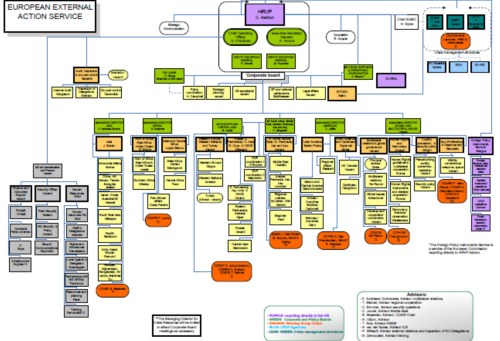
Organisation Chart for the European External Action Service

I can’t figure out how to post a legible chart, you therefore need to view the chart on the EEAS web site (click here) to fully comprehend (if possible) the organisational structure of the EEAS.  Presumably this is a work in progress.

Leave a comment

Filed under European Union, News

ASIL Insight article about M.S.S. v. Belgium & Greece

ASIL has just published an Insight article about M.S.S. v. Belgium & Greece written by Tom Syring, Co-chair of the ASIL International Refugee Law Interest Group, who currently serves at the Norwegian Immigration Appeals Board.

Excerpt from the conclusion:  “Apart from criticizing Greece for the current conditions of detention and subsistence awaiting asylum seekers, and Belgium for ‘intentional blindness’ for failing to properly scrutinize the adequacy of protection against refoulement in Greece, despite the fact that circumstances had called for application of the sovereignty clause, the Grand Chamber’s judgment exposes flaws in the current European asylum regime.

The judgment acknowledges … challenges [posed by CEAS and the Dublin regulation], yet underlines that neither uneven burden-distribution (Greece) nor a state’s minimalist reading of the Dublin Regulation (Belgium) absolves Member States of their responsibilities vis-à-vis the Convention or other applicable international treaties, including the 1951 Refugee Convention. As long as the EU and CEAS are comprised of individual Member States, as opposed to a ‘United States of Europe,’ individual states will be held responsible for independently assessing each case for the risk of direct or indirect refoulement.   While the Grand Chamber judgment uncovered a number of deficiencies in the current European asylum system, solutions to CEAS may have to be found outside the ‘Dublin world.’”

Click here for full article.

1 Comment

Filed under Analysis, Belgium, European Union, General, Greece, Judicial

JHA Council: Commission is Studying Different Funding Possibilities to Assist with Impact of Migratory Flows from North Africa

A Justice and Home Affairs press release summarizing today’s JHA Council meeting includes the following brief summary regarding the topic of migratory flows from North Africa:

“Over lunch, ministers discussed the situation in Northern Africa, and particularly the situation in Libya and the influx of migrants, above all from Tunisia to Italy. Since the beginning of the year, some 6000 immigrants have arrived mainly to the Italian island of Lampedusa. Following a formal request for help from the Italian Ministry of Interior, received on February 15, Frontex and Italy have started a Joint Operation in the central Mediterranean area on Sunday 20 February. Joint Operation Hermes 2011, originally planned to commence in June, was thus brought forward. Assets and experts for this operation were made available from a large number of EU member states. More information.  In addition to that, the Commission is studying different funding possibilities through various EU instruments, such as the European Refugee Fund, the European Return Fund and the European Border Fund.”

It is unclear whether the JHA Council will address this topic further tomorrow when the Council meeting resumes.

Click here for full JHA press release.

Leave a comment

Filed under Aegean Sea, European Union, Frontex, Libya, Mediterranean, News, Statements, Tunisia

ALDE: EU must be fully prepared for dealing with migrants fleeing persecution in Libya

ALDE issued a press release earlier today.  Excerpts:  “[T]he European Union must seek urgently prevent a humanitarian disaster but also prepare a contingency plan for the possible mass flux of refugees fleeing the country and seeking temporary sanctuary across the Mediterranean. Renate Weber MEP (PNL, Romania), Liberal Group spokesperson on the Justice and Home Affairs committee commented: ‘[***] It is appalling that while thousands of people are being killed, the EU is failing to show the unity and determination to force Gaddafi out due to some EU governments’ reluctance to jeopardise lucrative business deals with Libya and fears of massive migrant flows. If we are faced with a large scale influx of Libyans seeking humanitarian protection then the EU and its Member States will have to apply EU values and laws in force governing such circumstances, including international conventions, related to the protection of the life and the rights of refugees.  Art. 78.3 of the Treaty, specifically provides for the granting of temporary protection and provisional measures in case of the sudden influx of migrants. Anything else would be a dereliction of our international duty.’”

Click here for full statement.


1 Comment

Filed under European Union, Libya, Mediterranean, News, Statements

Italy, France, Spain, Malta, Cyprus Call for Redistribution of Asylum Seekers

The Ministers of the Interior of Italy, France, Spain, Malta and Cyprus met in Rome on Wednesday in advance of today’s JHA Council meeting and agreed to ask the EU for assistance in regard to the expected flow of migrants from North Africa.  The Ministers will call for the creation of a special EU fund to provide financial support to the frontline states directly affected by significant numbers of migrants and for the redistribution or relocation of asylum seekers among all EU member states so that the states of first arrival do not experience an unfair burden.  Michele Cercone, spokesperson for Commissioner Cecilia Malmström, noted that current European standards do not provide a mechanism for the redistribution between member states of migrants seeking asylum, other than on a voluntary basis.

Click here (IT) for article.

1 Comment

Filed under Cyprus, European Union, France, Italy, Libya, Malta, Mediterranean, News, Spain, Tunisia

Barroso Criticises Italy’s Use of Migration Issue to Not Support Democracy in North Africa

From the EU Observer:  “Italian leader Silvio Berlusconi is friends with Gaddafi…  Italy also has major oil, gas and arms interests in Libya and it fears a ‘biblical exodus’ of hundreds of thousands of irregular migrants and refugees if Gaddafi snaps.  The head of the European Commission, Jose Manuel Barroso, on Wednesday made an implicit criticism of Italian policy. ‘This question of migration, or of illegal migration, or even of refugees, is sometimes used as a way of not supporting democracy and I do not agree with that,’ [Barroso] said after meeting a top UN human rights official in the EU capital.”

Click here (EN) and here (IT) for articles.

1 Comment

Filed under European Union, Italy, Libya, Mediterranean, News

UNHCR: Imperative that Tunisia and Egypt Continue to Maintain Open Borders With Libya

The UNHCR “welcomed the positive indications it has received over the past two days from Tunisia and Egypt that they will maintain open borders for people fleeing the continuing violence in Libya.”

Click here for full statement.

1 Comment

Filed under Egypt, Libya, Mediterranean, Statements, Tunisia, UNHCR

JHA Council Meets 24-25 Feb – Meeting Topics Include North African Migrants, EASO, Greek Asylum Reform, EU-Turkey Readmission Agreement, and Frontex 2011 Work Programme

The two day JHA Council meeting begins today in Brussels.  According to the Background Note, “ministers will discuss the major influx of migrants from Northern Africa, particularly from Tunisia, to Southern EU member states, especially Italy. They will also look at the state of play on three other important internal border and migration issues:  the implementation of Greece’s National Action Plan on Migration Management and Asylum Reform; [and] the EU-Turkey readmission agreement. In this context, the Communication will present an evaluation and future strategy for EU readmission agreements;…  Ministers will then have exchange of views with the High Commissioner for Refugees (UNHCR) as well as with the Executive Director of the recently established European Asylum Support Office (EASO).”  Additionally, “FRONTEX will present to the committee its work programme for 2011.”

Click here for Background Note and here for Agenda.

Leave a comment

Filed under Aegean Sea, European Union, Frontex, Greece, Italy, Libya, Malta, Mediterranean, News, Tunisia, Turkey, UNHCR

Italy Warns that 300,000 Migrants May Seek to Flee Libya; Tunisians Continue to Reach Lampedusa in Moderate Numbers

After a meeting yesterday of the Prime Minister and the ministers of Foreign Affairs, Defence,  Economy, Labour, Justice, and Interior, the government formed a standing committee to follow the crisis in Libya (“un comitato permanente sulla crisi libica”).  The committee will monitor the flow of migrants to Italy.  According to reports in the Italian press, the Italian Government believes that between 200,000-300,000 migrants may seek to reach Italy if conditions in Libya continue to worsen.  Three Italian naval ships, the San Marco, San Giorgio and Mimbelli, have been moved close to Libya in order to be ready to assist with the evacuation of Italian citizens should it become necessary.  Tunisian migrants continue to arrive in Lampedusa.  Over the past day approximately 200 arrived.

Click here, here, and here for articles. (IT)

1 Comment

Filed under European Union, Frontex, Italy, Libya, Mediterranean, News, Tunisia