Category Archives: European Union

Informal Meeting of European Union Defence Ministers

An Informal Meeting of EU Defence Ministers was held in Mallorca last week to discuss the EU Common Security and Defence Policy (CSDP) established by the Treaty of Lisbon.

A decision was taken at the meeting to expand the objectives of Operation Atalanta to include the surveillance and control of Somali ports where pirate ships are based.  This decision will be implemented later in the month of March as weather conditions in the region improve.  The decision represents a potentially significant expansion of the EU’s anti-piracy operations.

Also attending the Informal Meeting were the ministers of defence from Algeria, Libya, Morocco, Mauritania and Tunisia.  A side meeting was conducted with regard to improving co-operation in matters of security in the Euro-Mediterranean zone.  The side talks pertained to the so-called “5+5 Western Mediterranean Defence Initiative” or more simply the “5 + 5 Initiative”.

Spanish Minister of Defence, Carme Chacón, who chaired the Informal Meeting said in regard to the meetings with the defence ministers from the five Maghreb countries:

“Spain is very clear on the fact that the Mediterranean is a sea of opportunities, but if we let our guard down then it can become a sea of problems – and we share this vision with all the associations we are involved in. At the moment it is a sea of peace and tranquillity, but both North and South must work together to tackle the dangers and new threats of the 21st Century, such as international terrorism, drug smuggling and organised crime. We must put our surveillance and maritime safety capacities into action in order to combat these threats, which could become an area of concern or a problem if we do not deal with them properly. And Spain will not forget this. In terms of the initiative of bringing together the countries of Europe and the Maghreb, we would like it to be not just the Spanish Presidency that sees to hold these meetings, but for the EU to be able to sit down regularly with these countries to discuss issues relating to the Mediterranean Sea, which must carry on being a source of opportunities rather than one of concern.”

Click here, here, here, and here for Press Releases from the Informal Meeting.

Cliquez ici pour un article (blog post) en francais.

Leave a comment

Filed under Algeria, European Union, Gulf of Aden, Indian Ocean, Libya, Mauritania, Mediterranean, Morocco, News, Somalia, Spain, Tunisia

“Harraga: La menace de la prison n’a rien changé”

El Watan: “Un an après la loi du 25 février 2009 criminalisant la harga [en Algérie], ils sont nombreux à ne plus vouloir partir. Mais pas par crainte de finir en prison dans leur pays. …  Les passeurs exigent des sommes énormes ! Les prix pratiqués aujourd’hui peuvent atteindre les 400 000 DA pour l’Espagne à partir de Ghazaouet.”

“Hocine Zehouane, président de la Ligue algérienne des droits de l’homme, a publié, en 2009, un rapport accablant relatif à cette tragédie : 36 000 jeunes harraga et environ 4 000 Algériens croupiraient dans les prisons espagnoles. Sans parler des 600 corps dans les morgues d’Almeria (Espagne). … « Les Européens ont mis beaucoup d’argent dans le programme Frontex (agence dotée de moyens de détection, de surveillance de toute migration par terre, par mer et même par air) et ont financé les régimes autoritaires du Sud (Libye, Tunisie, Algérie, Maroc) pour bloquer ce type d’émigration clandestine. Je crois que si les jeunes ont furieusement envie d’émigrer, ils n’ont pas envie de mourir en mer, ils n’ont pas envie de traîner misérablement dans les centres de détention s’ils arrivent en vie, ils n’ont pas envie d’être ensuite expulsés vers leur pays. »”

“Kamel Belabed, porte-parole du collectif des familles de harraga disparus, est du même avis : « Les jeunes s’informent, lisent la presse et ont accès à Internet. Ils savent, pour la plupart, qu’il y a maintenant une ‘coopération’ avec l’Union européenne pour l’interception des barques de nos harraga. Nous savons que le programme MEDA [NF – Règlement (CE) n° 1488/96 du Conseil du 23 juillet 1996] décidé, semble-t-il, pour ‘un partenariat euromediterranéen afin de garantir la paix, la stabilité et la prospérité’ du bassin, cachait mal une finalité qui ne disait pas son nom : l’externalisation des frontières de l’Europe ! Le programme MEDA a porté le montant de l’aide à l’Algérie à 10 millions d’euros. Le principal bénéficiaire de cette aide a été la police algérienne des frontières… Ceci en 2005.”

“L’Union européenne est devenue une des sources des projets de loi au Maghreb jusqu’en Egypte. C’est sous sa houlette que la loi 09-01 a été adoptée comme ont été adoptées les mêmes lois dans chacun des pays sud-méditerranéens. »

“[D]’autres réfléchissent à de nouvelles pistes pour atteindre l’eldorado. A leurs yeux, moins coûteuses et moins risquées. Comme la Turquie, plus précisément Izmir, la luxueuse station balnéaire. « Pour moins de 150 000 DA, vous êtes en Italie ! confie Mourad, … refoulé d’Italie y a quelques mois. Le procédé est simple : on prend l’avion pour la Turquie, ensuite le train ou un ferry pour Izmir, où des passeurs nous attendent. Le coût de la traversée entre la Turquie et la Grèce est de 500 euros environ. Pour atteindre l’Italie, avec l’aide du même baron de l’immigration clandestine, vous devez payer 1000 euros environ. »”

Cliquez ici pour l’article complet.

Leave a comment

Filed under Algeria, European Union, Frontex, Italy, Mediterranean, News, Spain, Turkey

Vacancy for ED of the European Asylum Support Office

Since the European Parliament will likely soon act to adopt formally the Regulation establishing the European Asylum Support Office, the vacancy for Executive Director position has been announced.

The Closing Date for applications is 9 April 2010.

Vacancy for an Executive Director (Grade AD 14) of the European Asylum Support Office, Malta —COM/2010/10234 .

“[T}the Office shall be a Community body having legal personality. The Office will play a key role in helping to improve the implementation of the Common European Asylum System and in strengthening practical cooperation among Member States in asylum-related matters.”

“The Director will be the legal representative and public face of the Office. She/he shall be independent in the performance of her/his duties and shall be accountable for her/his activities to the Management Board, which will consist of 26 voting members appointed by the Member States bound by the Regulation, 2 voting members appointed by the Commission, with Denmark and the Office of the United Nations High Commissioner for Refugees (UNHCR) attending as non-voting members.”

“The Executive Director shall report to the European Parliament on the performance of her/his tasks when invited. The Council may invite the Executive Director to report on the performance of his/her tasks.”

“The Director will have a central role in setting up the Office, which shall be fully operational within one year of the entry into force of the founding Regulation. She/he will be responsible for establishing the administrative, operational and financial structures necessary for the proper operation of the Office, including the recruitment of key staff.”

“Closing date – Applications must be sent either by e-mail or by registered mail no later than 9/04/2010 (date of e-mail or date as postmark for registered mail).”

Click here for full document.

Leave a comment

Filed under Communiqués, European Union

Italy Warns that Libya May Suspend Bi-Lateral Migration Agreement

Italian Interior Minister Roberto Maroni said that the Swiss – Libya visa dispute which has resulted in a Libyan decision to stop issuing visas to nationals of the Schengen zone may result in Libya halting its cooperation with Italy under the terms of the two countries’ bi-lateral migration agreement.

“Speaking on the sidelines of a meeting of European Union interior ministers, …  Maroni said the row put the Schengen zone at risk and could further strain relations with Libya. Cooperation by Tripoli in controlling immigration to the EU was one issue, he said. ‘The fear is in part that … Libya could weaken its border controls concerning illegal immigration.’”

Click here and here for articles.

Leave a comment

Filed under European Union, Italy, Libya, Mediterranean, News

JHA Council Conclusions on 29 measures for Reinforcing External Borders and Combating Illegal Immigration

Here are excerpts from the Justice and Home Affairs Council conclusions adopted on 25 February 2010:

“Council conclusions on 29 measures for reinforcing the protection of the external borders and combating illegal immigration

2998th JUSTICE and HOME AFFAIRS Council meeting – Brussels, 25 and 26 February 2010

The Council adopted the following conclusions:

The Council:

a) Taking into account the momentum created for the further development of the area of freedom, security and justice represented by the entry into force of the Lisbon Treaty and by the political priorities included in the Stockholm Programme, the European Pact on Immigration and Asylum, the Global Approach to Migration and the European Council Conclusions of June and October 2009; [***]

d) Stressing the need to share and assess analysis of the continuing illegal arrivals of migrants at the southern maritime borders, as well as the eastern land borders, as shown in particular by recent events in the Mediterranean area, and of the smuggling of migrants and trafficking in human beings, which often have tragic consequences; and to take a series of measures immediately, in the short term and medium term, in order to address the challenges;

e) Underlining that all measures and actions taken as a consequence of these conclusions shall fully respect human rights, the protection of persons in need of international protection and the principle of non-refoulement; [***]

Concerning the activities of FRONTEX, the Council has agreed:

1. To seek agreement as a matter of urgency on the Commission proposal for a Regulation of the European Parliament and of the Council amending the FRONTEX Regulation, in order to reinforce the capabilities of the FRONTEX Agency. [***]

4. To improve operational cooperation with third countries of origin and transit, in order to improve joint patrolling on land and at sea, upon consent of the Member State concerned, return, and collection and exchange of relevant information within the applicable legal framework, and other effective preventive measures in the field of border management and illegal immigration.

5. To underline the importance of the role of the European Asylum Support Office (EASO) in developing methods to better identify those who are in need of international protection in mixed flows and in cooperating with FRONTEX where ever possible, and to welcome the development of the regional protection programs and the enhancement of the dialogue and cooperation on international protection with third countries. [***]

9. To invite FRONTEX to implement its decision to carry out a pilot project for the creation of an operational office in the eastern Mediterranean, in Piraeus, as soon as possible in 2010. The Council takes note that Frontex has agreed that, on the basis of an independent external evaluation, it may decide whether to pursue the pilot project and/or establish other Frontex operational offices as appropriate, and invites FRONTEX to report to Council on the matter.

Concerning the development of the European Surveillance System – EUROSUR, the Council has agreed:

10. To call on the Member States to implement the phases and steps laid down for the development of EUROSUR as soon as possible, in order to reinforce cooperation and Member States’ border surveillance capabilities. The Council invites the European Commission to report on EUROSUR progress on mid-2010.

11. To urge relevant Member States to establish or further develop a single national border surveillance system and a single national Coordination Centre. A network of national Coordination Centres, compatible with the FRONTEX Information System, and available on a 24/7 basis in real time, should be fully operational on a pilot basis as of 2011, involving as many Member States of the southern and eastern external borders as possible. The Commission is invited to present legislative proposals if necessary to consolidate the network of Member States by 2013.

12. To create a Common pre-frontier intelligence picture in order to provide the Coordination Centres with pre-frontier information provided by Member States, Frontex and third countries. To this end, the Council invites Frontex, in close cooperation with the Commission and the Member States to take the necessary measures to implement the study carried out by the Commission in 2009.

13. To encourage cooperation by neighbouring third countries in border surveillance. It is essential that within the territorial scope of EUROSUR and in the current financial framework, financial and logistic support from the European Union and its Member States be made available to the third countries whose cooperation could significantly contribute to controlling illegal immigration flows, in order to improve their capacity to manage their own borders.

14. To invite the Commission to report before the end of 2010 on how the conclusions of the Global Monitoring for Environment and Security (GMES) border surveillance group on common application of surveillance tools, such as satellites, could be implemented in the EU land and sea borders. [***]

Concerning solidarity and the integrated management of external borders by the Member States, the Council has agreed:

17. To request Frontex and the Member States concerned to further develop the European Patrols Network (EPN) in order to generalize bilateral joint maritime patrols, in particular between neighbouring Member States at the southern and eastern maritime borders, taking into account the experience gained on joint police patrols in the context of the Prüm Decision, and to ensure the full integration of the EPN in the EUROSUR network. [***]

Concerning the cooperation with third countries, the Council has agreed:

22. To ensure that the migration policy objectives are at the centre of the political dialogue with relevant third countries of origin and transit, with a view to the strategic, evidence based and systematic implementation of the Global Approach to Migration in all its dimensions, i.e. legal migration, illegal immigration and migration and development. This also requires, as a matter of principle, that all parties concerned assume their responsibilities in terms of return and readmission of migrants entering or staying illegally, including those migrants who have entered or tried to enter the European Union illegally from their territory. [***]

24. To enhance in particular the implementation of the Global Approach in the dialogue on migration with the main countries of origin and transit, such as, in accordance with the Stockholm Programme, those of the Mediterranean area, the East and South-Eastern Europe and Africa. This process may cover, on a case by case basis, all aspects of migration, including also cooperation on and support of border management, return and readmission, and, where appropriate, mobility issues. In doing so, the EU will promote human rights and the full respect for relevant international obligations. Dialogue and cooperation should be further developed also with other countries and regions such as those in Asia and Latin America on the basis of the identification of common interests and challenges.

25. To implement actively the European Council Conclusions of June and October 2009, including in particular by taking forward the dialogue on migration with Libya, with a view to setting up in the short term an effective cooperation. The Commission is invited to explore, as a matter of urgency, a cooperation agenda between the European Union and Libya with a view to including initiatives on maritime cooperation, border management (including possibilities for the development of an integrated surveillance system), international protection, effective return and readmission of irregular migrants and issues of mobility of persons.

26. To welcome the constructive resumption of the formal negotiations on a EU/Turkey readmission agreement, which makes provision for the return of third country nationals, and to call for its conclusion as a matter of urgency, and to stress that adequate implementation of already existing bilateral readmission agreements remains a priority. Building on the dialogue now under way with Turkey, the Council invites the Commission, the Member States and Turkey to further develop cooperation on migration, international protection and mobility issues. The Commission is also invited, in the context of the existing Instrument for Pre-accession Assistance (IPA) financial framework, to explore possibilities to provide adequate financial means to improve Turkish capacity to tackle illegal migration, including support to the implementation of the Turkish integrated border management system.

27. To underline the importance of swift finalisation of the negotiation of Article 13 of the Cotonou Agreement, the revision of which should seek to reinforce the three dimensions of the Global Approach, and in particular the effectiveness of readmission obligations.

28. To invite the Commission to identify the necessary means to support enhanced capacity building and infrastructures in relevant third countries, so that they can control efficiently their external borders and tackle illegal immigration, taking also into account the assessments made by FRONTEX.

29. To invite the Commission to report on the implementation of these Conclusions by the end of 2010.”

Click here for full Document.
Leave a comment

Filed under Aegean Sea, Eastern Atlantic, European Union, Frontex, Libya, Mediterranean, News, Turkey

NGOs Urge EU to Respect Refugee Rights

ECRE, CEAR, and Amnesty International have released a joint statement urging EU governments to respect refugee rights as efforts are made to strengthen Frontex.

“Bjarte Vandvik, ECRE Secretary General said: ‘States have a legitimate right to control their borders, but this is not an excuse to ignore the fact that persons fleeing war or persecution are entitled to protection under international, European and national laws. As Frontex is being strengthened, its operations need to be monitored to ensure that human rights are respected’.”

“Regardless of where border controls take place and of who implements them, methods to prevent unauthorized entry must leave room for the identification of persons in need of international protection so they are not returned to any country where they will face persecution. Member States’ obligations under international and European refugee and human rights law do not stop at the physical boundaries of the EU. This responsibility is not only moral and political but also legal. EU Member States cannot abdicate their principles, values and commitments by doing outside their borders what would not be permissible in their territories.”

Click here for full statement.

Leave a comment

Filed under Aegean Sea, Eastern Atlantic, European Union, Frontex, Mediterranean, Statements

Malmström: Expand Frontex Powers and Respect Rights

On the eve of the 25-26 February meeting of the Council of Justice and Home Affairs, EC Home Affairs Commissioner Cecilia Malmström in her first press conference as Commissioner presented the Commission’s proposal to expand Frontex’s powers in several areas including giving it the authority to co-lead enforcement operations with member states.  The proposal would also introduce “an explicit requirement for all border guards taking part in operations to have been trained in fundamental rights, with the aim to safeguard that all immigrants are met with full respect of fundamental rights and in particular the principle of non-refoulement.”

Speaking of Italy’s forcible migrant return policy, Malmström said “I don’t exclude at all that errors were committed in the past, that’s why I’m so keen to really reinforce that all the people involved in Frontex operations have the adequate education and know exactly what to do. Because of course, these people [the migrants] are not criminals, they are in the search for a better life and they have the right to be treated in a dignified way.”

Click here and here for articles.

Click here for JHA Council 25-26 February Meeting Agenda.

Click here for JHA Council Meeting Background Note.

Leave a comment

Filed under Aegean Sea, Eastern Atlantic, European Union, Frontex, Italy, Libya, Mediterranean, News

Frontex Presentation at European Defence Agency Annual Conference

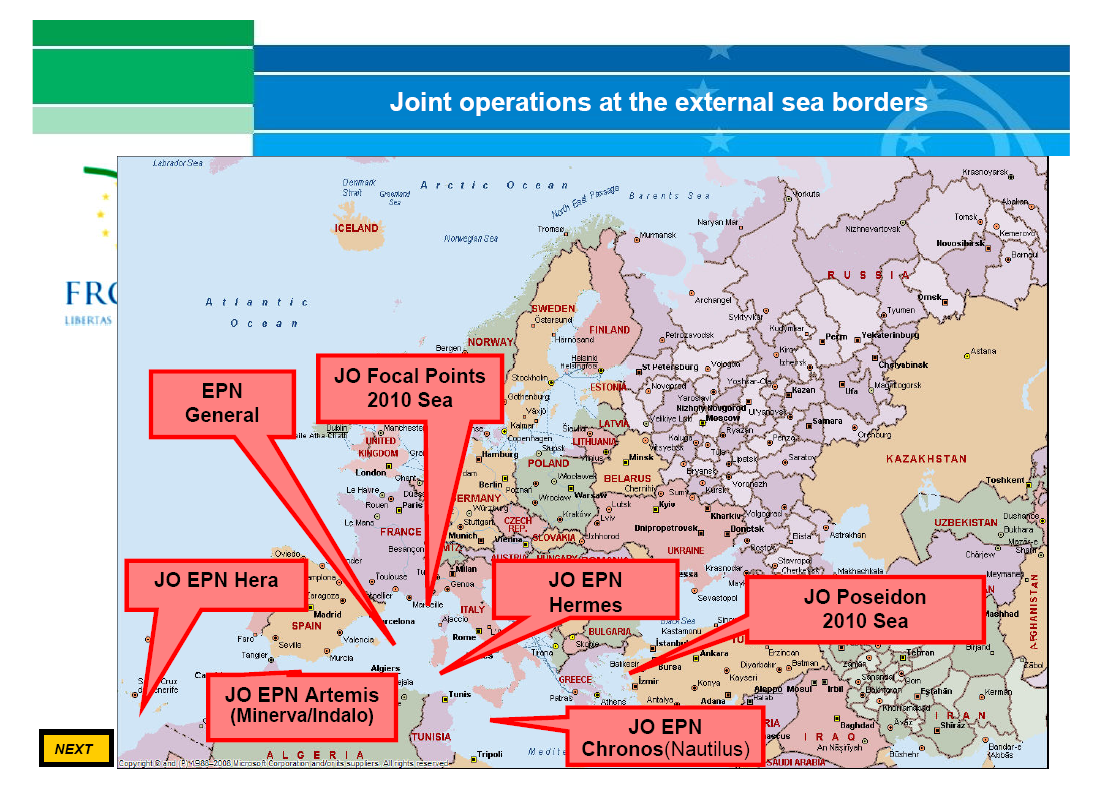
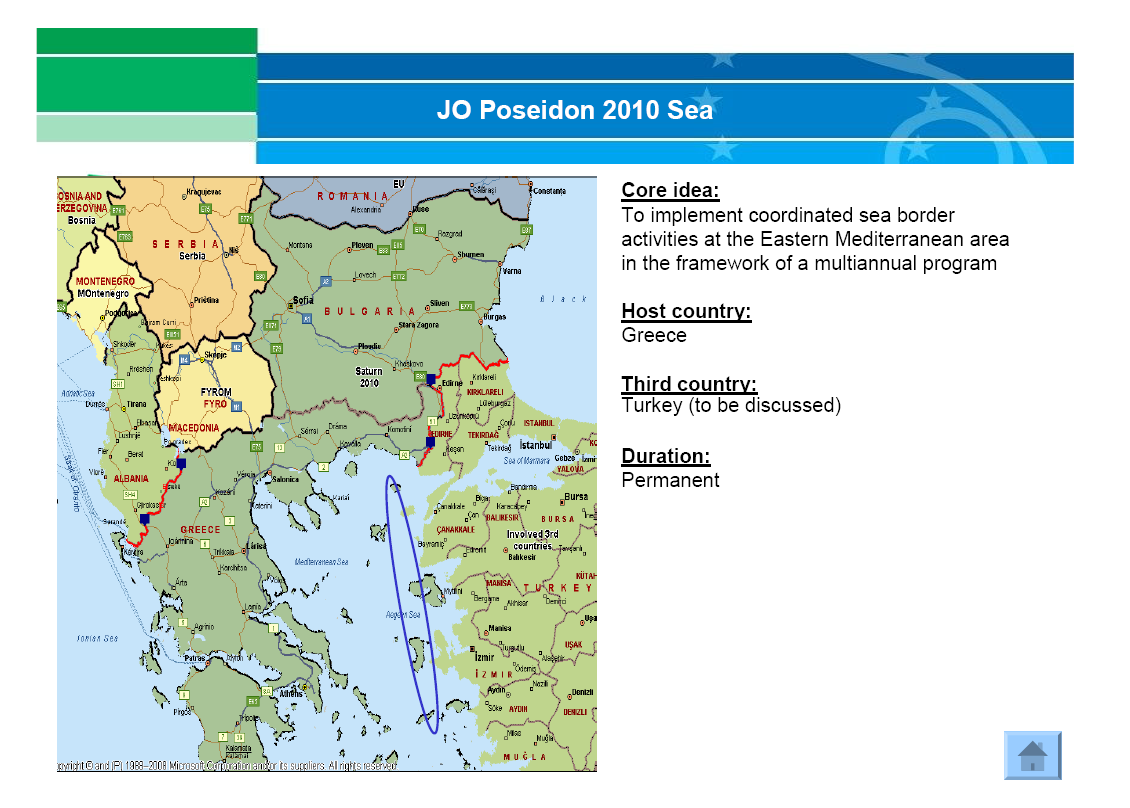
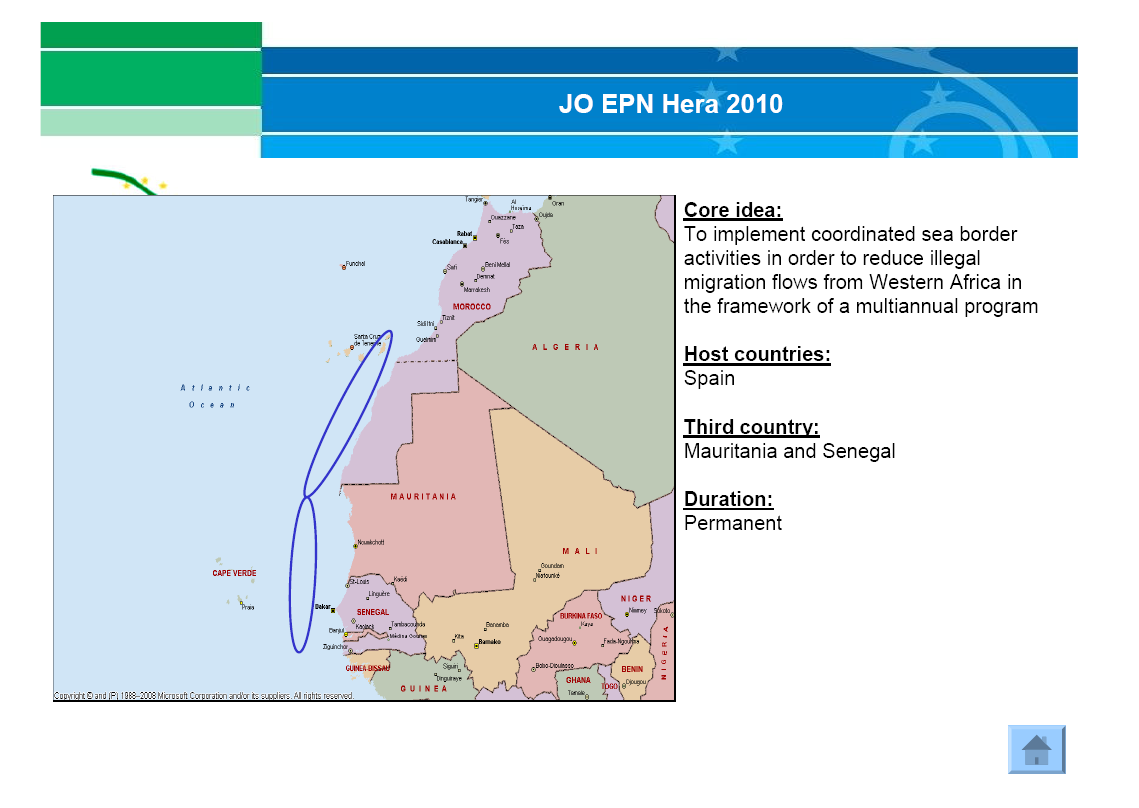
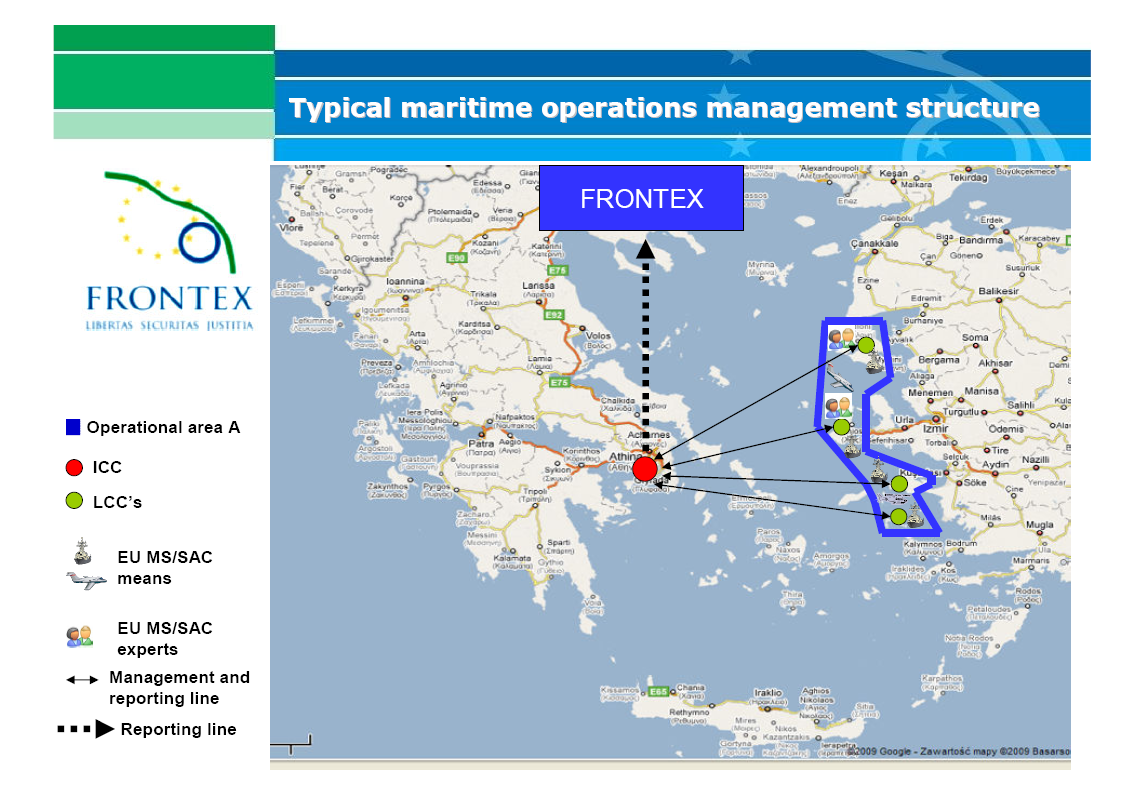
Rustamas Liubajevas, Head, Frontex Joint Operations Unit, presented a lecture entitled “Frontex within integrated Border management concept – Structural approach in planning capability” at the recent Annual Conference of the European Defence Agency.

Copies of some of his slides are reproduced here.

Click here for full slide presentation.

Leave a comment

Filed under Aegean Sea, Algeria, Colloques / Conferences, Eastern Atlantic, European Union, Frontex, Greece, Italy, Libya, Malta, Mauritania, Mediterranean, Morocco, News, Senegal, Spain, Turkey

Malta: New Frontex Guidelines for Operations at Sea Could Be Ignored

The new Armed Forces of Malta Commander, Brigadier Martin Xuereb, suggested in an interview with the Times of Malta that Frontex enforcement operations are governed by operational plans that “may or may not draw from the [newly approved Frontex] guidelines”.  “‘The guidelines also state that the modalities of the operation will be agreed upon in the operational plan decided by countries that participate in the mission,’ he says, insisting the operational plan superseded the [new] guidelines.”  Xuereb also said that it was too early to say whether Malta would decline to participate in future Frontext operations.

Click here for full article.

Leave a comment

Filed under European Union, Frontex, Malta, Mediterranean, News

Besson et Frattini: renforcement des frontières “urgent”

“La France et l’Italie veulent un renforcement ‘urgent’ des frontières extérieures de l’UE afin de lutter contre les filières d’immigration clandestine…. Paris et Rome veulent un ‘développement des capacités opérationnelles de … Frontex en vue de mettre en place la police européenne aux frontières prévue par le Pacte européen sur l’immigration et l’asile’ et une ‘généralisation des accords de coopération opérationnelle et de réadmission avec les principaux Etats tiers d’origine et de transit’.”

“Les ministres de l’UE en charge de l’immigration doivent tenir le 25 février à Bruxelles une réunion extraordinaire convoquée par Eric Besson après la découverte de 123 Kurdes sur une plage corse en janvier.”

Cliquez ici pour l’article.

Leave a comment

Filed under European Union, France, Frontex, Italy, Mediterranean, News

Malmström: Non-Refoulement Must be Respected in the Mediterranean

Speaking at the first meeting of the new European Commission (Barroso 2), Cecila Malmström made remarks about Frontex:

“We have evaluated Frontex, how it works, we will strengthen it, we will increase the coordination capacities and make it a better tool in order to work with the Member States on handling irregular immigration but also on making sure that the rule of law and the principle of ‘non-refoulement’ is respected on the Mediterranean.”

“Nous avons évalué le dispositif Frontex, son fonctionnement, et nous allons le renforcer, a-t-elle déclaré. Nous allons augmenter les capacités de coordination et en faire un meilleur outil pour faire en sorte, avec les Etats, de contrôler l’immigration mais aussi pour s’assurer que la primauté du droit et que le principe de non-refoulement soient respectés autour de la Méditerranée.”

Click here for article in English.

Cliquez ici pour l’article en francais.

Leave a comment

Filed under European Union, Frontex, Italy, Mediterranean, News

New Statewatch Report: NeoConOpticon- The EU Security-Industrial Complex

Statewatch and the Transnational Institute have published a comprehensive new report.

The report, “NeoConOpticon, The EU Security-Industrial Complex”, is a “follow-up [to Arming Big Brother, 2006] [and] contains new research showing how the European Security Research Programme [ESRP] continues to be shaped by prominent transnational defence and security corporations and other vested interests. Though technically a Research and Development (R&D) programme, the ESRP is heavily focused on the application of security technologies (rather than objective research per se), and is increasingly aligned with EU policy in the fields of justice and home affairs (JHA, the ‘third pillar’), security and external defence (CFSP, the ‘second pillar’).”

The Report includes a discussion of maritime immigration enforcement.  Excerpt:

“Having fortified many of the traditional entry points to Europe, the focus of the ‘war on migration’ has shifted to the islands of the Mediterranean and the coastlines of Africa and the Middle East. For FRONTEX, the newly created EU border management agency, this ‘southern maritime frontier’ is the ‘first line of defence’ of ‘Europe’s borders’. Since 2003 FRONTEX has coordinated a host of joint police and naval missions to combat ‘illegal’ immigration by sea and is now in the process of setting up a permanent European Patrols Network for the Mediterranean and a corps of Rapid Border Intervention Teams (RABITs) for deployment to ‘illegal immigration hotspots’.

This militarised approach to immigration control is part of a broader EU maritime security and defence strategy. In 2005, following the lead of the USA’s ‘SeaPower21’ strategy, the Chiefs of European Navies (CHENS) launched a 20-year ‘Vision for the Future Role of European Maritime Forces’ to meet the demands of the European Security Strategy (2003) and enhanced NATO Maritime Joint Operations. The rationale behind the CHENS strategy is that the sea: ‘has already been used for terror attacks by boats armed with rockets and small arms’ and ‘for logistic support to terrorism’. The sea is also a potential conduit for CBRN material and “criminal activity including narcotics, human trafficking and piracy’, all of which is ‘increasing in sophistication and volume.’ …”

Click here for Executive Summary.

Click here for full report.

Leave a comment

Filed under Eastern Atlantic, European Union, Frontex, Mediterranean, Reports

Presentation Materials from EU Conference on “Maritime Policies for a Prosperous and Secure Europe”

The Spanish EU Presidency conducted a conference on “MARITIME POLICIES FOR A PROSPEROUS AND SECURE EUROPE – Towards a Comprehensive 21st-Century Civil-Military Approach” in January 2010 during which multiple presentations were given by representatives from Frontex, military representatives, and others.

The PowerPoint presentations used by some of the presenters are posted on the internet (See http://www.eutrio.eu/export/sites/presidencia/comun/descargas/ [xxx] )

Links to two of the presentations are provided here.

“European Border Surveillance”, Erik Berglund, Director of Capacity Building, Frontex.

Click here.

“Integration of Maritime Surveillance Systems as a Keystone for Maritime Security”, Bg. Gen. José María Orea Malo, Head Operations Division Spanish Air Force Staff.

Click here.

Leave a comment

Filed under European Union, Frontex, Spain

Cecilia Malmström: New EC Commissioner for Justice & Home Affairs

After an 8 month delay, the European Parliament has approved a new term for European Commission president Jose Manuel Barroso and his 26 commissioners.

The new Commissioner with responsibility for Justice and Home Affairs is Cecilia Malmström.

Click here for link to the Commissioner’s new web site.

Click here for article about the Commissioner’s hearing before the EP.

Click here for article about the EP vote.

Leave a comment

Filed under European Union, News, Sweden

Background Note Pertaining to Proposed Guidelines for Frontex Operations at Sea

Given the strong objections by Malta and Italy to the proposed Guidelines for Frontex Operations at Sea, the “Note for the File” pertaining to the “Draft Council Decision supplementing the Schengen Borders Code as regards sea border surveillance in the context of operational cooperation coordinated by FRONTEX (COM(2009)658) as amended by the Council on 25 January 2010” is worth reading.

The “Note” explains the origins of the Guidelines and the additional procedures which will need to be completed before the Guidelines take effect:

“Note for the File:

The questions of who is responsible for saving people at sea and where they should be disembarked have been subject to intense debates in the context of surveillance operations concerning the EU’s sea borders coordinated by Frontex. The operations take place in a highly complex legal and political environment and touch upon international law issues and on the EU’s relations with third countries.

After long preparatory work, including a study on the relevant international law instruments completed in 2007, the Commission drafted a set of guidelines intended to

  • ensure that international rules are uniformly applied by all Member States taking part in surveillance operations coordinated by Frontex (Convention on the Law of the Sea (UNCLOS), conventions on safety at sea and search and rescue, international law on refugees and fundamental rights) and
  • create a basis in EU law enabling one Member State to carry out surveillance of another Member States’ maritime borders.

The Commission presented the draft guidelines in the form of an implementing measure, based on Article 12 (5) of the Schengen Borders Code.  This provision, together with Article 33 of the Borders Code, authorises the Commission to adopt additional measures governing border surveillance in accordance with the regulatory procedure with scrutiny as laid down in Council Decision 1999/468/EC (“comitology decision”).

After the entry into force of the Treaty of Lisbon this procedure continues to apply until the basic legal act, the Schengen Borders Code, has been aligned to the framework of the Treaty of Lisbon. Therefore, the regulatory procedure with scrutiny applies to the present draft measure.

The draft was first submitted to the Borders Code Committee. Member States’ experts failed to agree on the draft; therefore, the Committee did not issue a formal opinion. One of the controversial issues was whether the Commission’s draft went beyond its implementing powers.

On 7 December 2009, the Commission submitted a revised draft to the Council and to the Parliament, in the form of a draft Council Decision (COM(2009)658).

In accordance with the regulatory procedure with scrutiny the Council, acting by qualified majority, had the following options:

  • · oppose the proposed measure, in which case it will not be adopted; the Commission may submit an amended proposal or present a legislative proposal (option 1)
  • · envisage adopting the proposed measure, in which case it shall without delay submit it to the European Parliament (option 2)
  • · not act within the two months, in which case the Commission shall without delay submit the measures to the Parliament.

The Council had to act within a deadline of two months, i.e. before 7 February 2010.  On 25 January 2010 the Council, with Italy and Malta abstaining, decided to envisage adopting draft Council Decision and submit the draft Council Decision to the European Parliament. Furthermore, the Council agreed on an additional declaration to be adopted by the Council if Parliament does not oppose the measure, asking Frontex to report on the practical implementation of this decision.

European Parliament’s role in the procedure and deadline

In accordance with the regulatory procedure with scrutiny, Parliament has four months in total, starting from the date of referral on 7 December 2009, to scrutinise the draft measure. In practice, Parliament now has two more months to take position before 7 April 2010.

Parliament’s options in the regulatory procedure with scrutiny are limited to the following. Parliament may, acting by a majority of its component Members,

  • · oppose the adoption of the measure; in this case, Parliament must justify its opposition, stating that the proposed measure exceeds the implementing powers granted to the Commission in the basic instrument, or is not compatible with the aim or the content of the basic instrument or does not respect the principles of subsidiarity or proportionality; if Parliament opposes, the draft measure shall not be adopted; the Commission may submit an amended proposal or present a legislative proposal
  • · not oppose the adoption of the draft measure; in this case, the draft measure may be adopted by the Council or the Commission.

LIBE, as the committee responsible, will prepare Parliament’s position, in accordance with Rule 88 of the Rules of Procedure. The Member responsible in LIBE is Michael Cashman, rapporteur for the basic act, the Schengen Borders Code. Once the Council’s position, adopted on 25 February 2010, has been officially referred to the Parliament, the chairman will set a deadline for Members who wish to propose that the committee objects to the draft measure. If the committee decides to object, it shall table a motion for a resolution to the plenary for adoption before 7 April 2010.

Action undertaken by LIBE so far:

On 11 January 2010, LIBE, as the committee responsible, heard presentations of the Commission (Mr Henrik Nielsen, Head of Unit, DG JLS) and the Spanish Presidency (Mr Burgos Nieto, JHA Counsellor) and held a first exchange of views on the file.

During the debate, several Members highlighted the political importance of the decision on the guidelines (Mr Busuttil, Mrs Flautre, Mr Moraes, Mrs Hennis-Plasschaert) and the fact that this was a long-standing discussion in the Council. The Executive Director of Frontex (Mr Laitinen) underlined the swift adoption of guidelines would enhance the efficiency of Frontex’ operations.

Next steps:

The Council will refer its position, which was adopted on 25 January 2010, to the Parliament within a few days. Then it will be Parliament’s turn to take a position before the expiry of the deadline on 7 April 2010.

In order to prepare LIBE’s position, the rapporteur recommends that an opinion be requested from the Parliament’s legal service, which should answer the following questions:

1)

a) Having regard to the delineation between “rules” and “guidelines” for Member States in the draft measure as amended by the Council, could the content be considered a “non-essential element” of the final legal framework shaping the role of the Member States and Frontex?

b) Has the Commission exceeded its implementing powers under Article 12 (5) of the Schengen Borders Code by proposing the present draft measure?

2) In case the content or a part of the content of the draft measure touches upon essential elements of the basic act, could the objectives of the measure be achieved by a legislative act, notably by amending the basic act, i.e. the Schengen Borders Code?

OPERATIONAL INFORMATION:

Documents:

  • · Proposal for a Council Decision supplementing the Schengen Borders Code as regards the surveillance of the sea external borders in the context of the operational cooperation coordinated by Frontex, COM(2009)658 of 27.11.2009, as amended by the Council on 25 January 2010
  • · Commission staff working document, Study on the international law instruments in relation to illegal immigration by sea, SEC (2007)691 of 15.5.2007, available in EN and FR.

Contacts:

European Parliament:

Member responsible: Michael CASHMAN

Asisstant to Mr Cashman: Renaud-Raphaël Savignat, tel. – 47759

S&D political Advisor: Mrs Annie Lemarchal, tel. – 43057

Desk officer responsible in the LIBE Secretariat: Lotte Madlen Tittor, tel. -40785

European Commission:

Desk officer responsible in DG JLS: Ana Isabel Sanchez Ruiz, tel. 02-2998239, email: Ana-Isabel.Sanchez-Ruiz@ec.europa.eu

Head of the responsible Unit in DG JLS: Henrik Nielsen, tel. 02-2991641, email: Henrik.Nielsen@ec.europa.eu

Council General Secretariat:

Desk officer: Mr Bent Mejborn, tel. 02-2816722, email: bent.mejborn@consilium.europa.eu

Spanish Presidency:

Mr Eugenio Burgos Nieto, JHA Counsellor, email: eugenio.burgos@reper.maec.es”

Click here for link to Document.

1 Comment

Filed under Analysis, European Union, Frontex, Italy, Malta, Mediterranean