Category Archives: EU and EU Organizations

EU-Libya Resume Partnership Talks

The seventh round of negotiations on the EU-Libya partnership accord began on 8 June in Tripoli.  According to the AFP, EU negotiators hope to have a final agreement with Libya signed by the end of 2010.  The current EU delegation is led by Hugo Mingarelli, deputy head of the European Commission for foreign affairs.  The negotiations have been slow for a variety of reasons, one of them being disagreement over immigration topics and the reported pressure on Libya by the EU to sign the UN Refugee Convention.  (See my previous post on Libya’s sudden decision to close the UNHCR office in Tripoli.)

Click here and here (AR) for articles.

Click here for EC External Relations web page on Libya.

Leave a comment

Filed under European Union, Libya, Mediterranean, News

Libya Orders UNHCR Office Closed – Possible Link to EU-Libya Talks on Partnership Accord

The Libyan government has ordered the UNHCR office in Libya to halt all activities and to close it office.  UNHCR has been working in Libya since 1991 even though Libya is not a signatory to the UN Refugee Convention.

The UNHCR said it was not given a reason for the Libyan decision.  Reuters reported that Libya’s Foreign Ministry considers the UNHCR presence within Libya to be illegal since Libya is not a signatory to the Refugee Convention.  Reuters also says that JANA, the Libyan news agency, accused a UNHCR official of carrying out an unspecified illegal activity.

The Libyan newspaper Oya and other reports say that the EU is pressuring Libya in the ongoing EU-Libya Partnership Talks to sign the Refugee Convention and that illegal immigration is one of the main areas of disagreement in the current negotiations.

The UNHCR said in a press release “[i]n the absence of a national asylum system, UNHCR has carried out registration and refugee status determination, visiting detention facilities and providing medical and humanitarian assistance to detainees.”  Among the asylum seekers detained in Libya over the past year are persons who were forcibly returned to Libya by Italian authorities pursuant to the Italy-Libya migration agreement.

Click here for UNHCR press release.

Click here for Oya article (AR).

Click here, here, and here for articles (EN).

2 Comments

Filed under European Union, Libya, Mediterranean, News, UNHCR

Spanish Court Rules that Schengen Treaty Prevents Asylees From Leaving Ceuta and Melilla

As noted on Diario de la Inmigración, a Spanish Court in Ceuta (el Juzgado Contencioso Administrativo número 2 de Ceuta) has ruled that persons granted asylum or subsidiary protection may not leave Ceuta for the Spanish peninsula.  The court agreed with the position of the Spanish government and ruled that the two autonomous cities of Ceuta and Melilla are not part of the Schengen area and that proper documentation is therefore required to enter the Schengen area from the cities.  The court concluded that the “yellow card” (“tarjeta amarilla”) issued to persons granted asylum or subsidiary protection is insufficient documentation to enter the Schengen area.

The UNHCR and CEAR have previously criticised the Spanish’s government new policy of restricting the free movement of persons in Ceuta and Melilla who have been granted asylum or subsidiary protection.  UNHCR believes that the restrictions on free movement violate article 5 of Spain’s 2009 asylum law (la ley 12/2009, de 30 de octubre).

Click here, here, and here for articles (all ES).

Leave a comment

Filed under European Union, Judicial, Mediterranean, News, Spain, UNHCR

EP Seminar on Combating and Preventing Trafficking in Human Beings (10 June, Brussels)

NB – Registration to attend must be emailed by 16.00, Monday, 7 June.

“On Thursday 10 June 2010 LIBE will hold jointly with the Women’s Rights and Gender Equality Committee (FEMM) a seminar on “Combating and preventing trafficking in human beings: the way forward” to have an exchange of views contributing to drafting a co-decision report by Anna HEDH (S&D, SE) (LIBE) and Edit BAUER (EPP, SK) (FEMM).”

“REGISTRATION – This Round Table meeting is open to the public. We would ask the participants to send their registration before Monday 7 June at 16.00.  For security reasons, participants who do not have a European Parliament access badge must obtain a pass in advance.  Please send the following information to the joint FEMM-LIBE mailbox: ip-femm-libe@europarl.europa.eu:

LAST NAME-First name-date of birth*-place of birth*-address*-company/institution/ organisation

It is essential to provide us with this information. Without it the Security Service will not provide entry passes. If you already have an entrance pass, indicate it in the e-mail. In this case the information marked with asterisk (*) is not needed.”

Click here for more information.


Leave a comment

Filed under Colloques / Conferences, European Union

Article: Overview of North African Bilateral Cooperation on the Removal of Unauthorized Migrants

The May 2010 publication by the Middle East Institute (Washington DC), Viewpoints- Migration and the Maghreb, contains several articles including “An Overview of North African Countries’ Bilateral Cooperation on the Removal of Unauthorized Migrants: Drivers and Implications” by Jean-Pierre Cassarino.

Excerpts from the article (at page 34):

“Since 1965, when Bourguiba’s Tunisia signed with Austria its first bilateral agreement on the repatriation of its own nationals, North African countries’ patterns of cooperation on readmission or removal have changed dramatically….

“[R]eadmission agreements are … one of the many ways to consolidate a broader bilateral cooperative framework, including other strategic, and perhaps more crucial, policy areas such as security, energy, development aid, and police cooperation….

“Faced with the uncertainty surrounding the concrete implementation of the cooperative agreements, some EU Member States, particularly those affected by migration flows originating in North Africa (e.g., France, Spain, Italy), set out to devise flexible arrangements while opting for different ways of dealing with readmission. These include exchanges of letters, memoranda of understanding, or other types of arrangements (e.g., police cooperation agreements and pacts)….

“Readmission is embedded in power relations that can shape the intensity of the quid pro quo. Following their proactive involvement in the reinforced police control of the EU external borders, North African countries have become gradually aware that they could play the efficiency card in the field of migration and border management, while gaining further international credibility….”

Click here for link to publication (see p. 34 for this article.)

Click here for the MIREM Project Inventory of Agreements Linked to Readmission.

Leave a comment

Filed under Analysis, European Union

EU-Turkey Readmission Agreement Negotiations Continuing

The Turkish paper, Today’s Zaman, reported that Turkey and the EU have reached agreement on 19 articles of a draft readmission agreement, but have been unable to reach agreement on 5 articles.

The news article states that Turkey wants “the readmission agreement [to include] strong funding from the EU, mirroring similar funding that is available to member states under the “resettlement policies” within the European Refugee Fund (ERF), which was established to support and improve the efforts of member states to grant refugee or asylum status to beneficiaries.”

“The [Turkish] government also fears that, without a strong and clear readmission agreement in place, vetting thousands of immigrants and asylum seekers in reception centers while awaiting deportation will open a Pandora’s box for Turkey in the European Court of Human Rights (ECtHR). Turkey ranks second after Russia in terms of the number of cases ending up in the ECtHR and is trying to reduce them by introducing constitutional changes on fundamental rights, due to be submitted to a referendum on Sept. 12.”

“In April, for example, the ECtHR decided in three out of four cases involving refugees recognized by the UN High Commissioner for Refugees (UNHCR) that Turkey would violate Article 3 of the European Convention on Human Rights (ECHR) if the expulsion orders were enforced. The court also criticized the unlawfulness and the conditions of their detention in a police station and in some of the detention centers where they had been held awaiting deportation.”

Click here for article.

Leave a comment

Filed under Aegean Sea, European Court of Human Rights, European Union, Greece, News, Turkey

Colloque: les trajectoires migratoires vers l’UE au XXIe siècle (Marseille, 18-19 juin)

La PLAGE co-organise avec la Bibliothèque Marseillaise à Vocation Régionale, l’Alcazar, et le programme MIMED (MMSH-Migration en Méditerranée), deux journées de rencontres et de débats sur le thème des migrations vers l’Union Européenne.

La première journée sera consacrée d’une part à la présentation et à la clôture de l’exposition cartographique et géographique de Philippe Rekacewicz « Frontières, migrants et réfugiés » … et d’autre part à une rencontre sous le titre : « Du Sahara à la Mer Egée : Horizon Europe ».

Nous aborderons lors de la deuxième journée la question des camps de rétention – « L’enfermement, une étape dans les trajectoires migratoires ? » – puis celle du travail associatif et des relations entre la société civil et l’administration, notamment dans le contexte marseillais.

RDV vendredi 18 et samedi 19 juin à l’Alcazar, 58 cours belsunce, 13001 Marseille.”

Cliquez ici ou ici pour télécharger le programme.

Leave a comment

Filed under Aegean Sea, Colloques / Conferences, European Union

EASO Regulation Published in EU Official Journal

Regulation (EU) No 439/2010 of the European Parliament and of the Council of 19 May 2010 establishing a European Asylum Support Office was published in the Official Journal of the EU on 29 May 2010.

Click here for the link to the Journal.

Leave a comment

Filed under European Union, News, UNHCR

Frontex’s 5th Anniversary

Yesterday, 25 May, marked Frontex’s fifth anniversary.  Frontex marked the occasion by holding a conference, European Day for Border Guards, “publicising the work of 400,000 border guards in Europe [and] providing a forum for discussion and the exchange of best practices.”

Here is an interesting and thoughtful post on the Frontex anniversary by Professor J. Peter Burgess:

“… FRONTEX is quickly and quietly evolving into a kind of moral testing ground for Europe. It is here that the airy principles of European construction meet the pavement, where decisions are made about the role of rights and responsibilities in the management of Europe’s most dilemma-ridden challenge: the management of its external borders.  Border control is the operational theater where Europe meets its others: other worlds, other human beings, other values. It is here where the aspirations of those who long to embrace Europe, to be European, live under the protection of Europe’s social and economic well-being are confronted with European ideals of tolerance and universal rights. It’s also the place where Europe meets its ‘other’ other: trafficking, smuggling and other forms of cross-border criminality. The coherence with which Europe manages its others in both these forms is one measure of the success of the European project.….”

Click here for the full post.

Leave a comment

Filed under Analysis, European Union, Frontex, News

Spain and Senegal Renew Agreement Permitting Frontex to Operate From Dakar

Spain and Senegal have renewed a bi-lateral agreement permitting Frontex to operate from a base in Dakar for another year.

The Frontex mission in Senegal currently consists of two Spanish Guardia Civil patrol boats, a Spanish National Police helicopter, and a private airplane leased by the Spanish Defence Ministry.  One Frontex patrol boat also operates from Nuadibú, Mauritania.

Spanish Interior Minister Alfredo Pérez Rubalcaba said that France and Italy will soon be deploying additional assets and personnel to the Frontex mission in Senegal consisting of a ship and plane from Italy and a French security force team.  Rubalcaba stated that this new assistance demonstrates that “Spain is not alone” in the fight against the mafias responsible for the illegal boat arrivals to the coast this country. (“España no está sola” en la lucha contra las mafias responsables de las llegadas de embarcaciones irregulares a las costas de este país.)

Senegalese Interior Minister Ousmane Ngom, said that so far this year a total of 101 canoes from the coast of Senegal with 450 people aboard have been identified by the patrols. In 2006, the figures were 901 boats, with 35,490 irregular migrants.

Click here for article.  (ES)

1 Comment

Filed under Data / Stats, Eastern Atlantic, France, Frontex, Italy, Mauritania, News, Senegal, Spain

CSDP and Maritime Surveillance

The May edition of the ISIS European Security Review contains an article reviewing the Spanish EU Presidency and the Common Security and Defence Policy (CSDP, formerly ESDP).  The article notes that a main priority of the Spanish Presidency has been an “Integrated Maritime Surveillance.” “[T]he Spanish Government has clearly followed the Swedish Presidency in many areas, especially in the creation of an Integrated Maritime Surveillance, probably the most notable accomplishment of this EU Presidency on defence policy. *** The attention paid by Spain to naval protection is not something new: Spanish interest in increasing patrolling across Europe’s coastlines has been proven during the last decade, especially through its support to FRONTEX assistance in the Mediterranean Sea and the Canary Islands. Beyond that, the project of a common management of external borders has resulted in a need for protection of European interests away from the official maritime borders, moving also to trade routes where the EU economic interest is at stake.”

Click here for the ISIS May 2010 Newsletter.

Leave a comment

Filed under Eastern Atlantic, European Union, Frontex, Mediterranean, News, Spain

UNHCR to Frontex: Information on Operational Activities at Sea Are Limited

UNHCR has had a liaison officer assigned to work with Frontex since 2007.  The current UNHCR senior liaison officer is Michele Simone.  In a Q&A interview posted on the UNHCR web site Mr Simone expressed some concerns about Frontex operations at sea (in addition to speaking on other topics):

“It remains difficult to evaluate the impact of [UNHCR’s asylum and protection] training [of border officials] while information on operational activities at the borders, especially at sea, remains rather limited.”

“Frontex operations should ensure disembarkation of those intercepted at sea to a place where they are not only safe physically, but where their basic rights – including the rights to seek asylum and receive protection – are respected. This is spelled out in the recently adopted European Union guidelines for maritime border operations. In any event, the operations should anticipate that some of those intercepted at sea will be particularly vulnerable, notably unaccompanied children, women and torture victims. At this time, we believe there are not enough qualified staff at sea or land entry points to identify and support such vulnerable cases. To assist border guards in this identification process, UNHCR is currently discussing with Frontex the elaboration of ad hoc protection guidelines for some selected joint operations.”

Click here for full interview.

1 Comment

Filed under Frontex, News, UNHCR

Details from Frontex General Report 2009 (Post 2 of 2)

Last week I posted a summary of the first part of Frontex’s 2009 General Report.  This second post summarizes the portion of the Report pertaining to Frontex’s sea operations.

The General Report 2009 provides selective information regarding the six major Joint Operations conducted at the sea borders.  With only one exception, no information or data is provided regarding the specific numbers of intercepted migrants or vessels.

Instead of numbers, the Report provides various descriptive terms which could mean almost anything.  For example, Operation Hera led to a “drastic decrease of migrants,” during Operation Nautilus there was a “remarkable decrease” in migrants, and during Operation Hermes, the numbers of migrants arriving and dying at sea “decreased dramatically.” The one exception is for Operation Indalo where the Report states that 750 irregular migrants and 10 facilitators were detected.

When desired, the Report provides details and numbers.  For example, Operation Poseidon utilized 4 open sea vessels, 6 coastal patrol vessels, 13 coastal patrol boats, six airplanes, 4 helicopters, and 152 experts who delivered 2680 man days of operational activities, but no data regarding the total number of irregular migrants intercepted at sea is provided.

Here is a summary of the information provided in the Report for each of the six major Joint Operations:

Poseidon 2009, Eastern Mediterranean (365 Days)

Poseidon was conducted along land borders as well as at sea.  Interpreters were deployed on board ships to facilitate the identification process of intercepted migrants.  Less than 10% of the interviewed migrants claimed their original nationality.  There was an overall reduction in migrant flow of 16% (land and sea) compared to 2008.  “The main operational objectives of the joint operation were achieved but there is a clear need for closer cooperation between local authorities.”

Hera 2009, Atlantic Ocean waters between North Western African countries and Canary Islands (365 Days)

Due to the permanent implementation of Joint Operation Hera and better cooperation from “involved African countries”, there was a notable reduction in migrants reaching the Canary Islands, 2280 in 2009 compared with 9200 in 2008.  Aerial and maritime surveillance conducted close to the territory of Senegal and Mauritania and local cooperation from police led to the decrease in migrants.  “Despite these clear successes, participation of more member States would greatly increase effectiveness and outcomes.”  [NF- While the Report does provide migrant arrival data for the Canary Islands, it is silent on the number of migrants intercepted at sea or within Senegal or Mauritania.]

Nautilus 2009, Central Mediterranean (172 Days)

There was a remarkable decrease in migrant arrivals in Malta.  A “significant obstacle to the effectiveness of the Joint Operation lay in the contrasting interpretations of the International Law of the Sea by Member States….”  The effectiveness of the operation compared with 2008 was not improved.

Hermes 2009, Central Mediterranean (184 Days)

“Due to the bilateral agreement between Italy and Libya, the number of people arriving from Libya, as well as the number of migrants died at sea, decreased dramatically….”  “In addition, the first examples of co-operation with Algeria should also be considered as promising.”  As with Nautilus, “differing interpretations of the International Law of the Sea led to a limited contribution by the Member States to the joint operation by maritime surface means.”  The effectiveness of the operation compared with 2008 can be considered as increased.

Minerva 2009, Western Mediterranean (39 Days)

The launch of the operation was delayed in 2009.  Its effectiveness compared with 2008 has remained the same.

Indalo 2009, Western Mediterranean (50 Days)

The lack of cooperation from Algeria is an obstacle for operational activities.  10 Facilitators and 750 irregular migrants were identified.

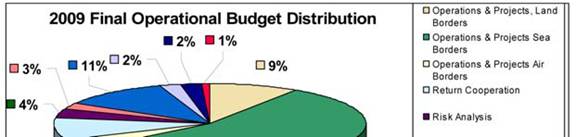
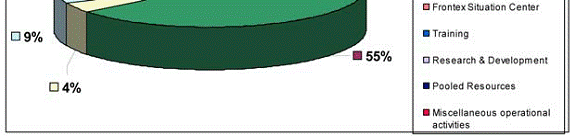
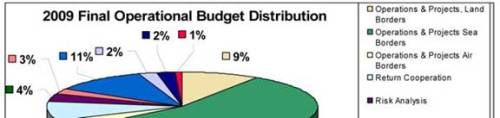
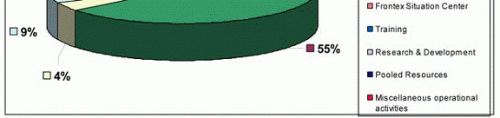
And as I noted in my earlier post, Frontex continued to devote the biggest single portion of its expenditures to maritime enforcement.  Almost 40% of Frontex’s total budget, over € 34 million, was spent on sea operations in 2009, constituting 55% of the operational budget.

This chart from the Report (p 23) shows the breakdown of expenditures within the 2009 Operational Budget (which was 71% of the total 2009 Frontex budget).
Click here for previous post.

Click here for the Frontex General Report 2009.
2 Comments

Filed under Aegean Sea, Algeria, Data / Stats, Eastern Atlantic, Frontex, Greece, Italy, Libya, Malta, Mauritania, Mediterranean, Reports, Senegal, Spain

EU-Libya Association Agreement Negotiations

A Reuters article from 11 May reports that the EU and Libya may sign a cooperation pact known as an Association Agreement before the end of the year and that the pact would address matters such as trade and the control illegal immigration.   An EU mission will likely be opened in Libya before the end of the year according to Reuters.

Commissioner Cecilia Malmström during an interview with the Times of Malta several weeks ago referred to her efforts to begin immigration discussions with Libya:

“Libya is not exactly the easiest government to cooperate with and you know that much better being neighbours. It’s a complicated but important country and we will try to move forward. I’ve already written a letter to the Libyan Foreign Minister suggesting that we should sit together and identify areas where we can cooperate more in the field of migration.”

And Frontex’s 2009 General Report states that one of Frontex’s “overriding priorit[ies]” for 2010 is the development of “structured operational co-operation with neighbouring Mediterranean countries.”  Presumably Frontex desires such an agreement with Libya.

Click here and here for articles.

2 Comments

Filed under European Union, Frontex, Libya, Mediterranean, News

LIBE Votes to Refer Frontex Sea Border Rules to JURI

At its meeting on 10 May, the LIBE committee voted to send a request to the JURI committee regarding the Council Decision pertaining to the procedures to be applied during Frontex surveillance and interdiction operations at sea.  The request asks the JURI committee to refer the Council Decision to the European Court of Justice on the procedural ground that the Council Decision should not have been dealt with as a comitology measure but instead should be grounded on a legal basis.

I have not yet been able to find a copy of the LIBE committee’s letter to JURI, but a video of the LIBE committee meeting can be found on the EP Multimedia Library here or here.  The vote and the brief discussion occurs at approximately 16:44 in the video.

Click here for an earlier post.

2 Comments

Filed under European Union, Frontex, Judicial, News