Category Archives: Eastern Atlantic

Les pirogues de fortune – CARIM Note

A CARIM Analytic and Synthetic Note by Serigne Mansour TALL and Aly TANDIAN was issued in July entitled “Regards sur la migration irrégulière des Sénégalais : vouloir faire fortune en Europe avec des pirogues de fortune.”

Résumé – Ce papier met en exergue le voyage des sénégalais qui utilisent des pirogues de fortune dans l’espoir d’atteindre l’Europe via les îles canaries. L’auteur analyse les motivations sous-tendant ces itinéraires « irréguliers » ou « illégaux » et met en lumière les stratégies ainsi que les ressources que ces migrants utilisent pour partir.

[Abstract (the paper is only in French) – The paper focuses on the Senegalese who embark on “fortune seeking pirogues”, hoping to reach Europe via the Canary Islands. The author analyses the motivations of these ‘irregular’ or illegal migratory itineraries and sheds light on the strategies and resources that they employ in order to leave.]

Click  here (FR) or here (FR) for Note.

Leave a comment

Filed under Analysis, Eastern Atlantic, Reports, Senegal, Spain

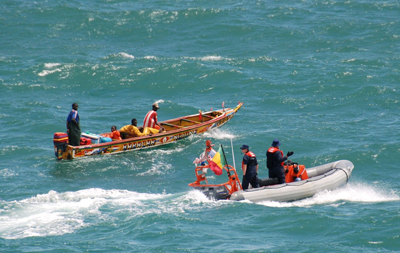
Joint US–Senegal Maritime Patrols

U.S Navy photo by Lt. Cmdr. James Stockman/Released

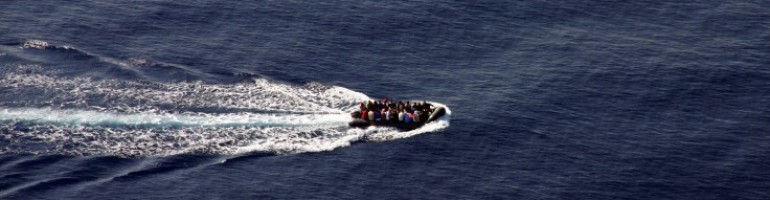
The United States Coast Guard recently completed a joint mission in cooperation with a Senegalese Law Enforcement Detachment (LEDET).   Such patrols have been conducted with several other African countries.   The US Coast Guard operations were conducted under the umbrella of the U.S. Military’s Africa Command and are a part of the ongoing African Maritime Law Enforcement Partnership (AMLEP).   While it is unclear whether this particular joint mission resulted in the interception of migrants, the US military article refers to numerous vessels stopped and searched for a variety of reasons, including narcotics interdiction.  The US vessel involved in this recent joint operation, USCGC Mohawk, frequently patrols the Haitian and Bahamian coasts as part of the US “Alien Migrant Interdiction Operations.”

Click here for US Military article.

Leave a comment

Filed under Eastern Atlantic, News, Senegal, United States

EUROSTAT Q1 2010 Asylum Statistics for EU27 Countries

EUROSTAT released updated data on 15 July for the First Quarter of 2010.  The report is entitled: Asylum applicants and first instance decisions on asylum applications in Q1 2010 (Doc. 32/2010).

Notable statistics include reductions of over 50% in the number of asylum applicants in three countries, Malta, Italy, and Greece, relative to the First Quarter of 2009.  Malta had the largest reduction of approximately 95%.

The reductions in Malta and Italy are almost certainly due to Italy’s push-back practice.  Though the first migrant arrivals in Malta in 2010 occurred this past weekend, 17 July, when 55 migrants on a sinking vessel were intercepted by Maltese and Libyan patrol boats.  The Times of Malta reported that the migrants were “shared out” between the Maltese and Libyan patrol boats.  28 migrants were brought to Malta and 27 were apparently taken to Libya.

Click here for the full EUROSTAT document.

Click here for Times of Malta article.

3 Comments

Filed under Aegean Sea, Data / Stats, Eastern Atlantic, European Union, Greece, Italy, Libya, Malta, Mediterranean, News

Frontex 2010 1st Quarter Report: Irregular Migration at Sea Borders Less Than 10% of Peak Levels

Frontex has released information from its 2010 First Quarter report by the Frontex Risk Analysis Network (FRAN).  A copy of the report itself has apparently not been released.  According to the summary provided, there have been significant reductions in irregular migration:

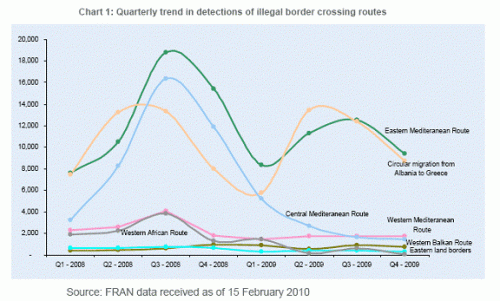
  • “[D]etections of irregular immigrants at [all EU] sea borders … were less than one-tenth of the peak level (for the third quarter of 2008) when roughly 33,600 detections were reported.”
  • “[D]etections at the Spanish and Italian sea borders became negligible…”
  • “[D]etections at the dominant Eastern Aegean Sea border between Greece and Turkey also fell by more than 60% to just under 2,300.”
  • “Detections at the Greek-Turkish land border were for the first time greater than those at the countries’ sea border.”
  • There were “only 150 detections of illegal border-crossing [in the Central Mediterranean], compared to 5,200 detections in the first quarter of 2009…”
  • There were “only 500 irregular immigrants detected [in the Western Mediterranean] (almost 72% down on the fourth quarter of 2009 …).”
  • There were “only five detections over the first three months of 2010 [on the West African/Canary Island route], in contrast to 31,700 detections in 2006…”

Click here for full statement.

Leave a comment

Filed under Aegean Sea, Algeria, Analysis, Data / Stats, Eastern Atlantic, European Union, Frontex, Greece, Italy, Libya, Malta, Mauritania, Mediterranean, Morocco, News, Reports, Senegal, Spain, Turkey

Frontex 2010 Annual Risk Analysis

Frontex’s Annual Risk Analysis (ARA) for 2010 was prepared in March 2010 and was posted to the Frontex web site on 7 July.  The public document only contains certain portions of the full ARA as recommendations and other “operationally sensitive details” have been redacted. While some of the ARA’s contents have previously been released by Frontex, this 35 page document contains a lot of data regarding irregular migration by land, sea, and air, and is worth a read.

Excerpts from the ARA relating to maritime migration include:

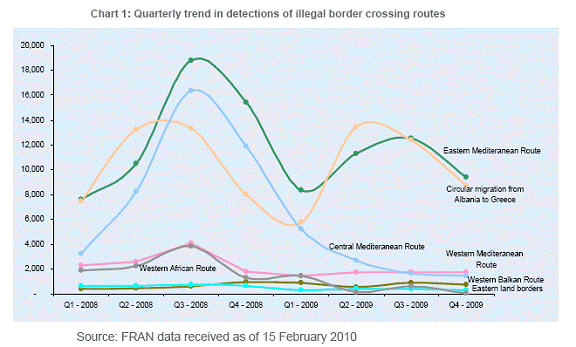
“Detections of illegal border crossing – In 2009, the [EU] Member States and Schengen Associated Countries reported a total of 106,200 detections of illegal border crossings at the sea and land borders of the EU. This represented a 33% decrease compared to 2008. The decrease is comprised of both a strong decrease reported from the sea borders (-23%), and land borders (-43%).”

“The bilateral collaboration agreements with third countries of departure on the Central Mediterranean route (Italy with Libya) and the Western African route (which Spain signed with Senegal and Mauritania) had an impact on reducing departures of illegal migrants from Africa.”

“The agreements were made at a time when the economic crisis decreased the labour demand in the EU, thus simultaneously reducing the pull factor. The synchronisation of these events probably explains why no displacement has so far been noticed from the Central Mediterranean and Western African routes to other illegal migration routes in the statistics for detections.”

“However, intelligence suggests that the risk of displacement remains high, either with the emergence of new routes or the exploitation of existing ones by nationalities which used to be detected along the Central Mediterranean or the Western African routes.”

“As a corollary to the sharp decreases registered in Italy and Spain, the number of detections of illegal border crossing in Greece rose from 50% of the total EU detections to 75% of the total. In 2009, the Greek land border sections with Albania and FYROM represented the largest share of the EU total, with 36,600 detections (34% of the EU total), followed by 22,000 detections in the Aegean Sea with (21% of the EU total).”

“Eastern Mediterranean route – The Eastern Mediterranean route is the route taken by illegal migrants transiting through Turkey and entering the EU through eastern Greece, southern Bulgaria or Cyprus. Turkey, due to its geographical position near the EU, is the main nexus point on this route. From Istanbul, illegal migrants may reach the Greek islands in the Aegean Sea, or cross the land borders to Greece or to Bulgaria.”

“In 2009, illegal border crossing on the Eastern Mediterranean route totalled 41,500, or 39% of all EU detections. Most of the detections were reported from the Aegean Sea, followed by detections along the land border between Turkey and Greece. The number of detections reported by Bulgaria and Cyprus were considerably lower.”

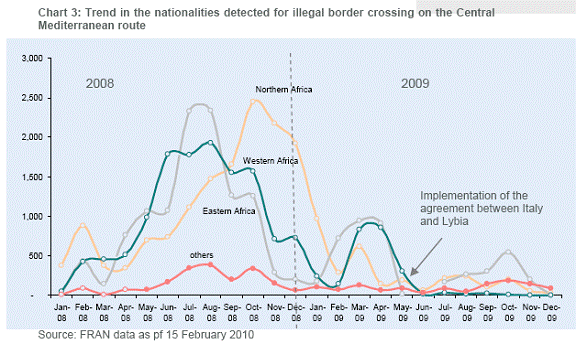
“Central Mediterranean route – The Central Mediterranean route refers to illegal migration from northern Africa to Italy and to Malta. For the past two years, Libya has been a nexus point where migrants from the Horn of Africa and Western African routes and a small proportion of Asian nationals met before embarking.”

“Since the signing of a bilateral agreement with Libya, joint patrols by Libya and Italy have had a clear and measurable deterrent effect, with 3,200 detections in the seven months after the joint patrols (June to December), compared to 7,200 detections in the five months before the joint patrols (January to May), and almost 40,000 detections in the whole of 2008.”

“Western African route – The Western African route is primarily through Western African countries to Spain via the Canary Islands. The main embarkation points are in Senegal and Mauritania and the main countries of origin are Mali, Mauritania, Guinea Conakry and Senegal. Other African nationals have also been reported, and occasionally migrants from Asia. This route is now less favoured since the Spanish collaboration agreements with Senegal and Mauritania. The Frontex coordinated Joint Operation Hera plays a major role in maintaining effective surveillance in the area.”

“The Western Mediterranean route includes the sea route from Northern Africa to the Iberian Peninsula, and the land route through Ceuta and Melilla. It is mostly used by Northern African nationals (Algerian and Moroccan) travelling to Spain, France and Italy.”

“Maritime detections between Northern Africa and Spain are rising, with increasing detections of Algerian and to a lesser extent Sub Saharan nationals. Moroccan nationals are also regularly detected on this route. The lack of employment opportunities for the growing population of young people in Morocco continues to increase the incentives of migrating to the EU. The Spanish authorities recently reported an increasing number of attempts by Moroccan minors to get on the ferry link between Tanger and Spain. These cases do not seem connected with criminal networks; rather individual attempts are driven by poor employment prospects in Morocco.”

Click here for the ARA.

Click here for link to Frontex Map showing situation at External Borders.
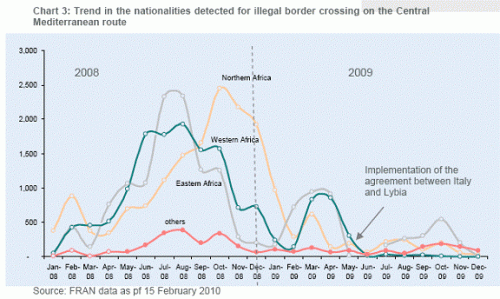
[ARA page 18]

[ARA page 13]

1 Comment

Filed under Aegean Sea, Data / Stats, Eastern Atlantic, European Union, Frontex, Greece, Italy, Libya, Malta, Mauritania, Mediterranean, Morocco, Reports, Senegal, Spain, Turkey

UNODC Publication: Smuggling of Migrants into, through and from North Africa

UNODC has issued a new publication entitled “Smuggling of Migrants into, through and from North Africa: A thematic review and annotated bibliography of recent publications.”  Most of the reviewed literature and data are from 2008 and earlier dates and therefore the publication does not include references to more recent events, e.g. the Italy-Libya migration agreement.  But it is a comprehensive and useful publication.  The 16 page Annotated Bibliography is a very good resource.

According to the UNODC web site, the publication “focuses primarily on the patterns and dynamics of migrant smuggling, as it concerns the North African region. Recognizing, however, that irregular migration and smuggling flows are transnational in nature, the review goes beyond North Africa, to also cover sub- Saharan African and European countries affected along the various smuggling routes.  The aim of the review is twofold: to describe major findings on smuggling of migrants; into, through and from North Africa, and to highlight the need for further research on specific issues that have not yet been studied.”

Table of Contents:

  • I. Introduction
  • II. Quantifying irregular migration and smuggling of migrants
  • III. Migrant smuggling routes
  • IV. Profiles and characteristics of smuggled migrants
  • V. Smuggler-migrant relationships
  • VI. Organizational structures of migrant-smuggling networks
  • VII. Modus operandi of migrant smuggling
  • VIII. Smuggling fees
  • IX. The human and social costs of smuggling
  • X. Summary of findings
  • XI. Annotated bibliography

Click here for the publication.

Leave a comment

Filed under Aegean Sea, Algeria, Analysis, Data / Stats, Eastern Atlantic, Egypt, France, Greece, Italy, Libya, Malta, Mauritania, Mediterranean, Morocco, Reports, Senegal, Spain, Tunisia, Turkey, UNODC

CEAR Releases 2010 Annual Report: La situación de las personas refugiadas en España

CEAR (Comisión Española de Ayuda al Refugiado) has released its 2010 annual report: “La situación de las personas refugiadas en España – INFORME 2010.”  The report is 350+ pages long.  I will try to review it and do an additional post on some portions of the Report in the coming days.

From CEAR’s web page: “Presentamos el octavo Informe Anual en un momento de grave preocupación por la garantía efectiva del derecho de asilo en España y en el mundo. En el año 2009 poco más de 3.000 personas solicitaron asilo en nuestro país, la cifra más baja desde que se contabilizan estos datos. Por el contrario, las demandas de protección internacional han aumentado en el ámbito de la Unión Europea y otros países industrializados. La pregunta clave es: ¿por qué no llegan refugiados a España? Pregunta que cobra aún más importancia si tenemos en cuenta que la situación en los países de origen de los solicitantes de asilo no ha mejorado, tal y como se analiza a lo largo de este Informe, como la situación de la R.D. Congo, América latina o Sri Lanka. La respuesta a este descenso de las solicitudes de asilo se desvela a lo largo del documento.

La publicación de este Informe Anual coincide con los primeros pasos para la puesta en práctica de la nueva Ley de Asilo, aprobada en octubre de 2009. CEAR volcó todos sus esfuerzos para hacer llegar a los grupos parlamentarios y a la sociedad sus propuestas para fortalecer el derecho de asilo como institución en España.

Uno de los mayores recortes de la nueva ley es la supresión de la vía diplomática para el acceso al asilo, por eso desde estas páginas CEAR realiza un recorrido por las últimas solicitudes por esta vía. También hace especial hincapié en el análisis de las demandas en frontera y de los Centros de Internamiento para Extranjeros (CIE). Por otro lado, la edición del octavo Informe coincide con la Presidencia española de la Unión Europea, por lo que se analizan las líneas políticas de actuación que ya se establecieron en el Pacto Europeo sobre Inmigración y Asilo de 2008. Este Informe presenta un completo recorrido desde la solicitud de asilo hasta la resolución de los casos, acompañado de un completo apéndice estadístico, sin prescindir de todo lo referente a la acogida, integración social e inserción sociolaboral de las personas refugiadas en España.”

Click here for the report (ES).

Leave a comment

Filed under Eastern Atlantic, European Union, Mediterranean, Reports, Spain

Spain and Senegal Renew Agreement Permitting Frontex to Operate From Dakar

Spain and Senegal have renewed a bi-lateral agreement permitting Frontex to operate from a base in Dakar for another year.

The Frontex mission in Senegal currently consists of two Spanish Guardia Civil patrol boats, a Spanish National Police helicopter, and a private airplane leased by the Spanish Defence Ministry.  One Frontex patrol boat also operates from Nuadibú, Mauritania.

Spanish Interior Minister Alfredo Pérez Rubalcaba said that France and Italy will soon be deploying additional assets and personnel to the Frontex mission in Senegal consisting of a ship and plane from Italy and a French security force team.  Rubalcaba stated that this new assistance demonstrates that “Spain is not alone” in the fight against the mafias responsible for the illegal boat arrivals to the coast this country. (“España no está sola” en la lucha contra las mafias responsables de las llegadas de embarcaciones irregulares a las costas de este país.)

Senegalese Interior Minister Ousmane Ngom, said that so far this year a total of 101 canoes from the coast of Senegal with 450 people aboard have been identified by the patrols. In 2006, the figures were 901 boats, with 35,490 irregular migrants.

Click here for article.  (ES)

1 Comment

Filed under Data / Stats, Eastern Atlantic, France, Frontex, Italy, Mauritania, News, Senegal, Spain

European–US–African Joint Military Exercises

16 years after withdrawing its military forces from Equatorial Guinea, Spanish armed forces members are now present in Mali, Mauritania, Senegal and Nigeria.  Spanish forces recently completed a three week multinational military exercise known as Flintlock 10 along with forces from other EU countries (France, Germany, the UK, and the Netherlands), the US, and 7 African countries.  Flintlock 10 was conducted in coordination with the US military’s Africa Command, Africom. (If you are not familiar with the US Military’s Africa Command, a quick look at its “2009 Posture Statement” will give you a feel for its very very extensive activities within Africa.)

Spain’s decision to resume a military presence in Africa was identified in its Africa Plan (“el Plan África”), adopted in 2006, which was intended to provide “‘a comprehensive approach to relations with neighbouring continent,’ sa[id] one expert, ‘but [also to] respond[ ] to the urgent need to curb the wave at the source of illegal immigration.’”  (Click here for the 2009Plan África.)

A joint maritime military exercise known as Exercise Phoenix Express 2010 began last week.  This exercise includes training of the Moroccan and Senegalese military by US and Spanish military personnel.  According to an Africom press release, Moroccan and Senegalese Maritime Interdiction Operations Teams are being trained on tactics, techniques, and procedures associated with Maritime Interdiction Operations.  Last month Spanish and US naval forces were involved in similar training exercises off the coast of Senegal under Africom’s Africa Partnership Station.

The current exercise, according to Africom, includes a focus on maritime interdiction operations.  Participating forces “will track and board suspect vessels carrying suspicious cargo, and Maritime Patrol Aircraft and Automated Identification Systems, along with MIOs like SARs and Visit, Board, Search and Seizures will be performed.”

Click here for El Pais article about Spain’s military’s return to Africa.

Click here and  here for Africom press releases.

Click here for US Naval Forces Africa press release.

1 Comment

Filed under Eastern Atlantic, Mauritania, Mediterranean, News, Senegal, Spain, United States

CSDP and Maritime Surveillance

The May edition of the ISIS European Security Review contains an article reviewing the Spanish EU Presidency and the Common Security and Defence Policy (CSDP, formerly ESDP).  The article notes that a main priority of the Spanish Presidency has been an “Integrated Maritime Surveillance.” “[T]he Spanish Government has clearly followed the Swedish Presidency in many areas, especially in the creation of an Integrated Maritime Surveillance, probably the most notable accomplishment of this EU Presidency on defence policy. *** The attention paid by Spain to naval protection is not something new: Spanish interest in increasing patrolling across Europe’s coastlines has been proven during the last decade, especially through its support to FRONTEX assistance in the Mediterranean Sea and the Canary Islands. Beyond that, the project of a common management of external borders has resulted in a need for protection of European interests away from the official maritime borders, moving also to trade routes where the EU economic interest is at stake.”

Click here for the ISIS May 2010 Newsletter.

Leave a comment

Filed under Eastern Atlantic, European Union, Frontex, Mediterranean, News, Spain

UPR of Spain Largely Ignores Interdiction and Readmission Practices

Spain was one of 15 countries whose records were reviewed during the 8th session of the Human Rights Council’s Universal Periodic Review (UPR) Working Group from 3-15 May 2010.  While reference is made to the treatment of asylum seekers and migrants who reach Spanish territory, little attention was directed (at least not in the national report or the Working Group’s Draft report) to the treatment of migrants intercepted at sea before reaching Spanish territory in the Canary Islands or elsewhere.  Likewise little attention was paid to the provisions and implementation of Spain’s several bilateral readmission agreements with various countries such as Senegal.

According to the Draft report, Spain agreed with a general recommendation to “[t]ake all measures necessary to ensure that actions related to unaccompanied minors (migrants, asylum seekers, refugees, victims of trafficking) are in line with international standards.” [Section II, Para. 84(54).]  But Spain did not agree to several more specific recommendations, instead agreeing only to “examine” and “provides responses” to the recommendations no later than September 2010 when the Human Rights Council meets for its 15th session.

Three of the more detailed recommendations were:

  • “Respect fully the principle of non-refoulement and ensure effective access to asylum procedures, taking into account the objectives of UNHCR’s 10-Point Plan on Mixed Migration” (New Zealand);
  • “Undertake a review of its readmission agreements with respect to refugees and asylum-seekers, and amend them as necessary to ensure that they contain human rights guarantees in line with international standards” (Canada); and
  • “Consider access to asylum procedures for victims of trafficking (Costa Rica).

[Section II, Para. 86(28-30).]

Click here for link to UPR site for Spain.

Click here for the Draft report of the Working Group.

Click here for Spain’s national report submitted to the Working Group.

Leave a comment

Filed under Eastern Atlantic, Mediterranean, News, OHCHR, Reports, Spain, UNHCR

Canary Island Trial of 3 Accused in Deaths of 25 Drowned Migrant Children

The trial of 3 Moroccan men (YF, MSB and BJ) accused of murder of 25 young African migrants began on 18 May in Gran Canaria before the Sixth Section of Audiencia Provincial de Las Palmas.  The migrants who died were all between the ages of 8 and 16.  The young migrants drowned when their boat sank 20 meters from the shore in Lanzarote, Canary Islands on 15 February 2009.  The boat had departed from Guelmin, Morocco on 13 February.  The migrants reportedly paid between 500 and 1000 euros to be transported to the Canary Islands.  The prosecution has asserted that the boat was designed for use as a small fishing boat close to shore and was not designed for travel on the open sea.  Six persons on the boat survived, several of them were rescued by a local surfer.

Click here, here, here, and here for articles (all ES).

Click here for video – Antena 3 Canarias televisión de difusión de noticias 17 May with video of rescue operation.

Leave a comment

Filed under Eastern Atlantic, Morocco, News, Spain

Details from Frontex General Report 2009 (Post 2 of 2)

Last week I posted a summary of the first part of Frontex’s 2009 General Report.  This second post summarizes the portion of the Report pertaining to Frontex’s sea operations.

The General Report 2009 provides selective information regarding the six major Joint Operations conducted at the sea borders.  With only one exception, no information or data is provided regarding the specific numbers of intercepted migrants or vessels.

Instead of numbers, the Report provides various descriptive terms which could mean almost anything.  For example, Operation Hera led to a “drastic decrease of migrants,” during Operation Nautilus there was a “remarkable decrease” in migrants, and during Operation Hermes, the numbers of migrants arriving and dying at sea “decreased dramatically.” The one exception is for Operation Indalo where the Report states that 750 irregular migrants and 10 facilitators were detected.

When desired, the Report provides details and numbers.  For example, Operation Poseidon utilized 4 open sea vessels, 6 coastal patrol vessels, 13 coastal patrol boats, six airplanes, 4 helicopters, and 152 experts who delivered 2680 man days of operational activities, but no data regarding the total number of irregular migrants intercepted at sea is provided.

Here is a summary of the information provided in the Report for each of the six major Joint Operations:

Poseidon 2009, Eastern Mediterranean (365 Days)

Poseidon was conducted along land borders as well as at sea.  Interpreters were deployed on board ships to facilitate the identification process of intercepted migrants.  Less than 10% of the interviewed migrants claimed their original nationality.  There was an overall reduction in migrant flow of 16% (land and sea) compared to 2008.  “The main operational objectives of the joint operation were achieved but there is a clear need for closer cooperation between local authorities.”

Hera 2009, Atlantic Ocean waters between North Western African countries and Canary Islands (365 Days)

Due to the permanent implementation of Joint Operation Hera and better cooperation from “involved African countries”, there was a notable reduction in migrants reaching the Canary Islands, 2280 in 2009 compared with 9200 in 2008.  Aerial and maritime surveillance conducted close to the territory of Senegal and Mauritania and local cooperation from police led to the decrease in migrants.  “Despite these clear successes, participation of more member States would greatly increase effectiveness and outcomes.”  [NF- While the Report does provide migrant arrival data for the Canary Islands, it is silent on the number of migrants intercepted at sea or within Senegal or Mauritania.]

Nautilus 2009, Central Mediterranean (172 Days)

There was a remarkable decrease in migrant arrivals in Malta.  A “significant obstacle to the effectiveness of the Joint Operation lay in the contrasting interpretations of the International Law of the Sea by Member States….”  The effectiveness of the operation compared with 2008 was not improved.

Hermes 2009, Central Mediterranean (184 Days)

“Due to the bilateral agreement between Italy and Libya, the number of people arriving from Libya, as well as the number of migrants died at sea, decreased dramatically….”  “In addition, the first examples of co-operation with Algeria should also be considered as promising.”  As with Nautilus, “differing interpretations of the International Law of the Sea led to a limited contribution by the Member States to the joint operation by maritime surface means.”  The effectiveness of the operation compared with 2008 can be considered as increased.

Minerva 2009, Western Mediterranean (39 Days)

The launch of the operation was delayed in 2009.  Its effectiveness compared with 2008 has remained the same.

Indalo 2009, Western Mediterranean (50 Days)

The lack of cooperation from Algeria is an obstacle for operational activities.  10 Facilitators and 750 irregular migrants were identified.

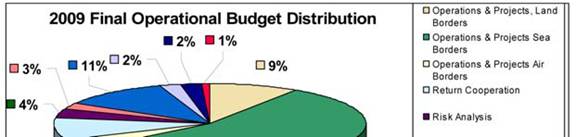
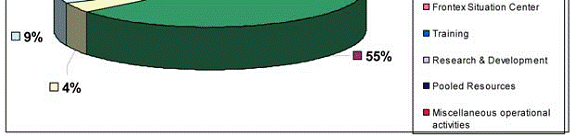
And as I noted in my earlier post, Frontex continued to devote the biggest single portion of its expenditures to maritime enforcement.  Almost 40% of Frontex’s total budget, over € 34 million, was spent on sea operations in 2009, constituting 55% of the operational budget.

This chart from the Report (p 23) shows the breakdown of expenditures within the 2009 Operational Budget (which was 71% of the total 2009 Frontex budget).

Click here for previous post.

Click here for the Frontex General Report 2009.

2 Comments

Filed under Aegean Sea, Algeria, Data / Stats, Eastern Atlantic, Frontex, Greece, Italy, Libya, Malta, Mauritania, Mediterranean, Reports, Senegal, Spain

Details from Frontex General Report 2009 (Post 1 of 2)

There is nothing really unexpected in the Frontex General Report for 2009.  If anything, it disappoints with its limited information.

The number of illegal border crossings at EU borders was smaller by a third in 2009 compared to 2008 and Frontex’s budget increased by 25% to € 88.3 million.

Frontex continued to devote the biggest single portion of its expenditures to maritime enforcement.  Almost 40% of Frontex’s total budget, over € 34 million, was spent on sea operations in 2009.  This constitutes 55% of the operational budget.  The Report notes that this cost is due to the high operating costs of ships and surveillance aircraft.

Expenditures for Frontex facilitated return operations sharply increased by 500% in 2009 to almost € 5.5 million.

Limited Information in the Report – The Report explains that Frontex made a decision in 2008 to decrease the level of detail provided in the General Report.  Frontex’s justification is that the Report “is mainly directed towards the general public” and the reduced level of detail “is more suited to this audience.”  This practice was unfortunately continued in the 2009 Report.

General Statistics – Overall there were 106,200 “detections of illegal border-crossings” at EU external land and sea borders in 2009.  This represents a 33% decrease in overall detected crossings relative to 2008, with a 23% reduction of detections at sea and a 43% reduction at land borders.

The reductions are attributed by Frontex to the economic crisis and to bilateral “collaboration agreements with third countries of departure” such as Libya, Senegal, and Mauritania.

Applications for international protection within the EU were 2% fewer in number than in 2008 and were approximately 50% of the 2001-2002 peak when 420,000 applications for international protection were filed.

Cooperation with Non-EU / Non-Schengen Countries – The Report states that cooperation with third countries, including neighbouring countries and countries of origin, is the critical element in “integrated border management.”   It describes Operation HERA as Frontex’s most successful joint operation due to close cooperation with West African countries, particularly Senegal and Mauritania.  On other fronts, “considerable progress” was made with Turkey consisting of Turkey’s appointment of a “first point of contact for Frontex related coordination issues” and preparation of a draft text of a possible Working Arrangement agreement.  “Ad hoc operational co-operation” was pursued when a targeted country was not willing or able to enter into a formal Working Arrangement with Frontex.  An “overriding priority” for Frontex in 2010 is the development of “structured operational co-operation with neighbouring Mediterranean countries.”  The Report acknowledges the existence of the bilateral migration agreement between Italy and Libya, but says nothing about its provisions other than to say that there were “contrasting interpretations of the International Law of the Sea” between Member States.  There is no criticism in the Report whatsoever of the Italian push-back practice.  It is obviously difficult for Frontex to criticise Italy, but was it not possible to note that most people and organizations who have considered the push-back practice have concluded that the practice violates international law?

New Partner Organisations – Frontex formalised a co-operation plan with Europol in October, a Working Arrangement with Interpol in May, a co-operation plan with IOM in February, and made a tripartite agreement with the European Maritime Safety Agency (EMSA) and the Community Fisheries Control Agency (CFCA) relating to maritime surveillance.

More to follow: I will post a second summary with additional information from the General Report pertaining to the specific sea operations for which information is provided within the next day or two.

Click here for the Report.

2 Comments

Filed under Aegean Sea, Data / Stats, Eastern Atlantic, European Union, Frontex, Greece, Italy, Libya, Malta, Mauritania, Mediterranean, Reports, Senegal, Spain, Turkey

Icelandic Coast Guard-Frontex Ship Delivers Charity Supplies to Senegal

The Icelandic Coast Guard ship Ægir will be participating in Frontex patrols off the Senegalese coast from May to October.  Iceland will also provide at least one surveillance plane, a TF-SIF, to the Frontex mission. While not an EU member (at least not yet), Iceland is a Schengen country.  The Coast Guard will reportedly use funds paid by Frontex for the mission to also partially fund helicopter rescue services in Iceland.

Before starting its Frontex patrols, the ship delivered charitable donations from Iceland for ABC Children’s Aid, an Icelandic charity with programmes in Dakar.

Click here, here, and here for articles.

Leave a comment

Filed under Eastern Atlantic, Frontex, Iceland, News, Senegal