Category Archives: Greece

Análisis del Real Instituto Elcano: La crisis en el Norte de África y su impacto en la inmigración irregular a la Unión Europea (by Frontex Dep. ED Gil Arias)

Real Instituto Elcano has published an analysis regarding the situation in North Africa and its impact on irregular immigration to the EU.  The analysis was written by Frontex’s Deputy Executive Director Gil Arias.

Of particular interest is the analysis regarding what Frontex believes might occur in regard to migrant flows from Libya under two different scenarios: Gadafi remaining in power or ultimately being removed from power (see Google translation of excerpt below):

“… En el caso de que el régimen de Gadafi recupere el control, la UE y sus Estados Miembros no podrán reanudar la cooperación con un régimen totalmente desacreditado. Se producirá el cese en la aplicación de acuerdos de cooperación policial que en el pasado (desde mayo de 2009) sirvieron para detener los flujos de inmigración irregular desde Libia hacia Italia y Malta. La posibilidad de que ciudadanos de otros países africanos bloqueados en Libia sean obligados o “ayudados” a emigrar a la UE no debe descartarse. De hecho, Gadafi ha amenazado con “abrir la puerta” de la inmigración ilegal hacia Europa.

La OIM estima la cifra de extranjeros presentes en Libia entre 0,5 y 1,5 millones. No obstante, no todos serian candidatos a la inmigración ilegal. Se trata fundamentalmente de trabajadores empleados por empresas extranjeras asentadas en el país, por lo que su intención primaria no sería la emigración a la UE y por otra parte una buena parte de ellos ya han abandonado Libia.

En el peor de los casos, la consecuencia de ese “abrir la puerta” sería la reactivación de los flujos por vía marítima hacia Lampedusa y Malta (eventualmente también Creta, que se encuentra a 200 km de distancia de la costa libia) en un escenario similar al de 2008 (40.000 inmigrantes llegaron a Italia y Malta, con origen en las costas libias) agravado por el efecto adicional de la inestabilidad en el país. Su destino principal serían los países con presencia importante de ciudadanos norteafricanos (Italia, Francia, España, Bélgica y el Reino Unido). El destino de los nacionales de países subsaharianos se encontraría más repartido por toda la UE.

Si Gadafi es derrocado resultará clave la capacidad y rapidez de la oposición para reorganizarse. La oposición se encuentra, por el momento, bastante desorganizada y es probable que se produzcan luchas internas por el poder, especialmente por el control de los campos petrolíferos. Ello podría conducir a un estado persistente de disturbios y a una ausencia de control por un largo periodo de tiempo.

La eventual reactivación de las rutas migratorias hacia la UE dependerá de la capacidad del nuevo régimen para imponer la ley y el orden en el país así como el control efectivo sobre los 2.000 km de costas y 4.000 km de fronteras terrestres libias. En el peor de los escenarios podría darse una situación similar a la de Somalia.

En este escenario, la economía libia puede deteriorarse y elevarse los niveles de desempleo. Actualmente se desconoce la tasa de desempleo en Libia, pero se presume baja. Previsiblemente, la mayoría de los trabajadores desempleados intentará regresar a sus países, pero parte de ellos (sobre todo los nacionales de países inseguros) buscaran otras oportunidades, entre ellas la emigración clandestina a la UE.

La ausencia de ley y orden, especialmente la ausencia de control sobre las fronteras marítimas, llevará rápidamente a las mafias al tráfico de inmigrantes hacia la UE. Los candidatos serían primariamente trabajadores desempleados no deseosos de volver a sus países (mayormente de África Occidental y Oriental, pero eventualmente también libios, egipcios, argelinos y tunecinos). Esta situación impediría, por otra parte, el retorno de quienes fuesen detectados cruzando ilegalmente las fronteras exteriores de la UE.

En tales circunstancias se puede prever un flujo constante de inmigración ilegal durante meses, mayoritariamente por vía marítima, pero también por vía aérea a través de Turquía. La duración en el tiempo de este escenario dependerá de la rapidez con la que la UE o los Estados Miembros y las nuevas autoridades sean capaces de restablecer la cooperación. En este sentido, serán determinantes los acuerdos de readmisión efectivos.

Por último, ha de tenerse también en cuenta el riesgo marginal de que los vencedores realicen acciones de persecución sobre los partidarios de Gadafi, lo que provocaría la huida de éstos del país en busca de refugio….”

Google translation of the above excerpts (NB – this is only a rough translation):

“…In the case of Qaddafi’s regime  regaining control, the EU and its Member States shall not resume cooperation with a discredited regime. Termination will occur in the implementation of agreements on police cooperation in the past (May 2009) served to stop the flow of illegal immigration from Libya to Italy and Malta. The possibility for citizens from other African countries locked in Libya are forced or “helped” to migrate to the EU can not be ruled out. In fact, Gaddafi has threatened to “open the door” of illegal immigration into Europe.

The IOM estimates the number of foreigners in Libya between 0.5 and 1.5 million. However, not all candidates would be illegal immigration. These are mainly employed by foreign companies settled in the country, so that their primary intention would not be the migration to the EU and, moreover, a good portion of them have already left Libya.

In the worst case, the consequence of this “open door” would be the reactivation of the flows by sea to Lampedusa and Malta (and possibly Crete, which is 200 km away from the Libyan coast) in a scenario similar to that of 2008 (40.000 immigrants arrived in Italy and Malta, departing from the Libyan coast) aggravated by the additional effect of instability in the country. Its main destination countries would be a significant presence of North African citizens (Italy, France, Spain, Belgium and the UK). The fate of the national sub-Saharan countries would be more distributed throughout the EU.

If Gadhafi is overthrown will be key capacity and speed of the opposition to regroup. The opposition is, at present, quite disorganized and is likely to produce internal power struggles, especially for control of the oilfields. This could lead to a persistent state of unrest and a lack of control over a long period of time.

The eventual recovery of migratory routes towards the EU depends on the ability of the new regime to impose law and order in the country as well as effective control over the 2,000 km of coastline and 4,000 km of land borders Libya. In the worst case scenario could be a situation similar to Somalia.

In this scenario, the Libyan economy may deteriorate and unemployment levels rise. Currently unknown unemployment rate in Libya, but presumably low. Predictably, most unemployed workers try to return to their countries, but some of them (especially insecure country nationals) to seek other opportunities, including illegal migration to the EU.

The absence of law and order, especially the lack of control over maritime borders, whisk the trafficking mafias immigrants into the EU. Candidates would be primarily unemployed workers eager to return to their countries (mostly from West and East Africa, but also possibly Libyans, Egyptians, Algerians and Tunisians). This would prevent, on the other hand, the return of those who were detected illegally crossing the external borders of the EU.

In such circumstances, can provide a steady flow of illegal immigration for months, mostly by sea, but also by air through Turkey. The long life of this scenario depends on the speed with which the EU or the Member States and the new authorities are able to restore cooperation. In this regard, will determine the effective readmission agreements.

Finally, it must also take into account the marginal risk that the winners perform acts of persecution on Gaddafi’s supporters, causing them to flee the country in search of refuge….”

Click here for the Analysis. (ES)

Leave a comment

Filed under Algeria, Analysis, Egypt, European Union, France, Frontex, Greece, Italy, Libya, Malta, Mediterranean, Morocco, Spain, Tunisia, Turkey

Draft Commission Communication on Migration

[UPDATE 4 May 2011 – the FINAL Communication on Migration was released today.  Click here for Communication and click here for my updated post.]

The European Commission will consider and likely adopt a Communication on migration on Wednesday, 4 May.  Below are excerpts from a draft document which appears to have been under consideration as of 15 April.  The draft Communication  [DRAFT 15-04-2011] includes proposals for burden sharing under certain circumstances and “a mechanism [for the introduction of] a coordinated and temporary reintroduction of [internal EU border] controls. 

Excerpts from the draft:

“Table of Contents

1……….. Introduction

2……….. Crossing the borders

2.1…….. Coping with the crisis: the short-term measures

2.2…….. Border controls

2.3…….. Schengen governance

2.4…….. Preventing irregular immigration

3……….. Moving and living in an area without internal borders

3.1…….. Organised mobility

3.2…….. A consistent policy on mobility including visas

3.3…….. A properly managed legal migration

3.4…….. Building an inclusive society by integrating immigrants

4……….. Providing international protection to persons in need

5……….. Migration in External relations beyond the crisis

5.1…….. The Global approach to migration

5.2…….. Beyond the crisis: the EU and the Southern Mediterranean in partnership

1.  Introduction

[***]

Some Member States, such as Italy, Malta, Greece and Cyprus are more directly exposed to massive arrivals of irregular migrants and, to a limited extent, of persons in need of international protection. This is not a national problem alone, but needs also to be addressed at the EU level and requires true solidarity amongst Member States.

The EU must ensure quick assistance to all persons in need – as it has done notably at the Tunisian-Libyan border – and provide shelter to those in need of international protection. Whilst the EU must maintain and consolidate its tradition of granting asylum and protection it should also foresee the appropriate tools in order to prevent large number of economic migrants crossing the borders irregularly. To reach these objectives, managing effectively the EU borders is a condition of credibility inside and outside the Union.

The continuously evolving situation in our Southern Neighbourhood requires rapid responses. Building upon the European Council Conclusions of 11 and 25 March, and the joint Communication of the Commission and the High Representative of 8 March, the Commission will present on 24 May a package of proposals to address the EU approach in the area of migration, mobility and security with the Southern Mediterranean countries.

However, the absolute need to address this challenging and evolving situation should not lead to a short-term approach limited to border control without taking account of long-term issues. Dialogue and cooperation with countries of origin and of transit of these migrants is essential. Such collaboration needs to be built on security and good governance for the establishment of mutually beneficial policies in the field of legal migration. It also implies enhanced economic cooperation in order to develop the conditions for growth and employment in the countries of origin, to address the causes of irregular migration and to promote a pact for development and well managed legal migration in its various forms.

[***]

2.1   Coping with the crisis: the short-term measures

[***]

Those Member States that are most exposed to the growing flows of refugees and irregular migrants have been helped with the financial consequences of the displacement. To this end, around 25 MEUR which were identified under the External Borders Fund and European Refugee Fund.

While the current crisis confirms the need for increased solidarity at the European level and better sharing of responsibility, it must be recognised that the EU is not fully equipped to help those Member States most exposed to massive migratory movements.

The financial resources available under the General programme “Solidarity and Management of Migration Flows” are inadequate to respond to all requests for assistance. First, these funds can not be mobilised easily; they are designed to intervene in a stable situation and not to tackle emergencies and crisis. Secondly, the magnitude of the problems largely exceeds the existing facilities.

In the context of the next Multi-Annual Financial Framework, the European Parliament, the Council and the Commission, will have to draw lessons from the current crisis. For the EU to react quickly and effectively in the case of unforeseen events or emergencies, Home Affairs funding should be adapted so that it can be mobilised much more rapidly and flexibly, including in third countries.

In principle, other forms of solidarity exist to respond to the dramatic events taking place in the region. Building on the experience gained so far with the current pilot project on relocation from Malta, the Commission will support an extension of this project in view of the current influx of migrants seeking international protection there, to be implemented in close cooperation with the United Nations High Commissioner for Refugees and the International Organisation for Migration. However, the currently available instruments fall short of fulfilling all the needs and providing a comprehensive response. They can only be resorted to in an ad hoc manner, and are entirely dependent on the will of Member States to voluntarily offer assistance – in whatever form – at a given point in time. This in turn exposes the EU to criticism and risks undermining the trust of the citizens in the EU.

The Commission will closely monitor the continuously evolving situation and may decide, if the relevant conditions are met, to trigger the Temporary Protection Directive to provide immediate and temporary protection to displaced persons from third countries that are unable to return to their country of origin.

The Commission will make further proposals during 2011 on delivering solidarity in a holistic manner and how concretely such assistance can be delivered. A number of different approaches are currently being studied, with a view to developing alternatives that will allow urgent needs to be responded to in a more rapid and structured fashion. This initiative will build on the appropriate legal basis of the Lisbon Treaty, such as Articles 80 and 78 paragraph 3, and will draw lessons from the situation in Greece, particularly at the land border between Greece and Turkey, and the crisis in the Southern Mediterranean; it will include possible ad hoc measures to be resorted to in case of particular temporary pressure on one or several Member States, as well as more structural means of ensuring solidarity, both financial and in the form practical cooperation and technical assistance (e.g. via FRONTEX, EASO, joint operations).

Finally, as an important gesture of solidarity towards the North African countries (especially Tunisia) which are currently hosting large number of persons in need of international protection who cannot be returned to their countries of origin, and in order to maintain ‘protection space’ in these countries, it is important for EU Member States to accept to resettle some of these persons.

2.3  Schengen governance

[***]

A mechanism must also be put in place to allow the Union to handle situations where either a Member State is not fulfilling its obligations to control its section of the external border, or where a particular portion of the external border comes under unexpected and heavy pressure due to external events. A coordinated response by the Union in these critical situations will increase trust among Member States. It will also reduce the need for unilateral initiatives by Member States to temporarily reintroduce internal border controls or to intensify police checks in internal border regions. However, even when such initiatives are taken within the limits set by the acquis, they inevitably slow down the crossing of internal borders for everyone. To be used as a last resort in truly critical situations, a mechanism may therefore need to be introduced allowing for a coordinated and temporary reintroduction of controls at one or several sections of the internal border. Such a mechanism would apply for a limited and pre-determined period of time, until other (emergency) measures have been taken to stabilise the situation at the relevant external border section either at European level, in a spirit of solidarity, and/or at national level, to better comply with the common rules. The Commission is exploring the feasibility of introducing such a mechanism, and may present a proposal to this effect shortly.

[***]”

Click on this link  “DRAFT 15-04-2011” for draft Communication.

Click here, here, and here for articles.

[UPDATE – 4 May 2011 – Click here for FINAL Communication and click here for my updated post.]

Leave a comment

Filed under Cyprus, European Union, Frontex, General, Greece, Italy, Libya, Malta, Mediterranean, News, Tunisia

Cyprus, Greece, Italy, Malta, & Spain Issue Joint Communiqué Regarding Response to North African Migration

Ministers of Home Affairs and Internal Security from Cyprus, Greece, Italy, Malta, and Spain, met in Nicosia on 19 April and issued a Joint Communiqué.  Here is the full text (HT to EASO Monitor):

“Joint Communiqué II

(Nicosia, 19 April, 2011)

Following the meeting in Rome on the 23rd February 2011, the Home Affairs and Internal Security Ministers of Cyprus, Greece, Italy and Malta as well as the representative of the Minister of Interior of Spain, met again today in Nicosia and discussed the continuing dramatic developments in the Southern Mediterranean region. At the end of the meeting it was decided to issue the following Joint Communiqué.

The Home Affairs and Internal Security Ministers of the Mediterranean Member States of the EU:

Recalling our February 23rd,2011 Joint Communiqué, we have repeated our utmost concern for the unfolding events in relation to the humanitarian situation as well as to the massive illegal immigration flows and movements of possible beneficiaries of international protection that affect our countries;

Taking into account that the escalating events in countries of Northern Africa and the greater Middle East are destabilising the region and acknowledging that political reforms and democratic transitions will not take effect immediately and that their outcome is still uncertain;

Bearing in mind Europe’s longstanding tradition and commitment to the provision of international protection to people in need, in accordance with the Geneva Convention and in line with humanitarian principles and full respect of human rights;

Underlying that security and stability in the Mediterranean is directly linked to the security and stability of the EU as a whole and that effective response to this challenge requires joint efforts, commitment and solidarity from all EU Member States;

Stressing that the current emergency situation with regard to the massive illegal immigration flows and movements of possible beneficiaries of international protection brings upon the Mediterranean Member States additional social, economic, administrative and demographic burden, to that already prevailing;

Recalling the already existing intense and continuous migratory pressure at the south eastern external borders of the EU;

Expressing deep concern about the conflict in Libya and its consequences in terms of sufferings of countless human beings and growing number of displaced persons fleeing the war and taking into account that huge number of people in need of international protection could arrive at the most exposed Mediterranean Member States in the immediate future;

Emphasizing that the possible prolongation of such influxes of illegal migrants and asylum seekers to the Mediterranean Member States, cannot be managed without the concrete and substantial support and solidarity from the rest of the EU’s Member States; alternatively, the situation will seriously jeopardize our ability, and subsequently the Union’s ability, to manage the displaced persons and provide those in need with international protection as well as undermine our common security;

Stressing that the arising situation will challenge and undermine the efforts of those Member States to reform their overburdened national asylum systems;

Reaffirming the urgent necessity for EU to provide concrete and immediate support to Member States on the EU southern external borders;

Stressing the need for additional actions and policies with a view to implement the EU principle of solidarity and fair sharing of responsibility as expressed in the Treaty on the Functioning of the European Union and in line with the Stockholm Programme, the European Pact on Immigration and Asylum, the Global Approach to Migration, the relevant European Council Declaration of 11 March 2011 and Conclusions of 24 and 25 March 2011, the JHA Council Conclusions of 11and 12 April 2011 on the management of migration from the Southern Neighbourhood and the JHA Council Conclusions of 25 and 26 February 2010 on 29 measures for reinforcing the protection of the external borders and combating illegal immigration;

Therefore we, the Ministers of Home Affairs and Internal Security of the EU Mediterranean Countries, have adopted a common position on the emerging situation in our region and urge the European Union to practically offer operational as well as financial support to Member States which face mass and disproportionate mixed migration flows, by fully mobilizing all available EU assets, instruments and capabilities, either existing or additional ones,.

Particularly, as the competent Ministers of the EU Mediterranean Member States, urge the European Union to:

Urgently present and implement proposals on the Global Approach to Migration as well as on Mobility Partnerships, in a spirit of genuine cooperation with the countries of the Southern Neighbourhood Region, also to effectively control and manage the current and the anticipated mass migration flows as well as situation-specific schemes on return and readmission.

Call on FRONTEX to immediately implement the provisions set out in section 5 of the JHA Council Conclusions of 11 April 2011, to speed up negotiations with the countries of the region – and in particular with Tunisia – with a view to concluding operational working arrangements, and organising joint patrolling operations in cooperation with Tunisian authorities and in application of all relevant international Conventions, in particular the UN Convention on the Law of the Sea (“the Montego Bay Convention”).

Call on FRONTEX to intensify the monitoring of the situation based on risk analysis and encourage Member States to provide the Agency with further human and technical resources so as to continue its ongoing operations (Joint Operation Hermes, Joint Operation Poseidon Land and Sea and the possible deployment of a RABIT operation in Malta) in the light of the emerging situation. Furthermore, call FRONTEX to expand its operations, where and when necessary, to prevent illegal flows in the eastern Mediterranean area of Egypt and Syria. To this end, further adequate financing of FRONTEX should be considered so as to increase the Organization’s capabilities to fulfil successfully its tasks.

Enhance the operational capacity and the coordinating role of the FRONTEX Operational Office in Piraeus in order to effectively deal with the situation;

Accelerate work on the FRONTEX Amending Regulation with a view to an agreement by June 2011 which will strengthen its capacity, make it truly operational and improve its synergy with other bodies.

Promote practical cooperation with the countries of origin or transit of illegal migrants in the region in preventing and fighting illegal migration flows, inter alia by concluding Readmission Agreements, developing Voluntary Return Programmes, enhancing their capacity of border management and surveillance, expanding the Immigration Liaison Officers Network, promoting legal migration by exploring the possibility of concluding mobility partnerships;

Encourage Member States to expedite discussions on the proposal for recasting the Dublin II Regulation, including a mechanism to suspend the transfers to Member States facing particular pressure on their national asylum systems.

Urgently mobilize all available financial assistance through the External Borders Fund and European Refugee Fund and in addition, as section 4 of the JHA Council Conclusions of 11 April, 2011 reads, activate supplementary funds that can be made available to Member States or FRONTEX at short notice when needed. In this vein establish a special solidarity Fund, when necessary, to tackle exceptional emergency situations and humanitarian crisis.

Deploy every available possibility by the European Asylum Support Office to offer practical support to the Member States of the Mediterranean Region in need. A permanent specialised mechanism should be set up through the EASO, which, at exceptional emergency situations, will provide Member States in need with the necessary logistical and technical support.

As a matter of priority, present a proposal for implementing a coherent and comprehensive mechanism for distributing responsibilities, on a voluntary basis, specifically regarding the relocation of beneficiaries of international protection among member states, in case of European countries faced with particular pressures, as a consequence of their geographical or demographic situation, especially when facing the sudden arrival of third country nationals in need of international protection.

Commit to the work on establishing a Common European Asylum System with a view to respect the 2012 deadline.

We the Ministers of the Mediterranean Member States of the EU agreed to meet again soon, at a date to be agreed, in order to further coordinate our efforts before the European Council of June this year.”

Click here for document.

2 Comments

Filed under Cyprus, Egypt, European Union, Frontex, Greece, Italy, Libya, Malta, Mediterranean, News, Statements, Tunisia

Frontex Announces Expansion of Joint Operation Poseidon Sea to Include Crete and Eastern Portions of Central Mediterranean

Two days after announcing the extension of Joint Operation Hermes and the westward expansion of the operational area of JO Hermes to include the waters around Sardinia, Frontex on 26 March announced the expansion of the operational area of Joint Operation Poseidon Sea to include the waters around Crete.  The expansion is due to the “highly volatile situation in North Africa” and was called for by the European Council’s Conclusions issued at the end of the Council meeting of 24/25 March: “the Commission will make additional resources available in support to [Frontex’s] 2011 Hermes and Poseidon operations and Member States are invited to provide further human and technical resources.”

Excerpts from the Frontex statement:  “March 26, 2011 — Responding to the highly volatile situation in North Africa Frontex extends operational area of its on-going Joint Operation (JO) Poseidon Sea. In the first four weeks of deployment Joint Operation Poseidon Land sees decreasing numbers of arrivals across the land border with Turkey.   In view of potential migratory flows from Libya operational area of JO Poseidon Sea, which covers the Greek islands in the Aegean sea, has been widened to include Crete. On Thursday, 24 February Romanian maritime surveillance vessel and a Portuguese plane were deployed to increase patrolling intensity in this region. [***]”

Click here for Frontex Poseidon Sea press release.

Click here for the Frontex Hermes press release.

Click here for the Council Conclusions.

Click here for previous post on the expansion of JO Hermes.

Leave a comment

Filed under Aegean Sea, European Union, Frontex, Greece, Italy, Libya, Mediterranean, News, Tunisia

Update from Today’s LIBE Committee’s Discussions re Central Mediterranean

The Hungarian Presidency and LIBE have released summaries regarding today’s LIBE Committee meeting.  Here are some points from the two summaries:

  • Commissioner Malmström emphasized that, so far, migrants had not started coming to Europe from Libya, but the EU had to prepare for this possibility;
  • Frontex Director Laitinen made it clear that the region should not be seen as a whole, but as separate countries with separate problems;
  • Laitinen underlined that from Tunisia only economic migration could be seen so far, but for the moment, as Tunisian authorities have regained control of the migration flow, this had stopped, as well. Since 26 February, no migrants had arrived to Lampedusa.
  • Laitinen also stressed that Italy was not the only entry point for migrants from North-Africa. Greece should not be forgotten in this context.  Low-cost flights from North-Africa to Istanbul were operating, bringing many migrants who then were trying to enter the Schengen area through the Greek-Turkish border;
  • Laitinen said that the possibility of extending Hermes to address Malta’s needs was being examined. More money and staff might be needed if the current emergency persists;
  • MEPs urged Member States to accelerate work on the “asylum package” and stressed the need for solidarity as regards relocating migrants;
  • Malmström said that most of the current migration from Tunisia to Lampedusa appears to be for economic reasons;
  • Malmström said that “Frontex and Member States may not push away people in need of international protection”;
  • MEP Simon Busuttil (EPP, MT) said the three main priorities in Libya are halting violence, sending humanitarian aid and planning for a possible immigration emergency. “What if a mass influx turns into Europe, is there a plan in the drawer to be pull out if this happens?” “Member States show no appetite for relocation.”

Click here and here for the two articles.

Leave a comment

Filed under European Union, Frontex, Greece, Hungary, Italy, Libya, Malta, Mediterranean, News, Tunisia, Turkey

Annual number of asylum applications in select countries, 2004-2009

From Migration Policy Institute’s MPI Data Hub: annual number of asylum applications in select countries.  I copied the data for years 2004-2009 below.  Click here for the data for the years 1980-2009, footnotes, and source information.

Countries of destination 2004 2005 2006 2007 2008 2009
Australia 3,201 3,204 3,515 3,980 4,771 6,170
Austria 24,634 22,461 13,349 11,921 12,841 15,830
Belgium 15,357 15,957 11,587 11,114 12,252 17,190
Canada 25,750 20,786 22,868 27,865 34,800 33,250
Denmark 3,235 2,260 1,918 1,852 2,360 3,750
Finland 3,861 3,574 2,324 1,505 4,016 5,910
France 58,545 49,733 30,748 29,387 35,404 41,980
Germany 35,613 28,914 21,029 19,164 22,085 27,650
Greece 4,469 9,050 12,267 25,113 19,884 15,930
Ireland 4,765 4,325 4,315 3,985 3,866 2,690
Italy 9,722 9,548 10,348 14,057 30,324 17,600
Netherlands 9,782 12,347 14,465 7,102 13,399 14,910
Norway 7,945 5,402 5,320 6,528 14,431 17,230
Spain 5,535 5,254 5,297 7,662 4,517 3,000
Sweden 23,161 17,530 24,322 36,373 24,353 24,190
United Kingdom 40,620 30,815 28,335 27,880 31,315 29,840
United States 44,972 39,240 41,101 40,449 39,362 38,968
             

Leave a comment

Filed under Australia, Belgium, Data / Stats, Denmark, European Union, France, Germany, Greece, Italy, Netherlands, Spain, Sweden, UK, United States

Most EU States View Italy’s Concerns Over Refugee Threat As Grossly Exaggerated

The JHA Council yesterday rejected Italy’s call for a stronger EU response to what it describes as an impending migrant flow from North Africa consisting of hundreds of thousands of migrants and asylum seekers.  Several EU governments described the Italian request as one that was based on exaggerated fears.  Hungary’s interior minister, Sandor Pinter, told reporters that “we shouldn’t paint the devil on the wall until he appears.”  German Interior Minister Thomas de Maiziere said “we shouldn’t be painting horror figures and encouraging refugees to come to Europe.”  Another accused Italy of “crying wolf.”

IOM spokeswoman Jemini Pandya said that while Italy should not shoulder a refugee burden on its own, no Libyans have arrived in Italy to date and she rejected the Italian estimates:  “I don’t think in any shape or form you are going to see one-and-a-half million migrants suddenly flood into Europe.  That is really not going to happen at all.  That would really be fear mongering to the extreme.”

Italy has done itself and neighbouring countries a disservice by repeatedly speaking of an “exodus of biblical proportions” and by suggesting that many hundreds of thousands of migrants are poised to take to the sea to try to reach Italy and Malta from Libya.  These estimates are in all likelihood grossly exaggerated.

But even if you agree that Italy’s feared numbers are exaggerations, the fact that no irregular migrant or asylum seeker has apparently yet left Libya by sea is not at all surprising.  Libya is in chaos and few people are likely to try to depart the country by sea until the level of violence begins to diminish.  Libya has (or had) a functioning network of human traffickers and they will be ready to begin exploiting the chaos and to take advantage of desperate people seeking to flee at some point in the future.  If Gaddafi manages to remain in power, once he is no longer concerned with his personal survival, his thoughts will at some point turn to revenge.  Libya will presumably cease cooperating with Italy on the bi-lateral pushback practice, and Gaddafi will tolerate or encourage irregular migration towards Europe.  So Italy is correct in that there is a real threat of significant numbers of migrants and asylum seekers leaving from Libya some time in the near future.  The numbers could easily and quickly surpass the 6,000 who have left Tunisia for Lampedusa.  Could the numbers surpass 30,000?  30,000 asylum seekers entered Sweden last year (population 9 million – Italy’s population is 50+ million) and Sweden has not received any extraordinary EU assistance as a result.  Could the numbers exceed the hundreds of thousands that fled the Balkan wars in the 1990s?  Possible, but probably not very likely.

Click here, here, here, here, and here for articles.  (EN)

2 Comments

Filed under Cyprus, European Union, France, Germany, Greece, Hungary, Italy, Libya, Malta, Mediterranean, News, Spain, Sweden, Tunisia

ASIL Insight article about M.S.S. v. Belgium & Greece

ASIL has just published an Insight article about M.S.S. v. Belgium & Greece written by Tom Syring, Co-chair of the ASIL International Refugee Law Interest Group, who currently serves at the Norwegian Immigration Appeals Board.

Excerpt from the conclusion:  “Apart from criticizing Greece for the current conditions of detention and subsistence awaiting asylum seekers, and Belgium for ‘intentional blindness’ for failing to properly scrutinize the adequacy of protection against refoulement in Greece, despite the fact that circumstances had called for application of the sovereignty clause, the Grand Chamber’s judgment exposes flaws in the current European asylum regime.

The judgment acknowledges … challenges [posed by CEAS and the Dublin regulation], yet underlines that neither uneven burden-distribution (Greece) nor a state’s minimalist reading of the Dublin Regulation (Belgium) absolves Member States of their responsibilities vis-à-vis the Convention or other applicable international treaties, including the 1951 Refugee Convention. As long as the EU and CEAS are comprised of individual Member States, as opposed to a ‘United States of Europe,’ individual states will be held responsible for independently assessing each case for the risk of direct or indirect refoulement.   While the Grand Chamber judgment uncovered a number of deficiencies in the current European asylum system, solutions to CEAS may have to be found outside the ‘Dublin world.’”

Click here for full article.

1 Comment

Filed under Analysis, Belgium, European Union, General, Greece, Judicial

JHA Council Meets 24-25 Feb – Meeting Topics Include North African Migrants, EASO, Greek Asylum Reform, EU-Turkey Readmission Agreement, and Frontex 2011 Work Programme

The two day JHA Council meeting begins today in Brussels.  According to the Background Note, “ministers will discuss the major influx of migrants from Northern Africa, particularly from Tunisia, to Southern EU member states, especially Italy. They will also look at the state of play on three other important internal border and migration issues:  the implementation of Greece’s National Action Plan on Migration Management and Asylum Reform; [and] the EU-Turkey readmission agreement. In this context, the Communication will present an evaluation and future strategy for EU readmission agreements;…  Ministers will then have exchange of views with the High Commissioner for Refugees (UNHCR) as well as with the Executive Director of the recently established European Asylum Support Office (EASO).”  Additionally, “FRONTEX will present to the committee its work programme for 2011.”

Click here for Background Note and here for Agenda.

Leave a comment

Filed under Aegean Sea, European Union, Frontex, Greece, Italy, Libya, Malta, Mediterranean, News, Tunisia, Turkey, UNHCR

Times of Malta: Frontex Preparing for “Unprecedented” Migrant Flow from Libya

The Times of Malta reports today that Frontex “has been given instructions to start preparing for a possible unprecedented influx of immigrants and asylum seekers fleeing Libya towards the EU, particularly through Malta and Lampedusa.” “‘The fact that the Libyan regime does not seem to be in control of the huge expanse of the 2,000-km long Libyan coastline might already pose a big danger of a flood of asylum seekers crossing by rogue boats towards Malta, Lampedusa and Sicily,’ the sources said.”  According to the article the planned response to a massive flow would involve all 27 member states.  EU spokesman for Home Affairs Michele Cercone confirmed that Frontex was engaged in planning for a migrant flow from Libya, but said he would not “speculate on details and suppositions.”  The article also states that “six EU Mediterranean member states [Malta, France, Cyprus, Spain, Greece, and Italy] will meet in Rome tomorrow in an urgent minisummit to devise a common stance on the immigration crisis facing the southern Mediterranean region, a day before official talks of EU justice ministers in Brussels.”

Click here article.

1 Comment

Filed under Cyprus, European Union, France, Frontex, Greece, Italy, Libya, Malta, Mediterranean, News, Spain

Video of Yesterday’s EP Plenary Session Addressing Common EU Asylum System and the Italian Migration Emergency

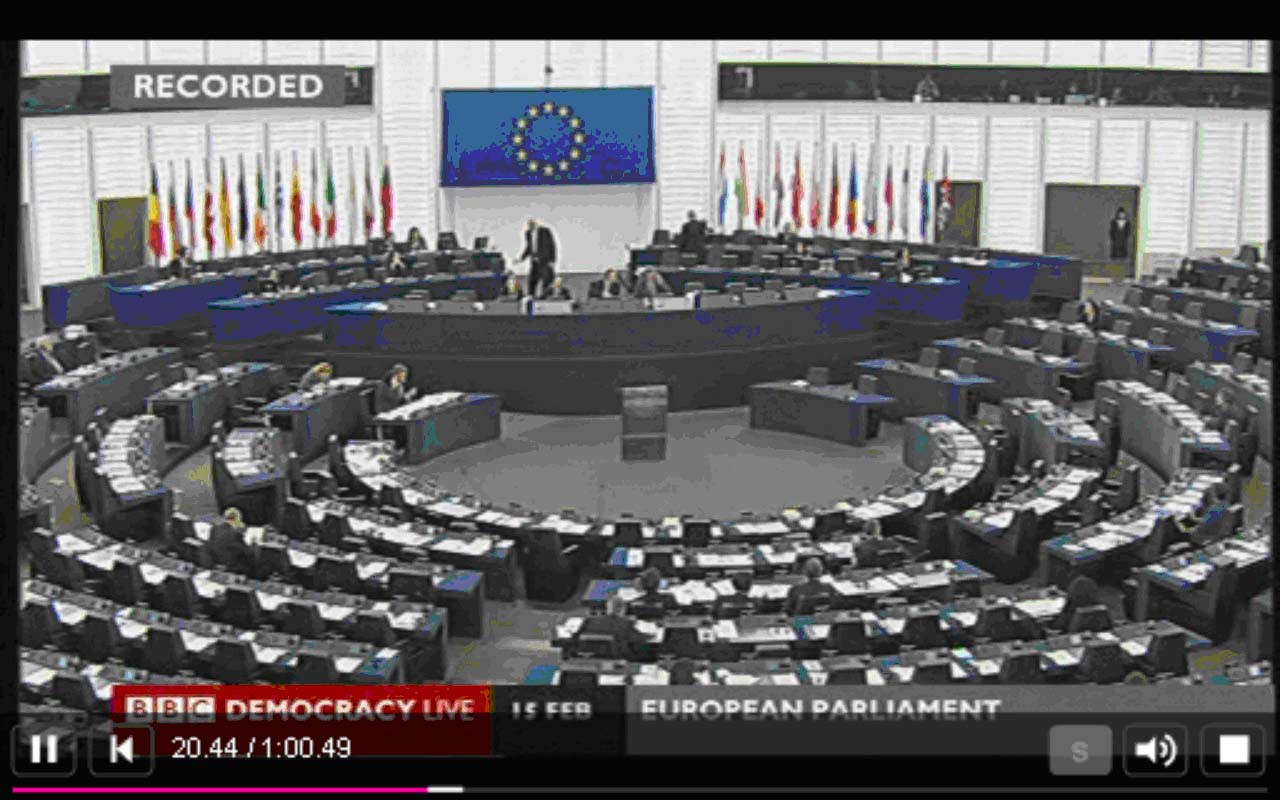
Of possible interest to a few, here are two links to the portions of yesterday’s plenary session of the European Parliament where the Common EU Asylum System and the migration emergency in Italy were discussed by a few MEPs and Commissioner Malmström.  As you can see from my screen shot below of the debate regarding the migration emergency, very few MEPs were in attendance.

Click here (Common EU Asylum System) and here (migration emergency) for link to the BBC’s Democracy Live site with the video.

Leave a comment

Filed under European Union, Frontex, Greece, Italy, Mediterranean, News, Tunisia, Turkey

Euro-Africa Conference on Illegal Immigration, Human Trafficking, Drug Trafficking, and Terrorism (Napoli, 7-9 February)

The Italian Interior Ministry and the Direzione Centrale dell’Immigrazione e della Polizia delle Frontiere are conducting a three day conference, beginning today, in Napoli, 7-9 February.  In attendance will be top police officials from 45 African countries, 25 EU countries as well as officials from agencies including Interpol, Europol, Frontex and, as observers, representatives of the US FBI and Dept. of Homeland Security.  Among those scheduled to attend are Rodolfo Ronconi, Direttore Centrale dell’Immigrazione e della Polizia delle Frontiere, Interior Minister Roberto Maroni, INTERPOL Secretary General Ronald Noble, EUROPOL Director Rob Wainwright, and Frontex Director Ilkka Laitinen.

According to a draft agenda for the conference, discussion topics will include:

  • Immigration Group – The African continent as a source and place of transit for migratory flows towards Europe across the Mediterranean Sea.  Internal migration within African. Threat assessment, ongoing bilateral initiatives, multilateral initiatives, and methods of law enforcement;
  • Group on human trafficking and organized crime – Criminal networks involved in smuggling: prevention and law enforcement investigative techniques, with particular reference to flows from Greece and Central Africa to Europe;
  • Drug Trafficking Group – African continent: new narcotrafficking directed towards Europe;
  • Group on Terrorism – Cyberspace as a new platform for radicalization: comparing experiences.

Original Italian:

  • Gruppo Immigrazione – Il  Continente africano quale origine e transito dei flussi migratory diretti in Europa attraverso il Mar Mediterraneo.  I fenomeni migratori interni al Continente africano.  Valutazione della minaccia, iniziative bilaterali, multilaterali e metodologie di contrasto;
  • Gruppo Tratta degli esseri umani e criminalità organizzata sul tema “Le reti criminali coinvolte nel traffico di migranti: tecniche di investigazione preventiva e repressiva, con particolare riferimento ai flussi provenienti dalla Grecia e dal Centro Africa verso l’Europa”;
  • Gruppo Traffico di Stupefacenti sul tema “Il Continente africano: nuovo crocevia del narcotraffico diretto verso l’Europa?”;
  • Gruppo Terrorismo sul tema “Il Cyberspazio quale nuova piattaforma per la radicalizzazione: esperienze a confronto”;

Click here (IT) for short article.

Click here (IT) for draft agenda.

I would love to know more about the substance of the conference – if anyone has any information or documents to share, please do so. ( nfrenzen@law.usc.edu ).

2 Comments

Filed under Aegean Sea, Colloques / Conferences, European Union, Frontex, Greece, Italy, Mediterranean, News

WikiLeaks 2008 US Cable: Background Regarding EU-Libya Framework Agreement Negotiations

This cable provides the views of the US Embassy in Tripoli regarding the state of the EU-Libya Framework Agreement negotiations in July 2008.  It was written by the US Embassy’s Chargé d’Affaires, John Godfrey.  The cable is titled: “THE EU-LIBYA FRAMEWORK AGREEMENT: VENI, VISAS, VETO.”  The cable states that Libya views the EU Framework Agreement as “a ‘reward’ for Libya’s decision in July 2007 to release six [Bulgarian and Palestinian] health workers accused of intentionally infecting over 400 Libyan children with HIV/AIDS.”  The cable describes threats to veto the framework agreement by individual EU member states in an effort to secure bi-lateral concessions from Libya and describes Libya’s claim that the “draft language initialed by [EU] Commissioner Ferrero-Waldner ‘commits’ the EU …  to funding a ‘surveillance mechanism’ along Libya’s land and sea borders to combat illegal migration.”

Most of the cable’s text follows:

“(C)  Summary.  The Government of Libya (GOL) remains keenly interested in pursuing a European Union-Libya Framework Agreement and views a more formalized partnership with the European Union (EU) as a “reward” for Libya’s decision in July 2007 to release six foreign health workers accused of intentionally infecting over 400 Libyan children with HIV/AIDS. Certain EU members, unsure that a more formal cooperation mechanism would be beneficial and sensing Libya’s eagerness, have used the threat of a veto to push their bilateral agendas, particularly with respect to commercial and human rights issues.  One year after Libya and the EU agreed in principle to pursue an agreement, a sizeable perception gap exists between the two sides on the merits of a more formalized partnership.  Despite occasional differences with the EU, most recently over the French-backed Union for the Mediterranean proposal, the GOL will continue to seek an EU framework agreement, in large part because of Muammar al-Qadhafi’s desire to be taken seriously by European leaders. End summary.

BULGARIAN MEDICS CASE HAUNTS EUROPE

2.  (C)  Libya’s much-heralded decision in July 2007 to [release] six foreign health workers imprisoned since 1999 on charges of intentionally infecting children in Benghazi with the HIV/AIDS virus frames current discussions on an EU-Libya Framework Agreement.  Widely seen by Europeans in Libya as a successful alignment of European and Libyan interests, the denoument of the Bulgarian medics case – particularly their immediate pardon upon their arrival in Bulgaria – remains a lasting embarrassment for key elements of the Libyan regime.  The GOL, preoccupied with avoiding the public perception that it caved to foreign pressure to resolve the case, has trumpeted a putative EU framework agreement as a significant concession and a positive coup for Libyan diplomacy.  In an hours-long televised news conference just days after the medics left, Foreign Minister Abdulrahman Shalgham and Under Secretary for European Affairs Abdulati Obeidi boasted that a draft agreement, initialed by EU Commissioner for External Relations Benita Ferrero-Waldner during her July 2007 visit to Tripoli, would pave the way for easier access to Schengen visas for Libyan citizens and increased EU infrastructure investments in Libya. Ferrero-Waldner’s announcement in February 2008 that the EU Commission had submitted a recommendation to the Council of Ministers to grant a mandate to open negotiations with Libya stoked GOL hopes for rapid progress.

3.  (C)  French, Spanish, and German diplomats describe Libya’s primary objective in pursuing an EU framework agreement as reducing the mandatory waiting period for Schengen visas for Libyan nationals from the current 10 days to 48 hours.  …

4.  (C)  The July 2007 EU-Libya draft also lays out cooperation in the fields of human rights, health, and development.  U/S Obeidi informed French Ambassador Francois Gouyette in June 2008 that Libya agreed in principle to negotiate a human rights chapter within the framework agreement; however, Obeidi categorically refused to include discussions of individual human rights cases in the EU negotiations.  … In addition, the GOL has claimed that draft language initialed by Commissioner Ferrero-Waldner “commits” the EU …  to funding a “surveillance mechanism” along Libya’s land and sea borders to combat illegal migration.

VENI, VIDI, VETO

5.  (C)  Certain EU members, sensing Libya’s eagerness to move ahead, have threatened to block a framework agreement as a means by which to secure bilateral concessions, chiefly on commercial and human rights issues.  Italian Economic and Commercial Counselor Domenico Bellantone said that Italy is prepared to veto any framework agreement unless Libya ends a series of discriminatory commercial practices that target Italian firms operating in Libya.  …  French and Greek diplomats in Tripoli have hinted that they may also dangle a veto threat to resolve commercial disputes.  The Netherlands have approached certain EU members about a possible veto over Libya’s outstanding private debt to Dutch firms. Danish Consul-General George Wallen recently told EU Ambassadors in Tripoli that Denmark would veto a framework agreement with Libya unless the GOL lifts bans on Danish imports and Danish participation in infrastructure projects in Libya (prompted by a Danish magazine’s re-publishing in February 2008 of cartoons depicting the Prophet Muhammad).  Denmark also wants the GOL to release Jamal al-Hajj, a Danish-Libyan dual-national arrested on February 16, 2007 in connection with plans to hold a peaceful political demonstration.  Maltese diplomats have said Malta is considering a veto over dissatisfaction with Libya’s maritime patrols in its designated Search and Rescue (SAR) area and continuing concerns over the lack of cooperation by the GOL in efforts to stem the flow of irregular migrants from Libya to Europe.

6.  (C) European diplomats believe that apart from help in combating illegal migration from sub-Saharan Africa and South Asia through Libya to Europe, Europe has little to gain from a closer partnership with Tripoli.  In absence of a more formal agreement, some European countries have pursued bilateral cooperation that they privately assess as being more nimble and effective than broader cooperation under an EU framework agreement might be.  Italian diplomats characterized a recent donation of six vessels to Libya’s coast guard and an offer to train Libyan border security officials as Italy’s bilateral response to what they view as a lack of meaningful EU engagement on illegal migrant flows through Libya.  Greek DCM Ioannis Stamatekos lauded Italy’s move and said Greece may follow suit. Maltese Poloff Daniel Malina said that Malta, lacking resources to make a large equipment donation, hoped to keep the critical migration issue on the EU’s radar during Council deliberations over the Commission’s mandate to pursue the framework agreement.

DON’T RAIN ON MY CHARADE

7.  (C)  Twelve months have passed since Ferrero-Waldner initialed a draft memorandum on an EU-Libya framework agreement; however, a year of inaction does not appear to have dampened GOL perceptions that relations with Europe are on an up-swing. While senior European diplomats in Tripoli are quick to point out that formal negotiations with Libya on any kind of European-Libyan cooperation agreement have yet to even begin, many GOL officials speak of key Libyan negotiating positions, such as the 48-hour Schengen visa point, as if they’re already in place. …  A series of high-level European visits, most recently that of Spanish Foreign Minister Miguel Moratinos, have helped attenuate the GOL’s disappointment over what it perceives as slow progress on the framework agreement and on implementing commitments made during al-Qadhafi’s visits to Spain and France in December 2007.

8. (C) Comment: Libya’s interest in a closer partnership with Europe seems sincere; however, the GOL’s foreign policy, particularly at the senior levels, remains somewhat fickle. Libyan leader Muammar al-Qadhafi’s visit to Madrid and Paris last December sparked a surge of pro-European rhetoric in Tripoli – in one instance, Qadhafi threatened to pull Libyan investment from sub-Saharan Africa to redirect to his new European friends.  More recently, though, al-Qadhafi orchestrated a meeting of Arab Maghreb Union leaders in Tripoli to publicly disparage Sarkozy’s Union for the Mediterannean proposal (reftel).  Characterizing the proposed union as “insulting”, he claimed it would undermine Arab and African member states’ commitments to the Arab League and African Union, and told former British Prime Minister Tony Blair he was concerned that the proposal represented an effort by southern European states to create a North African bulwark against illegal migration from sub-Saharan Africa and to “further legitimize” Israel.  Despite such disagreements, Qadhafi’s interest in being taken seriously, particularly by his “friends Nicholas (Sarkozy) and Silvio (Berlusconi)”, will continue to drive the GOL’s keen interest in finalizing a framework agreement with the EU.  End comment.   GODFREY”

Click here or here for full cable.

6 Comments

Filed under Denmark, European Union, France, Germany, Greece, Italy, Libya, Malta, Mediterranean, Netherlands, News, Spain

COE CPT Completes Ad Hoc Mission to Greece

The Committee for the Prevention of Torture and Inhuman or Degrading Treatment or Punishment (CPT) released a statement yesterday that it had completed a one week (20-27 Jan.) ad hoc mission to Greece “to assess the concrete steps taken by the Greek authorities to implement long-standing recommendations, in particular those contained in the reports on the CPT’s visits of September 2005, February 2007, September 2008 and September 2009.   In the course of the visit, the CPT’s delegation examined the treatment and conditions of detention of migrants held in aliens detention centres and in police and border guard stations, particularly in the Attica and Evros regions….”  The CPT report to the Greek government is scheduled to be delivered in March 2011.

Among the detention centres visited by the CPT were several Border Guard stations in Evros and the “Filakio Special holding facility for illegal immigrants” where many of persons apprehended along the land border of Greece and Turkey are being detained in deplorable conditions.  Doctors Without Borders released a press statement last week describing the conditions at the Greek detention centres in Evros as unbearable, inhumane, and having reached an emergency situation.

Click here for CPT Press Release.

Click here for Doctors Without Borders Press Release.

1 Comment

Filed under Aegean Sea, Council of Europe, European Committee for the Prevention of Torture and Inhuman or Degrading Treatment or Punishment, Frontex, Greece, News, Turkey

Frontex 3rd Quarter Report

On 16 January the Frontex Risk Analysis Unit released its Report for the Third Quarter of 2010 (July-Sept.).  The report contains data, charts, and graphs detailing detections of migrants, asylum seekers, false document use, detections of facilitators, and other information.  The deployment of Frontex’s RABIT force to the Greek-Turkey border did not begin until 2 November 2010, so the effects of the RABIT deployment do not appear in the Third Quarter.

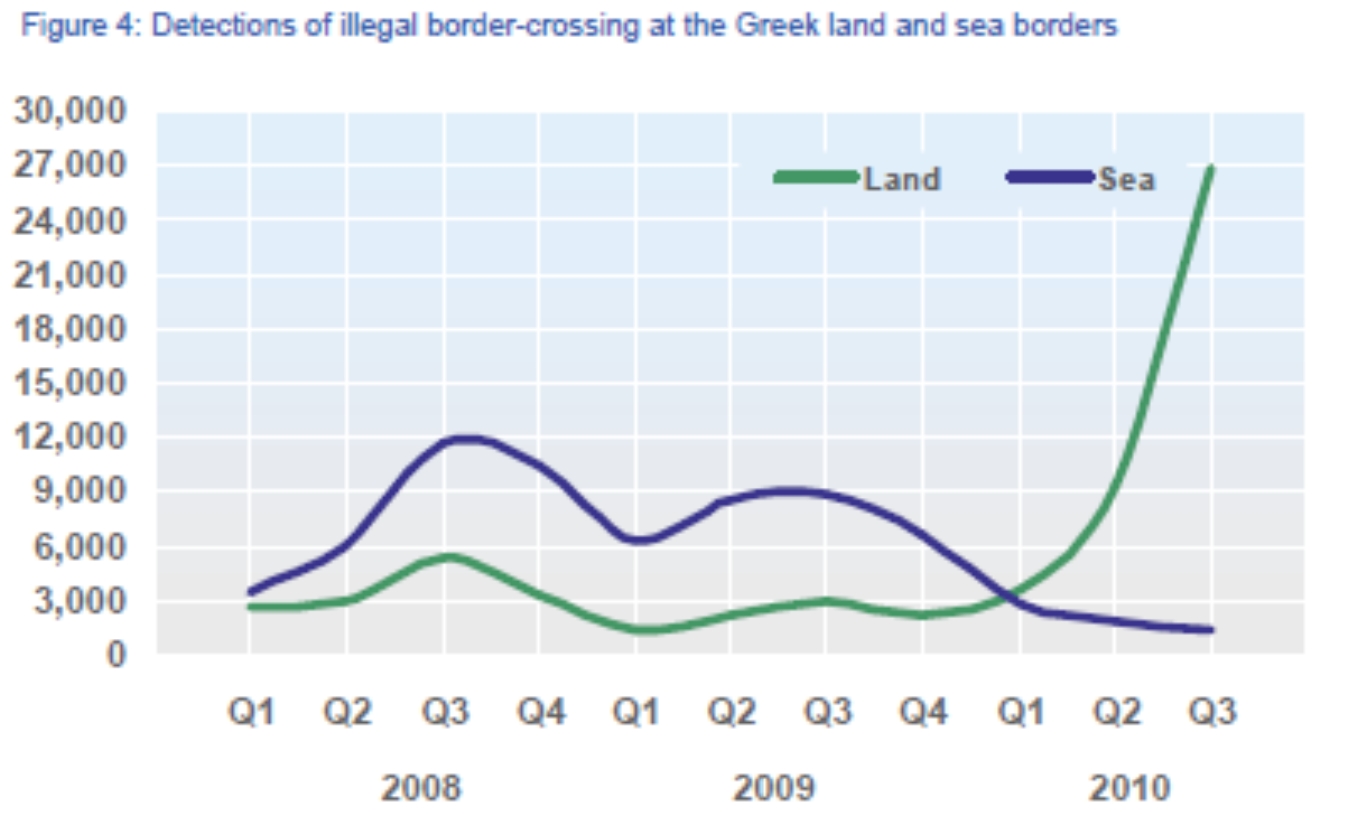
The Report notes that the “unprecedented peak in illegal border-crossings at the Greek land border with Turkey is the result of a shift from the sea to the land border” coupled with a “large increase in the absolute number of migrants” using Turkey as an EU entry point.  The Report states that there has been an eight-fold increase in the number Maghreb nationals detected at the Greek land border which “is thought to be the result of a displacement effect from the West Africa and Western Mediterranean routes.”

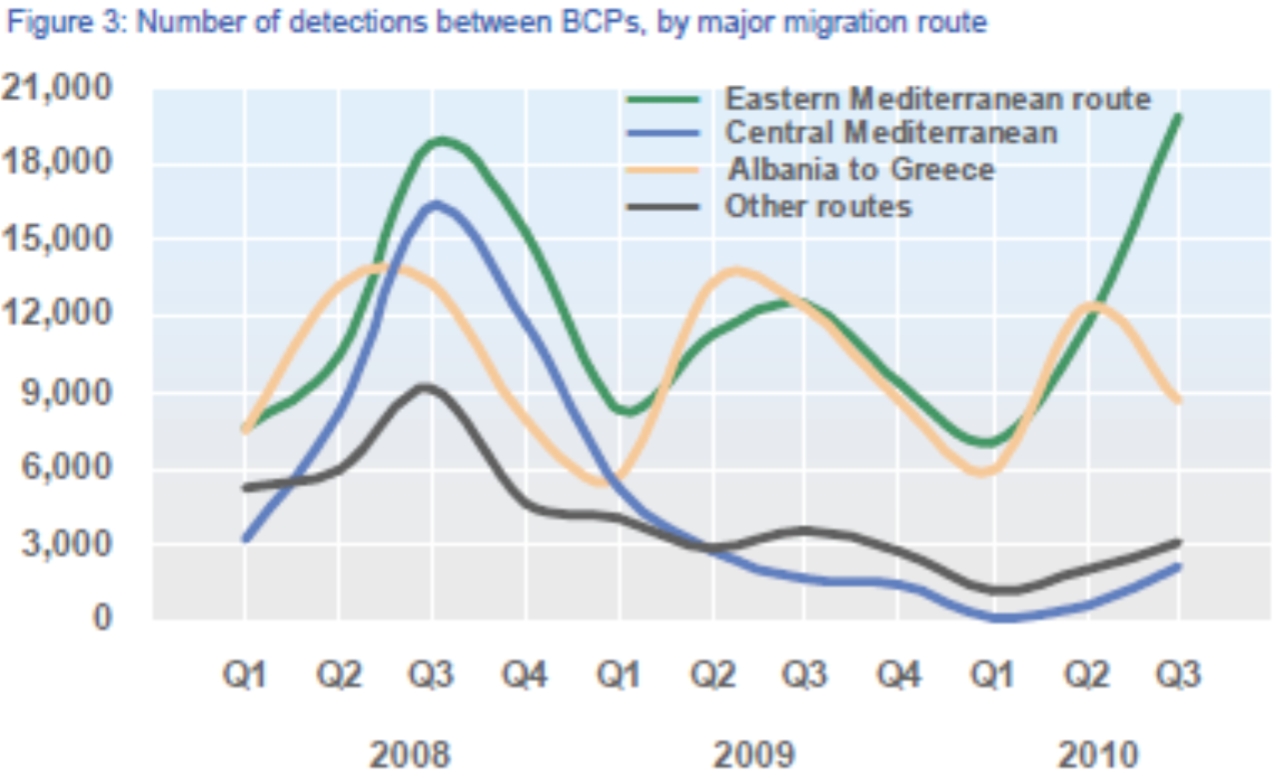
The Report also notes an increase in the number of detections on the Central and Western Mediterranean sea routes compared to Q2 which may be attributable to seasonal variations or “may be indicative of reorganized modi operandi in these areas in response to Frontex Joint Operations, more effective border controls and bilateral agreements implemented in 2008.”  See Figure 3 below.

Excerpts from the Report:

“Detections of illegal border-crossing”

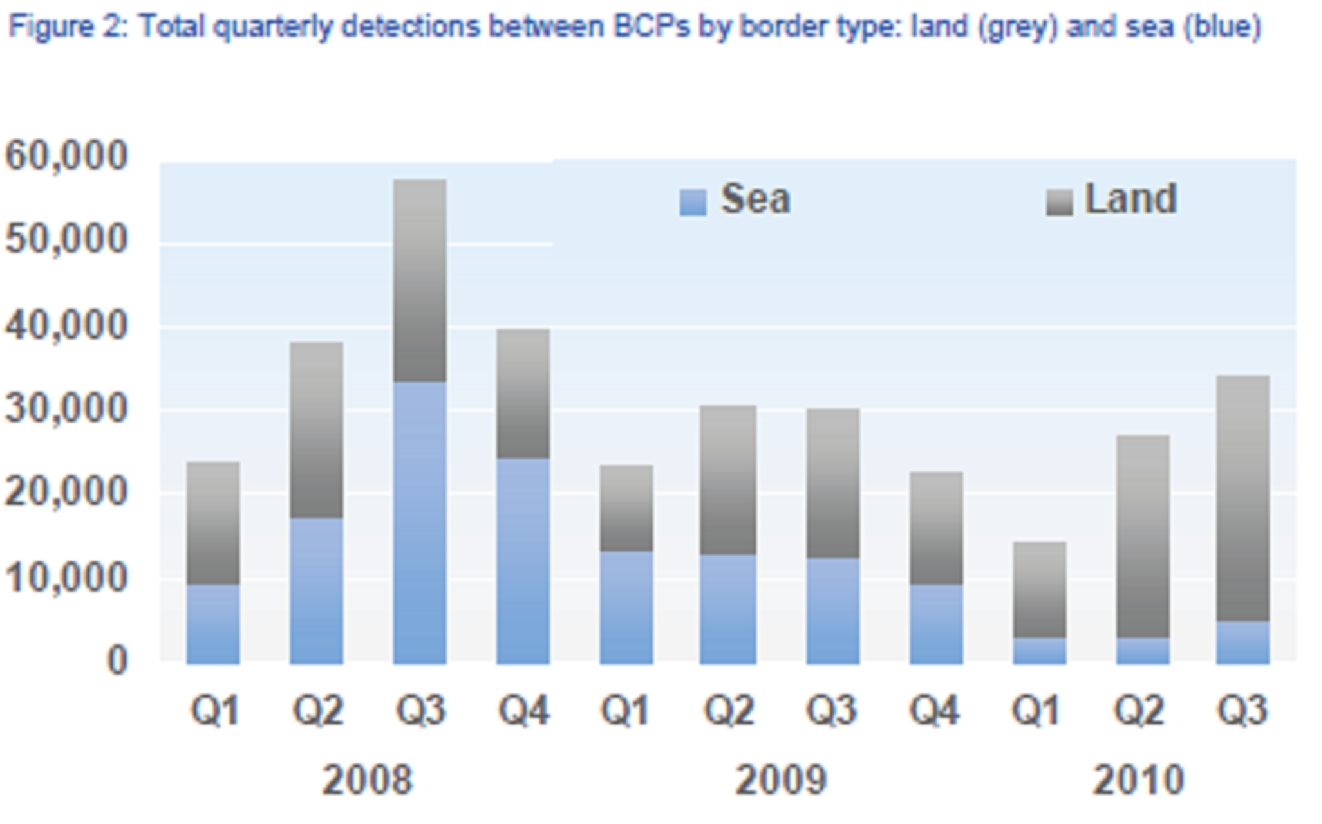
“…  Fig. 2 [see below] shows quarterly detections at the land and sea borders of the EU since the beginning of 2008. The 30% increase in the number of detections between the previous and present quarters is comprised of a 60% increase at the sea borders (although from a lower base) and a 23% increase at the land borders. This means that the shift from sea to land borders has not continued to same extent as in the previous quarters.  Nevertheless in Q3 2010, there were some 29 000 detections of illegal border-crossing at the external land border of the EU, which constitutes 85% of all the detections at the EU level, and the highest number of detections at the land border since data collection began in early 2008….”

“Eastern Mediterranean route”

The Report observes that there has been a shift in illegal crossings from the Greece-Turkey maritime border to the Greece-Turkey land border and notes an increase in the number of nationals from Maghreb countries apprehended at the Greece-Turkey land border.  “This route [being taken by Maghreb nationals] is very indirect, but is thought to be the result of a displacement effect from the West Africa and Western Mediterranean routes….”

See Figure 4 below which shows that detections of illegal border crossers at the land border of Greece have exceeded detections at the sea border since Q1 of 2010.

“Central Mediterranean route”

“There were 2 157 detections of illegal border-crossing during Q3 2010. This is more than a three-fold increase compared to the previous quarter and a third higher than the same period last year. However despite this apparently large increase, detections still remain massively reduced compared to the peak of around 16 000 during the same period in 2008 (Fig. 3)….”

“The JO Hermes 2010 which was operational between June and October 2010, focused on illegal migratory flows departing from Algeria to the southern borders of the EU, specifically to Sardinia. In 2010, there were fewer detections than in previous years….”

“Departures from Libya also remained low. In June 2010, a new law was implemented to serve more severe punishments for facilitating illegal immigration. Ambassadors of the countries of origin were called into the Ministry of Foreign Affairs in Tripoli to be informed about the consequences of the new law, which suggests that this may be a serious implementation.”

“Western Mediterranean route”

“In general, irregular immigration to southern Spain has decreased massively since the beginning of 2006. However, in Q3 2010 there were 2 200 detections of illegal border crossing in the Western Mediterranean, more than twice that of the previous quarter and around a third higher than the same period in 2009. There is growth in the number of detections of a wide range of African nationalities, nine of which more than doubled in number between Q2 and Q3 2010. The most detected nationalities were Algerian, Moroccan, Cameroonian and Guinean.”

“Western Africa route”

“The cooperation and bilateral agreements between Spain and the rest of the Western African countries (Mauritania, Senegal and Mali) are developing steadily, and are one of the main reasons for the decrease in arrivals, as is the presence of patrolling assets near the African coast.”

“According to data collected during JO Hera, the numbers of arrivals in the Canary Islands and detections in West Africa are very low compared to the same time last year. The main nationality and place of departure is from Morocco, to where migrants are returned within a few days.”

Click here for the 3rd Quarter 2010 Report.

Click here for the 2nd Quarter 2010 Report.

Click here for the 1st Quarter 2010 Report.

Click here for my previous post regarding the 2nd Quarter Report.


Leave a comment

Filed under Aegean Sea, Algeria, Data / Stats, Eastern Atlantic, European Union, Frontex, General, Greece, Italy, Libya, Malta, Mauritania, Mediterranean, Morocco, News, Reports, Senegal, Spain, Tunisia, Turkey