Category Archives: Malta

Italy and Malta Turn Back NATO Ship Carrying 100 Rescued Migrants

A political and diplomatic standoff is underway between Malta, Italy, Spain and NATO.  The Times of Malta is reporting that the Spanish frigate, the Almirante Juan de Borbón, carrying the 100 rescued migrants attempted to dock at Lampedusa after the rescue, “but the Italian authorities refused it entry  and directed the vessel to Malta, which also refused entry, arguing that Lampedusa was the nearest safe port.”  “The Spanish warship is now off Maltese waters while talks are held between Maltese, Italian and Spanish diplomats.  A meeting which included the Prime Minister and Home Affairs Minister Carm Mifsud Bonnici was being held this afternoon at the Auberge de Castille.  Nato is understood to have appealed to both Italy and Malta to accept the migrants.”  The Times of Malta also reported that a 10 month old baby was flown yesterday from the Spanish frigate to Malta for medical treatment and that a man and pregnant woman were airlifted to Malta today.

Click here for Times of Malta article.

Click here and here for previous posts.

1 Comment

Filed under European Union, Italy, Libya, Malta, Mediterranean, News

Rescued Migrants Remain on NATO Ship While Consultations Continue Regarding Place of Disembarkation

According to information provided to me today by the NATO Public Affairs Office for Operation Unified Protector, most of the migrants who were rescued on 10-11 July by a NATO warship are still on board the Spanish Navy frigate.  An unspecified number of the migrants in need of immediate medical attention have been “off-loaded to safety” to an unidentified location.

While the NATO Public Affairs Office did not identify the NATO ship or its nationality, the Spanish Defence Ministry and Navy have previously confirmed that the Spanish frigate Almirante Juan de Borbón is the NATO ship that performed the rescue.

According to NATO, “the NATO Frigate responded [on 10 July] to a vessel in distress some 75 miles off the coast of Libya. A NATO ship [then] … provided medical support, food and offered mechanical assistance to the distressed civilians. [On the] 11th of July, the migrants (approximately 100), Ghanaians, Tunisians and Libyans, were transferred onto the NATO ship in accordance with the Safety of Life at Sea (SOLAS) protocol…”

Most of the migrants remain on board the Spanish frigate.  NATO says that “the appropriate legal, diplomatic and military authorities are being consulted to determine future course of action.”

I have asked for further information regarding to what location the migrants who were in need of immediate medical attention have been taken.  The possibilities presumably are another ship with appropriate medical facilities, Tunisia, Libya, Italy, Malta, or Spain.

Click here for my previous post on this topic.

1 Comment

Filed under Italy, Libya, Malta, Mediterranean, News, Spain, Tunisia

NATO Warship Rescues 100 Migrants from Boat Off Libya; Where Will Migrants Be Disembarked?

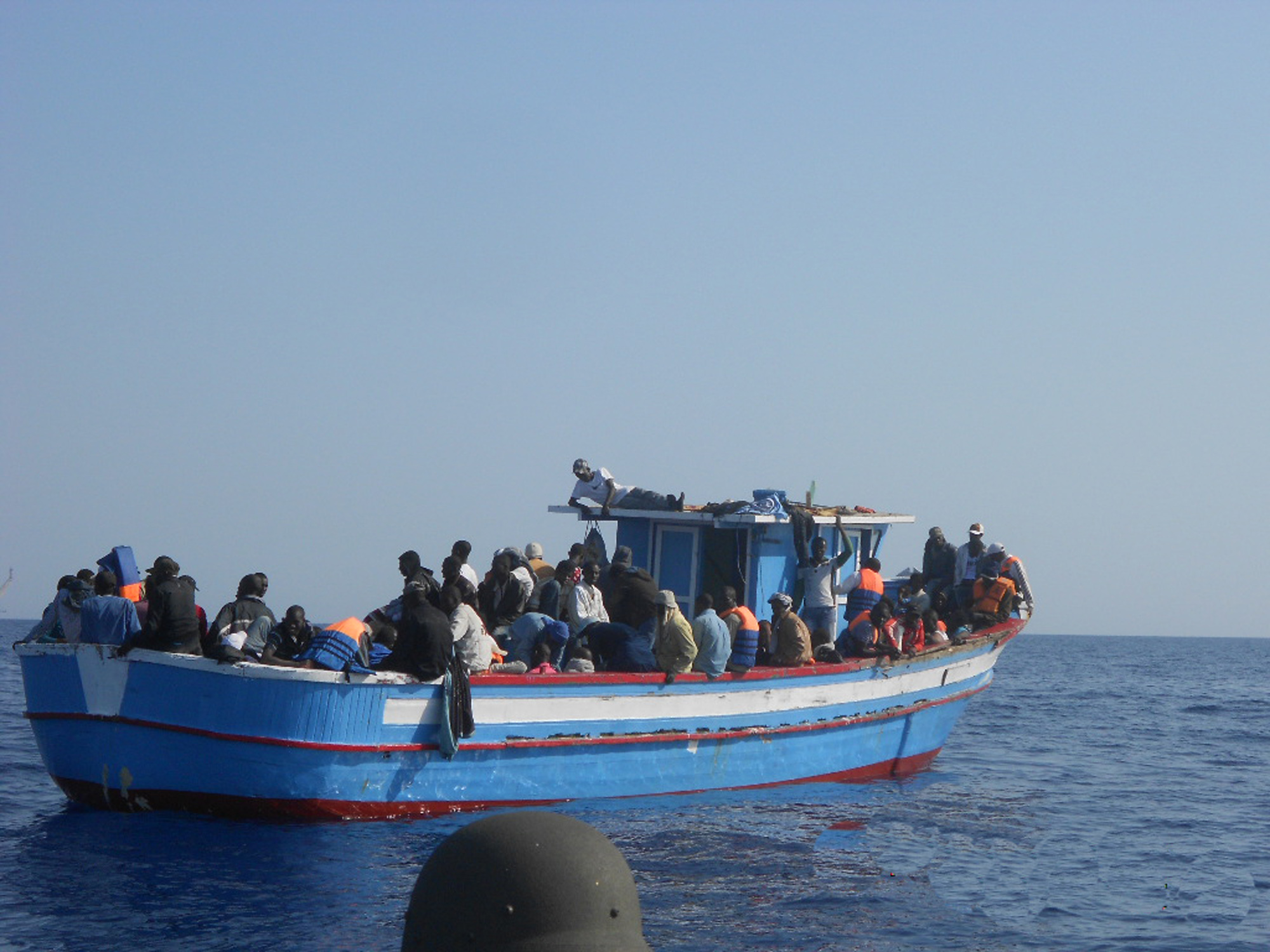
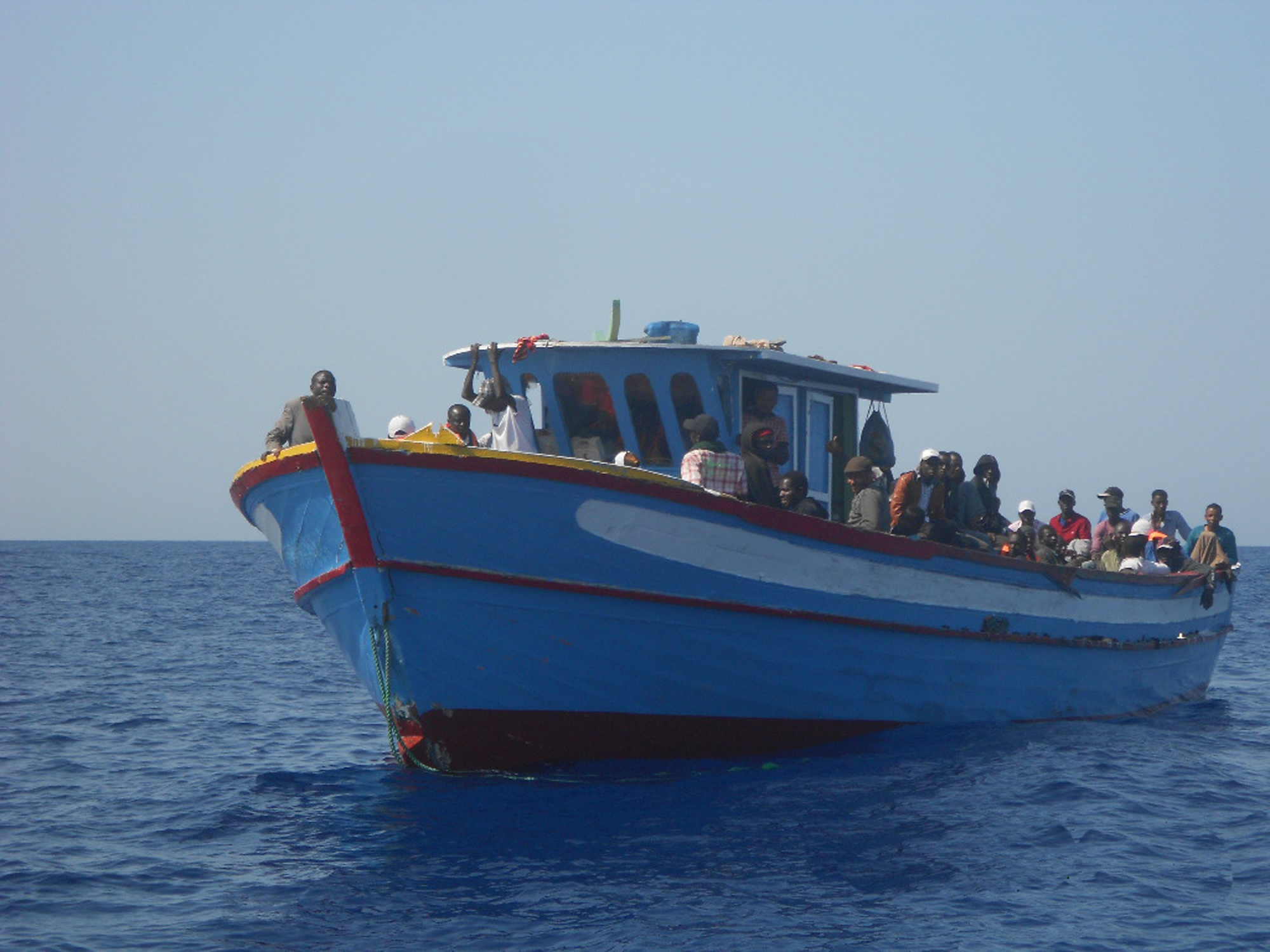
A Spanish Navy frigate, the Almirante Juan de Borbón, participating in NATO’s Operation Unified Protector, on Sunday rescued approximately 100 migrants who were in a disabled boat that reportedly left Zawiyah, Libya several days ago.  The migrants have been without food and water for at least two days.  Among the rescued persons are pregnant women and children.

It is not clear where the migrants will now be taken.  Some reports indicate that the Spanish Defence Ministry is hoping that Tunisia, Malta, or Italy will receive the migrants.  NATO is reportedly seeking a country to accept the migrants.  The migrants are reportedly from Libya, Tunisia, and Sub-Saharan Africa.

Hopefully the migrants will be disembarked quickly (assuming it has not already happened) in an appropriate location where any claims for international protection can be properly considered.  It would be problematic if the migrants are required to remain on the Spanish warship for an extended period and if nearby countries refuse to permit the disembarkation.

Click here (EN), here (ES), here (ES) and here (ES) for articles.

Click here and here for Spanish Defence Ministry and Navy press statements.  (ES)

These photos were released by the Ministerio de Defensa de España.

Photo Credit: Ministerio de Defensa de España (mde.es)

Photo Credit: Ministerio de Defensa de España (mde.es)


4 Comments

Filed under Italy, Libya, Malta, Mediterranean, News, Spain, Turkey

Head of Armed Forces of Malta Describes Malta’s Interpretation of Its SAR Responsibilities

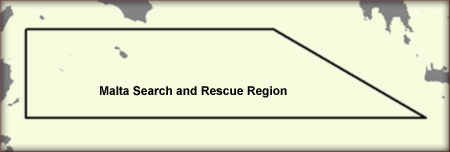
Brigadier Martin Xuereb, the head of the Armed Forces of Malta (AFM), spoke at a recent seminar sponsored by the European Parliament, “Europe’s new Mediterranean reality: Migration and asylum in Malta, Greece and Cyprus,” and summarised Malta’s interpretation of its search and rescue obligations.  Xuereb said that Malta is obligated to coordinate search and rescue operations within its SAR zone, but is not required to perform all rescue operations.

Xuereb said Malta believes rescued persons should be disembarked at the nearest place of safety which, given the size and location of the Maltese SAR, will sometimes mean that Italian territory, particularly Lampedusa, is closer.  Xuereb acknowledged that this interpretation is not shared by others.  Xuereb “said that Malta had consistently insisted that the arrangement that best represented the interests of rescued persons was one that saw them disembarked in the nearest place of safety.”  He said the Maltese Rescue Coordination Centre (RCC) has coordinated or assisted with 54 SAR cases so far this year.

Xuereb also confirmed that Malta would continue its refusal to host Frontex joint operations because of its objections to Frontex guidelines which are based “on a number of grounds, including the fact that [the guidelines] addressed matters deemed to be outside community competence and attempted to erode the rights that Malta enjoyed under the international legal framework. … In light of these guidelines, Malta considered the hosting of [Frontex] joint operations to be detrimental to its national interest.”  Malta objects to the guidelines because it believes they would require rescued migrants to be disembarked in the country hosting the joint operation.

Click here and here for articles.

Leave a comment

Filed under Frontex, Italy, Malta, Mediterranean, News

Klepp, Int J Refugee Law, “A Double Bind: Malta and the Rescue of Unwanted Migrants at Sea, a Legal Anthropological Perspective on the Humanitarian Law of the Sea”

An article by Silja Klepp (Research Associate, Research Center for Sustainability Studies (artec), University of Bremen) entitled “A Double Bind: Malta and the Rescue of Unwanted Migrants at Sea, a Legal Anthropological Perspective on the Humanitarian Law of the Sea” has been published as an online advance access article by the International Journal of Refugee Law.

Abstract: “This paper discusses research results from anthropological fieldwork carried out in Malta in 2007. The island, which is situated in the central Mediterranean Sea between Tunisia, Libya and Italy, is a focal point regarding the continuing refugee situation. One of the research aims was to investigate the situation at sea concerning Search and Rescue (SAR) operations for migrants and refugees crossing the Mediterranean by boat. In the year 2006, 556 missing and drowned migrants were registered in the central Mediterranean between Libya, Malta and Italy, this number increased to 642 in 2008.1 The goal of the research in Malta was therefore to understand why an increasing number of migrants were dying at sea and what role the European security forces play in this context.

After introducing the research perspective of this article, background information concerning migration movements in the Mediterranean Sea between Libya, Italy and Malta in recent years is provided. Due to European regulations, which are considered unfavourable for the island, and its population density, Malta feels under pressure from migrants arriving by boat across the Mediterranean. Different concepts regarding a ‘place of safety’ to disembark rescued boat migrants are debated. The ambiguities in the responsibilities cause problems for the captains who rescue migrants in distress at sea. These ambiguities may in turn lead to a weakening of the SAR regime. Following discussion of the legal and political quarrels on the place of safety, the SAR operations at sea of the Armed Forces of Malta is analysed. The findings show that it is not merely a case of enforcing legal norms created by international law. The process is much more complex: legal gaps are filled by regional actors, through informal or even illegal practices, asserting their own claims at their convenience. Thus, transnationalization processes of law, such as the international SAR regime, are a fragmented and ambiguous set of regulations, creating space for negotiation and manoeuvre.2

Click here for link.  (Subscription or payment required.)

Also by Klepp from 2010, European Journal of Migration and Law: “A Contested Asylum System: The European Union between Refugee Protection and Border Control in the Mediterranean Sea.”

Leave a comment

Filed under Analysis, European Union, Italy, Malta, Mediterranean, UNHCR

PACE Appoints Tineke Strik as Rapporteur to Investigate Mediterranean Sea Deaths

The Migration Committee of the Parliamentary Assembly of the Council of Europe has appointed Tineke Strik (Netherlands, SOC) to prepare a report on the deaths of boat people who have died in the Mediterranean since January 2011.

From the PACE press statement: “‘There have been allegations that migrants and refugees are dying after their appeals for rescue have been ignored,’ said Mrs Strik. ‘Such a grave allegation must be urgently investigated.  I intend to look into the manner in which these boats are intercepted – or not – by the different national coastguards, the EU’s border agency FRONTEX, or even military vessels. I also intend to speak to witnesses directly involved in reported incidents, and put questions to national authorities, the UNHCR, FRONTEX and NATO, among others.’  On 8 May, the Guardian newspaper reported that 61 boat people escaping from Libya had died after their appeals for rescue had been ignored by armed forces operating in the Mediterranean. The following day PACE President Mevlüt Çavusoglu called for ‘an immediate and comprehensive enquiry’ into the incident.”

Click here for PACE press statement.

1 Comment

Filed under Council of Europe, Frontex, Italy, Libya, Malta, Mediterranean, News, Tunisia

PACE Adopts Resolution and Recommendation Regarding the Interception and Rescue at Sea of Asylum Seekers, Refugees and Irregular Migrants

On 21 June 2011, PACE adopted Resolution 1821 and Recommendation 1974 both relating to “the interception and rescue at sea of asylum seekers, refugees and irregular migrants.” 

Here are extensive excerpts:

Provisional edition – The interception and rescue at sea of asylum seekers, refugees and irregular migrants – Resolution 1821 (2011)1

“1.       The surveillance of Europe’s southern borders has become a regional priority. The European continent is having to cope with the relatively large-scale arrival of migratory flows by boat from Africa, reaching Europe mainly through Italy, Malta, Spain, Greece and Cyprus.

[***]

5.       The Assembly notes that measures to manage these maritime arrivals raise numerous problems, of which five are particularly worrying:

5.1.       Despite several relevant international instruments satisfactorily setting out the rights and obligations of states and individuals applicable in this area, interpretations of their content appear to differ. Some states do not agree on the nature and extent of their responsibilities in specific situations and some states also call into question the application of the principle of non-refoulement on the high seas;

5.2.       While the absolute priority in the event of interception at sea is the swift disembarkation of those rescued to a “place of safety”, the notion of “place of safety” does not appear to be interpreted in the same way by all member states. Yet it is clear that the notion of “place of safety” should not be restricted solely to the physical protection of people, but necessarily also entails respect for their fundamental rights;

5.3.       Divergences of this kind directly endanger the lives of the persons to be rescued, in particular by delaying or preventing rescue measures, and are likely to dissuade seafarers from rescuing people in distress at sea. Furthermore, they could result in a violation of the principle of non-refoulement in respect of a number of persons, including some in need of international protection;

5.4.       Although the European Agency for the Management of Operational Cooperation at the External Borders of the Member states of the European Union (Frontex) plays an ever increasing role in interception at sea, the guarantees of respect for human rights and obligations arising under international and European Union law in the context of the joint operations it co-ordinates are inadequate;

5.5.       Finally, these sea arrivals place a disproportionate burden on the states located on the southern borders of the European Union. The goal of responsibilities being shared more fairly and greater solidarity in the migration sphere between European states is far from being attained.

6.       The situation is rendered more complex by the fact that these migratory flows are of a mixed nature and therefore call for specialised and tailored protection-sensitive responses in keeping with the status of those rescued. To respond to sea arrivals adequately and in line with the relevant international standards, the states must take account of this aspect in their migration management policies and activities.

[***]

8.       Finally and above all, the Assembly reminds the member states that they have both a moral and legal obligation to save persons in distress at sea without the slightest delay, and unequivocally reiterates the interpretation given by the Office of the United Nations High Commissioner for Refugees (UNHCR), which states that the principle of non-refoulement is equally applicable on the high seas. The high seas are not an area where states are exempt from their legal obligations, including those emerging from international human rights law and international refugee law.

9.       Accordingly, the Assembly calls on the member states, when conducting maritime border surveillance operations, whether in the context of preventing smuggling and trafficking in human beings or in connection with border management, be it in the exercise of de jure or de facto jurisdiction, to:

9.1.       fulfil without exception and without delay their obligation to save people in distress at sea;

9.2.       ensure that their border management policies and activities, including interception measures, recognise the mixed make-up of flows of individuals attempting to cross maritime borders;

9.3.       guarantee for all intercepted persons humane treatment and systematic respect for their human rights, including the principle of non-refoulement, regardless of whether interception measures are implemented within their own territorial waters, those of another state on the basis of an ad hoc bilateral agreement, or on the high seas;

9.4.       refrain from any practices that might be tantamount to direct or indirect refoulement, including on the high seas, in keeping with the UNHCR’s interpretation of the extraterritorial application of that principle and with the relevant judgements of the European Court of Human Rights;

9.5.       carry out as a priority action the swift disembarkation of rescued persons to a “place of safety” and interpret a “place of safety” as meaning a place which can meet the immediate needs of those disembarked and in no way jeopardises their fundamental rights, since the notion of “safety” extends beyond mere protection from physical danger and must also take into account the fundamental rights dimension of the proposed place of disembarkation;

9.6.       guarantee access to a fair and effective asylum procedure for those intercepted who are in need of international protection;

9.7.       guarantee access to protection and assistance, including to asylum procedures, for those intercepted who are victims of human trafficking or at risk of being trafficked;

9.8.       ensure that the placement in a detention facility of those intercepted – always excluding minors and vulnerable categories –, regardless of their status, is authorised by the judicial authorities and occurs only where necessary and on grounds prescribed by law, that there is no other suitable alternative and that such placement conforms to the minimum standards and principles set forth in Assembly Resolution 1707 (2010) on the detention of asylum seekers and irregular migrants in Europe;

9.9.       suspend any bilateral agreements they may have concluded with third states if the human rights of those intercepted are not appropriately guaranteed therein, particularly the right of access to an asylum procedure, and wherever these might be tantamount to a violation of the principle of non-refoulement, and conclude new bilateral agreements specifically containing such human rights guarantees and measures for their regular and effective monitoring;

9.10.       sign and ratify, if they have not already done so, the aforementioned relevant international instruments and take account of the Guidelines of the International Maritime Organisation (IMO) on the Treatment of Persons rescued at Sea;

9.11.       sign and ratify, if they have not already done so, the Council of Europe Convention on Action against Trafficking in Human Beings (CETS No. 197) and the so-called “Palermo Protocols” to the United Nations Convention against Transnational Organized Crime (2000);

9.12.       ensure that maritime border surveillance operations and border control measures do not affect the specific protection afforded under international law to vulnerable categories such as refugees, stateless persons, women and unaccompanied children, migrants, victims of trafficking or at risk of being trafficked, or victims of torture and trauma.

10.       The Assembly is concerned about the lack of clarity regarding the respective responsibilities of European Union states and Frontex and the absence of adequate guarantees for the respect of fundamental rights and international standards in the framework of joint operations co-ordinated by that agency. While the Assembly welcomes the proposals presented by the European Commission to amend the rules governing that agency, with a view to strengthening guarantees of full respect for fundamental rights, it considers them inadequate and would like the European Parliament to be entrusted with the democratic supervision of the agency’s activities, particularly where respect for fundamental rights is concerned.

[***]”

Provisional edition – The interception and rescue at sea of asylum seekers, refugees and irregular migrants – Recommendation 1974 (2011)1

“[***]

4.       [***] the Assembly reminds the Committee of Ministers of its dual responsibility: to support those member states that are in need, but also to make sure that all human rights obligations are complied with in the context of the interception and rescue at sea of asylum seekers, refugees and irregular migrants, including by guaranteeing to those intercepted access to a fair and efficient asylum procedure.

5.       The Assembly therefore calls on the Committee of Ministers to:

5.1.       include in the training material all necessary elements to enable the trained persons to proceed to a screening assessment of the international protection needs of intercepted persons and to ensure that staff involved in the operations of the European Agency for the Management of Operational Cooperation at the External Borders of the Member states of the European Union (Frontex) are trained accordingly;

5.2.       define, in close co-operation with the Office of the United Nations High Commissioner for Refugees (UNHCR), guidelines and standard operating procedures, when interception and rescue at sea takes place, determining minimum administrative procedures to guarantee that those persons with international protection needs are identified and provided with the appropriate protection;

5.3.       continue monitoring the situation of large-scale arrivals of irregular migrants and asylum seekers, and in particular the issue of interception and rescue at sea, including by holding extraordinary meetings on the situation, where appropriate, and use the good offices of the UNHCR with its representative at the Council of Europe, where relevant.”

Click here for full text of Resolution 1821 (2011).

Click here for full text of Recommendation 1974 (2011).

Click here  for speech by Tineke Strik (Netherlands, SOC) presenting the Resolution. (Scroll down page for the English text of speech.)
1 Comment

Filed under Aegean Sea, Council of Europe, Cyprus, Frontex, Greece, Italy, Libya, Malta, Mediterranean, News, Spain, Statements, UNHCR

1400 Migrant Landings in Malta in First 5 Months of 2011; 91% of Protection Applications Approved

According to information presented by Maltese Justice Minister Carmelo Mifsud Bonnici, 1,451 migrants have reached Malta during the first five months of 2011.  There were no arrivals during the first two months of the year.  819 people arrived in March, 288 in April, and 347 in May.  Most of the migrants were Somali (411) and Eritrean (280).

In a separate statement, Maltese Refugee Commissioner Mario Guido Friggieri said that a total of 1,530 migrants in seven boats have arrived in Malta to date in 2011.  This would suggest that there have been 79 migrant arrivals so far during the month of June.

Friggieri also reported that the Refugee Office has received 600 applications for protection of which 420 have been decided: 5 migrants have been granted refugee status, 370 granted subsidiary protection, 8 granted temporary humanitarian protection status, and 1 was granted “special protection.” 36 applications have been rejected.  91% of the applications for protection decided to date have been approved in some fashion.

As of the end of the month of April, there were 1,048 migrants being detained in detention centres and 2,294 in open centres.

Click here, here, and here for articles.

Leave a comment

Filed under Data / Stats, European Union, Libya, Malta, Mediterranean, News

Moreno-Lax, Int J Refugee Law, “Seeking Asylum in the Mediterranean: Against a Fragmentary Reading of EU Member States’ Obligations Accruing at Sea”

The latest edition of the International Journal of Refugee Law, contains an article by Violeta Moreno-Lax (PhD Candidate at Université catholique de Louvain; Visiting Fellow 2010-11 at Refugee Studies Centre, University of Oxford) entitled “Seeking Asylum in the Mediterranean: Against a Fragmentary Reading of EU Member States’ Obligations Accruing at Sea.”

Abstract: “Although both international and EU law impose a number of obligations on the EU Member States with regard to persons in distress at sea, their effective implementation is limited by the manner in which they are being interpreted. The fact that the persons concerned are migrants, who may seek asylum upon rescue, has given rise to frequent disputes and to episodes of non-compliance. Frontex missions and the Italian 2009 push-back campaign illustrate the issue. With the objective of clarifying the scope of common obligations and to establish minimum operational arrangements for joint maritime operations, the EU has adopted a set of common guidelines for the surveillance of the external maritime borders. On the basis of the principle of systemic interpretation, this article intends to contribute to the clarification of the main obligations in international and European law binding upon the EU Member States when they operate at sea.”

This is a revised and updated version of the paper presented at the 12th IASFM Conference held in Nicosia, 28 June-2 July 2009.  [The article was written and sent for typesetting before the various uprisings in North Africa – IJRL Editor, 4 March 2011]

Click here for link.  (Subscription or payment required.)

Leave a comment

Filed under Analysis, Eastern Atlantic, European Court of Human Rights, European Union, Frontex, Greece, Italy, Libya, Malta, Mauritania, Mediterranean, Senegal, Spain

1500+ Migrants Land in Lampedusa / NATO Helicopters Report Migrant Boat Sightings to Maltese SAR Authorities

Seven migrant boats from Libya carrying over 1500 migrants arrived in Lampedusa over a 12 hour period Friday night to Saturday.  The large number of arrivals follows an 11 day period when there where no arrivals on Lampedusa.  Improved sea conditions are again believed to be the main explanation for the timing of arrivals.

According to Maltese news reports, NATO Headquarters in Naples informed Maltese SAR authorities that a helicopter operating from a NATO vessel had sighted several of the migrant boats sailing north from Libya and search operations for the migrants boats were begun as a result.

It would be helpful if NATO’s press office would include information on NATO’s search and rescue activities and sightings of migrant boats in its daily Unified Protector Operational Media Update.  The Update already includes a daily tally of NATO air operations (sorties and strike sorties), hits, maritime arms embargo activities (hailings, boardings, interdictions), and humanitarian assistance movements.

Click here (EN), here (IT), here (IT), and here (IT) for articles.

1 Comment

Filed under Italy, Libya, Malta, Mediterranean, News

CoE HR Commissioner: Europe should increase air surveillance to spot and rescue migrant boats

Council of Europe Human Rights Commissioner Thomas Hammarberg issued a new Comment, “African migrants are drowning in the Mediterranean,” in which he voices the concern that “preventing migrants from coming [to Europe] has become more important than saving lives” and calls for a dramatic increase in “surveillance – from the air – along the Libyan coast and further out in order to spot any fragile [migrant] vessels at sea and safely prepare a rescue.”

Excerpts:

“The drowning tragedies in the Mediterranean are not a new phenomenon; … [European deterrent measures] ha[ve] not prevented people from trying to reach Europe, but it has made the journey more dangerous and given the smugglers a reason to increase their prices. The boats have become more and more overcrowded and more of them have capsized.  Smugglers have a responsibility; they take on board much too many migrants in much too unsuitable boats – and thereby put lives at risk. …

Europe has a role in this. The imperative principle of ‘rescue at sea’ must not only be respected for those close to a sinking ship; there is also a need to increase dramatically surveillance – from the air – along the Libyan coast and further out in order to spot any fragile vessels at sea and safely prepare a rescue.  In view of the ongoing military operations it would be difficult to argue that there are no resources for such reconnaissance activity. Indeed, the escalation of the armed conflict has contributed to the acute situation of the sub-Saharan migrants.

European governments and institutions have more responsibility for this crisis than they have demonstrated so far. Their silence and passivity are difficult to accept. When preventing migrants from coming has become more important than saving lives, something has gone dramatically wrong.”

Click here (EN) or here (FR) for full statement.

Leave a comment

Filed under Council of Europe, Italy, Libya, Malta, Mediterranean, Statements, Tunisia

CARIM: Libya Migration Profile

CARIM has published an updated Migration Profile for Libya.  The profile includes IOM data regarding migrant departures from Libya between 20 February and 26 May 2011 which again highlights the humanitarian burden imposed on Tunisia and Egypt relative to Italy and the EU.

Tunisia received 232,856 individuals from Libya during this period (185,442 of whom were TCNs) which is 43.8% of the total number of migrants who have fled Libya.  Egypt received 172,318 individuals (74,911 TCNs) which constitutes 32.4% of the migrants who have fled.  Italy received 13,110 individuals (all TCNs) which constitutes 2.5% of the total.   Niger received 13.1% of the total, Chad 5.1%, Algeria 2.3%, and Malta 0.3%.

Click here for the Profile.

Leave a comment

Filed under Algeria, Analysis, Data / Stats, Egypt, European Union, Italy, Libya, Malta, Mediterranean, Niger, Reports, Tunisia

Interview with Frontex Deputy ED Gil Arias

EurActiv.es conducted an interview in Spanish with Frontex Deputy Executive Director Gil Arias where he speaks about several topics, including Frontex’s response to the current situation in North Africa, the possible implications for Spain should unrest spread to Algeria or Morocco, Frontex’s budget shortfall and need for supplemental funding, and the problems experienced by Frontex when it attempts to negotiate cooperation or training agreements with third countries.

Click here for interview. (ES)

Leave a comment

Filed under Egypt, European Union, Frontex, Greece, Italy, Libya, Malta, Mediterranean, News, Spain, Tunisia

Commission to Adopt New Communication on Migration

The European Voice reported last week that the European Commission will likely adopt a new Communication on migration when the Commission meets on 24 May.  “A communication expected to be adopted by European commissioners … proposes that the countries of the region should receive increased assistance for managing migration in return for commitments to accept repatriated migrants and to tighten border controls. … [The new expected] communication follows a broader communication on migration adopted by the Commission on 4 May. A national diplomat said that the measures outlined in the two communications go ‘in the right direction’ but that the member states were now waiting for actual legislative proposals….”

Click here for EV article.

Click here for Communication on Migration of 4 May.

Click here for previous post regarding Communication of 4 May.

Leave a comment

Filed under European Union, Frontex, Italy, Libya, Malta, Mediterranean, News, Tunisia

Análisis del Real Instituto Elcano: La crisis en el Norte de África y su impacto en la inmigración irregular a la Unión Europea (by Frontex Dep. ED Gil Arias)

Real Instituto Elcano has published an analysis regarding the situation in North Africa and its impact on irregular immigration to the EU.  The analysis was written by Frontex’s Deputy Executive Director Gil Arias.

Of particular interest is the analysis regarding what Frontex believes might occur in regard to migrant flows from Libya under two different scenarios: Gadafi remaining in power or ultimately being removed from power (see Google translation of excerpt below):

“… En el caso de que el régimen de Gadafi recupere el control, la UE y sus Estados Miembros no podrán reanudar la cooperación con un régimen totalmente desacreditado. Se producirá el cese en la aplicación de acuerdos de cooperación policial que en el pasado (desde mayo de 2009) sirvieron para detener los flujos de inmigración irregular desde Libia hacia Italia y Malta. La posibilidad de que ciudadanos de otros países africanos bloqueados en Libia sean obligados o “ayudados” a emigrar a la UE no debe descartarse. De hecho, Gadafi ha amenazado con “abrir la puerta” de la inmigración ilegal hacia Europa.

La OIM estima la cifra de extranjeros presentes en Libia entre 0,5 y 1,5 millones. No obstante, no todos serian candidatos a la inmigración ilegal. Se trata fundamentalmente de trabajadores empleados por empresas extranjeras asentadas en el país, por lo que su intención primaria no sería la emigración a la UE y por otra parte una buena parte de ellos ya han abandonado Libia.

En el peor de los casos, la consecuencia de ese “abrir la puerta” sería la reactivación de los flujos por vía marítima hacia Lampedusa y Malta (eventualmente también Creta, que se encuentra a 200 km de distancia de la costa libia) en un escenario similar al de 2008 (40.000 inmigrantes llegaron a Italia y Malta, con origen en las costas libias) agravado por el efecto adicional de la inestabilidad en el país. Su destino principal serían los países con presencia importante de ciudadanos norteafricanos (Italia, Francia, España, Bélgica y el Reino Unido). El destino de los nacionales de países subsaharianos se encontraría más repartido por toda la UE.

Si Gadafi es derrocado resultará clave la capacidad y rapidez de la oposición para reorganizarse. La oposición se encuentra, por el momento, bastante desorganizada y es probable que se produzcan luchas internas por el poder, especialmente por el control de los campos petrolíferos. Ello podría conducir a un estado persistente de disturbios y a una ausencia de control por un largo periodo de tiempo.

La eventual reactivación de las rutas migratorias hacia la UE dependerá de la capacidad del nuevo régimen para imponer la ley y el orden en el país así como el control efectivo sobre los 2.000 km de costas y 4.000 km de fronteras terrestres libias. En el peor de los escenarios podría darse una situación similar a la de Somalia.

En este escenario, la economía libia puede deteriorarse y elevarse los niveles de desempleo. Actualmente se desconoce la tasa de desempleo en Libia, pero se presume baja. Previsiblemente, la mayoría de los trabajadores desempleados intentará regresar a sus países, pero parte de ellos (sobre todo los nacionales de países inseguros) buscaran otras oportunidades, entre ellas la emigración clandestina a la UE.

La ausencia de ley y orden, especialmente la ausencia de control sobre las fronteras marítimas, llevará rápidamente a las mafias al tráfico de inmigrantes hacia la UE. Los candidatos serían primariamente trabajadores desempleados no deseosos de volver a sus países (mayormente de África Occidental y Oriental, pero eventualmente también libios, egipcios, argelinos y tunecinos). Esta situación impediría, por otra parte, el retorno de quienes fuesen detectados cruzando ilegalmente las fronteras exteriores de la UE.

En tales circunstancias se puede prever un flujo constante de inmigración ilegal durante meses, mayoritariamente por vía marítima, pero también por vía aérea a través de Turquía. La duración en el tiempo de este escenario dependerá de la rapidez con la que la UE o los Estados Miembros y las nuevas autoridades sean capaces de restablecer la cooperación. En este sentido, serán determinantes los acuerdos de readmisión efectivos.

Por último, ha de tenerse también en cuenta el riesgo marginal de que los vencedores realicen acciones de persecución sobre los partidarios de Gadafi, lo que provocaría la huida de éstos del país en busca de refugio….”

Google translation of the above excerpts (NB – this is only a rough translation):

“…In the case of Qaddafi’s regime  regaining control, the EU and its Member States shall not resume cooperation with a discredited regime. Termination will occur in the implementation of agreements on police cooperation in the past (May 2009) served to stop the flow of illegal immigration from Libya to Italy and Malta. The possibility for citizens from other African countries locked in Libya are forced or “helped” to migrate to the EU can not be ruled out. In fact, Gaddafi has threatened to “open the door” of illegal immigration into Europe.

The IOM estimates the number of foreigners in Libya between 0.5 and 1.5 million. However, not all candidates would be illegal immigration. These are mainly employed by foreign companies settled in the country, so that their primary intention would not be the migration to the EU and, moreover, a good portion of them have already left Libya.

In the worst case, the consequence of this “open door” would be the reactivation of the flows by sea to Lampedusa and Malta (and possibly Crete, which is 200 km away from the Libyan coast) in a scenario similar to that of 2008 (40.000 immigrants arrived in Italy and Malta, departing from the Libyan coast) aggravated by the additional effect of instability in the country. Its main destination countries would be a significant presence of North African citizens (Italy, France, Spain, Belgium and the UK). The fate of the national sub-Saharan countries would be more distributed throughout the EU.

If Gadhafi is overthrown will be key capacity and speed of the opposition to regroup. The opposition is, at present, quite disorganized and is likely to produce internal power struggles, especially for control of the oilfields. This could lead to a persistent state of unrest and a lack of control over a long period of time.

The eventual recovery of migratory routes towards the EU depends on the ability of the new regime to impose law and order in the country as well as effective control over the 2,000 km of coastline and 4,000 km of land borders Libya. In the worst case scenario could be a situation similar to Somalia.

In this scenario, the Libyan economy may deteriorate and unemployment levels rise. Currently unknown unemployment rate in Libya, but presumably low. Predictably, most unemployed workers try to return to their countries, but some of them (especially insecure country nationals) to seek other opportunities, including illegal migration to the EU.

The absence of law and order, especially the lack of control over maritime borders, whisk the trafficking mafias immigrants into the EU. Candidates would be primarily unemployed workers eager to return to their countries (mostly from West and East Africa, but also possibly Libyans, Egyptians, Algerians and Tunisians). This would prevent, on the other hand, the return of those who were detected illegally crossing the external borders of the EU.

In such circumstances, can provide a steady flow of illegal immigration for months, mostly by sea, but also by air through Turkey. The long life of this scenario depends on the speed with which the EU or the Member States and the new authorities are able to restore cooperation. In this regard, will determine the effective readmission agreements.

Finally, it must also take into account the marginal risk that the winners perform acts of persecution on Gaddafi’s supporters, causing them to flee the country in search of refuge….”

Click here for the Analysis. (ES)

Leave a comment

Filed under Algeria, Analysis, Egypt, European Union, France, Frontex, Greece, Italy, Libya, Malta, Mediterranean, Morocco, Spain, Tunisia, Turkey