Tag Archives: Malta

PACE Appoints Tineke Strik as Rapporteur to Investigate Mediterranean Sea Deaths

The Migration Committee of the Parliamentary Assembly of the Council of Europe has appointed Tineke Strik (Netherlands, SOC) to prepare a report on the deaths of boat people who have died in the Mediterranean since January 2011.

From the PACE press statement: “‘There have been allegations that migrants and refugees are dying after their appeals for rescue have been ignored,’ said Mrs Strik. ‘Such a grave allegation must be urgently investigated.  I intend to look into the manner in which these boats are intercepted – or not – by the different national coastguards, the EU’s border agency FRONTEX, or even military vessels. I also intend to speak to witnesses directly involved in reported incidents, and put questions to national authorities, the UNHCR, FRONTEX and NATO, among others.’  On 8 May, the Guardian newspaper reported that 61 boat people escaping from Libya had died after their appeals for rescue had been ignored by armed forces operating in the Mediterranean. The following day PACE President Mevlüt Çavusoglu called for ‘an immediate and comprehensive enquiry’ into the incident.”

Click here for PACE press statement.

1 Comment

Filed under Council of Europe, Frontex, Italy, Libya, Malta, Mediterranean, News, Tunisia

1400 Migrant Landings in Malta in First 5 Months of 2011; 91% of Protection Applications Approved

According to information presented by Maltese Justice Minister Carmelo Mifsud Bonnici, 1,451 migrants have reached Malta during the first five months of 2011.  There were no arrivals during the first two months of the year.  819 people arrived in March, 288 in April, and 347 in May.  Most of the migrants were Somali (411) and Eritrean (280).

In a separate statement, Maltese Refugee Commissioner Mario Guido Friggieri said that a total of 1,530 migrants in seven boats have arrived in Malta to date in 2011.  This would suggest that there have been 79 migrant arrivals so far during the month of June.

Friggieri also reported that the Refugee Office has received 600 applications for protection of which 420 have been decided: 5 migrants have been granted refugee status, 370 granted subsidiary protection, 8 granted temporary humanitarian protection status, and 1 was granted “special protection.” 36 applications have been rejected.  91% of the applications for protection decided to date have been approved in some fashion.

As of the end of the month of April, there were 1,048 migrants being detained in detention centres and 2,294 in open centres.

Click here, here, and here for articles.

Leave a comment

Filed under Data / Stats, European Union, Libya, Malta, Mediterranean, News

Moreno-Lax, Int J Refugee Law, “Seeking Asylum in the Mediterranean: Against a Fragmentary Reading of EU Member States’ Obligations Accruing at Sea”

The latest edition of the International Journal of Refugee Law, contains an article by Violeta Moreno-Lax (PhD Candidate at Université catholique de Louvain; Visiting Fellow 2010-11 at Refugee Studies Centre, University of Oxford) entitled “Seeking Asylum in the Mediterranean: Against a Fragmentary Reading of EU Member States’ Obligations Accruing at Sea.”

Abstract: “Although both international and EU law impose a number of obligations on the EU Member States with regard to persons in distress at sea, their effective implementation is limited by the manner in which they are being interpreted. The fact that the persons concerned are migrants, who may seek asylum upon rescue, has given rise to frequent disputes and to episodes of non-compliance. Frontex missions and the Italian 2009 push-back campaign illustrate the issue. With the objective of clarifying the scope of common obligations and to establish minimum operational arrangements for joint maritime operations, the EU has adopted a set of common guidelines for the surveillance of the external maritime borders. On the basis of the principle of systemic interpretation, this article intends to contribute to the clarification of the main obligations in international and European law binding upon the EU Member States when they operate at sea.”

This is a revised and updated version of the paper presented at the 12th IASFM Conference held in Nicosia, 28 June-2 July 2009.  [The article was written and sent for typesetting before the various uprisings in North Africa – IJRL Editor, 4 March 2011]

Click here for link.  (Subscription or payment required.)

Leave a comment

Filed under Analysis, Eastern Atlantic, European Court of Human Rights, European Union, Frontex, Greece, Italy, Libya, Malta, Mauritania, Mediterranean, Senegal, Spain

1500+ Migrants Land in Lampedusa / NATO Helicopters Report Migrant Boat Sightings to Maltese SAR Authorities

Seven migrant boats from Libya carrying over 1500 migrants arrived in Lampedusa over a 12 hour period Friday night to Saturday.  The large number of arrivals follows an 11 day period when there where no arrivals on Lampedusa.  Improved sea conditions are again believed to be the main explanation for the timing of arrivals.

According to Maltese news reports, NATO Headquarters in Naples informed Maltese SAR authorities that a helicopter operating from a NATO vessel had sighted several of the migrant boats sailing north from Libya and search operations for the migrants boats were begun as a result.

It would be helpful if NATO’s press office would include information on NATO’s search and rescue activities and sightings of migrant boats in its daily Unified Protector Operational Media Update.  The Update already includes a daily tally of NATO air operations (sorties and strike sorties), hits, maritime arms embargo activities (hailings, boardings, interdictions), and humanitarian assistance movements.

Click here (EN), here (IT), here (IT), and here (IT) for articles.

1 Comment

Filed under Italy, Libya, Malta, Mediterranean, News

CARIM: Libya Migration Profile

CARIM has published an updated Migration Profile for Libya.  The profile includes IOM data regarding migrant departures from Libya between 20 February and 26 May 2011 which again highlights the humanitarian burden imposed on Tunisia and Egypt relative to Italy and the EU.

Tunisia received 232,856 individuals from Libya during this period (185,442 of whom were TCNs) which is 43.8% of the total number of migrants who have fled Libya.  Egypt received 172,318 individuals (74,911 TCNs) which constitutes 32.4% of the migrants who have fled.  Italy received 13,110 individuals (all TCNs) which constitutes 2.5% of the total.   Niger received 13.1% of the total, Chad 5.1%, Algeria 2.3%, and Malta 0.3%.

Click here for the Profile.

Leave a comment

Filed under Algeria, Analysis, Data / Stats, Egypt, European Union, Italy, Libya, Malta, Mediterranean, Niger, Reports, Tunisia

Commission to Adopt New Communication on Migration

The European Voice reported last week that the European Commission will likely adopt a new Communication on migration when the Commission meets on 24 May.  “A communication expected to be adopted by European commissioners … proposes that the countries of the region should receive increased assistance for managing migration in return for commitments to accept repatriated migrants and to tighten border controls. … [The new expected] communication follows a broader communication on migration adopted by the Commission on 4 May. A national diplomat said that the measures outlined in the two communications go ‘in the right direction’ but that the member states were now waiting for actual legislative proposals….”

Click here for EV article.

Click here for Communication on Migration of 4 May.

Click here for previous post regarding Communication of 4 May.

Leave a comment

Filed under European Union, Frontex, Italy, Libya, Malta, Mediterranean, News, Tunisia

Análisis del Real Instituto Elcano: La crisis en el Norte de África y su impacto en la inmigración irregular a la Unión Europea (by Frontex Dep. ED Gil Arias)

Real Instituto Elcano has published an analysis regarding the situation in North Africa and its impact on irregular immigration to the EU.  The analysis was written by Frontex’s Deputy Executive Director Gil Arias.

Of particular interest is the analysis regarding what Frontex believes might occur in regard to migrant flows from Libya under two different scenarios: Gadafi remaining in power or ultimately being removed from power (see Google translation of excerpt below):

“… En el caso de que el régimen de Gadafi recupere el control, la UE y sus Estados Miembros no podrán reanudar la cooperación con un régimen totalmente desacreditado. Se producirá el cese en la aplicación de acuerdos de cooperación policial que en el pasado (desde mayo de 2009) sirvieron para detener los flujos de inmigración irregular desde Libia hacia Italia y Malta. La posibilidad de que ciudadanos de otros países africanos bloqueados en Libia sean obligados o “ayudados” a emigrar a la UE no debe descartarse. De hecho, Gadafi ha amenazado con “abrir la puerta” de la inmigración ilegal hacia Europa.

La OIM estima la cifra de extranjeros presentes en Libia entre 0,5 y 1,5 millones. No obstante, no todos serian candidatos a la inmigración ilegal. Se trata fundamentalmente de trabajadores empleados por empresas extranjeras asentadas en el país, por lo que su intención primaria no sería la emigración a la UE y por otra parte una buena parte de ellos ya han abandonado Libia.

En el peor de los casos, la consecuencia de ese “abrir la puerta” sería la reactivación de los flujos por vía marítima hacia Lampedusa y Malta (eventualmente también Creta, que se encuentra a 200 km de distancia de la costa libia) en un escenario similar al de 2008 (40.000 inmigrantes llegaron a Italia y Malta, con origen en las costas libias) agravado por el efecto adicional de la inestabilidad en el país. Su destino principal serían los países con presencia importante de ciudadanos norteafricanos (Italia, Francia, España, Bélgica y el Reino Unido). El destino de los nacionales de países subsaharianos se encontraría más repartido por toda la UE.

Si Gadafi es derrocado resultará clave la capacidad y rapidez de la oposición para reorganizarse. La oposición se encuentra, por el momento, bastante desorganizada y es probable que se produzcan luchas internas por el poder, especialmente por el control de los campos petrolíferos. Ello podría conducir a un estado persistente de disturbios y a una ausencia de control por un largo periodo de tiempo.

La eventual reactivación de las rutas migratorias hacia la UE dependerá de la capacidad del nuevo régimen para imponer la ley y el orden en el país así como el control efectivo sobre los 2.000 km de costas y 4.000 km de fronteras terrestres libias. En el peor de los escenarios podría darse una situación similar a la de Somalia.

En este escenario, la economía libia puede deteriorarse y elevarse los niveles de desempleo. Actualmente se desconoce la tasa de desempleo en Libia, pero se presume baja. Previsiblemente, la mayoría de los trabajadores desempleados intentará regresar a sus países, pero parte de ellos (sobre todo los nacionales de países inseguros) buscaran otras oportunidades, entre ellas la emigración clandestina a la UE.

La ausencia de ley y orden, especialmente la ausencia de control sobre las fronteras marítimas, llevará rápidamente a las mafias al tráfico de inmigrantes hacia la UE. Los candidatos serían primariamente trabajadores desempleados no deseosos de volver a sus países (mayormente de África Occidental y Oriental, pero eventualmente también libios, egipcios, argelinos y tunecinos). Esta situación impediría, por otra parte, el retorno de quienes fuesen detectados cruzando ilegalmente las fronteras exteriores de la UE.

En tales circunstancias se puede prever un flujo constante de inmigración ilegal durante meses, mayoritariamente por vía marítima, pero también por vía aérea a través de Turquía. La duración en el tiempo de este escenario dependerá de la rapidez con la que la UE o los Estados Miembros y las nuevas autoridades sean capaces de restablecer la cooperación. En este sentido, serán determinantes los acuerdos de readmisión efectivos.

Por último, ha de tenerse también en cuenta el riesgo marginal de que los vencedores realicen acciones de persecución sobre los partidarios de Gadafi, lo que provocaría la huida de éstos del país en busca de refugio….”

Google translation of the above excerpts (NB – this is only a rough translation):

“…In the case of Qaddafi’s regime  regaining control, the EU and its Member States shall not resume cooperation with a discredited regime. Termination will occur in the implementation of agreements on police cooperation in the past (May 2009) served to stop the flow of illegal immigration from Libya to Italy and Malta. The possibility for citizens from other African countries locked in Libya are forced or “helped” to migrate to the EU can not be ruled out. In fact, Gaddafi has threatened to “open the door” of illegal immigration into Europe.

The IOM estimates the number of foreigners in Libya between 0.5 and 1.5 million. However, not all candidates would be illegal immigration. These are mainly employed by foreign companies settled in the country, so that their primary intention would not be the migration to the EU and, moreover, a good portion of them have already left Libya.

In the worst case, the consequence of this “open door” would be the reactivation of the flows by sea to Lampedusa and Malta (and possibly Crete, which is 200 km away from the Libyan coast) in a scenario similar to that of 2008 (40.000 immigrants arrived in Italy and Malta, departing from the Libyan coast) aggravated by the additional effect of instability in the country. Its main destination countries would be a significant presence of North African citizens (Italy, France, Spain, Belgium and the UK). The fate of the national sub-Saharan countries would be more distributed throughout the EU.

If Gadhafi is overthrown will be key capacity and speed of the opposition to regroup. The opposition is, at present, quite disorganized and is likely to produce internal power struggles, especially for control of the oilfields. This could lead to a persistent state of unrest and a lack of control over a long period of time.

The eventual recovery of migratory routes towards the EU depends on the ability of the new regime to impose law and order in the country as well as effective control over the 2,000 km of coastline and 4,000 km of land borders Libya. In the worst case scenario could be a situation similar to Somalia.

In this scenario, the Libyan economy may deteriorate and unemployment levels rise. Currently unknown unemployment rate in Libya, but presumably low. Predictably, most unemployed workers try to return to their countries, but some of them (especially insecure country nationals) to seek other opportunities, including illegal migration to the EU.

The absence of law and order, especially the lack of control over maritime borders, whisk the trafficking mafias immigrants into the EU. Candidates would be primarily unemployed workers eager to return to their countries (mostly from West and East Africa, but also possibly Libyans, Egyptians, Algerians and Tunisians). This would prevent, on the other hand, the return of those who were detected illegally crossing the external borders of the EU.

In such circumstances, can provide a steady flow of illegal immigration for months, mostly by sea, but also by air through Turkey. The long life of this scenario depends on the speed with which the EU or the Member States and the new authorities are able to restore cooperation. In this regard, will determine the effective readmission agreements.

Finally, it must also take into account the marginal risk that the winners perform acts of persecution on Gaddafi’s supporters, causing them to flee the country in search of refuge….”

Click here for the Analysis. (ES)
Leave a comment

Filed under Algeria, Analysis, Egypt, European Union, France, Frontex, Greece, Italy, Libya, Malta, Mediterranean, Morocco, Spain, Tunisia, Turkey

Malta Confirms that it Will Not Host Frontex Mission

The Sunday Times of Malta reports that Malta has again declined to host a Frontex mission because Malta objects to the rules of engagement for such missions which require under certain circumstances that intercepted migrants be brought to the territory of the Member State hosting the mission.  “‘If Frontex changes its mind and manages to convince the other member states about the rules of engagement for the mission it wants to hold in Malta, we will reconsider our position. However, at this stage, we have ruled out the possibility of hosting a Frontex mission’ said [Home Affairs Minister Carmelo Mifsud Bonnici.]”  “Frontex sources said other member states had been sounded out on Malta’s demand to have different rules for its mission based on the ‘closest safe port’ concept. However, the Warsaw-based agency failed to convince them.”

Click here for article.

Click here, here, and here for previous posts on the Malta–Frontex negotiations.

Leave a comment

Filed under European Union, Frontex, Malta, Mediterranean, News

Maltese JHA Minister: Migrant Boats Have Rights of Passage and Rescue Not Always Needed

Maltese Justice and Home Affairs Minister Carm Mifsud Bonnici is quoted by AP as saying that migrant boats leaving Libya “have the right of passage and nobody can stop them, not even our forces or a NATO ship.  As long as [the boats] are not in distress, then [there] is no issue.”

While Mifsud Bonnici’s observation about the right of passage in international waters is technically correct, given that all or virtually all of the migrant boats that have left Libya in recent weeks have been severely overloaded, all migrant boats leaving North Africa under the current situation should be considered to be in distress and in need of rescue.  Migrant boats departing from Libya with few exceptions must pass through the Maltese Search and Rescue Area and Malta should not avoid its rescue at sea obligations under international law by claiming that it is respecting a vessel’s right of passage.  The UNHCR has called upon “states, commercial shipping companies and others present in the Mediterranean to consider that all boats leaving Libya for Europe are likely to require assistance.”

Click here or here for AP article.

Click here for UNHCR statement.

Leave a comment

Filed under Libya, Malta, Mediterranean, News, UNHCR

Maltese JHA Minister Doubts Migrants Are Being Pushed to Flee Libya

An article in the Malta Independent says that Maltese Justice and Home Affairs Minister Carm Mifsud Bonnici believes it is unlikely that the asylum seekers who have reached Malta in recent weeks have been forced by anyone to flee Libya.  His view is at odds with the statements being made by some of the migrants who have recently arrived in both Lampedusa and Malta.

Mifsud Bonnici “said that he doesn’t think the thousands who have fled from the north African country so far have done so because they were pushed by some people. ‘I don’t think there are any people who are benefiting from this exodus of immigrants to Europe. From the information we have, there is no evidence to suggest that people are being pushed into boats and sent towards Europe. Most immigrants have sought pastures new simply because they fear for their lives. As I have said time and time before, this latest wave of immigration is different to what we have experienced before. Quite a lot of the immigrants who have come to Europe by boat over the past few weeks came with their families, are university graduates, and have a lot of work experience behind them,’ Dr Mifsud Bonnici said.”  The latest boat arrival in Malta carried mostly Libyan nationals.  Over 1100 persons have landed in Malta over the past six weeks.

Click here for article.

1 Comment

Filed under European Union, Italy, Libya, Malta, Mediterranean, News

10+ Countries Agree to Accept 300+ Asylum Seekers from Malta

After the Pledging Conference on Relocation and Resettlement which was held by Commissioner Malmström in the margins of yesterday’s JHA Council meeting, it has been announced that at least ten EU member states (news reports have identified different countries – Germany, Romania, Spain, the Netherlands, Switzerland, Poland, Portugal, Bulgaria, Hungary, Denmark, Slovakia, and Luxembourg have been mentioned) as well several non-EU MS (news reports have mentioned Lichtenstein, Switzerland, and Norway), have agreed to resettle 323 asylum seekers who are currently in Malta.  Germany will reportedly resettle 100 migrants.  Most of the other resettlement pledges are for small token numbers.  There are over 2500 asylum seekers, beneficiaries of international protection, and migrants currently in Malta.

The Commission will provide funding for the extension of the pilot project of relocation from Malta, as well as for resettlement directly from North Africa, undertaken on a voluntary basis by MS.  Funding for the project has previously been provided through the European Refugee Fund.  The pledging conference that was held yesterday was reportedly the first such conference held since the Maltese pilot project known as European Relocation Malta (Eurema) began in July 2009.  The project was scheduled to end this year but has been extended for at least one more year given the current situation in Libya.

Click here, here, and here for articles.

1 Comment

Filed under European Union, Germany, Libya, Malta, Mediterranean, News

PACE President Calls for Inquiry into Europe’s Role in Deaths of 61 Boat People

Full Text:

“Strasbourg, 09.05.2011 – Mevlüt Çavusoglu, President of the Parliamentary Assembly of the Council of Europe (PACE), today expressed his distress and deep concern following reports that 61 boat people have died after their appeals for rescue were ignored. Reportedly, their boat was left to drift in the Mediterranean for 16 days.

‘If this grave accusation is true – that, despite the alarm being raised, and despite the fact that this boat, fleeing Libya, had been located by armed forces operating in the Mediterranean, no attempt was made to rescue the 72 passengers aboard, then it is a dark day for Europe as a whole,’ he declared.

‘I call for an immediate and comprehensive inquiry into the circumstances of the deaths of the 61 people who perished, including babies, children and women who – one by one – died of starvation and thirst while Europe looked on,’ he added.

‘At the same time, we have also witnessed acts of solidarity: over 400 boat people were rescued yesterday by the Italian coastguard, with the help of Lampedusa’s inhabitants,’ he said. ‘This is something Europe should be proud of.’

‘Finally, Europe should stop exaggerating the impact of these arrivals. Libya’s neighbouring countries, mainly Egypt and Tunisia, are dealing with over 650 000 refugees who have fled the conflict there. In a spirit of solidarity and of burden-sharing, the 27 EU member states should at least be able to deal, in a humane way and in compliance with their international obligations, with the arrival by boat of several thousand,’ Mr Çavusoglu added.

‘Our Assembly will be sending a delegation to Lampedusa on 23-24 May 2011 to evaluate the situation there, ahead of two major debates – possibly in June – on the rescue of boat-people and the need for Europe to share responsibility. The Assembly has produced a string of critical reports on these matters, and will continue to urgently insist on the humane and lawful treatment of asylum-seekers, refugees and irregular migrants coming to Europe.'”

Click here for link to statement.

2 Comments

Filed under Council of Europe, Mediterranean, News, Statements

Report: Military Ships Failed to Rescue or Render Aid and 61 Died at Sea

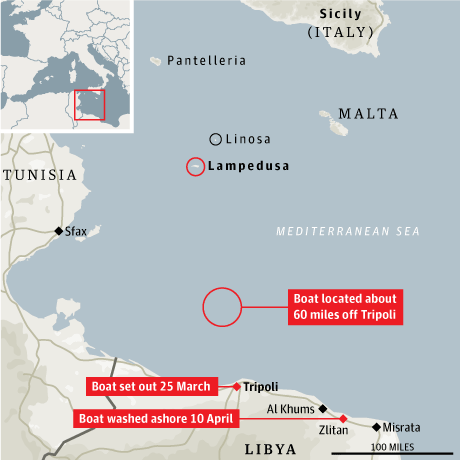
The Guardian on Sunday reported many more details about an incident that began on 25 March when a migrant boat left Libya carrying 72 asylum seekers and which ended 16 days later on 10 April when the disabled vessel washed ashore in Libya with only 11 survivors.  The survivors have described several incidents where military ships and planes ignored their pleas for rescue.  It is clear from the survivors’ descriptions that their disabled vessel was sighted because at one point a military helicopter dropped bottles of water and emergency food rations on the migrant boat.

The UNHCR and Father Mussie Zerai, an Eritrean priest in Rome who runs the refugee rights organisation Habeshia, have called for further investigations into why the boat’s passengers were not rescued.

From the Guardian article: “The Guardian’s investigation into the case of the boat of 72 migrants which set sail from Tripoli on 25 March established that it carried 47 Ethiopians, seven Nigerians, seven Eritreans, six Ghanaians and five Sudanese migrants. Twenty were women and two were small children, one of whom was just one year old. The boat’s Ghanaian captain was aiming for the Italian island of Lampedusa, 180 miles north-west of the Libyan capital, but after 18 hours at sea the small vessel began running into trouble and losing fuel.  Using witness testimony from survivors and other individuals who were in contact with the passengers during its doomed voyage, the Guardian has pieced together what happened next. The account paints a harrowing picture of a group of desperate migrants condemned to death by a combination of bad luck, bureaucracy and the apparent indifference of European military forces who had the opportunity to attempt a rescue….

The Guardian has made extensive inquiries to ascertain the identity of the Nato aircraft carrier, and has concluded that it is likely to have been the French ship Charles de Gaulle, which was operating in the Mediterranean on those dates.  French naval authorities initially denied the carrier was in the region at that time. After being shown news reports which indicated this was untrue, a spokesperson declined to comment.

A spokesman for Nato, which is co-ordinating military action in Libya, said it had not logged any distress signals from the boat and had no records of the incident. ‘Nato units are fully aware of their responsibilities with regard to the international maritime law regarding safety of life at sea,’ said an official. ‘Nato ships will answer all distress calls at sea and always provide help when necessary. Saving lives is a priority for any Nato ships.’”

Click here for full Guardian article.

Click here (IT) for earlier article.

The route of the boat - from guardian.co.uk

2 Comments

Filed under France, Italy, Libya, Malta, Mediterranean, News, UNHCR

Commission Communication on Migration of 4 May

The European Commission today issued a Communication on Migration (COM(2011) 248 final) in response to the ongoing arrivals of migrants and asylum seekers in Italy and Malta and in response to the calls by Italy and France for changes in the implementation or interpretation of the Schengen Agreement.

France has welcomed the Commission’s Communication: “We note with interest that the Commission is considering establishing a mechanism for the temporary reintroduction of controls on some sections of internal borders in cases of difficulties or failures of a Member State. We also welcome the emphasis on strengthening the operational capacity of Frontex, the prospect of ultimately creating a European border guard that France has repeatedly called for. Finally, we welcome with satisfaction the intention of the Commission to propose a suspension clause of the liberalization of visa abuse.” (“Nous relevons ainsi avec intérêt que la Commission envisage l’établissement d’un mécanisme permettant la réintroduction temporaire des contrôles à certaines sections des frontières intérieures en cas de difficultés ou de défaillances d’un État membre. Nous nous félicitons aussi de l’accent mis sur le renforcement des capacités opérationnelles de FRONTEX, avec la perspective de créer à terme un système européen de garde-frontières que la France a régulièrement appelé de ses vœux. Nous accueillons enfin avec satisfaction l’intention de la Commission de proposer une clause de suspension de la libéralisation des visas en cas d’abus.”)

Excerpts from the Commission’s Communication on Migration:

“[***]

The purpose of this Communication is to set recent and future policy proposals in a framework that takes account of all relevant aspects and allows the EU and its Member States to manage asylum, migration and mobility of third-country nationals in a secure environment.

[***]

The continuously evolving situation in our Southern Neighbourhood requires rapid responses. Building upon the European Council Conclusions of 11 and 25 March, the European Parliament’s Resolution of 5 April1, and, the joint Communication of the Commission and the High Representative of 8 March, the Commission will present on 24 May a package of proposals to ensure a coherent EU approach in the area of migration, mobility and security with the Southern Mediterranean countries.

However, the need to address this challenging and evolving situation should not lead to a short-term approach limited to border control without taking account of long-term issues.

[***]

The EU should also ensure that it has in place safe and efficient asylum procedures for people in need of protection. Sixty years after the signature of the Geneva Convention on the Status of Refugees, it is time for the EU to reaffirm its commitment to offer protection to any persecuted third country national or stateless person arriving on its territory. A Common European Asylum System, offering a high level of protection and reducing the disparities among Member States’ asylum systems, must be completed by 2012, as agreed by the European Council.

[***]

At the same time, as recent events have starkly illustrated, the EU continues to face serious challenges in the development of its migration policy. The vulnerability of some sections of the EU’s external borders is a clear example, notably in the Southern Mediterranean and at the land border between Greece and Turkey. In particular, measures must be taken to prevent large numbers of irregular migrants, often exploited by unscrupulous criminal networks, from arriving in the EU. The EU should accordingly pursue a migration policy based on ensuring that inward migration is effectively managed and ensure that the need for enhanced mobility does not undermine the security of the Union’s external borders. While this Communication naturally focuses on regions of most immediate concern, the EU’s migration policy follows a geographically comprehensive approach.

[***]

However, while the current crisis confirms the need for increased solidarity at the European level and better sharing of responsibility, it must be recognised that the EU is not fully equipped to help those Member States most exposed to massive migratory movements.

[***]

Building on the experience gained so far with the current pilot project on relocation from Malta, the Commission will support an extension of this project in view of the current influx of migrants seeking international protection there, to be implemented in close cooperation with the United Nations High Commissioner for Refugees and the International Organisation for Migration.

However, the currently available instruments fall short of fulfilling all the needs and providing a comprehensive response. They can only be resorted to in an ad hoc manner, and are entirely dependent on the will of Member States to voluntarily offer assistance – in whatever form – at a given point in time. This in turn exposes the EU to criticism and risks undermining the trust of the citizens in the EU.

The Commission will closely monitor the continuously evolving situation and may decide, if the relevant conditions are met, to trigger the Temporary Protection Directive3 to provide immediate and temporary protection to displaced persons from third countries that are unable to return to their country of origin.

The Commission will make further proposals during 2011 on delivering solidarity in a holistic manner and how concretely such assistance can be delivered. A number of different approaches are currently being studied, with a view to developing alternatives that will allow urgent needs to be responded to in a more rapid and structured fashion. This initiative will build on the appropriate legal basis of the Lisbon Treaty, such as Articles 80 and 78 paragraph 3, and will draw lessons from the situation in Greece, particularly at the land border between Greece and Turkey, and the crisis in the Southern Mediterranean; it will include possible ad hoc measures to be resorted to in case of particular temporary pressure on one or several Member States, as well as more structural means of ensuring solidarity, both financial and in the form of practical cooperation and technical assistance (e.g. via FRONTEX, EASO, joint operations).

[***]

FRONTEX’s role is key in channelling resources to places where the border is under pressure, as shown by the deployment – for the first time ever – of rapid border intervention teams to the Greek-Turkish land border in 2010 and the deployment of the joint naval operation HERMES to support Italy in 2011. FRONTEX’s legal framework needs be updated to allow it to be more effective in terms of its operational capacity to act at the external border. The Commission proposed the necessary changes in February last year5 and it is now urgent, especially in the light of recent events, that the Council and the Parliament approve this proposal before the end of this semester, as called for by the European Council.

[***]

[A] clear system for Schengen governance is needed. Currently the Union still relies on an intergovernmental system of peer reviews to ensure the application of the common rules. The current revision of the Schengen evaluation mechanism should be based on a Community approach with participation of experts from Member States, FRONTEX and lead by the Commission. The proposed mechanism would ensure more transparency and improve the follow-up of shortcomings identified during the experts’ evaluations. The Commission will also issue guidelines to ensure a coherent implementation and interpretation of the Schengen rules.

A mechanism must also be put in place to allow the Union to handle situations where either a Member State is not fulfilling its obligations to control its section of the external border, or where a particular portion of the external border comes under unexpected and heavy pressure due to external events. A coordinated Community-based response by the Union in critical situations would undoubtedly increase trust among Member States. It would also reduce recourse to unilateral initiatives by Member States to temporarily reintroduce internal border controls or to intensify police checks in internal border regions which inevitably slow down the crossing of internal borders for everyone. Such a mechanism may therefore need to be introduced, allowing for a decision at the European level defining which Member States would exceptionally reintroduce internal border control and for how long. The mechanism should be used as a last resort in truly critical situations, until other (emergency) measures have been taken to stabilise the situation at the relevant external border section either at European level, in a spirit of solidarity, and/or at national level, to better comply with the common rules. The Commission is exploring the feasibility of introducing such a mechanism, and may present a proposal to this effect shortly.

[***]

One of the main purposes of the Common European Asylum System is to reduce the wide divergence in the outcome of asylum applications lodged in different countries of the EU, and to ensure a common set of procedural and substantive rights which can be relied on across the Union, while ensuring full compliance with the 1951 Geneva Convention on refugees and other relevant international obligations.

In 2010, there were some 257 800 asylum seekers registered in the EU, or 515 applicants per million inhabitants. Ten Member States accounted for more than 90% of applicants registered in the EU17.

It is time to complete the Common European Asylum System by reaching agreement on a balanced package by the 2012 deadline agreed by the European Council in December 2009. To that end, the Commission will shortly put forward modified proposals on the Reception Conditions and the Asylum Procedures Directives. A balanced agreement on the revision of the Dublin Regulation must be reached, including on a last resort emergency mechanism in case of exceptional pressures, and on the revised Eurodac system.

[***]”

Click here for the Communication – COM(2011) 248 final.

Click here for Commission Press Statement and here for Commission FAQs.

Click here for French Government’s Point de Presse.

3 Comments

Filed under Communiqués, European Union, France, Frontex, Italy, Libya, Malta, Mediterranean, News, Tunisia

2500+ New Migrant Landings in Lampedusa; Italy and Malta in New Diplomatic Dispute Over Search and Rescue Responsibilities

Migrant boats carrying over 2500 persons arrived in Lampedusa over the weekend.  The boats are all believed to have departed from Libya.  Improving sea conditions are thought to be responsible for the new surge in migrant boats.  Italy has said it will lodge a formal diplomatic complaint with Malta over what it says was Malta’s failure to rescue a migrant boat in distress.  The migrant boat in question was apparently closer to Lampedusa than to Malta, but was within the Maltese SAR zone when a distress call was made.  Maltese authorities said they were unable to send their patrol boats to the boat that was in distress due to bad sea conditions.  Italian coast guard boats eventually provided assistance while NATO and Armed Forces of Malta aircraft provided air surveillance.

Click here (IT), here (EN), here (EN) and here (EN) for articles.

2 Comments

Filed under Frontex, Italy, Libya, Malta, Mediterranean, News