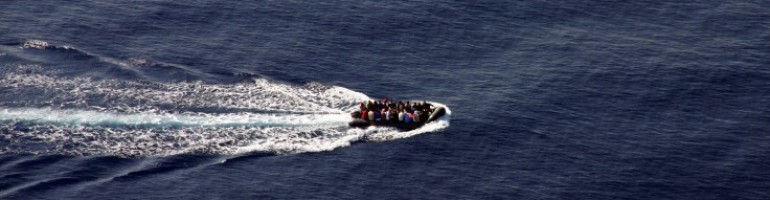
Austrian Interior Minister Maria Fekter said that while she doubts there will be a massive flow of refugees from Libya, if necessary, Austria would be in a position to accept up to 6,000 asylum seekers.
Click here (EN) and here (DE) for articles.
Austrian Interior Minister Maria Fekter said that while she doubts there will be a massive flow of refugees from Libya, if necessary, Austria would be in a position to accept up to 6,000 asylum seekers.
Click here (EN) and here (DE) for articles.
Filed under Austria, European Union, Italy, Libya, Malta, Mediterranean, News
An article from OpenDemocracy by Prof. Gregor Noll (Lund University) and Mariagiulia Giuffré (doctoral candidate at the School of International Studies, University of Trento):
“[T]here is a far-reaching consensus that a government [such as the Gaddafi Government] that uses indiscriminate lethal force to retain power is, as the diplomatic phrasebook has it, “unacceptable”. Yet, over the past six years, it has been perfectly acceptable for EU governments to outsource its border protection to an authoritarian leader with a dismal human rights record…. We, the citizens of the EU, should also be reminded that for over three years now, we have relied on Gaddafi and his state apparatus to keep asylum seekers and other migrants away from our doors….”
Click here for article.
Filed under Analysis, European Union, Italy, Libya, Mediterranean
Du blog de “Défense en ligne” écrit par Philippe Leymarie: “Guerre civile en Libye et options militaries.”
“Alors que le Conseil de sécurité de l’ONU réuni vendredi dernier a décidé d’un embargo sur les armes et de sanctions contre le régime Kadhafi, la violence de la répression en Libye a incité les pays européens, qui n’envisagent pas d’intervention militaire pour le moment, à entamer une démonstration de force… navale, qui a pris forme en quelques heures, avec une célérité inhabituelle. Une petite armada converge en direction des côtes libyennes, dans ce qui pourrait, à terme, devenir une véritable opération, mêlant la dissuasion à l’humanitaire. …
“Dans la pratique, le déploiement de cette petite armada pourrait également constituer un cordon de sécurité afin d’éviter une fuite en masse par la mer de Libyens ou d’immigrés africains vers l’Europe – donnant plus de consistance à l’opération de surveillance « Hermès », entamée (sous la pression notamment de l’Italie, en première ligne) par l’agence européenne Frontex….”
Cliquez ici pour l’article complet.
Filed under Analysis, European Union, Frontex, Libya, Mediterranean, United Nations
From Migration Policy Institute’s MPI Data Hub: annual number of asylum applications in select countries. I copied the data for years 2004-2009 below. Click here for the data for the years 1980-2009, footnotes, and source information.
| Countries of destination | 2004 | 2005 | 2006 | 2007 | 2008 | 2009 |
| Australia | 3,201 | 3,204 | 3,515 | 3,980 | 4,771 | 6,170 |
| Austria | 24,634 | 22,461 | 13,349 | 11,921 | 12,841 | 15,830 |
| Belgium | 15,357 | 15,957 | 11,587 | 11,114 | 12,252 | 17,190 |
| Canada | 25,750 | 20,786 | 22,868 | 27,865 | 34,800 | 33,250 |
| Denmark | 3,235 | 2,260 | 1,918 | 1,852 | 2,360 | 3,750 |
| Finland | 3,861 | 3,574 | 2,324 | 1,505 | 4,016 | 5,910 |
| France | 58,545 | 49,733 | 30,748 | 29,387 | 35,404 | 41,980 |
| Germany | 35,613 | 28,914 | 21,029 | 19,164 | 22,085 | 27,650 |
| Greece | 4,469 | 9,050 | 12,267 | 25,113 | 19,884 | 15,930 |
| Ireland | 4,765 | 4,325 | 4,315 | 3,985 | 3,866 | 2,690 |
| Italy | 9,722 | 9,548 | 10,348 | 14,057 | 30,324 | 17,600 |
| Netherlands | 9,782 | 12,347 | 14,465 | 7,102 | 13,399 | 14,910 |
| Norway | 7,945 | 5,402 | 5,320 | 6,528 | 14,431 | 17,230 |
| Spain | 5,535 | 5,254 | 5,297 | 7,662 | 4,517 | 3,000 |
| Sweden | 23,161 | 17,530 | 24,322 | 36,373 | 24,353 | 24,190 |
| United Kingdom | 40,620 | 30,815 | 28,335 | 27,880 | 31,315 | 29,840 |
| United States | 44,972 | 39,240 | 41,101 | 40,449 | 39,362 | 38,968 |
Filed under Australia, Belgium, Data / Stats, Denmark, European Union, France, Germany, Greece, Italy, Netherlands, Spain, Sweden, UK, United States
A new report from Entreculturas and Alboan:
“Casi 25 millones de euros de un total de 466 es la Ayuda Oficial al Desarrollo destinada a países de África Occidental cuestionada por contribuir más a intereses de la política de migraciones que al desarrollo humano y lucha contra la pobreza durante el periodo 2004-2008. Es una de las conclusiones del informe “Políticas de control migratorio y de cooperación al desarrollo entre España y África Occidental durante la ejecución del primer Plan África” presentado por Entreculturas y Alboan….”
Resumen: “En el marco de la coherencia de políticas a favor del desarrollo, y con el objetivo de investigar si la cooperación bilateral española está condicionada por intereses de control de los flujos migratorios, las ONG Alboan y Entreculturas presentan el informe ‘Políticas de control migratorio y de cooperación al desarrollo entre España y África Occidental durante la ejecución del primer Plan África’ que analiza el destino de la ayuda oficial al desarrollo (AOD). España durante los años 2004 – 2008 ha destinado 25 millones de euros de AOD a proyectos que tienen más relación con el control de fronteras e intereses comerciales que con el desarrollo humano y lucha contra la pobreza. Esto supone un 5,2% de del total de la ayuda de AOD bilateral en África Occidental.”
Click here (ES) or here (ES) for full report.
Click here (ES) for news article.
Italian Defence Minister Ignazio La Russa stated that “the Italy-Libya treaty is effectively defunct, inoperative, suspended.” In addition to the migration control provisions, the treaty also contains provisions which forbade Italy from participating in military actions again Libya.
La Russa also said that the Italian Finance Police officers who under the terms of the treaty were assigned to Libyan patrol vessels engaged in anti-migrant patrols have been withdrawn and are present at the Italian embassy in Tripoli.
Click here (EN), here (EN) (WSJ registration required), here (IT), and here (IT) for articles.
Filed under Italy, Libya, Mediterranean, News
The Malta Independent reported yesterday that Frontex Director Ilkka Laitinen will visit Malta shortly “with a view to organising a Frontex mission that would be hosted by Malta but, [Justice and Home Affairs Minister] Dr Mifsud Bonnici stresses, not under the infamous guidelines that are being disputed [before the European Court of Justice] by Malta, Italy and the European Parliament.” Dr Mifsud Bonnici said “I have also made it a precondition that if we are to host this Frontex mission, it would not be under those guidelines and there is an agreement on that.”
Malta’s primary objection to the Frontex Sea Border Rule is likely due to provisions which require that intercepted migrants be taken to the country hosting the Frontex mission under certain circumstances. The relevant provision provides:
“2. Disembarkation- 2.1. The operational plan should spell out the modalities for the disembarkation of the persons intercepted or rescued, in accordance with international law and any applicable bilateral agreements. The operational plan shall not have the effect of imposing obligations on Member States not participating in the operation. Without prejudice to the responsibility of the Rescue Coordination Centre, and unless otherwise specified in the operational plan, priority should be given to disembarkation in the third country from where the ship carrying the persons departed or through the territorial waters or search and rescue region of which that ship transited and if this is not possible, priority should be given to disembarkation in the host Member State unless it is necessary to act otherwise to ensure the safety of these persons.”
Commissioner Cecilia Malmström has previously said that the Sea Border Rule guidelines can be negotiated by member states on a mission by mission basis and that before a mission starts participating member states can agree on different rules of engagement, which might include the sharing of responsibility where not all intercepted migrants would be brought to country hosting the mission.
Click here for Malta Independent article.
Click here for previous post regarding Malmström’s comments.
Filed under European Union, Frontex, Libya, Malta, Mediterranean, News
The assets dedicated to Joint Operation Hermes Extension continue to increase, although at present there are only two coastal patrol boats (Italian) participating in the Frontex mission. Ten surveillance aircraft will soon be deployed. See the table with the list of resources below.
While the naval assets dedicated to JO Hermes Extension are minimal, there is a growing number of EU and NATO naval ships in the Central Mediterranean. Nicolas Gros-Verheyde (writing on the Bruxelles2 blog (FR)) has counted 14 naval ships from EU states that are present in the waters near Libya; the ships consist of destroyers, frigates, electronic surveillance ships, and supply and support ships. Additionally, Turkey has two naval ships in the area.
Some of the naval ships have already been used to evacuate European and other non-Libyan nationals from Libya. What additional activity the EU ships may engage in remains to be seen. They may become involved in military activities (presumably with UN authority (?)) and/or they may play a yet undetermined role should there be a sudden flow of migrants and asylum seekers from Libya. If there is a sudden and significant migratory flow, the naval ships should function in a search and rescue manner, but there is always the possibility that if faced with large numbers of migrants, the navy vessels may be used to interdict, blockade, or otherwise to try to prevent migrants from leaving Libya.
Click here for link to Frontex update regarding deployed assets.
Click here and here for Bruxelles2 postings. (FR)
Table: Resources available to JO Hermes Extension 2011 as of February 25, 2011.
| Italy (HMS) | 2 Coastal Patrol Vessel, 1 aircraft, 5 experts, 2 cultural mediators |
| Austria | 1 expert |
| Belgium | 2 experts |
| Denmark | 3-5 experts |
| France | 10 experts, 1 aircraft |
| Germany | 2 experts, 2 aircrafts |
| Hungary | 2 experts |
| the Netherlands | 1 aircraft, 2 experts |
| Portugal | 7 experts, 1 aircraft |
| Romania | 6 experts |
| Sweden | 1 expert |
| Switzerland | 2 experts |
| Spain | 4 experts, 1 aircraft (at a later stage) |
Filed under Algeria, Data / Stats, European Union, Frontex, General, Italy, Libya, Malta, Mediterranean, News, Tunisia
LIBE will meet on Monday and Tuesday with a full and timely agenda. I’ll try to post summaries of several of the meeting documents which are now posted on the EP LIBE Meeting Document page later today or Sunday.
Here are some of the agenda items to be voted on or considered:
28 Feb. 2011, 15.00 (room PHS, Hemicycle)
Item 4. Adoption of Draft Opinion – Migration Flows arising from Instability: Scope and Role of the EU Foreign Policy
[Frenzen’s note – the draft opinion on which the vote will be taken is dated 14 January 2011 and was prepared before the current situation in North Africa became apparent].
Click here for Draft Opinion and here for Amendments 1-53.
Item 12. Consideration of Amendments – Minimum standards on procedures in Member States for granting and withdrawing international protection (recast)
Click here for Draft Report and here for Amendments 54 – 286.
Click here for “Proposal for a DIRECTIVE OF THE EUROPEAN PARLIAMENT AND OF THE COUNCIL on minimum standards on procedures in Member States for granting and withdrawing international protection.”
Item 15. Consideration of Working Document – European Union’s Internal Security Strategy
Click here for Part 1 of the Working Document on the European Union’s internal security strategy and here for Part 2.
1 March 2011, 9.00 (Meeting with the Council and Commission – N.B. this part of the meeting will be held in meeting room JAN 4 Q 2)
Item 17. The democratic process in the central Mediterranean area, the impact on migration fluxes and the EU immigration and asylum policy.
Exchange of views in the presence of:
No documents for this item have been posted.
Click here for the Full Agenda of the LIBE meeting and here for the Meeting Documents page.
Filed under European Union, Frontex, Libya, Mediterranean, News, Tunisia
From CIR: “…[I]l Network Euro Mediterraneo per i Diritti dell’Uomo ha organizzato una missione di raccolta informazioni, che si è svolta dal 18 al 24 febbraio prima in Tunisia e poi in Italia. La missione era composta da rappresentanti di organizzazioni membro del Network e di partner e da esperti del Nord e del Sud del Mediterraneo. La missione ha potuto raccogliere testimonianze e informazioni dirette, tanto in Tunisia che in Italia.
La missione ha permesso di smentire sia la tesi della presenza massiva tra i migarnti arrivati in Italia di delinquenti di diritto comune evasi dalle carceri, sia quella di un complotto migratorio che sarebbe stato ordito dalla Libia e dai nostalgici di Ben Ali.
Nel corso della missione, le preoccupazione legate agli avvenimenti drammatici che sconvolgono la Libia hanno, in qualche maniera, soppiantato gli interrogativi che circondano i migranti tunisini.
Al termine di questa missione, il Network formula le seguenti raccomandazioni:
Alle autorità italiane:
Alle autorità tunisine
Alle autorità europee
Click here (IT) for full CIR post.
See also CIR “Emergenza Nord Africa”.
Filed under European Union, General, Italy, Libya, Mediterranean, Reports, Statements, Tunisia
Consiglio Italiano per i Rifugiati (CIR) created a special web page – Emergenza Nord Africa – which is tracking migration and other related aspects of the North African crisis.
Click here (IT).
Filed under European Union, Italy, Libya, News, Tunisia
The JHA Council yesterday rejected Italy’s call for a stronger EU response to what it describes as an impending migrant flow from North Africa consisting of hundreds of thousands of migrants and asylum seekers. Several EU governments described the Italian request as one that was based on exaggerated fears. Hungary’s interior minister, Sandor Pinter, told reporters that “we shouldn’t paint the devil on the wall until he appears.” German Interior Minister Thomas de Maiziere said “we shouldn’t be painting horror figures and encouraging refugees to come to Europe.” Another accused Italy of “crying wolf.”
IOM spokeswoman Jemini Pandya said that while Italy should not shoulder a refugee burden on its own, no Libyans have arrived in Italy to date and she rejected the Italian estimates: “I don’t think in any shape or form you are going to see one-and-a-half million migrants suddenly flood into Europe. That is really not going to happen at all. That would really be fear mongering to the extreme.”
Italy has done itself and neighbouring countries a disservice by repeatedly speaking of an “exodus of biblical proportions” and by suggesting that many hundreds of thousands of migrants are poised to take to the sea to try to reach Italy and Malta from Libya. These estimates are in all likelihood grossly exaggerated.
But even if you agree that Italy’s feared numbers are exaggerations, the fact that no irregular migrant or asylum seeker has apparently yet left Libya by sea is not at all surprising. Libya is in chaos and few people are likely to try to depart the country by sea until the level of violence begins to diminish. Libya has (or had) a functioning network of human traffickers and they will be ready to begin exploiting the chaos and to take advantage of desperate people seeking to flee at some point in the future. If Gaddafi manages to remain in power, once he is no longer concerned with his personal survival, his thoughts will at some point turn to revenge. Libya will presumably cease cooperating with Italy on the bi-lateral pushback practice, and Gaddafi will tolerate or encourage irregular migration towards Europe. So Italy is correct in that there is a real threat of significant numbers of migrants and asylum seekers leaving from Libya some time in the near future. The numbers could easily and quickly surpass the 6,000 who have left Tunisia for Lampedusa. Could the numbers surpass 30,000? 30,000 asylum seekers entered Sweden last year (population 9 million – Italy’s population is 50+ million) and Sweden has not received any extraordinary EU assistance as a result. Could the numbers exceed the hundreds of thousands that fled the Balkan wars in the 1990s? Possible, but probably not very likely.
Click here, here, here, here, and here for articles. (EN)
From AlertNet: “Tens of thousands of impoverished migrant workers from sub-Saharan Africa and southern Asia may be trapped by the escalating violence in Libyan cities, unable to leave the country because they cannot pay for transport to border areas, the International Organization for Migration (IOM) said on Thursday. … ‘We are very concerned for all those migrants who may wish to leave, but cannot,’ Laurence Hart, IOM’s chief of mission for Libya, said in a statement. … IOM spokesman Jean Philippe Chauzy told AlertNet around half a dozen states … to evacuate their nationals from Libya. The agency says it currently does not have the funds to launch such an operation, and will make an appeal for additional contributions on Friday. … On Wednesday, the U.N. refugee agency (UNHCR) said it had received ‘alarming reports’ Libyans were turning on refugees from other African countries, suspecting them of being mercenaries fighting for Gaddafi’s administration. ‘African refugees from Somalia, Ethiopia and Eritrea have told us that just being a black face in Libya is very dangerous at the moment,’ spokeswoman Sybella Wilkes told Reuters….”
Click here for full article.
Filed under Libya, Mediterranean, News, UNHCR
According to an article in The Australian, “the Immigration Department approved 94 per cent of all refugee status claims from people arriving illegally by boat, after initial assessments and independent merits reviews, between October 2008 and December 22 last year. In stark contrast, the department approved only 39 per cent of protection visa requests for non-boat arrivals in the first half of this financial year…” “South Australian independent MP Bob Such, who lodged the [Freedom of Information] request [which resulted in the release of the data], said the high number of successful refugee claims by people arriving by boat showed the federal government’s detention policies were ‘flawed’. ‘Not only is the current policy costly and harmful to their mental state, it’s costly to Australia,’ Dr Such said. ‘They’re spending hundreds of millions . . . on detaining people who are no threat at all.’…”
Click here for full article.
(As reported in the Human Rights Law Resource Centre (Australia) Human Rights News Stories for the week ending 25 February 2011.)
Filed under Australia, Data / Stats, Indian Ocean, News
ASIL has just published an Insight article about M.S.S. v. Belgium & Greece written by Tom Syring, Co-chair of the ASIL International Refugee Law Interest Group, who currently serves at the Norwegian Immigration Appeals Board.
Excerpt from the conclusion: “Apart from criticizing Greece for the current conditions of detention and subsistence awaiting asylum seekers, and Belgium for ‘intentional blindness’ for failing to properly scrutinize the adequacy of protection against refoulement in Greece, despite the fact that circumstances had called for application of the sovereignty clause, the Grand Chamber’s judgment exposes flaws in the current European asylum regime.
The judgment acknowledges … challenges [posed by CEAS and the Dublin regulation], yet underlines that neither uneven burden-distribution (Greece) nor a state’s minimalist reading of the Dublin Regulation (Belgium) absolves Member States of their responsibilities vis-à-vis the Convention or other applicable international treaties, including the 1951 Refugee Convention. As long as the EU and CEAS are comprised of individual Member States, as opposed to a ‘United States of Europe,’ individual states will be held responsible for independently assessing each case for the risk of direct or indirect refoulement. While the Grand Chamber judgment uncovered a number of deficiencies in the current European asylum system, solutions to CEAS may have to be found outside the ‘Dublin world.’”
Click here for full article.


 MIGRANTS AT SEA