Tag Archives: Search and Rescue

PACE Rapporteur to Begin Fact-Finding Mission to Italy to Investigate Mediterranean Migrant Deaths

Tineke Strik (Netherlands, SOC) will begin a two day fact-finding trip to Italy on 6 September as Rapporteur for the PACE Migration Committee (Parliamentary Assembly of the Council of Europe).  She is investigating the deaths of boat people who have died in the Mediterranean since January 2011.

From the PACE press statement of 2 September:  “Meetings are scheduled with survivors of a shipwreck, officers of Italian coastguard units, representatives of NGOs active in the field and representatives of the Office of the United Nations High Commissioner for Refugees.  During her visit the rapporteur will in particular look into the way boats are intercepted – or not intercepted – by national coastguard forces, or by military vessels under either NATO or national command.  Further to reports that migrants and refugees have perished after their distress calls were ignored, the PACE Committee on Migration, Refugees and Population appointed Ms Strik in June to conduct an inquiry into these matters.”

From the PACE press statement issued in June 2011: “‘There have been allegations that migrants and refugees are dying after their appeals for rescue have been ignored,’ said Mrs Strik. ‘Such a grave allegation must be urgently investigated.  I intend to look into the manner in which these boats are intercepted – or not – by the different national coastguards, the EU’s border agency FRONTEX, or even military vessels. I also intend to speak to witnesses directly involved in reported incidents, and put questions to national authorities, the UNHCR, FRONTEX and NATO, among others.’  On 8 May, the Guardian newspaper reported that 61 boat people escaping from Libya had died after their appeals for rescue had been ignored by armed forces operating in the Mediterranean. The following day PACE President Mevlüt Çavusoglu called for ‘an immediate and comprehensive enquiry’ into the incident.”

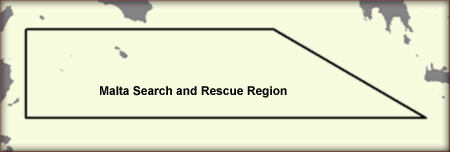
Presumably Ms. Strik’s investigation will also seek information from Maltese authorities.  The Maltese Rescue Coordination Centre run by the Armed Forces of Malta is in possession of relevant information pertaining to incidents within the Maltese Search and Rescue Area where many (perhaps most?) of the migrant deaths have occurred.

Click here and here for COE press statements.

Click here for link to COE’s web page regarding “PACE’s Response to Migrants and refugees arriving from North Africa.”

Click here and here for my previous posts on the topic.

1 Comment

Filed under Council of Europe, European Union, Frontex, Italy, Libya, Malta, Mediterranean, News, Reports, Tunisia

10th Anniversary of Australia’s Tampa Affair

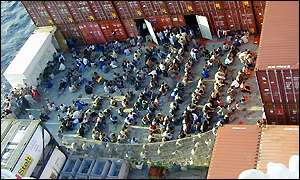
Today, 26 August, marks the ten year anniversary of the beginning of the Tampa affair in Australia.  On 26 August 2001, the Norwegian cargo ship Tampa responded to a distress call issued by the Australian Rescue Coordination Centre and rescued over 430 Afghan asylum seekers from a sinking migrant boat.  Australian Prime Minister John Howard’s government refused to permit the Tampa to offload the rescued asylum seekers on Christmas Island, the closest place of safety.  After a several day stand-off, the Tampa’s captain declared an emergency and entered Australian territorial waters.  Australian SAS special forces boarded the Tampa and took control of the ship.  The asylum seekers were eventually transferred to a naval vessel and sent to Nauru where they were detained.  The incident marked the beginning of Australia’s so-called Pacific Solution policy.

Here is an excerpt from UNHCR’s 2006 State of the World’s Refugees report describing the incident:

“A recent renowned rescue at sea was carried out by the Norwegian merchant ship Tampa in August 2001. Sailing from Perth, Australia under the command of Captain Arne Rinnan, the freighter of the Wallenius Wilhelmsen Line received a call for assistance from the Rescue Coordination Centre of the Australian Maritime Safety Authority. The Tampa changed course and was guided by an Australian coastal search airplane to reach an Indonesian boat crowded with passengers and in acute distress. The boat was breaking up in heavy seas as the Tampa arrived just in time to transfer the 433 people on board to its own decks. The Norwegian ship had facilities on board for only 50 people, including its crew of 27.

The closest port to the site of the rescue was on Christmas Island, an Australian territory, but Australia’s Immigration Department forbade the Tampa to enter Australian territorial waters. The Australian government was determined to stop unauthorized arrivals of asylum seekers, and so refused to disembark the Tampa‘s passengers and permit the vessel to proceed on its scheduled route. After long and tense negotiations – during which conditions on board the Tampa reached crisis proportions – a complicated and costly arrangement saw the passengers forcibly removed from the ship and dispersed to camps in Nauru, a small state nearby. Some 132 unaccompanied minors and families were accepted by New Zealand, where almost all received refugee status. None went directly to Australia. In this long process, the owners and agents of the Tampa incurred substantial losses.

At the time, the obligation to render assistance to vessels in distress was codified in international maritime law in such instruments as the UN Convention on the Law of the Sea (1982) and the International Convention on Maritime Search and Rescue (1979). The obligation to extend aid applies without regard to the nationality, status, or circumstances of the persons in distress. Under these rules, ship owners, ships masters, coastal nations and flag states (the states where ships are registered) all have responsibilities for search and rescue.

The International Convention on Search and Rescue mandates that a rescue is not complete until the rescued person is delivered to a place of safety. That could be the nearest suitable port, the next regular port of call, the ship’s home port, a port in the rescued person’s own country, or one of many other possibilities. The convention provides that ‘a situation of distress shall be notified not only to consular and diplomatic authorities but also to a competent international organ if the situation of distress pertains to refugees or displaced persons.’ The ship itself cannot be considered a ‘place of safety’ – indeed, carrying a large number of unscheduled passengers could endanger the crew and passengers themselves, owing to overcrowding, insufficient food and water and the tensions of life at close quarters.

The inability to disembark rescued passengers in a timely fashion and return to scheduled ports of call lead to strong reluctance in the maritime industry to engage actively in search and rescue missions. For their principled actions in the face of such profound disincentives, in 2002 UNHCR gave the captain, crew and owner of the Tampa its highest award, the Nansen Refugee Award.

The Tampa affair helped focus international attention on the question of who has responsibility for accepting asylum seekers rescued at sea, adjudicating their claims, and providing a place of safety for those who are confirmed in their need for international protection. In 2002, the general assembly of the International Maritime Organization (IMO) adopted a resolution seeking to identify any gaps, inconsistencies and inadequacies associated with the treatment of persons rescued at sea. IMO solicited the input of a number of UN agencies in a search for a coordinated approach to the issue.

Consequently, in 2004 IMO’s Maritime Safety Committee adopted pertinent amendments to the International Convention for Safety at Sea and the International Convention on Maritime Search and Rescue. (These amendments are to enter into force on 1 July 2006.) At the same session, the committee adopted the current Guidelines on the Treatment of Persons Rescued at Sea. The purpose of these amendments and the current guidelines is to ensure that persons in distress are assisted, while minimizing the inconvenience to assisting ships, and to safeguard the continued integrity of the International Convention on Maritime Search and Rescue.

The amendments impose upon governments an obligation to cooperate to ensure that captains of ships that have rescued persons in distress at sea are released from their obligations with the minimum further deviation from the ship’s intended route. The government or party responsible for maritime safety and rescue where survivors are recovered is responsible for ensuring that a place of safety is provided. The guidelines, on the other hand, aim to help governments and masters of ships fulfil their legal and humanitarian obligations to persons rescued at sea.”

Click here and here for articles.

Click here for Wikipedia entry on the Tampa Affair.

Click here for UNHCR 2006 State of the World’s Refugees report.
Leave a comment

Filed under Australia, Indian Ocean, News

Italy Calls for Formal Inquest Into “Presumed Failure” of NATO to Render Assistance to Disabled Migrant Boat and for Expansion of NATO Mandate to Include Rescue at Sea

Here is today’s full statement from the Italian Foreign Ministry:

Minister for Foreign Affairs Franco Frattini instructed the Italian Permanent Representative to NATO to call for a formal inquest into the dynamic regarding the presumed failure to come to the aid of boats carrying civilians fleeing Libya. Minister Frattini also asked Ambassador Sessa to urge discussion within the Atlantic Alliance of the possibility of adapting the mandate of the mission sanctioned by UN resolutions 1970 and 1973 to safeguard Libyan civilians, to the effect that the defence and aid of those fleeing the conflict by sea, and thereby risking their lives, be adequately taken into consideration.

In relazione alle polemiche circa il presunto mancato soccorso a battelli con clandestini a bordo in fuga dalla Libia, il Ministro degli Esteri Frattini ha dato istruzioni al Rappresentante Permanente italiano presso la NATO di chiedere un’inchiesta formale per l’accertamento della dinamica di quanto accaduto. Il Ministro Frattini ha anche chiesto all’Ambasciatore Sessa di sollecitare una discussione all’interno dell’Alleanza Atlantica per il possibile adeguamento del mandato della missione di salvaguardia delle popolazioni civili in Libia, sulla base delle risoluzioni delle Nazioni Unite 1970 e 1973, affinchè vengano opportunamente considerate la tutela e soccorso anche di coloro che per cause belliche sono costretti a fuggire su barconi mettendo a rischio la propria incolumità.

Click here (EN) and here (IT) for links.

Click here (EN), here (EN) and here (IT) for articles.

Click here for previous post.

2 Comments

Filed under Italy, Libya, Mediterranean, News

Italy Rescues 300 Migrants from Disabled Boat; Multiple Deaths May Have Occurred Before Rescue; Italy Seeks Clarification Regarding Possible Failure of NATO Ship to Render Assistance

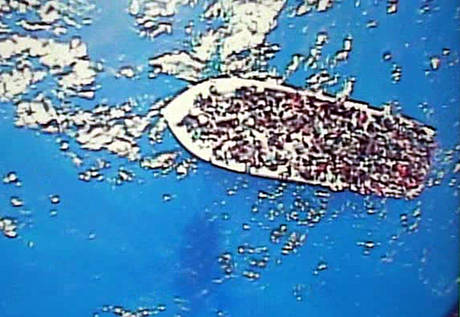
Italian patrol boats yesterday rescued approximately 300 migrants from a disabled boat 90 miles south of Lampedusa.  There are unconfirmed reports from survivors that before the rescue many people died and bodies were put in the sea.  The boat may have been drifting for one and a half days before the rescue.

The disabled migrant boat was reportedly first discovered by a Cyprus tug boat which was forced to move away from the disabled boat when some migrants jumped overboard and tried to swim to the tug.  An Italian helicopter which attempted to lower emergency supplies was forced to abandon its efforts when persons attempted to climb into the basket being used to drop supplies.

According to news reports, a NATO ship was located about 27 miles from the disabled migrant boat, but NATO reportedly failed to respond to a request by Italian authorities to render assistance.  Italian patrol boats were then forced to travel 90 miles from Lampedusa in order to reach the migrant boat.

The Italian government is seeking clarification from NATO regarding the possible failure to respond to the request to render assistance to the migrant boat.  A Spanish frigate under NATO command on 11 July rescued 100 migrants.  During the five day period that the migrants were on board the Spanish frigate, before the migrants were eventually transferred to Tunisian authorities, the Spanish frigate was removed from its NATO Operation Unified Protector embargo patrols due to the civilian passengers.

Click here, here, here, here, and here for articles. (IT)

Click here and here for articles.  (EN)

Click here for short AFP TV video from rescue helicopter.

Click here and here for previous posts on migrant rescue by Spanish frigate.

Image of migrant boat from monitor inside Italian rescue helicopter


3 Comments

Filed under Italy, Libya, Mediterranean, News

[Post Updated 4 August] Spanish Defence Ministry: NATO Instructed Spanish Navy to Transfer Rescued Migrants to Tunisia

A press release issued yesterday by the Spanish Ministry of Defence states that the 114 migrants who were rescued by the Spanish frigate Almirante Juan de Borbón on 11 July were transferred to Tunisian authorities on 16 July pursuant to orders issued by NATO command.

I previously have sought clarification from both NATO and the Spanish Defence Ministry regarding who made the decision to turn the rescued migrants over to Tunisian authorities and what procedures, if any, were followed to screen rescued migrants before the transfer.  NATO’s Operation Unified Protector press office informed me that all inquiries had to be directed to the Spanish Defence Ministry.  The Defence Ministry’s press office in turn has ignored my inquiries.

[Update – 4 August – I received information today from Communication Office of the Spanish Ministry of Defence reiterating that the Spanish frigate was under NATO command as an asset participating in NATO’s Operation Unified Protector.  According to the Communication Office, after the Spanish frigate commander made the decision that the migrants needed to be rescued, all of the frigate’s subsequent actions were carried out pursuant to specific commands issued by the NATO command, including the final order to transfer the migrants to Tunisian authorities.  Spanish authorities were never involved in discussions or negotiations with other countries regarding the rescued migrants.  The Communication Office referred me to NATO’s OUP Press Office for information regarding any further details of the operation.  I will try again with NATO.]

The press release issued yesterday pertains to a visit made to the Spanish  frigate Almirante Juan de Borbón by Italian Rear Admiral Filippo Maria Foffi, Commander of the NATO naval task group for Operation Unified Protector, where he praised the crew of the frigate for the rescue operation.

The press release goes on to state that after the migrants were taken on board the frigate on 11 July, “on orders from NATO command, the Juan de Borbón sailed to Malta and took a position 40 miles off the coast of that country. On 16 July, instructed by the command of NATO, the Spanish frigate headed for the coast of Tunisia to start the transfer to the Tunisian Navy patrol boat Carthage of the 106 immigrants who were still on board, after the earlier evacuation of eight persons for health and medical reasons.”

(“…siguiendo órdenes del mando de la OTAN, la ‘Juan de Borbón’ puso rumbo a Malta posicionándose a 40 millas frente a las costas de ese país.  El pasado 16 de julio, siguiendo instrucciones del mando de la Alianza, se dirigió hacia las costas de Túnez para iniciar el traslado al patrullero Carthage de la Armada tunecina, de los 106 inmigrantes que aún permanecían a bordo tras la evacuación de ocho personas por motivos médicos y de salud…”)

The Spanish government and NATO are rightfully to be praised for the rescue operation.  What is unfortunate is the lack of transparency on the part of both NATO and the Spanish Defence Ministry in regard to why the decision was made to transfer the migrants to Tunisia and what procedures, if any, were used to screen the migrants for claims to international protection.

Click here for Defence Ministry Press Release. (ES)

Click here for my last post on this topic.

2 Comments

Filed under Italy, Libya, Malta, Mediterranean, News, Spain, Tunisia

Head of Armed Forces of Malta Describes Malta’s Interpretation of Its SAR Responsibilities

Brigadier Martin Xuereb, the head of the Armed Forces of Malta (AFM), spoke at a recent seminar sponsored by the European Parliament, “Europe’s new Mediterranean reality: Migration and asylum in Malta, Greece and Cyprus,” and summarised Malta’s interpretation of its search and rescue obligations.  Xuereb said that Malta is obligated to coordinate search and rescue operations within its SAR zone, but is not required to perform all rescue operations.

Xuereb said Malta believes rescued persons should be disembarked at the nearest place of safety which, given the size and location of the Maltese SAR, will sometimes mean that Italian territory, particularly Lampedusa, is closer.  Xuereb acknowledged that this interpretation is not shared by others.  Xuereb “said that Malta had consistently insisted that the arrangement that best represented the interests of rescued persons was one that saw them disembarked in the nearest place of safety.”  He said the Maltese Rescue Coordination Centre (RCC) has coordinated or assisted with 54 SAR cases so far this year.

Xuereb also confirmed that Malta would continue its refusal to host Frontex joint operations because of its objections to Frontex guidelines which are based “on a number of grounds, including the fact that [the guidelines] addressed matters deemed to be outside community competence and attempted to erode the rights that Malta enjoyed under the international legal framework. … In light of these guidelines, Malta considered the hosting of [Frontex] joint operations to be detrimental to its national interest.”  Malta objects to the guidelines because it believes they would require rescued migrants to be disembarked in the country hosting the joint operation.

Click here and here for articles.

Leave a comment

Filed under Frontex, Italy, Malta, Mediterranean, News

Klepp, Int J Refugee Law, “A Double Bind: Malta and the Rescue of Unwanted Migrants at Sea, a Legal Anthropological Perspective on the Humanitarian Law of the Sea”

An article by Silja Klepp (Research Associate, Research Center for Sustainability Studies (artec), University of Bremen) entitled “A Double Bind: Malta and the Rescue of Unwanted Migrants at Sea, a Legal Anthropological Perspective on the Humanitarian Law of the Sea” has been published as an online advance access article by the International Journal of Refugee Law.

Abstract: “This paper discusses research results from anthropological fieldwork carried out in Malta in 2007. The island, which is situated in the central Mediterranean Sea between Tunisia, Libya and Italy, is a focal point regarding the continuing refugee situation. One of the research aims was to investigate the situation at sea concerning Search and Rescue (SAR) operations for migrants and refugees crossing the Mediterranean by boat. In the year 2006, 556 missing and drowned migrants were registered in the central Mediterranean between Libya, Malta and Italy, this number increased to 642 in 2008.1 The goal of the research in Malta was therefore to understand why an increasing number of migrants were dying at sea and what role the European security forces play in this context.

After introducing the research perspective of this article, background information concerning migration movements in the Mediterranean Sea between Libya, Italy and Malta in recent years is provided. Due to European regulations, which are considered unfavourable for the island, and its population density, Malta feels under pressure from migrants arriving by boat across the Mediterranean. Different concepts regarding a ‘place of safety’ to disembark rescued boat migrants are debated. The ambiguities in the responsibilities cause problems for the captains who rescue migrants in distress at sea. These ambiguities may in turn lead to a weakening of the SAR regime. Following discussion of the legal and political quarrels on the place of safety, the SAR operations at sea of the Armed Forces of Malta is analysed. The findings show that it is not merely a case of enforcing legal norms created by international law. The process is much more complex: legal gaps are filled by regional actors, through informal or even illegal practices, asserting their own claims at their convenience. Thus, transnationalization processes of law, such as the international SAR regime, are a fragmented and ambiguous set of regulations, creating space for negotiation and manoeuvre.2

Click here for link.  (Subscription or payment required.)

Also by Klepp from 2010, European Journal of Migration and Law: “A Contested Asylum System: The European Union between Refugee Protection and Border Control in the Mediterranean Sea.”

Leave a comment

Filed under Analysis, European Union, Italy, Malta, Mediterranean, UNHCR

Moreno-Lax, Int J Refugee Law, “Seeking Asylum in the Mediterranean: Against a Fragmentary Reading of EU Member States’ Obligations Accruing at Sea”

The latest edition of the International Journal of Refugee Law, contains an article by Violeta Moreno-Lax (PhD Candidate at Université catholique de Louvain; Visiting Fellow 2010-11 at Refugee Studies Centre, University of Oxford) entitled “Seeking Asylum in the Mediterranean: Against a Fragmentary Reading of EU Member States’ Obligations Accruing at Sea.”

Abstract: “Although both international and EU law impose a number of obligations on the EU Member States with regard to persons in distress at sea, their effective implementation is limited by the manner in which they are being interpreted. The fact that the persons concerned are migrants, who may seek asylum upon rescue, has given rise to frequent disputes and to episodes of non-compliance. Frontex missions and the Italian 2009 push-back campaign illustrate the issue. With the objective of clarifying the scope of common obligations and to establish minimum operational arrangements for joint maritime operations, the EU has adopted a set of common guidelines for the surveillance of the external maritime borders. On the basis of the principle of systemic interpretation, this article intends to contribute to the clarification of the main obligations in international and European law binding upon the EU Member States when they operate at sea.”

This is a revised and updated version of the paper presented at the 12th IASFM Conference held in Nicosia, 28 June-2 July 2009.  [The article was written and sent for typesetting before the various uprisings in North Africa – IJRL Editor, 4 March 2011]

Click here for link.  (Subscription or payment required.)

Leave a comment

Filed under Analysis, Eastern Atlantic, European Court of Human Rights, European Union, Frontex, Greece, Italy, Libya, Malta, Mauritania, Mediterranean, Senegal, Spain

1500+ Migrants Land in Lampedusa / NATO Helicopters Report Migrant Boat Sightings to Maltese SAR Authorities

Seven migrant boats from Libya carrying over 1500 migrants arrived in Lampedusa over a 12 hour period Friday night to Saturday.  The large number of arrivals follows an 11 day period when there where no arrivals on Lampedusa.  Improved sea conditions are again believed to be the main explanation for the timing of arrivals.

According to Maltese news reports, NATO Headquarters in Naples informed Maltese SAR authorities that a helicopter operating from a NATO vessel had sighted several of the migrant boats sailing north from Libya and search operations for the migrants boats were begun as a result.

It would be helpful if NATO’s press office would include information on NATO’s search and rescue activities and sightings of migrant boats in its daily Unified Protector Operational Media Update.  The Update already includes a daily tally of NATO air operations (sorties and strike sorties), hits, maritime arms embargo activities (hailings, boardings, interdictions), and humanitarian assistance movements.

Click here (EN), here (IT), here (IT), and here (IT) for articles.

1 Comment

Filed under Italy, Libya, Malta, Mediterranean, News

PACE President Calls for Inquiry into Europe’s Role in Deaths of 61 Boat People

Full Text:

“Strasbourg, 09.05.2011 – Mevlüt Çavusoglu, President of the Parliamentary Assembly of the Council of Europe (PACE), today expressed his distress and deep concern following reports that 61 boat people have died after their appeals for rescue were ignored. Reportedly, their boat was left to drift in the Mediterranean for 16 days.

‘If this grave accusation is true – that, despite the alarm being raised, and despite the fact that this boat, fleeing Libya, had been located by armed forces operating in the Mediterranean, no attempt was made to rescue the 72 passengers aboard, then it is a dark day for Europe as a whole,’ he declared.

‘I call for an immediate and comprehensive inquiry into the circumstances of the deaths of the 61 people who perished, including babies, children and women who – one by one – died of starvation and thirst while Europe looked on,’ he added.

‘At the same time, we have also witnessed acts of solidarity: over 400 boat people were rescued yesterday by the Italian coastguard, with the help of Lampedusa’s inhabitants,’ he said. ‘This is something Europe should be proud of.’

‘Finally, Europe should stop exaggerating the impact of these arrivals. Libya’s neighbouring countries, mainly Egypt and Tunisia, are dealing with over 650 000 refugees who have fled the conflict there. In a spirit of solidarity and of burden-sharing, the 27 EU member states should at least be able to deal, in a humane way and in compliance with their international obligations, with the arrival by boat of several thousand,’ Mr Çavusoglu added.

‘Our Assembly will be sending a delegation to Lampedusa on 23-24 May 2011 to evaluate the situation there, ahead of two major debates – possibly in June – on the rescue of boat-people and the need for Europe to share responsibility. The Assembly has produced a string of critical reports on these matters, and will continue to urgently insist on the humane and lawful treatment of asylum-seekers, refugees and irregular migrants coming to Europe.'”

Click here for link to statement.

2 Comments

Filed under Council of Europe, Mediterranean, News, Statements

Report: Military Ships Failed to Rescue or Render Aid and 61 Died at Sea

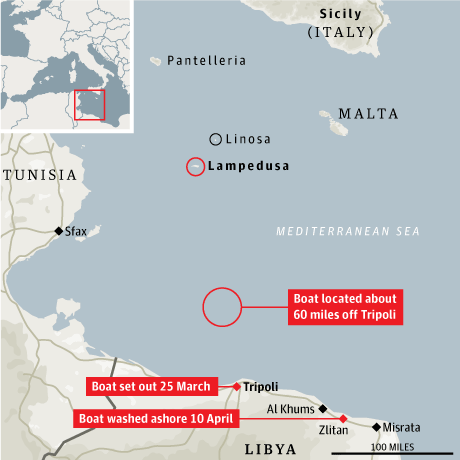
The Guardian on Sunday reported many more details about an incident that began on 25 March when a migrant boat left Libya carrying 72 asylum seekers and which ended 16 days later on 10 April when the disabled vessel washed ashore in Libya with only 11 survivors.  The survivors have described several incidents where military ships and planes ignored their pleas for rescue.  It is clear from the survivors’ descriptions that their disabled vessel was sighted because at one point a military helicopter dropped bottles of water and emergency food rations on the migrant boat.

The UNHCR and Father Mussie Zerai, an Eritrean priest in Rome who runs the refugee rights organisation Habeshia, have called for further investigations into why the boat’s passengers were not rescued.

From the Guardian article: “The Guardian’s investigation into the case of the boat of 72 migrants which set sail from Tripoli on 25 March established that it carried 47 Ethiopians, seven Nigerians, seven Eritreans, six Ghanaians and five Sudanese migrants. Twenty were women and two were small children, one of whom was just one year old. The boat’s Ghanaian captain was aiming for the Italian island of Lampedusa, 180 miles north-west of the Libyan capital, but after 18 hours at sea the small vessel began running into trouble and losing fuel.  Using witness testimony from survivors and other individuals who were in contact with the passengers during its doomed voyage, the Guardian has pieced together what happened next. The account paints a harrowing picture of a group of desperate migrants condemned to death by a combination of bad luck, bureaucracy and the apparent indifference of European military forces who had the opportunity to attempt a rescue….

The Guardian has made extensive inquiries to ascertain the identity of the Nato aircraft carrier, and has concluded that it is likely to have been the French ship Charles de Gaulle, which was operating in the Mediterranean on those dates.  French naval authorities initially denied the carrier was in the region at that time. After being shown news reports which indicated this was untrue, a spokesperson declined to comment.

A spokesman for Nato, which is co-ordinating military action in Libya, said it had not logged any distress signals from the boat and had no records of the incident. ‘Nato units are fully aware of their responsibilities with regard to the international maritime law regarding safety of life at sea,’ said an official. ‘Nato ships will answer all distress calls at sea and always provide help when necessary. Saving lives is a priority for any Nato ships.’”

Click here for full Guardian article.

Click here (IT) for earlier article.

The route of the boat - from guardian.co.uk

2 Comments

Filed under France, Italy, Libya, Malta, Mediterranean, News, UNHCR

UNHCR Calls on EU to Improve Rescue at Sea Measures; NATO Should Also Actively Participate in Rescue at Sea in Regard to All Overcrowded Boats

UNHCR issued a statement on Friday, 8 April, calling “on the European Union to urgently put into place more reliable and effective mechanisms for rescue-at-sea” in the aftermath of last week’s disaster that saw “[m]ore than 220 Somali, Eritrean and Ivorian refugees drowned early on Wednesday morning when their boat capsized some 39 nautical miles south of the Italian island of Lampedusa. This is the worst such incident in the Mediterranean in recent years.  ‘It is hard to comprehend that at a time when tens of thousands are fleeing the Libyan conflict and pouring across the land borders into Tunisia and Egypt where they enjoy safety and receive shelter and aid, the protection of people fleeing via Libya’s maritime border does not appear to have the same priority’ said Assistant High Commissioner for Protection Erika Feller.” “‘We also appeal to shipmasters to continue to render assistance to those in distress at sea. Any overcrowded boat leaving Libya these days should be considered to be in distress’ [, said Feller.]”

While NATO was not mentioned in the UNHCR statement, the call for improved measures to save the lives of migrants who flee North Africa by boat should also be heard and considered by the NATO Maritime Command Naples which is conducting the maritime embargo of Libya known as Operation Unified Protector.   NATO has a significant naval force patrolling the area through which migrant boats leaving Libya are passing and this force should be actively engaged in protecting fleeing civilians.  (Click here for earlier post regarding NATO’s maritime embargo.)

While UN Security Council Resolution 1973 does not speak directly to this issue, it does call for the protection of civilians.  Relevant portions from Security Council Resolution 1973:

  • “Expressing [the Security Council’s] determination to ensure the protection of civilians and civilian populated areas and the rapid and unimpeded passage of humanitarian assistance and the safety of humanitarian personnel, [***];
  • Reiterating [the Security Council’s] concern at the plight of refugees and foreign workers forced to flee the violence in the Libyan Arab Jamahiriya, welcoming the response of neighbouring States, in particular Tunisia and Egypt, to address the needs of those refugees and foreign workers, and calling on the international community to support those efforts, [***];
  • Protection of civilians – 4. Authorizes Member States that have notified the Secretary-General, acting nationally or through regional organizations or arrangements, and acting in cooperation with the Secretary-General, to take all necessary measures, notwithstanding paragraph 9 of resolution 1970 (2011), to protect civilians and civilian populated areas under threat of attack in the Libyan Arab Jamahiriya,… [***].”

As with UNHCR’s call to EU states, NATO ships should also render assistance to any migrant boat detected by NATO forces – any overcrowded boat leaving Libya should be considered to be in distress.

Click here for UNHCR statement.

Click here for article.

Leave a comment

Filed under European Union, Italy, Libya, Malta, Mediterranean, News, UNHCR

Italy Criticises Malta Regarding Search and Rescue Response

Italian Interior Minister Maroni has criticised Malta for failing to immediately deploy rescue ships to assist the migrant boat that sank near Lampedusa.  The Armed Forces of Malta said that the migrant boat did not capsize until after two Italian coast guard boats had responded and were on scene attempting to render assistance.  The AFM said the first call for assistance was received Wednesday at 0025, the Rescue Co-ordination Centre of the AFM notified Italian Coast Guard headquarters in Rome and NATO headquarter in Naples at 0120, two Italian coast guard boats and an Italian fishing vessel, the Cartagine, were on scene by 0416, and the migrant boat capsized around 0535.  The migrant boat was closer to Italian territory than to Malta, but was located within Malta’s large Search and Rescue Area.  Italy and Malta have had past disputes over the boundaries of the SAR with Italy calling for the Maltese SAR to be reduced in size.

The Secretary-General of International Maritime Organization, Efthimios E. Mitropoulos, issued a statement saying that “[i]t was ironic that the devastating news of this latest tragedy reached us while we were holding a [Legal Committtee] meeting with representatives of Italy and Spain to consider what measures countries in the Mediterranean Basin should take to deal with the increasing number of persons leaving north African and eastern Mediterranean countries to seek refuge in Europe.”

The statement also said that “IMO is in contact with Italy, Malta and the UN High Commissioner for Refugees (UNHCR).  The [Legal Committee] meeting mentioned above was hosted by IMO and held against a background of increasing movement of persons by sea for political and socio-economic reasons or as a result of armed conflict.  It was part of an on-going process aimed at improving existing provisions for rescuing migrants at sea and disembarking them at a place of safety, in accordance with the International Convention on Maritime Search and Rescue (SAR Convention) and the International Convention for the Safety of Life at Sea (SOLAS Convention).”

Click, here, here, here, and here for articles. (EN)

Click here for article. (IT)

Click here for map the SARs.

Click here for IMO Statement.

1 Comment

Filed under Italy, Libya, Malta, Mediterranean, News

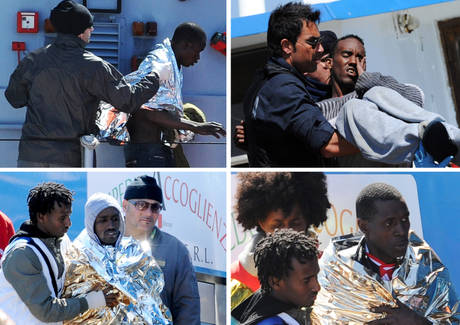
Rescued Migrants Arriving at Lampedusa (Pictures)

53 survivors have been rescued from today’s accident.  The total number of dead and missing is not known.  Dozens of bodies, including those of children, have been observed in the sea by a Guardia di Finanza helicopter.

Click here for article. (IT)

© Copyright ANSA - Tutti i diritti riservati - Rescued migrants arriving at Lampedusa.


1 Comment

Filed under Italy, Libya, Mediterranean, News

200 or More Now Feared Dead in Migrant Boat Sinking Off Lampedusa – Boat Was Likely Coming from Libya, Not Tunisia

It now appears that the boat that capsized earlier this morning off of Lampedusa was carrying Sub-Saharan Africans and that it had sailed from Libya not from Tunisia. The boat departed from Zuwarah in western Libya according to the Times of Malta.  Woman and children were on board and are likely among the victims.  The accident occurred around 4:00 AM local time in very rough seas.  A call for help was made by satellite phone to Malta SAR.  ANSA reported a short time ago that 48 people have been rescued and approximately 20 bodies have been recovered.  IOM said that based on interviews with survivors there may have been as many as 300 people on board the boat.

Click here (EN), here (IT), and here (IT) for articles.


3 Comments

Filed under Italy, Libya, Malta, Mediterranean, News