Tag Archives: Spain

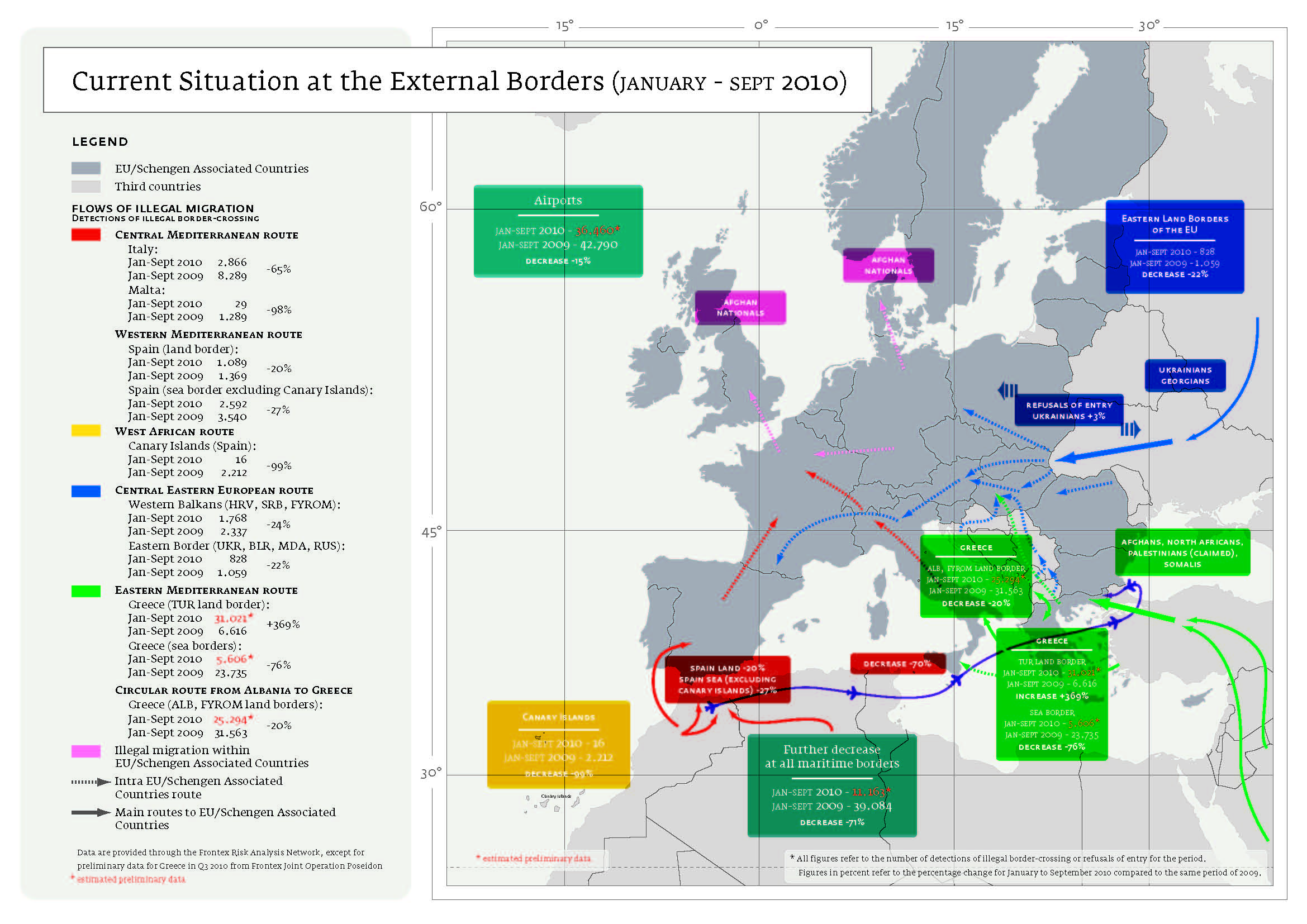
Frontex Map: Current Situation at the External Borders (JANUARY – SEPT 2010)

Frontex has released an updated Third Quarter map, January-September 2010, showing data regarding the situation at the external borders.   Note the information on the map pre-dates the deployment of the Frontex RABIT forces to the Greek border in October/November.  The data shows a 369% increase in detected irregular crossings along the Greek-Turkey land border over the first three quarters of 2010 compared to 2009.

The significant reduction in migrants detected at maritime borders continues:

  • Jan-Sept 2010:   11.163 (estimated preliminary data)
  • Jan-Sept 2009:   39.084
  • 71% reduction

Data by route:

Central Mediterranean route

  • Italy:
    • Jan-Sept 2010:     2.866
    • Jan-Sept 2009:    8.289
    • 65% reduction
  • Malta:
    • Jan-Sept 2010:    29
    • Jan-Sept 2009:    1.289
    • 98% reduction

Western Mediterranean route

Spain (land border):

  • Jan-Sept 2010:   1.089
  • Jan-Sept 2009:   1.369
  • 20% reduction

Spain (sea border excluding Canary Islands):

  • Jan-Sept 2010:   2.592
  • Jan-Sept 2009:   3.540
  • 27% reduction

West African route – Canary Islands (Spain):

  • Jan-Sept 2010:   16
  • Jan-Sept 2009:   2.212
  • 99% reduction

Eastern Mediterranean route

Greece (TUR land border):

  • Jan-Sept 2010:   31.021 (estimated preliminary data)
  • Jan-Sept 2009:   6.616
  • 369% increase

Greece (sea borders):

  • Jan-Sept 2010:   5.606 (estimated preliminary data)
  • Jan-Sept 2009:   23.735
  • 76% decrease

Click here to view Jan-Sept 2010 Map.

Click here for link to Jan-June 2010 Map.

Click here for link to 2009 Map.
1 Comment

Filed under Aegean Sea, Data / Stats, Eastern Atlantic, European Union, Frontex, Greece, Italy, Libya, Malta, Mediterranean, News, Spain, Turkey

Les pirogues de fortune – CARIM Note

A CARIM Analytic and Synthetic Note by Serigne Mansour TALL and Aly TANDIAN was issued in July entitled “Regards sur la migration irrégulière des Sénégalais : vouloir faire fortune en Europe avec des pirogues de fortune.”

Résumé – Ce papier met en exergue le voyage des sénégalais qui utilisent des pirogues de fortune dans l’espoir d’atteindre l’Europe via les îles canaries. L’auteur analyse les motivations sous-tendant ces itinéraires « irréguliers » ou « illégaux » et met en lumière les stratégies ainsi que les ressources que ces migrants utilisent pour partir.

[Abstract (the paper is only in French) – The paper focuses on the Senegalese who embark on “fortune seeking pirogues”, hoping to reach Europe via the Canary Islands. The author analyses the motivations of these ‘irregular’ or illegal migratory itineraries and sheds light on the strategies and resources that they employ in order to leave.]

Click  here (FR) or here (FR) for Note.

Leave a comment

Filed under Analysis, Eastern Atlantic, Reports, Senegal, Spain

CEAR Releases 2010 Annual Report: La situación de las personas refugiadas en España

CEAR (Comisión Española de Ayuda al Refugiado) has released its 2010 annual report: “La situación de las personas refugiadas en España – INFORME 2010.”  The report is 350+ pages long.  I will try to review it and do an additional post on some portions of the Report in the coming days.

From CEAR’s web page: “Presentamos el octavo Informe Anual en un momento de grave preocupación por la garantía efectiva del derecho de asilo en España y en el mundo. En el año 2009 poco más de 3.000 personas solicitaron asilo en nuestro país, la cifra más baja desde que se contabilizan estos datos. Por el contrario, las demandas de protección internacional han aumentado en el ámbito de la Unión Europea y otros países industrializados. La pregunta clave es: ¿por qué no llegan refugiados a España? Pregunta que cobra aún más importancia si tenemos en cuenta que la situación en los países de origen de los solicitantes de asilo no ha mejorado, tal y como se analiza a lo largo de este Informe, como la situación de la R.D. Congo, América latina o Sri Lanka. La respuesta a este descenso de las solicitudes de asilo se desvela a lo largo del documento.

La publicación de este Informe Anual coincide con los primeros pasos para la puesta en práctica de la nueva Ley de Asilo, aprobada en octubre de 2009. CEAR volcó todos sus esfuerzos para hacer llegar a los grupos parlamentarios y a la sociedad sus propuestas para fortalecer el derecho de asilo como institución en España.

Uno de los mayores recortes de la nueva ley es la supresión de la vía diplomática para el acceso al asilo, por eso desde estas páginas CEAR realiza un recorrido por las últimas solicitudes por esta vía. También hace especial hincapié en el análisis de las demandas en frontera y de los Centros de Internamiento para Extranjeros (CIE). Por otro lado, la edición del octavo Informe coincide con la Presidencia española de la Unión Europea, por lo que se analizan las líneas políticas de actuación que ya se establecieron en el Pacto Europeo sobre Inmigración y Asilo de 2008. Este Informe presenta un completo recorrido desde la solicitud de asilo hasta la resolución de los casos, acompañado de un completo apéndice estadístico, sin prescindir de todo lo referente a la acogida, integración social e inserción sociolaboral de las personas refugiadas en España.”

Click here for the report (ES).

Leave a comment

Filed under Eastern Atlantic, European Union, Mediterranean, Reports, Spain

Spanish Court Rules that Schengen Treaty Prevents Asylees From Leaving Ceuta and Melilla

As noted on Diario de la Inmigración, a Spanish Court in Ceuta (el Juzgado Contencioso Administrativo número 2 de Ceuta) has ruled that persons granted asylum or subsidiary protection may not leave Ceuta for the Spanish peninsula.  The court agreed with the position of the Spanish government and ruled that the two autonomous cities of Ceuta and Melilla are not part of the Schengen area and that proper documentation is therefore required to enter the Schengen area from the cities.  The court concluded that the “yellow card” (“tarjeta amarilla”) issued to persons granted asylum or subsidiary protection is insufficient documentation to enter the Schengen area.

The UNHCR and CEAR have previously criticised the Spanish’s government new policy of restricting the free movement of persons in Ceuta and Melilla who have been granted asylum or subsidiary protection.  UNHCR believes that the restrictions on free movement violate article 5 of Spain’s 2009 asylum law (la ley 12/2009, de 30 de octubre).

Click here, here, and here for articles (all ES).

Leave a comment

Filed under European Union, Judicial, Mediterranean, News, Spain, UNHCR

Spain and Senegal Renew Agreement Permitting Frontex to Operate From Dakar

Spain and Senegal have renewed a bi-lateral agreement permitting Frontex to operate from a base in Dakar for another year.

The Frontex mission in Senegal currently consists of two Spanish Guardia Civil patrol boats, a Spanish National Police helicopter, and a private airplane leased by the Spanish Defence Ministry.  One Frontex patrol boat also operates from Nuadibú, Mauritania.

Spanish Interior Minister Alfredo Pérez Rubalcaba said that France and Italy will soon be deploying additional assets and personnel to the Frontex mission in Senegal consisting of a ship and plane from Italy and a French security force team.  Rubalcaba stated that this new assistance demonstrates that “Spain is not alone” in the fight against the mafias responsible for the illegal boat arrivals to the coast this country. (“España no está sola” en la lucha contra las mafias responsables de las llegadas de embarcaciones irregulares a las costas de este país.)

Senegalese Interior Minister Ousmane Ngom, said that so far this year a total of 101 canoes from the coast of Senegal with 450 people aboard have been identified by the patrols. In 2006, the figures were 901 boats, with 35,490 irregular migrants.

Click here for article.  (ES)

1 Comment

Filed under Data / Stats, Eastern Atlantic, France, Frontex, Italy, Mauritania, News, Senegal, Spain

European–US–African Joint Military Exercises

16 years after withdrawing its military forces from Equatorial Guinea, Spanish armed forces members are now present in Mali, Mauritania, Senegal and Nigeria.  Spanish forces recently completed a three week multinational military exercise known as Flintlock 10 along with forces from other EU countries (France, Germany, the UK, and the Netherlands), the US, and 7 African countries.  Flintlock 10 was conducted in coordination with the US military’s Africa Command, Africom. (If you are not familiar with the US Military’s Africa Command, a quick look at its “2009 Posture Statement” will give you a feel for its very very extensive activities within Africa.)

Spain’s decision to resume a military presence in Africa was identified in its Africa Plan (“el Plan África”), adopted in 2006, which was intended to provide “‘a comprehensive approach to relations with neighbouring continent,’ sa[id] one expert, ‘but [also to] respond[ ] to the urgent need to curb the wave at the source of illegal immigration.’”  (Click here for the 2009Plan África.)

A joint maritime military exercise known as Exercise Phoenix Express 2010 began last week.  This exercise includes training of the Moroccan and Senegalese military by US and Spanish military personnel.  According to an Africom press release, Moroccan and Senegalese Maritime Interdiction Operations Teams are being trained on tactics, techniques, and procedures associated with Maritime Interdiction Operations.  Last month Spanish and US naval forces were involved in similar training exercises off the coast of Senegal under Africom’s Africa Partnership Station.

The current exercise, according to Africom, includes a focus on maritime interdiction operations.  Participating forces “will track and board suspect vessels carrying suspicious cargo, and Maritime Patrol Aircraft and Automated Identification Systems, along with MIOs like SARs and Visit, Board, Search and Seizures will be performed.”

Click here for El Pais article about Spain’s military’s return to Africa.

Click here and  here for Africom press releases.

Click here for US Naval Forces Africa press release.

1 Comment

Filed under Eastern Atlantic, Mauritania, Mediterranean, News, Senegal, Spain, United States

CSDP and Maritime Surveillance

The May edition of the ISIS European Security Review contains an article reviewing the Spanish EU Presidency and the Common Security and Defence Policy (CSDP, formerly ESDP).  The article notes that a main priority of the Spanish Presidency has been an “Integrated Maritime Surveillance.” “[T]he Spanish Government has clearly followed the Swedish Presidency in many areas, especially in the creation of an Integrated Maritime Surveillance, probably the most notable accomplishment of this EU Presidency on defence policy. *** The attention paid by Spain to naval protection is not something new: Spanish interest in increasing patrolling across Europe’s coastlines has been proven during the last decade, especially through its support to FRONTEX assistance in the Mediterranean Sea and the Canary Islands. Beyond that, the project of a common management of external borders has resulted in a need for protection of European interests away from the official maritime borders, moving also to trade routes where the EU economic interest is at stake.”

Click here for the ISIS May 2010 Newsletter.

Leave a comment

Filed under Eastern Atlantic, European Union, Frontex, Mediterranean, News, Spain

UPR of Spain Largely Ignores Interdiction and Readmission Practices

Spain was one of 15 countries whose records were reviewed during the 8th session of the Human Rights Council’s Universal Periodic Review (UPR) Working Group from 3-15 May 2010.  While reference is made to the treatment of asylum seekers and migrants who reach Spanish territory, little attention was directed (at least not in the national report or the Working Group’s Draft report) to the treatment of migrants intercepted at sea before reaching Spanish territory in the Canary Islands or elsewhere.  Likewise little attention was paid to the provisions and implementation of Spain’s several bilateral readmission agreements with various countries such as Senegal.

According to the Draft report, Spain agreed with a general recommendation to “[t]ake all measures necessary to ensure that actions related to unaccompanied minors (migrants, asylum seekers, refugees, victims of trafficking) are in line with international standards.” [Section II, Para. 84(54).]  But Spain did not agree to several more specific recommendations, instead agreeing only to “examine” and “provides responses” to the recommendations no later than September 2010 when the Human Rights Council meets for its 15th session.

Three of the more detailed recommendations were:

  • “Respect fully the principle of non-refoulement and ensure effective access to asylum procedures, taking into account the objectives of UNHCR’s 10-Point Plan on Mixed Migration” (New Zealand);
  • “Undertake a review of its readmission agreements with respect to refugees and asylum-seekers, and amend them as necessary to ensure that they contain human rights guarantees in line with international standards” (Canada); and
  • “Consider access to asylum procedures for victims of trafficking (Costa Rica).

[Section II, Para. 86(28-30).]

Click here for link to UPR site for Spain.

Click here for the Draft report of the Working Group.

Click here for Spain’s national report submitted to the Working Group.

Leave a comment

Filed under Eastern Atlantic, Mediterranean, News, OHCHR, Reports, Spain, UNHCR

Canary Island Trial of 3 Accused in Deaths of 25 Drowned Migrant Children

The trial of 3 Moroccan men (YF, MSB and BJ) accused of murder of 25 young African migrants began on 18 May in Gran Canaria before the Sixth Section of Audiencia Provincial de Las Palmas.  The migrants who died were all between the ages of 8 and 16.  The young migrants drowned when their boat sank 20 meters from the shore in Lanzarote, Canary Islands on 15 February 2009.  The boat had departed from Guelmin, Morocco on 13 February.  The migrants reportedly paid between 500 and 1000 euros to be transported to the Canary Islands.  The prosecution has asserted that the boat was designed for use as a small fishing boat close to shore and was not designed for travel on the open sea.  Six persons on the boat survived, several of them were rescued by a local surfer.

Click here, here, here, and here for articles (all ES).

Click here for video – Antena 3 Canarias televisión de difusión de noticias 17 May with video of rescue operation.

Leave a comment

Filed under Eastern Atlantic, Morocco, News, Spain

Spanish Parliamentary Delegation Visits Senegal to Discuss Immigration

A Spanish parliamentary delegation from the Foreign Affairs Committee has completed an official visit to Senegal where they visited the Spanish-Frontex mission based in Dakar and met with Senegalese government officials.  The Spanish delegation included Josep Antoni Duran i Lleida, Chair of the Standing Committee on Foreign Affairs of the Congress of Deputies, and Jorge Moragas, coordinator of the Presidency and International Relations for the Partido Popular.

Duran i Lleida noted that no boat has succeeded in reaching the Canary Islands in recent months and that this is due to the Spanish presence in Senegal in the form of the National Police and Civil Guard.  The Spanish presence in Senegal along with support from Frontex carries out ongoing surveillance and patrols known as Operation Hera.

Duran i Lleida is quoted as saying that “Thanks to the work of the Spanish National Police and Civil Guard and collaboration with security forces, Senegal has managed to curb illegal immigration.”  He writes on his blog (in Catalan) that “for many years, Senegal is a country that has exported more illegal immigration. … Spanish authorities decided to negotiate with Senegal the conditions for ending illegal immigration. … Here in Dakar there is a unit of the Guardia Civil and [Spanish] police force with naval and air means that control, in collaboration with the Senegalese, the possible departures of illegal immigrants.”

Click here (ES), here (ES), and here (ES) for articles.

1 Comment

Filed under Eastern Atlantic, Frontex, News, Senegal, Spain

UNHCR Research Paper: Les violences faites aux femmes pendant leur voyage clandestin: Algérie, France, Espagne, Maroc

Un nouveau rapport du HCR (UNHCR Research Paper) par Smaïn Laacher a été publié: “Les violences faites aux femmes  pendant leur voyage clandestin: Algérie, France, Espagne, Maroc.”

Extraits:

“L‟objet de notre mission a porté sur les violences faites aux femmes migrantes pendant leur voyage clandestin. Les femmes qui constituent la population de notre étude sont des femmes qui ont quitté illégalement leur pays et ont voyagé jusqu‟au Maroc, en Algérie, en Espagne, et en France. *** Les violences subies par les femmes pendant leur voyage clandestine … , dont la plus destructrice est la violence sexuelle, visent principalement des êtres sans défense, c‟est-à-dire des femmes qui n‟ont pu ou qui ne peuvent pas être défendues, précisément parce qu‟elles n‟existent pour personne, si ce n‟est que pour elles-mêmes et pour leurs agresseurs. ***”

Cliquez ici pour télécharger le rapport.

Cliquez ici pour télécharger le rapport.

1 Comment

Filed under Algeria, France, Morocco, Reports, Spain, UNHCR

Spain Adds New SIVE Radar Stations

The Spanish Ministry of Interior is investing €3.8 million to expand the SIVE network in Valencia.  The two new SIVE radar stations are in addition to the four SIVE radar stations that operate on the Alicante coast in Cabo Roig, Santa Pola, Sierra Frost, and Denia.  According to ABC, the Ministry of Interior acknowledges that SIVE has numerous problems and that since its entry into operation last September in Alicante, SIVE has detected only four of the fifteen illegal boats discovered on the coast.

ABC also reports that despite the problems with SIVE on the Alicante coast, Frontex’s coming summer enforcement operation, Operation Indalo, will not extend to Alicante.  Operation Indalo, using patrol boats and helicopters from Spain, Portugal, France, Italy, Malta and Luxembourg, will be deployed along the Spanish coast from Granada to Murcia.

Click here (ES) for article.

1 Comment

Filed under France, Frontex, Libya, Luxembourg, Malta, Mediterranean, News, Portugal, Spain

8th Conference of the Foreign Ministers of the Western Mediterranean (“5+5”)

Foreign Ministers from the so-called “5+5” countries, France, Spain, Italy, Malta, Portugal, Morocco, Algeria, Libya, Mauritania, and Tunisia, are meeting this week in Tunis to discuss a variety of issues including migration, which will be discussed at the plenary session on 16 April.

Click here (FR) and here (FR) for articles.

Leave a comment

Filed under Algeria, France, Italy, Libya, Malta, Mauritania, Mediterranean, Morocco, News, Portugal, Spain, Tunisia

Frontex Operation Indalo 2010

Operation Indalo, which focuses on the interception of migrants travelling from North Africa, primarily Algeria, to Spain, will take place from June to September this year and will focus primarily on migrant arrivals on the coasts of the Spanish provinces of Murcia and Almeria.

Last year’s Operation Indalo took place in September and October, used assets from Spain, Italy, France, Belgium, Germany and Portugal, and resulted in the detention of approximately 500 migrants.

Click here for article (ES).

Leave a comment

Filed under Algeria, Frontex, Mediterranean, News, Spain

Público: La llegada de inmigrantes en cayucos a España ha caído hasta mínimos históricos

«La llegada de inmigrantes en cayucos o pateras a España ha caído en los últimos meses hasta mínimos históricos. Entre enero y febrero de este año hubo sólo 126 detenciones, por 1.432 en el mismo periodo de 2009, lo que supone un 91,2% menos. Es el arranque de año con menor migración marítima desde que el Ministerio del Interior empezó a contabilizar losdesembarcos, en 1999. »

[“The arrival of immigrants in cayucos or pateras in Spain has fallen in recent months to historic lows. Between January and February of this year there were only 126 arrests compared with 1,432 during the same period in 2009, representing a 91.2% reduction.  These are the smallest numbers of beginning of year arrivals since the Interior Ministry began tracking arrivals in 1999.”]

Click here for article.

Leave a comment

Filed under Data / Stats, Eastern Atlantic, Mediterranean, News, Spain